
In This Article
You’re standing in your workshop, staring at that rickety benchtop saw that vibrates like a paint mixer every time you fire it up. The fence drifts mid-cut, the motor bogs down in hardwood, and you’ve spent more time adjusting than actually cutting. Sound familiar?
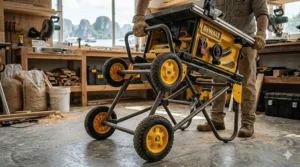
Here’s the thing about contractor table saws under 1000 dollars—they’ve become incredibly capable machines that would have been considered professional equipment just a decade ago. We’re not talking about those flimsy DIY models that your neighbor bought at a big-box store clearance sale. Modern contractor saws in this price range deliver real performance.
What makes a contractor table saw under 1000 worth your investment? It bridges the gap between portable jobsite saws and full cabinet models. You get serious cutting capacity, reliable accuracy, and build quality that survives daily professional use, all without requiring a forklift to move it or a second mortgage to buy it.
According to OSHA’s woodworking equipment guidelines, proper table saw selection directly impacts both safety and productivity on job sites. The right contractor saw becomes your workshop centerpiece—the tool that handles everything from ripping framing lumber to precision cabinet work.
I’ve tested dozens of contractor saws over the past fifteen years, from budget models to premium rigs, and I can tell you this: the sweet spot for value sits right around $500-$900. That’s where manufacturers pack in features that matter—rack-and-pinion fences, powerful motors, solid stands, and meaningful safety features—without the markup of full cabinet saws.
Quick Comparison Table
| Model | Motor | Rip Capacity | Standout Feature | Price Range |
|---|---|---|---|---|
| DeWalt DWE7491RS | 15A, 4800 RPM | 32.5″ | Industry-leading capacity | $599-$699 |
| Skilsaw SPT99-11 | 15A Worm Drive | 30.5″ | Maximum torque | $749-$849 |
| Makita 2705X1 | 15A, 4800 RPM | 25″ | Electric brake | $649-$749 |
| SKIL TS6307-00 | 15A, 4600 RPM | 25.5″ | Best budget value | $299-$349 |
| Bosch 4100-10 | 15A, 3650 RPM | 25″ | Gravity-Rise stand | $549-$649 |
| Metabo HPT C10RJSM | 15A, 4500 RPM | 35″ | Largest rip capacity | $419-$649 |
| SawStop JSS-120A60 | 1.5HP, 15A | 25.5″ | Flesh-detection safety | $899-$999 |
💬 Just one click – help others make better buying decisions too! 😊
Top 7 Contractor Table Saw Under 1000: Expert Analysis
1. DeWalt DWE7491RS – The Capacity Champion
The DeWalt DWE7491RS has dominated job sites for years, and there’s a solid reason why contractors keep choosing it. This saw delivers a 32.5-inch rip capacity that handles full sheet goods without breaking a sweat.
Key Specifications:
- 15-amp motor producing 4,800 RPM
- Maximum cutting depth of 3-1/8″ at 90°
- Rolling stand with 8-inch wheels
The rack-and-pinion fence system glides smoothly and locks down tight—no more fighting with spring-loaded fences that drift mid-cut. DeWalt’s telescoping fence rails retract for transport, creating a surprisingly compact footprint when you need to load it in the truck.
Customer feedback consistently praises the saw’s ability to power through hardwood without bogging down. One cabinet maker told me he’s been running the same unit for five years, cutting everything from pine to Brazilian cherry, with zero motor issues.
✅ Pros:
- Exceptional 32.5″ rip capacity
- Proven reliability across thousands of job sites
- Rolling stand makes solo setup effortless
❌ Cons:
- Slightly higher price point in this category
- Stand adds weight (total: 90 lbs)
Who Should Buy: Contractors who regularly handle sheet goods and need maximum versatility in a portable package.
2. Skilsaw SPT99-11 – The Torque Monster
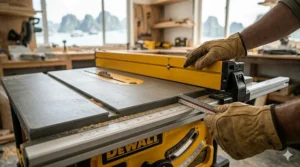
Worm drive power in a table saw format? That’s exactly what the Skilsaw SPT99-11 delivers, and it changes everything when you’re cutting thick stock.
Key Specifications:
- 15-amp worm drive motor
- 30.5-inch rip capacity
- Aggressive 3-5/8″ depth of cut
- Dual-field motor runs cooler under load
Traditional direct-drive saws spin fast but lack grunt. This worm drive configuration flips that script, delivering maximum torque for ripping applications. The saw cuts through 4×4 posts in a single pass—something that makes framing carpenters very happy.
The 16-inch wheels on the rolling stand handle job site terrain better than smaller wheels. I’ve rolled this saw over gravel, up ramps, and across plywood bridges without drama. Professional reviews from Pro Tool Reviews consistently highlight its field durability.
Contractors note the motor stays cool even during extended ripping sessions. The patented Dual-Field motor design allows for harder work over longer periods without thermal shutdown.
✅ Pros:
- Unmatched torque for heavy ripping
- 16″ wheels conquer job site obstacles
- Cool-running motor for sustained work
❌ Cons:
- Higher initial investment
- Heavier than standard direct-drive models
Who Should Buy: Framing contractors and builders who need serious ripping power for dimensional lumber and engineered products.
3. Makita 2705X1 – The Precision Performer
The Makita 2705X1 brings workshop-quality accuracy to the job site. This saw earned its reputation through precision engineering and thoughtful safety features.
Key Specifications:
- 15-amp motor delivering 4,800 RPM
- Electric brake stops blade quickly
- 25-inch rip capacity with telescoping rails
- Dead-on cam-locking rip fence
Here’s what sets it apart: the electric brake. Most saws coast for 10-15 seconds after shutdown. The Makita stops in under 2 seconds. That matters when you’re working efficiently and can’t afford to wait between cuts. It’s also a significant safety upgrade.
The modular blade guard system deserves attention. Everything—riving knife, anti-kickback pawls, barrier guard—installs tool-free and adjusts to three positions depending on your cut type. This actually encourages you to use the safety equipment because it’s not a hassle to configure.
Finish carpenters appreciate the precision-machined table that arrives flat and stays true. The split side guard design allows easy measurement from blade to fence without removing components.
✅ Pros:
- Electric brake dramatically reduces coasting time
- Tool-free modular safety system
- Precision-machined flat table surface
❌ Cons:
- Portable stand less robust than some competitors
- Discontinued (2705X1 with stand), though 2705 still available
Who Should Buy: Finish carpenters and cabinetmakers who prioritize accuracy and safety features.
4. SKIL TS6307-00 – The Budget Champion
Don’t let the $299-$349 price fool you. The SKIL TS6307-00 packs features that used to require spending twice as much.
Key Specifications:
- 15-amp motor producing 4,600 RPM
- 25.5-inch rip capacity
- Integrated folding stand (no separate purchase)
- Rack-and-pinion fence system
SKIL got acquired by a new ownership group that completely overhauled their product line. This table saw represents that new commitment to quality. The integrated folding stand eliminates the need to buy a separate base—that alone saves $150-200.
The rack-and-pinion fence adjustment feels smooth and locks positively. Budget saws usually skimp here with basic tube fences that never quite stay parallel. Not this one. According to reviews on Pro Tool Reviews, the fence system competes with saws costing significantly more.
Customer feedback consistently mentions how the integrated stand provides surprising stability. The folding legs lock securely and create a rigid cutting platform despite the lower price point.
✅ Pros:
- Exceptional value with integrated stand
- Rack-and-pinion fence at budget price
- Compact storage when folded
❌ Cons:
- Smaller table size than premium models
- Limited dado capacity
Who Should Buy: DIY enthusiasts and part-time contractors who need serious capability without premium pricing.
5. Bosch 4100-10 – The Smart Stand Solution
The Bosch 4100-10 pairs a capable saw with Bosch’s legendary Gravity-Rise wheeled stand—a combination that solves real job site challenges.
Key Specifications:
- 15-amp motor delivering 4.0 max HP
- 25-inch rip capacity
- SquareLock rip fence with enhanced clamping
- Soft-start circuitry prevents breaker trips
The Gravity-Rise stand deploys and collapses with a single motion. One person can set up or break down this saw in under 30 seconds. The 8-inch rubber-composite tires handle rough terrain while the quick-release mounting brackets secure the saw for transport.
Bosch incorporated soft-start circuitry that gradually ramps up motor speed. This prevents the current spike that trips circuit breakers in older buildings—a problem every contractor has encountered. The Constant Response circuitry maintains cutting speed under load, so the blade doesn’t slow down when you’re powering through oak.
The Smart Guard System features a three-position adjustable riving knife, anti-kickback pawls, and a translucent barrier guard. You can actually see your cut line clearly while maintaining protection.
✅ Pros:
- Gravity-Rise stand sets up in seconds
- Soft-start prevents breaker trips
- Clear visibility through barrier guard
❌ Cons:
- Smaller rip capacity than some competitors
- Stand adds significant weight
Who Should Buy: Remodelers and contractors working in existing buildings where portability and electrical compatibility matter.
6. Metabo HPT C10RJSM – The Capacity King
The Metabo HPT C10RJSM delivers something remarkable: 35 inches of rip capacity to the right. That’s the widest in this entire category.
Key Specifications:
- 15-amp motor running at 4,500 RPM
- Industry-leading 35″ right-side rip capacity
- Oversized 28-3/4″ x 22″ table
- Fold & roll stand with durable wheels
That extra rip capacity means you can handle full 4×8 sheets with the fence in the middle of the cut—providing better support and control. Most contractor saws force you to either hang the sheet off one side or flip your setup around mid-project.
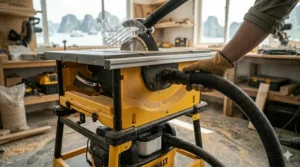
The fold & roll stand incorporates a clever upright storage position. When you’re done working, the saw folds and locks vertically, taking up minimal floor space in your shop or trailer. The soft-start motor and electric brake mirror features found on more expensive models.
Professional woodworkers note the oversized table provides exceptional material support. When you’re wrestling with plywood or MDF panels solo, that extra surface area prevents tipping and makes accurate cuts more achievable.
✅ Pros:
- Unbeatable 35″ rip capacity
- Oversized table supports large materials
- Space-saving vertical storage
❌ Cons:
- Fence system less refined than premium competitors
- Heavier due to larger table
Who Should Buy: Contractors and shops handling lots of sheet goods who need maximum cutting capacity.
7. SawStop Jobsite Saw Pro JSS-120A60 – The Safety Revolution
The SawStop Jobsite Saw Pro sits at the top of this price range, but it brings technology that could literally save your fingers.
Key Specifications:
- 1.5HP motor (15-amp, 120V)
- Patented flesh-detection safety system
- 25.5-inch rip capacity (extended)
- One-turn blade elevation
SawStop’s flesh-detection technology stops a spinning blade in under 5 milliseconds when it contacts skin. The blade retracts below the table, turning what would be an amputation into a minor cut. According to Wikipedia’s table saw safety documentation, this represents the most significant safety advancement in table saw technology.
The system works by detecting the electrical conductivity of human skin. Wood doesn’t trigger it because wood is a poor conductor. When skin contacts the blade, an aluminum brake fires, stopping rotation almost instantly. You’ll need to replace the brake cartridge ($90-100) and possibly the blade, but that’s dramatically cheaper than emergency room bills and lost work time.
Beyond safety, this saw delivers thoughtful features. The one-turn elevation raises or lowers the blade fully in a single handwheel rotation—other saws require 20+ turns. The T-style fence with ErgoLock slides smoothly and locks with one touch.
✅ Pros:
- Industry-leading flesh-detection safety system
- Premium build quality and precision
- Thoughtful convenience features
❌ Cons:
- Highest price in this category
- Replacement cartridges add ongoing cost
- Smaller rip capacity than some alternatives
Who Should Buy: Professional woodworkers and serious hobbyists who prioritize safety and are willing to invest in the best protection available.
✨ Don’t Miss These Exclusive Deals!
🔍 Take your contractor table saw under 1000 search to the next level with these carefully selected products. Click on any highlighted item to check current pricing and availability. These tools will help you create precise cuts your clients will notice!
Understanding Contractor Table Saw Under 1000 Categories
Before diving deeper, let’s clarify what separates contractor saws from other table saw types—because understanding these distinctions helps you make the right choice.
What Defines a Contractor Saw?
A contractor table saw under 1000 typically features a 10-inch blade, 1.5-2HP motor, and an open or partially enclosed base. The term “contractor saw” originated from these saws being designed for contractors who needed more power than portable models but couldn’t dedicate permanent shop space to full cabinet saws.
Modern contractor saws blur traditional lines. Many now incorporate features from cabinet saws—like better dust collection, precision fences, and improved safety systems—while maintaining the portability contractors demand.
Contractor vs. Jobsite vs. Cabinet Saws
Jobsite saws prioritize maximum portability. They’re lighter (50-70 lbs), use direct-drive motors, and sacrifice some cutting capacity for ease of transport. Perfect for finish carpenters moving between rooms or floors.
Contractor saws balance power, capacity, and portability. They weigh 80-100 lbs, deliver more torque, and handle larger materials. The sweet spot for dedicated shop use with occasional mobility needs.
Cabinet saws optimize for precision and power over portability. They weigh 400+ lbs, use heavy-duty induction motors, and offer superior dust collection. They’re stationary shop fixtures, not field equipment.
According to OSHA’s woodworking safety standards, proper tool selection based on your actual work requirements improves both safety and productivity.
Essential Features in Best Contractor Saw Value Models
Motor Power and Performance
All saws in this roundup feature 15-amp motors, but they deliver power differently. Direct-drive saws (most models here) connect the motor shaft directly to the blade arbor, achieving high RPM speeds for clean cuts. The Skilsaw’s worm drive configuration uses gear reduction for maximum torque at slightly lower speeds—ideal for ripping thick stock.
Don’t get hung up on horsepower ratings. Manufacturers measure HP differently (peak vs. running), making comparisons unreliable. Instead, focus on real-world cutting performance in materials you’ll actually use.
Fence Systems Matter More Than You Think
The rip fence determines accuracy. Period. A fence that drifts, flexes, or requires constant adjustment wastes time and ruins materials.
Rack-and-pinion systems (found on the DeWalt, SKIL, and others) use geared rails for smooth, precise adjustment. They stay parallel to the blade and lock positively. T-square fences attach at the front and rear rails, maintaining alignment through geometry.
Cheaper tube fences mount only at the front rail. They’re prone to deflection under pressure and rarely stay perfectly parallel. If you’re considering a saw not in this list, check the fence type first.
Cutting Capacity and Depth
Rip capacity measures the distance from the blade to the maximum fence position. Larger capacity (30-35″) allows you to cut sheet goods with the fence in the middle, providing better support. Smaller capacity (24-26″) forces you to hang materials off one side or flip your setup.
Depth of cut ranges from 2-1/4″ to 3-5/8″ at 90 degrees. All saws here cut 4×4 lumber in one pass at 90 degrees—a minimum requirement for contractor work. The Skilsaw’s 3-5/8″ depth gives the most margin when the blade isn’t perfectly sharp.
Safety Features That Actually Matter
Modern contractor saws include better safety equipment than older models. Look for these essential features:
Riving knives prevent kickback by keeping the kerf open behind the blade. They’re far more effective than old-style splitters because they move with the blade during height and angle adjustments. Every saw in this roundup includes one.
Anti-kickback pawls grab the workpiece if it starts moving backward. They’re your last line of defense against kickback injuries. Make sure you can install and remove them easily—if they’re a hassle, you won’t use them.
Blade guards provide a physical barrier between your hands and the spinning blade while allowing clear visibility. SawStop’s flesh-detection system represents the cutting edge, but traditional guards still prevent most accidents when used properly.
The Canadian Centre for Occupational Health and Safety emphasizes that proper safety equipment use reduces table saw injuries significantly.
How to Choose Contractor Table Saw Under 1000
Assess Your Primary Use Case
Frame carpenters need maximum capacity and portability—the DeWalt or Metabo HPT makes sense. Finish carpenters prioritize precision and smooth operation—the Makita or SawStop fits better. Cabinet shops want the best fence and table flatness—again, the Makita or SawStop.
Don’t buy for hypothetical future needs. Choose based on what you’ll actually cut this year. You can always upgrade later when your requirements change.
Consider Your Work Environment
Mobile contractors working across multiple job sites need robust stands, manageable weight, and quick setup. The Bosch’s Gravity-Rise stand or the SKIL’s integrated design solve these challenges.
Shop-based workers with occasional mobility needs can accept heavier models with better cutting capacity. The Metabo HPT or Skilsaw make sense here.
Home workshop users should prioritize value and versatility. The SKIL TS6307-00 delivers impressive capability for the price.
Budget Realistically
The contractor table saw under 1000 category spans $299 to $999. That’s more than a 3x price difference. Here’s how to think about it:
$300-400 range: Excellent value if you’re starting out or work part-time. The SKIL TS6307-00 dominates here.
$500-700 range: The sweet spot for serious professionals. DeWalt, Makita, Bosch, and Metabo HPT all deliver proven performance.
$800-1000 range: Premium features justify the cost if safety or specific capabilities matter. The SawStop or Skilsaw worm drive deliver unique benefits.
Remember to budget for blades, dado sets, sleds, and other accessories. A quality 40-tooth combination blade runs $40-80. A dado stack costs $100-300. Plan accordingly.
Maintenance Tips for Professional Contractor Saw Longevity
Keep It Clean and Aligned
Sawdust buildup causes accuracy problems and accelerates wear. After each significant use, blow out dust from the motor housing, trunnions, and blade elevation mechanisms. Monthly, remove the blade and clean pitch buildup with a specialized blade cleaner.
Check blade alignment quarterly. A blade that’s not parallel to the miter slots causes burning and increases kickback risk. Most saws allow adjustment—consult your manual for the specific procedure.
Maintain the Table Surface
Cast iron and aluminum tables can rust or corrode. After cleaning, apply a thin coat of paste wax or specialized table protectant. This reduces friction, prevents rust, and helps materials slide smoothly.
Remove rust immediately when it appears. Use fine steel wool with mineral spirits, working in the direction of any machining marks. Wax afterward to prevent recurrence.
Lubricate Moving Parts
The blade elevation and tilt mechanisms include gears that need periodic lubrication. Use a dry lubricant (graphite or PTFE) rather than oil—oil attracts and holds sawdust. Apply sparingly at adjustment points.
Fence rails benefit from a thin coat of paste wax or specialized rail lubricant. This ensures smooth fence adjustment without excess friction.
Common Workshop Centerpiece Saw Mistakes to Avoid
Choosing Based Solely on Price
The cheapest option isn’t always the best value. A $300 saw that frustrates you daily and limits your work costs more than a $700 saw that performs reliably for a decade. Factor in your time, material waste from inaccurate cuts, and the cost of potential upgrades.
Ignoring Fence Quality
Some manufacturers cut costs on fence systems. A saw with a great motor but terrible fence will disappoint you constantly. Read reviews that specifically mention fence performance and accuracy.
Underestimating Your Needs
“I’ll just get by with 24 inches of rip capacity” sounds reasonable until you’re fighting to balance a sheet of plywood for the tenth time. If you regularly cut sheet goods, pay the extra $100-200 for a model with 30+ inches of capacity.
Overlooking Safety Features
Every experienced woodworker knows someone who’s been injured on a table saw. Don’t skip safety equipment to save $50 or because it seems like a hassle. The riving knife, blade guard, and anti-kickback pawls exist for a reason.
If you can afford the SawStop, the flesh-detection system provides unmatched protection. It’s expensive, but so are fingers.
FAQ: Contractor Table Saw Under 1000 Questions Answered
❓ What is the best contractor table saw under 1000 for professional use?
❓ How much rip capacity do I really need in a contractor saw?
❓ Are contractor table saws under 500 dollars worth buying?
❓ What's the difference between direct drive and worm drive table saws?
❓ Is the SawStop safety system worth the extra cost?
Conclusion: Choosing Your Best Contractor Saw Value
Finding the right contractor table saw under 1000 comes down to matching features to your actual work requirements. If you’re cutting sheet goods daily, the Metabo HPT’s 35-inch capacity or DeWalt’s 32.5-inch capacity makes sense. If portability matters most, the Bosch’s Gravity-Rise stand or SKIL’s integrated design solves real problems. If safety is paramount, the SawStop’s flesh-detection system provides unmatched protection.
For most contractors, the DeWalt DWE7491RS represents the sweet spot—proven reliability, excellent capacity, and features that enhance productivity without unnecessary complexity. Budget-conscious buyers should seriously consider the SKIL TS6307-00, which delivers surprising capability for $300-350.
The semi-professional saw market has never been stronger. Manufacturers understand that contractors demand real performance, not marketing hype. The saws in this roundup have all earned their reputations through thousands of hours on actual job sites.
Whatever you choose, invest in quality blades, use safety equipment consistently, and maintain your saw properly. A contractor table saw under 1000 that’s well-maintained will serve you reliably for a decade or more.
Now stop researching and start cutting. Your workshop centerpiece saw is waiting.
Recommended for You
- 7 Best Contractor Table Saw Under 800 in 2026
- 7 Best Cordless Table Saw Kit Options in 2026
- 7 Best Ryobi Cordless Table Saw & Affordable Options 2026
Disclaimer: This article contains affiliate links. If you purchase products through these links, we may earn a small commission at no additional cost to you.
✨ Found this helpful? Share it with your friends! 💬🤗
