
In This Article
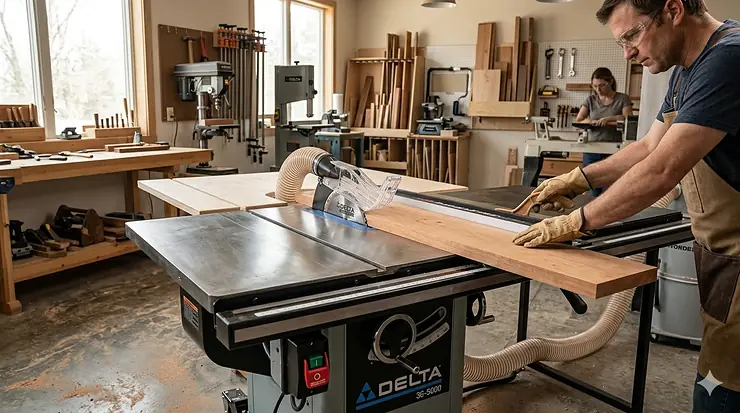
Picture this: You’re standing in your workshop, a beautiful piece of cherry wood resting on your table, ready for that critical rip cut that’ll make or break your project. The motor hums to life, the blade spins true, and you guide the wood through with confidence. That’s the Delta difference — a century of engineering excellence compressed into one reliable machine.
When Herbert Tautz founded Delta Specialty Company in a Milwaukee garage back in 1919, he couldn’t have imagined that his tools would still be reshaping workshops in 2026. Yet here we are, with Delta contractor table saws maintaining their reputation as the sweet spot between cabinet saw precision and portable saw convenience. These machines aren’t trying to be everything to everyone; they’re laser-focused on one mission: delivering professional-grade cuts without requiring a forklift to move them.
The delta contractor table saw occupies a unique niche in woodworking. Too substantial to be called portable, yet nimble enough to relocate when your shop layout demands it, these saws bridge the gap between hobby and professional work. With cast iron tables that resist warping, contractor-grade motors that power through hardwoods, and fence systems accurate to within 1/64 inch, they’ve earned their place in serious workshops.
But here’s what nobody tells you: not all Delta contractor saws are created equal. Some feature the legendary Biesemeyer fence system, others sacrifice rip capacity for portability, and a few models from 2020 had motor cooling issues that Delta has since resolved. Knowing which model matches your workflow makes the difference between a tool that empowers your craft and one that constrains it.
Quick Comparison Table: Delta Contractor Table Saws at a Glance
| Model | Motor Power | Rip Capacity | Table Material | Price Range | Best For |
|---|---|---|---|---|---|
| Delta 36-725T2 | 1.75 HP | 30″ | Cast Iron | $599-699 | Budget-conscious pros |
| Delta 36-5052T2 | 15 Amp | 52″ | Cast Iron | $899-999 | Wide stock cutting |
| Delta 36-5000T2 | 15 Amp | 30″ | Cast Iron | $799-899 | Serious hobbyists |
| DEWALT DWE7491RS | 15 Amp | 32.5″ | Aluminum | $549-699 | Jobsite mobility |
| SKIL TS6307-00 | 15 Amp | 25.5″ | Aluminum | $279-329 | DIY enthusiasts |
| Bosch GTS15-10 | 15 Amp | 32″ | Aluminum | $699-799 | Premium portability |
| SKILSAW SPT99-11 | 15 Amp | 30.5″ | Aluminum | $699-799 | Heavy-duty power |
💬 Just one click – help others make better buying decisions too! 😊
Top 7 Delta Contractor Table Saw: Expert Analysis
1. Delta 36-725T2 Contractor Table Saw – The Goldilocks Option
The Delta 36-725T2 represents everything that makes Delta legendary, packaged in an accessible format that won’t bankrupt your tool budget. This saw arrived on the scene as Delta’s answer to contractors who needed Unisaw precision without the Unisaw price tag.
Key Specifications:
- 1.75 HP belt-driven motor for smooth, low-vibration operation
- 30-inch rip capacity handles standard plywood sheets
- Cast iron table (27.13″ x 20.24″) with two stamped steel extension wings
At $599-699, this saw punches well above its weight class. The belt-driven design means quieter operation and easier tensioning compared to direct-drive competitors. That cast iron table? It’s not just for show — the material stays flat through temperature swings and resists the warping that plagues cheaper aluminum tops.
Customer feedback consistently praises the Biesemeyer-style fence system, which locks down with satisfying precision. One woodworker noted: “I checked it against my square after a year of use, and it was still dead-on accurate.” The tubular rolling stand makes repositioning manageable, though you’ll want a helper for stairs.
✅ Pros:
- Exceptional value for cast iron construction
- Legendary fence accuracy (1/64 inch tolerance)
- Belt-driven smoothness reduces vibration
❌ Cons:
- 30″ rip capacity limits work with wider panels
- 232 lbs makes frequent moves challenging
Price: $599-699 | Best For: Budget-conscious professionals seeking precision
2. Delta 36-5052T2 Contractor Saw – When Size Matters
Need to rip a full sheet of plywood lengthwise without gymnastics? The Delta 36-5052T2 brings an impressive 52-inch rip capacity that transforms how you handle large stock.
Key Specifications:
- 15 Amp motor pushing 3450 RPM
- 52″ right-of-blade capacity
- Cast iron top with steel extension wings
This beast changes your workflow. No more awkward sheet goods hanging off the edge, no more asking someone to support the offcut. The extended rails and wings create a stable platform that supports material confidently from start to finish.
The motor deserves attention. While rated at 15 amps like smaller saws, Delta engineered this unit specifically for sustained cutting in dense hardwoods. Users report zero bogging when ripping thick maple or oak — the saw just keeps pulling through.
Customer reviews highlight the dado capacity (13/16″ x 8″) as a standout feature for box joints and shelf dadoes. “I can stack a full dado set without worrying about clearance,” one cabinet maker explained.
✅ Pros:
- Industry-leading 52″ rip capacity
- Handles full dado stacks effortlessly
- Powerful motor maintains RPM under load
❌ Cons:
- Requires significant shop space
- Higher price point ($899-999)
Price: $899-999 | Best For: Cabinet makers and those working with sheet goods
3. Delta 36-5000T2 Contractor Table Saw – The Balanced Performer
The Delta 36-5000T2 sits right in the middle of Delta’s contractor saw lineup, offering features that satisfy serious woodworkers without the premium price of top-tier models.
Key Specifications:
- 15 Amp induction motor
- 30″ rip capacity with dual rip windows
- Belt-driven mechanism with unique tubular stand
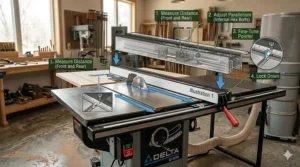
What sets this model apart? The dual rip windows. This seems like a small detail until you’re making precision cuts and can verify your fence measurement from both sides without walking around the saw. It’s one of those features that becomes indispensable once you’ve used it.
The three-wheel stand configuration (two fixed, one swivel) provides surprising stability while maintaining mobility. Unlike some stands that wobble during cuts, this design keeps the saw planted firmly, even when you’re pushing stock through aggressively.
Reviews consistently mention the blade brake as a safety feature worth its weight in gold. “I can stop the blade in seconds instead of waiting for coast-down,” one user noted. That time savings adds up when you’re making multiple cuts.
✅ Pros:
- Dual rip windows enhance measurement accuracy
- Stable three-wheel stand design
- Blade brake improves safety and efficiency
❌ Cons:
- Mid-range pricing without standout features
- 230 lbs weight limits portability
Price: $799-899 | Best For: Woodworkers wanting balanced features and reliability
4. SKILSAW SPT99-11 Worm Drive Table Saw – Maximum Torque Beast
When you need brute cutting power combined with professional durability, the SKILSAW SPT99-11 delivers legendary worm drive performance that contractors have trusted for decades.
Key Specifications:
- Worm drive gearing with dual-field motor for superior torque
- 3-5/8″ depth of cut (deeper than standard saws)
- 30.5″ rip capacity with rack and pinion fence
This isn’t your typical contractor saw — the worm drive configuration places the motor behind the blade, creating a uniquely balanced tool with exceptional torque. That extra depth of cut (3-5/8″ vs. the standard 3-1/8″) means you can cut through 4×4 posts in a single pass, a game-changer for framing and deck construction.
The dual-field motor technology runs cooler under sustained loads, allowing you to work longer without thermal shutdown. Professional framers appreciate this when ripping dozens of studs or cutting through engineered lumber all day.
Customer feedback emphasizes the stand’s rugged construction and 16-inch wheels. “This saw goes places other table saws can’t,” one contractor noted. “I’ve rolled it across gravel, up stairs, and over job site debris without issues.”
✅ Pros:
- Legendary worm drive torque for demanding cuts
- Deepest cut capacity in class (3-5/8″)
- Rugged 16″ wheels handle rough terrain
❌ Cons:
- Heavier than direct-drive alternatives
- Worm drive maintenance requires occasional gear oil
Price: $699-799 | Best For: Contractors needing maximum cutting power
5. DEWALT DWE7491RS Table Saw – The Industry Standard
Let’s talk competition. The DEWALT DWE7491RS has earned its reputation as the saw that other jobsite models measure themselves against, and for good reason.
Key Specifications:
- 15 Amp motor with 4,800 RPM no-load speed
- 32.5″ rip capacity
- Rolling stand with heavy-duty wheels
DEWALT nailed the details. The rack-and-pinion fence system glides smoothly and locks positively — no fiddling to get it square. The metal gear height adjustment stays accurate even after years of use, something cheaper plastic gears can’t claim.
The rolling stand deserves special mention. Those large wheels handle rough jobsite terrain without drama, and the stand collapses with a few quick releases. At 110 lbs, this saw strikes the sweet spot for portability without feeling flimsy.
Users consistently praise the power delivery. “This motor doesn’t bog down like my old saw,” one contractor shared. “It just pulls through whatever I feed it.”
✅ Pros:
- Proven reliability across countless job sites
- Excellent fence system
- Superior portability with rolling stand
❌ Cons:
- Aluminum table lacks cast iron stability
- Higher noise level than belt-driven saws
Price: $549-699 | Best For: Contractors prioritizing mobility
6. SKIL TS6307-00 Table Saw – Best Budget Entry
⭐ Best Seller – 2K+ Bought Recently
Not everyone needs contractor-grade features. The SKIL TS6307-00 targets DIYers and weekend warriors who want reliable cutting without professional pricing.
Key Specifications:
- 15 Amp motor
- 25.5″ rip capacity
- Integrated folding stand
For $279-329, SKIL delivers surprising value. The integrated stand means no separate purchase, and it folds impressively compact for storage. Perfect for garage workshops where floor space comes at a premium.
The rack-and-pinion fence represents a significant upgrade over budget saws with basic fence rails. It adjusts smoothly and locks securely — not Biesemeyer-level precision, but far better than entry-level alternatives.
Customer reviews emphasize the bang-for-buck factor. “I wasn’t expecting much at this price, but this saw handles everything I throw at it,” one hobbyist woodworker commented. Common projects like deck boards, furniture parts, and home improvements all fall well within its capabilities.
✅ Pros:
- Outstanding value proposition
- Space-saving folding stand
- Adequate power for DIY projects
❌ Cons:
- Aluminum table less stable than cast iron
- Not designed for heavy production use
Price: $279-329 | Best For: DIY enthusiasts and home workshop owners
7. Bosch GTS15-10 Portable Table Saw – Premium Engineering
Bosch’s entry into contractor saws emphasizes German engineering principles: precision, durability, and user-focused design. The GTS15-10 commands a premium because it delivers on these promises.
Key Specifications:
- 15 Amp motor with 4 HP maximum power
- 32″ rip capacity with SquareLock fence
- Gravity-Rise wheeled stand
The SquareLock fence system uses rack-and-pinion technology, but Bosch refined it further. One-handed adjustments stay perpendicular without constant checking. The fence face has embedded T-slots for mounting featherboards and other accessories directly — a detail that reveals this saw’s professional pedigree.
That Gravity-Rise stand? It’s not marketing hyperbole. The mechanism uses spring-assisted pneumatics to raise and lower the saw smoothly. No awkward lifting or wrestling with folding legs. Just pull a lever and watch it rise effortlessly.
Reviews highlight the overall refinement. “Everything about this saw feels thoughtfully designed,” noted one professional carpenter. From the blade guard that actually stays clear of your sight line to the dust port that angles away from your fence position, small details add up to a superior experience.
✅ Pros:
- Innovative Gravity-Rise stand technology
- Refined fence system with accessory mounting
- Professional-grade fit and finish
❌ Cons:
- Premium pricing ($699-799)
- Aluminum table doesn’t match cast iron stability
Price: $699-799 | Best For: Professionals valuing convenience and precision
🎯 Ready to Upgrade Your Workshop?
Whether you’re choosing the budget-friendly SKIL TS6307-00 at $279 or the premium Bosch GTS15-10, each saw on this list delivers proven performance. Click the links above to check current deals and read verified customer reviews!
Understanding the Delta Contractor Table Saw Legacy
When you invest in a delta contractor table saw, you’re not just buying a tool — you’re connecting with over a century of American manufacturing excellence. That heritage matters more than marketing departments realize, because it reflects accumulated knowledge about what actually works in real workshops.
Delta’s journey began in 1919 when German immigrant Herbert Tautz opened his small machine shop in Milwaukee, Wisconsin. The company didn’t start with grand ambitions of revolutionizing woodworking; Tautz simply wanted to build quality tools that solved real problems. That practical focus became Delta’s signature.
The breakthrough came in 1939 with the introduction of the Unisaw, the first 10-inch tilting arbor table saw. This innovation established design principles that modern contractor saws still follow: cast iron tables for stability, precision-machined trunnions for accurate blade adjustment, and robust fence systems for repeatable cuts. These weren’t just features — they represented a philosophy that precision tools should be accessible beyond industrial settings.
The Delta Cast Iron Advantage
Here’s something worth understanding: cast iron isn’t used for contractor table saw tops because it looks professional. The material choice solves fundamental problems that plague woodworking.
Cast iron remains dimensionally stable across temperature ranges. Your aluminum-topped saw might expand slightly on hot summer days and contract in winter, affecting accuracy. Cast iron doesn’t care about weather. It stays flat, season after season, maintaining the reference surface your measurements depend on.
The material’s mass also dampens vibration naturally. When you’re cutting, you want the blade spinning true, not chattering through the wood. Cast iron absorbs and dissipates those vibrations, resulting in cleaner cuts with less tearout. This isn’t placebo effect — you can measure it with accuracy gauges and see it in your finished work.
Delta understood this early. While competitors chased lighter materials for easier shipping, Delta stuck with cast iron for contractor models where it mattered most. That’s why you’ll find many Delta saws from the 1950s still cutting accurately in workshops today. The competition? Not so much.
Delta Fence System: The Biesemeyer Difference
Let’s talk about what separates mediocre table saws from precision machines: the fence system. And when it comes to fence systems, one name dominates: Biesemeyer.
Delta acquired the Biesemeyer fence design, recognizing that the simple T-square configuration solved the chronic problem of fences that drifted out of parallel during cuts. The system locks to both the front and rear rails simultaneously, creating a triangulated connection that resists twisting forces.
Many delta contractor saw reviews emphasize fence accuracy because it matters profoundly. When you’re cutting expensive hardwood, a fence that stays parallel to within 1/64 inch means the difference between tight-fitting joinery and frustrating gaps. It’s not about chasing impossible tolerances — it’s about consistency.
The fence design also addresses another issue: ease of adjustment. You shouldn’t need five minutes and a square to reposition your fence. The Biesemeyer-style system glides smoothly on the rails, locks with a single handle, and returns to parallel automatically. This efficiency compounds over time; what seems like minor convenience becomes major productivity gains over thousands of cuts.
Modern Delta contractor saws incorporate updated versions of this fence system, maintaining the core principles while adding features like dual rip windows for easier measurement verification. These refinements show Delta’s commitment to evolution without abandoning proven fundamentals.
Choosing Between Delta Models: A Practical Framework
Shopping for a delta contractor table saw can feel overwhelming when you’re staring at model numbers and spec sheets. Let me cut through the confusion with a decision framework based on real workshop priorities.
Step 1: Assess Your Mobility Needs
Do you move your saw weekly, monthly, or never? This question matters more than any other single factor.
Stationary workshop: Models like the Delta 36-5052T2 make sense. That 232-pound weight becomes an asset, providing mass that dampens vibration. The extended rip capacity transforms how you work with sheet goods.
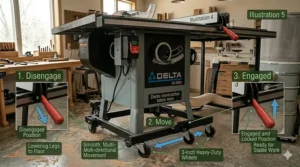
Occasional mobility: The Delta 36-725T2 hits the sweet spot. Heavy enough for stability, but the rolling stand makes repositioning manageable within your shop or to a client’s location a few times per year.
Regular transport: Look toward the Delta 36-6023 or consider competitors like the DEWALT DWE7491RS. These saws prioritize quick setup and lighter weight without completely sacrificing performance.
Step 2: Calculate Your Rip Capacity Requirements
Think about your typical projects. Are you building cabinets that require ripping plywood panels? Crafting furniture from narrower hardwood stock? Making picture frames from thin strips?
30-inch capacity handles standard 4×8 sheets ripped lengthwise, plus gives you comfortable margin for material support. This works for most furniture and general woodworking.
52-inch capacity transforms large panel processing. If you regularly work with sheet goods, this extended reach eliminates awkward workarounds and improves safety by keeping material fully supported.
32-inch capacity represents the jobsite standard — enough for most construction applications without requiring excessive shop space.
Step 3: Budget Realistically
Your budget isn’t just the purchase price; factor in these often-forgotten costs:
- Blade upgrades: Factory blades work, but aftermarket blades cut better
- Dado stack: If you cut grooves or rabbets, budget $150-300
- Dust collection: A shop vac or dust collector transforms the experience
- Mobile base or stand: If buying a standalone saw, account for support costs
- Accessories: Featherboards, push sticks, outfeed support, zero-clearance inserts
A $599 saw easily becomes a $900+ system once you’ve equipped it properly. Plan accordingly rather than getting surprised by necessary additions.
Safety Considerations for Contractor Table Saws
Table saws demand respect. According to OSHA regulations, contractor table saws are classified as high-risk equipment requiring specific safety protocols. These aren’t bureaucratic suggestions; they’re guidelines written in the aftermath of serious injuries.
Essential Safety Equipment
Every delta contractor table saw should incorporate these safety features:
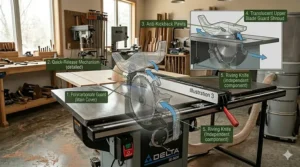
Blade guards that adjust automatically to stock thickness while maintaining visibility. Delta’s modern guards use clear materials and quick-release mechanisms for easy removal during dado cuts or special operations.
Riving knives that follow the blade height and prevent kickback by keeping the kerf open behind the blade. These have largely replaced traditional splitters because they don’t need removal for non-through cuts.
Anti-kickback pawls that grab the workpiece if it starts traveling backward toward you. These spring-loaded fingers dig into the wood, stopping dangerous kickback events.
Push sticks and push blocks keep your hands away from the blade when cutting narrow stock. You should have multiple styles within arm’s reach, specific to different cutting operations.
Operating Best Practices
Beyond equipment, safe operation demands consistent habits:
Stand to the left of the blade path, never directly behind the workpiece. Kickback travels straight back from the fence — position yourself out of that trajectory.
Use appropriate personal protective equipment: safety glasses with side shields, hearing protection rated for sustained noise exposure, and dust masks when cutting materials that generate fine particles.
Maintain blade height correctly. The blade should extend approximately 1/8 inch above your workpiece — no more. Excessive height increases kickback risk and exposes more blade unnecessarily.
Keep your work area clean. Sawdust accumulation creates slip hazards and potential fire risks. The 2.5-inch dust ports on Delta contractor saws connect to shop vacuums or dust collection systems for good reason. Use them.
Maintenance Tips for Long-Term Performance
A delta contractor table saw represents a significant investment. Proper maintenance extends its working life from years into decades. I’ve seen 1950s Delta saws still cutting accurately because their owners understood basic care principles.
Daily Maintenance
After each work session, wipe down the cast iron table with a slightly damp cloth to remove sawdust and moisture. Follow up with a coat of paste wax — the kind used for protecting metal surfaces, not car wax. This thin barrier prevents surface rust and keeps the table smooth for easy stock feeding.
Clean the blade guard and anti-kickback mechanisms. Resin and pitch buildup can cause these safety devices to bind, reducing their effectiveness. A soft brush and some mineral spirits dissolve accumulated gunk quickly.
Weekly Maintenance
Check blade sharpness. Dull blades force you to push harder, increasing kickback risk and producing rougher cuts. Most woodworkers should have blades professionally sharpened when they notice burning or tearout.
Inspect the fence for parallel alignment. Set the fence to maximum rip capacity and measure front-to-back distance from the blade at both ends. Any variation beyond 1/16 inch warrants adjustment.
Vacuum dust from inside the saw cabinet. Accumulated sawdust near the motor can restrict airflow, causing overheating. A few minutes with a shop vacuum prevents expensive motor failures.
Monthly Maintenance
Lubricate moving parts with appropriate products. The trunnions and gearing benefit from white lithium grease. The fence rails work better with dry lubricants like paste wax rather than oils that attract dust.
Check belt tension on belt-driven models like the Delta 36-725T2. The belt should deflect about 1/2 inch under moderate thumb pressure. Too loose and you lose power transmission; too tight and you wear bearings prematurely.
Verify blade alignment to the miter slots. Place a combination square against the blade body (not the teeth) and against the miter slot. Rotate the blade 180 degrees and check again. Any variation requires trunnion adjustment to prevent binding during cuts.
Comparing Delta vs. Competitive Brands
The market for contractor table saws has evolved dramatically. While Delta built its reputation on innovation and quality, brands like DeWalt, Bosch, and SkilSaw have launched compelling alternatives. Understanding these differences helps you make informed decisions rather than defaulting to brand loyalty.
Delta vs. DeWalt: Philosophy Differences
Delta approaches contractor saws from a heritage of stationary woodworking machinery. Their designs emphasize stability, precision, and features that matter in dedicated workshop spaces. Cast iron construction, Biesemeyer fences, and belt-driven mechanisms reflect this priority.
DeWalt enters from the opposite direction — portable power tools designed for job sites. Their contractor saws prioritize weight reduction, quick setup, and durability under transport. Aluminum tables, direct-drive motors, and folding stands make sense for this application.
Neither approach is “wrong” — they serve different users. If your saw stays in one location and you work wood seriously, Delta’s design philosophy aligns better with your needs. If you’re a trim carpenter moving between sites, DeWalt’s portability focus serves you better.
Delta vs. Bosch: Engineering Approaches
Bosch brings Germanic precision engineering to American contractor saws. Their attention to detail shows in refinements like the SquareLock fence system and Gravity-Rise stand. These features don’t fundamentally change how the saw cuts, but they eliminate small frustrations that accumulate into major annoyances over time.
Delta saws feel more utilitarian by comparison. The focus stays on core functionality: accurate cuts, reliable power, and proven mechanisms. Fewer convenience features, but also fewer potential points of failure.
Price reflects these philosophies. Bosch commands premiums because their engineering includes niceties. Delta prices competitively because they’re not charging for bells and whistles you might not need.
Understanding the American Made Question
Here’s an uncomfortable truth: the american made contractor saw landscape has changed dramatically. Delta Power Equipment Corporation now operates under Taiwan-based ownership, with manufacturing split between facilities in the United States and overseas.
When people search for american made contractor saw options, they’re often seeking the quality and longevity associated with domestic manufacturing. The reality is more nuanced. Modern manufacturing involves global supply chains — motors from one country, castings from another, final assembly elsewhere.
Focus less on where individual components come from and more on the company’s quality control standards and warranty support. A saw assembled in South Carolina from globally sourced parts can deliver better performance than a fully domestic product if engineering and quality control exceed standards.
Real-World Applications: Which Saw Fits Your Projects
Theory meets reality when you’re actually cutting wood. Let me walk through common workshop scenarios and match them with appropriate delta contractor saw models.
Scenario 1: Full-Time Furniture Builder
You’re working predominantly with hardwoods, building case pieces, chairs, and tables. Production volume matters because this generates your income, but you’re not running three shifts like a factory.
Recommended: Delta 36-5000T2 or 36-5052T2
The dual rip windows and sturdy construction support professional work. The extended rip capacity of the 5052 model helps with wide panels for cabinet sides or tabletops. Cast iron absorbs vibration during hardwood ripping, producing cleaner edges that require less hand planing.
Budget for a quality thin-kerf combination blade and a dado stack. You’ll recover the investment in reduced material waste and faster joinery cutting.
Scenario 2: Weekend Woodworking Hobbyist
You build projects evenings and weekends — bookcases, cutting boards, small furniture pieces. Quality matters because this is your creative outlet, but you’re not depending on production speed for income.
Recommended: Delta 36-725T2
This model delivers professional-level accuracy without the cost of higher-end options. The 30-inch rip capacity handles standard lumber and plywood sheets comfortably. The cast iron table provides the reference surface needed for precision work.
Invest remaining budget in quality layout tools, clamps, and hand planes rather than maximizing saw features. Your skills development matters more than incremental saw capabilities.
Scenario 3: Remodeling Contractor
You’re cutting everything from framing lumber to finish trim, often on job sites without dedicated workshop space. The saw needs to handle abuse, set up quickly, and deliver consistent results under less-than-ideal conditions.
Recommended: DEWALT DWE7491RS or SKILSAW SPT99-11 over Delta models
Job site demands favor portability and durability over ultimate precision. The DEWALT rolling stand and aluminum construction reduce transport hassle while providing adequate accuracy for construction applications.
For maximum cutting power through tough materials, the SKILSAW SPT99-11 worm drive delivers legendary torque that excels at ripping framing lumber, cutting through engineered beams, and handling abusive job site conditions. The deeper 3-5/8″ cut capacity handles 4×4 posts in one pass.
Pair with a quality blade designed for cutting nail-embedded lumber. Job site material often contains hidden fasteners that destroy ordinary blades quickly.
Scenario 4: High School or Community Workshop
The saw serves multiple users with varying skill levels, cutting everything from pine to plywood. Durability and safety features outweigh precision because students are learning fundamentals rather than demanding tight tolerances.
Recommended: Delta 36-5000T2 or SKIL TS6307-00 with enhanced safety training
The Delta’s blade brake significantly improves safety in educational settings. For budget-constrained schools, the SKIL TS6307-00 at $279-329 provides reliable performance with funds remaining for comprehensive safety equipment and multiple push sticks at different positions around the saw.
Consider adding a SawStop retrofit if budget allows. The active safety system provides an additional layer of protection that pays for itself if it prevents even one serious injury.
Understanding Motor Power and Performance
Motor specifications dominate contractor table saw marketing, but raw numbers tell incomplete stories. Understanding what motor ratings actually mean helps you evaluate performance claims accurately.
Horsepower Ratings: Marketing vs. Reality
That “15 Amp” rating you see everywhere? It describes electrical current draw, not mechanical power output. Manufacturers use amp ratings because they’re simple to measure and regulated by electrical codes.
What matters for cutting performance? Actual horsepower delivered to the blade under load. This involves motor efficiency, power transmission losses, and how the motor responds when encountering resistance.
The Delta 36-725T2 lists 1.75 HP, which represents honest measurement of power output. Other saws claim “15 Amp” without specifying horsepower because the conversion depends on motor efficiency. A cheap motor might draw 15 amps but deliver barely 1 HP. A quality motor converts electrical input more efficiently.
Belt Drive vs. Direct Drive
Delta’s contractor models predominantly use belt-driven mechanisms. This isn’t nostalgia for old designs — it offers real advantages.
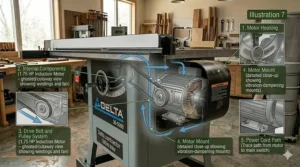
Belt drives isolate vibration between the motor and blade. The belt absorbs oscillations that would otherwise transmit directly to your workpiece. This isolation produces cleaner cuts, especially in plywood where vibration causes veneer tearout.
Belt systems also simplify maintenance. When your blade dulls or motor wears, replacing either component doesn’t require specialized tools or electrical rewiring. The belt simply transfers power between two independent units.
Direct-drive saws couple the motor shaft directly to the arbor. This eliminates belt slippage and makes the saw more compact. The tradeoff? More vibration transmission and tougher maintenance when components fail.
For dedicated workshop use, belt drive makes sense. For portable applications where every pound and inch matters, direct drive’s compactness wins despite the compromises.
Dust Collection Strategies for Cleaner Workshops
The 2.5-inch dust port on delta contractor table saws isn’t decorative. Effective dust collection transforms your workshop from a sawdust-filled disaster zone into a healthier, more pleasant working environment.
Understanding Collection Efficiency
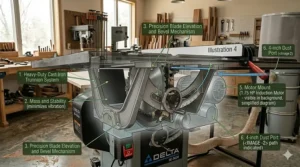
Table saws generate dust in two zones: above and below the table. The main dust port connects to the blade housing below the table, capturing sawdust as it’s expelled from the blade gullets.
Here’s the reality: even excellent below-table collection captures maybe 80-90% of generated dust. The remaining 10-20% exits above the table, particularly during through cuts where the blade’s top revolution throws particles forward.
Complete dust control requires both lower collection and upper blade guard with vacuum attachment. Delta’s modern guards include shrouds connecting to smaller hoses that capture the overhead dust fraction.
Matching Dust Collection to Saw Output
A central dust collection system rated for 600-800 CFM (cubic feet per minute) handles a single contractor saw effectively. The 2.5-inch port restricts flow velocity, so excessive CFM capability doesn’t improve capture significantly.
Shop vacuum systems work but require understanding their limitations. Consumer shop vacs typically provide 50-100 CFM — adequate for light dust loads but overwhelmed by continuous ripping. You’ll need to empty the canister frequently and monitor for clogs that reduce suction.
Intermediate solutions like 1-2 HP dedicated dust collectors provide 350-500 CFM at reasonable prices. These systems manage contractor saw output without requiring industrial infrastructure.
Blade Selection for Optimal Performance
Your delta contractor table saw came with a blade. Use it for breaking down construction lumber and rough dimensioning, then invest in quality blades matched to specific applications.
Combination Blades: The Versatile Workhorse
A 40-50 tooth combination blade handles both ripping and crosscutting adequately. The tooth design compromises between the aggressive hook angles needed for ripping and the flat-top geometry ideal for crosscuts.
Freud and Forrest manufacture excellent combination blades in the $60-90 range. That seems expensive until you compare cut quality against the $25 factory blade. The difference is dramatic — less burning, reduced tearout, and cleaner edges that require minimal sanding.
Dedicated Blades for Specific Materials
Plywood blades feature 60-80 teeth with triple-chip tooth geometry. These teeth alternate between flat-top “rakers” and angled “chamfer” teeth that score veneer cleanly before the raker removes material. This configuration minimizes the splintering that ruins plywood appearances.
Thin-kerf blades remove less material, requiring less motor power to push through cuts. This matters when ripping thick hardwoods where motor strain causes bogging. The tradeoff? Thinner plate thickness can deflect under side loads, so proper technique becomes more important.
Dado sets aren’t really blades — they’re stacked cutting systems for making grooves and rabbets. Delta contractor saws accommodate 13/16-inch dado stacks, sufficient for most joinery applications. Invest in an 8-inch set rather than the 6-inch economy versions; the larger diameter cuts more efficiently.
Price Analysis: Is Delta Worth the Premium?
Let’s address the elephant in the workshop: Delta contractor saws cost more than many alternatives. The Delta 36-725T2 at $599-699 competes against the SKIL TS6307-00 at $279-329. That $300-400 difference buys you cast iron, belt drive, and Biesemeyer fence — but does it justify the cost?
Calculating Long-Term Value
Consider a 10-year ownership period. The cast iron table on the Delta won’t warp, pit, or lose its precision flatness. Aluminum tables on budget saws can develop surface irregularities, especially if you accidentally drop heavy stock.
The Biesemeyer fence maintains accuracy through thousands of adjustments. Budget fence systems often develop play in the locking mechanisms, requiring constant squaring checks.
Belt-driven motors run quieter and last longer than direct-drive equivalents. Bearing replacement costs maybe $30 every few years. Motor replacement on a direct-drive saw? You’re looking at $150-200 plus the hassle of finding compatible parts.
Over 10 years, the $300-400 premium averages to $30-40 annually. That’s a modest cost for superior daily experience and eliminated frustrations.
When Budget Models Make Sense
Not every user benefits from Delta’s precision features. If you’re building a deck, framing a shed, or making rough shop fixtures, aluminum tables and direct-drive motors serve adequately.
The SKIL TS6307-00 makes excellent sense for casual users who cut occasionally rather than daily. Save the $300+ and invest in quality measuring tools, good clamps, or hand planes that elevate every project regardless of which saw made the cuts.
The Used Market Opportunity
Vintage Delta saws remain excellent values. A 1970s Delta 34-444 or similar model might cost $300-500 on the used market. With some cleaning and minor parts replacement, these saws deliver performance matching or exceeding new budget models.
The catch? You need knowledge to evaluate used equipment and willingness to invest time in restoration. Factor in blade replacement, electrical updates, and potential bearing service when calculating total cost.
FAQ: Common Questions About Delta Contractor Table Saws
❓ What is the difference between delta contractor saw and cabinet saw?
❓ How accurate is the delta fence system for fine woodworking?
❓ Can delta contractor table saw handle dado cutting?
❓ What maintenance does cast iron table require on delta saws?
❓ Are replacement parts available for older Delta contractor models?
Conclusion: Making Your Delta Contractor Table Saw Decision
Selecting the right delta contractor table saw isn’t about finding the “best” model in some absolute sense. It’s about matching capabilities to your specific needs, budget, and working style.
If you’re a professional furniture builder or serious hobbyist working primarily in a dedicated shop, the Delta 36-5052T2 with its extended rip capacity and robust construction delivers the performance that elevates your craft. The cast iron construction and Biesemeyer fence provide the precision foundation your work demands.
Budget-conscious woodworkers and those just establishing their workshops will find the Delta 36-725T2 hits the optimal value point. You get Delta’s legendary accuracy and durability without paying for features you might not need immediately. This saw grows with your skills rather than constraining them.
Mobile contractors and those working job sites should honestly evaluate whether Delta’s stationary-minded designs serve your needs, or whether the DEWALT DWE7491RS better matches portable demands. For maximum cutting power and torque, the SKILSAW SPT99-11 worm drive configuration delivers legendary performance that handles the toughest materials. There’s no shame in choosing the tool designed for your application rather than forcing an ill-suited saw into uncomfortable roles.
Remember that your table saw forms just one component of a complete woodworking system. A $599 saw paired with quality blades, accurate measuring tools, proper dust collection, and safety equipment produces better results than a $999 saw used with dull blades and inadequate support.
Delta’s century-plus legacy in woodworking machinery isn’t empty marketing — it reflects accumulated knowledge about what makes tools work reliably across decades of use. When you choose a Delta contractor table saw, you’re investing in that heritage, betting that time-tested design principles outweigh flashy features that might not matter for your actual work.
The saw that serves you best is the one that disappears into your workflow, letting you focus on creating rather than fighting equipment limitations. Whether that’s a Delta, DeWalt, Bosch, Skil, or SKILSAW ultimately matters less than understanding how each tool’s characteristics align with your priorities.
Your workshop awaits. Choose wisely, cut confidently, and build something remarkable.
Recommended for You
- Best Contractor Table Saw Under 1000: 7 Pro Picks 2026
- 7 Best Contractor Table Saw Under 800 in 2026
- 7 Best Cordless Table Saw Kit Options in 2026
Disclaimer: This article contains affiliate links. If you purchase products through these links, we may earn a small commission at no additional cost to you.
✨ Found this helpful? Share it with your friends! 💬🤗
