
In This Article
You know that moment when you’re hauling materials across a busy construction site, and your current saw just isn’t cutting it anymore? I’ve been there, friend. After fifteen years in woodworking and construction, I’ve learned that finding the right heavy duty jobsite table saw isn’t just about power—it’s about reliability when you need it most.
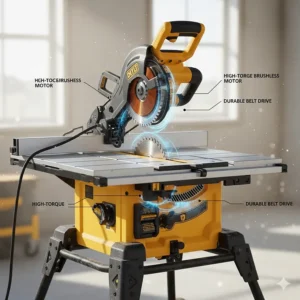
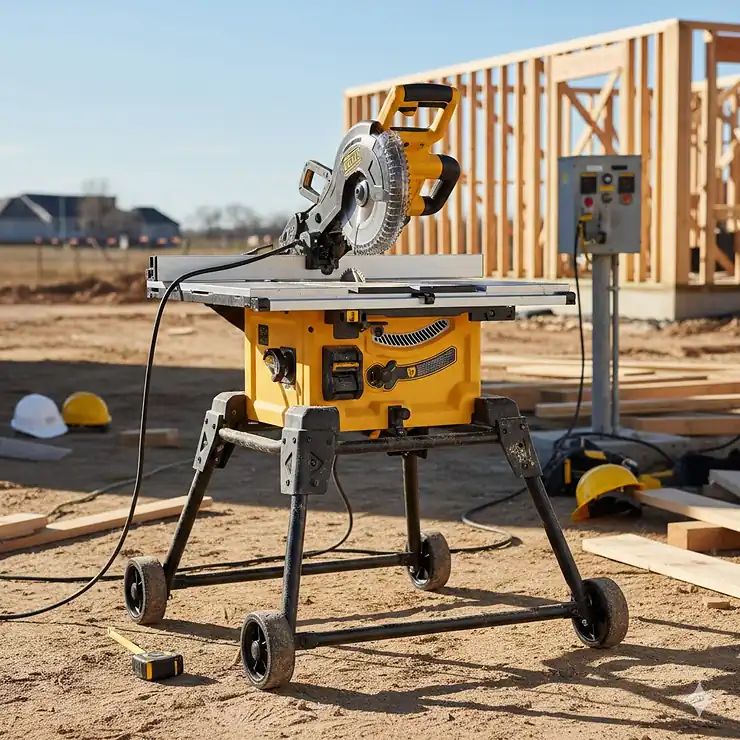
A heavy duty jobsite table saw represents the perfect marriage between raw cutting power and genuine portability. Unlike their cabinet cousins that sit pretty in climate-controlled shops, these workhorses need to handle everything from subflooring on rainy job sites to precision cuts in hardwood trim work. What exactly makes one “heavy duty” versus just another portable saw? It’s the combination of continuous duty motors, industrial-grade components, and construction that can withstand daily transport without losing accuracy.
The market has exploded with options in 2026, from traditional worm drive beasts to innovative hybrid designs. Whether you’re a professional contractor handling commercial projects or a serious woodworker who values quality, choosing the right saw can mean the difference between seamless workflow and constant frustration. I’ve tested and researched the top contenders to help you make that critical decision.
Quick Comparison Table
| Model | Motor Power | Rip Capacity | Weight | Price Range | Best For |
|---|---|---|---|---|---|
| DeWalt DWE7491RS | 15A, 4,800 RPM | 32.5″ | 110 lbs | $650-$750 | All-around pro use |
| SKIL SPT99-11 | 15A, 5,000 RPM | 30.5″ | 94 lbs | $600-$700 | Maximum torque |
| Bosch GTS15-10 | 15A, 3,800 RPM (4HP) | 32.125″ | 91 lbs | $650-$800 | Innovative features |
| SawStop JSS-120A60 | 1.5HP/4HP max, 4,000 RPM | 25.5″ | 84 lbs | $1,599-$1,899 | Safety-conscious pros |
| Ridgid R4514 | 15A, 5,000 RPM | 30″ | ~100 lbs | $499-$599 | Budget-minded contractors |
| Makita 2705X1 | 15A, 4,800 RPM | 25″ | 115 lbs | $550-$700 | Precision work |
| Evolution R10TS | 15A | 26″ | ~75 lbs | $400-$550 | Multi-material cutting |
💬 Just one click – help others make better buying decisions too!😊
Top 7 Heavy Duty Jobsite Table Saws: Expert Analysis
1. DeWalt DWE7491RS – The Industry Standard
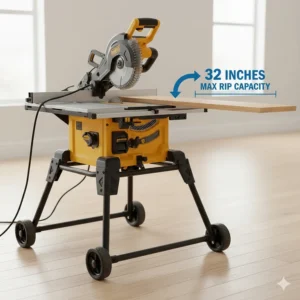
The DeWalt DWE7491RS has earned its reputation as the go-to choice for serious contractors who refuse to compromise. This powerhouse combines a robust 15-amp motor delivering 4,800 RPM with an impressive 32.5-inch rip capacity that handles full sheets of plywood with ease.
Key Specifications:
- 15A motor with rack and pinion telescoping fence
- 32.5″ right / 24″ left rip capacity
- 3-1/8″ depth of cut at 90°, 2-1/4″ at 45°
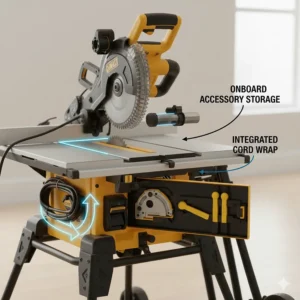
What sets this saw apart is its rolling stand design that collapses for transport yet provides rock-solid stability during operation. The onboard storage system keeps all essential accessories organized, while the tool-free guard adjustments let you switch between operations quickly. Contractors praise its ability to power through hardwoods without bogging down, even on demanding jobsite electrical circuits.
Customer feedback highlights the saw’s accuracy straight from the box, though a few users mention the 110-pound weight requires two people for loading into trucks. The price sits around $650-$750, positioning it firmly in the professional tier.
✅ Pros:
- Exceptional rip capacity for full sheet goods
- Rock-solid rolling stand with excellent stability
- Tool-free adjustments save time on busy sites
❌ Cons:
- Heavy at 110 lbs (requires help moving)
- Stand can be bulky for compact storage
2. SKIL SPT99-11 – Legendary Worm Drive Power
The SKIL SPT99-11 brings legendary worm drive technology to the jobsite table saw category, delivering unmatched torque for the most demanding applications. This is the saw you want when cutting pressure-treated lumber or hardwoods all day long.
Key Specifications:
- Dual-Field motor, 15A, 5,000 RPM
- 30.5″ rip capacity with 3-5/8″ depth of cut
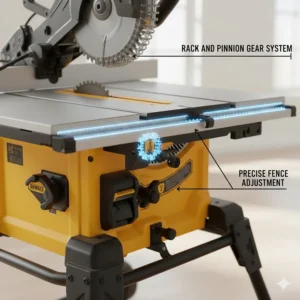
- Precision rack and pinion fence system
The worm drive gearing provides superior torque that rips through 4x material like butter. Its rugged rolling stand features 16-inch wheels that conquer rough terrain, stairs, and jobsite obstacles that would stop lesser saws. The dust elbow system contains debris effectively, keeping your workspace cleaner.
Professionals love the saw’s ability to maintain cutting speed under heavy loads—something direct drive saws struggle with. At $600-$700, it’s competitively priced for the power delivered. Some users note the saw runs slightly louder than direct drive alternatives, but accept this as the trade-off for superior torque.
✅ Pros:
- Unbeatable worm drive torque for thick materials
- 16″ wheels handle rough terrain effortlessly
- Cooler-running Dual-Field motor extends lifespan
❌ Cons:
- Louder operation than direct drive saws
- Slightly heavier (94 lbs) than some competitors
3. Bosch GTS15-10 – German Engineering Excellence
The Bosch GTS15-10 represents a significant upgrade in jobsite saw technology, featuring innovations that streamline workflow and improve precision. This saw demonstrates why Bosch consistently ranks among professional favorites.
Key Specifications:
- 15A motor with 3,800 RPM (4 HP rating)
- 32-1/8″ rip capacity with 4×4 single-cut capability
- Electronically regulated speed maintains performance under load
The rack and pinion rip fence stands out with its color-coded index system that makes micro-adjustments intuitive and fast. Bosch’s ClampZone areas transform the saw table into a secondary work surface for light finishing tasks—brilliant for tight spaces. The gravity-rise wheeled stand features 8-inch treaded tires and foot-release setup that gets you cutting in seconds.
The soft-start circuitry prevents tripping circuit breakers on marginal power supplies, while the convenience brake stops the blade in approximately three seconds. Priced between $650-$800, it offers exceptional value with included features that competitors charge extra for.
✅ Pros:
- Innovative ClampZone secondary work surface
- Soft-start prevents circuit breaker trips
- Color-coded fence system speeds adjustments
❌ Cons:
- 8″ wheels less robust than competitors’
- Premium pricing compared to basic models
4. SawStop JSS-120A60 – The Safety Revolution
The SawStop JSS-120A60 Jobsite Saw Pro isn’t just another table saw—it’s insurance against life-changing injuries. The patented safety system that stops the blade in less than 5 milliseconds upon skin contact has prevented countless amputations.
Key Specifications:
- 1.5HP continuous / 4HP max motor, 4,000 RPM
- 25.5″ rip capacity with 24-5/8″ table depth
- One-turn blade elevation (vs. 25+ turns on others)
Beyond safety, this saw impresses with thoughtful engineering. The one-turn elevation system adjusts blade height in a single rotation instead of endless cranking. The ErgoLock fence slides smoothly and locks firmly with a simple push. Class-leading table depth at 24-5/8″ provides superior material support for accurate cuts.
The included Active Dust Collection Blade Guard captures above-table sawdust remarkably well—a feature that previously cost $120 extra. At $1,599-$1,899, it’s the most expensive option reviewed, but ask anyone who’s avoided an injury: your fingers are priceless. Contractors note the 84-pound weight makes it surprisingly portable for such robust construction.
✅ Pros:
- Revolutionary safety system prevents amputations
- One-turn elevation saves tremendous time
- Superior dust collection included
❌ Cons:
- Premium pricing ($1,599-$1,899)
- Smaller 25.5″ rip capacity than competitors
5. Ridgid R4514 – Best Value Champion
The Ridgid R4514 proves you don’t need to spend a fortune for professional-grade performance. Backed by Ridgid’s legendary Lifetime Service Agreement (when registered within 90 days), this saw delivers exceptional value.
Key Specifications:
- 15A motor, 5,000 RPM power
- 30″ rip capacity for sheet goods
- SOFTstart technology extends motor life
This saw handles 4x material in a single pass while maintaining accuracy that rivals more expensive models. The gravity-rise stand deploys quickly with two wheels for easy transport. The SOFTstart technology gradually ramps up the motor, reducing startup noise and extending component lifespan—a clever feature often reserved for premium saws.
Priced at $499-$599, the R4514 represents incredible value, especially considering the free lifetime parts and service. Users consistently praise its out-of-box accuracy and smooth fence operation. Some mention the rip fence requires occasional adjustment, but this minor inconvenience pales against the warranty coverage and overall performance.
✅ Pros:
- Unbeatable value at $499-$599
- Lifetime Service Agreement included
- SOFTstart technology protects motor
❌ Cons:
- Fence may require periodic adjustment
- Basic feature set compared to premium options
6. Makita 2705X1 – Precision Contractor’s Choice
The Makita 2705X1 brings shop-quality precision to the jobsite with features that serious woodworkers demand. This saw excels when accuracy matters as much as power.
Key Specifications:
- 15A motor with electric brake (rare on jobsite saws)
- 25″ rip capacity with telescopic extension rails
- 3-5/8″ depth at 90°, 2-1/2″ at 45°
Makita’s electric brake stands out as a safety feature rarely found on portable saws, stopping the blade quickly after shutdown. The tool-less modular blade guard system with adjustable dual side guards allows precise fence measurement setups. The riving knife adjusts to three positions (through, non-through, dado cuts) without removing the throat plate.
The precision-machined table top remains flat and true for accurate cuts right from the box. Complete onboard storage holds all commonly used accessories, keeping everything organized. At $550-$700 with included stand, it represents solid value for contractors who prioritize cut quality. The 115-pound weight reflects robust construction but requires help for transport.
✅ Pros:
- Electric brake improves safety
- Tool-less modular guard system
- Precision-machined flat table surface
❌ Cons:
- Heavier at 115 lbs
- Smaller 25″ rip capacity
7. Evolution R10TS – Multi-Material Master
The Evolution R10TS breaks conventional boundaries with patented multi-material cutting technology that slices through wood, mild steel, aluminum, and composites with a single blade. It’s the Swiss Army knife of jobsite saws.
Key Specifications:
- 15A motor with soft-start technology
- 26″ rip capacity, 3-3/8″ maximum cut depth
- Electronic blade brake for safety
This saw’s ability to cut through embedded nails and fasteners without damage makes it perfect for demolition and remodeling work. The dual rack and pinion fence rails deliver precision normally reserved for higher-priced saws. Soft-start technology prevents power trips on marginal electrical supplies common on construction sites.
The lightweight steel frame with integrated carry handles makes transport easier than traditional cast iron designs. Built-in outfeed support provides stability for larger materials—a feature appreciated when working solo. Priced at $400-$550, it’s the most affordable option reviewed while offering unique capabilities. Some users note the multi-material blade creates burr-free cuts in metal but dulls faster when cutting hardwoods exclusively.
✅ Pros:
- Unique multi-material cutting capability
- Most affordable option ($400-$550)
- Lightweight design (approximately 75 lbs)
❌ Cons:
- Multi-material blade compromises on hardwood performance
- Lighter construction less rugged than premium models
Understanding Heavy Duty Jobsite Table Saw Categories
What Defines Industrial Portable Saw Quality
Not all portable saws deserve the “heavy duty” designation. True industrial portable saws feature continuous duty motors designed for all-day operation without overheating, unlike intermittent duty motors that need frequent cooling breaks. The motor housing, arbor bearings, and drive systems use commercial-grade components that withstand constant transport vibration.
The table surface on heavy duty models uses precision-ground cast iron or machined aluminum that maintains flatness despite temperature changes and rough handling. Fence systems employ rack and pinion designs instead of cheaper friction locks, ensuring repeatable accuracy after hundreds of adjustments. Professional models also include robust safety features meeting OSHA woodworking machinery standards for blade guards, riving knives, and anti-kickback devices.
Jobsite Saw for Hardwood: Power Requirements
Cutting hardwoods like oak, maple, or exotic species demands serious torque. A 15-amp motor is the minimum for consistent performance, but raw amperage tells only part of the story. Worm drive saws excel here, using gearing that multiplies torque at the expense of slightly reduced RPM. This proves ideal for continuous ripping of dense materials where blade speed matters less than pushing power.
Direct drive saws compensate with higher RPM (5,000 vs. 4,000 typically) and robust arbor assemblies that resist deflection. The depth of cut capability matters too—look for at least 3-1/8 inches at 90 degrees to handle dimensional lumber in one pass. Ball bearing construction throughout the drive train reduces friction and heat buildup during extended hardwood cutting sessions.
Motor Technology: High Torque Portable Saw Advantages
Worm Drive vs. Direct Drive Systems
Worm drive systems revolutionized portable power saws decades ago, and the technology continues dominating heavy-duty applications. The gearing mechanism multiplies motor torque while reducing blade speed slightly, creating tremendous pushing power perfect for ripping thick stock. These saws maintain cutting speed under heavy loads that would bog down direct drive models.
The trade-offs include additional weight (typically 10-15 pounds more) and slightly louder operation. Worm drive saws also position the motor behind the blade rather than alongside, which some operators prefer for better sightlines. Maintenance requirements increase slightly due to periodic gear oil changes.
Direct drive saws connect the motor arbor directly to the blade, creating a more compact, lighter package. Higher RPM ratings (4,800-5,000) compensate for lower torque by increasing cutting speed. Modern high-torque direct drive designs bridge the performance gap through improved motor efficiency and robust arbor bearings.
Continuous Duty Saw Motor Ratings
“Continuous duty” means a motor can run indefinitely at rated load without overheating—critical for professional applications. Contrast this with “intermittent duty” motors requiring periodic cooling breaks. Heavy duty jobsite saws use continuous duty motors with enhanced cooling fins, larger windings, and superior insulation materials.
Motor ratings deserve scrutiny beyond simple amperage. A 15-amp motor’s actual performance depends on efficiency and design quality. Some manufacturers rate “peak horsepower” (brief maximum output) rather than continuous ratings. Look for continuous horsepower ratings between 1.5-2HP for serious work, with peak ratings up to 4HP possible on premium models.
Thermal protection circuitry prevents damage from overload conditions, automatically shutting down before critical temperatures. Soft-start circuits ramp up motor speed gradually, reducing mechanical stress and electrical demand spikes that trip circuit breakers on marginal power supplies.
Essential Features for Commercial Grade Portable Saws
Fence Systems and Accuracy
The fence system determines whether your cuts end up straight or become expensive kindling. Rack and pinion designs dominate professional saws, using geared rails that maintain parallel alignment with precision. Color-coded scales with magnified cursors allow accurate positioning within 1/32 inch.
T-square fences with multiple lock points prevent deflection when pushing heavy stock through. Look for fences that lock firmly without requiring excessive force—you’ll make hundreds of adjustments daily on busy projects. Front-mounted controls allow fence adjustments without reaching across the blade, improving both safety and convenience.
Some premium models include flip-over fence designs, presenting a low profile for thin stock and high support for thick materials. Micro-adjustment features enable fine-tuning after locking the fence at approximate position. The fence surface should resist warping and provide a smooth glide path without binding.
Dust Collection Performance
Effective dust collection protects your lungs and maintains visibility of cut lines. Heavy duty saws incorporate 2.5-inch ports compatible with standard shop vacuum hoses. Above-table guards with integrated collection shrouds capture dust at the source before it becomes airborne.
Blade design influences dust creation—combination blades with alternating tooth patterns produce larger chips easier to collect than fine-toothed crosscut blades creating dust. The table insert’s fit around the blade matters too, with minimal gaps preventing dust escape.
Some advanced models feature oversize collection hoods with baffle systems that maintain strong suction despite varying blade heights. Dedicated dust extraction ports below the table capture material that escapes the blade guard. While no jobsite saw achieves shop-grade dust collection, these features significantly improve working conditions.
Portability vs. Stability: Finding the Right Balance
Stand Design and Transport Features
Rolling stands transform heavy saws into genuinely portable tools, but design quality varies enormously. Gravity-rise mechanisms using spring assistance allow single-person setup and breakdown—essential when working solo. Larger wheels (10-16 inches diameter) conquer rough terrain, stairs, and obstacles that stop small casters.
Scissor-style stands provide excellent stability through wide footprints yet collapse compactly for transport. Tubular steel construction balances strength against weight, with powder coating resisting corrosion from weather exposure. Foot-operated release pedals keep your hands free during setup and takedown.
Storage hooks and clips for accessories (fence, miter gauge, guards) prevent loss during transport. Extension supports for outfeed or side support improve handling of large sheet goods when working alone. Consider how the saw loads into your vehicle—some stands include handles positioned for lifting into truck beds.
Weight Considerations for Different Applications
The 75-110 pound range encompasses most heavy duty jobsite saws, with specific needs dictating ideal weight. Contractors frequently moving between sites prioritize lighter designs (75-90 lbs) even if sacrificing some mass-based stability. Cabinet installers or finish carpenters working from single locations for days prefer heavier models (100-110 lbs) that dampen vibration during precision cuts.
Remember that stand weight adds significantly to total transport weight. A 90-pound saw with 20-pound stand equals 110 pounds total. Premium stands use lighter materials maintaining strength, saving your back during loading and unloading.
Two-person lifting remains safest for saws over 100 pounds, regardless of rolling stand convenience. Plan vehicle loading accordingly or risk injury and equipment damage. Handles positioned for balanced carrying make enormous difference—some designs force awkward grips that cause strain.
Safety Features: Protecting Your Most Valuable Tools (Your Hands)
Modern Blade Guard Technology
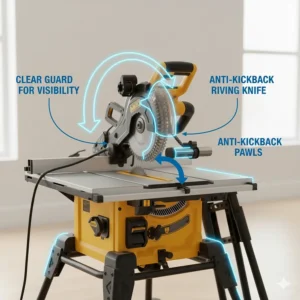
Traditional blade guards frustrated users with clumsy designs that interfered with work visibility. Modern modular systems separate into components (blade guard, riving knife, anti-kickback pawls) that install or remove without tools. Clear polycarbonate guards maintain blade visibility while providing protection, with independent side guards adjusting to material thickness.
Riving knives have largely replaced simple splitters, following the blade through height and angle adjustments. This maintains proper positioning that prevents material from pinching the blade—the primary kickback cause. Quick-release mechanisms allow riving knife removal for dados and non-through cuts, then rapid reinstallation.
Anti-kickback pawls grab material if the blade catches and tries throwing it back toward the operator. Proper adjustment sets pawl teeth just below material surface, engaging only during reverse movement. OSHA regulations mandate these safety features on commercial equipment, but proper use depends on operator discipline.
Emergency Stop Systems
Convenient emergency stops allow instant shutdown during problems. Large paddle switches positioned for knee or body contact enable stopping without releasing material. Some saws include blade brakes that halt rotation within seconds rather than allowing coasting that extends danger.
Restart protection prevents accidental startup after power interruptions. This feature requires deliberately resetting the switch after power restoration, preventing the saw from unexpectedly running when electricity returns. Particularly important on construction sites with unstable power supplies.
The ultimate safety technology—contact detection systems like SawStop—uses electrical sensors detecting skin contact and stops the blade in milliseconds. While adding significant cost, these systems have prevented thousands of amputations. For professionals, the investment pays for itself by avoiding even a single serious injury.
How to Choose Heavy Duty Jobsite Table Saw for Your Needs
- Assess Your Primary Materials: Hardwood cutting demands worm drive or high-torque motors. Softwood framing and sheet goods work fine with standard 15A direct drive saws. Multi-material work may benefit from specialty saws like the Evolution R10TS.
- Evaluate Transport Frequency: Daily site changes favor lighter saws (75-90 lbs) with robust rolling stands. Semi-permanent setups benefit from heavier models (100-110 lbs) providing superior stability and dampened vibration.
- Determine Required Rip Capacity: Full sheet plywood demands 30″+ rip capacity. Trim work and smaller projects manage with 24-26″ capacity. Consider how often you’ll cut large panels versus narrow stock.
- Calculate Budget Realistically: Entry-level heavy duty saws start around $400-500. Professional-grade models run $600-800. Premium options with advanced safety or unique features reach $1,500-2,000. Include stand cost if purchasing separately.
- Factor in Power Supply Limitations: Job sites with questionable electrical service need soft-start equipped saws preventing circuit breaker trips. Generator-powered tools benefit from efficient motors drawing lower startup current.
- Consider Safety Priorities: Operators new to table saws should seriously consider contact-detection systems. Experienced users might prioritize conventional safety features with proper discipline. Insurance costs and liability exposure influence commercial decisions.
- Plan for Dust Management: Allergies or lung sensitivity require superior dust collection. Indoor work demands better collection than outdoor construction. Verify collection port size matches your vacuum equipment.
Maintenance Tips for Continuous Duty Saws
Daily Maintenance Procedures
Start each workday by inspecting blade condition—dull or damaged teeth cause binding, burning, and dangerous kickback. Remove accumulated pitch and resin with blade cleaning solution. Check that the blade runs true without wobble by spinning it by hand with power off.
Verify fence alignment before critical cuts using a reliable square against the blade. Clean sawdust from fence rails and mechanisms to maintain smooth operation. Inspect electrical cords for cuts or damage that could cause shorts or shocks.
Lubricate elevation and bevel mechanisms according to manufacturer specifications. Spray lubricants work well for rack and pinion systems, while lithium grease suits worm gears. Wipe excess lubricant preventing dust attraction and buildup.
Test safety features including blade guard operation, riving knife position, and anti-kickback pawl condition. Replace worn or damaged safety components immediately—never operate with compromised protection. Ensure emergency stops function properly with quick activation response.
Long-Term Care and Storage
Indoor storage protects saws from weather exposure that corrodes mechanisms and warps wood components. Cover saws even when stored inside, preventing dust accumulation in bearings and motors. Climate-controlled storage prevents rust formation on precision-machined surfaces.
Periodic deep cleaning removes built-up sawdust from internal mechanisms. Compressed air blows debris from motor housings and inaccessible areas. Inspect and clean dust collection systems, replacing clogged filters maintaining proper suction.
Annual professional servicing identifies worn bearings, loose mounting hardware, or electrical issues before causing failures. Motor brushes require periodic replacement based on operating hours. Document maintenance performed and component replacements for warranty purposes and resale value.
Blade storage matters too—hanging blades prevents warping and protects teeth from damage. Carbide-tipped blades justify periodic professional sharpening maintaining optimal performance. Maintain several blades for different materials, avoiding blade changes mid-project.
Comparing Heavy Duty Models: Specifications That Matter
| Feature | Why It Matters | Ideal Range |
|---|---|---|
| Motor Amperage | Determines cutting power | 15A minimum for hardwoods |
| RPM Rating | Affects cutting speed | 4,000-5,000 for balanced performance |
| Rip Capacity | Maximum width of crosscut | 30″+ handles full plywood sheets |
| Depth of Cut (90°) | Thickness capability | 3-1/8″ minimum for 4x material |
| Table Size | Material support area | 26″x40″ minimum extended |
| Weight | Portability vs. stability | 85-95 lbs optimal balance |
| Fence Type | Accuracy and adjustability | Rack & pinion for precision |
| Dust Port Size | Collection effectiveness | 2.5″ standard shop vacuum compatible |
Price Ranges and Value Analysis
Budget Tier ($400-$550)
Budget heavy duty saws like the Evolution R10TS sacrifice premium features but deliver solid core performance. Expect acceptable accuracy, adequate power for most materials, and basic safety features. Stands may use lighter construction with smaller wheels. Warranties run shorter (1-2 years) with limited coverage.
Value seekers find legitimate professional tools here, especially from reputable brands offering specific niche advantages (multi-material cutting capability). Perfect for side businesses, DIY enthusiasts with serious projects, or supplementary saws for specific tasks. Register products promptly for maximum warranty coverage.
Mid-Range ($550-$800)
This sweet spot encompasses most professional contractors’ choices. Models like the DeWalt DWE7491RS, SKIL SPT99-11, and Bosch GTS15-10 deliver refined features, superior build quality, and extensive warranties. Expect precision-machined components, robust stands, and thoughtful ergonomic details.
The performance gap between mid-range and premium often exceeds the price difference. Professional features like soft-start motors, brake systems, and advanced dust collection appear at this tier. Stands include convenience features (gravity-rise mechanisms, large wheels) that save time and effort daily.
Premium Tier ($800+)
Premium pricing brings revolutionary features like SawStop’s contact detection ($1,599-$1,899) or industrial-grade construction exceeding standard duty cycles. Warranties extend longer with superior coverage. Premium models often include accessories requiring separate purchase on cheaper saws.
Justify premium costs through reduced injury risk, extended lifespan, or specialized capabilities essential to your work. Professional contractors working daily can amortize costs across thousands of cuts. Insurance considerations (lower liability exposure) influence commercial decisions.
❓ FAQ
❓ What makes a heavy duty jobsite table saw different from regular portable saws?
❓ Can a jobsite saw for hardwood handle exotic woods like teak or ebony?
❓ How important is rip capacity for professional contractors?
❓ Do continuous duty saws really last longer than intermittent duty models?
❓ What safety features should commercial grade portable saws include?
Conclusion: Investing in Your Craft’s Foundation
Selecting the right heavy duty jobsite table saw represents more than purchasing another tool—you’re investing in productivity, safety, and the quality of every project you’ll tackle over the coming years. The seven models reviewed here each excel in different scenarios, from the DeWalt DWE7491RS’s all-around professional performance to the SawStop JSS-120A60’s revolutionary safety technology.
Your specific needs will guide the right choice. Contractors moving between sites daily should prioritize the SKIL SPT99-11’s rugged portability and torque. Those cutting diverse materials benefit from the Evolution R10TS’s multi-material capability. Budget-conscious professionals find exceptional value in the Ridgid R4514’s lifetime service agreement.
Whatever you choose, remember that proper maintenance extends any saw’s lifespan dramatically. Daily cleaning, periodic lubrication, and prompt safety component replacement protect both your investment and your hands. The finest saw in the world becomes dangerous through neglect.
I’ve watched the industry evolve over fifteen years, and 2026’s offerings represent the best balance of power, precision, and portability we’ve ever seen. The gap between jobsite saws and stationary cabinet models continues narrowing as manufacturers apply advanced materials and engineering. Take time choosing the right tool for your work—it’ll become your most-used ally for years to come.
Recommended for You
- 7 Most Accurate Jobsite Table Saw – 2026
- 7 Best Jobsite Table Saw With Rolling Stand – 2026
- 7 Most Portable Jobsite Table Saws for Contractors (2026 Guide)
Disclaimer: This article contains affiliate links. If you purchase products through these links, we may earn a small commission at no additional cost to you.
✨ Found this helpful? Share it with your friends! 💬🤗
