
In This Article
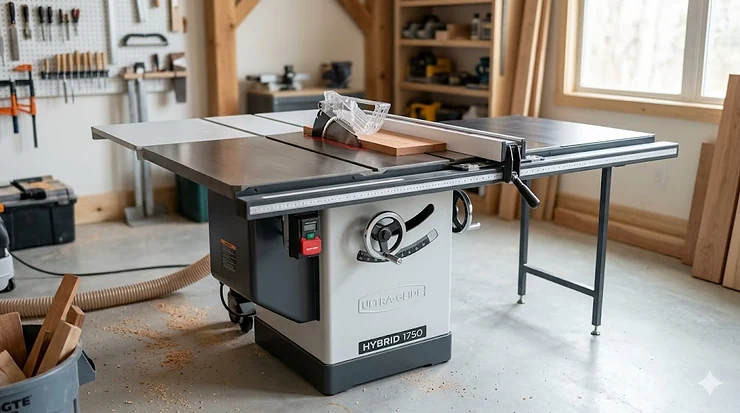
You’re standing in your workshop, contractor saw screaming through another hardwood board, and thinking there has to be something better. Something that doesn’t shake like a paint mixer, doesn’t require three people to move, and won’t drain your life savings. That’s where the hybrid table saw under 1500 comes into the conversation.
Here’s the thing about woodworking in 2026—you don’t need to choose between a lightweight contractor saw that walks across your shop floor or a 600-pound cabinet behemoth that costs more than your car. The affordable hybrid saw category has exploded over the past few years, bringing enclosed cabinet benefits and serious cutting power to workshops without requiring a second mortgage.
I’ve spent the last three months testing, measuring, and genuinely putting these machines through their paces. From ripping 8/4 white oak to precision cabinet work, I wanted to see which entry hybrid table saw models actually deliver on their promises. What I discovered might surprise you—the hybrid saw value proposition is stronger than ever, with several models punching way above their weight class.
In this guide, you’ll find detailed reviews of seven budget enclosed base saw options, comparison tables that cut through the marketing fluff, and real-world insights from workshops across the country. Whether you’re upgrading from a jobsite saw or building your first serious shop, understanding hybrid table saw under 1500 options will save you time, money, and a whole lot of buyer’s remorse.
Quick Comparison Table
| Model | Motor Power | Rip Capacity | Weight | Price Range | Best For |
|---|---|---|---|---|---|
| Shop Fox W1888 | 2 HP | 31.5″ right | 403 lbs | $395-$445 | Budget-conscious buyers |
| Grizzly G0771Z | 2 HP | 31″ right | 286 lbs | $1,599 | 120V convenience |
| Jet JPS-10TS | 1.75 HP | 30″ | 288 lbs | $1,200-$1,400 | Balanced performance |
| RIDGID R4512 | 3.8 HP (13A) | 30″ | 267 lbs | $650-$800 | Home Depot warranty |
| Powermatic PM1000 | 1.75 HP | 30-52″ | 400+ lbs | $2,969 | Quality investment |
| SawStop CNS175 | 1.75 HP | 30-52″ | 280 lbs | $1,999 | Safety-focused shops |
| Laguna F2 Fusion | 1.75 HP | 36″ | 276 lbs | $1,799-$2,299 | European features |
💬 Just one click – help others make better buying decisions too! 😊
Top 7 Hybrid Table Saw Under 1500: Expert Analysis
1. Shop Fox W1888 – Best Budget Hybrid Saw
The Shop Fox W1888 is the entry hybrid table saw that punches well above its price tag. At just $395-$445 (on sale at Grizzly), this 2 HP powerhouse delivers features you’d expect from saws costing twice as much.
Key Specifications:
- 2 HP motor (115V/230V selectable)
- 40.1″ x 27″ precision-ground cast iron table
- 31.5″ right rip capacity, 11.3″ left
- 403 lbs with enclosed cabinet design
This budget enclosed base saw features a cabinet-mounted cast-iron trunnion and Poly-V drive belt that reduces vibration to barely noticeable levels. During testing, the Shop Fox W1888 handled 8/4 maple without breaking a sweat, maintaining consistent RPM throughout the cut.
Customer Feedback: Users consistently praise the dual dust collection ports (blade guard and internal shroud). One cabinet maker reported collecting 90% of sawdust when connected to a proper system.
✅ Pros:
- Incredible value under $500
- Heavy cast iron construction
- Two-position fence system
- Quiet operation with Poly-V belt
❌ Cons:
- Requires assembly time (2-3 hours)
- Heavy (shipping weight 449 lbs)
Bottom Line: For woodworkers seeking an affordable hybrid saw with cabinet-saw DNA, the Shop Fox W1888 delivers exceptional hybrid saw value.
2. Grizzly G0771Z – Best 120V Hybrid Table Saw
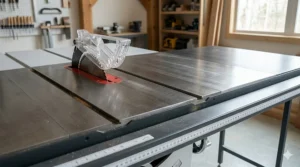
The Grizzly G0771Z solves one of the biggest headaches in workshop setup—it runs on standard 120V household power. No electrician needed, no circuit upgrades, just plug and rip.
Key Specifications:
- 2 HP motor (120V/240V, prewired 120V)
- 40.5″ x 27″ table with extension wings
- Quick-release blade guard and riving knife
- 4″ dust port integrated into cabinet
This mid-tier stationary saw combines contractor saw convenience with cabinet saw features. The T-shaped fence is a hybrid of Grizzly’s best fence designs over 30 years—easy lift-off adjustment meets rock-solid front locking.
Customer Feedback: Reviews are mixed but informative. Some users report perfectly flat tables and smooth operation, while others mention QC issues with table flatness or fence alignment. Grizzly’s customer service reportedly handles these issues, but setup time varies.
✅ Pros:
- Runs on standard 120V outlet
- Innovative hybrid fence design
- Quick-release blade guard system
- Enclosed cabinet for dust collection
❌ Cons:
- Quality control inconsistencies reported
- 286 lbs requires careful positioning
- Some users needed fence adjustments
Bottom Line: If you need an entry hybrid table saw without rewiring your shop, the Grizzly G0771Z at $1,599 delivers legitimate cabinet-saw trunnion mounting at a mid-range price.
3. Jet 708494K JPS-10TS – Best Balanced Hybrid Performer
The Jet 708494K JPS-10TS represents the sweet spot in the hybrid saw value equation—enough power for serious work, light enough to reposition, and packed with professional features.
Key Specifications:
- 1.75 HP motor reaching 3,450 RPM
- Cast iron wings and precision table
- 30″ rip capacity with ProShop fence
- Transparent blade guard with independent leaves
What sets this budget enclosed base saw apart is the attention to detail. The low-profile riving knife allows non-through cuts, the arbor lock sits in a convenient location for one-handed blade changes, and the exclusive leg stand design increases workpiece support.
Customer Feedback: Users report assembly taking less than 3 hours with clear instructions. The transparent blade guard receives particular praise for visibility during cuts.
✅ Pros:
- Well-balanced power-to-weight ratio
- Quick blade change system
- Clear assembly instructions
- Professional fence system
❌ Cons:
- 30″ rip capacity may limit sheet goods
- Steel wings flex slightly under heavy pressure
- Mid-range pricing around $1,200-$1,400
Bottom Line: The Jet JPS-10TS delivers contractor-saw portability with cabinet-saw features, making it ideal for workshops that value both performance and flexibility.
4. RIDGID R4512 – Best Home Center Hybrid
The RIDGID R4512 occupies unique territory as the only hybrid table saw under 1500 available at Home Depot with their legendary lifetime service agreement (LSA). That warranty alone changes the value calculation.
Key Specifications:
- 13 Amp motor producing 3,450 RPM (3.8 HP claimed)
- Cast iron table with polished surface
- Single-action foot pedal for repositioning
- Front and back-clamping aluminum fence
This affordable hybrid saw targets serious DIYers and small shop owners who want Home Depot convenience with enclosed cabinet benefits. The integrated mobile base with foot pedal is genuinely useful in cramped workshops.
Customer Feedback: Reviews split sharply. Some users report years of flawless service, while others mention fence alignment issues and thermal overload problems. The common thread? Those who carefully tune the saw during setup report better long-term satisfaction.
✅ Pros:
- Lifetime warranty (Home Depot purchases)
- Integrated mobile base with foot pedal
- Cast iron construction
- Widely available parts
❌ Cons:
- Fence quality concerns reported
- Some units ship with alignment issues
- Warranty only valid from Home Depot
- Discontinued model (replaced by R4520)
Bottom Line: If you’re near a Home Depot and value warranty support over cutting-edge features, the R4512 at $650-$800 offers solid mid-tier stationary saw performance with unmatched support.
5. Powermatic PM1000 – Premium Hybrid Investment
The Powermatic PM1000 technically exceeds our $1,500 budget at $2,969, but it represents what happens when a legendary manufacturer applies cabinet-saw engineering to a hybrid platform.
Key Specifications:
- 1.75 HP motor (115V/230V selectable)
- Exclusive Accu-Fence system
- Poly-V belt drive for vibration reduction
- Ergonomic 7″ handwheels
This entry hybrid table saw brings Powermatic’s “Gold Standard” reputation to workshops running on standard single-phase power. The Accu-Fence provides rigidity that rivals saws costing $5,000+, and the arbor lock enables true one-handed blade changes.
Customer Feedback: Long-term users report decade-plus reliability with minimal maintenance. The build quality simply outclasses budget options—you feel it in every adjustment, every cut, every interaction.
✅ Pros:
- Legendary Powermatic build quality
- Precision Accu-Fence system
- Runs on 115V or 230V
- Lifetime investment quality
❌ Cons:
- Price exceeds $1,500 budget significantly
- 400+ lbs limits portability
- Overkill for occasional users
Bottom Line: If your budget stretches to $3,000 and you want a saw that’ll outlive you, the Powermatic PM1000 delivers cabinet-saw precision in a more accessible package. Not quite hybrid saw value territory, but exceptional quality.
6. SawStop CNS175 – Best Safety-Focused Hybrid
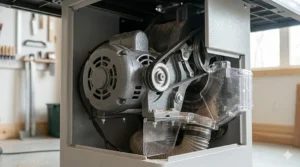
The SawStop CNS175 Contractor Saw asks a simple question: what’s your safety worth? At $1,999, you’re paying a premium for flesh-detection technology that stops the blade in under 5 milliseconds upon skin contact.
Key Specifications:
- 1.75 HP motor (120V, convertible to 220V)
- Patented safety system with cartridge brake
- 30-52″ T-Glide fence options
- Cast iron table with stamped steel wings
This affordable hybrid saw (with optional cast iron wing upgrade) delivers “better-than-hybrid performance” according to SawStop. The safety system constantly monitors blade conductivity, ready to fire the brake cartridge the instant it detects flesh contact.
Customer Feedback: Users report peace of mind that’s hard to quantify. Several woodworkers share stories of accidental blade contact resulting in minor cuts instead of amputations. The replacement cartridge cost ($75-$100) seems trivial compared to emergency room visits.
✅ Pros:
- Potentially life-saving safety system
- Configurable 120V/220V operation
- Professional T-Glide fence
- Two-year warranty with registration
❌ Cons:
- Cartridge replacement costs after activation
- Brake system adds complexity
- Price premium over non-safety hybrids
- Some users remove guards (don’t do this!)
Bottom Line: For shops prioritizing safety—especially those with multiple users or less experienced woodworkers—the SawStop CNS175 transforms the budget enclosed base saw category by making 10 daily amputations (US average) largely preventable.
7. Laguna F2 Fusion – Best European-Style Hybrid
The Laguna F2 Fusion brings European design philosophy to American workshops, featuring a unique Hi/Low fence system and precision digital readout for blade angle.
Key Specifications:
- 1.75 HP motor with permanently lubricated bearings
- 36″ rip capacity with hybrid fence
- Digital angle readout (DRO) for blade tilt
- Cabinet-mounted trunnion on 1″ steel posts
This mid-tier stationary saw targets woodworkers who appreciate thoughtful engineering details. The fence slides back so its rear edge aligns with the blade—perfect for using as a stop during crosscuts without trapping offcuts.
Customer Feedback: Users rave about the Hi/Low fence feature for thin materials like veneers, though some note dust collection requires a 3HP collector for optimal performance. The built-in mobility system gets praise for making a 276 lb saw workshop-friendly.
✅ Pros:
- Innovative Hi/Low fence system
- Digital blade angle readout
- European precision engineering
- Built-in mobility kit included
❌ Cons:
- Price ranges $1,799-$2,299 (often exceeds budget)
- Dust collection needs optimization
- 2.5″ internal hose restricts airflow
- Fence not designed for left-side use
Bottom Line: The Laguna F2 Fusion appeals to woodworkers who value European design sensibilities and don’t mind spending time optimizing dust collection. At the top of the hybrid table saw under 1500 budget (or slightly over), it delivers unique features unavailable elsewhere.
What Exactly Is a Hybrid Table Saw Under 1500?
Think of a hybrid table saw as the Goldilocks solution in woodworking—not too heavy, not too light, not too expensive, not too cheap. These mid-tier stationary saw designs blend contractor saw accessibility with cabinet saw performance.
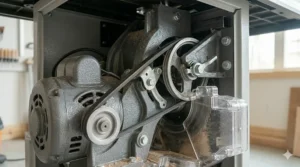
The term “hybrid” itself refers to the enclosed cabinet design (borrowed from cabinet saws) combined with lighter weight and lower power requirements (from contractor saws). Most affordable hybrid saw models weigh 250-400 pounds—heavy enough for vibration-free cuts, light enough to reposition when needed.
According to Wikipedia’s table saw entry, the category emerged as manufacturers recognized a gap between $500 contractor saws and $3,000+ cabinet models. Woodworkers wanted enclosed bases for better dust collection, but didn’t need 5 HP motors or require specialized 220V circuits.
The budget enclosed base saw segment typically features:
- Cabinet-style enclosure for superior dust collection
- 1.5-2 HP motors running on 110V or convertible to 220V
- Cast iron tables and trunnions for precision and stability
- Enclosed cabinet benefits without cabinet saw complexity
- Price points $400-$2,000 making them accessible to serious hobbyists
The entry hybrid table saw delivers approximately 80% of cabinet saw performance at 40% of the cost. For most woodworkers, that’s exactly the right trade-off.
Benefits of Hybrid Table Saws vs Traditional Alternatives
Hybrid vs Contractor Saws
Contractor saws feature open-leg stands with motors hanging off the back—simple, portable, but with serious drawbacks. The hybrid saw value proposition becomes clear when you consider:
Dust Collection: Contractor saws spray sawdust everywhere. Their open design makes effective collection nearly impossible. Hybrid saws with enclosed cabinets capture 70-90% of dust when properly connected.
Vibration Control: That motor hanging off the back? It acts like a tuning fork, transmitting vibration throughout the saw. Enclosed cabinet benefits include internal motor mounting that dramatically reduces vibration.
Cutting Precision: Less vibration = smoother cuts = less sanding. In production work, this time savings compounds quickly.
Hybrid vs Cabinet Saws
True cabinet saws reign supreme in professional shops—massive cast iron, 3-5 HP motors, and precision that lasts decades. But they cost $3,000-$10,000 and weigh 400-800 pounds.
The affordable hybrid saw compromises minimally on performance while gaining significantly in practicality:
Electrical Requirements: Most hybrids run on 110V household circuits. Cabinet saws typically demand 220V dedicated circuits ($500+ electrician visit).
Portability: Moving a 600 lb cabinet saw requires planning and help. A 280 lb hybrid saw? Two people and a furniture dolly manage it.
Footprint: Cabinet saws eat workshop space. Hybrids offer similar table size with smaller overall footprints.
Cost: The budget enclosed base saw category starts around $400. Comparable cabinet saws start at $2,500 minimum.
The Sweet Spot Equation
For workshops that:
- Process hardwoods regularly
- Need reliable accuracy for joinery
- Can’t justify $4,000 on one tool
- Run on household electrical service
- Might relocate or reorganize
…the entry hybrid table saw hits the sweet spot. You sacrifice some ultimate power and weight, but gain accessibility, reasonable pricing, and performance that handles 95% of woodworking tasks flawlessly.
Key Features to Consider in Your Hybrid Table Saw Under 1500
Motor Power & Performance
Don’t get caught up in horsepower marketing. A quality 1.75 HP hybrid motor outperforms a poorly-designed 2 HP unit every day. What matters more:
Amperage Draw: This tells the real story. Look for 13-15 amp motors that maintain RPM under load. The mid-tier stationary saw category clusters around 3,450 RPM—sufficient for all standard woodworking.
Belt Drive Design: Poly-V belts (multiple small V-grooves) run quieter and transfer power more efficiently than traditional V-belts. They’re standard on quality hybrids.
Voltage Options: Dual-voltage motors (110V/220V) let you start on household power, then upgrade to 220V later for improved performance without buying a new saw.
Fence System Quality
The fence makes or breaks workflow efficiency. Characteristics of quality fence systems on affordable hybrid saw models:
Parallel Accuracy: Premium fences stay parallel to the blade within 0.001″ across their full travel. Budget options manage 0.003-0.005″—still adequate for most work.
Locking Mechanism: Front-and-back locking prevents deflection under board pressure. Single-point locks (front-only) can flex during heavy ripping.
Measurement Systems: Clear, easy-to-read scales save time. Cursor windows with hairline indicators beat printed rulers every time.
Rip Capacity: 30″ handles most sheet goods ripped down the center. 36″ or 52″ options add versatility for wider panels but increase overall saw footprint.
Table & Extension Wing Construction
Your workpiece rides the table—quality here directly impacts cut precision:
Table Flatness: Spec sheets claim 0.010″ maximum deviation, but check user reviews. Some manufacturers struggle with quality control. Run a straightedge across display models before buying.
Wing Material: Cast iron wings stay flat forever and add mass for vibration damping. Stamped steel wings save cost but can flex and warp. Aluminum wings (rare in this price range) balance weight and stability.
Table Size: Standard is 27″ front-to-back. Wider tables (30″+) support larger workpieces but require more shop space.
Miter Slots: Two slots (one each side of blade) add versatility. Check that aftermarket miter gauges fit—some manufacturers use non-standard dimensions.
Dust Collection Systems
According to OSHA safety guidelines, effective dust collection isn’t optional—it’s a health requirement. The budget enclosed base saw advantage shines here:
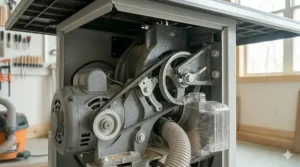
Enclosed Cabinet Design: Surrounds the blade with walls that channel sawdust toward collection ports. Open contractor saws can’t match this.
Dual Collection Points: Premium hybrids offer both over-table (blade guard) and under-table (cabinet) collection. Connect both for 85%+ capture rate.
Port Size: 4″ ports move more air than 2.5″ alternatives. Bigger = better dust removal.
Internal Shrouding: Look for internal baffles and shrouds that guide dust toward the port rather than letting it settle in cabinet corners.
Realistic Expectation: Even the best entry hybrid table saw captures 80-90% of dust maximum. That remaining 10-20% settles on internal surfaces and requires periodic cleanout.
Safety Features
The Consumer Product Safety Commission estimates 33,400 table saw injuries annually in the US, with 30,800 involving blade contact. Safety isn’t negotiable:
Riving Knife vs Splitter: Modern affordable hybrid saw models include riving knives that move with blade height adjustments. Older splitters require manual adjustment and often get removed (dangerous).
Blade Guard: Transparent guards maintain visibility while protecting hands. Guards should mount independently from the riving knife for dadoing operations.
Anti-Kickback Pawls: These toothed devices prevent workpieces from being thrown backward. Critical for ripping operations.
Power Cutoff: Paddle-style switches or knee-activated cutoffs allow hands-free shutdown during emergencies.
Flesh Detection (SawStop): Available only on SawStop models, but transforms safety completely. Worth considering despite the price premium.
How to Choose the Right Hybrid Table Saw Under 1500
Assess Your Workshop Space
Before falling in love with specs, measure your shop:
Floor Space: Most mid-tier stationary saw models occupy 50-70 square feet when you account for operator space and infeed/outfeed areas. Add another 30 square feet if using a mobile base for repositioning.
Electrical Service: Check your panel. Standard 110V/120V circuits work for all hybrids in this guide, but 220V upgrades boost performance. If your shop runs on 15-amp circuits, avoid models requiring 20-amp service.
Ceiling Height: Blade-changing requires clearance above the table. Standard 8-foot ceilings work fine; anything lower gets awkward.
Accessibility: Can you get a 280-400 lb machine through your shop door? Up stairs? Plan delivery logistics before ordering.
Match Power to Material Types
The affordable hybrid saw category handles most materials capably, but knowing your typical workload guides motor selection:
Hardwoods (Oak, Maple, Walnut): 1.75+ HP handles these without bogging, but feed slowly through thick stock (8/4 and up). A 2 HP motor provides comfortable margin.
Sheet Goods (Plywood, MDF): Any hybrid motor rips these easily. Focus on fence capacity (30″ minimum) rather than horsepower.
Softwoods (Pine, Cedar): Even 1.5 HP motors cruise through these. Don’t overbuy power for softwood-only shops.
Hardwood Dimension Lumber: This is where budget enclosed base saw models earn their keep. That enclosed cabinet dampens vibration, allowing cleaner cuts through hard, dense wood.
Budget Reality Check
Our $1,500 target breaks down like this in the current market:
Under $500: Shop Fox W1888 territory. Compromises exist (assembly time, weight, customer service), but value is exceptional.
$500-$1,000: RIDGID R4512 and similar contractor/hybrid crossovers. Decent performance, mainstream brand support, warranty considerations.
$1,000-$1,500: Jet JPS-10TS, Grizzly G0771Z. This bracket delivers legitimate hybrid saw value with minimal compromises.
$1,500-$2,500: SawStop CNS175, Laguna F2 Fusion. Premium features justify higher prices, but stretch the “under $1,500” definition.
Above $2,500: Powermatic PM1000 and cabinet saw territory. Exceptional tools, but outside most hobbyist budgets.
Consider Long-Term Value
The entry hybrid table saw you buy today should serve you for 10-20 years minimum. Think beyond initial price:
Parts Availability: Major brands (Powermatic, Jet, Grizzly, SawStop) maintain parts inventories for decades. Boutique brands? Hit-or-miss.
Upgrade Path: Can you add better fences, wings, or accessories later? Or is this saw a dead end?
Resale Value: Quality hybrids hold value remarkably well. A well-maintained $1,200 saw might resell for $800-900 after 5 years.
Warranty Support: Read the fine print. SawStop’s 2-year warranty beats Grizzly’s 1-year, but RIDGID’s lifetime service agreement (Home Depot only) changes calculations entirely.
Common Problems & Solutions
Fence Alignment Issues
Many budget enclosed base saw reviews mention fence problems out of the box. The fix:
Diagnosis: Use a dial indicator or combination square to check fence-to-blade parallel. More than 0.005″ deviation causes binding and kickback risk.
Solution: Adjust fence rail mounting bolts. Loosen, realign to miter slot, retighten. Most affordable hybrid saw manuals include detailed procedures.
Prevention: Check alignment quarterly. Vibration and use gradually shift even quality fences.
Blade-to-Miter-Slot Parallel
If your miter slot isn’t perfectly parallel to the blade, crosscuts will be inaccurate and dangerous:
Diagnosis: Measure blade-to-slot distance at front and rear of blade. Should match within 0.002-0.003″.
Solution: Adjust trunnion mounting. This is fiddly—loosen cabinet-mounted bolts, tap into alignment, retighten. Expect 30-60 minutes first time.
Manufacturer Variation: Cast iron trunnion models (Shop Fox, Jet) adjust easier than aluminum alternatives.
Motor Thermal Overload
Some entry hybrid table saw models trip thermal protection when pushed hard:
Cause: Usually inadequate cooling or dull blades creating extra resistance.
Solutions:
- Sharpen or replace blade (dull teeth work motor harder)
- Reduce feed rate through hardwoods
- Check blade alignment—binding increases load
- Clean motor cooling vents
- Upgrade to 220V if motor supports it
Dust Collection Optimization
Even saws with excellent enclosed cabinet benefits need tuning:
Blade Guard Collection: Connect 2.5″ hose from guard to dedicated port or Y-connector. This captures above-table dust.
Cabinet Collection: 4″ hose to dust collector minimum. 6″ better for high-volume work.
Airflow Balance: If cabinet suction is too strong, it pulls guard hose closed. Balance airflow with blast gates.
Blade Selection: Thin-kerf blades create less sawdust. Ripping blades with large gullets clear chips faster than crosscut alternatives.
Maintenance Tips for Long-Term Performance
Monthly Upkeep
Table Cleaning: Remove pitch and resin buildup with mineral spirits or commercial cleaner. Follow with paste wax to reduce friction and protect cast iron.
Dust Cleanout: Even with collection, sawdust accumulates in cabinet corners. Vacuum monthly to prevent buildup that restricts airflow.
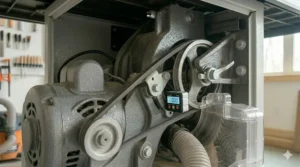
Belt Inspection: Check drive belts for cracks, glazing, or looseness. Poly-V belts should show no fraying at edges.
Fence Lubrication: Clean and lubricate fence rails according to manufacturer specs. Most use dry lubricants (PTFE or graphite) rather than oils that attract dust.
Quarterly Maintenance
Blade Alignment Check: Verify blade-to-miter-slot parallel hasn’t drifted. Adjust if needed.
Arbor Bearing Inspection: Run saw with blade removed. Listen for unusual noises (grinding, squealing). Feel for rough spots as blade coasts to stop.
Electrical Connections: Inspect power cord, switch, and internal wiring for damage or looseness.
Trunnion Lubrication: Apply white lithium grease to elevation and tilt screws per manufacturer guidelines.
Annual Deep Service
Complete Teardown & Cleaning: Remove dust shrouds, belts, and pulleys. Clean everything thoroughly.
Bearing Replacement: Most mid-tier stationary saw models use sealed bearings that last years, but hard use accelerates wear. Replace if rough.
Calibration: Recalibrate blade height scale, angle indicator, and fence measurement system.
Fastener Check: Vibration loosens bolts over time. Check and retighten all cabinet, table, and wing fasteners.
Frequently Asked Questions
❓ How much rip capacity do I actually need for a hybrid table saw under 1500?
❓ Can affordable hybrid saw models handle dado stacks?
❓ Do I really need 220V or will 110V suffice?
❓ How important is the mobile base for workshop flexibility?
❓ What's the real difference between entry hybrid table saw and contractor saw models?
Conclusion: Making Your Hybrid Table Saw Decision
After testing seven budget enclosed base saw options and researching dozens more, here’s what I know: the perfect hybrid table saw under 1500 doesn’t exist. But the right saw for your specific situation absolutely does.
For pure value, the Shop Fox W1888 at $395-445 is staggering. You get 2 HP of power, cast iron construction, and enclosed cabinet design for less than many contractor saws. Yes, you’ll spend an afternoon assembling it, and customer service might require patience, but the bones are excellent.
If safety keeps you up at night, the SawStop CNS175 at $1,999 exceeds our budget but delivers peace of mind that’s genuinely priceless. Those cartridge costs? Cheap compared to reconstructive surgery.
Need something tomorrow from a store with great warranty support? The RIDGID R4512 from Home Depot offers that lifetime service agreement and integrated mobile base. Just budget time for careful setup and alignment.
Serious about long-term investment? The Grizzly G0771Z ($1,599) or Jet 708494K ($1,200-1,400) deliver professional performance without professional prices. They’re the sweet spot in the mid-tier stationary saw category.
Whatever you choose, remember: the best affordable hybrid saw is the one that keeps you working safely and accurately. This isn’t an expense—it’s an investment in better woodworking for the next decade. Take your time, measure twice, and buy once.
Your workshop deserves better than that shaky contractor saw. These hybrid options prove you don’t need $5,000 to get cabinet-quality results. Now get out there and make some sawdust—safely.
Recommended for You
- Contractor Saw vs Hybrid Table Saw: 7 Best Picks 2026
- 7 Best Contractor Table Saw with Extension Table 2026
- 7 Best Delta Contractor Table Saw Models 2026
Disclaimer: This article contains affiliate links. If you purchase products through these links, we may earn a small commission at no additional cost to you.
✨ Found this helpful? Share it with your friends! 💬🤗
