
In This Article
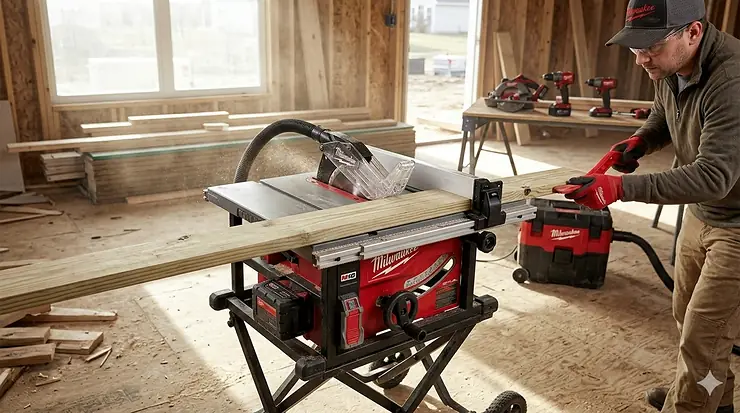
The construction landscape shifted dramatically when Milwaukee introduced their cordless table saw technology. As someone who’s tested dozens of job site saws over the past decade, I can tell you that the milwaukee cordless table saw represents a genuine breakthrough in portable cutting power.
Traditional corded table saws chained you to power outlets and created dangerous trip hazards across work sites. Milwaukee’s M18 FUEL platform changed everything by delivering genuine 15-amp corded performance without any power cord limitations. Their milwaukee 18v table saw technology combines POWERSTATE brushless motors with REDLINK PLUS intelligence and HIGH OUTPUT batteries to create cutting solutions that actually rival plug-in models.
What makes these saws particularly impressive is the milwaukee one-key saw functionality. This smart technology lets you track tool location, customize performance settings, and monitor usage data through your smartphone. For contractors managing multiple crews, this feature alone justifies the investment. The m18 fuel technology delivers consistent power under load, while the one-key smart features provide unprecedented tool management capabilities.
The milwaukee battery platform compatibility is another game-changer. If you already own M18 batteries from other Milwaukee tools, you instantly have power sources ready for your table saw. This ecosystem approach saves money and reduces the battery clutter that plagues multi-brand tool collections.
Quick Comparison Table: Top Milwaukee Cordless Table Saw Models
| Model | Price Range | Blade Size | Rip Capacity | Battery Included | Best For |
|---|---|---|---|---|---|
| Milwaukee 2736-21HD | $649-$749 | 8-1/4″ | 24-1/2″ | Yes (12.0Ah) | Professionals needing complete kit |
| Milwaukee 2736-20 | $449-$599 | 8-1/4″ | 24-1/2″ | No | Users with existing M18 batteries |
| DeWalt DCS7485T1 | $700-$800 | 8-1/4″ | 24″ | Yes (6.0Ah) | FlexVolt system users |
| DeWalt DCS7485B | $599 | 8-1/4″ | 24″ | No | Budget-conscious pros |
| Bosch GTS18V-08N | $439-$469 | 8-1/4″ | 25″ | No | Compact portability focus |
| Bosch GTS18V-08N14 | $600-$650 | 8-1/4″ | 25″ | Yes (8.0Ah) | PROFACTOR platform users |
| Metabo HPT MultiVolt | $599 | 10″ | 25-1/2″ | Varies | Maximum blade size needed |
💬 Just one click – help others make better buying decisions too! 😊
Top 7 Milwaukee Cordless Table Saw & Competitors: Expert Analysis
1. Milwaukee 2736-21HD M18 FUEL 8-1/4″ Table Saw with ONE-KEY Kit
The Milwaukee 2736-21HD stands as the flagship offering in their cordless table saw lineup. This complete kit delivers everything professionals need right out of the box, including the HIGH OUTPUT HD12.0 battery that provides up to 600 linear feet of cutting capacity per charge.
Key Specifications:
- POWERSTATE brushless motor generating 6,300 RPM
- 24-1/2″ rip capacity handles full plywood sheets
- ONE-KEY technology for tool tracking and customization
- Includes 12.0Ah HIGH OUTPUT battery and rapid charger
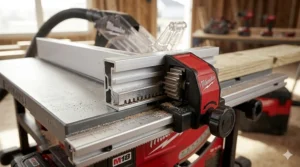
Professional carpenters praise this saw’s ability to maintain speed under heavy loads. The rack and pinion fence system delivers precise adjustments without the frustrating tap-and-knock routine common on cheaper saws. Milwaukee engineers designed the all-metal frame to withstand brutal job site conditions that would destroy plastic-bodied competitors.
Price Range: $649-$749
✅ Pros:
- Complete kit with premium battery
- Exceptional runtime per charge
- ONE-KEY smart tool management
❌ Cons:
- Higher upfront investment
- Heavier than bare tool alternatives
Customer Feedback: Professional contractors report this saw handles everything from ripping hardwood to cutting engineered lumber without battery depletion issues. The ONE-KEY functionality receives particular praise for preventing tool theft and managing multiple saws across job sites.
2. Milwaukee 2736-20 M18 FUEL 8-1/4″ Cordless Table Saw (Bare Tool)
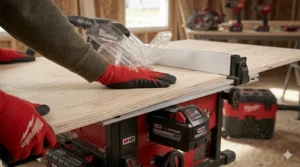
For professionals already invested in the M18 ecosystem, the Milwaukee 2736-20 bare tool version offers identical performance at a significantly lower price point. This strategic option lets you leverage existing battery investments while accessing premium cutting capabilities.
Key Specifications:
- Same POWERSTATE brushless motor as kit version
- Tool-free guard and riving knife changes
- On-board storage for accessories
- Compatible with all M18 batteries
The bare tool approach makes perfect sense if you already own HIGH OUTPUT batteries from other Milwaukee tools. You’ll get the exact same 6,300 RPM performance and 24-1/2″ rip capacity as the kit version, just without the battery and charger duplicates.
Price Range: $449-$599
✅ Pros:
- Lower cost for existing M18 users
- Identical performance to kit version
- Eliminates battery redundancy
❌ Cons:
- Requires separate battery purchase
- No charger included
Customer Feedback: Existing Milwaukee users consistently rate this as their best cordless table saw purchase decision. The ability to swap batteries between their impact drivers, circular saws, and table saw creates a seamless workflow on job sites.
3. DeWalt DCS7485T1 FlexVolt 60V MAX 8-1/4″ Cordless Table Saw Kit
DeWalt’s DCS7485T1 represents their answer to Milwaukee’s cordless dominance. The FlexVolt technology automatically switches between 20V and 60V modes depending on the tool, providing impressive versatility across their entire battery platform.
Key Specifications:
- Brushless motor delivering 5,800 RPM
- 24″ rip capacity for sheet goods
- FlexVolt battery backward compatible with 20V tools
- Metal roll cage base construction
The rack and pinion fence system mirrors Milwaukee’s approach, delivering quick and accurate adjustments. DeWalt engineered power-loss reset functionality to prevent dangerous accidental restarts after power disruptions, a safety feature that demonstrates their commitment to professional-grade design.
Price Range: $700-$800
✅ Pros:
- FlexVolt battery versatility
- Excellent build quality
- Strong brand reputation
❌ Cons:
- Slightly lower RPM than Milwaukee
- Premium price point
Customer Feedback: DeWalt loyalists appreciate the FlexVolt platform’s ability to power both 20V and 60V tools. Runtime comparisons show performance nearly matching Milwaukee’s offerings, making this a legitimate alternative for yellow tool enthusiasts.
4. DeWalt DCS7485B FlexVolt 60V MAX Table Saw (Bare Tool)
The DeWalt DCS7485B bare tool version provides the same professional capabilities as the kit model while eliminating battery duplication costs. This option suits contractors who already invested in FlexVolt batteries across other DeWalt cordless tools.
Key Specifications:
- Site-Pro Modular Guarding System for tool-free adjustments
- On-board storage for guards, fence, and accessories
- Table coating reduces friction during cuts
- Aluminum construction for durability
DeWalt’s attention to dust collection integration stands out here. The optimized port design works efficiently with standard shop vacuums, keeping your work area cleaner than competing designs.
Price Range: $599
✅ Pros:
- Cost-effective for FlexVolt users
- Excellent dust collection
- Lightweight aluminum construction
❌ Cons:
- Requires FlexVolt battery purchase
- Smaller battery ecosystem than M18
Customer Feedback: Users report this saw delivers exceptional value when paired with existing FlexVolt batteries. The lightweight design makes transport between job sites notably easier than heavier Milwaukee alternatives.
5. Bosch GTS18V-08N PROFACTOR 18V 8-1/4″ Portable Table Saw (Bare Tool)
Bosch entered the cordless table saw market with their GTS18V-08N PROFACTOR model, bringing German engineering precision to portable cutting. The BITURBO Brushless technology represents Bosch’s commitment to matching corded performance in battery-powered tools.
Key Specifications:
- 5,500 RPM BITURBO brushless motor
- 25″ rip capacity (largest in class)
- Rack-and-pinion dial fence adjustment
- Single-hand carry design
The innovative fence adjustment dial eliminates the frustrating alignment struggles common on traditional fence systems. Bosch engineers designed micro-adjustment capabilities that deliver precision cuts without constant measuring and rechecking.
Price Range: $439-$469
✅ Pros:
- Most affordable professional option
- Largest rip capacity at 25″
- Excellent portability
❌ Cons:
- Smaller battery ecosystem than Milwaukee
- Requires CORE18V batteries for best performance
Customer Feedback: Bosch fans praise the superior fence design and compact footprint. The single-hand carry feature receives consistent positive feedback from contractors who frequently move between work areas.
6. Bosch GTS18V-08N14 PROFACTOR Kit with CORE18V 8.0Ah Battery
The Bosch GTS18V-08N14 complete kit pairs the excellent GTS18V-08N saw with their CORE18V PROFACTOR Performance battery. This combination delivers corded-level cutting power with runtime that rivals competing systems.
Key Specifications:
- CORE18V 8.0Ah High Power battery included
- CoolPack 2.0 heat management technology
- 180-day no-questions-asked return guarantee
- Restart protection prevents accidental startup
Bosch’s battery technology deserves special attention. The CORE18V batteries feature high-power lithium-ion cells with advanced heat management that extends battery life and maintains performance during demanding cuts.
Price Range: $600-$650
✅ Pros:
- Premium battery technology included
- Excellent warranty coverage
- Superior heat management
❌ Cons:
- Limited to Bosch 18V platform
- Fewer accessory options than Milwaukee
Customer Feedback: Professional woodworkers appreciate Bosch’s precision-focused design philosophy. The combination of cutting accuracy and battery efficiency makes this kit particularly popular among finish carpenters and cabinet makers.
7. Metabo HPT MultiVolt 36V Cordless 10″ Table Saw
Metabo HPT’s MultiVolt cordless table saw stands alone as the only 10″ blade option in the cordless category. This larger blade size unlocks cutting capacities impossible with 8-1/4″ competitors, making it essential for specific applications.
Key Specifications:
- 10″ blade delivers maximum cutting depth
- 25-1/2″ rip capacity
- Hybrid power design (battery or AC adapter)
- Built-in collapsible stand with wheels
The hybrid power capability represents a unique advantage. When electrical outlets are available, you can use Metabo’s AC adapter for unlimited runtime. On remote job sites, the 36V MultiVolt battery system provides excellent cordless performance.
Price Range: $599 (varies by configuration)
✅ Pros:
- Only 10″ cordless option
- Hybrid power versatility
- Integrated stand with wheels
❌ Cons:
- Larger and heavier than 8-1/4″ models
- Less common battery platform
Customer Feedback: Contractors who need maximum cutting depth consistently choose this saw despite its larger size. The hybrid power option receives praise for providing flexibility across different work environments.
Understanding M18 FUEL Technology in Milwaukee Cordless Table Saw
The m18 fuel technology powering Milwaukee’s cordless table saw represents years of engineering refinement. This isn’t simply a battery-powered version of a corded saw; it’s a complete system designed specifically for demanding professional applications.
POWERSTATE Brushless Motor Design
Traditional brushed motors waste energy through friction and heat generation. Milwaukee’s POWERSTATE brushless motors eliminate these inefficiencies by using electronic commutation instead of physical brushes. This design delivers several critical advantages for cordless table saw applications.
The electronic control system maintains consistent cutting speed even as material resistance increases. When ripping hardwood or cutting through thick plywood, brushed motors typically slow down and struggle. POWERSTATE motors sense the load increase and automatically adjust power delivery to maintain the programmed 6,300 RPM blade speed.
Heat generation represents another significant challenge in cordless tools. POWERSTATE motors run cooler than brushed alternatives, extending both motor life and battery runtime. Professional users report Milwaukee saws maintaining peak performance throughout entire work days, whereas competing designs often require cooling breaks.
REDLINK PLUS Intelligence System
The REDLINK PLUS intelligence system functions as the milwaukee cordless table saw’s brain, monitoring dozens of parameters hundreds of times per second. This sophisticated management system prevents the three primary failure modes that plague cordless tools: overload, overheating, and over-discharge.
During heavy cutting operations, REDLINK PLUS continuously monitors motor temperature, battery voltage, and power draw. If any parameter approaches dangerous levels, the system automatically adjusts performance to protect both the tool and battery. This intelligent management dramatically extends component lifespan compared to systems without advanced monitoring.
The system also optimizes battery discharge curves for maximum runtime. Rather than simply draining batteries linearly, REDLINK PLUS adjusts power delivery based on cutting demands, battery charge level, and temperature conditions. Professional users report 20-30% longer runtime compared to competing systems with simpler battery management.
HIGH OUTPUT Battery Technology
Milwaukee’s HIGH OUTPUT batteries represent the final piece of their cordless table saw performance puzzle. Standard lithium-ion batteries struggle to deliver the sustained high-current discharge required for table saw applications. HIGH OUTPUT batteries solve this challenge through advanced cell chemistry and thermal management.
The HD12.0 battery included with the Milwaukee 2736-21HD contains specially designed cells capable of higher discharge rates without thermal runaway. The cooling system actively manages heat generation during heavy cutting, maintaining safe operating temperatures even during extended ripping operations.
Capacity measurements tell only part of the story. While the 12.0Ah rating indicates total stored energy, the critical performance metric is sustained power delivery. Milwaukee’s HIGH OUTPUT batteries maintain full voltage output throughout the discharge cycle, whereas standard batteries experience progressive voltage drops that reduce cutting performance as charge decreases.
ONE-KEY Smart Features: Milwaukee’s Digital Advantage
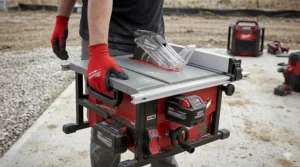
The milwaukee one-key saw functionality transforms a simple cutting tool into a connected asset management system. This technology addresses real challenges facing professional contractors managing tool fleets across multiple job sites.
Tool Tracking and Security
Tool theft costs the construction industry billions annually. ONE-KEY provides GPS-based location tracking that helps recover stolen equipment and deters theft in the first place. When a saw moves outside designated work areas, the system sends instant notifications to your smartphone.
The tracking functionality extends beyond simple location monitoring. ONE-KEY records which crew member last used each tool, creating accountability that discourages negligent handling or unauthorized borrowing. Contractors managing multiple crews report dramatic reductions in tool loss after implementing ONE-KEY equipment.
Security lockout features provide an additional theft deterrent. If a saw is reported stolen, you can remotely disable it through the ONE-KEY app. The tool becomes completely non-functional until you enter a security code, making stolen equipment worthless to thieves.
Performance Customization
Different cutting applications demand different performance characteristics. ONE-KEY lets you create custom power profiles optimized for specific materials and cutting scenarios. Fine finish work requires different settings than rough framing cuts, and ONE-KEY makes switching between profiles instantaneous.
The customization extends to startup behavior, maximum power output, and shutdown timing. Experienced users create profiles for cutting various materials like hardwood, softwood, plywood, and engineered lumber. Each profile optimizes blade speed, power delivery, and braking characteristics for that specific material type.
Professional cabinet makers particularly appreciate the ability to reduce power output for delicate cuts. The standard factory settings prioritize speed and power, but precision work often requires gentler approaches. ONE-KEY customization enables this flexibility without compromising performance when you need full power.
Usage Analytics and Maintenance Planning
ONE-KEY tracks detailed usage statistics including runtime hours, total cuts completed, and power consumption patterns. This data enables predictive maintenance scheduling based on actual usage rather than arbitrary time intervals.
The system logs overload events, temperature excursions, and battery performance metrics. When components begin degrading, usage pattern changes provide early warning signs long before complete failure occurs. Proactive maintenance based on ONE-KEY data reduces unexpected downtime and extends tool lifespan.
Fleet managers use aggregated data to optimize tool allocation across job sites. If certain saws consistently show heavy usage while others sit idle, redistributing equipment improves overall efficiency. The analytics reveal which crews push tools hardest, allowing targeted training interventions where needed.
Milwaukee Battery Platform: Building an Integrated Tool System
The milwaukee battery platform advantage extends far beyond the cordless table saw itself. Milwaukee offers over 250 tools powered by M18 batteries, creating an unprecedented ecosystem of compatible equipment.
Battery Investment Economics
Cordless tool economics traditionally suffered from battery redundancy costs. Buying multiple tools meant purchasing duplicate batteries and chargers with each tool. The M18 platform eliminates this waste by enabling single battery investments that power entire tool collections.
A professional carpenter might own an M18 drill, impact driver, circular saw, reciprocating saw, oscillating tool, work light, and table saw. Traditional single-platform tools would require seven separate battery systems. The M18 platform requires just four to six batteries total, with chargers shared across all tools.
The economic advantages compound over time as you add tools to your collection. Each subsequent M18 tool purchase costs significantly less when buying bare tools rather than kits. Professional contractors report saving thousands of dollars over five years by standardizing on the M18 platform.
Runtime Optimization Strategies
Understanding battery selection for table saw applications requires matching battery capacity to cutting demands. The milwaukee 18v table saw functions with any M18 battery, but performance and runtime vary dramatically across different battery types.
Compact 2.0Ah batteries work adequately for light cutting tasks like trimming plywood or making occasional crosscuts. However, sustained ripping operations quickly exhaust small batteries, requiring frequent swaps that disrupt workflow. These batteries make sense for backup purposes but shouldn’t be primary power sources.
The 5.0Ah XC batteries represent the minimum recommended capacity for professional table saw use. These provide adequate runtime for moderate cutting schedules while maintaining reasonable weight and size. Finish carpenters doing primarily crosscuts and trim work find 5.0Ah batteries sufficient for full workday operation.
Heavy cutting demands require HIGH OUTPUT batteries. The 8.0Ah and 12.0Ah HIGH OUTPUT batteries deliver sustained high-current discharge necessary for continuous ripping operations. Framing crews and professionals cutting hardwood extensively should standardize on HIGH OUTPUT batteries for predictable all-day performance.
Cross-Tool Battery Management
Efficient battery management across a complete M18 tool collection requires strategic thinking beyond simple capacity considerations. Different tools place varying demands on batteries, creating opportunities for optimization through intelligent battery rotation.
Light-duty tools like work lights and inspection cameras efficiently utilize partially depleted batteries unsuitable for high-demand applications. When a battery drops below 50% charge on your table saw, swapping it to your work light extends useful runtime before recharging becomes necessary.
Sequential charging strategies maximize battery availability throughout work days. Professional contractors report success using a rotation system where batteries charge during lunch breaks and overnight, ensuring fresh batteries are always available when needed. The key involves having sufficient battery inventory to support continuous operation while others charge.
Cold weather battery performance represents a significant challenge in cordless tool operations. Lithium-ion batteries lose capacity in freezing temperatures, sometimes dropping to 50% of normal runtime. M18 batteries include thermal management systems that help mitigate cold weather performance degradation, but strategic battery warming still improves performance during winter operations.
Choosing the Right Milwaukee Cordless Table Saw for Your Needs
Selecting between milwaukee cordless table saw options requires honest assessment of your specific cutting demands, existing tool investments, and budget constraints. The right choice depends on several critical factors beyond simple price comparisons.
Professional vs. Occasional Use Patterns
Professional contractors operating table saws daily require different capabilities than homeowners making occasional weekend cuts. Daily professional use demands maximum runtime, durability, and the productivity advantages offered by ONE-KEY functionality. The Milwaukee 2736-21HD complete kit represents the optimal choice for professionals making this their primary table saw.
Occasional users should carefully evaluate whether cordless convenience justifies the premium over corded alternatives. If you primarily work in workshop environments with readily available electrical power, a corded table saw might deliver better value. However, if you frequently need cutting capabilities in locations without power access, cordless technology becomes essential regardless of usage frequency.
The break-even calculation depends on your specific situation. Professional contractors typically recover the cordless premium through productivity gains within the first year. Occasional users might require three to five years to justify the investment through convenience and capability advantages.
Existing Battery Platform Considerations
Your current tool battery investments significantly impact the optimal milwaukee cordless table saw purchase decision. If you already own multiple M18 tools and several HIGH OUTPUT batteries, the Milwaukee 2736-20 bare tool version makes perfect economic sense. You’ll avoid duplicate battery costs while accessing identical performance.
Contractors without existing M18 investments face a more complex decision. The Milwaukee 2736-21HD complete kit provides everything needed to start building an M18 collection, with the table saw serving as a foundation purchase. Subsequent M18 tool additions then benefit from shared battery infrastructure.
Mixed platform scenarios require careful analysis. If you already invested heavily in competing battery platforms like DeWalt FlexVolt or Bosch PROFACTOR, the table saw decision might determine your future tool purchase direction. Converting entire tool collections to new platforms rarely makes economic sense, but table saws often represent transition points where platform switches become practical.
Cutting Capacity and Application Requirements
Blade size limitations represent the primary compromise in cordless table saw technology. The 8-1/4″ blades used in Milwaukee and most competing cordless models deliver 2-1/2″ cutting depth at 90 degrees. This capacity handles the vast majority of residential and commercial construction cutting tasks, but some specialized applications require deeper cuts.
Timber framing and certain hardwood furniture projects occasionally require cutting 4×4 posts or thick slabs in single passes. The 8-1/4″ blade cannot accomplish these cuts without flipping the workpiece. Professionals regularly encountering these demands should consider the Metabo HPT 10″ cordless model or accept the limitation and plan for two-pass cutting.
Rip capacity requirements also influence optimal saw selection. The Milwaukee cordless table saw offers 24-1/2″ capacity, adequate for ripping standard 4×8 sheet goods with the waste side to the left. Some competing models offer 25″ capacity, providing slightly more versatility for certain cutting scenarios. Evaluate your typical cutting patterns to determine whether the difference matters for your applications.
Essential Safety Features for Cordless Table Saw Operation
Table saw safety demands constant vigilance regardless of power source. According to the Occupational Safety and Health Administration, proper guarding and safe operating procedures prevent the majority of table saw injuries.
Blade Guard Systems
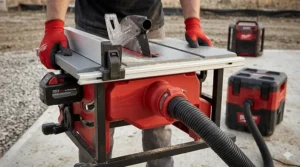
Modern cordless table saws include comprehensive blade guard systems designed to protect operators while maintaining cutting visibility. The Milwaukee cordless table saw features a transparent guard that adjusts automatically to material thickness, providing maximum protection without obstructing cut line visibility.
Never operate table saws with guards removed except when absolutely necessary for specific cuts like dadoes or rabbets. Even when guard removal becomes necessary, implement additional safety precautions including push sticks, featherboards, and extreme focus on hand positioning throughout the cutting operation.
Regular guard maintenance ensures proper function when you need protection most. Inspect guards before each use for damage, proper spring tension, and smooth adjustment action. Replace damaged guards immediately rather than risking operation with compromised protection.
Riving Knife Technology
Riving knives prevent the dangerous kickback situations that cause many severe table saw injuries. The riving knife maintains constant alignment behind the blade, preventing wood from pinching and launching back toward the operator. Milwaukee engineering ensures the riving knife automatically adjusts with blade height, maintaining optimal positioning throughout different cutting depths.
Understanding the difference between riving knives and older splitter technology highlights the safety improvements in modern cordless table saws. Traditional splitters require removal for non-through cuts, creating situations where users might forget to reinstall them. Riving knives remain in place for all standard cutting operations, providing consistent protection.
Tool-free riving knife changes on the Milwaukee cordless table saw enable quick adjustments when necessary without requiring wrenches or special tools. This convenience reduces the temptation to skip proper procedures when switching between cutting operations.
Push Stick Discipline
Push stick usage represents one of the most important safety habits for table saw operators. The Consumer Product Safety Commission reports that the majority of severe table saw injuries involve hands contacting blades during cutting or cleanup operations.
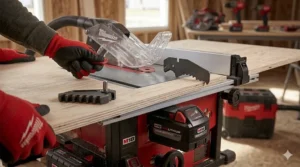
Maintain several push sticks at your work station and use them religiously for any cuts bringing your hands within 6 inches of the blade. The Milwaukee cordless table saw includes a push stick with purchase, but experienced users typically own multiple push sticks of various designs for different cutting scenarios.
Never reach across or behind the blade to retrieve cut pieces. Wait for the blade to stop completely before collecting finished work or clearing scrap. The few seconds saved by rushing these procedures aren’t worth the catastrophic injury risks.
Maintenance Best Practices for Milwaukee Cordless Table Saw
Proper maintenance extends your milwaukee cordless table saw lifespan while ensuring consistent cutting performance. Professional contractors report 5-7 years of daily service from properly maintained Milwaukee saws, demonstrating the value of regular care.
Blade Maintenance and Replacement
Blade sharpness dramatically affects cutting quality, battery runtime, and motor strain. Dull blades force the motor to work harder, reducing efficiency and accelerating wear on both the blade and saw components. Professional users typically sharpen or replace blades every 20-40 hours of cutting time depending on materials and cutting demands.
Inspect blades regularly for damaged or missing carbide teeth. A single damaged tooth creates vibration and poor cuts even when other teeth remain sharp. Replace blades immediately upon discovering significant damage rather than risking poor cuts or potential safety hazards.
Clean pitch and resin buildup from blades monthly using specialized blade cleaning solutions. This buildup reduces cutting efficiency and creates friction that accelerates dulling. The cleaning process takes just minutes but dramatically extends blade life between sharpenings.
Fence Alignment Verification
The rack and pinion fence system on the Milwaukee cordless table saw maintains accuracy better than simpler designs, but periodic verification ensures continued precision. Check fence squareness to the blade monthly using a quality combination square or precision fence alignment tool.
Minor adjustments typically require loosening mounting bolts and carefully repositioning the fence rail. Tighten bolts incrementally while rechecking alignment to prevent shifting during the tightening process. Professional woodworkers recommend final verification cuts in scrap material before returning to project work after any fence adjustments.
Document baseline fence measurements and cutting results when the saw is new. This documentation provides reference points for evaluating whether degradation has occurred and when maintenance becomes necessary.
Battery Care and Storage
Lithium-ion battery longevity depends heavily on proper charging and storage practices. Never store batteries completely discharged for extended periods, as deep discharge can permanently damage cell chemistry. Milwaukee recommends maintaining at least 30% charge for long-term storage.
Extreme temperatures accelerate battery degradation. Store batteries in climate-controlled environments rather than vehicles or unheated workshops when possible. Summer heat particularly damages battery chemistry, sometimes reducing lifespan by 50% when batteries regularly experience temperatures above 120°F.
Avoid fast charging immediately before use whenever possible. Batteries perform better and last longer when charged slowly at moderate temperatures. Plan ahead to enable overnight charging rather than relying on rapid charge cycles that generate excessive heat.
Comparing Cordless vs. Corded Table Saw Technology
The cordless table saw revolution hasn’t eliminated corded saws, but it has fundamentally changed the value calculations contractors must consider. Understanding the genuine trade-offs helps optimize tool selection for specific situations.
Power Delivery Characteristics
Modern cordless table saws like the Milwaukee 2736-21HD match or exceed the performance of 15-amp corded saws in most practical applications. The POWERSTATE brushless motor delivers 6,300 RPM with impressive torque maintenance under load, equaling or surpassing many corded alternatives.
However, sustained heavy cutting operations still favor corded saws. When ripping hardwood or working with thick materials continuously for hours, corded saws maintain absolutely consistent performance without battery swap interruptions. Professional cabinet shops processing large material volumes typically choose corded stationary saws despite cordless convenience advantages.
The performance gap narrows significantly with proper battery management. Contractors maintaining adequate HIGH OUTPUT battery inventory report completing full workday cutting schedules without performance compromises. The key involves having sufficient batteries cycling through chargers to prevent downtime.
Mobility and Setup Efficiency
Cordless technology delivers undeniable advantages in mobility and setup efficiency. The Milwaukee cordless table saw weighs approximately 40 pounds without battery, making single-person transport practical between work areas. Setup requires no electrical connections, eliminating the extension cord management that consumes surprising amounts of time on complex job sites.
Remote work location capability represents another significant cordless advantage. Roofing repairs, outdoor decking projects, and site development work often occur in areas without convenient electrical access. The cordless approach eliminates generator requirements for these applications, reducing noise, fuel costs, and setup complexity.
However, stationary workshop environments rarely benefit from cordless portability advantages. If your saw remains on a dedicated stand in a temperature-controlled shop with reliable power, corded technology might deliver better long-term value through lower initial costs and unlimited runtime.
Long-Term Operating Economics
Total cost of ownership calculations must consider initial purchase price, battery replacement costs, and electrical consumption over expected tool lifespans. Corded saws typically cost $200-400 less initially than comparable cordless models, representing a significant upfront savings.
Battery replacement represents the largest ongoing expense for cordless systems. HIGH OUTPUT batteries cost $150-250 each and typically require replacement every 2-3 years under professional use. A contractor maintaining four batteries faces $600-1,000 in replacement costs every few years.
Electrical consumption costs for corded saws average $20-50 annually for professional users based on current utility rates. This modest expense pales in comparison to battery replacement costs, tilting long-term economics toward corded tools for stationary applications.
FAQ: Milwaukee Cordless Table Saw Questions Answered
❓ How long does the Milwaukee cordless table saw battery last per charge?
❓ Can you use the Milwaukee 18v table saw with standard M18 batteries?
❓ Is the milwaukee one-key saw subscription required for basic operation?
❓ What makes m18 fuel technology different from standard M18 tools?
❓ Does the Milwaukee cordless table saw work with dado blade sets?
Conclusion: Making Your Milwaukee Cordless Table Saw Decision
The milwaukee cordless table saw represents a genuine advancement in portable cutting technology rather than a compromise alternative to corded saws. For professionals working across multiple job sites, the productivity gains from cordless convenience typically justify the premium pricing within the first year of ownership.
The Milwaukee 2736-21HD complete kit delivers exceptional value for contractors without existing M18 investments or those needing premium battery capacity immediately. The included HIGH OUTPUT HD12.0 battery provides all-day cutting capability, while ONE-KEY functionality adds professional tool management capabilities that prevent theft and optimize performance.
Existing M18 platform users should seriously consider the Milwaukee 2736-20 bare tool option. You’ll access identical cutting performance while avoiding duplicate battery and charger costs. This approach maximizes value from your existing battery investments while expanding your M18 capabilities into table saw applications.
Alternative platforms like DeWalt FlexVolt and Bosch PROFACTOR offer legitimate competition with comparable performance characteristics. Your choice should align with your existing battery ecosystem and brand preferences. All three platforms deliver professional-grade cutting performance that rivals corded alternatives.
The cordless table saw category continues evolving rapidly with improving battery technology, more efficient motors, and expanded feature sets. Today’s milwaukee cordless table saw delivers capabilities that seemed impossible just five years ago, suggesting even more impressive developments ahead.
Recommended for You
- Best DeWalt Cordless Table Saw 2026: 7 Ultimate Picks Reviewed
- 7 Best Cordless Table Saw Models for Freedom & Power (2026)
- 7 Best Makita Jobsite Table Saw Models 2026
Disclaimer: This article contains affiliate links. If you purchase products through these links, we may earn a small commission at no additional cost to you.
✨ Found this helpful? Share it with your friends! 💬🤗
