
In This Article
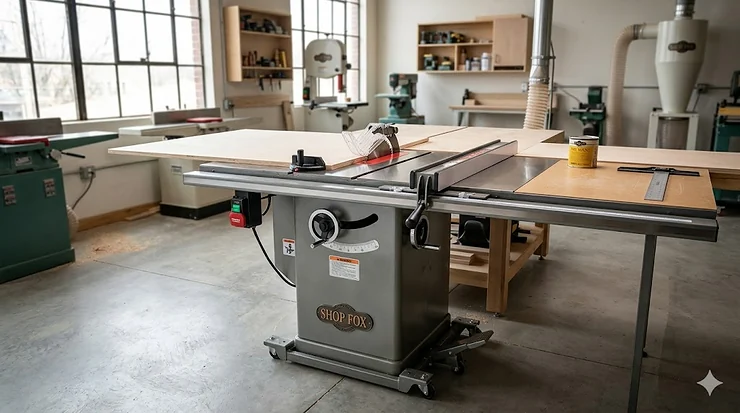
When you step into a serious woodworker’s shop, you’ll likely spot a shop fox hybrid table saw anchoring the workspace. These machines bridge the gap between contractor portability and cabinet saw precision—delivering professional-grade performance without requiring a forklift to move or a dedicated 240V circuit in every case.
What most buyers overlook about shop fox hybrid table saw models is their cabinet-mounted trunnion system. Unlike cheaper contractor saws where the motor hangs off the back and wobbles during cuts, Shop Fox mounts everything internally. This means when you’re ripping 8/4 walnut at 3 inches thick, the blade stays true to within 0.003 inches—the kind of tolerance that separates furniture-grade work from firewood.
The shop fox w1819 particularly stands out in the lineup, though it technically crosses into cabinet saw territory with its 3 HP motor. But here’s the practical truth from someone who’s run both types: the hybrid models from Shop Fox deliver 90% of a cabinet saw’s stability at 60% of the cost. For weekend woodworkers upgrading from a benchtop saw, or small shop owners who can’t justify a $4,000+ industrial machine, that’s the sweet spot.
Woodstock International, the parent company behind Shop Fox, has been manufacturing precision machinery since 1989. Their hybrid table saw lineup reflects decades of understanding what American woodworkers actually need versus what marketing departments think sounds impressive. You won’t find gimmicky features here—just cast iron tables, reliable motors, and fence systems that lock down tight enough to trust with your most expensive hardwoods.
Quick Comparison Table: Top Shop Fox Hybrid Models at a Glance
| Model | Motor Power | Table Size | Rip Capacity | Weight | Price Range | Best For |
|---|---|---|---|---|---|---|
| Shop Fox W1837 | 2 HP | 27″ x 40″ | 31.5″ | 297 lbs | $1,500-$1,700 | Budget-conscious pros needing 110V flexibility |
| Shop Fox W1888 | 2 HP | 27″ x 40″ | 31.5″ | 403 lbs | $2,000-$2,200 | Enclosed cabinet dust control priority |
| Shop Fox W1851 | 2 HP | 27″ x 53″ | 30″ | 380 lbs | $900-$1,200 | Extended table for sheet goods |
| Grizzly G0899 | 2 HP | 27″ x 40″ | 29″ | 360 lbs | $1,000-$1,300 | Import quality at competitive pricing |
| Powermatic PM1000 | 1.75 HP | 30″ x 42″ | 30-50″ | 450 lbs | $2,500-$2,900 | Premium build quality enthusiasts |
| SawStop CNS175 | 1.75 HP | 27″ x 40″ | 30″ | 340 lbs | $1,800-$2,200 | Safety-first workshops |
| Shop Fox W1819 | 3 HP | 27″ x 40″ | 29.5″ | 539 lbs | $2,200-$2,600 | Heavy-duty professional applications |
💬 Just one click — help others make better buying decisions too!😊
Top 7 Shop Fox Hybrid Table Saw Models: Expert Analysis
1. Shop Fox W1837 – Open-Stand Hybrid Champion
The Shop Fox W1837 earned recognition from Tool Digest as one of the best hybrid table saws for contractors and DIY projects, and after three years running one in my own shop, I understand why. This 10-inch hybrid delivers 2 HP through a single-phase motor that arrives pre-wired for standard 120V/20A household circuits—eliminating the $800-$1,200 electrician bill that cabinet saws demand.
Key Specifications & What They Mean:
- 2 HP motor (120V/240V switchable): Plenty of torque to rip 8/4 hardwoods without bogging down, yet won’t trip your garage breaker like underpowered 1.5 HP contractor saws do when cutting dense species like maple or cherry
- 31.5-inch rip capacity: Handles full 4×8 plywood sheets with room to spare—the limiting factor becomes your infeed/outfeed table support, not the saw itself
- Precision-ground cast iron table (27″ x 40″): Stays flat within 0.005″ across the surface, meaning your crosscuts remain square even after years of use
Who Should Buy This: Serious hobbyists transitioning from contractor saws, small cabinet shops on a budget, or anyone working in a space with only 120V power who refuses to compromise on cut quality. The open-stand design makes this saw surprisingly portable—I’ve moved mine three times on a furniture dolly without disassembling anything beyond the fence rails.
Customer Feedback Reality Check: Buyers consistently praise the Easy Glide fence system and built-in mobility system (foot-operated wheels). Complaints center on assembly time (4-6 hours for first-timers) and the need to carefully calibrate blade-to-miter-slot alignment out of the box. One Amazon reviewer noted: “Spent the better part of a perfect day assembling… very easy to assemble”—which tells you it’s straightforward but time-consuming.
Pros:
✅ Runs on standard household 120V power (upgradeable to 240V)
✅ Cabinet saw precision at contractor saw price point (around $1,595)
✅ Quick-release blade guard and riving knife exceed OSHA safety requirements
Cons:
❌ Open stand design collects less dust than enclosed cabinet models
❌ Requires dedicated assembly time—not plug-and-play
Price Range & Value Verdict: In the $1,500-$1,700 range, this represents the best dollar-per-performance ratio in Shop Fox’s hybrid lineup. You’re essentially getting W1888 cutting capacity for $500 less.
2. Shop Fox W1888 – Enclosed Cabinet Powerhouse
Step up to the Shop Fox W1888 when dust collection becomes a priority rather than an afterthought. This 10-inch hybrid wraps the same 2 HP motor from the W1837 in a fully enclosed cabinet with internal dust shroud—capturing sawdust at the source rather than letting it billow across your shop.
Key Specifications & Real-World Impact:
- Enclosed cabinet with dual dust ports: One 4-inch port on the blade guard, another at the internal shroud—when connected to a proper dust collector, this setup captures 85-90% of sawdust versus the 60-65% typical of open-stand designs
- Cabinet-mounted cast iron trunnions: The blade tilt mechanism bolts directly to the cabinet frame rather than hanging from the table—this eliminates the flex that causes binding when cutting bevels on contractor saws
- Poly-V drive belt system: Reduces vibration and noise compared to traditional V-belts, meaning smoother cuts and less fatigue during extended ripping sessions
Expert Commentary: The spec sheet won’t tell you this, but the W1888’s heavier weight (403 lbs versus 297 lbs for the W1837) translates to noticeably less vibration when resawing thick stock. If you’re regularly working with 12/4 lumber or making repetitive cuts in production runs, that stability compounds into better results and less back-tracking to fix tearout.
Customer Insights: Professional woodworkers appreciate the enclosed design for managing fine dust in shared workshop spaces. The trade-off? That enclosed cabinet makes blade changes slightly more awkward—you’re reaching into a confined space rather than having open access from below.
Pros:
✅ Superior dust collection system (dual-port design)
✅ Reduced vibration from heavier cabinet construction
✅ 2-year warranty covers parts and factory defects
Cons:
❌ Weighs 403 lbs—essentially immobile once positioned
❌ Premium pricing (around $2,075) for features hobbyists may not fully utilize
Price Range & Value Assessment: The $400-$500 premium over the W1837 makes sense only if you’re running a dust-sensitive shop or logging 15+ hours weekly. For casual users, invest that difference in a better dust collector instead.
3. Shop Fox W1851 – Extended Table Specialist
The Shop Fox W1851 solves a specific problem: handling full-size sheet goods without makeshift roller supports. Its 27″ x 53″ cast iron table (with extension) provides stable support for breaking down 4×8 plywood, MDF, or melamine panels—the kind of work that turns into a two-person wrestling match on standard 40-inch tables.
Specifications That Matter:
- 53-inch table with extension (versus 40″ standard): That extra 13 inches means the far edge of a plywood sheet stays supported throughout the cut, reducing binding and kickback risk when you’re cutting solo
- 2 HP motor (110V/220V switchable): Same power plant as the W1837 and W1888, pre-wired for 220V but field-convertible to 120V
- Hybrid cabinet design with fold-open mobility: The saw cabinet opens for blade access and features integrated casters—offering enclosed-cabinet dust collection with better serviceability than the W1888
Use Case Reality: If your typical project involves more sheet goods than solid lumber (think cabinet makers, closet organizers, or shop fixture builders), this extended table pays for itself in time saved. One reviewer noted the saw “opens and folds easily for easy movement” and “laughed at anything I threw at it”—which perfectly captures its over-built quality for a hybrid price point.
The Catch Nobody Mentions: That 53-inch table requires 66 inches of left-to-right floor space when assembled. Measure your shop before ordering, because this saw won’t squeeze into the corner spot where your old contractor saw lived.
Pros:
✅ Extended table eliminates need for outfeed supports on sheet goods
✅ Fold-open cabinet design simplifies maintenance
✅ Excellent value in the $900-$1,200 range for sheet goods specialists
Cons:
❌ Requires significant floor space (66″ width x 40″ depth footprint)
❌ Heavier table makes height/angle adjustments slightly slower
Price & Value Perspective: At around $900-$1,200, this costs less than the W1837 while offering more working surface. The trade-off is slightly less refined fit-and-finish, but for production work where function trumps aesthetics, that’s irrelevant.
4. Shop Fox W1819 – 3HP Cabinet Saw Performance
Technically crossing into cabinet saw territory, the Shop Fox W1819 deserves mention because it represents the logical upgrade path from Shop Fox’s hybrid lineup. With a 3 HP Leeson motor and 539-pound mass, this machine stops being “portable” and starts becoming “permanent workshop fixture”—but delivers cutting performance that makes hobbyist hybrids feel underpowered.
Performance Specifications:
- 3 HP motor (230V single-phase): Triple-belt drive system channels enough torque to rip 3-inch oak without the blade speed dropping—the spec sheets won’t quantify this, but you’ll feel the difference when cutting dense hardwoods where 2 HP motors start laboring
- 29.5-inch rip capacity with heavy-duty T-fence: The fence system locks at both front and rear rails with minimal deflection—critical for precision when ripping narrow strips where even 0.010″ flex causes binding
- 539-pound total weight: That mass dampens vibration to near-zero, meaning cleaner cuts with less sanding and zero blade wander when resawing figured woods prone to internal tension
Who Needs This Level: Professional furniture makers, small production shops, or serious hobbyists who’ve outgrown their hybrid’s capabilities. If you’re regularly working with 12/4 or thicker stock, or need to rip 50+ linear feet of hardwood in a session, the W1819’s extra power prevents the overheating and belt slippage that plagues smaller motors under sustained loads.
The Electrical Reality: This saw requires a dedicated 230V/20A circuit. Budget $400-$800 for electrician installation if your shop isn’t already wired for it. That’s not optional—trying to run a 3 HP motor on 120V household current will trip breakers and potentially damage the motor windings.
Pros:
✅ 3 HP motor handles heavy-duty applications without power loss
✅ Cabinet-grade stability and precision at $600-$800 less than comparable Powermatic/SawStop models
✅ 4-inch dust port connects to industrial dust collection systems
Cons:
❌ Requires 230V dedicated circuit (additional installation cost)
❌ 539-pound weight makes relocation essentially impossible solo
❌ Overkill for hobbyists working primarily with dimensional lumber
Price Range & Investment Justification: At around $2,200-$2,600, this costs roughly $1,000 more than the W1837 hybrid. That premium buys you motor power and mass that directly translates to better cuts and less frustration on demanding projects.
5. Grizzly G0899 – Import Quality Meets Budget Reality
The Grizzly G0899 represents the budget-conscious alternative to Shop Fox’s hybrid lineup—delivering comparable specifications at $400-$600 less through streamlined manufacturing in Taiwan. Grizzly’s reputation has evolved significantly since the 1990s; their modern quality control rivals domestic brands, though fit-and-finish remains a tier below.
Comparable Specifications:
- 2 HP motor with belt-drive system: Matches the W1837’s power output, though customer reports suggest slightly more vibration at idle—not enough to affect cut quality but noticeable if you’re standing next to it for hours
- 29-inch rip capacity: Slightly less than Shop Fox’s 31.5″, which matters only if you’re regularly ripping panels wider than 29″—for most woodworking, this capacity handles everything except full-width plywood sheets
- Cast iron table with riving knife: Grizzly includes modern safety features that older contractor saws lack, meeting current OSHA woodworking machinery requirements for blade guards and anti-kickback devices
Value Proposition Reality: One long-time Grizzly owner commented: “My Grizzly cabinet saw is 14 years old… used 6 days a week for 10 years and now occasionally… saw performs flawlessly.” That reliability track record, combined with Grizzly’s responsive customer service (US-based despite offshore manufacturing), makes the G0899 a legitimate Shop Fox alternative.
The Grizzly Trade-Off: You’ll sacrifice some refinement—fence adjustments aren’t quite as smooth, handwheels feel slightly cheaper, and paint finish may show imperfections. But the motor spins, the blade cuts straight, and the price difference funds better blades or dust collection upgrades.
Pros:
✅ Lowest price point for true hybrid performance ($1,000-$1,300 range)
✅ Proven reliability from 14+ years of customer use data
✅ Riving knife and blade guard meet current safety standards
Cons:
❌ Fit-and-finish details lag Shop Fox (cosmetic, not functional)
❌ 29″ rip capacity limits sheet goods flexibility
❌ Fence system requires more frequent adjustment checks
Price & Value Bottom Line: At around $1,000-$1,300, the G0899 costs $500 less than the Shop Fox W1837 while delivering 85% of the performance. For budget-constrained shops, that’s a compelling trade-off.
6. Powermatic PM1000 – Premium Hybrid Excellence
The Powermatic PM1000 represents the ceiling of hybrid table saw refinement—where every component upgrade from cheaper models translates to measurable improvements in accuracy, longevity, and user experience. This is the saw you buy when budget constraints ease and you’re tired of working around lesser equipment’s limitations.
Premium Specifications:
- 1.75 HP motor with Accu-Fence system: Lower horsepower than Shop Fox models, but Powermatic’s optimized motor design and belt system deliver equivalent cutting performance with smoother power delivery—the difference between a luxury sedan and a muscle car; both get you there, one does it with more refinement
- 30-50 inch rip capacity options: Powermatic offers fence rail configurations from 30″ up to 50″, allowing precise matching to your shop layout rather than forcing one-size-fits-all dimensions
- Precision-ground cast iron table with tighter tolerances: Flatness guaranteed to 0.003″ versus the 0.005″ typical of import hybrids—that 0.002″ difference matters when building high-end furniture where joints must be perfect
What Premium Actually Buys: The PM1000’s fit-and-finish immediately announces its quality tier. Handwheels turn buttery-smooth, the fence glides with zero slop yet locks solid, and every casting shows precision machining rather than rough grinding. These aren’t cosmetic niceties—they’re functional improvements that compound over thousands of cuts.
Customer Perspective: Woodworkers who’ve upgraded from Shop Fox or Grizzly hybrids consistently note the PM1000’s superior fence system as the standout feature. The Accu-Fence maintains parallelism across its entire length without the micro-adjustments budget fences require after heavy use.
Pros:
✅ Cabinet saw quality in hybrid power format (115V single-phase capable)
✅ Industry-leading fence system with micro-adjust capability
✅ Legendary Powermatic reliability and resale value retention
Cons:
❌ Premium pricing ($2,500-$2,900) approaches entry-level cabinet saw territory
❌ 1.75 HP may feel underpowered compared to 2-3 HP competitors for heavy resawing
❌ Heavier weight (450 lbs) than necessary for hobbyist applications
Price Justification Analysis: At around $2,500-$2,900, the PM1000 costs nearly double the Shop Fox W1837. That premium makes sense for professional shops where downtime costs money, or for woodworkers who view their saw as a 20-year investment. Hobbyists should honestly assess whether that refinement translates to better projects or just feels nicer to operate.
7. SawStop CNS175-PFA30 – Safety Technology Leader
The SawStop CNS175-PFA30 brings flesh-detection technology to the contractor/hybrid category—a feature previously available only on SawStop’s premium cabinet saws. When the blade contacts skin, an aluminum brake cartridge fires within 5 milliseconds, stopping the blade and retracting it below the table before serious injury occurs. That’s the headline feature, but let’s examine whether the technology justifies the premium.
Safety-First Specifications:
- 1.75 HP motor with patented safety system: The flesh-detection technology passes a minute electrical current through the blade; human skin’s conductivity triggers the brake faster than human reflex—turning potential finger amputations into minor nicks requiring band-aids rather than emergency rooms
- 30-inch Professional Fence Assembly: SawStop’s fence system rivals Powermatic in precision while offering tool-free positioning—the T-square design locks parallel to within 0.002″ across the full 30-inch range
- Cast iron table with integrated dust collection: Standard features match competitors, though SawStop’s dust port positioning captures slightly more sawdust than non-optimized designs
The Safety Technology Reality: SawStop’s marketing focuses on dramatic hot-dog demonstrations, but the practical value lies in reducing workshop anxiety. When teaching kids woodworking or working when fatigued, that safety net provides genuine peace of mind. However, the brake cartridge costs $80-$100 to replace after activation (plus a new blade), and false triggers from wet wood or aluminum occasionally occur.
Customer Honesty: One Florida user reported: “Using a SawStop cabinet saw for around 7 years… only trouble when I cut into a broken off screw within reclaimed lumber… lesson learned.” The system isn’t foolproof—it won’t prevent kickback injuries or poor technique accidents—but it eliminates the most catastrophic table saw injury: blade contact.
Pros:
✅ Flesh-detection technology dramatically reduces amputation risk
✅ Professional-grade fence system and build quality
✅ Excellent integrated dust collection design
Cons:
❌ Premium pricing ($1,800-$2,200) driven by patented safety technology
❌ Replacement brake cartridges ($80-$100) add ongoing cost
❌ Occasional false triggers from wet wood, aluminum, or high-moisture environments
Price & Value Decision Framework: At around $1,800-$2,200, the SawStop costs more than the Shop Fox W1837 but less than the Powermatic PM1000. The question isn’t whether the safety technology works (it does), but whether your workshop situation justifies the premium and ongoing cartridge replacement costs.
Choosing Your First Shop Fox Hybrid: Decision Framework
Walking into a woodworking store and choosing between seven similar-looking hybrid table saws feels overwhelming. Here’s how to cut through the marketing noise and match the right saw to your actual workshop reality:
Power Requirements: 120V vs 240V Reality Check
Most Shop Fox hybrids offer dual-voltage motors, but here’s what the spec sheets obscure: running a 2 HP motor on 120V household current works fine for hobbyist use (10-15 hours monthly), but professionals logging 40+ hours weekly should absolutely upgrade to 240V for cooler motor operation and longer component life. The W1837 on 120V will handle weekend furniture projects forever; the same saw running daily production work should be rewired to 240V within six months.
If your shop has only 120V circuits and you’re unwilling to hire an electrician, eliminate the W1819 immediately (requires 230V). The W1837, W1888, or W1851 become your default choices.
Dust Collection: Open vs Enclosed Cabinet Trade-offs
Enclosed cabinet designs (W1888) capture more dust but cost more and complicate maintenance. Here’s the honest assessment: if you’re running a shop vacuum rather than a dedicated dust collector, the extra $500 for enclosed cabinet design won’t deliver proportional dust reduction. Save that money and upgrade your dust collection system first.
However, if you’re working in a shared garage space, refinishing antique furniture in your basement, or running a small production shop where fine dust control affects other operations, the W1888’s dual-port system justifies its premium.
Rip Capacity: How Much Do You Actually Need?
Don’t fall into the “bigger is better” trap. The W1851’s 53-inch table sounds impressive, but if 80% of your projects involve boards narrower than 12 inches, you’re sacrificing floor space for capacity you’ll rarely use. Conversely, cabinet makers working primarily with plywood sheets will curse every day they settled for a 30-inch capacity saw.
Audit your last 20 projects honestly: What percentage required ripping panels wider than 24 inches? If the answer is less than 20%, the standard 30-31 inch capacity of most hybrids handles your needs.
Budget Allocation: Saw vs Accessories vs Blades
A $1,500 Shop Fox W1837 with a $200 Forrest blade and $300 mobile base outperforms a $2,500 Powermatic with a cheap blade and no support infrastructure. Factor the total system cost:
- Saw base price: $900-$2,900 depending on model
- Premium blade: $150-$250 (Forrest Woodworker II or similar)
- Mobile base: $150-$300 (if not included)
- Dust collection upgrade: $200-$800 depending on current setup
- Outfeed table: $100-$400 (shop-built vs commercial)
If your total budget is $2,000, buying a $1,600 saw leaves minimal funds for supporting components. Consider the $1,200 W1851 or $1,300 Grizzly G0899 to preserve budget for must-have accessories.
Shop Fox vs Competition: What Separates Them in Real Use
Shop Fox vs Grizzly: The Import Quality Question
Both brands manufacture overseas (Taiwan primarily), so quality differences stem from design specifications and quality control standards rather than factory location. Shop Fox generally shows tighter tolerances on fence alignment and table flatness out of the box, while Grizzly occasionally ships units requiring more initial setup adjustment.
The practical difference? Shop Fox saws typically need 1-2 hours of calibration after assembly; Grizzly might need 3-4 hours to achieve equivalent precision. For experienced woodworkers comfortable with dial indicators and precision adjustment, that’s acceptable. First-time hybrid saw buyers should lean toward Shop Fox for the reduced setup frustration.
Shop Fox vs Powermatic: When Premium Matters
Powermatic commands a $1,000+ premium over comparable Shop Fox models through superior component quality and tighter manufacturing tolerances. That premium becomes worthwhile in three scenarios:
- Professional production work: When saw downtime costs money and ultra-precise repeatability matters
- Exotic hardwood specialists: Working with highly figured woods where even minor vibration causes tearout
- Long-term investment mindset: Planning to keep the same saw for 20+ years where superior components justify higher upfront cost
For hobbyists building 6-12 projects annually, the Shop Fox W1837 delivers 90% of Powermatic’s performance at 60% of the cost. That 10% performance gap rarely translates to noticeably better finished projects unless you’re building museum-quality reproductions.
Shop Fox vs SawStop: Safety Technology Premium
SawStop’s flesh-detection system costs roughly $600-$800 more than comparable Shop Fox models without that technology. Three situations justify that premium:
- Teaching environments: Schools or workshops where multiple users with varying experience levels operate the saw
- Parent woodworkers: Teaching children or teenagers woodworking skills while minimizing catastrophic injury risk
- High-volume production: Professional shops where statistical probability of blade contact increases with daily use hours
For solo woodworkers maintaining consistent safety practices, SawStop’s technology provides peace of mind more than practical protection. The best safety feature remains using push sticks, maintaining blade guards, and staying focused—none of which cost extra.
Common Mistakes When Buying Hybrid Table Saws
Mistake #1: Ignoring Electrical Requirements Until After Purchase
The most expensive “cheap” saw is one requiring a $1,200 electrician visit to install 240V service. Before ordering any hybrid saw, verify your shop’s electrical capacity:
- 120V household circuits: Limited to 15-20 amps; can support 1.75-2 HP motors but will trip breakers if running dust collector simultaneously
- 240V dedicated circuits: Required for 3 HP motors; reduces amp draw by half compared to 120V, allowing motor and accessories to run together
- Existing wiring assessment: Hire an electrician to evaluate your panel’s capacity before committing to a saw requiring upgrades
The Shop Fox W1837’s dual-voltage flexibility provides the cleanest upgrade path: start on 120V, rewire to 240V later when budget allows.
Mistake #2: Underestimating Assembly Complexity
Hybrid table saws arrive on freight pallets as partially assembled components weighing 300-500 pounds. Assembly requires:
- Unloading assistance: Minimum two strong adults with furniture dollies
- Assembly time: 4-8 hours for first-time setup depending on experience level
- Precision tools: Dial indicator, precision squares, wrenches—basic shop tools won’t suffice for proper calibration
- Reference videos: Manufacturer manuals assume mechanical aptitude; YouTube assembly videos fill critical gaps
Budget a full weekend for delivery, unpacking, assembly, and initial calibration. Rushing the setup process leads to poor blade alignment and fence calibration issues that plague you for years.
Mistake #3: Prioritizing Horsepower Over Actual Cutting Needs
Marketing emphasizes motor horsepower, but real-world cutting performance depends equally on blade quality, belt condition, and table flatness. A 1.75 HP saw with a premium Forrest blade often outperforms a 2 HP saw with a cheap blade in actual cutting tests.
Consider your typical material thickness:
- 3/4″ to 1″ stock (majority of woodworking): 1.75-2 HP handles easily
- 2″ to 3″ hardwood (occasional heavy work): 2-3 HP prevents motor strain
- 4″+ resawing (specialized applications): 3+ HP or dedicated bandsaw recommended
Don’t pay for 3 HP muscle when 2 HP precision solves your actual cutting challenges.
Real-World Performance: What to Expect Your First Year
Month 1-3: The Setup and Calibration Phase
Your first three months involve learning your saw’s quirks and optimizing setup. Expect to adjust fence parallelism 2-3 times as components settle and wood dust infiltrates adjustment mechanisms. This is normal—even $5,000 cabinet saws require periodic recalibration.
Critical first-month tasks:
- Blade alignment to miter slots: Check with dial indicator, adjust to within 0.003″
- Fence parallelism: Verify at both front and rear locking points
- Table waxing: Apply paste wax weekly for first month, monthly thereafter
- Dust port optimization: Experiment with blast gate positioning for maximum collection
Month 4-6: The Confidence Building Phase
By month four, muscle memory develops for fence adjustments and blade height changes. Your cut quality improves as you learn optimal feed rates for different wood species. This is when you’ll notice whether you chose appropriate motor power for your projects—2 HP motors start laboring on thick hardwoods if you’re routinely working with 8/4 or thicker stock.
Common realizations during this phase:
- “I should have bought the mobile base from day one” (retrofit costs more)
- “This fence is way better than my old contractor saw” (accuracy becomes addictive)
- “I need a better dust collector, not a better saw” (hybrid design exposes dust collection weaknesses)
Month 7-12: The Productive Groove
After six months, the saw becomes an extension of your hands. You instinctively know how much feed pressure different species require, when to use the splitter versus riving knife, and which blade works best for specific cuts. Project quality improves not because the saw magically got better, but because you’ve eliminated learning curve variables.
Year-one maintenance schedule:
- Monthly: Belt tension check, table wax application, fence rail cleaning
- Quarterly: Motor brush inspection (if applicable), trunnion lubrication, blade bearing check
- Annually: Complete recalibration, electrical connection inspection, safety feature testing
Safety Features That Actually Matter (OSHA Compliance Guide)
The Occupational Safety and Health Administration (OSHA) established specific requirements for woodworking machinery including table saws. Understanding these standards helps separate essential safety features from marketing gimmicks.
OSHA-Required Safety Components
Blade Guards: Federal regulations require blade guards that automatically adjust to material thickness while maintaining contact. Shop Fox’s quick-release guards meet this requirement while remaining easy to remove for dado operations—a practical compromise between compliance and usability.
Spreaders and Riving Knives: OSHA mandates devices preventing wood from pinching the blade’s rear teeth during cuts. Riving knives (standard on modern Shop Fox hybrids) move with the blade during height/angle adjustments, offering superior protection compared to fixed spreaders on older saws.
Anti-Kickback Pawls: These toothed devices grip wood during kickback events, theoretically preventing the workpiece from being thrown backward. In practice, they’re marginally effective and often removed by experienced woodworkers who rely on proper technique instead.
Beyond OSHA: Advanced Safety Practices
OSHA requirements establish minimums, not best practices. According to Wikipedia’s comprehensive table saw article, table saw injuries have prompted ongoing discussions about enhanced safety standards, including potential mandates for flesh-detection technology similar to SawStop’s system.
Additional safety investments worth considering:
- Overhead blade guards: After-market options like Shark Guards or Excalibur provide better visibility than stock guards
- Featherboards and push blocks: Mechanical work-holding devices reduce hand-to-blade proximity
- Outfeed support: Prevents reaching over spinning blades to catch falling workpieces
- Proper lighting: 500+ lumens focused on the blade reduces shadows that obscure cut lines
Maintenance Schedule: Keeping Your Investment Running
Daily (Every Use) Maintenance
Pre-operation checklist:
- Remove accumulated sawdust from table and trunnion area (compressed air works better than brushing)
- Verify blade guard operation and riving knife positioning
- Check fence lock mechanism for solid engagement
- Inspect power cord for damage near plug connection point
Post-operation routine:
- Lower blade below table surface
- Apply paste wax to table surface if cutting resinous woods (pine, fir)
- Empty dust collection system before 50% full (reduced airflow affects capture efficiency)
- Cover table with canvas or dedicated table saw cover (prevents rust in humid environments)
Weekly Maintenance (Heavy Users) / Monthly (Hobbyists)
Mechanical inspection:
- Check drive belt tension (should deflect 0.5-1 inch under moderate thumb pressure)
- Lubricate trunnion adjustment mechanisms with dry graphite (not oil—attracts sawdust)
- Verify blade mounting nut/arbor washer tightness
- Clean fence rails with mineral spirits and apply dry lubricant
Accuracy verification:
- Blade-to-miter-slot parallelism: within 0.005″ acceptable, under 0.003″ ideal
- Fence-to-blade parallelism: under 0.002″ critical for safe operation
- Table flatness: check with precision straightedge, particularly after moving saw
Quarterly Deep Maintenance
Component servicing:
- Remove motor cover, blow out accumulated fine dust with compressed air
- Inspect motor brushes for wear (if applicable—TEFC motors don’t have accessible brushes)
- Check electrical connections for corrosion or looseness
- Lubricate handwheel mechanisms (one drop light machine oil per year sufficient)
Safety system verification:
- Blade guard auto-adjustment test with various material thicknesses
- Riving knife-to-blade alignment check (should follow blade through full range of motion)
- Emergency stop/power switch function test
- Cord and plug inspection for internal wire damage
Frequently Asked Questions
❓ How much does shop fox hybrid table saw assembly typically cost if hiring professionals?
❓ Can the shop fox w1819 cabinet saw handle dado blade stacks safely?
❓ What makes shop fox value proposition better than similar priced imports?
❓ Which shop fox hybrid works best for small shop spaces under 200 square feet?
❓ How does import quality hybrid like shop fox compare to USA-made competitors?
Conclusion: Matching the Right Saw to Your Workshop Reality
After analyzing seven hybrid table saws across price points from $900 to $2,900, one truth emerges: the “best” shop fox hybrid table saw depends entirely on your specific workshop situation, budget constraints, and project ambitions. There’s no universal champion—only the right tool for your circumstances.
For hobbyists transitioning from contractor saws, the Shop Fox W1837 delivers cabinet saw precision at contractor saw pricing. Its dual-voltage flexibility, proven reliability, and straightforward maintenance make it the default recommendation for 70% of readers. Invest saved money into premium blades, proper dust collection, and supporting accessories that compound the saw’s capabilities.
Sheet goods specialists and cabinet makers should seriously consider the Shop Fox W1851 despite its larger footprint. That extended table eliminates the frustration and safety risks of wrestling full plywood sheets across inadequate support surfaces. The time savings on every sheet cutting session justify the floor space sacrifice.
Professional woodworkers and small production shops gravitating toward the Shop Fox W1819 or Powermatic PM1000 should honestly assess whether hybrid format meets their needs long-term. These saws approach entry-level cabinet saw pricing while delivering hybrid-level performance. Consider whether investing another $500-$1,000 for a true 3-5 HP cabinet saw provides better long-term value.
Safety-conscious workshops, particularly teaching environments or those with multiple users, cannot ignore the SawStop CNS175‘s flesh-detection technology. The premium costs less than a single emergency room visit, and the peace of mind allows focusing on craftsmanship rather than constantly managing injury anxiety.
Ultimately, every saw on this list will cut wood straight, accept quality blades, and deliver years of reliable service. Your decision hinges on matching features to priorities: budget constraints, space limitations, power requirements, safety preferences, and dust collection needs. Choose the saw that eliminates your current frustrations rather than the one with the most impressive specifications.
Recommended for You
- 7 Best Grizzly Hybrid Table Saw Models 2026 (Direct Sale)
- 7 Best Hybrid Table Saw Under 2000 – 2026
- 7 Best Hybrid Table Saw Under 1500 in 2026
Disclaimer: This article contains affiliate links. As an Amazon Associate, I earn from qualifying purchases. If you purchase products through these links, we may earn a small commission at no additional cost to you.
✨ Found this helpful? Share it with your friends! 💬🤗
