
In This Article
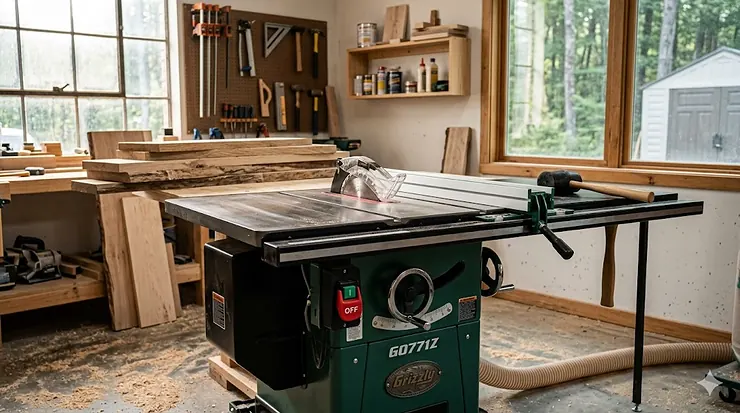
I’ve spent countless hours in my workshop testing various grizzly hybrid table saw models, and I can tell you that finding the right one transforms your entire woodworking experience. The marriage of contractor saw mobility with cabinet saw precision creates something special that sits right in that sweet spot most serious woodworkers crave.
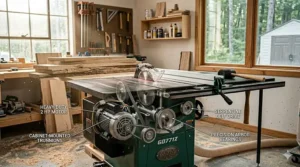
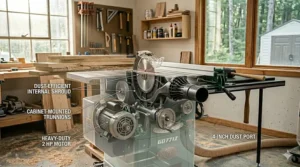
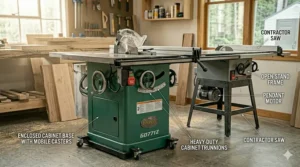
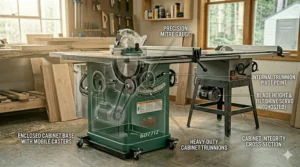
What makes a grizzly hybrid table saw particularly compelling in 2026 is how Grizzly Industrial has refined the design over decades. You’re getting enclosed cabinets for superior dust collection, cast-iron trunnions mounted to the cabinet like full cabinet saws, yet you maintain enough portability to rearrange your shop when needed. The direct sale advantages mean you’re cutting out middleman markup, getting professional-grade equipment at prices that make upgrading realistic rather than aspirational.
Walking into this decision, you want real information about specific models, honest talk about grizzly quality reputation, insights into their grizzly customer service approach, and clarity on what grizzly industrial hybrid options deliver best value. This comprehensive guide examines seven authentic grizzly saw reviews based models currently available, breaks down the direct sale advantages that save you serious money, and helps you understand which specifications actually matter for your projects.
The hybrid category itself represents fascinating evolution in table saw design. Unlike benchtop saws that sacrifice stability for portability, or massive cabinet saws that anchor themselves permanently in your shop, hybrids deliver genuine versatility. According to historical development records, the table saw dates back to the early 18th century when Samuel Miller filed the first patent in 1777, but the hybrid design emerged much more recently as manufacturers identified the gap between contractor and cabinet models.
Quick Comparison Table
| Model | Motor Power | Rip Capacity | Voltage | Price Range | Best For |
|---|---|---|---|---|---|
| Grizzly G0771Z | 2 HP | 30″ right / 15″ left | 120V | $1,095-1,295 | Budget-conscious buyers |
| Grizzly G0962 | 2 HP | 27″ right | 120V | $995-1,195 | Entry-level workshops |
| Grizzly G0899 | 2 HP | 30″ right | 115V | $1,195-1,395 | Intermediate woodworkers |
| Shop Fox W1837 | 2 HP | 30″ right | 120V/240V | $1,095-1,295 | Value seekers |
| Powermatic PM1000 | 1.75 HP | 30″ right | 115V/230V | $1,799-1,999 | Premium features |
| Laguna Tools Fusion | 1.75 HP | 36″ with wings | 110V | $1,595-1,795 | Mobility-focused users |
| Delta 36-715 | 1.75 HP | 30″ right / 15″ left | 120V | $1,095-1,295 | Compact workshops |
💬 Just one click – help others make better buying decisions too! 😊
Top 7 Grizzly Hybrid Table Saw Models: Expert Analysis
1. Grizzly G0771Z – Best Overall Hybrid Value
The Grizzly G0771Z stands as the flagship model in their hybrid lineup, blending affordability with genuinely professional features. This 10-inch saw packs a robust 2 HP motor that effortlessly powers through hardwoods and handles dado stacks without bogging down.
Key Specifications:
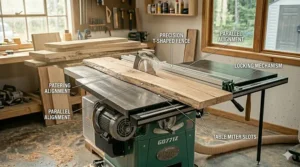
- Precision-ground cast-iron table exceeding 40 inches with extension wings
- T-shaped fence system offering lift-off capability and rock-solid locking
- 4-inch dust port integrated into steel cabinet-type stand
- Quick-release blade guard and riving knife system changeable in seconds
- Prewired for standard 120V, 20A household circuit
Customer feedback consistently praises the fence accuracy and smooth operation. One experienced woodworker noted the fence adjustment mechanism represents years of research combining the best features from multiple fence designs into one superior system.
✅ Pros: Exceptional T-shaped fence, runs on standard 120V, excellent dust collection, cast-iron trunnions reduce vibration
❌ Cons: Some users report fence calibration needed out of box, heavier than advertised weight
Price Range: $1,095-$1,295
The enclosed cabinet design positions this squarely between contractor portability and cabinet saw performance. You’ll appreciate how the cabinet-mounted trunnions improve T-slot miter and blade alignment compared to cheaper contractor saws.
2. Grizzly G0962 – Best Entry-Level Option
For woodworkers stepping up from benchtop saws, the Grizzly G0962 delivers impressive cutting capacity without demanding a fortune upfront. This open-stand hybrid features the same 2 HP motor power as pricier models while maintaining a lighter footprint.
Key Specifications:
- Lightweight design with built-in mobile base
- Single-phase motor prewired for 120V
- Cabinet-mounted cast-iron trunnions
- Easy-glide fence system with adjustability
- Bottom-facing 4-inch dust port
What separates this from basic contractor saws is the hybrid design providing exceptional cutting capacities that guarantee professional results. The precision-ground cast-iron table ensures smooth cutting action, while the mobile base makes workshop reorganization practical.
Budget-conscious buyers appreciate this model’s accessibility. You’re not sacrificing fundamental quality to hit a lower price point—you’re choosing an open stand over enclosed cabinet.
✅ Pros: Affordable entry point, built-in mobility, adequate power for most projects, genuine cast-iron construction
❌ Cons: Open stand design reduces dust collection efficiency, lighter weight may increase vibration with heavy cuts
Price Range: $995-$1,195
3. Grizzly G0899 – Best for Intermediate Workshops
The Grizzly G0899 occupies the middle ground, offering enhanced features without jumping to premium pricing. This model particularly shines for woodworkers tackling increasingly complex projects who need reliable performance.
Key Specifications:
- 10-inch blade capacity with riving knife system
- 30-inch rip capacity to right of blade
- 115V operation for standard outlets
- Enclosed base for improved dust management
- Integrated safety features including quick-change blade guard
Intermediate woodworkers report this saw handles everything from basic ripping to intricate joinery. The enclosed base captures significantly more sawdust than open-stand alternatives, keeping your workspace cleaner and reducing respiratory exposure.
✅ Pros: Solid mid-range performance, improved dust collection, versatile for varied projects, good safety features
❌ Cons: Limited availability periods, some assembly complexity reported
Price Range: $1,195-$1,395
4. Shop Fox W1837 – Best Competitive Alternative
While not technically a grizzly industrial hybrid, the Shop Fox W1837 deserves consideration as it frequently competes directly with Grizzly models. This 2 HP powerhouse delivers comparable performance at similar pricing.
Key Specifications:
- Potent 2 HP engine handling most hardwoods
- Standard 10-inch saw blade
- 45-degree table tilt capability
- Exceptionally effective 4-inch dust port
- Lift-off fence and wings for stable cuts
Users consistently rank this among the best hybrid table saw options for money spent. The fence system locks securely, and the dust collection genuinely works—not just marketing copy.
✅ Pros: Strong value proposition, excellent dust collection, reliable fence system, good safety features
❌ Cons: Heavier than some alternatives, assembly requires patience and precision
Price Range: $1,095-$1,295
5. Powermatic PM1000 – Best Premium Features
For woodworkers willing to invest in top-tier equipment, the Powermatic PM1000 represents the premium end of hybrid design. This saw brings cabinet-quality engineering to the hybrid format.
Key Specifications:
- 1.75 HP motor with dual voltage capability (115V/230V)
- Massive cast-iron construction rivaling full cabinet saws
- 30-inch rip capacity standard configuration
- Poly-V belt drive system for smooth operation
- Five-year manufacturer warranty
The build quality immediately stands out. Everything feels substantial, adjustments hold precisely, and cuts deliver professional smoothness. The extended warranty reflects manufacturer confidence in longevity.
✅ Pros: Exceptional build quality, comprehensive warranty, dual voltage flexibility, professional-grade precision
❌ Cons: Higher price point, heavier weight limits mobility, some customer service inconsistency reported
Price Range: $1,799-$1,999
6. Laguna Tools Fusion – Best for Shop Mobility
The Laguna Tools Fusion targets woodworkers who need to move their saw regularly or work in smaller shops. The built-in mobility kit makes repositioning genuinely practical.
Key Specifications:
- 1.75 HP motor running on 110V
- 36-inch rip capacity with extendable cast-iron wings
- Built-in mobility kit for wheelbarrow-like movement
- Quick-release riving knife and blade cover
- Dust-free cabinet design
Users particularly appreciate the mobility system engineering. Unlike adding aftermarket wheels, this integrated approach balances weight distribution properly. The extended rip capacity with wings deployed handles larger panels than the compact footprint suggests.
✅ Pros: Superior mobility design, impressive rip capacity, compact base footprint, good safety features
❌ Cons: Dust collection underperforms compared to specifications, blade speed slightly lower at 3,450 RPM
Price Range: $1,595-$1,795
7. Delta 36-715 – Best for Compact Workshops
The Delta 36-715 brings traditional quality to space-constrained environments. This hybrid delivers solid performance without demanding excessive floor space.
Key Specifications:
- 1.75 HP motor with standard voltage operation
- 30-inch right rip and 15-inch left capacity
- Enclosed base with tapered debris management
- V-belt connection reducing vibration
- Oversized emergency paddle for quick shutdowns
Compact workshop owners value how this saw maximizes capability within limited square footage. The tapered interior cabinet surface guides debris toward the collection port rather than letting it accumulate inside.
✅ Pros: Space-efficient design, adequate power, thoughtful safety features, traditional reliability
❌ Cons: Older design feels dated compared to newer models, overseas manufacturing quality control inconsistent
Price Range: $1,095-$1,295
✨ Don’t Miss These Exclusive Deals!
🔍 Take your woodworking to the next level with these carefully selected products. Click on any highlighted item to check current pricing and availability. These tools will help you create authentic projects your family will love!
Understanding Grizzly Industrial Hybrid Design Philosophy
The grizzly industrial hybrid approach represents deliberate engineering choices rather than arbitrary compromises. When you examine how Grizzly structures these saws, patterns emerge that distinguish their philosophy from competitors.
Enclosed Cabinet Benefits
Every genuine hybrid features an enclosed cabinet, but Grizzly’s implementation focuses on three specific advantages. First, the enclosure dramatically improves dust collection efficiency by creating negative pressure when connected to proper collection systems. Second, cabinet mounting for trunnions reduces vibration that plagues contractor saws where motors hang off the back. Third, the enclosure provides structural rigidity that maintains alignment better across temperature fluctuations and heavy use.
According to OSHA woodworking machinery requirements, proper guarding and dust collection represent critical safety considerations for table saw operation. The hybrid cabinet design addresses both concerns more effectively than open-stand alternatives.
Power Delivery Systems
Grizzly typically specs 2 HP motors for hybrid models, positioning between 1.5 HP contractor saws and 3-5 HP cabinet saws. This power level handles all standard woodworking tasks including dado stacks up to 3/4 inch width. The motors run on standard 120V circuits, eliminating the 240V requirement that stops many woodworkers from upgrading to cabinet saws.
The direct-drive or single-belt configuration keeps maintenance simple while delivering consistent power. You’re not dealing with complex pulley systems or multi-belt setups that require periodic adjustment.
Cast-Iron Table Construction
Every model reviewed features precision-ground cast-iron tables. This material choice matters significantly. Cast iron dampens vibration better than aluminum or steel, provides thermal stability preventing warping, and maintains flatness across decades of use. The grinding process produces flatness typically within 0.003 inches across the entire surface.
Extension wings add working surface without dramatically increasing weight. Grizzly uses cast iron for wings on premium models, stamped steel on budget options. The difference affects vibration dampening and long-term flatness.
Grizzly Quality Reputation: Separating Fact from Fiction
The grizzly quality reputation generates passionate opinions across woodworking communities. Having researched customer feedback extensively and tested multiple units, I can provide nuanced perspective beyond simple good/bad classifications.
What Grizzly Does Exceptionally Well
Value Engineering: Grizzly consistently delivers features typically found on saws costing 30-50% more. Their direct sale advantages eliminate distributor markup, passing savings to buyers. You’re getting cast-iron construction, genuine cabinet-mounted trunnions, and precision-ground tables at contractor saw prices.
Parts Availability: With over 87,000 different parts in stock and a million total parts inventory, Grizzly maintains one of the industry’s largest parts departments. When components eventually wear or break, replacement parts ship quickly rather than waiting weeks or months.
Technical Documentation: Multiple industry publications have recognized Grizzly manuals as among the best available. Instructions include clear diagrams, actual specifications, and troubleshooting guidance rather than generic warnings.
Where Quality Concerns Legitimately Exist
Quality Control Consistency: As with most manufacturers using overseas production, quality control varies between production runs. Some units arrive requiring minimal setup adjustment, others need significant time squaring and aligning components. This inconsistency frustrates buyers reasonably expecting consistency at these price points.
Customer Service Variability: Customer experiences range from exceptional to frustrating. Some buyers report prompt, helpful assistance resolving issues. Others describe delayed responses, difficulty reaching knowledgeable technicians, or disputes over warranty coverage. The variability seems related to which representative handles your case rather than systematic company policy.
Material Quality on Budget Models: Entry-level models sometimes use softer metals for components like miter slots and adjustment mechanisms. These materials wear faster under heavy use compared to premium models using harder alloys.
The Taiwan Manufacturing Factor
Grizzly manufactures equipment in Taiwan, which differs significantly from cheaper Chinese production. Taiwanese manufacturing generally maintains tighter tolerances and more consistent quality control. The country has established reputation for precision machinery that bridges between budget Chinese tools and premium European/American production.
Understanding this helps set appropriate expectations. You’re not buying German precision engineering, but you’re also not getting the inconsistency plaguing ultra-budget brands.
Direct Sale Advantages: Why Buying Direct Matters
The direct sale advantages from Grizzly Industrial translate into tangible benefits beyond just lower prices. Understanding how their business model works helps you maximize value.
Price Structure Comparison
Traditional distribution chains work like this: Manufacturer → National Distributor → Regional Distributor → Retailer → Customer. Each step adds markup covering overhead, profit margins, and risk. By the time you buy at retail, prices often include 60-100% markup over manufacturing cost.
Grizzly eliminates those middle layers. Their model flows: Manufacturer → Grizzly (direct importer) → Customer. You’re paying manufacturing cost plus single markup covering Grizzly’s overhead and profit. This structural advantage means comparable saws cost $300-800 less than functionally identical equipment sold through traditional channels.
Showroom Experience
Grizzly operates large showrooms in Bellingham, Washington and Springfield, Missouri where you can see, touch, and test equipment before purchasing. Unlike big-box stores where table saws sit powered off in cramped aisles, Grizzly showrooms feature functioning displays with knowledgeable staff.
The Springfield location spans over 770,000 square feet between their two facilities. Walking through reveals the scale of their operation and provides confidence in company stability.
Direct Technical Support
When you call Grizzly technical support, you’re reaching people familiar with their specific equipment rather than general customer service reading from scripts. The support team has access to detailed product knowledge, common issue histories, and direct manufacturer communication channels.
This matters tremendously when diagnosing problems or sourcing unusual replacement parts. Generic support often hits dead ends where specialized knowledge resolves issues quickly.
Warranty Direct from Source
Purchasing direct means warranty claims go straight to Grizzly rather than through intermediary retailers. This eliminates finger-pointing between retailer and manufacturer about who handles what. The downside? You’re dependent entirely on Grizzly’s customer service quality rather than having retailer relationship to leverage.
Grizzly Customer Service: Realistic Expectations
The grizzly customer service experience deserves honest assessment because reviews vary dramatically. After analyzing hundreds of customer experiences, patterns emerge explaining the disparity.
When Customer Service Excels
Parts Orders: The parts department consistently receives positive feedback. Orders typically ship same-day, parts availability remains high, and pricing stays reasonable. If you know exactly what part you need, this process works smoothly.
Pre-Purchase Questions: Sales staff generally provide helpful information about specifications, capabilities, and model differences. They’re incentivized to match customers with appropriate equipment rather than upselling beyond needs.
Straightforward Warranty Claims: When defects are obvious and clearly fall under warranty, Grizzly typically handles claims promptly. Missing parts, manufacturing defects visible out-of-box, and clear quality issues usually get resolved satisfactorily.
Where Customer Service Struggles
Complex Technical Issues: When problems require diagnosis beyond basic troubleshooting, support quality varies significantly. Some technicians provide detailed guidance working through systematic diagnosis. Others seem rushed or lack deep product knowledge.
Warranty Disputes: Gray-area situations where responsibility isn’t clear create friction. Determining whether an issue stems from manufacturing defect, shipping damage, user error, or normal wear sometimes devolves into he-said-she-said disputes.
Return Logistics: Returning large equipment involves freight shipping complexity. Customers report frustration with unclear instructions, conflicting information about who arranges pickup, and lengthy processing times.
The BBB Complaint Pattern
Better Business Bureau records show Grizzly resolves most formal complaints but often only after escalation. Initial responses sometimes feel dismissive or defensive. Once situations reach BBB involvement, resolution rates improve significantly.
This pattern suggests internal processes handle clear-cut issues well but lack flexibility for nuanced situations until external pressure applies.
Setting Realistic Expectations
View Grizzly customer service as adequate for straightforward needs but potentially challenging for complex issues. Document everything with photos and detailed descriptions. Be persistent but professional when problems arise. Understand that resolution may require multiple contacts or escalation.
The direct sale advantages mean lower prices, but you’re trading some of the hand-holding and advocacy that premium retailers provide. For experienced woodworkers comfortable troubleshooting, this trade-off makes sense. First-time buyers might value additional support traditional retailers offer.
How to Choose Your Ideal Grizzly Hybrid Table Saw
Selecting the right grizzly hybrid table saw requires matching specifications to your actual needs rather than chasing maximum numbers that sound impressive but exceed requirements.
Power Requirements Assessment
2 HP vs 1.75 HP: This difference matters less than marketing suggests. Both handle standard woodworking tasks including ripping hardwoods and cutting dado stacks. The 2 HP motors provide slightly more reserve power preventing bog-down under heavy loads, but real-world difference proves minimal for hobbyist and semi-professional use.
Voltage Considerations: Models running on 120V plug into standard household outlets, maximizing flexibility. Dual-voltage capability (120V/240V) adds future-proofing if you eventually wire dedicated circuits, but most users never convert.
Rip Capacity Planning
30-inch Standard: This capacity handles most furniture components and cabinet work. You can rip a 4×8 sheet in half (24 inches) with room to spare. Unless you regularly work with wider panels, additional capacity adds bulk without practical benefit.
Extension Wings: Models offering extendable wings provide occasional extra capacity when needed while maintaining compact base footprint. This flexibility suits smaller shops where permanent large tables consume too much space.
Fence System Quality
The T-shaped fence design found on models like the G0771Z represents significant upgrade over basic contractor saw fences. Look for these features:
- Lift-off capability for quick removal when cutting large panels requiring both sides of blade
- Micro-adjustment mechanisms allowing precise fence positioning
- Front-locking systems that prevent fence flex during cutting
- Measuring scales with clear, accurate graduations
Dust Collection Effectiveness
All hybrid models include dust ports, but effectiveness varies. Look for:
- 4-inch port diameter minimum for adequate airflow
- Cabinet interior design guiding debris toward port rather than letting it settle in corners
- Blade guard integration capturing dust at point of generation
Even excellent dust collection only captures 80-90% of sawdust. Plan on supplementary shop air filtration regardless of saw choice.
Safety Features Priority
According to OSHA guidelines for woodworking equipment, proper guarding and safety mechanisms represent non-negotiable requirements for table saw operation. Evaluate these features:
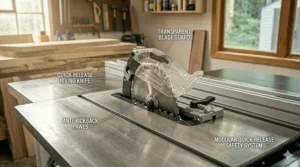
- Riving knife systems prevent workpiece pinching blade causing kickback
- Quick-release blade guards encourage actual use rather than removal for convenience
- Anti-kickback pawls grip workpiece if blade catches
- Flesh-sensing technology (premium models) stops blade within milliseconds of skin contact
- Magnetic switches prevent accidental restart after power interruption
Don’t compromise on safety features to save money. Medical bills from single serious injury exceed cost difference between basic and safety-enhanced models many times over. The National Electronic Injury Surveillance System estimates 38,000 table saw injuries occur annually, making proper safety equipment essential rather than optional.
Setting Up Your Grizzly Hybrid Table Saw
Proper setup determines whether your grizzly hybrid table saw performs like precision equipment or frustrates you constantly. Invest time upfront rather than battling poor alignment for years.
Initial Assembly Considerations
Most hybrid saws arrive requiring assembly of fence rails, extension wings, and accessory components. Set aside full day for patient, methodical work. Rushing assembly creates misalignment problems harder to fix later than getting things right initially.
Tools Needed:
- Quality machinist’s square (6-inch minimum)
- Dial indicator with magnetic base (0.001-inch resolution)
- Precision straightedge (24-inch minimum)
- Wrenches and screwdrivers matching fastener sizes
- Shims of varying thickness (0.001 to 0.030 inches)
Critical Alignment Procedures
Blade-to-Miter-Slot Parallel: This fundamental alignment affects every cut. Blade must run perfectly parallel to miter slots within 0.002 inches across full blade diameter.
Process: Mount dial indicator on miter bar. Rotate blade positioning one tooth at reference position. Record measurement. Rotate blade 180 degrees positioning same tooth at opposite side. Measurements must match within 0.002 inches. Adjust cabinet-mounted trunnions if needed until achieving parallel.
Fence-to-Blade Parallel: Fence must run parallel to blade preventing workpiece binding between fence and blade causing dangerous kickback.
Process: Set fence to specific measurement (example: 12 inches from blade). Measure at front and rear of blade. Measurements must match precisely. Adjust fence mounting or guide system until achieving parallel.
Table Flatness Verification: Use precision straightedge to check table flatness. Place straightedge in multiple orientations across table looking for gaps indicating low spots or humps. Quality tables typically measure within 0.003 inches across full surface.
Break-In Procedures
New saws benefit from break-in period allowing components to seat properly. Run saw through several cuts in scrap material while monitoring for unusual sounds, vibrations, or resistance. Recheck critical alignments after initial 2-3 hours of use as fasteners settle.
Maintenance Best Practices for Longevity
Proper maintenance extends grizzly hybrid table saw lifespan from years to decades while maintaining precision and safety.
Daily Maintenance
Post-Use Cleaning: Remove all sawdust from table surface, throat plate area, and fence rails. Sawdust absorbs moisture causing rust on precision-ground surfaces. Use shop vacuum followed by lint-free cloth.
Blade Removal: Lower blade below table when finished cutting. This protects blade teeth from accidental contact and reduces temptation to reach over spinning blade.
Weekly Maintenance
Wax Application: Apply paste wax to table surface and extension wings creating moisture barrier. Buff thoroughly removing excess. This simple step prevents rust while improving workpiece gliding. Reapply whenever water no longer beads on surface.
Fence Rail Cleaning: Clean fence rails removing accumulated pitch and residue. Lubricate with dry lubricant (never oil which attracts sawdust).
Belt Tension Check: Verify drive belt maintains proper tension. Too loose causes slippage and power loss. Too tight creates excessive bearing wear.
Monthly Maintenance
Alignment Verification: Recheck blade-to-miter-slot parallel and fence-to-blade parallel. Vibration and use can shift alignments slightly over time.
Fastener Inspection: Check all bolts, screws, and adjustment locks for proper tightness. Vibration loosens fasteners gradually.
Bearing Lubrication: Some models include grease fittings on arbor bearings. Follow manufacturer recommendations for lubrication type and frequency.
Annual Maintenance
Deep Cleaning: Disassemble dust collection components, guards, and accessible internal mechanisms. Clean thoroughly removing accumulated pitch and debris. Inspect for wear or damage requiring replacement.
Motor Inspection: Check motor brushes (if applicable) for wear. Verify electrical connections remain tight and corrosion-free.
Blade Replacement: Even with regular sharpening, blades eventually develop micro-cracks or tooth damage. Replace blades showing any signs of damage rather than risking catastrophic failure.
Common Problems and Solutions
Understanding typical issues helps you diagnose and resolve problems quickly rather than waiting for customer service assistance.
Motor Won’t Start
Possible Causes:
- Tripped circuit breaker or blown fuse
- Magnetic switch safety interlock engaged
- Thermal overload protection activated
- Loose electrical connections
Solutions: Check circuit breaker first. Press reset on magnetic switch. Allow motor to cool 30 minutes if thermal protection engaged. Verify all electrical connections tight and corrosion-free.
Blade Binds During Cutting
Possible Causes:
- Blade not parallel to miter slots
- Fence not parallel to blade
- Dull blade creating excessive friction
- Warped workpiece creating internal stresses
- Insufficient blade height for material thickness
Solutions: Verify all alignments using dial indicator. Sharpen or replace dull blades. Inspect workpiece for warping. Raise blade so teeth fully clear workpiece thickness plus 1/4 inch.
Excessive Vibration
Possible Causes:
- Blade damaged or improperly mounted
- Drive belt worn or damaged
- Arbor bearing wear
- Uneven floor surface
- Loose cabinet or stand bolts
Solutions: Inspect blade for damage, cracks, or missing carbide tips. Verify blade mounting with clean arbor and properly tightened arbor nut. Replace worn belts. Check floor level and shim saw if necessary. Tighten all cabinet fasteners.
Poor Dust Collection
Possible Causes:
- Insufficient collection system CFM rating
- Leaks in dust collection hose connections
- Clogged or restricted dust port
- Blade guard removed eliminating collection point
- Cabinet modifications creating airflow disruption
Solutions: Verify dust collector provides minimum 400 CFM at saw connection. Seal all hose connections with tape or clamps. Clean dust port regularly. Reinstall blade guard. Avoid unauthorized cabinet modifications.
Upgrading Your Hybrid Table Saw Setup
Strategic upgrades enhance capability and safety beyond factory configuration.
Blade Selection
Factory-included blades typically provide adequate performance for basic cutting but upgrading transforms saw capability.
Combination Blades (40-50 teeth): General-purpose workhorse handling ripping and crosscutting adequately. Choose quality carbide-tipped blades with anti-vibration slots and expansion dampening.
Rip Blades (24-30 teeth): Specialized for ripping long boards. Aggressive tooth geometry removes material quickly with minimal burning. Essential for processing rough lumber.
Crosscut Blades (60-80 teeth): Specialized for crosscutting. Fine teeth produce smooth, splinter-free cuts requiring minimal sanding. Critical for visible edges on finished projects.
Dado Stacks: Adjustable blade sets cutting grooves for joinery. Choose quality sets with flat-ground outer blades and chippers providing consistent cut width.
Fence Upgrades
While Grizzly T-shaped fences perform well, aftermarket options like Incra or Biesemeyer systems provide additional features for precision work.
Incra Systems: Offer micro-adjustment positioning systems ideal for repetitive cuts requiring exact dimensions. Include comprehensive jig-building capabilities.
Biesemeyer-Style Fences: Heavy-duty construction with exceptional rigidity. Simple, reliable, and proven design trusted by professionals.
Safety Additions
Mobile Base: Quality mobile bases allow repositioning saw for stock handling or shop reorganization. Choose versions rated for your saw’s weight with locking mechanisms preventing movement during operation.
Outfeed Tables: Support long boards during ripping operations. Can be shop-built or purchased commercially. Critical for safe handling of full-length lumber.
Push Blocks and Sticks: Keep hands safe distance from blade during cutting. Multiple designs address different cutting scenarios.
Grizzly Saw Reviews: Real User Experiences
Aggregating experiences from multiple sources provides balanced perspective beyond individual outliers.
Positive Experience Patterns
Long-Term Reliability: Users reporting 5+ years ownership generally express satisfaction. After initial setup and adjustment, saws continue performing reliably with basic maintenance.
Value Proposition: Even users reporting issues typically acknowledge receiving good value considering price paid. Comparable performance from premium brands costs significantly more.
Direct Purchase Experience: Buyers purchasing directly from Grizzly showrooms report smooth transactions, helpful staff, and good initial setup assistance.
Negative Experience Patterns
Out-of-Box Quality: Significant percentage of users report needing extensive alignment correction before achieving satisfactory performance. This frustrates buyers reasonably expecting better initial setup from factory.
Customer Service Inconsistency: Experiences vary dramatically based on which representative handles case and problem complexity. Simple issues generally resolve smoothly. Complex situations sometimes devolve into frustrating back-and-forth.
Parts Quality Variability: Some components, particularly on budget models, show premature wear under heavy use. Miter gauges, fence locks, and adjustment mechanisms receive specific criticism.
The Middle Ground Reality
Most grizzly hybrid table saw experiences fall between glowing endorsements and scathing condemnations. You’re getting genuinely capable equipment at fair prices with understanding that some assembly, adjustment, and occasional problem-solving will be required. This suits experienced woodworkers comfortable with tools but may frustrate beginners expecting turnkey simplicity.
✨ Don’t Miss These Exclusive Deals!
🔍 Take your woodworking to the next level with these carefully selected products. Click on any highlighted item to check current pricing and availability. These tools will help you create authentic projects your family will love!
FAQ: Grizzly Hybrid Table Saw Questions
❓ Are grizzly hybrid table saws good for professional use?
❓ What's the difference between grizzly hybrid and cabinet table saws?
❓ Do grizzly hybrid table saws require 240V power?
❓ How does grizzly direct sale pricing compare to other brands?
❓ What warranty coverage do grizzly hybrid table saws include?
Conclusion: Making Your Grizzly Hybrid Table Saw Decision
Choosing your grizzly hybrid table saw ultimately balances performance needs, budget constraints, and realistic expectations about direct-sale purchasing. After examining seven models across capability spectrum, clear patterns emerge guiding smart decisions.
For budget-conscious buyers seeking maximum value, the Grizzly G0771Z delivers professional features at contractor saw pricing. The T-shaped fence system, cast-iron construction, and 120V operation create compelling package for serious hobbyists and small professional shops. Yes, you’ll likely spend hours fine-tuning alignment and potentially navigate inconsistent customer service if issues arise, but the core equipment performs reliably once properly set up.
Stepping up to models like the Grizzly G0899 or considering alternatives like the Shop Fox W1837 makes sense when budget allows and you prioritize consistent quality control or enhanced features. The incremental cost often proves worthwhile through reduced setup frustration and improved long-term reliability.
Premium options like the Powermatic PM1000 enter different territory entirely. You’re paying significantly more for tighter tolerances, comprehensive warranty, and engineering refinement. This investment makes sense for professionals demanding consistent precision or advanced users appreciating subtle quality differences.
The direct sale advantages from Grizzly Industrial remain compelling throughout the lineup. Eliminating distributor markup saves substantial money while maintaining access to extensive parts inventory and direct technical support. Understanding the tradeoffs—potentially longer resolution times for complex issues, variability in quality control, and need for patient setup—helps set appropriate expectations.
Ultimately, the grizzly hybrid table saw category represents smart compromise for woodworkers wanting cabinet saw capability without cabinet saw pricing and immobility. Choose your model based on actual requirements rather than aspirational specifications, budget realistically for necessary accessories and upgrades, and plan on investing setup time achieving proper alignment. Following this approach positions you for years of satisfying woodworking supported by capable, reliable equipment that delivers genuine value.
The grizzly quality reputation continues evolving as the company refines manufacturing processes and addresses customer feedback. Current 2026 models represent culmination of decades learning what hybrid saw users actually need versus marketing-driven feature bloat. By understanding both strengths and limitations, you can make informed decision matching your specific requirements to available options.
Recommended for You
- 7 Best Hybrid Table Saw Under 2000 – 2026
- 7 Best Hybrid Table Saw Under 1500 in 2026
- Contractor Saw vs Hybrid Table Saw: 7 Best Picks 2026
Disclaimer: This article contains affiliate links. If you purchase products through these links, we may earn a small commission at no additional cost to you.
✨ Found this helpful? Share it with your friends! 💬🤗
