

In This Article
You bought the table saw. Maybe it cost you a few hundred dollars, maybe more. And then you slapped on whatever blade came in the box — and wondered why your cuts looked like they were made by someone using a rusty butter knife.
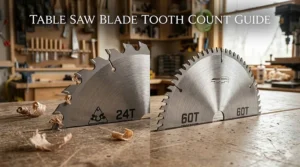
Here’s the thing nobody tells you upfront: the saw is just the engine. The blade is the real tool. Picking the right one isn’t nitpicking — it’s the difference between a crisp, glass-smooth edge and a tear-out disaster that sends you back to the lumber yard.
So which table saw blade do I need? The answer depends on what you’re cutting, how clean you need it to look, and how much power your saw can actually deliver. A 24-tooth ripping blade demolishes thick oak in seconds but leaves a finish that needs serious sanding. An 80-tooth crosscut blade glides through plywood like a hot wire through butter — but bog it down in a 2-inch hardwood rip and your motor will beg for mercy.
This guide cuts through the noise (pun fully intended). We’ve dug into real products available right now on Amazon, analyzed tooth geometry, hook angles, kerf widths, and carbide grades — and translated all of it into plain English so you can walk away knowing exactly which blade belongs on your saw. Whether you’re a weekend warrior building a deck or a serious woodworker crafting cabinets, there’s a blade on this list that’ll make you wonder why you ever settled for anything less.
Quick Comparison: Top 7 Table Saw Blades at a Glance
| Blade | Teeth | Kerf | Type | Best For | Price Range |
|---|---|---|---|---|---|
| Diablo D1040X | 40T | Thin (.098″) | ATB GP | All-around use | ~$20–25 |
| DEWALT DW3106P5 | 60T+32T | Thin | Combo Pack | Value & versatility | ~$40–55 |
| Freud LU83R010 | 50T | Thin (.091″) | Comb ATB | Rip & crosscut combo | ~$55–70 |
| Forrest WW10307100 | 30T | Full (3/32″) | ATB | Premium finish work | ~$110–130 |
| WEN BL1080 | 80T | Thin (2.4mm) | ATB | Fine finish, crosscuts | ~$25–35 |
| Diablo D1060X | 60T | Thin (.098″) | Hi-ATB | Plywood, fine finish | ~$35–50 |
| Diablo D1024X | 24T | Thin (.098″) | ATB | Aggressive ripping | ~$20–30 |
What this table tells you beyond the specs: The Diablo D1040X sits in the sweet spot for most woodworkers — thin kerf means less motor strain, 40 teeth means cuts are fast and reasonably clean. The Forrest jumps out on price, but that premium buys you something money can’t easily quantify: a virtually hand-made blade where the performance difference is immediate and physical. Budget buyers get genuine value in the WEN BL1080; the 80-tooth count delivers finish quality that competes with blades twice the price.
💬 Just one click — help others make better buying decisions too! 😊
Top 7 Table Saw Blades: Expert Analysis
1. Diablo D1040X 10″ 40-Tooth ATB General Purpose Saw Blade
If there were a “Swiss Army knife of table saw blades,” the D1040X would be it — and it’d come with a really nice case. This is the blade most woodworking instructors recommend first because it genuinely does everything adequately, and many tasks impressively.
The 40-tooth ATB (Alternate Top Bevel) grind means every other tooth leans in an opposing direction, creating a slicing action rather than a chopping one. In practice, this translates to rip cuts that are smooth enough to glue directly (on softwoods and many hardwoods) and crosscuts clean enough for most joinery. The 0.098″ thin kerf removes less material and demands less horsepower — a meaningful advantage if your saw is under 3HP. Perma-SHIELD non-stick coating keeps pitch and resin from building up, which is something cheap blades absolutely do not offer, and the laser-cut stabilizer vents reduce vibration for a quieter, straighter cut.
At around $20–25, this blade is practically a throw-in. Customers consistently describe it as punching far above its price point — many report running it for a year of regular use before needing a resharpening.
Who should buy this? Anyone new to table saws, anyone who switches between ripping and crosscutting frequently, or anyone who just wants one reliable blade on standby.
✅ Perma-SHIELD anti-pitch coating extends blade life
✅ Laser-cut vents reduce noise and vibration noticeably
✅ Fits virtually every 10″ table or miter saw (5/8″ arbor)
❌ Not ideal for ultra-fine veneer or thin plywood with demanding finish requirements
❌ Full-kerf users may prefer more tooth contact area for heavy material
Value verdict: Best all-around blade under $25. Buy two.
2. DEWALT DW3106P5 10-Inch Miter/Table Saw Blade Combo Pack (60T + 32T)
DEWALT solved a real problem with this pack: the eternal dilemma of owning one blade that’s either too fine for ripping or too coarse for finish cuts. The DW3106P5 gives you both ends of the spectrum in one box.
The 60-tooth DW3106 blade handles fine crosscutting in hardwood, chipboard, and plywood with impressive cleanliness — the thin kerf design and tungsten carbide tips leave edges that need minimal sanding. DEWALT’s exclusive wedge shoulder design, which places extra steel directly behind each carbide tip, is the feature most reviewers don’t notice until they compare it against a worn-out budget blade: the tips stay sharper, longer, and seat more precisely. The included 32-tooth general purpose blade is your workhorse for framing lumber, rough ripping, and anything where you’re removing material fast and finishing later.
Customers repeatedly note these blades stay sharp through construction-grade projects that would dull cheaper alternatives quickly. Where they earn their keep especially well: job sites where you’re cutting PT lumber, LVL beams, and sheet goods all in the same afternoon without blade-swapping drama.
Best for: Contractors, serious DIYers, and anyone who runs both a table saw and a miter saw and wants blades that move interchangeably between them.
✅ Two-blade system covers most cutting scenarios without extras
✅ Wedge shoulder tip design improves tip retention and accuracy
✅ Crosscutting quality rivals specialty blades costing twice as much
❌ The 32T blade is a general-purpose tool, not a dedicated rip blade — thick hardwood rips will be adequate, not exceptional
❌ Kerf width can vary slightly between the two blades, requiring fence adjustment when switching
Value verdict: Outstanding value for a two-blade system in the $40–55 range. Hard to beat for versatility-per-dollar.
3. Freud LU83R010 10″ 50-Tooth Thin Kerf Combination Saw Blade
Freud manufactures its own carbide — a fact that separates them from most competitors who source tips externally. The LU83R010 uses TiCo Hi-Density Carbide, and the practical result is a blade that holds its edge measurably longer than carbide-tipped blades using standard C3 or C4 grades.
The genius of this blade is its 5-tooth group configuration: one flat-top tooth for ripping, followed by four ATB teeth for crosscutting, with a large gullet between groups for chip evacuation. What does this mean in the shop? You can rip a hardwood board, then spin the workpiece and crosscut without changing blades — and both operations produce results good enough for cabinet-grade work. The thin .091″ kerf means your saw’s motor isn’t fighting excess material removal, and the anti-kickback design adds a safety net for woodworkers still developing their feed-rate intuition. Laser-cut anti-vibration slots eliminate the need for stabilizers, keeping your setup simple.
Woodworkers who own one report using it for months before reaching for a dedicated blade. It handles material from ¾” plywood to 1½” solid hardwood with equal composure.
Ideal for: Furniture makers, cabinet builders, and anyone who wants professional results without running a blade arsenal.
✅ TiCo Hi-Density Carbide extends sharpening intervals significantly
✅ No stabilizer needed — laser-cut slots handle it
✅ ATB/flat-top combo genuinely replaces two separate blades
❌ Not the right tool for aggressive ripping in timber over 2″ thick — a dedicated rip blade wins that race
❌ At $55–70, it’s a step up in investment; budget shoppers may hesitate
Value verdict: The best single-blade solution for serious hobbyists and semi-pro woodworkers. Worth every dollar.
4. Forrest WW10307100 Woodworker II 10″ 30-Tooth 5/8″ Arbor Saw Blade
Some products transcend the price chart. The Forrest Woodworker II is, by the standards of any objective observer, expensive for a saw blade — and woodworkers who own one will tell you it’s one of the best purchases they’ve made.
Here’s what justifies the premium. Each blade is essentially hand-crafted: the plate is hand-tensioned (up to 15 minutes per blade), C-4 carbide teeth are hand-brazed rather than machine-set, and the blade is straightened and re-straightened multiple times throughout production. The result is a 3/32″ full kerf blade that runs eerily true — almost no wobble, no vibration signature, no chatter. At 30 teeth with a specific ATB grind, rip-cut edges come off the blade smooth enough to glue without jointing. Cross-cut edges are nearly mark-free. The backside tearout on plywood is so minimal that experienced woodworkers consistently describe it as “almost like a knife cut.”
The Forrest also resharpens beautifully — send it back to Forrest’s service center and it comes back like new. Over a decade of use, the total cost-per-cut math is surprisingly favorable.
Who buys this? Fine furniture makers, heirloom woodworkers, anyone who has been frustrated by “almost perfect” results from mid-range blades. If you’re building something you’ll pass down a generation, this blade earns a place on your saw.
✅ Hand-tensioned plate runs with exceptional trueness — near-zero vibration
✅ Rip edges smooth enough to glue directly, crosscuts essentially tear-out free
✅ Resharpenable; long-term cost-per-cut is lower than it appears
❌ Price ($110–130 range) is a hard sell for casual use
❌ 30 teeth makes it less ideal for fine crosscutting in thin material
Value verdict: The best blade money can buy for serious woodworking. An investment, not a purchase.
5. WEN BL1080 10″ 80-Tooth Carbide-Tipped Fine Finish Saw Blade
The WEN BL1080 answers a specific question: what’s the most crosscutting performance available for under $35? The answer is 80 carbide-tipped teeth on a 10″ plate with a 1/10″ ultra-thin kerf — and it’s a legitimate answer.
Eighty teeth means 80 micro-slices per revolution rather than 40 or 50. In hardwoods like cherry, maple, and walnut, the difference shows up immediately: edges come off this blade ready for final fitting without sanding. In ¾” plywood, backside tearout is minimal to non-existent. The 2.4mm kerf removes less material than most full-kerf blades, reducing waste and motor load simultaneously — particularly useful on contractor saws with 1.5 to 2HP motors that can bog down under heavier blades cutting sheet goods at speed. Rated to 6000 RPM, this blade handles both hardwoods and softwoods without complaint.
What the BL1080 is not is a ripping blade. Feed it a 2×4 rip cut and it’ll do the job, but slowly and reluctantly — 80 teeth have small gullets, which means chips can’t evacuate fast enough for aggressive material removal. Use it for what it’s designed for — crosscuts, miters, panel cuts — and it’ll outperform blades that cost significantly more.
Perfect for: Trim carpenters, hobbyists who work primarily with hardwood panels, and anyone building cabinetry faces or drawer fronts.
✅ 80-tooth count delivers furniture-quality crosscut edges straight off the blade
✅ Ultra-thin kerf is easy on contractor and jobsite saw motors
✅ Exceptional value — competes with mid-range blades at a budget price
❌ Not suited for ripping — slow chip evacuation in thick material
❌ Thin kerf requires careful setup; slight fence drift shows in narrow crosscuts
Value verdict: Best budget fine-finish blade on the market. Punch well above your price bracket.
6. Diablo D1060X 10″ 60-Tooth Hi-ATB Fine Finish Saw Blade
Where the D1040X is the all-rounder and the D1024X is the brute, the D1060X is the finesse player — Diablo’s answer to “I need better crosscut quality without going full 80 teeth.” The Hi-ATB grind (steeper bevel angle than standard ATB) creates a more aggressive slicing action that virtually eliminates tearout in plywood, veneered panels, and melamine.
The 60-tooth count hits a sweet spot: fine enough for clean finish cuts, with gullets just large enough that you won’t feel the blade labor on 4/4 hardwood crosscuts. Diablo’s TiCo carbide tips — manufactured in-house to their own specification — are harder than commodity carbide and stay sharper noticeably longer. The PermaShield coating keeps the blade free from pitch and resin buildup, which on a finish blade matters more than on a ripping blade; residue on fine teeth affects cut quality immediately.
Customers who work with laminated sheet goods, melamine-faced MDF, or Baltic birch plywood repeatedly choose this blade because it eliminates the front-and-back tearout that cheaper blades inevitably produce. That tearout costs time in sanding and sometimes forces expensive material replacement.
Best matched to: Cabinet builders, shop furniture makers, and anyone who regularly cuts veneered or laminated panels.
✅ Hi-ATB grind virtually eliminates tearout on veneered and laminated sheet goods
✅ 60T count balances speed and finish quality — doesn’t bog down on solid wood
✅ TiCo carbide stays sharp through extended cutting sessions
❌ Overkill for rough construction — don’t waste its precision on framing
❌ Not ideal for ripping: dedicated rip blades remain faster in thick stock
Value verdict: The go-to upgrade for anyone cutting sheet goods frequently. Spend the extra $15 over budget alternatives — you’ll earn it back in saved material.
7. Diablo D1024X 10″ 24-Tooth ATB Ripping Saw Blade
This is the blade for one specific job — and it does that job better than almost anything else. Ripping. Thick stock, fast, with a motor-friendly demand and no drama.
Twenty-four teeth sounds aggressive, and it is — deliberately. Large gullets between teeth evacuate sawdust almost immediately, which is the single most important factor in ripping performance. When you’re sending 8/4 oak down the fence at a controlled feed rate, chips need somewhere to go. Thin-tooth blades clog, burn, and kill motors. The D1024X doesn’t. The 15-degree hook angle pulls material into the cut assertively, and paired with a thin .098″ kerf, feed rates are fast enough that ripping a 6-foot hardwood board takes less effort than it sounds. The ATB grind — rather than the flat-top (FTG) grind common on older rip blades — also keeps rip faces cleaner than you’d expect from a 24T blade.
What it leaves behind, honestly, is not furniture-grade surface quality. You’ll still want to run ripped edges through a jointer or hand plane before gluing. But for breakdown cuts, rough dimensioning, and cutting lumber down to manageable size before switching to a finish blade, the D1024X is exactly right.
Built for: Furniture makers who rough-dimension lumber before finish cuts, framing and decking applications, and anyone processing rough-sawn lumber.
✅ Aggressive feed capability with minimal motor load — fast and safe
✅ Large gullets prevent heat buildup and burning in hardwoods
✅ Thin kerf means less waste on expensive hardwood
❌ Rip edges require jointing or planing before any glue-up
❌ Crosscutting with this blade is functional but visually rough — have a second blade ready
Value verdict: Essential if you process any significant quantity of solid lumber. The $20–30 price is irrelevant; this blade pays for itself in a single afternoon.
✨ Don’t Miss These Exclusive Deals!
🔍 Take your woodworking to the next level with these carefully selected blades. Click on any highlighted product to check current pricing and availability on Amazon — each one has been verified as actively listed and well-reviewed.
Real-World Scenario Guide: Which Blade Fits Your Workshop Life?
Not everyone runs the same projects, and “which table saw blade do I need” has more than one right answer depending on who’s asking. Here are three common woodworker profiles and the best match for each.
The Weekend Warrior Building Home Projects
You’re building a deck, maybe a bookshelf, possibly some raised garden beds. Your saw is a contractor or jobsite model with a 1.5–2HP motor. You buy dimensional lumber from the big box store and cut sheet goods occasionally.
Your blade: The Diablo D1040X. It handles softwood framing cuts, PT lumber, and ¾” plywood without complaint, fits your lower-horsepower saw perfectly (thin kerf), and costs less than a dinner out. If you find yourself crosscutting trim more than ripping boards, consider pairing it with the WEN BL1080 as a second blade — you’ll have every scenario covered for under $60 combined.
The Furniture Maker Building Heirloom Pieces
You’re working with walnut, maple, or cherry. Every edge matters. You run a cabinet saw with 3HP or more, and you’ve jointed your lumber before it ever touches the table saw. You’re building to last decades.
Your blade: Start with the Freud LU83R010 as your everyday combo blade, and add the Forrest WW10307100 when quality demands are uncompromising. The Forrest, particularly for final crosscuts and miter joints in hardwood, produces edges that simply don’t require sanding — a workflow advantage that compounds across a project’s entire cutting phase.
The Shop Class Teacher or Maker Space Operator
Your saw runs 6–8 hours a day. Students use it, skill levels vary wildly, and you need a blade that’s forgiving, durable, and consistent.
Your blade: DEWALT DW3106P5 combo pack. The wedge-shoulder tip design holds up under heavier use cycles, the two-blade system handles the full range of what students cut, and when a blade finally dulls (and it will), the replacement cost doesn’t sting the budget.
How to Choose a Table Saw Blade: 6 Criteria That Actually Matter
Buying a blade should feel like hiring a tool, not gambling on specs. Here’s the framework that experienced woodworkers use — stripped of marketing language.
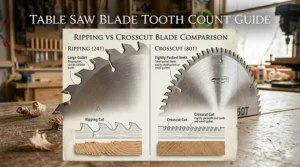
1. Decide on your primary cut type first. Ripping (with the grain) and crosscutting (against the grain) demand different geometries. A dedicated rip blade (24T, large gullets, steep hook angle) and a crosscut blade (60–80T, small gullets, neutral hook angle) are purpose-built. A combination blade (40–50T) compromises on both — productively.
2. Match tooth count to your finish requirement. According to Popular Woodworking, the general rule holds: fewer teeth = faster, rougher cut; more teeth = slower, finer cut. A 40T blade gives you a “finished enough” result for most furniture work; 80T gives you cabinet-grade edges. A 24T blade is for material removal, not presentation.
3. Understand kerf width and your motor’s horsepower. Full-kerf blades (.125″) remove more material and require more power. Thin-kerf blades (.091–.098″) are easier on motors under 3HP — which covers most contractor and jobsite saws. If you run a portable saw, thin kerf is essentially non-negotiable.
4. Read the hook angle. A positive hook angle (the tooth leaning forward, toward the cut) is aggressive and fast — good for ripping, risky for crosscutting where a workpiece can grab. A neutral or negative hook angle produces more controlled cuts. For a table saw’s combination blade, a 10–15° positive hook is the sweet spot.
5. Check the carbide grade. According to Fine Woodworking, C3 carbide suits general use, while C4 and higher-density proprietary carbides (Freud’s TiCo, Diablo’s TiCo grade) hold an edge meaningfully longer. The specification won’t appear on Amazon’s headline listing — dig into the product description.
6. Verify arbor compatibility before purchase. The standard for 10″ blades is 5/8″ arbor. All seven blades in this guide use it. If your saw has a 1″ arbor (older cast-iron machines), you’ll need a bushing or a blade specified for that size. Never guess.
ATB vs. TCG vs. Hi-ATB: Table Saw Blade Geometry Decoded
Tooth geometry is where most buyers’ eyes glaze over — and where the most important performance differences actually live. Let’s make this simple.
ATB — Alternate Top Bevel
The most common grind for general-purpose and crosscut blades. Alternating teeth lean left and right, creating a slicing action across wood fibers. Excellent for clean crosscuts in solid wood and plywood. The steeper the bevel angle, the finer the slicing action — which is why Hi-ATB blades (steeper angle) excel on veneered panels and melamine.
TCG — Triple Chip Grind
One high flat-top tooth followed by a lower chamfered “triple chip” tooth. This combination is ideal for non-ferrous metals, laminates, MDF, and man-made materials. The flat-top removes material while the chamfered tooth bevels the edge, preventing chipping on brittle surfaces. Not suited for solid wood — it’s the wrong geometry for fiber-cutting. If you’re seeing TCG blades marketed for general woodworking, skip them.
Combination Grind (ATBR or 4+1)
Used on combination blades like the Freud LU83R010 — one flat-top tooth per group paired with four ATB teeth. The flat tooth handles the ripping demand; the ATB teeth handle the crosscutting. A large gullet between groups keeps chips clear. According to woodworking research published by The Wood Database, combination blades perform within 10% of dedicated blades in both rip and crosscut applications — making them genuinely versatile rather than just a marketing claim.
What to Expect: Real-World Performance vs. What the Spec Sheet Says
Manufacturers are not lying to you — but spec sheets tell you theoretical performance under ideal conditions. Here’s what the specs don’t prepare you for.
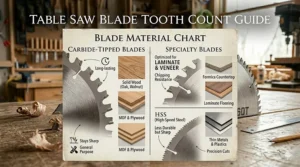
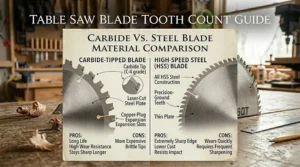
“Carbide-tipped” is not a quality level — it’s a category. A $12 no-name blade and a $130 Forrest are both “carbide-tipped.” What differs is carbide density, brazing quality (tri-metal vs. standard silver solder), and plate tensioning. The Forrest’s hand-brazed, hand-tensioned plate won’t vibrate itself into inaccuracy over time. A budget blade’s machine-brazed tips can develop micro-fractures under heavy use and shed tips prematurely — which is both a quality and a safety concern. OSHA’s woodworking safety guidelines note that damaged or improperly maintained blades are a leading factor in table saw incidents.
Thin kerf blades deflect more under lateral pressure. This is physics, not a flaw. If you’re ripping long boards and your fence isn’t perfectly parallel to the blade, a thin-kerf blade will flex slightly toward the fence face, causing binding and burning. Full-kerf blades are stiffer. Solution: dial in your fence before running thin-kerf blades under load.
Pitch buildup happens faster than you think. Resinous woods — pine, cherry, anything treated — deposit pitch on blade surfaces within a few cuts. Uncoated blades (most budget options) accumulate it aggressively; PermaShield or non-stick coated blades resist it. A blade with significant pitch buildup doesn’t just cut poorly — it burns wood and overheats the plate. Learn to clean blades with a dedicated blade cleaner between uses. It takes three minutes and extends blade life substantially.
Common Mistakes When Choosing a Table Saw Blade
Even experienced woodworkers get this wrong. Here’s where the buying errors concentrate.
Mistake #1: Using the stock blade indefinitely. Most table saws ship with a blade designed to demonstrate the saw, not to perform. If your saw came with a 24T steel-tooth blade (not carbide), it’s meant to be replaced immediately.
Mistake #2: Buying one blade for everything. A 40T combination blade is excellent — but it’s a compromise. If you do significant ripping and fine crosscutting regularly, owning a dedicated rip blade ($20–25) alongside a quality combination or crosscut blade isn’t extravagance; it’s workflow efficiency.
Mistake #3: Ignoring kerf width relative to motor power. A full-kerf blade on a 1.75HP contractor saw will bog down in dense hardwood. The motor strains, the cut slows, and the blade heats up. Thin kerf is not optional for lower-powered saws — it’s essential.
Mistake #4: Assuming more teeth always means better. An 80T blade crosscutting 4/4 walnut is excellent. That same blade ripping a 6-foot oak board will overheat and smoke. Match tooth count to cut type, not to a vague idea of “quality.”
Mistake #5: Neglecting the arbor fit. A blade that doesn’t seat perfectly on the arbor introduces runout — the micro-wobble that ruins finish quality and accelerates bearing wear. Check the bore size, and if you’re using a reducing bushing, make sure it’s precision-machined.
Long-Term Cost and Blade Maintenance: What Nobody Tells You at Purchase
A table saw blade is a depreciating asset — unless you treat it like one that can be restored.
Sharpening vs. replacing: Most quality carbide blades can be sharpened 3–5 times before the plate needs retirement. A $60 Freud LU83R010 sent to a professional sharpening service costs roughly $10–18 per sharpening — meaning the total service life of that blade might cost $110 over five years, versus buying three or four budget blades in the same period at similar total cost but lower performance. The premium blade wins the economics.
When to sharpen vs. when to push through: A blade is due for sharpening when crosscuts require noticeably more feed pressure than usual, when burn marks appear on the workpiece, or when edge quality degrades visibly. Pushing a dull blade harder is the single fastest way to ruin a project — and it overworks your saw motor.
Storage matters. Carbide tips are hard but brittle. Stack blades without protection and the teeth contact each other; over time, micro-chipping occurs. Blade covers (Diablo and Freud both include them) or individual blade slots in a wall-mounted rack eliminate this problem entirely. It takes fifteen seconds to put a blade away properly. Build the habit.
Table Saw Blades vs. Circular Saw Blades: Why You Can’t Just Swap Them
A quick but important note for beginners: while many table saw blades can physically fit a circular saw (same arbor size, same diameter), the blade designs are optimized for specific feed directions, RPM ranges, and cutting orientations. Table saw blades are typically designed for continuous, controlled feed with the workpiece supported on a flat surface. Circular saw blades used inverted (as in a table saw) can create different vibration characteristics. Always verify that a blade is rated for the RPM your specific table saw produces — this information is stamped on every quality blade plate and is non-negotiable for safe operation. Wikipedia’s saw blade article provides a useful technical overview of blade classifications and their appropriate applications.
FAQ: Which Table Saw Blade Do I Need?
❓ How many teeth does a table saw blade need for smooth crosscuts?
❓ Can I use the same table saw blade for ripping and crosscutting?
❓ What does ATB mean on a table saw blade?
❓ Is a thin kerf table saw blade better for a contractor saw?
❓ How often should I sharpen a carbide table saw blade?
Conclusion: Stop Overthinking, Start Cutting Better
The honest answer to which table saw blade do I need isn’t complicated. Start with a quality 40T ATB combination blade — the Diablo D1040X is the industry-standard recommendation for good reason — and add a dedicated rip blade (D1024X) if you process a lot of lumber, and a fine crosscut blade (WEN BL1080 or D1060X) if you build furniture or cabinetry regularly. That three-blade setup covers 95% of what a table saw needs to do.
If you want the best single blade money can buy and your work demands it, the Forrest Woodworker II is the answer. Full stop.
What separates great woodworking from merely adequate woodworking isn’t always skill. Sometimes it’s simply having the right tool in the right place. A sharp, correctly chosen blade doesn’t just cut better — it’s safer, quieter, and kinder to your saw’s motor. The $25 you save by running a dull or wrong-type blade costs you in burned edges, wasted material, and frustrated afternoons.
✨ Don’t Miss These Exclusive Deals!
🔍 Click any highlighted product above to check current pricing and availability on Amazon. These blades are actively listed, highly reviewed, and ready to ship. Upgrade your table saw’s most critical component today — your projects will thank you.
Recommended for You
- Best Table Saw for Cutting Plywood: 7 Expert Picks
- 7 Best Table Saws Under $2000 in 2026
- Best Table Saw Under 1000: 7 Expert Picks for 2026
Disclaimer: This article contains affiliate links. As an Amazon Associate, I earn from qualifying purchases. If you purchase products through these links, we may earn a small commission at no additional cost to you.
✨ Found this helpful? Share it with your friends! 💬🤗
