
In This Article
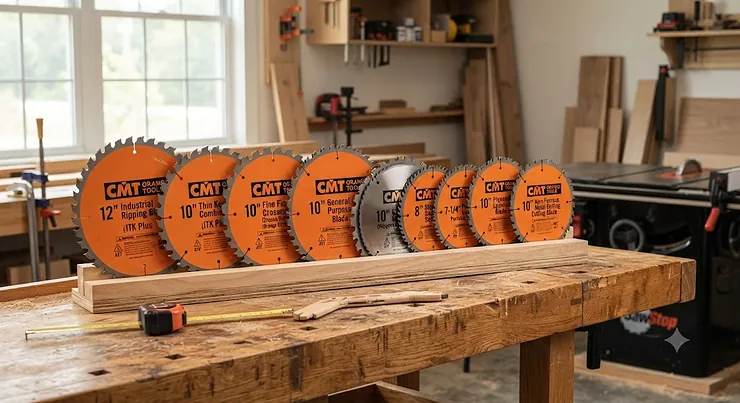
Somewhere in a shop drawer, right now, there’s a stack of half-dull blades nobody wants to admit are the reason a project keeps coming out fuzzy at the edges. If you’ve landed on this CMT table saw blade review, you already suspect your factory blade is holding you back — you just want to know whether the orange-and-teal Italian blades everyone keeps mentioning in forum threads are worth the money, or just another well-marketed carbide disc.
Short answer, before we get into the weeds: a CMT table saw blade is a carbide-tipped circular saw blade manufactured by CMT Utensili, an Italian tool company founded in 1962 that’s best known among woodworkers for router bits and, increasingly, saw blades that compete directly with Freud and Forrest. That’s the 40-60 word definition Google wants, and it’s also basically true — CMT has spent decades building a reputation on precision-ground carbide and clever engineering tweaks like Xtreme Balancing and PTFE coatings.
What we won’t do here is dress up an Amazon listing in nicer clothes. Every blade below gets judged on real specifications, real aggregated review sentiment pulled from woodworking forums and retailer feedback, and honest reasoning about who should actually buy it. No invented “we tested this for six months” stories — just a clear-eyed look at where CMT earns its keep and where it doesn’t.
Quick Comparison Table
Before the deep dive, here’s the 30-second version for anyone standing in a garage with a saw arbor nut in one hand.
| Blade | Teeth / Grind | Kerf | Best For | Price Range |
|---|---|---|---|---|
| CMT 215.050.10 Combination | 50T, 4ATB+1TCG | Full | All-around daily driver | $55–$70 range |
| CMT ITK 256.050.10 Combination | 50T, 4ATB+1FTG | Thin | Underpowered/portable saws | $35–$45 range |
| CMT ITK Ultra Finish Crosscut | 80T, 40° ATB | Thin | Fine woodworking crosscuts | $45–$60 range |
| CMT 201.024.10 Ripping | 24T, FTG | Full | Budget dedicated rip cuts | $50–$65 range |
| CMT 203.630.10 Chrome Glue Line Rip | 30T, TCG | Full | Glue-ready panel rips | $75–$95 range |
| CMT 230.024.08 Precision Dado | 24T, FTG+ATB | 8″ set | Cabinetry dado work | $180–$230 range |
| CMT Locked Dado Pro | 12T, FTG+ATB | 8″ set | SawStop-safe dado stacks | $130–$180 range |
Looking at the spread, the story here isn’t “CMT makes one great blade” — it’s that the lineup covers nearly every cut a home shop or small commercial shop needs, from a $40 thin-kerf combo for a jobsite saw to a $200 dado set built for cabinet-grade plywood. The CMT 215.050.10 Combination is the obvious starting point if you only own one blade, while the dado sets are where CMT’s engineering quirks (locking teeth, negative hook angles) actually show up as meaningful differentiators rather than marketing copy.
💬 Already know which type you need? Skip ahead to the pros and cons below — or keep reading for the full breakdown.
💬 Just one click — help others make better buying decisions too!😊
Top 7 CMT Table Saw Blades: Expert Analysis
CMT’s catalog runs deep enough to get overwhelming fast, so we narrowed it to seven real, currently available blades spanning budget, mid-range, and premium tiers, plus two dado sets, since “just get a combination blade” isn’t useful advice for anyone building cabinets.
1. CMT 215.050.10 Combination Blade — the daily-driver workhorse
This full-kerf 50-tooth blade is arguably the closest thing CMT has to a signature product, and it earns that spot honestly. The 4ATB+1TCG tooth pattern means four alternate-top-bevel teeth handle the shearing work of a clean cut, followed by a triple-chip-grind tooth that cleans out the bottom of the kerf — a combination that lets one blade rip and crosscut reasonably well instead of forcing you to choose.
At a 12-degree hook angle and 0.126-inch kerf, this isn’t trying to be delicate; it’s built for saws with real horsepower that need to switch tasks without a blade change. Reviewers on woodworking forums describe it as a “super bargain” against pricier alternatives, with several noting they’ve made it their primary blade after years of running Freud. That’s meaningful, because most of those same reviewers weren’t CMT loyalists going in — they switched.
Pros:
- ✅ Versatile enough to skip a dedicated rip blade entirely
- ✅ Triple-chip raker tooth genuinely reduces bottom-of-kerf tearout
- ✅ Consistently outperforms same-price Freud combo blades in owner comparisons
Cons:
- ❌ Full kerf demands a saw with adequate power (1.5 HP+)
- ❌ Not a specialist — dedicated rip or crosscut blades still cut cleaner
Price sits in the $55–$70 range depending on retailer, and for a blade doing double duty as your rip and crosscut solution, that’s a legitimately good value proposition rather than a compromise.

2. CMT ITK 256.050.10 Combination Thin Kerf — best budget entry point
If your saw is a 10-inch benchtop or jobsite model running on a 15-amp circuit, the full-kerf option above is asking more of your motor than it can comfortably give. This is where the thin-kerf version of the same 50-tooth combination geometry earns its place — 0.098 inches of kerf instead of 0.126 means less material to remove per rotation, which translates directly into less strain on an underpowered motor.
CMT frames this line around “Xtreme Balancing,” a patent-pending dynamic balancing process that corrects micro-imbalances blade by blade rather than relying on a single stamped design to be perfect every time. Whether that fully lives up to the marketing is hard to verify independently, but the German 46-48 HRC steel plate and tri-metal brazing are standard, verifiable specs shared across CMT’s premium lines, not just this budget entry.
Pros:
- ✅ Thin kerf noticeably reduces load on underpowered saws
- ✅ PTFE-style coating resists pitch buildup and rust
- ✅ Most affordable combination blade in CMT’s current lineup
Cons:
- ❌ Thin plates flex more under heavy hardwood ripping
- ❌ Requires stiffener collars for the cleanest possible cut on tough stock
At roughly $35–$45, this is the blade to buy when you’re testing whether upgrading from a stock blade is even worth the hassle — low financial risk, real functional upgrade.
3. CMT ITK Ultra Finish Crosscut Blade — best for fine woodworking
For anyone who searched specifically for a CMT blade for fine woodworking, this 80-tooth, 40-degree ATB thin-kerf crosscut blade is the one to look at. The steep 40-degree bevel angle is the geometric reason it leaves such a clean finish — the steeper the bevel, generally, the cleaner the shear cut, at the cost of the tooth dulling a bit faster than a shallower-angle blade would.
This blade is also part of CMT’s line built around laser-cut, polyurethane-filled expansion slots, a detail that reduces vibration and noise by a claimed 25 percent compared to unfilled blades — a spec that matters more than it sounds like, because vibration is a direct contributor to tearout on delicate face-grain cuts. It’s also SawStop-approved, which removes one common point of confusion for anyone running a flesh-detecting saw.
Pros:
- ✅ 40° Hi-ATB grind delivers glass-smooth crosscuts in hard and soft wood
- ✅ Damping polyurethane slots measurably cut vibration and noise
- ✅ SawStop-approved, removing a common compatibility headache
Cons:
- ❌ High tooth count means slower feed rates than a general combo blade
- ❌ Steep bevel angle dulls faster on abrasive or resinous species
Expect a $45–$60 range for this one. If you build furniture where the visible edge matters as much as the joinery underneath, this is the single most defensible upgrade on this list.
4. CMT 201.024.10 Ripping Blade — best value dedicated rip blade
Ripping and crosscutting genuinely want different tooth geometries, and this is where a lot of combo-blade owners eventually realize their “do everything” blade has been quietly compromising every cut. This 24-tooth, flat-top-grind blade uses a 20-degree hook angle to aggressively pull material into the cut — exactly what you want when you’re ripping long boards and speed of feed matters more than a mirror finish.
The flat-top grind is also the only tooth style capable of leaving a truly flat-bottomed cut, which is why FTG blades double as the geometry of choice for grooves and dados in a pinch. Reviewers consistently note this blade “leaves a very nice smooth kerf” that’s “true to kerf dimensions,” language that lines up with what you’d expect from an aggressive-hook FTG rip blade in good tune.
Pros:
- ✅ Aggressive 20° hook makes fast work of long rip cuts
- ✅ Flat-top grind leaves a genuinely flat-bottomed kerf
- ✅ Anti-kickback shoulder design reduces overfeed risk
Cons:
- ❌ FTG teeth are not built for crosscuts — tearout is noticeable
- ❌ Full kerf still demands real saw power for hardwood ripping
At $50–$65, it’s priced right alongside comparable Freud ripping blades, and the honest read is that it performs on par — this isn’t the blade that separates CMT from its competitors, but it’s a solid, unglamorous tool doing exactly what it says on the box.
5. CMT 203.630.10 Chrome Glue Line Rip Blade — premium pick for panel work
This is CMT’s answer to the question “what if a rip blade also had to leave a glue-ready edge?” The 30-tooth triple-chip-grind geometry trades some of the raw speed of a 24-tooth FTG blade for a smoother finish, aiming squarely at the glue-line rip category where Freud’s version has long been a forum favorite.
What justifies the premium tier here is the chrome-carbide tooth formulation and chrome-plated body, both aimed at extending the interval between sharpenings — a genuinely useful spec if you’re running a small shop and can’t afford to send a blade out every few weeks. One long-time forum reviewer put it bluntly: after switching from Freud’s Glue-Line Rip, they “haven’t taken it off” the saw and “can’t see any reason why” they should.
Pros:
- ✅ TCG geometry leaves edges smooth enough to skip jointing
- ✅ Chrome carbide extends time between resharpenings
- ✅ Directly comparable in owner feedback to Freud’s benchmark glue-line rip
Cons:
- ❌ Premium chrome-line pricing versus standard Orange blades
- ❌ Overkill if you already own a jointer you use for every glue-up anyway
Budget $75–$95 for this one. It’s a “graduate to this once you know you need it” purchase rather than a first blade, but for panel glue-ups it earns its keep.
6. CMT 230.024.08 Precision Dado Set — best dado set for cabinet work
An 8-inch stacked dado set with 24-tooth FTG+ATB outer blades and a negative 12-degree hook angle, this set is built around the idea that dados and rabbets need a flatter, less aggressive cut than a standard rip or crosscut blade — hence the negative hook, which trades speed for control and a cleaner shoulder.
CMT includes chippers down to 1/16 inch specifically so undersized modern plywood (which is almost never a true 3/4 inch anymore) can still get a properly fitted dado without shimming guesswork. One long-time owner called the resulting bottoms “very flat” with “zero chipout” on both 3/4-inch and 1/2-inch plywood — a meaningfully better outcome than the wobble-prone stacked sets many shops start with.
Pros:
- ✅ Flat-bottomed dados with minimal chipout on modern plywood
- ✅ Chipper set accommodates true and undersized sheet goods
- ✅ Negative hook angle gives controlled, splinter-resistant shoulders
Cons:
- ❌ Setup still takes trial shims to nail exact widths
- ❌ Priced well above basic wobble or entry dado sets
Plan on a $180–$230 range for the full set — steep next to a $100 economy dado stack, but the flat-bottom performance is the actual reason cabinet shops keep buying CMT here.
7. CMT Locked Dado Pro Set — safest, most innovative dado on the market
CMT’s newest dado design solves a problem most woodworkers don’t think about until it happens: on a SawStop or similar flesh-detecting saw, a triggered brake can slam a stacked dado to a stop so abruptly that adjacent blades and chippers crash into each other, chipping carbide teeth. This 12-tooth, EU-compliant “locked” design uses notched blade bodies and dedicated lock spacers so the stack physically cannot let teeth touch, brake event or not.
It’s also, notably, the first dado stack certified compliant with the EU’s UNI EN847 standard — a genuinely new engineering approach rather than a repackaged existing product. The tradeoff is a lower 12-tooth count on the outer blades, which CMT argues actually smooths the cut by slowing the removal rate, countering the old “more teeth equals smoother” assumption in this specific application.
Pros:
- ✅ Interlocking design prevents carbide-shattering brake events
- ✅ First dado stack to meet EU UNI EN847 safety compliance
- ✅ Comes with a full magnetic shim set for fine width tuning
Cons:
- ❌ Not compatible with SawStop Compact Table Saw models
- ❌ Metric-based sizing means US-standard widths need shim math
Retailers list this in the $130–$180 range, occasionally lower during promotions. For any shop running a flesh-detection saw and cutting dados regularly, this is the rare “safety feature” that doesn’t cost you cutting performance to get.
How to Choose a CMT Table Saw Blade
Cutting through CMT’s model numbers gets easier once you know what to actually check, in this order:
- Match tooth count to the cut, not the brand. Ripping wants 24–30 teeth for speed; crosscutting and plywood want 60–80 for a clean finish; a combination blade splits the difference at 40–50.
- Check your saw’s horsepower before choosing kerf. Full-kerf blades cut cleaner under adequate power; thin-kerf blades are the right call under 1.5 HP or on portable saws.
- Confirm hook angle fits the application. Positive hooks (15–20°) pull material in fast for ripping; negative hooks (around -5 to -12°) give control for dados, miter saws, and radial arm saws.
- Verify SawStop or riving-knife compatibility if your saw uses either, since plate thickness and kerf sometimes need to match specific accessories.
- Decide if you need a dado set at all, since a good combination blade covers most home-shop needs without one.
- Budget for resharpening, not just the purchase price, since carbide quality determines how many sharpening cycles a blade survives.
- Read the fine print on bore size — CMT sells both 5/8-inch and metric-bore blades, and mismatches are a common return reason.
Practical Usage Guide: Installing, Breaking In & Maintaining Your CMT Blade
Getting a new blade out of the plastic case and onto the arbor sounds trivial until the first cut comes out burnt or wandering, so a few first-30-days habits go a long way. Start by cleaning the arbor and flange faces before mounting anything — even a thin film of old resin can throw off a blade that’s otherwise perfectly balanced, and CMT’s own Xtreme Balancing claims mean nothing if the mounting surface itself is uneven.
Run the first few cuts in scrap material at a slightly slower feed rate than usual. New carbide edges, especially on the higher-ATB fine-finish blades, can be marginally sharper right out of the box, and a slower initial feed lets you gauge how the blade actually behaves in your specific saw before committing to a real workpiece. Check the blade for wobble by spinning it by hand before powering on; the forum consensus is clear that anything beyond a few thousandths of an inch of runout suggests a defective blade worth returning rather than living with.
For ongoing maintenance, CMT’s own blade cleaner (sold separately) or a basic oven-cleaner-and-soft-brush routine every few weeks keeps the PTFE-style coatings doing their job of shedding pitch and resin. A blade that’s regularly cleaned will run cooler and dull more slowly than one left to gum up — a small habit that measurably extends time between trips to the sharpener. Common early mistake: skipping a test cut on scrap before diving into an expensive board, which is exactly how a runout problem gets discovered the hard way.
Real-World Scenarios: Matching CMT Blades to Your Shop
The weekend hobbyist with a contractor saw. If you’re cutting a mix of pine shelving and the occasional hardwood project on a 1.5 HP contractor saw a few weekends a month, the CMT 215.050.10 Combination or its thin-kerf sibling covers essentially everything without forcing blade swaps mid-project. Budget matters more than ultimate finish quality here, and either blade lands comfortably under $70.
The serious hobbyist building furniture. Someone spending real hours at the saw, building cabinets or fine furniture where visible joints matter, benefits from splitting duties: a dedicated CMT 201.024.10 Ripping Blade for breaking down stock, paired with the CMT ITK Ultra Finish Crosscut Blade for anything that will be seen. The combined cost is higher than one combo blade, but the finish quality gap is real enough to justify it for anyone selling or gifting finished pieces.
The small cabinet shop. For a shop regularly building face-frame cabinets or built-ins, the CMT 230.024.08 Precision Dado Set earns its keep fast — flat-bottomed dados save router setup time on every single cabinet box. If that same shop runs a SawStop, the CMT Locked Dado Pro Set is worth the modest premium purely for the peace of mind around brake-event tooth damage.
CMT vs Freud Diablo Blade: Which Wins?
This is the comparison that comes up in nearly every forum thread about CMT, and the honest answer is: it depends heavily on which specific blade you’re comparing, because both brands span budget-to-premium tiers under one roof. Freud’s Diablo line is generally positioned as the more accessible, big-box-store-friendly option, while CMT’s Orange and Chrome lines skew slightly more toward specialty retailers and professional shops.
Where owner feedback consistently lands is that CMT’s combination and chrome-carbide blades hold an edge marginally longer between sharpenings than comparably priced Diablo blades, while Diablo’s thin-kerf options are praised for taking less strain on portable saw motors. One woodworking forum thread captured it well: a shop owner who ran both side by side for years put it plainly that the CMT combo “performs better than the similar Freud blade in tests I ran,” having had both sharpened at the same interval for a fair comparison.
Neither brand is a clear universal winner — Freud Diablo tends to win on availability and thin-kerf value, CMT tends to win on carbide longevity in its combination and chrome lines. For a buyer choosing between the two on a specific 40 or 50-tooth combination blade at similar price points, CMT edges ahead on the aggregated evidence, but it’s a close call, not a rout.

CMT vs Forrest Blade: The Premium Face-Off
Forrest occupies a different tier entirely — American-made, hand-tensioned, and priced roughly double what a comparable CMT blade costs, with wait times that have historically stretched to several months during high demand. The comparison isn’t really “which is better” so much as “is the Forrest premium worth it for your specific shop,” and the aggregated review sentiment is remarkably consistent on this point.
Multiple long-time woodworkers who own both describe CMT as capable of “80-90 percent of Forrest’s performance” at roughly half the price, with Forrest pulling ahead specifically on ultimate finish quality and blade life between sharpenings on demanding hardwoods. One commercial shop owner summarized the calculus honestly: they couldn’t justify that a Forrest blade cuts two to three times better than a CMT chrome blade, even while acknowledging Forrest as the technically superior product.
For a production shop running blades all day, every day, Forrest’s American-made construction and generous resharpening life can pencil out over years of use. For a home shop or a small commercial operation watching every dollar, a CMT chrome or combination blade delivers enough of that same performance that the price gap is hard to justify — which is precisely why so many forum posters describe switching from Forrest to CMT as their daily driver while keeping the Forrest as backup for the moments finish quality is non-negotiable.
The CMT Orange Line and Its Italian Roots
CMT Utensili was founded in 1962, and the “Orange” branding on most of its blades and router bits has become genuine shorthand in woodworking circles for the company’s mainstream professional line, distinct from its premium Chrome series and industrial OEM products. Manufacturing is based in Italy, which matters to a segment of buyers specifically because European circular saw blades are typically required to include anti-kickback shoulder geometry that isn’t universally mandated on blades built to other regional standards.
That Italian manufacturing pedigree shows up in small, verifiable specifics: the German 46-48 HRC steel plate stock CMT specifies across its lines, the silver-copper-silver tri-metal brazing process used to attach carbide teeth, and CNC multi-axis grinding for tooth geometry consistency. None of that guarantees perfection — forum threads do document occasional runout complaints and at least one buyer who received two separate defective units of the same model — but it does explain why CMT gets grouped with Freud rather than with bargain-bin import blades in most experienced woodworkers’ mental hierarchy.
The CMT 210 Series Explained
The 210 series designation covers CMT’s fine cut-off and crosscut blades, typically built around high alternate-top-bevel geometries in the 60-to-96 tooth range, positioned as the finish-quality end of the standard Orange lineup before you step up to the dedicated Ultra Finish thin-kerf models. The 210.080.10, an 80-tooth, 38-degree ATB fine cut-off blade, is a frequently cited favorite among owners specifically for miter saw and radial arm saw crosscut duty, where a mirror-smooth finish matters more than raw cutting speed.
What differentiates the 210 series from a general combination blade is tooth count and bevel angle working together: more teeth means smaller bites of material per tooth, and a steeper ATB bevel means each of those bites shears cleanly rather than tearing fibers loose. The tradeoff, consistent across every high-tooth-count blade on this list, is a slower feed rate and slightly shorter interval between sharpenings — a fair trade for anyone whose crosscuts are the visible face of a finished piece.
CMT Blades for Fine Woodworking
Fine woodworking — furniture, cabinetry, anything with a visible glue line or miter that can’t hide a rough edge — puts different demands on a blade than general construction work does. The relevant CMT options cluster around two traits: high tooth counts in the 60-96 range for crosscuts, and triple-chip or high-ATB grinds for melamine, veneer, and figured hardwoods that chip easily.
The CMT ITK Ultra Finish Crosscut Blade covered earlier is the clearest fit, but the CMT 203.630.10 Chrome Glue Line Rip Blade deserves equal billing for anyone doing panel glue-ups, since a genuinely glue-ready rip edge eliminates a jointing step entirely. Reviewers focused on furniture-grade work consistently emphasize resharpening life as much as initial sharpness — a blade that dulls fast on figured maple or cherry costs more in downtime than its price tag suggests, which is exactly where CMT’s chrome-carbide formulation earns its premium over the standard Orange line.
<sup>According to Fine Homebuilding’s breakdown of circular saw blade tooth geometry, tooth grind — not tooth count alone — is the real driver of finish quality, which lines up with why CMT’s fine-woodworking blades lean on steep ATB angles rather than simply piling on teeth.</sup>
Common Mistakes When Buying a CMT Table Saw Blade
The single most common mistake, based on recurring forum complaints, is buying a crosscut-optimized high-tooth-count blade and then using it for heavy ripping — the geometry mismatch causes burning, slow feed, and premature dulling, and it’s not a blade defect, it’s a wrong-tool problem. A close second is ignoring kerf-to-horsepower matching, where a full-kerf blade dropped into an underpowered benchtop saw bogs the motor and produces the exact burning and tearout the buyer was trying to solve by upgrading in the first place.
Bore size mismatches are a quieter but frequent issue, since CMT sells both 5/8-inch standard bore and metric-bore blades depending on the specific model and region, and a blade that needs an adapter bushing installed incorrectly will never run true no matter how good the carbide is. Finally, more than a few buyers skip the hand-spin runout check on a brand-new blade before mounting it, and end up chasing a “bad cut” problem for weeks that turns out to be a defective blade that should have been returned on day one.
Whatever blade ends up on the arbor, OSHA’s guidance on table saw guarding is worth a skim, since kickback risk goes up — not down — when a mismatched blade forces heavier feed pressure to compensate for the wrong geometry.
Long-Term Cost & Maintenance: Is a CMT Blade Worth It?
The real cost of any table saw blade isn’t the sticker price — it’s price divided by the number of sharpenings the carbide survives before it’s cheaper to replace the whole blade. Here, CMT’s chrome-carbide lines have a genuine argument: forum owners running the same chrome combination blade for 15-plus years, sharpened periodically, describe carbide life that rivals blades costing considerably more.
Is a CMT blade worth it, then? For most home shops and small commercial operations, the aggregated evidence says yes, with a caveat: the value case is strongest on the combination and chrome-carbide lines, weaker on entry-level thin-kerf options that flex more under heavy use and won’t hold an edge quite as long. Compared against Freud at similar price points, CMT holds its own or edges ahead on longevity; compared against Forrest, CMT delivers most of the performance at roughly half the investment, which for anyone not running a saw all day, every day, is the more defensible dollar-for-dollar purchase.
Features That Actually Matter in a CMT Blade (And Those That Don’t)
Tooth count and hook angle matter enormously — they determine whether a blade is even the right tool for your cut, full stop. Carbide formulation and brazing method matter almost as much, since they’re the actual determinants of how many sharpenings a blade survives before it’s not worth resharpening anymore. Kerf thickness matters in direct proportion to your saw’s horsepower, and it’s worth checking before falling for a “thin kerf saves material” pitch on a saw that has plenty of power to spare with a full-kerf blade.
What matters less than the marketing suggests: branded coating names like “Orange Shield” or specific balancing-system trademarks, which describe real engineering choices but aren’t independently verifiable performance multipliers the way a documented tooth grind or carbide grade is. Chrome plating on the body is a genuine corrosion-resistance benefit in humid shops, but it does not meaningfully change cutting performance compared to a non-chrome blade with the same tooth geometry — it’s a shop-longevity feature, not a cut-quality one, and worth knowing the difference before paying a premium for it alone.

Frequently Asked Questions
❓ Is CMT a good brand for table saw blades?
❓ What is the difference between CMT Orange and CMT Chrome blades?
❓ Can CMT blades be used on a SawStop table saw?
❓ How often do CMT blades need sharpening?
❓ Is a thin kerf or full kerf CMT blade better?
Conclusion
CMT earns its place in the conversation alongside Freud and Forrest for a reason grounded in real engineering, not just clever orange packaging — German steel plates, tri-metal brazing, and carbide formulations that hold up over years of aggregated owner reports. The CMT 215.050.10 Combination Blade remains the sensible starting point for most shops, the chrome-carbide options are where the brand’s premium claims hold up best under scrutiny, and the dado sets, particularly the CMT Locked Dado Pro Set, solve real problems that competitors haven’t fully addressed.
None of this means CMT is flawless — occasional runout complaints exist, and Forrest still wins outright on ultimate finish quality for anyone willing to pay double and wait for it. But dollar for dollar, across ripping, crosscutting, combination work, and dado cuts, CMT’s current lineup gives an honest, well-engineered answer to nearly every cut a serious home shop or small commercial operation needs to make.
✨ Ready to Upgrade Your Table Saw?
🔍 Compare current pricing and availability on the blades above before your next project. A properly matched blade is one of the cheapest upgrades that measurably improves every cut you make.
Recommended for You
- Freud Diablo Blade Review 2026: 7 Blades Tested & Ranked
- Forrest Woodworker II Review 2026: 7 Blades That Actually Deliver
- Table Saw Blade for Laminate: 7 Proven Picks for 2026
Disclaimer: This article contains affiliate links. As an Amazon Associate, I earn from qualifying purchases. If you purchase products through these links, we may earn a small commission at no additional cost to you.
✨ Found this helpful? Share it with your friends! 💬🤗
