
In This Article
Here’s a confession every woodworker eventually makes: the first time someone said “just clamp on a sacrificial fence,” you nodded like you understood, then went home and stared at your table saw’s rip fence wondering what exactly you were supposed to sacrifice. You’re not alone, and honestly, the terminology in this hobby seems designed by people who forgot what it’s like to be new.
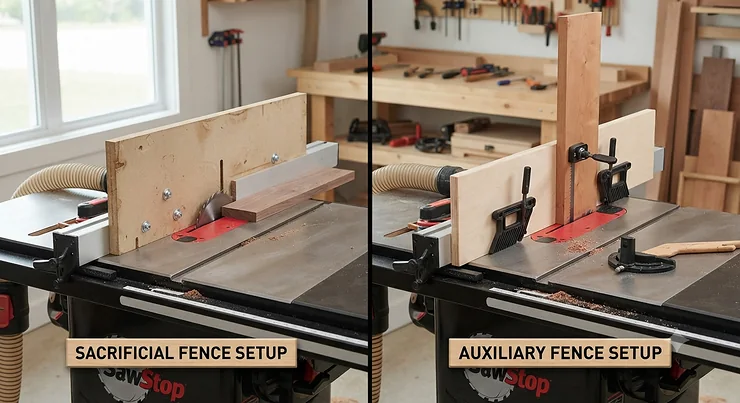
So let’s clear the fog. The debate over sacrificial fence vs auxiliary fence for beginners isn’t really a debate at all — the two terms describe overlapping ideas that solve different-but-related problems at your table saw. A sacrificial fence is a piece of expendable material (wood, MDF, plastic) that you let the blade cut into, usually to create a zero-clearance surface or bury a dado stack safely. An auxiliary fence is a broader term for any secondary fence clamped to your factory fence — sometimes sacrificial, sometimes just longer, taller, or straighter than what came with your saw.
Below, we’ll walk through seven real, purchasable products that solve this exact problem, show you how they stack up, and build out a beginner guide to fence attachments so the next time someone throws around this jargon, you’re the one nodding with actual comprehension. As this overview of woodworking fences explains, an auxiliary or sacrificial fence is built from material that won’t harm the blade and gets attached to an existing fence, typically for situations where the fence needs to sit close to, or in direct contact with, the blade. That distinction — protecting your real fence while getting closer, cleaner cuts — is the whole game.
Quick Comparison Table
| Product | Type | Best For | Price Range |
|---|---|---|---|
| Rockler Universal Fence Clamps | Clamp system | First-time DIY sacrificial fence builders | Budget ($15–$25 range) |
| Milescraft 4009 Fence Clamps | Clamp system | Tightest budget, occasional use | Budget (under $20) |
| POWERTEC Universal Fence Clamps 71004V | Clamp system | Wider fence stock, multi-tool use | Budget-mid ($20–$30 range) |
| Shop Fox D4586 Fence Clamp Set | Clamp system | Heavier-duty everyday clamping | Mid ($25–$35 range) |
| Woodpeckers Auxiliary Rip Fence ARF-BSCS (36″) | Auxiliary fence | Compact and jobsite table saws | Mid-premium ($100–$150 range) |
| Woodpeckers Auxiliary Rip Fence ARF-48 | Auxiliary fence | Full-size shop saws, big panels | Premium ($150–$220 range) |
| TSO Products Sacrificial Rip Fence for DeWalt | Sacrificial fence | DeWalt jobsite saw owners wanting zero-clearance | Mid ($50–$90 range) |
Looking at the spread above, notice that four of the seven picks are clamp systems, not fences themselves — that’s intentional, because for most beginners the real first purchase is the hardware that lets you attach a homemade fence, not a finished fence assembly. The Woodpeckers Auxiliary Rip Fence ARF-48 and its compact sibling occupy the premium tier because they replace the DIY step entirely with a machined aluminum solution. Meanwhile, the TSO Products Sacrificial Rip Fence for DeWalt sits in a category of its own: a drop-in accessory engineered for one specific jobsite saw platform rather than a universal fit.
💬 Bookmark this comparison — you’ll want to reference it again once you’ve read the “who’s it for” breakdown below!
Top 7 Sacrificial and Auxiliary Fence Products: Expert Analysis
1. Rockler Universal Fence Clamps — the classic beginner clamp pair
If there’s a “starter kit” answer to sacrificial fence vs auxiliary fence for beginners, this is probably it. The Rockler Universal Fence Clamps are a compact, lightweight aluminum clamp pair designed to hold a shop-made auxiliary or sacrificial fence against your existing rip fence without a single screw touching either surface.
Each clamp arm seats into a 3/8-inch hole drilled in the top edge of your auxiliary board, which keeps the clamping hardware completely out of the cutting path — a small detail that matters enormously once you’re feeding stock past the blade. The clamp travel runs from about a half-inch up to nearly six inches, so it accommodates a wide range of shop-made fence thicknesses.
What most beginners overlook about this style of clamp is that it turns any scrap of 3/4-inch plywood or MDF into a functional sacrificial fence in minutes, with zero permanent modification to a factory fence that might cost hundreds of dollars to replace. Reviewers consistently report that the clamps install and remove quickly and hold firmly through repeated use, though a handful mention the clamping pads lack rubberized grip, which can matter on glossy melamine-faced fences.
If you’re a first-time buyer trying to figure out which fence accessory to buy first, this is the low-risk, high-utility entry point: it doesn’t lock you into one fence design, and it works across table saws, band saws, and router tables alike.
Pros:
- ✅ Keeps clamp hardware out of the cutting path entirely
- ✅ Works on nearly any tool with an existing fence
- ✅ No drilling or screws into your factory fence
Cons:
- ❌ Requires you to build your own auxiliary fence board
- ❌ Clamp pads aren’t rubberized, so slick surfaces can slip
At around $15–$25, this remains one of the most sensible first purchases for anyone building out their beginner woodworking terminology and toolkit at the same time — you’ll learn what “auxiliary fence” means by literally assembling one. Check current price and availability before buying, since retailer stock fluctuates.
2. Milescraft 4009 Fence Clamps — most affordable way to get started
The Milescraft 4009 Fence Clamps cover almost identical ground to the Rockler set — a 3/8-inch rod clamp pair for table saws, miter saws, and router tables — but typically undercut on price, which matters if you’re not yet sure this is a technique you’ll use often.
Constructed from aluminum and steel, the clamps offer roughly the same half-inch to nearly six-inch range of adjustment, meaning the two products are functionally close cousins. On paper, the specs barely differ from the competition, but that’s actually the point: for beginners, this is proof that the “premium” name on a clamp doesn’t buy you meaningfully more clamping capability.
Aggregated review sentiment collected by third-party woodworking review sites has placed this clamp set in the 4.6-star range on Amazon, with buyers frequently praising the setup speed and pointing to it as a dependable option for occasional shop use. The honest analytical take here is that if your only goal is to test whether a sacrificial fence workflow fits into your routine — say, for cutting a single dado joint — this is the lowest-friction way to find out without much financial commitment.
Pros:
- ✅ Lowest typical price point among clamp-style options
- ✅ Same functional range of adjustment as pricier rivals
- ✅ Simple 3/8-inch hole mounting, no special tools needed
Cons:
- ❌ Lighter-duty build than heavier steel alternatives
- ❌ Limited long-term durability data from extended daily use
Priced generally under $20, the Milescraft set is a reasonable answer if your first table saw accessories budget is tight and you’d rather spend the savings on lumber for the auxiliary board itself.
3. POWERTEC Universal Fence Clamps 71004V — best for wider fence stock
Where the previous two clamp sets top out with a similar adjustment range, the POWERTEC Universal Fence Clamps 71004V advertise compatibility across an especially broad set of tools — table saws, miter saws, router tables, and even drill press tables — with a clamping range reported at roughly 0.5 to 5.75 inches.
What that flexibility means in practice is you’re not boxed into a single auxiliary fence thickness; you can swap between a thin quarter-inch hardboard sacrificial face for delicate trim work and a thick 1-inch laminated fence for tall panel cuts without buying new hardware.
Based on the spec comparison with the Rockler and Milescraft sets, POWERTEC’s extruded aluminum body and slightly heavier feel put it a notch above entry-level in perceived build quality, while still landing solidly in beginner-friendly pricing. A woodworking review roundup covering fence clamps in this category also noted the brand’s clamps performed reliably across multiple tool types during testing, reinforcing that this is a genuinely multi-purpose accessory rather than a single-tool gadget.
For a beginner who owns both a table saw and a router table — a common combo in small shops — this cross-compatibility can eliminate a redundant purchase down the line.
Pros:
- ✅ Wide 0.5″–5.75″ clamping range fits varied fence stock
- ✅ Rated compatible across four different tool types
- ✅ Extruded aluminum body feels sturdier than base-tier clamps
Cons:
- ❌ Slightly pricier than the absolute cheapest clamp options
- ❌ Bulkier profile than the compact Rockler design
Expect a price in the $20–$30 range, positioning this as the practical “buy once” option if you plan to use auxiliary fences on more than one machine in your shop.
4. Shop Fox D4586 Fence Clamp Set — sturdiest budget-tier build
The Shop Fox D4586 Fence Clamp Set leans into heavier-duty construction, weighing in at roughly 2.4 pounds for the pair — noticeably more substantial than the featherweight aluminum clamps further up this list. Shop Fox, a Woodstock International brand more commonly associated with full machine lines, brings a manufacturing pedigree that shows up in the clamp’s rigid steel components and tight tolerances.
What most beginners overlook about clamp weight is that a heavier, stiffer clamp resists flex under pressure, which translates to a sacrificial fence that sits flatter and truer against your factory fence during a cut — small differences in rigidity add up when you’re trying to hold a zero-clearance tolerance. The design is explicitly marketed for creating stop blocks and shop-made jigs in addition to sacrificial fences, so it does double duty beyond the immediate use case.
Reviewers commonly frame the D4586 as a “no-nonsense” clamp that simply works, without much fanfare, which honestly is exactly what you want from clamping hardware — it should disappear into the background of your workflow rather than becoming its own maintenance project.
Pros:
- ✅ Heavier steel build resists flex better than lightweight rivals
- ✅ Doubles as stop-block and shop-jig clamping hardware
- ✅ Backed by an established machine-tool manufacturer
Cons:
- ❌ Added weight makes it slightly less pocket-friendly for travel
- ❌ Smaller footprint of user reviews than more popular rivals
At roughly $25–$35, the Shop Fox set suits a beginner who wants to skip the “will this hold up” anxiety and just buy something built to a slightly higher spec from day one.
5. Woodpeckers Auxiliary Rip Fence ARF-BSCS (36-inch Compact) — best for jobsite and compact saws
Here’s where auxiliary fence for new woodworkers shopping shifts from “clamps plus scrap wood” to “purpose-built accessory.” The Woodpeckers Auxiliary Rip Fence ARF-BSCS is a 36-inch, American-made aluminum auxiliary fence engineered specifically for saws whose factory fence stands under 3-1/4 inches tall — which describes the vast majority of benchtop and jobsite table saws that beginners actually own.
Rather than clamping a piece of plywood to your fence, you’re clamping a precision-machined extruded aluminum rail with built-in T-track slots, plus two 7-inch material supports for the infeed and outfeed sides of the blade. Key spec with real-world meaning: the clamping system adds exactly 2 inches to your existing fence width, so your fence’s measurement scale still reads accurately once you add that 2 inches to your target dimension — a detail that eliminates the guesswork plaguing shop-made sacrificial fences, which often throw off your fence scale unpredictably.
Honest analytical take: this product is overkill if you only need an occasional zero-clearance cut, but it’s a genuine upgrade if your jobsite saw’s stock fence face constantly warps from humidity or you’re tired of rebuilding a plywood auxiliary fence every few months. It fits compact saws, vintage contractor’s saws, and even router tables, provided the existing fence is under 3-1/4 inches tall.
Pros:
- ✅ Purpose-built aluminum construction, no shop-made board needed
- ✅ T-track slots allow feather boards, stops, and jigs to attach directly
- ✅ Fence scale stays accurate thanks to the exact 2-inch offset
Cons:
- ❌ Only fits saws with a factory fence under 3-1/4 inches tall
- ❌ Higher upfront cost than a DIY clamp-and-plywood setup
Typically priced in the $100–$150 range, this is a meaningful step up in the which fence accessory to buy first conversation once you’ve outgrown the DIY phase and want a permanent, precision-built solution.
6. Woodpeckers Auxiliary Rip Fence ARF-48 (Full-Size 48-inch) — premium pick for full-size shop saws
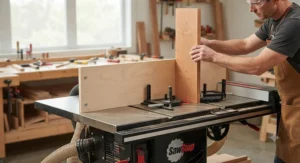
Scaled up for cabinet saws and full-size contractor saws, the Woodpeckers Auxiliary Rip Fence ARF-48 stretches to 48 inches long and stands over 3-1/2 inches tall, with a 12-inch material support and seven built-in T-track slots for reconfiguring featherboards, stops, and jigs. This is the auxiliary fence equivalent of trading a compact car for a full-size truck — more length, more height, and considerably more configuration options, at a proportionally higher price.
What the spec sheet won’t tell you outright, but the design implies clearly, is that the extra height matters most when you’re running raised panels or cutting tenon cheeks, where you need a tall, unwavering vertical reference surface rather than the roughly 2-inch face of a stock rip fence. Because the fence clamps on rather than replacing your factory fence, you can remove it in seconds and revert to stock configuration whenever a cut calls for it.
Reviewers and woodworking forums that discuss premium auxiliary fences in this class routinely cite the ability to reconfigure the fence into “high, low, or L-fence” positions as the standout feature, since it effectively gives you three fence heights from one accessory. For a beginner, the honest verdict is that this product makes the most sense once you’ve confirmed — through cheaper clamp-and-plywood experiments — that you genuinely value a longer, taller reference surface on a regular basis.
Pros:
- ✅ 48-inch length plus 12-inch support handles large panels confidently
- ✅ Seven T-track slots enable extensive jig and featherboard mounting
- ✅ Configurable high/low/L-fence positions from a single accessory
Cons:
- ❌ Premium price bracket relative to beginner clamp-based options
- ❌ Length may be excessive for smaller benchtop table saws
Expect this pick to land in the $150–$220 range at the time of research, making it best suited to woodworkers who’ve already committed to the hobby rather than someone testing the waters.
7. TSO Products Sacrificial Rip Fence for DeWalt — best dedicated sacrificial fence for jobsite saws
Unlike the previous two entries, the TSO Products Sacrificial Rip Fence for DeWalt is explicitly branded as sacrificial rather than auxiliary, and it’s purpose-built as a drop-in accessory for DeWalt’s upgraded rip fence on their popular jobsite table saw line. The design adds protection to the existing DeWalt fence and lets woodworkers safely embed blades or dado stacks for zero-clearance cuts, and it’s built with a fully reversible face so you get a fresh cutting surface when one side wears out.
This is arguably the clearest real-world illustration of the sacrificial fence vs auxiliary fence for beginners distinction: this product isn’t trying to extend your fence’s length or height like the Woodpeckers picks — it exists purely so that the blade can cut into something replaceable instead of your primary fence face. What most first-time buyers overlook is that dado stacks in particular chew through standard plywood auxiliary fences fast, and a reversible, purpose-fit sacrificial fence like this one effectively doubles your service life before you need a replacement.
Because it’s engineered for one specific fence platform, fit and alignment are tighter than a universal DIY board, though that also means it won’t transfer if you switch saw brands later. The broader TSO fence lineup for this saw also includes complementary stock-guide brackets and featherboard mounts, so the accessory ecosystem can grow with you.
Pros:
- ✅ Purpose-fit, reversible sacrificial face for DeWalt jobsite saws
- ✅ Ideal for dado stacks and repeated zero-clearance cuts
- ✅ Extends usable life versus a single-sided shop-made board
Cons:
- ❌ Locked to the DeWalt fence platform, not universal
- ❌ Narrower buyer pool means fewer independent reviews to compare
Pricing generally sits in the $50–$90 range for this accessory tier — check current price directly through TSO or Amazon listings, since jobsite-saw accessory pricing shifts more than universal clamp hardware.
Top 7 Products: Detailed Comparison
| Product | Material | Fits | Best For |
|---|---|---|---|
| Rockler Universal Fence Clamps | Aluminum/steel | Any 3/8″ hole board | Beginners building their first sacrificial fence |
| Milescraft 4009 Fence Clamps | Aluminum/steel | Any 3/8″ hole board | Tightest budget testers |
| POWERTEC 71004V | Extruded aluminum | Wide range of stock thickness | Multi-tool shops (saw + router table) |
| Shop Fox D4586 | Steel | Any 3/8″ hole board | Heavier-duty daily clamping |
| Woodpeckers ARF-BSCS | Extruded aluminum | Fences under 3-1/4″ tall | Compact/jobsite saw owners |
| Woodpeckers ARF-48 | Extruded aluminum | Most full-size rip fences | Cabinet/contractor saw owners |
| TSO Sacrificial Fence | Engineered composite/aluminum | DeWalt jobsite fence only | Dado-heavy DeWalt jobsite users |
The pattern that emerges here is one of escalating commitment: the four clamp systems ask you to supply your own auxiliary board and figure out the geometry yourself, while the three purpose-built fences hand you an engineered solution at a proportionally higher cost. Neither route is objectively “better” — a Rockler Universal Fence Clamps setup paired with a $10 sheet of MDF solves 90% of beginner problems, while the TSO Products Sacrificial Rip Fence for DeWalt solves the remaining 10% for one very specific, dado-heavy use case. If you’re still undecided, weigh how often you expect to need zero-clearance or extended-height cuts against how much you’d rather spend that money on lumber and blades instead.
✨ Ready to stop guessing and start cutting? Grab the clamp set that matches your saw and build your first sacrificial fence this weekend!
Fence Terminology 101: What “Sacrificial” and “Auxiliary” Actually Mean
What is a sacrificial fence? A sacrificial fence is an expendable fence face — typically wood, MDF, or plastic — clamped or screwed to your saw’s primary fence so the blade can safely cut into it, creating a zero-clearance edge for cleaner, safer cuts…
Beginner woodworking terminology gets confusing fast because these two terms genuinely overlap, and even a solid woodworking glossary will often list them side by side rather than drawing a hard line. In plain terms: “auxiliary” describes the role (a secondary, add-on fence), while “sacrificial” describes the fate (it’s meant to get cut into and eventually replaced). Every sacrificial fence is technically auxiliary, but not every auxiliary fence is sacrificial — the Woodpeckers Auxiliary Rip Fence ARF-48, for example, is auxiliary because it’s a secondary fence, but it’s not sacrificial since you’re never supposed to run the blade into its aluminum face.
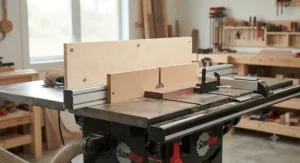
This distinction matters for beginners because it changes what material you should even consider. A sacrificial fence needs to be something the blade can safely pass through — hence wood, MDF, or dense plastic, never aluminum or steel. An auxiliary fence that’s purely for extra length or height, like the Woodpeckers picks above, is built from rigid metal precisely because it should never meet the blade. Get this backwards and you’ll either dull a blade against unforgiving aluminum or build a “permanent” auxiliary fence out of MDF that disintegrates the first time you accidentally nudge it into the cut.
Which Fence Accessory to Buy First: A Buyer’s Decision Framework
If you’re standing in the beginner-accessory aisle mentally comparing all seven products above, here’s a simple framework instead of decision paralysis:
- If your factory fence face is warped, cracked, or peeling → choose a clamp system (Rockler, Milescraft, POWERTEC, or Shop Fox) because it lets you build a flat replacement face for a few dollars in lumber.
- If you regularly cut dados or need zero-clearance for thin stock → choose a dedicated sacrificial fence like the TSO Products Sacrificial Rip Fence for DeWalt (or a shop-made equivalent) because standard plywood chews up fast under repeated dado passes.
- If your factory fence is short and your saw is a benchtop or jobsite model → choose the Woodpeckers Auxiliary Rip Fence ARF-BSCS because compact saws benefit most from extra height and infeed/outfeed support.
- If you own a full-size cabinet or contractor saw and cut large panels regularly → choose the Woodpeckers Auxiliary Rip Fence ARF-48 because the extra length and reconfigurable positions pay off on bigger stock.
- If you’re simply not sure yet → start with the cheapest clamp pair and a scrap of 3/4-inch plywood; you’ll learn what you actually need within your first few projects.
This “if-then” logic mirrors how most experienced woodworkers actually build out their shops — incrementally, in response to a specific frustration, rather than buying every accessory on day one.
Beginner Guide to Fence Attachments: Setup, Maintenance, and Common Mistakes
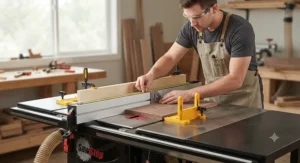
Getting your first sacrificial or auxiliary fence dialed in takes about twenty minutes, but a handful of first-timer mistakes can eat up an entire afternoon if you don’t know to avoid them.
Setup basics: Start by cutting your auxiliary board — 3/4-inch MDF or void-free plywood — slightly longer than your factory fence and at least as tall. Drill 3/8-inch holes near the top edge, spaced to match your clamp hardware, then dry-fit the whole assembly with the blade lowered before you ever power on the saw. As OSHA’s guidance on table saw kickback hazards explains, kickback happens when the blade seizes the stock and throws it back toward the operator, so a shaky or misaligned auxiliary fence is a genuine safety issue, not just a cosmetic one.
First 30 days — common mistakes: New woodworkers frequently over-tighten clamps on thin auxiliary boards, which can bow the material and throw off your cut’s parallelism to the blade. Another frequent error is forgetting to account for the auxiliary fence’s added thickness when reading the fence scale — this is exactly why the Woodpeckers products’ “exactly 2 inches” spec is such a thoughtful design touch. Finally, many beginners advance the blade into a brand-new sacrificial fence at full height on the first pass instead of raising it gradually, which can tear out a ragged kerf instead of the clean, tight zero-clearance slot you’re after.
Maintenance schedule: Inspect your sacrificial fence face before every session that involves dado or rabbet cuts — once the kerf slot widens beyond about 1/8 inch, it stops offering meaningful tear-out support and it’s time to flip or replace the board. Auxiliary fences that aren’t sacrificial (like the aluminum Woodpeckers picks) need far less attention: a quick check that the clamping blocks are still snug is generally sufficient.
Auxiliary Fence for New Woodworkers: Real-World Scenarios
Scenario one — the apartment-dwelling hobbyist: You’ve got a benchtop table saw stored under a workbench, and your projects are mostly small boxes and shelving. A Rockler Universal Fence Clamps setup with a scrap MDF sacrificial fence solves nearly everything you’ll encounter, and it stores flat when you’re done.
Scenario two — the weekend jobsite-saw owner: You bought a DeWalt jobsite saw for a deck project and have since caught the woodworking bug. Your factory fence face is starting to show wear from repeated dado cuts on shelf supports. The TSO Products Sacrificial Rip Fence for DeWalt matches your exact saw platform and solves the wear problem directly, without forcing you to become a fence-building hobbyist on the side.
Scenario three — the budget-conscious cabinet-saw upgrader: You inherited or bought a used full-size contractor saw, and you’re starting to build raised-panel cabinet doors that need tall, stable vertical support. Here, the Woodpeckers Auxiliary Rip Fence ARF-48 earns its premium price tag, because the extra height and T-track accessory mounting genuinely change what cuts are safe and practical to make solo.
Each of these profiles maps a different budget, saw type, and frequency of use onto a different pick from our list — which is really the point of a beginner guide to fence attachments in the first place. Nobody needs all seven products; they need the one that matches their actual saw and actual project mix.
Common Mistakes When Buying Fence Accessories
Beginners tend to make a handful of predictable purchasing errors when shopping for their first fence accessory. First, buying a universal clamp set without first confirming a 3/8-inch hole will actually clear your factory fence’s own hardware — on some fence designs, the clamp arm can interfere with an existing rail or knob. Second, purchasing a purpose-built auxiliary fence like the Woodpeckers ARF-BSCS without measuring the factory fence height first; remember, it’s designed for fences under 3-1/4 inches tall, and installing it on a taller factory fence simply won’t work as intended. Third, assuming any flat board will do for a sacrificial fence — thin hardboard flexes and warps quickly under blade pressure, while void-free plywood or MDF holds a flatter reference surface over repeated use. Fourth, overlooking that a sacrificial fence needs to be replaced, not maintained indefinitely; treating a badly chewed-up board as still usable is a false economy that compromises cut quality and safety alike.
What to Expect: Real-World Performance
On paper, the difference between a $15 clamp set and a $200 machined aluminum auxiliary fence might look like it’s mostly about material and price. In practice, what changes is repeatability. A shop-made sacrificial fence, rebuilt every few months from fresh plywood, gives you excellent results but requires you to re-square and re-check alignment each time you swap it in. A purpose-built auxiliary fence like the Woodpeckers ARF-48 holds its calibration far longer because it isn’t being cut into and isn’t warping from humidity swings the way plywood can. Reviewers who’ve used both approaches over time consistently note that the “rebuild it from scratch” DIY method is perfectly safe and effective, it just asks a little more diligence from the operator each session — a worthwhile trade for a much lower price of entry.
Long-Term Cost and Maintenance
Running the numbers honestly: a clamp set plus replacement MDF boards might cost $20–$30 upfront and another $10–$15 every few months in replacement lumber, depending on how hard you’re using dado stacks. Over two or three years, that adds up to something in the neighborhood of $100–$150 total — right in line with the one-time cost of the Woodpeckers Auxiliary Rip Fence ARF-BSCS. The premium auxiliary fence essentially front-loads that same spend into a single purchase, then requires close to nothing afterward beyond occasional clamp-block checks. Neither path is objectively cheaper in the long run; the real variable is whether you value the lower upfront cost of the DIY route or the “buy it once and stop thinking about it” convenience of a machined product.
Features That Actually Matter (And Those That Don’t)
Marketing copy on fence accessories loves to tout flashy add-ons, but a few features genuinely move the needle for beginners while others are mostly noise. T-track slots matter — they let you mount featherboards and stop blocks later without buying yet another accessory. An accurate, predictable offset (like the Woodpeckers “exactly 2 inches” spec) matters because it keeps your fence scale trustworthy. What doesn’t matter nearly as much: exotic anodized color finishes, bundled carrying cases you’ll rarely use, or marginal weight differences between competing clamp sets that are all well within a comfortable range for hand tightening. Save your money for the features with a real, demonstrable effect on cut quality and safety.
Safety, Regulations, and Compliance Guide
Table saw fences aren’t just a convenience feature — they’re a documented safety requirement. Under OSHA’s woodworking machinery regulation 1910.213, circular saw fences must be built so they can be firmly secured to the table without shifting their alignment relative to the blade, which is exactly why loose, poorly clamped auxiliary fences are a genuine hazard rather than a minor inconvenience. Whatever sacrificial or auxiliary fence you choose from this list, always verify it locks down rigidly and stays parallel to the blade before making a cut, and never remove your saw’s riving knife, splitter, or blade guard to accommodate a fence attachment. This is a sensitive topic in the sense that table saw injuries are common and serious, so if you’re ever unsure whether a setup is safe, it’s worth consulting your saw’s manual or an experienced woodworker before proceeding.
Frequently Asked Questions
❓ What's the actual difference between sacrificial fence vs auxiliary fence for beginners?
❓ Which fence accessory to buy first for a brand-new table saw?
❓ Can I use any wood for a sacrificial fence?
❓ Do auxiliary fences work on jobsite and benchtop table saws?
❓ How often should I replace a sacrificial fence?
Conclusion
If you take one thing away from this guide, let it be this: sacrificial fence vs auxiliary fence for beginners isn’t really an either/or question. Most woodworkers end up owning both — a clamp system for building expendable, replaceable fence faces, and eventually a purpose-built auxiliary fence once they know exactly which cuts they make often enough to justify the upgrade. Start with the cheapest clamp set that fits your saw, build your first sacrificial fence out of scrap plywood this weekend, and let your actual project needs tell you whether a premium auxiliary fence like the Woodpeckers picks is worth the jump later. The terminology stops being confusing the moment you’ve built one with your own hands.
Recommended for You
- Fence Accessory Kit for Cabinet Saw Owners: 7 Real Upgrades (2026)
- 7 Best T-Track Accessories for Table Saw Fence Upgrades (2026)
- Fence Extension Rails for Outfeed Table Support: 7 Picks (2026)
Disclaimer: This article contains affiliate links. As an Amazon Associate, I earn from qualifying purchases. If you purchase products through these links, we may earn a small commission at no additional cost to you.
✨ Found this helpful? Share it with your friends! 💬🤗
