
In This Article
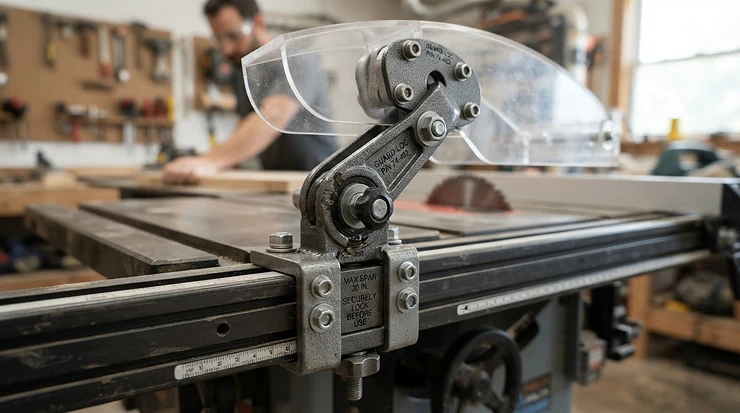
A table saw is refreshingly honest. It does exactly what you ask, it does it fast, and it has no opinion whatsoever about your thumbs. That’s why a well-chosen overhead blade guard for table saw safety keeps climbing the upgrade list in serious shops. It hangs a clear shield above the blade and stays out of your sightline. As a bonus, it inhales the dust cloud the spinning blade flings skyward.

The stakes aren’t abstract. The U.S. Consumer Product Safety Commission estimated roughly 26,500 emergency-department-treated table saw blade-contact injuries in 2017. Its own trend analysis found no discernible change in injury risk from 2004 to 2018, even as more saws shipped with modular guards and riving knives. Translation: a guard in the box isn’t the same as a guard in use. The best overhead design is the one you’ll actually leave on.
This guide sorts seven real options, from budget to premium, through six lenses:
- overhead guard visibility and dust collection
- blade guard mounting compatibility
- rated overhead saw guards
- blade exposure risk
- dust collection integration
- guard clearance
Prices below are ranges as of September 2026, so check current price before you buy.
What Is an Overhead Blade Guard for Table Saw Safety?
An overhead blade guard for table saw safety is a transparent blade cover suspended from an overarm or ceiling boom rather than bolted to the splitter. It shields the spinning blade from above, rides over the workpiece, swings aside for blade changes, and usually includes a dust port that captures airborne chips and fine dust at the source.
Quick Comparison Table: 7 Overhead Guards at a Glance
| Product | Mounting Style | Dust Port | Standout Trait | Best For |
|---|---|---|---|---|
| PSI TSGUARD | Extension-table or ceiling boom (up to 83″) | 4″ | Ceiling-mount option | Budget shops with a long fence rail |
| Exaktor EXOA-2 | Extension-table mast, telescopic boom | 4″ boom | Counterbalance hidden behind basket | Big-fence cabinet saws |
| Grizzly T10113 | Self-supporting arm bolted to saw base | 4″ integrated | 6-1/2″ vertical adjustment | Cabinet saws that shouldn’t stress the extension table |
| Shark Guard | Splitter or riving-knife mount; overhead kit optional | 2.5″, 3″ or 4″ | Thick Lexan, cuts close to fence | Narrow rips and easy removal |
| Excalibur 50-EXBC | Extension-table boom | 4″ main, 3″ inner | Rigid steel boom | Used-market shoppers |
| SawStop TSA-ODC (with SawStop TSG-DC) | Tubing to splitter-mounted guard | 4″ Y-port | Merges above- and below-table ports | SawStop cast-iron owners |
| SawStop TSG-FDC | Floating overarm on extension table | 4″ tube | Stays on for non-through cuts | Dado and joinery work on SawStop saws |
Looking at the comparison above, the split that matters most isn’t price. It’s whether the guard floats (SawStop TSG-FDC, Grizzly T10113, the boom designs) or rides on the splitter (SawStop TSG-DC, Shark Guard). Floating guards handle dadoes and grooves, while splitter-mounted guards bring kickback protection along for the ride. Budget buyers should note that the PSI TSGUARD trades brand polish for reach and flexibility.
💬 Just one click — help others make better buying decisions too!😊
Top 7 Overhead Blade Guard for Table Saw Safety Options: Expert Analysis
The products run roughly from budget to premium. Everything below draws on manufacturer specifications and aggregated owner feedback. Where a review pool was too thin to characterize, I say so.
1. PSI TSGUARD — longest reach, ceiling-mount option
Most overarm systems live or die by their boom, and the PSI TSGUARD offers the longest one in this roundup: up to 83 inches. You can also hang it from the ceiling instead of bolting it to your extension table.
The hood is a single piece of clear, shatterproof plastic that accepts blades up to 16 inches, tolerates dado blades, and clears a 45-degree tilt. So it isn’t a one-trick guard that becomes useless when your setup changes. It accommodates a splitter and anti-kickback pawls, which matters because overhead hoods don’t stop kickback on their own. A counterbalance lets you position it with a fingertip, and it connects to a standard 4-inch hose.
Based on the spec sheet, this suits shops with long fence rails or layouts where an extension-table mast would collide with something. Ceiling mounting is the sleeper feature, since it removes the mast from your footprint entirely. The catch is a one-piece plastic hood that will scratch over the years. A replacement (TSGUARD-DH) exists, which is reassuring.
Verified review depth is thinner than for the big-name arms, so treat this as a known quantity rather than a proven crowd favorite. Older woodworking-forum threads describe this style as a solid performer with real dust collection.
Pros:
- ✅ Boom reaches up to 83 inches
- ✅ Ceiling-mount option frees floor space
- ✅ Accepts splitter, pawls, and dado blades
Cons:
- ❌ Plastic hood scratches with heavy use
- ❌ Fewer recent independent reviews to lean on
Check current price. This class of arm has historically landed in the low-to-mid hundreds of dollars. It’s the best value if you’re comfortable with DIY mounting.
2. Exaktor EXOA-2 — counterbalance stays out of your sightline
The Exaktor EXOA-2 attacks the classic overarm gripe, a dangling weight in your field of view, by hiding its counterbalance behind the guard basket.
The telescopic boom lets you park the rip fence up to 70 inches from the blade. The cover can sit as close as a quarter inch to the fence. The boom is a 4-inch hollow aluminum tube. The maker recommends a 4-inch hose and a 600-800 CFM collector, and it clears a 16-inch blade raised 4 inches and tilted to 45 degrees. That CFM figure is the fine print that decides whether you get a clean table or a decorative hose. Buyer feedback also flags a minimum of about 39 inches from blade to table edge.
The tool-free disconnect of the mast top and boom is quietly clever for crosscutting long stock, because you can clear the overhead without hunting for a wrench. On paper, this is the mid-range pick for a saw with a large fence system.
Amazon reviewers consistently describe it as sturdy and well balanced. Several say they’re glad to stop being pelted with dust. At least one buyer found the dust gain modest on a saw that already had a decent shroud, and another mentioned installation hiccups. A long-running forum comparison also called its hood adjustment fiddlier than the old Excalibur‘s.
Pros:
- ✅ Counterweight sits behind the basket
- ✅ Wheels won’t mark the workpiece
- ✅ Boom telescopes for fences up to 70 inches
Cons:
- ❌ Hood adjustment feels fiddly to some owners
- ❌ Needs roughly 39 inches from blade to table edge
Check current price. Expect the mid-hundreds range, and note that it’s a good value if your collector really does move 600 CFM or more.
3. Grizzly T10113 — self-supporting arm with 6-1/2 inches of vertical range
Where most overarms borrow rigidity from your extension table, the Grizzly T10113 brings its own.
It bolts to the saw base and reaches 39 to 68 inches, with an integrated 4-inch dust line. The see-through housing pivots and locks at height, rides on dual rollers, and offers 6-1/2 inches of vertical adjustment. Unlock the arm and it swings 90 degrees out of the way. The roughly 66-pound shipping weight hints at the steel involved. A separate contractor-saw adapter (T21584) extends compatibility.
Because it’s independent of your extension table, this design sidesteps the twisting torque that a Fine Woodworking review flagged on table-mounted booms. But Grizzly is refreshingly upfront that the T10113 provides no kickback protection. It’s a shield and a dust hood, not a complete safety system, so pair it with a riving knife or splitter.
I couldn’t verify a large, current pool of independent customer reviews for this model. Rather than invent a consensus, I’d suggest reading recent buyer feedback before ordering. Grizzly backs it with a one-year warranty and U.S.-based support.
Pros:
- ✅ Self-supporting, so no extension-table stress
- ✅ Integrated 4-inch duct captures dust at the blade
- ✅ Swings 90 degrees clear of the table
Cons:
- ❌ No kickback protection built in
- ❌ Heavy, and cabinet-style saws fit best
Check current price. It sits in the mid-range and offers strong value for a stationary cabinet saw.
4. Shark Guard — clearest view, slimmest profile for narrow rips
The Shark Guard is the odd duck here. It’s built on a splitter or riving knife, yet an overarm or “tail fin” kit lets you hang it overhead, so it earns a seat.
The guard is molded from thick Lexan, and one reviewer measured it as 70 percent thicker than his stock guard. It’s about 1.625 inches wide outside, which lets you cut closer to the fence. A nylon roller helps it glide, and the dust port comes in 2.5-, 3- and 4-inch sizes. The maker warns that a 4-inch port on a high-CFM system can act like a vacuum and pull work into the guard.
Its port sits directly over the blade, which forum users argue captures dust better than a distant rear port. And because it rides a riving knife, you get kickback protection in the same package, which pure overarms lack. That said, it’s built to order per saw model, so you’ll confirm your model number first.
Owners commonly praise visibility and dust capture. One said the view beat the old Excalibur he replaced. Complaints center on made-to-order lead times and order-delay stories in comment threads, so confirm timing before you commit. One user noted the guard only rises about an inch and an eighth above the table.
Pros:
- ✅ Excellent visibility through thick Lexan
- ✅ Riving knife or splitter comes in the package
- ✅ Three port sizes to match your collector
Cons:
- ❌ Made to order, so confirm lead time
- ❌ Limited lift height for tall stock
Owner reports put saw-specific packages in the roughly $300-$400 range, so verify current pricing. It’s a strong value if you’re patient.
5. Excalibur 50-EXBC — the legacy benchmark with a rigid steel boom
If overhead guards had a hall of fame, the Excalibur 50-EXBC would have a plaque. Availability is the catch.
It came in 10-inch (50-EXBC10) and 12-14-inch (50-EXBC14) versions. It pairs a 4-inch main boom with a 3-inch telescopic inner boom and a flexible 3-inch hose to the cover. Its spring-loaded swing arm follows the workpiece, and it fits saws with roughly 39-3/4 to 67 inches from blade to extension end. Its manual calls it a blade cover and dust hood only, meant to be used with your existing guard or splitter. A Fine Woodworking review noted the cover locks up to 8 inches above the table and that side mounting works with any fence system. It also warned that the boom’s weight can twist an extension table. Use every mounting slot, since the manual advises against fewer than four.
One owner’s site says it’s out of production, and the listings that surfaced during research were used or new-old-stock. So this entry is really a yardstick for what “good” looks like, and a fair pick only if you find a trustworthy unit.
Owners consistently praise its tabletop dust collection, while some note it’s hard to remove when you need clearance for big parts. Others say the 3-inch port sits far from the dust source.
Pros:
- ✅ Sealed steel tubes give strong dust capture
- ✅ Cover locks up to 8 inches above table
- ✅ Works with any fence system
Cons:
- ❌ Hard to remove for oversized stock
- ❌ Discontinued, so parts support is uncertain
Used listings have surfaced in the roughly $150-$200 range, and new-old-stock will vary. Value depends entirely on condition.

6. SawStop TSA-ODC — the SawStop owner’s above-table dust upgrade
The SawStop TSA-ODC isn’t a guard. It’s a tubing assembly that plugs into the SawStop TSG-DC guard, and together they form a tidy above-table system.
The SawStop TSG-DC is splitter-mounted to the trunnion. Its independent lateral slides minimize blade exposure, and its low profile allows cuts as narrow as 3/4 inch. It comes standard on 3HP and larger cast-iron saws, and the 1.75HP models can add it. The SawStop TSA-ODC adds a Y-port that merges above- and below-table collection into a single 4-inch port, with a rubberized collar. It works with all SawStop cast-iron saws but not the Jobsite Saw or the Contractor Saw 30-inch rail kit. SawStop claims the pairing captures 99 percent of dust, and that’s a manufacturer figure, not an independent one.
The analytical catch is that the guard rides on the splitter and must stay down for the collection to work. One Fine Woodworking forum user called that a visibility trade-off. Non-through cuts also mean removing it, and that’s exactly where the floating arm below earns its money.
Owner comments describe strong rip-cut collection, with one calling it near 100 percent on rips.
Pros:
- ✅ Single 4-inch port for the whole saw
- ✅ Low profile handles cuts down to 3/4 inch
- ✅ Simple, factory-matched fit
Cons:
- ❌ SawStop cast-iron saws only
- ❌ Guard must be down, which reduces visibility
The SawStop TSG-DC runs around $170, while the SawStop TSA-ODC should be priced at check current price. Value is excellent if you already own a compatible SawStop.
7. SawStop TSG-FDC — floating arm that stays on for dados and joinery
The SawStop TSG-FDC is the premium play, and its party trick is floating above the table with no splitter mount.
Its wide tube is 3 inches inside and 4 inches outside, and SawStop lists a 400 CFM minimum. The tube stands about 13-1/2 inches above the table. The rigid steel overarm swings away, and the clear cover lifts on a scissor mechanism. Fit depends on the saw: it needs roughly 35-3/4 to 68 inches from blade to extension-table end. Retailers list compatibility with 36-inch and 52-inch T-Glide setups on the CNS, PCS and ICS saws.
Because it doesn’t ride the splitter, you can leave it on for dados, rabbets, and grooves. That’s a rarity and the reason it costs what it does. The guard stays out of the way of your riving knife, so your saw’s kickback protection remains untouched.
The handful of verified buyer ratings I could see call it sturdy, well made, and better than the stock dust arm. That’s a small sample, so weigh it accordingly.
Pros:
- ✅ Works on through and non-through cuts
- ✅ Wide 4-inch tube moves serious air
- ✅ Heavy-duty steel arm swings clear
Cons:
- ❌ Premium price tag
- ❌ Specific to SawStop cast-iron rails
Expect the mid-$500s to low-$600s across retailers, so check current price. Value is strong if joinery cuts are routine.
Top 7 Specs and Value Snapshot
| Product | Reach / Fit | Port | Kickback Protection | Price Tier | Best For |
|---|---|---|---|---|---|
| PSI TSGUARD | Boom to 83″ | 4″ | Accepts splitter and pawls | Budget | DIY-friendly shops |
| Exaktor EXOA-2 | Fence to 70″ | 4″ | Pair with your splitter | Mid | Large-fence saws |
| Grizzly T10113 | 39″-68″ reach | 4″ | None (per maker) | Mid | Cabinet saws |
| Shark Guard | Model-specific | 2.5″-4″ | Riving knife/splitter packages | Mid | Narrow rips |
| Excalibur 50-EXBC | 39-3/4″-67″ | 4″/3″ | None (cover only) | Used | Bargain hunters |
| SawStop TSA-ODC | SawStop-specific | 4″ Y-port | TSG-DC includes pawls and knife/guard switch | Mid-premium | SawStop owners |
| SawStop TSG-FDC | 35-3/4″-68″ | 4″ tube | Saw’s riving knife | Premium | Dado work |
The table makes the trade-off plain: only the Shark Guard and SawStop TSG-DC bring kickback protection to the guard itself. The Grizzly T10113 and Excalibur 50-EXBC are explicitly shields and dust hoods, so plan a riving knife alongside them. If budget is tight, the PSI TSGUARD and a good used Excalibur 50-EXBC are the entry points. Everyone else is paying for fit and finish.
How to Choose an Overhead Blade Guard for Table Saw Safety
Here’s a quick, numbered path from confusion to checkout.
- Measure blade-to-table-edge distance. The Exaktor EXOA-2 wants about 39 inches, the Grizzly T10113 spans 39-68 inches, and the SawStop TSG-FDC spans 35-3/4 to 68. A guard that doesn’t fit is just expensive art.
- Match your rails and fence system. SawStop’s accessories are rail-specific, and long fences need long booms.
- Check your collector’s airflow. A guard with a 4-inch port and a weak collector is a decorative hose.
- Decide whether you cut dados. If yes, favor a floating design.
- Confirm kickback protection separately. Keep a riving knife or splitter on the saw.
- Test visibility. Clear covers fog, scratch, and dust up, so look for easy cleaning and replacement parts.
- Confirm blade size and tilt. Look for at least 45-degree tilt clearance and your blade diameter.
Blade guard mounting compatibility and guard clearance are the two criteria buyers most often skip, and they’re the two most likely to end in a return.
Overhead Guard Visibility and Dust Collection: The Trade-Off Nobody Advertises
Overhead guard visibility and dust collection pull in opposite directions. A tight shroud captures more dust but gives you a smaller window. A bigger, higher hood improves your view but lets dust escape.
Hardware helps. Exaktor hides its counterweight behind the basket so nothing crosses your line of sight. Shark Guard uses thick Lexan and a slim profile. SawStop describes the transparent cover on its floating arm as helping with narrow-cut visibility.
The trade-off shows up plainly in owner reports. One Fine Woodworking forum user noted that SawStop’s overarm collection requires the guard down, which costs some sightline. And there’s such a thing as too much suction. Shark Guard warns that a 4-inch port on a high-CFM collector can pull your work toward the guard.
Keep the cover clean. Shark’s makers suggest periodic glass cleaner and a soft cloth, since dust builds on both sides. Treat overhead guard visibility and dust collection as a system, not a spec sheet. Get the port size, CFM, and hood height working together.
Blade Guard Mounting Compatibility: Will It Actually Fit Your Saw?
Blade guard mounting compatibility comes down to three families: extension-table booms, base-mounted arms, and ceiling mounts.
Extension-table designs like the Exaktor EXOA-2 and Excalibur 50-EXBC need a specific distance to the table end, around 39 to 67 inches depending on the model. The Excalibur 50-EXBC manual insists on using all four mounting slots, and Fine Woodworking noted the torque can twist a table. The Grizzly T10113 bolts to the base and sidesteps that, but contractor saws need the T21584 adapter. The PSI TSGUARD can mount to the ceiling entirely.
SawStop’s ecosystem is the strictest. The SawStop TSA-ODC fits all cast-iron SawStops but not the Jobsite Saw or the Contractor Saw 30-inch rail kit, and it requires the SawStop TSG-DC. Retailers list the SawStop TSG-FDC for 36- and 52-inch T-Glide setups.
Watch for layout conflicts too. One Canadian forum poster skipped an overarm because his saw wing doubles as a router table. Before ordering, sketch where the boom, mast, and support legs will land.
Rated Overhead Saw Guards: What “Rated” Really Means in 2026
Let’s be blunt. I couldn’t locate an independent lab or agency that scores rated overhead saw guards the way a magazine scores blenders. When a listing says “rated,” it usually means one of four things:
- an airflow rating (SawStop lists a 400 CFM minimum; Exaktor recommends 600-800 CFM)
- a blade-size rating (PSI TSGUARD accepts up to 16 inches)
- a manufacturer capture claim (SawStop’s 99 percent pairing claim)
- a star average built from a small pool of buyers
None of these is an injury-prevention certification. The CPSC’s rulemaking record found no discernible improvement in blade-contact injuries even as modular guards spread on new saws. So a guard’s “rating” mostly tells you about fit and airflow, not about protecting your fingers. Use rated overhead saw guards as shorthand for compatibility, and use technique, a riving knife, and a push stick for the actual protection.
Blade Exposure Risk: Where an Overhead Guard Helps and Where It Doesn’t
Blade exposure risk is about how much spinning steel is available to touch, and an overhead guard trims it in specific ways.
It covers the top and sides of the blade, adjusts to stock height, and, with slim designs, hugs the fence. The SawStop TSG-DC allows cuts as narrow as 3/4 inch with its lateral slides, and the Exaktor EXOA-2 lets the cover sit a quarter inch from the fence. Rockler also advises setting the blade so teeth extend only about 1/8 to 1/4 inch above the material, which shrinks blade exposure risk before any guard is involved.
What overhead guards don’t do is stop kickback, and Grizzly T10113 says so plainly. Consumer-advocacy summaries of CPSC data report that roughly one-third of injuries occur with a guard in place, so a guard is a layer rather than a cure. Blade exposure risk also spikes when a guard is removed. Owners on forums describe pulling guards off half the time, and an awkward guard is the one that gets pulled.
Dust Collection Integration: Matching Your Guard to Your Collector
Dust collection integration is where good guards become great or get abandoned.
Wood dust isn’t just a housekeeping problem. OSHA’s woodworking eTool lists wood dust as an IARC Group 1 carcinogen and advises adding a local exhaust hood above the saw blade for extra control. That’s exactly the job an overhead guard does.
Match the port to your airflow. SawStop TSG-FDC needs 400 CFM or more, Exaktor EXOA-2 wants 600-800, and Grizzly T10113 and PSI TSGUARD both use 4-inch connections. A forum owner said the 1.5-inch port on his stock guard was useless, while a 3-inch Shark Guard port “works really well.” Another noted that the Excalibur‘s rear 3-inch port sits far from the dust source, whereas the Shark Guard port sits right over the blade.
For SawStop owners, the SawStop TSA-ODC Y-port simplifies dust collection integration by uniting above- and below-table extraction. Add blast gates so you can balance airflow when one port needs more suction.

Guard Clearance: Room for Your Hands, Stock, and Push Sticks
Guard clearance is the difference between a guard you’ll use and one that ends up in the corner.
Fine Woodworking’s review of the Excalibur overarm cover notes the cover locks up to 8 inches above the table. Modern equivalents vary. The Grizzly T10113 gives 6-1/2 inches of vertical adjustment, and one Shark Guard owner reported about an inch and an eighth of lift on his setup. That’s fine for 1x lumber and plywood but a limit on thicker stock.
Then there’s side clearance. One forum contributor asked whether a push stick fits between the fence and guard, noting that the moments you need protection most are when guards interfere. Slim designs help, and the SawStop TSG-DC and Shark Guard both target narrow-cut guard clearance.
Overhead guard clearance also means what’s above and behind you. Boom length, ceiling height, and outfeed support all matter. Before buying, test the swing arc with a piece of cardboard and a tape measure.
Overhead Arm vs Splitter-Mounted Guard vs No Guard
| Feature | Overhead Arm Guard | Splitter-Mounted Guard | No Guard |
|---|---|---|---|
| Blade coverage from above | Adjustable hood | Low-profile hood on splitter | None |
| Above-table dust capture | Strong with 4″ port and enough CFM | Good if port sized right | Poor |
| Kickback protection | None by itself | Usually built in | None |
| Non-through cuts | Possible with floating designs | Guard typically comes off | Not applicable |
| Best For | SawStop TSG-FDC, Grizzly T10113 | SawStop TSG-DC, Shark Guard | Nobody we’d recommend |
The table shows why the debate isn’t either/or. Overhead arms win on dust capture and non-through cuts, especially the floating SawStop TSG-FDC, while splitter-mounted guards win on built-in kickback protection. If your saw already has a good riving knife, an overhead arm adds coverage and dust control without duplicating anything. If it doesn’t, consider a Shark Guard-style package first.
Practical Guide: Installing and Tuning Your Overhead Guard
Before You Drill
Unplug the saw, then measure. Confirm blade-to-table-edge distance, clear the rail area, and mark mounting holes on the table apron. Use every mounting slot the manufacturer provides, since Excalibur 50-EXBC documentation warns against fewer than four.
First-Use Tune-Up
Level the boom parallel to the table, then center the cover over the blade. Set cover height just above the workpiece, then swing it out to check for interference with your fence and miter slot. Seal joints on the dust tubes and connect the hose. Run the collector before you cut, and watch whether it pulls stock into the guard, a real concern the Shark Guard makers flag with 4-inch ports.
The First 30 Days
Common mistakes:
- leaving the cover higher than needed
- forgetting to re-check clearance after tilting the blade
- overtightening pivot clamps until the guard fights you
- ignoring a fogged cover
Wipe the clear panels regularly, and check hose clamps and joints for leaks monthly. If you never remove the guard for tasks it blocks, you’re more likely to leave it on the other 95 percent of the time.
Real-World Scenarios: Which Guard Fits Which Shop?
The garage hobbyist. A contractor saw, a shop vacuum, a tight budget, and cuts twice a week. A Shark Guard with a 2.5-inch port fits shop-vac hoses and brings a riving knife along. The PSI TSGUARD is the alternative if you have a real 4-inch collector and want a ceiling mount to free floor space. Budget sits roughly in the $200-$400 range.
The joinery-heavy SawStop owner. A cast-iron saw with 36-inch rails, frequent dadoes and grooves, and a dedicated collector. The SawStop TSG-FDC is built for exactly this, since it stays on for non-through cuts. If cuts are mostly through-cuts and the budget is tighter, the SawStop TSG-DC with the SawStop TSA-ODC provides an efficient single-port setup.
The small cabinet shop. A 3HP saw, a collector moving 1,000+ CFM, and daily sheet-good work. Here the Grizzly T10113 or Exaktor EXOA-2 makes sense. Both take a 4-inch line and cover long fence distances. Choose the Grizzly T10113 if you’d rather not load your extension table. Pair either with a good riving knife.
In every scenario, the winning guard is the one that fits your saw, your collector, and your habits.
Safety, Regulations, and Compliance Guide
Home shops aren’t regulated the way workplaces are, but the rules make a useful benchmark. Under OSHA’s woodworking machinery standard, hand-fed circular ripsaws must be guarded by a hood that completely encloses the portion of the saw above the table and above the material being cut. Crosscut table saws carry the same hood requirement.
Dust has exposure limits, too. OSHA’s PEL for total dust is 15 mg/m³, while NIOSH recommends a much stricter 1 mg/m³. Product pages for SawStop’s guard carry California Proposition 65 wood-dust warnings, another reminder that above-table collection matters.
Manufacturer compliance statements are just that, statements. Shark Guard says its products conform to OSHA and Canadian CCOHS regulations, and you should verify that against your own situation. Regulations vary by location, and this article isn’t legal advice. If you run a commercial shop, confirm requirements with your local authority before relying on any guard.

Frequently Asked Questions
❓ Can an overhead blade guard for table saw safety stay on for dado cuts?
❓ How much airflow does an overarm guard need?
❓ Will an overarm guard fit my contractor saw?
❓ Does an overhead guard replace a riving knife?
❓ Can I replace a scratched hood or a dust port?
Conclusion
An overhead blade guard for table saw safety won’t make a table saw forgiving, but it makes safe habits easier to keep. It covers the blade, tames the dust, and stays out of the way when it’s well chosen. The six lenses (overhead guard visibility and dust collection, blade guard mounting compatibility, rated overhead saw guards, blade exposure risk, dust collection integration, and guard clearance) turn a confusing market into a short list.
If you own a compatible SawStop and cut a lot of dados, the SawStop TSG-FDC is the standout, with the SawStop TSA-ODC and SawStop TSG-DC pairing as the efficient alternative. For cabinet saws where you’d rather not stress the extension table, the Grizzly T10113 is the sturdy pick. The Exaktor EXOA-2 and PSI TSGUARD cover mid-range and budget needs, the Shark Guard wins on visibility and riving-knife integration, and the Excalibur 50-EXBC remains the yardstick if you find a clean used one.
Whichever you choose, pair it with a riving knife, a sharp blade set only slightly above the stock, and a push stick you’re willing to use. Then leave the guard on. That’s where the protection actually lives.
Recommended for You
- Aftermarket Blade Guard Under $150: 7 Proven Picks (2026)
- Top Rated Featherboards For Consistent Rip Cuts: 7 Picks (2026)
- Featherboard For Beginners Table Saw Setup: 7 Picks For 2026
Disclaimer: This article contains affiliate links. As an Amazon Associate, I earn from qualifying purchases. If you purchase products through these links, we may earn a small commission at no additional cost to you.
✨ Found this helpful? Share it with your friends! 💬🤗
