
In This Article
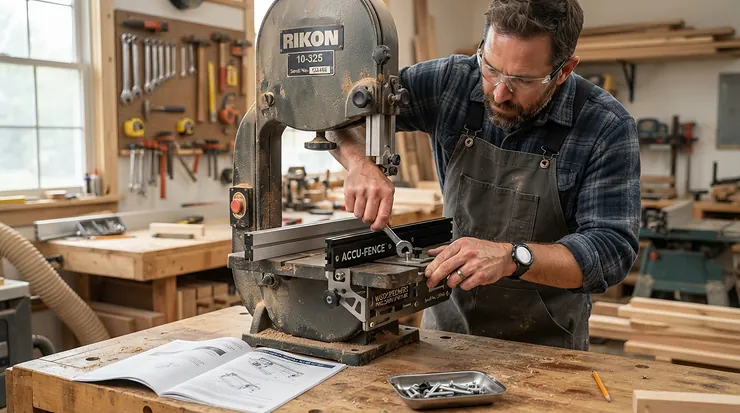
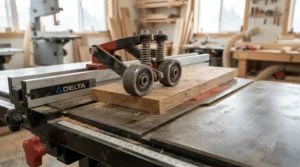
An anti kickback roller kit for contractor saws is a set of spring-loaded, one-way rollers, usually clamped to the rip fence or locked into a miter slot, that press the board down and against the fence while letting it travel only toward the outfeed. Because the rollers resist backward motion, a rip cut has a much harder time twisting or sliding back at you. 🛠️
Here’s the thing about contractor saws, though. They sit in a funny middle ground. According to Wikipedia’s overview of table saw types, contractor saws are the heavier, open-stand, often wheeled machines that sit above benchtop models and below cabinet saws. Most have a belt-driven motor hanging off the back and a cast-iron top. They’re capable. They’re also frequently older, frequently missing a modern riving knife, and frequently asked to rip stock that a cabinet saw would laugh off.
That gap is exactly where a contractor saw kickback roller upgrade earns its keep.
A small honesty note before we go further: there is no single universal “kit” that bolts onto every open-stand saw. The market is a patchwork of fence-mounted roller sets, miter-slot roller guides, spring-finger featherboards, splitters, and push blocks. So this guide ranks seven real products that work as a roller kit for contractor table saw setups, or that cover the gaps rollers leave behind. Think of it as assembling a safety toolkit rather than buying one magic box.
Everything below is based on published specs, published reviews, and aggregated owner feedback. No hands-on testing is claimed, and prices appear as ranges because they move constantly. Check current price before you buy.
Quick Comparison Table: Which Pick Fits Which Contractor Saw Owner?
| Product | Type | Mounts To | Best For |
|---|---|---|---|
| Compass Universal Roller Guides RG-1 | Dial-adjusted roller guide | T-shaped miter slot | Compass Universal Roller Guides RG-1: owners wanting precise pressure and multi-tool use |
| Board Buddies W1104 | Fence-mounted one-way rollers | Rip fence (3–3½ in. tall) | Board Buddies W1104: classic fence-mounted retrofit on open-stand saws |
| BOW FeatherPRO FP1 | EVA-finger featherboard | Miter slot (¾ in. bar) | BOW FeatherPRO FP1: smooth, non-marring side pressure |
| POWERTEC Universal Tandem Featherboards 71393 | Tandem featherboard pair | T-track / fence | POWERTEC Universal Tandem Featherboards 71393: budget-minded multi-tool shops |
| Kreg PRS3020 True-FLEX Featherboard | Wedge-lock featherboard pair | Miter slot or T-slot | Kreg PRS3020 True-FLEX Featherboard: no-hardware, quick-swap setups |
| MicroJig MJ Splitter SteelPro SP-2 | Aftermarket splitter | Zero clearance insert | MicroJig MJ Splitter SteelPro SP-2: saws with no riving knife |
| MicroJig GRR-RIPPER GR-100 3D | Push block | Hand-held | MicroJig GRR-RIPPER GR-100 3D: narrow rips and hand control |
Read the table as a map, not a verdict. The rollers and featherboards manage the board’s position. The splitter manages the kerf behind the blade. The push block manages your hands. Notice that the Compass Universal Roller Guides RG-1 and Board Buddies W1104 are the only true one-way roller systems here, while the Kreg PRS3020 True-FLEX Featherboard and BOW FeatherPRO FP1 do a similar anti-reverse job with flexible fingers instead. If you own a saw without a riving knife, the MicroJig MJ Splitter SteelPro SP-2 deserves a look before anything else.
💬 Just one click — help others make better buying decisions too!😊
Top 7 Anti Kickback Roller Kit for Contractor Saws Options: Expert Analysis
1. Compass Universal Roller Guides RG-1 — dial-set pressure, one-way rollers
The standout here is the pressure dial. After you touch the rollers to the workpiece and lock them, a precise dial sets the force, and each roller is individually spring-loaded, so even imperfect alignment still gives both rollers a grip. That’s the headline from Fine Woodworking’s review of the Compass Universal Roller Guides.
The urethane rollers turn one direction, which lets the board advance but not retreat or lift. In practice, that means less drifting toward the blade and less rearward travel, the two behaviors that precede a nasty kickback. The guide mates with any T-shaped miter slot, so contractor saw compatibility is usually straightforward as long as your slot profile is a true T. The Compass Universal Roller Guides RG-2 adds a second layer of rollers for extra height at a modest price bump, according to the same review.
On paper, this is the most “engineered” option on the list. What the spec sheet won’t tell you is that miter-slot mounting keeps the fence free, which matters on a contractor saw where the fence rail already crowds the table.
Reviewers consistently describe the Compass Universal Roller Guides RG-1 as easy to adjust and better than the featherboards they already owned. Comments under the review mention using it on table saws and router tables.
Pros:
- ✅ Dial sets roller pressure precisely
- ✅ Spring-loaded rollers forgive imperfect alignment
- ✅ Works across table saw, bandsaw, router table
Cons:
- ❌ Costs several times more than a featherboard
- ❌ Requires a T-shaped miter slot
Price: roughly in the $180–$300 range depending on model and promotions. Value verdict: pricey, but the most flexible roller retrofit here.

2. Board Buddies W1104 — the classic fence-mounted one-way roller pair
The standout feature is simplicity. The Board Buddies W1104 is a pair of spring-loaded neoprene wheels on die-cast aluminum bodies that turn clockwise only, so they work as both hold-down and anti-reverse devices. Each unit has a mounting bracket, main body, and roller, and the listing says it mounts to fences 3 to 3½ inches high and at least 1 inch wide.
That fence-height spec is your first compatibility test. Measure before you buy.
Fine Homebuilding’s writer found the setup sturdy enough for jobsite saws, even if it isn’t industrial-grade, and appreciated the lift lever that lets you pull stock either direction. In practical terms, the rear roller keeps pressure on the board after it clears the blade, so you can retrieve long stock from the outfeed side.
Here’s the honest caveat from woodworking forums: one-way rollers prevent a board sliding back, but may not stop the violent type of kickback where the blade’s rising teeth lift the board off the table. Several owners say the Board Buddies W1104 doesn’t replace a splitter or riving knife, yet makes cuts more consistent.
Pros:
- ✅ Quick on-and-off fence mounting
- ✅ Wheels turn clockwise only for anti-reverse
- ✅ Non-marring neoprene protects stock
Cons:
- ❌ Can crowd small boards and push sticks
- ❌ Fence-height limits restrict compatibility
Price: historically around the $80 range for a set; listings vary and stock fluctuates, so check current price. Value verdict: fair value for fence-mounted retrofit mounting.
3. BOW FeatherPRO FP1 — smooth EVA feathers on a ¾-inch miter bar
The standout is the EVA feather material, described in listings as non-marring and mounted on a ¾-inch AnchorPRO miter bar. The manufacturer claims strong kickback resistance, a marketing claim worth treating as a claim rather than a measured fact.
Why does the feather material matter? Stiff plastic fingers can chatter or dent softer woods, while EVA flexes more evenly. On a contractor saw, where the cast-iron top and wings are usually flat and stable, that smoother pressure helps rip cuts stay straight against the fence.
Marketplace data from Amazon’s table saw accessory ranking lists the BOW FeatherPRO FP1 at number 7 in Table Saw Accessories in one snapshot, which suggests steady demand. I couldn’t verify individual review scores for this unit at research time, so check the live listing.
My analytical take: this is the pick for woodworkers who want featherboard behavior without a roller’s footprint. It won’t replace a one-way roller’s positive grip, but it holds boards snugly and gently.
Pros:
- ✅ Non-marring EVA feathers protect finished stock
- ✅ Miter bar mounting avoids fence clutter
- ✅ Works across saw, router table, band saw
Cons:
- ❌ Needs a standard ¾-inch miter slot
- ❌ Review scores not verified at research time
Price: not verified at research time, so check current price. Value verdict: reasonable mid-tier choice if your miter slots are standard.
4. POWERTEC Universal Tandem Featherboards 71393 — budget pair with T-track bolts
The standout is the tandem, two-pack design with included T-track bolts, aimed at table saws, router tables, router fences, and band saws. Catalog data from July 2026 shows it among the best-selling featherboards in Amazon’s results, though I’m treating that as a popularity signal, not a quality endorsement.
Two featherboards mean you can press stock down and toward the fence at once, a mix that mimics what a roller pair does. On a contractor saw, that matters because you typically have only one hand free for a push stick near the blade.
Reviewer sentiment for this specific product wasn’t verifiable in my sources, so I’d rather say that than invent it. What I can say from the spec: the T-track compatibility means you may need an auxiliary fence or T-track on your rip fence, which adds a small retrofit mounting task.
My take for budget builders: a decent entry point into a roller kit for contractor table saw setups when funds are tight, provided you accept that fingers flex but don’t lock like one-way rollers.
Pros:
- ✅ Two featherboards for pressure on two axes
- ✅ T-track bolts included in the box
- ✅ Multi-tool use across the shop
Cons:
- ❌ Fingers don’t mechanically lock like rollers
- ❌ Reviews unverified in available sources
Price: typically a modest budget range; check current price. Value verdict: strong value if you already have T-track.
5. Kreg PRS3020 True-FLEX Featherboard — wedge-lock miter slot mounting
The standout is the wedge-lock system: the featherboard grips a ⅜ x ¾-inch miter slot or T-slot without extra hardware. Kreg says each finger delivers consistent pressure, and the body is a durable plastic composite.
Why care? Hardware-free mounting means setup takes seconds, and on a contractor saw you’ll move featherboards constantly between rip widths. That convenience is a quiet safety feature, since a tool that’s annoying to set up tends to live in a drawer.
One retailer listing showed roughly 4.6 stars across more than a thousand ratings. Reviewers say it’s helpful on a table saw, though a few note fit issues. One mentioned oversized miter slots needing a snug-up, another reported problems on certain DeWalt saws while someone else found it locked tight on a DeWalt DWE7491. Translation: test your slot width.
If you want true contractor saw compatibility, measure your miter slot first.
Pros:
- ✅ Wedge-lock needs no extra hardware
- ✅ Twin pack covers two positions
- ✅ Large review base around 4.6 stars
Cons:
- ❌ Some saws’ slots fit loosely
- ❌ Fingers flex rather than lock
Price: roughly $25–$40 range. Value verdict: best bang-for-buck featherboard here.
6. MicroJig MJ Splitter SteelPro SP-2 — the aftermarket splitter fix
The standout is what it solves: no riving knife. The MicroJig MJ Splitter SteelPro SP-2 installs directly into a wood or plastic zero clearance insert and has an automatic kerf keeper that follows a pinching kerf. Its ABS shell wraps a stainless-steel core. Variants exist for thin and full kerf blades.
Why does this belong in an article about rollers? Because rollers address board travel, while a splitter addresses the pinch behind the blade, the classic kickback trigger. Fine Woodworking’s kickback explainer is blunt that a riving knife or splitter is the best prevention.
Owner sentiment is mixed in a useful way. One owner of an old cabinet saw installed it after making a custom insert and liked it. Another reported it wouldn’t work on their Ridgid saw, and a LumberJocks poster returned theirs. The lesson: measure your insert and blade kerf.
Pros:
- ✅ Adds splitter protection to riving-knife-less saws
- ✅ Kerf keeper reduces blade pinching
- ✅ Drill guide helps alignment
Cons:
- ❌ Needs a compatible zero clearance insert
- ❌ Doesn’t suit every saw
Price: listings I found varied widely; check current price. Value verdict: essential if your saw lacks a splitter.
7. MicroJig GRR-RIPPER GR-100 3D — the hand-control backup
The standout is that it’s a push block, not a roller, and that’s exactly why it’s here. A push block keeps your hand away from the blade and controls the stock. In Amazon’s featherboard results, it appears among the best sellers, per market snapshots.
I could not verify detailed specs or reviewer text for this unit, so I’ll stay in analysis mode. On a contractor saw, rollers hold the board in place until it clears the blade, but you still need to push the trailing end past it. A push block fills that moment. A commenter on Fine Homebuilding’s roller article even called the MicroJig GRR-RIPPER GR-100 3D a better option than rollers for custom work, a subjective opinion, but telling.
Think of it as the partner, not the competitor. Roller plus push block beats either alone.
Pros:
- ✅ Keeps hands clear of the blade
- ✅ Complements fence-mounted rollers
- ✅ Useful on narrow rips
Cons:
- ❌ Doesn’t hold stock down mid-board
- ❌ Specs unverified in available sources
Price: check current price. Value verdict: low-cost insurance.
Top 7 Specs and Price-Range Comparison
| Product | Mounting | Direction Control | Price Range | Rating Signal | Best For |
|---|---|---|---|---|---|
| Compass Universal Roller Guides RG-1 | T-shaped miter slot | One-way urethane rollers | ~$180–$300 | Positive Fine Woodworking review | Compass Universal Roller Guides RG-1: precision seekers |
| Board Buddies W1104 | Rip fence | One-way (clockwise) | Around $80 historically | 4.5/5 on one retailer | Board Buddies W1104: fence retrofits |
| BOW FeatherPRO FP1 | ¾-inch miter bar | Flexible EVA feathers | Not verified | Ranked #7 in accessories | BOW FeatherPRO FP1: finished stock |
| POWERTEC Universal Tandem Featherboards 71393 | T-track bolts | Flexible fingers | Budget range | Not verified | POWERTEC Universal Tandem Featherboards 71393: budget builds |
| Kreg PRS3020 True-FLEX Featherboard | Wedge-lock miter/T-slot | Flexible fingers | ~$25–$40 | ~4.6 stars, 1,000+ ratings | Kreg PRS3020 True-FLEX Featherboard: quick swaps |
| MicroJig MJ Splitter SteelPro SP-2 | Zero clearance insert | Splitter and kerf keeper | Varies | Mixed owner feedback | MicroJig MJ Splitter SteelPro SP-2: no riving knife |
| MicroJig GRR-RIPPER GR-100 3D | Hand-held | Push control | Check price | Best-seller listings | MicroJig GRR-RIPPER GR-100 3D: hand safety |
The pattern is clear: money buys precision and mechanical lock, but the cheaper picks deliver most of the daily value. The Compass Universal Roller Guides RG-1 justifies its premium only if you’ll use it across several machines. For most contractor saw owners, a Kreg PRS3020 True-FLEX Featherboard pair plus a MicroJig GRR-RIPPER GR-100 3D is the cost-effective floor, with the Board Buddies W1104 as the roller upgrade.
Contractor Saw Compatibility: What Fits, What Doesn’t
Contractor saw compatibility is the single most common reason a perfectly good accessory ends up in a drawer. Open-stand saws vary wildly, so check four things before ordering.
Miter slot profile. Many roller guides and featherboards assume a standard ⅜ x ¾-inch slot. The Compass Universal Roller Guides RG-1 specifically wants a T-shaped slot. Slide a known ¾-inch bar through yours. If it rattles or binds, you’ll know quickly.
Fence face height and width. The Board Buddies W1104 lists a fence height of 3 to 3½ inches and at least 1 inch wide. Some contractor fences are taller or shorter, and a few have rounded or tubular faces that complicate clamping.
Table surface. Cast-iron tops are common on contractor saws, as noted earlier, but extension wings are sometimes stamped steel. Flatness matters for roller contact, so lay a straightedge across the wings.
Blade guard hardware. If your saw has an old-style guard or a factory splitter, check clearance behind the blade so a roller doesn’t collide with it. Some owners remove guard hardware entirely for dado work, but through-cuts are a different story, as one manufacturer manual stresses using the guard, riving knife, and anti-kickback pawls whenever you make a through cut.
Dust and belts matter too. A contractor saw’s motor and belt hang behind the cabinet-less stand, and long offcuts can catch there. Keep outfeed space clear so the roller’s rear wheel isn’t fighting debris.
Retrofit Mounting: A Step-by-Step Guide for Open-Stand Saws
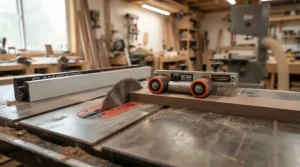
Retrofit mounting sounds technical, but it comes down to repeatable steps. Here’s a practical sequence that works for fence-mounted rollers like the Board Buddies W1104 and miter-slot types like the Compass Universal Roller Guides RG-1.
- Unplug the saw. Always, and tape a note on the switch if others share the shop.
- Verify alignment first. The blade should be parallel to the miter slots and fence. Fine Woodworking stresses this because misalignment itself can cause kickback.
- Park the fence at your cut width. Mount a fence roller so the first wheel sits ahead of the blade and the second sits beyond it, never directly beside the teeth.
- Set height to the stock. The roller should press near the board’s center thickness, not the edge.
- Check clearances. Raise and lower the blade, run the guard through its travel, and confirm nothing collides.
- Test with scrap. Feed a scrap board by hand with the saw off, feeling for smooth forward motion and resistance backward.
That last step is the quiet hero. A retrofit roller system for open stand saw setups only works if the one-way action truly bites in reverse. If the board slides backward freely, the roller isn’t engaging.
Common retrofit mounting mistakes in the first month: tightening a clamp so hard it deforms the fence, setting rollers too close to the blade, and forgetting that moving the fence changes everything. Re-check after each fence move.
Roller Tension Adjustment: Dial It In Without Binding
Roller tension adjustment is where good retrofits become great ones, and where a lot of people quietly over-tighten.
The goal: enough pressure to keep the board against the table and fence, not so much that feeding becomes a wrestling match. According to the Compass review, the pressure dial lets you set force precisely after the rollers touch the work and are locked, with each roller spring-loaded so both press on the board. With a fence-mounted unit like the Board Buddies W1104, tension comes from bracket height and spring preload, with owners describing many adjustment points.
Try this process:
- Start light. Set the rollers so they just touch the stock.
- Add a quarter turn of pressure and feed a scrap.
- Feel for stalls. If you must push hard to move the board, back off.
- Test reverse resistance. Pull gently backward. It should grip.
- Re-check on thick versus thin stock. Pressure that works on ¾-inch plywood may crush a thin strip.
Featherboards behave differently. A Kreg PRS3020 True-FLEX Featherboard relies on finger flex, so position it so fingers deflect slightly, about an inch or so of engagement is a commonly used rule of thumb among woodworkers, though your stock thickness decides. Place featherboards ahead of the blade, never beside or beyond it, because pressure past the blade can pinch the offcut and cause the very kickback you’re trying to avoid.
Real-World Scenarios: Matching Kits to Real Shops
Scenario 1: The weekend remodeler. Imagine a homeowner ripping 3/4-inch plywood for shelving twice a month on an older contractor saw with a stamped-steel wing and no riving knife. Budget matters. The sensible stack: a MicroJig MJ Splitter SteelPro SP-2 for the missing splitter, a Kreg PRS3020 True-FLEX Featherboard pair for side pressure, and a MicroJig GRR-RIPPER GR-100 3D for hand control.
Scenario 2: The small cabinet shop. Picture a part-time maker ripping hardwood boards several times a week. Repeatability matters, and time spent fiddling costs money. A Compass Universal Roller Guides RG-1 earns its premium by serving the table saw, router table, and bandsaw, and setting pressure by dial speeds repeat setups.
Scenario 3: The jobsite-turned-garage woodworker. Think of someone who moved a contractor saw from job to job and now keeps it in a garage. They want fast on-off. The Board Buddies W1104 goes on in seconds according to owner reports, and its fence mount suits a saw with a solid rail. They’d add a BOW FeatherPRO FP1 for thin, finished stock where marring matters.
Notice the pattern. No one needs all seven. Pick the two or three that address your particular hazard.
How to Choose an Anti Kickback Roller Kit for Contractor Saws
Here’s a short decision path. Use it as a checklist.
- Confirm your saw has a splitter or riving knife. If not, address that first. Fine Woodworking says a properly used riving knife prevents kickback better than anything else.
- Measure your miter slot. Standard ⅜ x ¾ inch? T-shaped? This decides whether miter-slot guides fit.
- Measure your fence face. Compare to the 3–3½-inch spec of fence-mounted rollers.
- Decide roller versus feather. One-way rollers grip rearward motion mechanically. Featherboards apply gentle flexing pressure.
- Count your machines. If a tool will also serve a router table, versatile mounts pay off.
- Set a budget. A pair of featherboards sits at the low end, a dial-adjusted roller guide at the high end.
- Read recent reviews for your saw brand. Several buyers flagged fit issues on specific saws, so search your model.

Common Mistakes When Buying and Using Roller Kits
Treating rollers as a riving knife substitute. Forum owners say plainly that rollers don’t replace a splitter. Pawls, riving knives, and splitters tackle different parts of the problem. Fine Woodworking’s analysis of kickback explains why the splitter or riving knife matters most.
Placing the roller beside the blade. The offcut can pinch. Keep pressure points ahead of the teeth.
Ignoring board prep. Internal stress, warped boards, and knots can cause kickback regardless of accessories. Rip only boards with a jointed edge when possible.
Buying by marketing claims. “5x kickback resistance” is a manufacturer claim. Evaluate fit, build, and independent reviews.
Forgetting maintenance. Rubber ages. Springs fatigue. More on that next.
Roller Kit vs Alternatives: Which Protection Layer Does What?
| Option | Main Job | Weakness | Best For |
|---|---|---|---|
| Board Buddies W1104 | Holds stock, resists backward travel | May not stop board lift-up | Board Buddies W1104: steady straight rips |
| Kreg PRS3020 True-FLEX Featherboard | Side pressure toward fence | Fingers flex, don’t lock | Kreg PRS3020 True-FLEX Featherboard: fast setups |
| MicroJig MJ Splitter SteelPro SP-2 | Keeps kerf open behind blade | Insert-dependent fit | MicroJig MJ Splitter SteelPro SP-2: saws lacking splitters |
| MicroJig GRR-RIPPER GR-100 3D | Hand control | No mid-board hold-down | MicroJig GRR-RIPPER GR-100 3D: narrow stock |
Each tool covers a different failure mode. A roller addresses board movement along the fence; a splitter addresses the kerf closing behind the blade; a push block addresses your hands. The honest conclusion: the strongest setup layers two or three of these. If a riving knife or splitter is missing, buy that first. Then add a roller or featherboard for control, then a push block for the final inches of every cut.
Long-Term Cost and Maintenance
Let’s talk total cost of ownership, because the sticker price lies a little.
A pair of Kreg PRS3020 True-FLEX Featherboard units in the $25–$40 range might last years of heavy use per the manufacturer’s claim, but plastic fingers can fatigue. Replacement is cheap, so cost per year stays tiny. A Compass Universal Roller Guides RG-1 costs several times more up front, yet spreading it across three machines and a decade of use narrows the gap.
Rubber and urethane rollers deserve a monthly look. Wipe sawdust and pitch off the wheels, check that the one-way action still bites, and test spring return. If a roller starts slipping backward, it’s done its job; replace it. A Board Buddies W1104 has multiple adjustment points, so tighten loose hardware periodically.
Splitters like the MicroJig MJ Splitter SteelPro SP-2 are consumable in a sense: replace the zero clearance insert as the slot widens, and replace the splitter if the kerf keeper deploys, since the manufacturer says that’s your cue to shut off the saw.
Budget roughly: $60–$100 for a basic featherboard-plus-push-block starter stack, and $300 or more for a premium roller-plus-splitter stack. These are rough planning ranges, not quotes.
Safety, Standards, and Why Rollers Are One Layer, Not the Whole Cake
Regulation context helps you calibrate expectations. In a proposed rule, the Consumer Product Safety Commission estimated 33,400 emergency-department-treated table saw injuries in 2015, with about 92 percent likely involving blade contact, and concluded that existing safety devices such as modular guards and riving knives did not adequately address that risk. You can read the details in the Federal Register notice on table saw blade-contact injuries.
Fine Woodworking also notes that riving knives became standard on new U.S. saws in 2005 via the UL 987 update. That matters for contractor saw owners because many older machines predate the requirement, which is exactly why aftermarket splitters and roller upgrades are popular.
The takeaway isn’t doom. It’s layering: guard or splitter, pawls where applicable, roller or featherboard, push block, sharp blade, and attention. No accessory makes a table saw safe on its own.
FAQ: Anti Kickback Roller Kit for Contractor Saws
❓ Do roller kits fit open stand contractor saws without drilling?
❓ Can a roller replace a riving knife on my contractor saw?
❓ How tight should I set roller pressure?
❓ Are featherboards a good substitute for one-way rollers?
❓ How often should I inspect an anti kickback roller upgrade?
Conclusion: Build a Layered Setup, Not a Single Silver Bullet
If you take one idea from this guide, take this: an anti kickback roller kit for contractor saws is a team player. The Compass Universal Roller Guides RG-1 is the precision pick, the Board Buddies W1104 is the classic fence-mounted retrofit, the BOW FeatherPRO FP1 and Kreg PRS3020 True-FLEX Featherboard cover gentle pressure, the POWERTEC Universal Tandem Featherboards 71393 serves tight budgets, the MicroJig MJ Splitter SteelPro SP-2 fills the riving-knife gap, and the MicroJig GRR-RIPPER GR-100 3D guards your hands.
Start by confirming your saw’s splitter situation, then measure your miter slots and fence, then buy the smallest set that covers your actual weak spots. Dial in roller tension adjustment slowly, mount everything with the saw unplugged, and re-check after every fence move. A contractor saw kickback roller upgrade is cheap insurance compared with the alternative.
✨ Ready to upgrade your saw?
🔍 Click any highlighted product above to check current pricing and availability, then build a setup that fits your shop, your saw, and your budget. Your future fingers will thank you!
Recommended for You
- Anti Kickback Device For Ripping Hardwood: 7 Safest Picks (2026)
- Pawl System Vs Roller System For Kickback Safety: 7 Best Picks 2026
- Anti Kickback Pawls For Table Saw: 7 Smart Picks For 2026
Disclaimer: This article contains affiliate links. As an Amazon Associate, I earn from qualifying purchases. If you purchase products through these links, we may earn a small commission at no additional cost to you.
✨ Found this helpful? Share it with your friends! 💬🤗
