In This Article
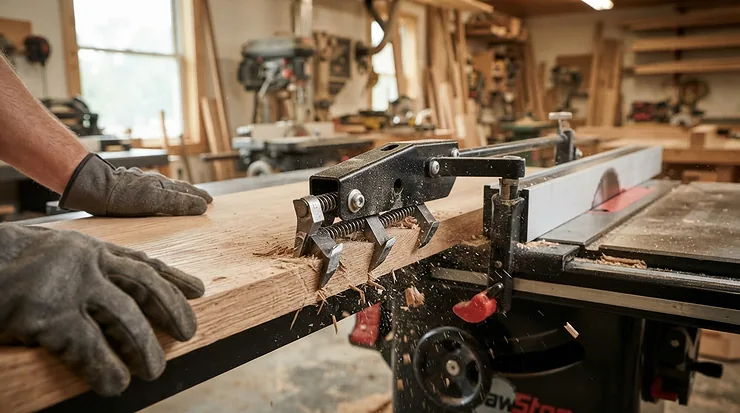
A kickback never sends a polite warning. One second you’re guiding a plank of white oak past the blade. The next, the board is a projectile and your reflexes are about three steps behind. Dense stock makes it worse, because heavy, stiff lumber stores more energy and fights the blade harder. That’s why the right anti kickback device for ripping hardwood isn’t a luxury accessory. It’s the cheapest insurance in the shop.
The backdrop is sobering. Regulators estimate roughly 30,000 table saw blade-contact injuries needing medical care each year in the U.S., with about 4,000 ending in amputation, according to NPR’s coverage of the CPSC’s proposed safety rule. Fine Woodworking calls kickback the primary cause of table saw accidents. A modern riving knife, which Wikipedia notes has been required on new UL-compliant table saw designs since 2008, is only one layer of defense.
This guide is built around hardwood specifically. You’ll get seven real products, from a push block to a retrofit splitter. You’ll also get straight talk on hardwood density and kickback force, feed rate for hardwood, and blade binding risk. Each pick is a hardwood ripping safety accessory judged on real specs and aggregated reviewer feedback, not marketing copy. Prices are ranges only, so check current price before you buy.
Quick Comparison: Top Anti Kickback Device for Ripping Hardwood Picks
| Product | Type | Price Range | Best For |
|---|---|---|---|
| GRR-RIPPER GR-100 | Push block | $30–$50 | Everyday narrow-to-medium rips |
| MJ SPLITTER SteelPro | Retrofit splitter | $35–$50 | Saws without a riving knife |
| Board Buddies | Roller hold-down | $40–$90 | Long boards and repeat rips |
| Kreg PRS3020 True-FLEX | Featherboards (2-pack) | $25–$40 | Steady fence pressure |
| Powertec 71553 | Featherboards (2-pack) | Budget tier | Starter setups |
| Diablo D1024X | 24-tooth rip blade | $25–$35 | Easier, cooler feeding |
| GRR-RIPPER Complete | Push block system | $100–$130 | Hardwood-heavy shops |
Notice that no single row solves everything. The MJ SPLITTER SteelPro keeps the cut open, the Kreg PRS3020 True-FLEX keeps the board against the fence, and the GRR-RIPPER GR-100 keeps your hands out of harm’s way. The smartest buyers combine one product from each job, which is why the “Best For” column reads like a job description rather than a trophy.
💬 Just one click — help others make better buying decisions too!😊
Top 7 Anti Kickback Device for Ripping Hardwood Picks: Expert Analysis
Each entry below turns specs into shop-floor meaning, then weighs it against what real reviewers keep repeating. Think of it as a spec sheet that finally learned to talk.
1. GRR-RIPPER GR-100 — best everyday push block for tight rips
The headline feature is three-directional control. Two fixed rubber-soled legs flank an adjustable center leg that bridges the blade path, so both the keeper board and the offcut stay pinned.
That center leg slides side to side, and the handle can be repositioned, which lets you aim your pushing force where it does the most good. Woodsmith found the rubber soles grip about as well as a jointer push block. With dense, planed maple that tends to skate, that traction is what keeps stock tracking along the fence.
Based on the design, this suits anyone ripping hardwood strips regularly. One caveat matters: a push block controls the board but doesn’t hold the kerf open, so it’s a partner to a riving knife, not a replacement.
Reviewers consistently praise the grip and the confidence it gives. Common complaints are that the block must be set up for every cut, that blade height is limited to clear its roof, and, per an older Fine Woodworking review, that it can interfere with a blade guard on narrow stock.
Pros:
- ✅ Rubber soles grip slick hardwood securely
- ✅ Adjustable center leg handles varied widths
- ✅ Keeps hands well above the blade
Cons:
- ❌ Requires setup adjustment for each width
- ❌ Limits how high the blade can sit
Price: roughly $30–$50, which makes it a strong value for the control it adds.
2. MJ SPLITTER SteelPro — retrofit splitter for saws without a riving knife
This one installs in your zero-clearance insert and holds the kerf open behind the blade. It comes in a standard-kerf version for blades in roughly the 0.118″–0.145″ range and a separate thin-kerf version, so matching matters.
The mechanism is simple and smart. Popular Woodworking argues the best cure for kickback is denying the wood access to the back of the blade. The dual-splitter design and its “kerf keeper” offsets act like mini featherboards on each side of the cut. A GRR-RIPPER GR-100 can also pass over it, which is no small thing.
Based on the design, this is a lifeline for older contractor or cabinet saws whose factory guards got retired long ago. Hardwood is prone to pinching as internal stress releases, so keeping the kerf open pays off.
Buyers like how it modernizes old Craftsman and Unisaw-style machines. Cautions repeat too: measure your saw first, expect to drill the insert with the included guide, and note that a few buyers couldn’t make it fit certain saws. One returned it.
Pros:
- ✅ Adds splitter protection to older saws
- ✅ Works with zero-clearance inserts
- ✅ Lets compatible push blocks pass over
Cons:
- ❌ Must match your blade’s kerf exactly
- ❌ Fit varies by saw and insert
Price: roughly $35–$50, a modest sum for the cut-holding job it does.
3. Board Buddies — roller hold-down that doubles as a kickback lock
Two spring-loaded urethane rollers ride in a fence-mounted carriage, and each turns one direction only. Stock moves forward freely but can’t be thrown back.
In practice, that’s a hold-down, a fence-pusher, and a built-in one-way lock in one assembly. A Fine Homebuilding reviewer felt confident enough to walk around and pull long boards through the cut. The same reviewer called it sturdy but not industrial grade.
Forum users disagree on exact placement relative to the blade, so follow the manual and make sure pressure never pinches the kerf closed. They also warn that a lightweight fence without a rear hold-down can lift when the rollers press down.
Reviewer sentiment is generally warm among repeat users. Critics call it obstructive for one-off custom work. If you rip lots of 1″ strips or long boards, it’s a more natural fit.
Pros:
- ✅ One-way rollers resist backward movement
- ✅ Hold stock down and against fence
- ✅ Free your hands on long boards
Cons:
- ❌ Can lift lightweight fences without rear clamping
- ❌ Obstructive for varied, one-off cuts
Price: roughly $40–$90 depending on seller and condition, which is fair for production-style ripping.
4. Kreg PRS3020 True-FLEX — consistent finger pressure with a no-tool mount
The big idea is evenly engineered fingers. Kreg says each finger delivers optimum pressure, and the Wedge-Lock system secures it in a standard 3/8″ x 3/4″ miter slot or a T-slot without extra hardware. The two-pack covers saw and router table at once.
Pressure consistency matters more with hardwood than with pine. A dense board barely flexes, so a featherboard that’s too stiff pinches and one that’s too soft lets the board wander. Place it on the infeed side, never beyond the front edge of the blade, as Popular Woodworking cautions.
Retail reviewers rate it between 4.5 and 5 stars on small samples and praise the build and the quick mounting. A few note it won’t lock down on certain portable saws, like some DeWalt and Ryobi tables, and that oversized miter slots need tightening.
Pros:
- ✅ Wedge-Lock mounting needs no extra hardware
- ✅ Even finger pressure for dense stock
- ✅ Two-pack covers saw and router table
Cons:
- ❌ Fit problems on some portable saws
- ❌ Oversized miter slots need tightening
Price: roughly $25–$40, solid value for dependable lateral pressure.
5. Powertec 71553 — budget-friendly low-profile featherboards
This 2-pack fits standard miter slots and T-tracks, weighs about 1.2 pounds, and includes hardware for several mounting styles. One DeWalt DWE7491 owner reported the short height lets a push stick clear the top comfortably.
Low height is a quiet advantage. Tall featherboards can collide with push blocks and guards, and that collision is exactly when people give up and remove the safety gear. Based on the specs, it’s a sensible way to put two featherboards on a saw without a big spend.
Reviewers mostly describe it as strong, easy to install, and supplied with plenty of hardware. One dissenter called it flimsy next to Rockler’s build quality. Since dense hardwood demands firm, steady pressure, test the tension before you commit to a long rip.
Pros:
- ✅ Short profile clears push sticks
- ✅ Includes hardware for multiple setups
- ✅ Two featherboards at a modest cost
Cons:
- ❌ Some reviewers find the build flimsy
- ❌ Plastic body may flex under heavy load
Price: budget tier, so check current price, and it makes a respectable starter set.
6. Diablo D1024X — thin-kerf rip blade that reduces feed effort
Strictly speaking, this isn’t a guard. But a sharp, appropriate rip blade directly lowers the force you need, and force is what turns a hiccup into a kickback. The specs: 24 alternate-top-bevel teeth, a 15° hook angle, a 0.098″ kerf, and a 5/8″ arbor. Retailers list it for rips from 3/4″ up to 2-3/4″ in wood.
A low tooth count means large gullets to clear dense chips, so you can keep a steady feed without bogging or burning. The thin kerf also demands less motor power.
Here’s the catch. That 0.098″ kerf requires a riving knife or splitter rated for thin-kerf blades. One reviewer admitted removing a standard 1/8″ riving knife to fit it, which is precisely the wrong fix. Buy the matching thin-kerf knife or splitter instead.
Reviewers praise clean, effortless cuts in oak and the price, though one calls it good but not top-tier.
Pros:
- ✅ Large gullets clear dense chips well
- ✅ Thin kerf reduces motor strain
- ✅ Strong value for rip work
Cons:
- ❌ Needs a thin-kerf riving knife or splitter
- ❌ Not a premium-tier blade
Price: roughly $25–$35, an easy yes if your saw’s splitter matches.
7. GRR-RIPPER Complete — full 3D push block system for hardwood-heavy shops
This is the expanded kit. The listing includes the Advanced block, a 1/8″ leg accessory, deflector/connector, gravity heel kit, and handle bridge kit. The stabilizing plate acts as a secondary fence traveling along the stock.
The manufacturer says the green grip material excels on hardwoods, and that using two blocks lets you feed long stock continuously, reducing burn marks from stop-start feeding. Those are manufacturer claims, but the logic is sound. Burning and binding usually start when feed rate wavers.
Based on the components, this is for frequent rippers who want one system for the table saw, router table, jointer, and band saw. Casual users will find the base block enough.
One retailer listing averages about 4.4 stars across roughly 128 reviews. Woodsmith called the 3D version a significant step up from simpler blocks, thanks to the adjustable arm and balance support.
Pros:
- ✅ Stabilizing plate adds second-fence control
- ✅ Accessories cover multiple cutting setups
- ✅ Supports continuous feeding with two blocks
Cons:
- ❌ Highest price in this lineup
- ❌ Overkill for occasional rippers
Price: roughly $100–$130, worth it only if you rip hardwood often.
Side-by-Side Spec Check
| Product | Key Spec | Price Range | Review Sentiment | Best For |
|---|---|---|---|---|
| GRR-RIPPER GR-100 | 3-leg adjustable design | $30–$50 | Strongly positive, 4+ stars on listings | Beginners to pros |
| MJ SPLITTER SteelPro | Kerf-matched dual splitters | $35–$50 | Positive, with fit warnings | Older saws |
| Board Buddies | One-way urethane rollers | $40–$90 | Positive from repeat users | Long boards |
| Kreg PRS3020 True-FLEX | Wedge-Lock mount | $25–$40 | 4.5–5 stars, small samples | Fence pressure |
| Powertec 71553 | Low-profile body | Budget tier | Mostly positive, some flimsy notes | Starter kits |
| Diablo D1024X | 24T, 0.098″ kerf | $25–$35 | Mostly positive | Easier rip feeding |
| GRR-RIPPER Complete | Stabilizing plate kit | $100–$130 | About 4.4 stars on one listing | Heavy users |
The pattern is clear: the best value lives in the middle. A MJ SPLITTER SteelPro, a GRR-RIPPER GR-100, and a Kreg PRS3020 True-FLEX pair cover the three core jobs for well under what the GRR-RIPPER Complete costs alone. Upgrade to the GRR-RIPPER Complete only when your rip volume justifies it.
What Is an Anti Kickback Device for Ripping Hardwood?
An anti kickback device for ripping hardwood is any accessory that stops a board from being thrown back at the operator during a rip cut. Typical examples include riving knives and splitters, kickback pawls, featherboards, roller hold-downs, and grip-style push blocks, each controlling a different link in the kickback chain.
Think of kickback as a three-part failure. First, the kerf closes or the board drifts into the back of the blade. Second, the rising teeth lift and throw it. Third, your hands are in the line of fire. Popular Woodworking points out that the lifting force starts at the back of the blade, not the front, which explains why a splitter behind the blade matters more than anything in front of it.
That’s also why an anti kickback device for hardwood stock does several jobs: keeping the cut open, keeping stock tight to the fence and table, and keeping hands away from the blade path. No single gadget does all three, so every hardwood ripping safety accessory in this guide earns its place by owning one job.
How to Choose an Anti Kickback Device for Ripping Hardwood
Follow these steps in order, because each one narrows the next decision.
- Check your kerf-holding hardware first. If your saw has no riving knife, start with a retrofit splitter. Fine Woodworking argues a properly used riving knife virtually eliminates kickback.
- Match kerf thickness. A thin-kerf blade needs a thin-kerf riving knife or splitter. Mismatches create the very pinch you’re trying to prevent.
- Confirm fence and slot compatibility. Measure your miter slots and fence height before buying featherboards or rollers.
- Layer the jobs. Pick one device for kerf control, one for lateral pressure, and one for hand protection.
- Check clearances. Make sure featherboards and push blocks don’t collide with your guard or each other.
- Match the device to your stock. Narrow strips favor push blocks, while long boards favor rollers or featherboards.
- Budget for the blade. A sharp rip blade lowers feed force, so it belongs in your safety budget.
Hardwood Density and Kickback Force
Hardwood density and kickback force are linked through a chain of reasoning, not a single formula. The Janka test, which measures the force needed to embed a steel ball into wood, correlates strongly with density, according to the Wood Database’s Eric Meier.
Here’s what the ratings look like in practice. Eastern white pine sits near 380 lbf, American cherry near 950, red oak near 1,290, and American beech near 1,300. Hard maple lands roughly in the mid-1,400s, and the extreme end, quebracho, reaches about 4,570.
Janka doesn’t measure kickback directly, so treat this as on-paper reasoning. Heavier, stiffer boards carry more momentum if they’re thrown. They resist being nudged back to the fence, and they punish slow feeding with heat. A 1,300-lbf beech board isn’t “twice as dangerous” as 650-lbf stock, but it leaves less margin for error, which is why dense wood deserves a full stack of protection rather than a single accessory.
Feed Rate for Hardwood
The right feed rate for hardwood is a balancing act. Feed too slowly and friction burns the edge and heats the blade. Feed too aggressively and the motor bogs, the blade grabs, and control slips.
Woodcraft’s advice is to feed as quickly as your saw can comfortably handle, listen for the sound of the motor, and ease off the moment you hear bogging. It also admits no universal number exists, because blade sharpness, motor power, drive belt efficiency, stock thickness, and density all change the answer.
That’s why steadiness beats speed. A wavering feed leaves burn marks at every pause, and burns signal friction that can make the board grab. Push blocks help by letting you keep a smooth, continuous push. The manufacturer of the GRR-RIPPER Complete says two blocks let you feed long stock without stopping, and while that’s a manufacturer claim, the principle is sound.
One practical test: if you need heavy force to move a board, stop and check the blade, the alignment, and the stock before pushing harder.
Blade Binding Risk
Blade binding risk is the quiet precursor to most kickbacks. Binding happens when wood squeezes the blade, and the usual culprits are a closing kerf, a fence that isn’t parallel to the blade, or stock that rocks because it’s cupped or twisted.
Hardwood adds its own twist. Internal stress means a board can spring open or squeeze shut as you cut it. Woodworkers on forums describe boards that seem to have “a life of their own,” and some rip slightly oversize, then finish on a second pass or a planer. Loose knots can also turn into projectiles on the table saw, per Fine Woodworking.
Defenses stack well. A correctly aligned riving knife or MJ SPLITTER SteelPro keeps the cut open. A Kreg PRS3020 True-FLEX or Powertec 71553 holds the board to the fence. A sharp Diablo D1024X reduces drag. Never rip a square block, since it may never reach the splitter. Avoid “levering” the front of the board up at the start, which creates sudden friction when it drops onto the blade.
Kickback Prevention for Dense Wood: Anti Kickback Device for Hardwood Stock vs Traditional Alternatives
Kickback prevention for dense wood works best as a layered system. Here’s how the approaches stack up.
| Approach | What It Controls | Main Limitation | Best For |
|---|---|---|---|
| Riving knife or MJ SPLITTER SteelPro | Keeps kerf open | Must match kerf thickness | Every through-cut rip |
| Kickback pawls | Dig in to resist reverse motion | Can bind narrow strips | Supplement on guards |
| Kreg PRS3020 True-FLEX or Powertec 71553 | Lateral pressure | Must sit before the blade | Long fence-hugging rips |
| GRR-RIPPER GR-100 | Downward/forward pressure and hand safety | Doesn’t hold kerf open | Narrow rips |
| Board Buddies | Hold-down and one-way lock | Fence compatibility | Long boards |
| Bandsaw ripping | Narrow blade avoids pinch | Slower, blade drift | Thick resawing |
Fine Woodworking notes the bandsaw’s thin blade sidesteps the pinching problem entirely, which makes it a legitimate alternative for thick, tricky stock. But for dimensioning boards on a table saw, the layered approach wins. The MJ SPLITTER SteelPro and a featherboard address the cause, while the GRR-RIPPER GR-100 handles the consequences. Pawls are supplementary, and some users note they can bind narrow strips.
Hardwood Ripping Safety Accessory: Features That Actually Matter (and Those That Don’t)
Every hardwood ripping safety accessory advertises something. Here’s what’s worth your attention.
Features that matter:
- ✅ Kerf match. Thin versus standard kerf compatibility is non-negotiable.
- ✅ Grip surface. Rubber or urethane that actually bites dense, planed wood.
- ✅ Mounting security. Wedge-Lock or magnetic systems that don’t creep under vibration.
- ✅ Low profile. Short bodies that clear push blocks and guards.
Features that matter less:
- ❌ Bright colors and branding.
- ❌ Extra accessories you’ll never attach.
- ❌ “Virtually eliminates kickback” claims, since no accessory removes the need for technique.
Total cost is modest. Combining a splitter, push block, featherboard pair, and rip blade at the ranges above comes to roughly $115–$175. Spread across years of ripping, that’s trivial next to a ruined hand or a wrecked board.
✨ Don’t Miss These Safety Upgrades!
🔍 Take your hardwood ripping to the next level with these carefully selected products. Click on any highlighted item to check current pricing and availability. These tools will help you create the confident, controlled cuts your projects deserve!
Practical Setup Guide: Building Your Hardwood Ripping Stack
Great gear fails with sloppy setup, so run this checklist before the first cut.
- Flatten and square the stock. Woodcraft’s burn-free cutting tips warn that a cupped face can rock and bind. Joint one face and one edge first.
- Align the blade and fence. Confirm the blade runs parallel to the miter slots and the fence. Misalignment is a leading cause of binding.
- Install and align the splitter or riving knife. Match the kerf, then check it sits in line with the blade.
- Set featherboards. Place the Kreg PRS3020 True-FLEX on the infeed side, ahead of the blade’s front edge, with light, even pressure.
- Set the push block. Adjust the GRR-RIPPER GR-100 center leg so the blade passes cleanly, and keep blade height compatible.
- Stand slightly to the side of the board’s path, not directly behind it.
- Support the outfeed. Long boards need support, or they tip and bind at the end of the cut.
In the first 30 days, the common mistakes are over-tightening featherboards, ignoring kerf mismatch, and slowing down mid-cut to “be careful.” Careful means steady.
Real-World Scenarios: Matching Gear to Your Shop
These are hypothetical profiles built to show the reasoning, not real testimonials.
The garage hobbyist. Picture a weekend woodworker with an older contractor saw, no riving knife, and a budget near $120, ripping 4/4 cherry and oak a few times a month. The logical stack is the MJ SPLITTER SteelPro, a GRR-RIPPER GR-100, and a Powertec 71553 pair. That covers kerf, hand protection, and fence pressure within budget.
The furniture maker. Imagine a cabinet saw with a factory riving knife, ripping 8/4 hard maple weekly. A Kreg PRS3020 True-FLEX and a GRR-RIPPER Complete make sense for the volume. A Diablo D1024X fits only if the riving knife is rated for its 0.098″ kerf.
The long-board solo shop. Consider someone working alone with 10-foot stock and good outfeed support. Board Buddies let them walk around and finish pulling the board, provided the fence is secure at the rear.
Across all three, notice the pattern: budget, frequency, and saw hardware decide the stack, not brand loyalty.
Problem and Solution Guide: Common Hardwood Ripping Headaches
Problem: burn marks on maple. Slow feeding creates friction. Fix it by sharpening or swapping to a Diablo D1024X, checking alignment, and keeping a continuous push with the GRR-RIPPER GR-100.
Problem: the board pinches halfway through. The kerf is closing. Fix it by fitting a splitter or riving knife that matches your blade, such as the MJ SPLITTER SteelPro, and checking the stock for internal stress.
Problem: the board drifts from the fence. Add a Kreg PRS3020 True-FLEX on the infeed side or Board Buddies for hold-down.
Problem: your thin-kerf blade doesn’t match the riving knife. Don’t remove the knife. Buy a thin-kerf-rated knife or splitter instead.
Problem: narrow strips jam under pawls or guards. Use the GRR-RIPPER GR-100 and consider removing pawls only if the splitter stays in place.
Frequently Asked Questions
❓ What is the best anti kickback device for ripping hardwood on a budget?
❓ Do kickback pawls work on thick hardwood?
❓ Can a featherboard replace a riving knife?
❓ Is a thin-kerf blade riskier for dense hardwood?
❓ How do I avoid burning maple without increasing kickback risk?
Conclusion
Ripping dense lumber is one of the most satisfying jobs in woodworking, and one of the most unforgiving. The good news is that safety here isn’t mysterious. It’s a system: keep the kerf open, keep the board tight to the fence, keep your hands high and out of the way, and keep the feed steady.
The best anti kickback device for ripping hardwood is really a small team. The MJ SPLITTER SteelPro handles kerf control for saws without a riving knife. The GRR-RIPPER GR-100 protects your hands, with the GRR-RIPPER Complete as the upgrade for heavy use. The Kreg PRS3020 True-FLEX and Powertec 71553 manage fence pressure, Board Buddies serve long-board work, and the Diablo D1024X makes the feed smoother, provided your splitter matches its kerf.
Start with the biggest gap in your setup, then add layers. Respect hardwood density and kickback force, watch your feed rate for hardwood, and never ignore blade binding risk.Recommended for You
Recommended for You
- Pawl System Vs Roller System For Kickback Safety: 7 Best Picks 2026
- Anti Kickback Pawls For Table Saw: 7 Smart Picks For 2026
- Aftermarket Anti Kickback Pawls Under $60: 7 Smart Picks (2026)
Disclaimer: This article contains affiliate links. As an Amazon Associate, I earn from qualifying purchases. If you purchase products through these links, we may earn a small commission at no additional cost to you.
✨ Found this helpful? Share it with your friends! 💬🤗
