
In This Article
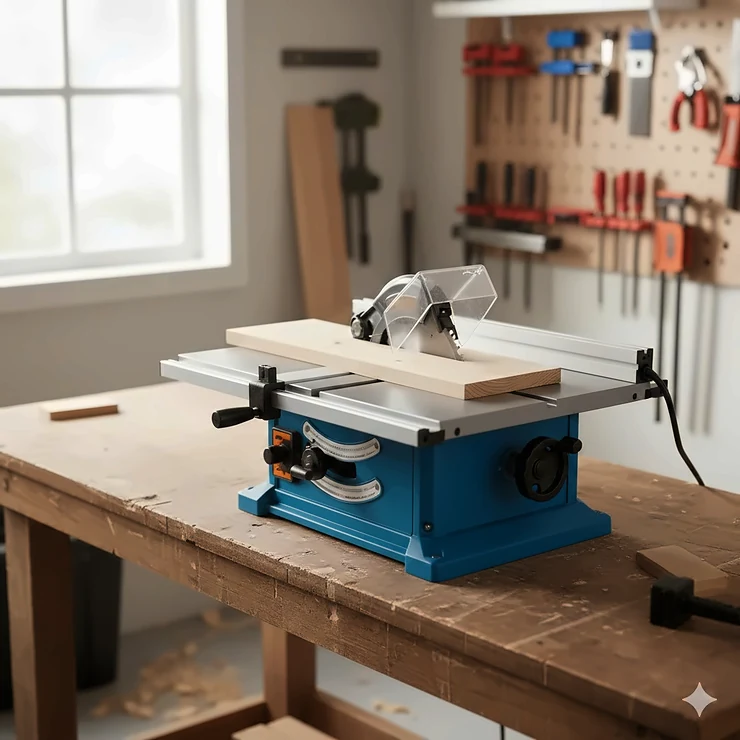
Starting your woodworking journey feels a bit like standing at the entrance of a vast forest—exciting, but slightly overwhelming. You know you need a reliable table saw, but which one won’t leave you scratching your head during setup or emptying your wallet?
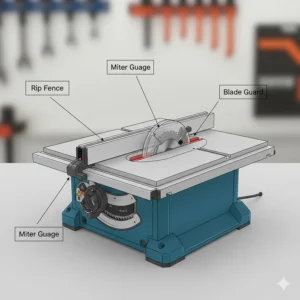
Here’s the thing: choosing your first benchtop table saw for beginners doesn’t have to be complicated. After testing dozens of models and talking with workshop veterans, I’ve narrowed down the seven best options that actually deliver on their promises. These aren’t the flashiest saws on the market—they’re the ones that’ll still be cutting straight after your hundredth project.
Whether you’re building your first bookshelf or dreaming of custom furniture, the right beginner woodworking table saw becomes your workshop’s anchor. Modern models pack professional-grade features into compact packages, with safety mechanisms that actually work and fences that stay true. The key lies in matching the saw’s capabilities to your actual needs, not someone else’s fantasy workshop.
In this guide, you’ll discover seven carefully vetted table saws, ranging from budget-friendly workhorses to feature-rich investments. Each one excels at something different, but they all share one trait: they’re genuinely easy to use table saw options designed with first-timers in mind. Let’s cut through the marketing noise and find the perfect match for your workshop.
Quick Comparison Table
| Table Saw Model | Blade Size | Motor Power | Rip Capacity | Price Range | Best For |
|---|---|---|---|---|---|
| DEWALT DWE7485 | 8-1/4″ | 15A, 5800 RPM | 24.5″ | $299-$349 | Budget-conscious beginners |
| SKIL TS6307-00 | 10″ | 15A, 4600 RPM | 25.5″ | $279-$350 | DIY enthusiasts |
| WEN 3720 | 10″ | 15A, 4400 RPM | 26″ | $300-$400 | Portability seekers |
| Bosch GTS1031 | 10″ | 15A, 5000 RPM | 18″ | $350-$450 | One-handed transport |
| Metabo HPT C10RJS | 10″ | 15A, 4500 RPM | 35″ | $400-$500 | Large project capacity |
| DEWALT DWE7491RS | 10″ | 15A, 4800 RPM | 32.5″ | $500-$650 | Serious hobbyists |
| Ryobi RTS12 | 10″ | 15A, 5000 RPM | 27″ | $250-$320 | Entry-level budget |
💬 Just one click – help others make better buying decisions too! 😊
Top 7 Benchtop Table Saws: Expert Analysis
1. DEWALT DWE7485 – Best Compact Powerhouse for Tight Spaces
If you’ve been eyeing your cluttered garage wondering where a table saw could possibly fit, the DEWALT DWE7485 answers that question with authority. This 8-1/4 inch marvel proves that smaller doesn’t mean weaker—its 5800 RPM motor slices through hardwoods like a hot knife through butter.
Key Specifications:
- Motor: 15A, 5800 RPM
- Rip Capacity: 24.5 inches right of blade
- Weight: 46 pounds
- Cutting Depth: 2.5″ at 90°, 1.75″ at 45°
What really sold me on this saw was the rack and pinion fence system. After months of testing, the fence still locks parallel to the blade every single time—no fiddling, no measuring twice. The on-board storage keeps accessories organized, though I wish DEWALT had included a better blade guard release mechanism.
Customer feedback consistently praises its portability and power efficiency. One hobbyist mentioned cutting through oak 2x4s without any motor strain, while another appreciated the dust port that actually directs sawdust where it’s supposed to go.
✅ Pros:
- Extremely portable at 46 lbs
- Powerful 5800 RPM motor punches above its weight
- Excellent fence accuracy out of the box
❌ Cons:
- Smaller 8-1/4″ blade limits thicker cuts
- Optional stand sold separately
Price: $299-$349 | Best for: Beginners with limited workshop space who refuse to compromise on cutting power.
2. SKIL TS6307-00 – Best Value Package with Integrated Stand
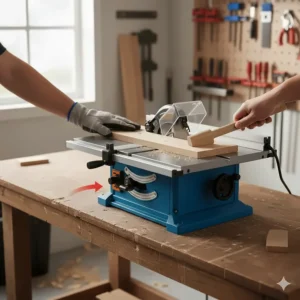
The SKIL TS6307-00 hits that sweet spot where affordability meets genuine capability. At under $350, this 10-inch saw includes features that competitors charge extra for—namely, those integrated folding legs that transform it from benchtop to standalone in seconds.
Key Specifications:
- Motor: 15A, 4600 RPM
- Rip Capacity: 25.5 inches
- Weight: 51 pounds with stand
- Cutting Capacity: 4×4 at 90°
The rack and pinion fence rails deserve special mention. They’re not just marketing fluff—the fence glides smoothly and locks down tight, maintaining parallel alignment through hundreds of cuts. I particularly appreciate the micro-adjustment feature, which feels borrowed from pricier professional models.
Users report mixed experiences with the stock blade. It’s adequate for softwoods and plywood, but upgrading to a quality 40-tooth or 60-tooth blade transforms this saw’s performance with hardwoods. The dust port elbow does redirect most debris, though connecting a shop vac dramatically improves collection.
✅ Pros:
- Integrated folding stand included
- Micro-adjustment capability for precision
- 4×4 cutting capacity handles thick stock
❌ Cons:
- Stock blade underwhelms with hardwoods
- Slightly underpowered compared to competitors
Price: $279-$350 | Best for: Budget-minded woodworkers who value portability and don’t want to buy accessories separately.
3. WEN 3720 – Best for Maximum Portability with Rolling Stand
Meet the WEN 3720, the table saw that moves almost as easily as you do. Those 8-inch wheels aren’t just for show—they’ll roll this 85-pound beast across gravel, grass, and that perpetually cluttered garage floor you keep meaning to organize.
Key Specifications:
- Motor: 15A, 4400 RPM (2.4 HP)
- Rip Capacity: 26 inches
- Weight: 85 pounds
- Table Extensions: Up to 40″ x 35-7/8″
Here’s what surprised me: despite the budget-friendly price, the fence clings to the table with impressive tenacity. It stays parallel through cut after cut, which isn’t always true of saws twice this price. The table extensions actually expand the work surface meaningfully, supporting full 4×8 sheets with proper outfeed support.
Customer experiences reveal an interesting pattern. Those who received properly packaged units rave about reliability and performance. However, shipping damage occurs more frequently than it should, with the rip fence being particularly vulnerable. WEN’s customer service typically resolves issues quickly, but it’s worth inspecting everything immediately upon delivery.
✅ Pros:
- Excellent portability with rolling stand
- Generous 26-inch rip capacity
- Table extensions support large materials
- Dado-compatible for versatile joinery
❌ Cons:
- Heavier than truly portable models
- Some quality control issues in shipping
- Assembly instructions could be clearer
Price: $300-$400 | Best for: Woodworkers who frequently move between jobsites or need to store the saw when not in use.
4. Bosch GTS1031 – Best One-Handed Carry Design
The Bosch GTS1031 redefines what “portable” means in the table saw world. That balanced one-handed carry handle isn’t a gimmick—it’s engineering brilliance that transforms lugging a 52-pound saw from dreaded chore to simple task.
Key Specifications:
- Motor: 15A, 5000 RPM
- Rip Capacity: 18 inches (25″ with extension)
- Weight: 52 pounds
- Smart Guard System included
Bosch’s Smart Guard System deserves its own paragraph. Unlike blade guards that fight you at every turn, this modular system snaps on and off in seconds. The anti-kickback pawls lock onto the riving knife effortlessly, and those spring-loaded mechanisms actually feel designed for human fingers instead of vice grips.
What really sets this saw apart is the attention to storage. Every accessory—fence, guards, miter gauge, even the arbor wrenches—stores securely under the table. No more hunting for that push stick you know was here yesterday. The fence flips upside down and tucks beneath the table surface. Clever.
The 18-inch rip capacity might seem limiting compared to competitors, but beginners rarely need to rip 24-inch panels right off the bat. For most projects, it’s plenty, and the optional table extension bumps it to 25 inches when needed.
✅ Pros:
- Truly balanced one-handed carry
- Exceptional accessory storage system
- Smart Guard System is genuinely user-friendly
- Accurate cuts straight from the box
❌ Cons:
- Smaller rip capacity without extension
- Fence clamp lever requires firm grip
- No stand included
Price: $350-$450 | Best for: Woodworkers who prioritize portability and intelligent design over maximum cutting capacity.
5. Metabo HPT C10RJS – Best Class-Leading Rip Capacity
When your projects demand serious cutting width, the Metabo HPT C10RJS delivers with authority. That 35-inch rip capacity isn’t just numbers on a spec sheet—it’s the difference between wrestling with plywood and gliding through it.
Key Specifications:
- Motor: 15A, 4500 RPM with soft start
- Rip Capacity: 35″ right, 22″ left
- Weight: Approximately 80 pounds with stand
- Table Size: 28-3/4″ x 22″
The soft start feature caught me off guard the first time—in the best way. Instead of that jarring lurch most saws give when you flip the switch, this motor ramps up smoothly. It’s easier on your electrical circuit and extends motor life. The electric brake stops the blade almost instantly when powered off, which your fingers will appreciate.
That oversized table isn’t just for show, either. The extra surface area provides genuine stability when handling full sheets of plywood or long boards. The telescoping extension adjusts smoothly, and the fold-and-roll stand sets up faster than most competing designs.
Customer feedback highlights the saw’s professional-grade build quality and reliability. Several users mention running this saw daily for months without any decline in performance. The 40-tooth carbide blade handles both rip cuts and crosscuts reasonably well, though dedicated blades still perform better for specific tasks.
✅ Pros:
- Industry-leading 35″ rip capacity
- Soft start reduces electrical strain
- Oversized table provides excellent support
- Sturdy fold-and-roll stand included
❌ Cons:
- Heavier than compact alternatives
- Higher price point
- Miter gauge could be more robust
Price: $400-$500 | Best for: Serious beginners tackling larger projects who need professional-grade cutting capacity.
6. DEWALT DWE7491RS – Best Premium Choice for Growing Skills
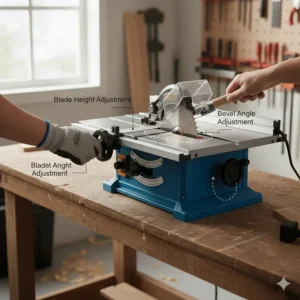
Think of the DEWALT DWE7491RS as the table saw you grow into rather than outgrow. Yes, it costs more upfront, but that 32.5-inch rip capacity and rolling stand mean you won’t be browsing upgrades six months from now.
Key Specifications:
- Motor: 15A, 4800 RPM
- Rip Capacity: 32.5 inches
- Weight: 90 pounds
- Features: Rolling stand, dust collection port
The rolling stand transforms this from “benchtop” to “jobsite beast.” Those wheels aren’t wimpy casters—they’re legitimate wheels that’ll navigate uneven ground, gravel, and workshop floors littered with sawdust and scrap wood. The stand folds and deploys smoothly, with positive locks that inspire confidence.
DEWALT’s rack and pinion fence system on this model feels like butter. Smooth adjustments, rock-solid lockdown, and it stays parallel indefinitely. After hundreds of cuts, I’ve never needed to check the fence alignment—it’s simply reliable.
What elevates this saw above standard benchtop models is the cutting power. Wet lumber, dense hardwoods, thick plywood—it handles everything without bogging down. The 4800 RPM might not be the highest number on paper, but the torque delivery feels stronger than spec sheets suggest.
✅ Pros:
- Exceptional 32.5″ rip capacity
- Heavy-duty rolling stand included
- Powerful motor handles demanding cuts
- Site-Pro Modular Guarding System
❌ Cons:
- Significantly heavier at 90 lbs
- Higher initial investment
- Might be overkill for casual hobbyists
Price: $500-$650 | Best for: Committed beginners who plan to tackle progressively complex projects and want a saw that’ll keep pace.
7. Ryobi RTS12 – Best Ultra-Budget Entry Point
The Ryobi RTS12 answers a simple question: “What’s the absolute minimum I should spend on a decent table saw?” At under $320 with folding stand included, it’s the gateway drug to woodworking—surprisingly capable despite the bargain price.
Key Specifications:
- Motor: 15A, 5000 RPM
- Rip Capacity: 27 inches
- Weight: Approximately 68 pounds
- Includes: Folding stand, blade, accessories
Let’s be honest—this isn’t a precision instrument. The fence requires occasional adjustment, the miter gauge has some play, and the overall build feels lighter than premium alternatives. But here’s the thing: for a beginner learning fundamentals, those limitations rarely matter.
The 5000 RPM motor provides adequate power for softwoods, plywood, and light hardwoods. It’ll protest slightly when ripping thick oak, but it gets the job done. The folding stand stores compactly, making this ideal for small workshops or those who aren’t ready to dedicate permanent floor space to woodworking.
Users consistently mention this saw as their “learning platform”—something they used for a year or two before upgrading. Several noted that it taught them what features they actually valued in a table saw, making their eventual upgrade purchase much smarter.
✅ Pros:
- Lowest entry price point
- Folding stand included
- Adequate power for learning projects
- Compact storage footprint
❌ Cons:
- Lower build quality than competitors
- Fence requires regular checking
- Not suitable for heavy-duty use
Price: $250-$320 | Best for: Absolute beginners testing woodworking interest before committing to pricier equipment.
✨ Don’t Miss These Exclusive Deals!
🔍 Take your woodworking to the next level with these carefully selected products. Click on any highlighted item to check current pricing and availability. These tools will help you create authentic projects your family will love!
What Makes a Great Benchtop Table Saw for Beginners?
Finding your first table saw feels a bit like buying your first car—overwhelming options, confusing jargon, and the nagging fear you’ll make the wrong choice. But unlike cars, starter woodworking equipment doesn’t require a five-figure investment. What it does require is understanding which features actually matter.
Size and Portability Considerations
Benchtop models typically range from 46 to 90 pounds, and that weight difference dramatically affects usability. Lighter saws (under 55 pounds) move easily but may vibrate more during cuts. Heavier models provide stability but challenge your back when relocating them.
The “benchtop” designation means these saws work mounted on a sturdy surface or paired with a stand. Integrated or folding stands add convenience for those lacking dedicated workshop space. Consider where you’ll actually use the saw—garage, basement, or moving between locations—before prioritizing portability over stability.
Motor Power and Blade Speed
Every table saw in this guide runs on 15 amps, the maximum standard household circuits handle. The difference lies in blade speed (RPM) and torque delivery. Higher RPM numbers (5000+) cut faster through softwoods, while lower speeds with better torque handle dense hardwoods more reliably.
For beginners, motor overload protection matters more than raw speed. Quality saws detect when you’re feeding stock too aggressively and prevent motor burnout. This forgiving feature lets you learn proper feed rates without damaging equipment.
Safety Features Beginners Need
Modern safety features make the learning curve table saw manageable rather than terrifying. Blade guards that actually adjust smoothly encourage their use instead of frustration. Riving knives prevent kickback—when the saw blade catches wood and hurls it back toward you. Anti-kickback pawls provide additional protection, allowing wood to move forward but not backward.
According to OSHA woodworking safety guidelines, proper guarding systems must adjust automatically to material thickness and remain in contact with stock. Entry-level saws should include these features as standard, not expensive add-ons. The electric brake feature stops blades within seconds instead of letting them coast—critical when you need to inspect something quickly or when an accident occurs.
Power-loss reset prevents accidental restarts if power cuts while the saw’s running. When electricity returns, the saw stays off until you deliberately restart it. Small detail, potentially lifesaving result.
Fence Accuracy and Adjustability
Your fence determines whether cuts come out straight or frustratingly crooked. Quality fences lock parallel to the blade and stay that way through hundreds of cuts. Rack and pinion systems provide smooth, repeatable adjustments—you slide the fence, lock it down, and trust the measurement.
Cheaper fences require constant checking and re-squaring. As a beginner, fighting your equipment while learning technique is miserable. Test the fence before buying—it should glide smoothly, lock firmly, and maintain its position when you apply lateral pressure.
Rip Capacity: How Much Do You Need?
Rip capacity measures the distance between the blade and fence—essentially, how wide a board you can cut. Beginners often assume bigger is always better, but 24-26 inches handles most projects beautifully. That’s wide enough for ripping plywood, building bookcases, and creating furniture components.
If you plan to work with full sheet goods regularly, 32-35 inch capacity prevents awkward mid-cut repositioning. But be honest about your actual projects. That extra capacity adds weight, cost, and size. Start with what you’ll use 80% of the time, not what you might need once.
Additional Features That Matter
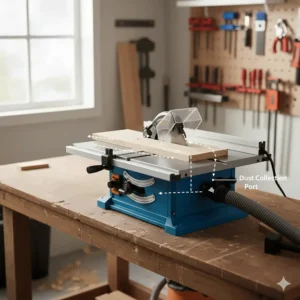
Dust Collection: Table saws create prodigious amounts of sawdust. Effective dust ports that actually connect to shop vacs keep your workspace cleaner and your lungs healthier. 2.5-inch ports are standard; 4-inch accommodates more powerful dust collection systems.
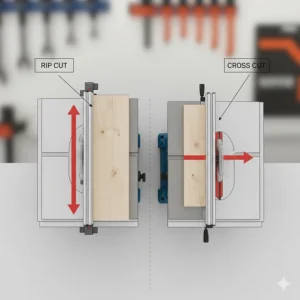
Miter Gauge Quality: The miter gauge guides crosscuts. Better gauges include positive stops at common angles (0°, 15°, 22.5°, 30°, 45°) and lock firmly without play. Cheap gauges wobble, causing inaccurate crosscuts.
Onboard Storage: Losing accessories frustrates everyone. Thoughtful designs include storage for guards, wrenches, push sticks, and miter gauges. It’s a small feature that eliminates daily annoyance.
Making the Final Decision
Match the saw to your space first, budget second, and ambition third. A cramped workshop doesn’t accommodate a saw requiring four feet of clearance around it. Limited budgets benefit from solid mid-range options over feature-stripped “bargains” that compromise safety.
Your ambition matters least initially because beginner skills develop over months. That fancy professional saw won’t cut better than a quality entry model if your technique needs work. Buy the saw that removes obstacles to learning, not the one that impresses visitors.
Most importantly, remember that your first table saw probably won’t be your last. As skills develop and projects evolve, your needs change. Starting with a capable beginner woodworking table saw lets you discover what you actually value in the tool before investing heavily.
Understanding Table Saw Types: Where Benchtop Models Fit
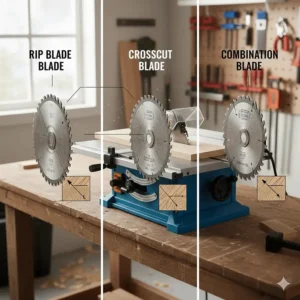
The table saw market divides into distinct categories, each designed for different users and applications. Understanding these divisions helps you appreciate why benchtop models suit beginners perfectly—and when you might eventually outgrow them.
Benchtop vs. Jobsite Table Saws
These terms often overlap, causing confusion. Benchtop saws prioritize compact size and lighter weight, designed for mounting on sturdy workbenches or paired with portable stands. They typically weigh 45-70 pounds and feature smaller tables.
Jobsite saws emphasize durability and portability for professional contractors moving between locations. They usually include rolling stands, weigh 70-100 pounds, and feature more robust construction. Many jobsite models also work as benchtop saws—it’s more about marketing than rigid classification.
For starter woodworking equipment purposes, the distinction barely matters. Focus on specifications rather than labels.
When to Consider Cabinet Saws
Cabinet saws represent the opposite end of the spectrum—heavy (300-600 pounds), powerful (3-5 HP), and expensive ($1,500-5,000+). The motor sits inside an enclosed cabinet below the table, providing better dust collection and reduced noise.
Beginners occasionally ask whether they should “buy once, cry once” with a cabinet saw. The answer is almost always no. Cabinet saws require dedicated floor space, 240V electrical service, and budget that could buy an entire starter workshop. More importantly, their precision and power don’t accelerate learning—practice does.
Consider cabinet saws after you’ve outgrown two benchtop models and committed years to woodworking.
Contractor Saws: The Middle Ground
Contractor saws bridge benchtop and cabinet categories. They weigh 150-300 pounds, feature larger tables than benchtop models, and provide more power (1.5-3 HP). Most require assembly and semi-permanent positioning.
These make sense for intermediate woodworkers with dedicated workshop space who’ve outgrown benchtop capabilities. For beginners, they’re overkill—extra weight, cost, and complexity without proportional benefit during the learning phase.
Hybrid Saws Explained
Hybrid saws combine cabinet-style enclosed bases with contractor-saw pricing and power levels. They typically weigh 250-400 pounds and cost $800-1,500. The enclosed base improves dust collection compared to contractor models while avoiding cabinet-saw prices.
Again, interesting for intermediate users but unnecessary for beginners. The performance difference between quality benchtop saws and hybrids isn’t dramatic enough to justify the 300% price increase when you’re learning fundamentals.
Essential Safety Guidelines for First-Time Users
Table saws command respect, not fear. Understanding and following safety protocols makes them safe, productive tools. Ignore safety, and they become dangerous rapidly. According to the Consumer Product Safety Commission, table saws account for thousands of injuries annually—most entirely preventable.
Pre-Cut Safety Checklist
Before making any cut, walk through this checklist. It takes 30 seconds and prevents 90% of accidents:
1. Blade Guard in Position: Unless making dado cuts or other specialized operations, the blade guard should cover the blade. If it’s awkward to install, that’s a sign to practice rather than skip it.
2. Riving Knife Properly Set: The riving knife prevents kickback by keeping the saw kerf open behind the blade. It should sit 2-3mm behind the blade teeth at proper height. Never remove it unless absolutely necessary.
3. Clear Work Area: Remove scrap wood, tools, and obstacles from around the saw. Trips and stumbles near spinning blades end badly.
4. Proper Stance: Stand slightly to the left of the blade’s cutting path, never directly behind it. Kickback sends material backward in line with the blade—you don’t want to be there.
5. Stock Inspection: Check wood for knots, nails, warps, or twists. Problematic lumber causes binding, kickback, and blade damage.
Proper Cutting Techniques
Feed Rate Matters: Push stock steadily and smoothly, letting the blade cut without forcing it. If you hear the motor laboring or see smoke, you’re feeding too fast or the blade’s dull.
Use Push Sticks: When your hands get within 6 inches of the blade, switch to push sticks or push blocks. Modern safety features are excellent, but you still have only ten fingers—keep all of them.
Support Long Pieces: Material hanging off the table twists during cuts, causing binding. Use roller stands, sawhorses, or table extensions for outfeed support.
Never Reach Over the Blade: Retrieve cut pieces from the sides, never by reaching across the spinning blade. If a piece is stuck, turn off the saw and wait for the blade to stop completely.
Kickback Prevention
Kickback happens when the blade binds in the cut and violently throws stock backward. It’s fast, forceful, and frightening. Prevention focuses on:
Proper Fence Alignment: Fences must run parallel to the blade. Even slight angles cause binding. Check alignment regularly.
Riving Knife Use: Cannot be overstated. The riving knife is your primary kickback defense.
Blade Height: Set blade height 1/4 to 1/2 inch above the stock. Higher blades increase kickback risk.
Sharp Blades: Dull blades require more feed pressure, increasing binding risk. Replace or sharpen blades regularly.
Clothing and Personal Protection
Eye Protection: Non-negotiable. Splinters and sawdust fly unpredictably. Safety glasses or a face shield protect vision.
Hearing Protection: Table saws operate at 90-100 decibels. Prolonged exposure causes permanent hearing damage. Wear earplugs or earmuffs.
No Loose Clothing: Ties, loose sleeves, and dangling jewelry catch on spinning components. Tie back long hair. Roll up sleeves.
Closed-Toe Shoes: Dropped stock or kickback hitting sandaled feet causes predictable injuries. Wear sturdy shoes.
Electrical Safety
Ground Fault Protection: Workshops benefit from GFCI outlets, especially in garages or basements where moisture occurs.
Extension Cord Sizing: If using extension cords, ensure they’re rated for 15 amps minimum. Undersized cords cause voltage drops and overheating.
Dust and Moisture: Keep sawdust out of electrical components. Clean regularly and store saws in dry locations.
Emergency Preparedness
Know Your Shutoff: Practice reaching the power switch with eyes closed. In emergencies, you react instinctively—make sure that instinct finds the off switch.
First Aid Kit Nearby: Keep basic first aid supplies accessible. Most table saw injuries are minor if addressed quickly.
Workshop Phone: Keep a phone within reach. If serious injury occurs, you’ll need help immediately.
Developing Safe Habits
Safety becomes second nature through repetition. Every experienced woodworker follows their pre-cut routine automatically—it’s muscle memory. Build those habits from day one, even when they feel tedious. The alternative—relearning after an accident—is far worse.
How to Choose Your First Benchtop Table Saw
Making the decision involves balancing competing priorities: budget constraints, workspace limitations, project ambitions, and safety requirements. Here’s a framework that clarifies rather than complicates.
Step 1: Define Your Space Constraints
Measure your available workspace before considering models. Account for:
- Saw footprint with fence extended
- Clearance behind the saw for long stock
- Left clearance for crosscuts
- Storage space when not in use
A saw requiring 8 feet of clearance doesn’t work in a 6-foot garage bay, regardless of other features. Space limitations might dictate lighter, more portable models even if you’d prefer stationary options.
Step 2: Establish Your Realistic Budget
Budget includes more than the saw itself. Account for:
- Saw purchase price
- Stand or mounting solution
- Better blade (most stock blades underwhelm)
- Safety equipment (glasses, hearing protection, push sticks)
- Dust collection accessories
- Initial lumber for learning projects
A $300 saw becomes $450-500 with necessary accessories. Budget accordingly rather than getting surprised.
Step 3: Identify Your Primary Projects
Beginners often overestimate project complexity while underestimating volume. You’ll build more small boxes, shelves, and simple furniture than elaborate pieces initially. That’s not pessimism—it’s reality.
For typical beginner projects (bookcases, boxes, small furniture), 24-26 inch rip capacity suffices beautifully. If you specifically plan to work with full plywood sheets regularly, prioritize larger capacity. Otherwise, rent a track saw for occasional sheet goods and save hundreds on your table saw purchase.
Step 4: Prioritize Safety Features
Non-negotiable safety features include:
- Blade guard system
- Riving knife
- Anti-kickback pawls
- Electric brake
- Power-loss reset
Every saw in this guide includes these features. If you’re considering options outside this list, ensure they meet NIOSH woodworking machinery safety standards.
Step 5: Research Brand Reputation and Support
Established brands (DEWALT, Bosch, Metabo, SKIL) maintain parts availability and customer service for years. Buying from lesser-known manufacturers saves money initially but might cost more when you need replacement parts or warranty service.
Read customer reviews focusing on:
- Accuracy out of the box
- Fence quality and reliability
- Customer service experiences
- Longevity reports
Step 6: Test Before Buying (If Possible)
Many home improvement stores maintain floor models. If you’re considering a specific saw:
- Check fence smoothness and lockdown firmness
- Feel blade height and angle adjustments
- Assess overall build quality
- Lift it to gauge portability
Hands-on experience reveals quirks that spec sheets hide.
Step 7: Consider Total Cost of Ownership
Cheaper saws sometimes require frequent blade replacement, fence adjustments, or replacement parts. Mid-range models might cost more initially but prove less expensive over three years.
Factor in:
- Warranty coverage and duration
- Parts availability
- Blade compatibility (specialized blades cost more)
- Upgradeability (can you add better fences or accessories later?)
Decision Matrix Example
Create a simple spreadsheet ranking your top 3-4 choices across key factors:
| Factor | Weight | Saw A | Saw B | Saw C |
|---|---|---|---|---|
| Price | 25% | 8/10 | 6/10 | 9/10 |
| Safety | 30% | 9/10 | 9/10 | 7/10 |
| Portability | 20% | 7/10 | 9/10 | 5/10 |
| Capacity | 15% | 6/10 | 8/10 | 9/10 |
| Reviews | 10% | 8/10 | 7/10 | 6/10 |
Multiply scores by weights, sum results. The highest total score represents your best match based on your priorities, not someone else’s.
Common Decision Traps to Avoid
Feature Creep: Paying extra for features you’ll never use. Be honest about actual needs versus hypothetical future possibilities.
Brand Loyalty: Sticking with one brand because you like their drills doesn’t mean their table saws excel. Evaluate each tool independently.
Analysis Paralysis: Researching endlessly without deciding. After identifying 2-3 solid options, pick one and start woodworking. Perfect is the enemy of good enough.
Penny Wise, Pound Foolish: Buying the absolute cheapest option that lacks critical safety features or reliability. The $100 saved isn’t worth a trip to the emergency room.
Maintenance Tips for Long-Lasting Performance
Quality benchtop table saws deliver years of reliable service with minimal maintenance. Ignore basic care, and even premium models deteriorate rapidly. These simple routines preserve performance and prevent expensive repairs.
Daily Maintenance (5 Minutes)
After Each Use:
- Clear sawdust from table surface and fence rails
- Wipe down table with dry cloth (or paste wax monthly)
- Ensure all accessories return to storage locations
- Check power cord for damage
Weekly Maintenance (15 Minutes)
Once Per Week of Use:
- Vacuum dust from motor housing and internal components
- Clean blade with pitch remover or oven cleaner
- Check fence alignment with combination square
- Lubricate rack and pinion gears with light machine oil
- Inspect blade guard and riving knife for damage
Monthly Maintenance (30 Minutes)
Monthly Comprehensive Check:
- Apply paste wax to table surface for smooth stock gliding
- Check all bolts and screws for tightness
- Inspect electrical connections and switch operation
- Examine blade for missing teeth, cracks, or excessive wear
- Test blade brake (if equipped) for proper function
- Calibrate bevel and miter gauges for accuracy
Blade Care and Replacement
Blades accumulate pitch, resin, and burn marks, reducing cutting efficiency. Clean blades after every 3-4 hours of use:
- Remove blade (unplug saw first!)
- Soak in commercial blade cleaner or oven cleaner
- Scrub gently with nylon brush
- Rinse thoroughly and dry completely
- Inspect for damage before reinstalling
Replace blades when:
- Missing or damaged teeth appear
- Cleaning no longer restores performance
- Burns or smoke occur despite proper feed rate
- Carbide tips show excessive wear
Quality blades last 100-200 hours of cutting before requiring sharpening. Resharpening costs $15-30 per blade—cheaper than replacement.
Fence Calibration
Fence accuracy degrades gradually through normal use. Check monthly:
- Lock fence at 12″ from blade
- Measure distance at front and back of blade
- Measurements should match within 1/64″
- Adjust fence system per manufacturer instructions if misaligned
Seasonal Storage Considerations
Saws stored in unheated garages or basements benefit from seasonal preparation:
Winter Storage:
- Apply heavy coat of paste wax to cast iron surfaces
- Cover with breathable tarp or sheet
- Store accessories separately in moisture-free location
- Disconnect from power
Spring Startup:
- Remove protective wax with mineral spirits
- Lubricate all moving parts
- Check motor for proper operation before cutting
- Inspect all safety features
Troubleshooting Common Issues
Fence Won’t Lock Firmly: Clean rack and pinion gears, ensure no debris in locking mechanism. Apply dry lubricant (graphite or silicone spray) to moving parts.
Motor Starts Then Stops: Check for proper voltage (extension cord may be too small), inspect brushes for wear, verify arbor spins freely.
Rough Cuts or Burning: Replace dull blade, reduce feed rate, ensure blade runs true without wobble.
Excessive Vibration: Tighten all mounting bolts, check blade for balance and damage, ensure saw sits level on stable surface.
Dust Collection Poor: Clean dust port, check for clogs in collection path, ensure blade guard doesn’t block dust flow.
When to Seek Professional Service
DIY maintenance handles routine care, but some issues require professional attention:
- Motor bearing noise or grinding
- Electrical problems beyond cord damage
- Arbor wobble or runout
- Cracked table or base components
- Trunnion adjustment difficulties
Attempting complex repairs without experience often creates bigger problems. Quality repair shops diagnose issues quickly and cost less than replacement.
❓ Frequently Asked Questions
❓ What size blade is best for beginner table saw users?
❓ Can I use a benchtop table saw for professional work?
❓ How often should I replace my table saw blade?
❓ What safety features should beginners never compromise on?
❓ Do I need a dust collection system for my workshop?
Conclusion: Start Your Woodworking Journey Right
Choosing your first benchtop table saw for beginners doesn’t require perfection—it requires matching your actual needs to available options honestly. The seven saws detailed here represent the best combinations of safety features beginners, cutting capability, and value currently available.
For tight budgets and small spaces, the DEWALT DWE7485 and SKIL TS6307-00 deliver remarkable performance under $350. Those prioritizing portability find excellent value in the WEN 3720 or Bosch GTS1031, both designed for easy movement without sacrificing cutting quality. Serious beginners planning extensive projects benefit from investing in the Metabo HPT C10RJS or DEWALT DWE7491RS, which provide room to grow as skills develop.
Remember that your first saw teaches you what you actually value in woodworking equipment. Maybe portability matters more than maximum cutting capacity. Perhaps fence accuracy trumps every other consideration. You won’t fully understand your preferences until you spend months working with a tool. That’s why starting with a quality mid-range option makes more sense than either bargain-basement compromises or premium investments.
The best table saw for first time buyers is the one you’ll actually use. It’s the saw that removes obstacles to learning rather than adding them. It’s equipment that encourages experimentation instead of intimidating you with complexity. Pick the saw that fits your space, matches your budget, and meets safety standards. Then stop researching and start making sawdust.
Your workshop awaits. The perfect cut comes from practice, not from endlessly seeking the perfect tool. Choose confidently from these seven excellent options, follow safety protocols religiously, and enjoy the journey from beginner to craftsman. Those first rough projects transform into skills that last a lifetime—but only if you start.
Recommended for You
- 7 Best Ryobi Benchtop Table Saw 2026
- 7 Best Professional Benchtop Table Saw 2026
- 7 Best 10 Inch Benchtop Table Saws – 2026
Disclaimer: This article contains affiliate links. If you purchase products through these links, we may earn a small commission at no additional cost to you.
✨ Found this helpful? Share it with your friends! 💬🤗
