In This Article
Somewhere in every woodworker’s shop there’s a drawer full of half-finished jigs — a crosscut sled with no stop block, a taper jig held together with hope and hot glue, a featherboard clamped on with a C-clamp that slips every third cut. The fix for almost all of it is the same humble strip of aluminum: a t-track fence system for table saw jigs. Once you embed one along the fence or edge of a sled, every stop, clamp, and featherboard you own suddenly has a home that slides, locks, and repeats to the same spot every time.
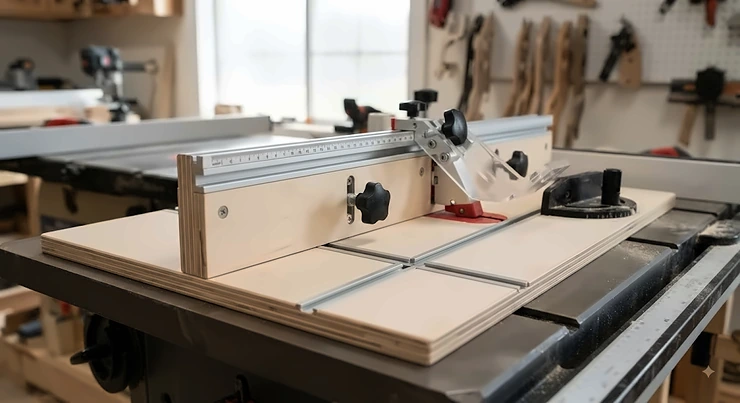
That last part — repeatability — is the whole game. A t-track fence system for table saw jigs isn’t flashy. It’s a channel with a T-shaped cross-section that captures the head of a bolt, letting you position and lock hardware anywhere along its length. But the difference between a shop that fights its jigs and one that flows through a cut list comes down almost entirely to whether the fences are set up with usable accessory mounting slots or not.
This guide covers seven real, currently available track systems and accessories — spanning basic aluminum extrusion to a full aftermarket fence — plus honest analysis of who each one suits, what reviewers actually report, and how to avoid the mistakes that turn a $30 upgrade into a $30 paperweight. Everything here is sourced from real product specifications and aggregated customer feedback, never invented reviews or fabricated hands-on testing. Let’s get into it.
What Is a T-Track Fence System for Table Saw Jigs?
A t-track fence system for table saw jigs is an aluminum track — typically 3/4″ wide with a T-shaped internal slot — mounted to a saw fence, sled, or jig base so that stops, hold-down clamps, and featherboards can be positioned anywhere along its length and locked with a T-bolt. It turns a fixed fence into an adjustable, repeatable work-holding platform.
Quick Comparison Table
| Product | Type | Price Range | Best For |
|---|---|---|---|
| POWERTEC 71372V | Basic universal track (4-pack) | around $25-$35 | Budget jig builders retrofitting several fixtures at once |
| Rockler 17-Piece Universal T-Track Kit | Track + hardware bundle | around $65-$85 | First-timers who want everything in one box |
| INCRA T-Track Plus 36″ | Precision track with scale | around $40-$55 | Anyone who needs a built-in ruler for repeat cuts |
| BOW Products XT XTENDER | Complete aftermarket fence system | around $170-$230 | Jobsite and contractor saws needing a real upgrade |
| Woodpeckers T-Track 36″ | Precision USA-made track | around $50-$65 | Woodworkers who won’t compromise on tolerance |
| POWERTEC 71168-P2 Hold-Down Clamps | 4-pack hold-down clamps | around $20-$30 | Anyone already running t-track who needs work-holding |
| BOW Products FencePRO FP4 | T-track featherboard, 2-pack | around $55-$75 | Rip-cut safety and kickback control |
Looking at the lineup, the split is clear: the POWERTEC 71372V and Rockler 17-Piece Universal T-Track Kit are where most people should start if they’re outfitting a shop-built sled or auxiliary fence for the first time, while the BOW Products XT XTENDER stands apart as the only true drop-in replacement fence rather than a component you build into something else. If precision matters more than budget, the INCRA T-Track Plus 36″ and Woodpeckers T-Track 36″ both earn their higher price with tighter tolerances — the kind of difference that shows up in tenth-of-an-inch repeat cuts, not in a spec sheet. The two accessory picks, the POWERTEC 71168-P2 Hold-Down Clamps and BOW Products FencePRO FP4 featherboard, aren’t optional add-ons so much as the reason to install track in the first place.
💬 Already know which style fits your shop? Check current pricing before it changes — availability on these accessory tracks shifts fast.
Top 7 T-Track Fence Systems & Accessories for Table Saw Jigs: Expert Analysis
1. POWERTEC 71372V 36″ Universal T-Track (4-Pack) — cheapest way to outfit multiple jigs at once
The standout here is quantity: four 36-inch lengths for less than most single-track competitors charge for one. That math changes how you plan a shop — instead of retrofitting one sled at a time, you can wire up a crosscut sled, a taper jig, and a router table fence in the same afternoon. Each piece uses the “double-cut” profile, meaning the top opening is milled slightly differently than the lower T-slot, a design choice that lets it accept both standard hex bolts and dedicated t-track bolts without you needing to stock two kinds of hardware. Predrilled mounting holes save the step of measuring and spotting your own screw pattern, which matters more than it sounds like when you’re installing four separate lengths.
Based on the spec comparison with pricier options, this is squarely a “get the job done” track rather than a precision instrument — it lacks the tighter extrusion tolerances of the INCRA or Woodpeckers pieces below, so a bolt head can have a hair more side-to-side play inside the channel. Reviewers consistently describe it as solid for general jig-building and note the value of getting four pieces in one purchase, though a handful mention the aluminum finish shows tool marks under close inspection — cosmetic, not functional.
Pros:
- ✅ Four 36″ lengths for the price of roughly one premium track
- ✅ Predrilled holes cut installation time significantly
- ✅ Double-cut profile accepts multiple bolt/hardware types
Cons:
- ❌ Looser tolerances than precision-grade track
- ❌ Aluminum finish is utilitarian, not showroom-polished
Priced around $25-$35 for the set, this is the easiest recommendation in the entire lineup for anyone building more than one jig on a budget — check current price before buying, since multi-packs like this fluctuate with aluminum costs.
2. Rockler 17-Piece Universal T-Track Kit — most complete starter bundle
What most first-time buyers overlook about track systems is that the track itself is only half the job — you still need T-bolts, knobs, and often a stop block before anything is actually usable. The Rockler 17-Piece Universal T-Track Kit solves that by bundling four feet of track with the hardware to make it functional out of the box: T-slot bolts, star knobs, and mounting screws all included. The “stacked slot” design is the more meaningful engineering detail — it accepts 5/16″ T-bolts, 1/4″ T-bolts, and 1/4″ hex bolts in the same channel, so if you already own hardware from another Rockler jig, it drops right in.
This is the pick for someone who doesn’t yet own any t-track hardware and doesn’t want three separate shopping trips before their first jig works. Reviewers who bought it as a first track kit report that having the bolts and knobs included removed the guesswork that usually stalls a first jig-building project. The trade-off is that at four feet, a single kit likely won’t stretch across a full-length fence or a large sled without buying additional track separately.
Pros:
- ✅ Includes bolts and knobs — no separate hardware purchase needed
- ✅ Stacked-slot design accepts three bolt/hardware types
- ✅ Backed by Rockler’s long-standing woodworking hardware catalog
Cons:
- ❌ 4-foot length may not cover larger fences or sleds
- ❌ Costs more per foot than buying bare track separately
At around $65-$85, the value case rests on not needing a second purchase for hardware — for a first-time jig builder, that convenience is usually worth the premium over bare extrusion.
3. INCRA T-Track Plus 36″ with Adjustable Scale — best for repeatable, measured cuts
Here’s what the spec sheet doesn’t fully convey: the “Plus” in this track’s name refers to a sliding Lexan scale embedded directly in the channel, one that can be zeroed to any reference point on your jig. In practice, that means you can dial in a stop position, take a test cut, and if it’s off by a sixteenth, adjust and re-zero without hunting for a tape measure every time. For jigs that get used dozens of times a month — crosscut sleds, taper jigs, box-joint fixtures — that built-in reference turns a repeat-measure chore into a five-second glance.
The large 1/4-20 T-slot accepts standard hex bolts and nuts, which is a deliberate INCRA choice: rather than proprietary hardware, you’re using fasteners available at any hardware store. Aggregated reviewer sentiment is unusually consistent for a shop accessory — buyers repeatedly single out the “well machined” fit and describe reusing INCRA track across multiple jigs once they’ve tried it, calling it worth the extra cost over unscaled track.
Pros:
- ✅ Built-in zeroing scale eliminates repeat measuring
- ✅ Standard 1/4-20 hardware — no proprietary bolts
- ✅ Reviewers consistently praise machining precision
Cons:
- ❌ Costs noticeably more per foot than basic track
- ❌ Scale adds height, which can matter in low-clearance jigs
In the $40-$55 range for a 36″ length, this is the track to reach for on any jig where you’re setting the same stop position over and over — the time saved on measurement alone pays the price difference back within a few projects.
4. BOW Products XT XTENDER T-Track Table Saw Fence System, 36″ — the actual fence upgrade, not just track
This is the odd one out on the list, and deliberately so: rather than a strip of track you embed into something you’re building, the BOW Products XT XTENDER is a complete aftermarket rip fence extension with three built-in T-slots for accessories, designed to bolt onto the existing fence rail of jobsite and contractor-style saws. If your current fence is short, flimsy, or lacks any accessory mounting slots at all — a common complaint with portable and benchtop saws — this replaces the whole front face rather than asking you to retrofit one.
Reasoning through the spec sheet: three separate T-slots means you can run a featherboard, a flip stop, and material support simultaneously without them competing for the same channel, something a single strip of track can’t offer. The milled clamp slots and compatibility with both 1/4″ and 5/16″ T-bolts mean it plays well with hardware from other brands on this list, so you’re not locked into a single accessory ecosystem. This is genuinely a category above the rest of the entries here — it’s a fence, not a fence component — and the price reflects that.
Pros:
- ✅ Three independent T-slots run multiple accessories at once
- ✅ Full fence replacement, not a component to retrofit
- ✅ Compatible with both 1/4″ and 5/16″ T-bolt hardware
Cons:
- ❌ Significant jump in price over standalone track
- ❌ Overkill if you only need to outfit a single shop-built jig
At around $170-$230, this isn’t a casual add-on — it’s the pick for someone whose factory fence is the actual bottleneck, particularly on jobsite saws that ship with minimal accessory support.
5. Woodpeckers T-Track 36″ (USA Made) — tightest tolerance track on this list
The standout feature is a tapered profile engineered specifically to wedge tightly into standard table saw dado cuts — the slightly wider top compensates for grooves that come out marginally undersized from the factory, so the track seats snugly instead of rattling in an oversized channel. That’s a subtle but real advantage over generic extrusion, where a loose-fitting groove can let the whole track shift under clamping pressure.
Based on the spec comparison, this is the track built for people who’ve already been frustrated by a track that wiggled in its groove. It’s compatible with standard 1/4-20 hardware, stop blocks, and edge clips, so it doesn’t lock you into Woodpeckers-branded accessories exclusively. Being made in the USA with a satin anodized finish is a genuine quality signal here, not just marketing language — anodizing resists the corrosion and wear that raw aluminum extrusion picks up in a humid shop over a few seasons. The honest trade-off is that a tighter dado-cut fit only pays off if your table saw’s dado groove is actually cut to spec; on a jig with a hand-routed groove, the benefit shrinks.
Pros:
- ✅ Tapered profile fits snugly in standard dado-cut grooves
- ✅ USA-made with anodized finish for corrosion resistance
- ✅ Standard 1/4-20 hardware compatibility
Cons:
- ❌ Premium pricing versus import track
- ❌ Snug-fit advantage depends on groove being cut to spec
Expect to pay in the $50-$65 range for a 36″ section — worth it specifically for jigs where you’ve had track loosen or shift over time, less critical for a one-off fixture.
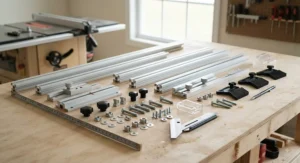
6. POWERTEC 71168-P2 T-Track Hold-Down Clamp, 4-Pack — the accessory that actually uses your track
Track without hold-down clamps is just a groove — this is one of the two accessories that makes the whole system earn its keep. Each clamp uses a lever-shaped anodized aluminum arm with a non-marring rubber pad, tightened with an ergonomic five-star knob that seats into a 5/16″ or 1/4″ T-bolt. The design detail worth noting: POWERTEC explicitly states these bolts are sized for universal T-track or larger and will not seat properly in mini or 1/4″ narrow-profile track, which trips up buyers who mix and match brands without checking slot width first.
What most buyers overlook about hold-down clamps generally is that they’re not just for holding a workpiece flat — they’re what lets you clamp a stop block, an auxiliary fence face, or a jig component in place without pre-drilling a single hole into your sled. Reviewers report reliable, firm clamping pressure across repeated use and flag the rubber pads as effective at preventing marring on finished stock, with the anodized aluminum body holding up to shop use without visible wear.
Pros:
- ✅ Firm, repeatable clamping pressure via lever design
- ✅ Non-marring rubber pads protect finished workpieces
- ✅ Anodized aluminum resists corrosion and wear
Cons:
- ❌ Bolt head won’t fit narrow or mini-profile track
- ❌ Four clamps may not be enough for larger jigs
At around $20-$30 for a 4-pack, this is close to a mandatory companion purchase for any of the track options above — track without hold-down clamps is only half a system.
7. BOW Products FencePRO FP4 T-Track Featherboard, 2-Pack — dedicated kickback control that mounts to track
The standout feature is the EVA foam feather material, which the manufacturer states offers roughly five times the kickback resistance of the plastic or wood feathers found on cheaper featherboards, while remaining soft enough not to damage carbide blade teeth on accidental contact. The feathers are also reversible and replaceable, meaning a worn or compressed set doesn’t mean replacing the whole unit.
Reasoning through why this matters specifically for t-track systems: a tool-free mount that slides directly into a t-track for featherboards and stops means you can reposition it in seconds as stock width changes, rather than loosening and re-clamping a C-clamp-style featherboard every time. Reviewers and independent product write-ups consistently point to the EVA foam’s vibration-dampening effect as producing noticeably cleaner rip cuts compared to rigid plastic feathers, alongside praise for how quickly the unit repositions along the track. The main limitation is that, like all featherboards, it only guards against kickback from the front of the blade — a secondary stock guide or a rear hold-down is still recommended for full protection on wide rips.
Pros:
- ✅ EVA feathers offer notably more kickback resistance than plastic
- ✅ Tool-free t-track mounting for fast repositioning
- ✅ Reversible, replaceable feathers extend usable life
Cons:
- ❌ Doesn’t protect against kickback from behind the blade alone
- ❌ Two-pack cost adds up next to a single basic featherboard
Priced around $55-$75 for the pair, this pairs naturally with any of the track options above — particularly the BOW Products XT XTENDER, which shares the same T-slot hardware standard.
How to Choose a T-Track Mounting System for Your Fence
Picking the right t-track mounting system for fence upgrades comes down to matching the track to what you’re actually building, not just grabbing whatever’s cheapest on the page. Here’s the reasoning, step by step:
- Measure your existing groove or plan your dado cut first. Track profiles vary in width and depth — buying track before confirming your groove dimensions is the single most common return reason cited across listings.
- Decide if you need a scale. If the jig repeats the same stop position often (crosscut sleds, box joints), a scaled track like the INCRA T-Track Plus pays for itself in saved measuring time.
- Check hardware compatibility before ordering clamps or stops. Universal track and mini track use different bolt head sizes — mixing brands without checking this is the second most common installation headache.
- Total your accessory count before buying length. A single 36″ track full of a flip stop, hold-down clamp, and featherboard mount gets crowded fast — buy more length than you think you need.
- Weigh a full fence replacement against retrofitting. If your factory fence has no accessory mounting slots at all, a system like the BOW Products XT XTENDER solves the problem once instead of piecemeal.
- Match material to your climate. Anodized aluminum, like the Woodpeckers T-Track, resists the corrosion that raw extrusion can develop in a humid or unheated shop.
- Budget for hold-downs and featherboards as part of the same purchase, not an afterthought — track alone doesn’t hold anything.
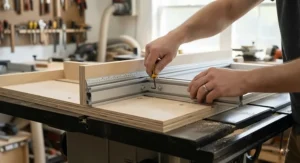
Practical Usage Guide: Installing and Setting Up Your T-Track
Getting a t-track fence system for table saw jigs from box to functional takes about thirty minutes for a single jig, most of which is measuring rather than fastening. Start by dry-fitting the track in its groove or against its mounting surface before drilling a single hole — even predrilled track needs to be checked for square against your fence or sled edge, since a track installed a few degrees off will throw every stop position off cumulatively as you slide down its length.
For surface-mounted track (as opposed to track set into a routed dado), use the predrilled holes as your guide but pilot-drill your mounting surface first; driving a screw into MDF or plywood without a pilot hole risks splitting the material right at the point where you need it strongest. Once mounted, run a T-bolt and knob through the channel before you do anything else — it’s a five-second check that confirms the slot isn’t pinched or misaligned before you’ve committed glue or additional hardware to the jig.
The most common mistake in the first thirty days of owning a new track system isn’t installation — it’s over-tightening hold-down knobs, which can bow a thin auxiliary fence face or, on lower-quality clamps, strip the T-bolt threads. Snug is sufficient; if you’re leaning your body weight into a knob, back off and check whether the clamp pad needs repositioning instead. For maintenance, an occasional wipe with a dry cloth and a drop of dry lubricant on the T-bolt threads keeps knobs turning smoothly — sawdust packed into an unlubricated channel is the usual culprit when a once-smooth-sliding stop starts binding.
Real-World Scenarios: Matching Track to Your Shop
The apartment-shop hobbyist. Building one or two jigs a year on a benchtop saw with limited storage, working mostly with a jobsite-style saw whose stock fence has no accessory mounting slots at all. The POWERTEC 71372V 4-pack paired with a set of POWERTEC hold-down clamps covers a crosscut sled and a taper jig without a large investment, and the leftover track length handles a future project.
The weekend furniture builder with a contractor saw. Cutting joinery several times a month, frustrated by a factory fence that flexes under a featherboard clamp. The BOW Products XT XTENDER solves the root problem — a genuinely inadequate fence — in one purchase, and pairing it with the FencePRO FP4 featherboard addresses the kickback risk that comes with narrow rip cuts on thin stock.
The production-minded shop running repeat cuts daily. Cabinet parts, box joints, or batch runs where a sixteenth of an inch of drift compounds across dozens of pieces. The INCRA T-Track Plus or Woodpeckers T-Track, both chosen for tighter tolerance and (in INCRA’s case) a built-in reference scale, reduce the re-measuring that eats into a production schedule.
Common Mistakes When Buying and Installing T-Track
The most frequent and costly mistake is buying track and hardware from different sources without checking slot width compatibility — a 5/16″ T-bolt simply won’t seat in a narrow or mini-profile channel, and reviewers across nearly every listing on this page mention discovering this after the package arrives. Second is under-buying length: a single 36″ or 48″ section sounds like plenty until a stop block, a hold-down clamp, and a featherboard mount are all competing for the same few inches of channel.
A third, subtler mistake is mounting track before confirming it’s square to the blade or fence reference edge — a track installed a degree or two off doesn’t show up on the first cut, but by the third or fourth stop position down its length, the error has compounded into a measurable miss. Finally, skipping hold-down clamps entirely to save money defeats much of the purpose: track without anything to lock into it is just an expensive groove.
T-Track vs. Miter Track vs. Dovetail Track: What’s the Difference
| Feature | Standard T-Track | Table Saw Miter Track | Dovetail Track |
|---|---|---|---|
| Cross-section | T-shaped slot | Rectangular/T-shaped, factory-cut | Angled dovetail groove |
| Hardware | Standard T-bolts, widely available | Often saw-specific miter bars | Proprietary dovetail clamps |
| Best For | DIY jigs, fences, accessory mounting | Miter gauges, crosscut sled runners | Fast-swap clamping systems |
| Retrofit Difficulty | Easy — surface mount or shallow dado | Usually factory-installed only | Requires routed dovetail groove |
Standard t-track wins on flexibility and hardware availability — since it uses widely stocked T-bolts, you’re not tied to one manufacturer for every accessory you add later. Miter track, by contrast, is usually the factory-cut slot under your saw’s table that your miter gauge or sled runner rides in, and it’s rarely something you retrofit yourself; it’s a reference to build around, not a product to buy. Dovetail systems trade that broad compatibility for faster tool-free clamping, at the cost of needing a precisely routed groove and generally being locked into a single brand’s accessory ecosystem once you commit.
✨ Ready to compare options side by side? Click through to check current availability before your next shop day.
What to Expect: Real-World Performance of T-Track Jig Accessories
On paper, every track in this guide does the same basic job — captures a bolt head, lets it slide, lets it lock. In practice, the differences show up under repeated use. Budget track like the POWERTEC 71372V performs reliably for occasional jig-building but can develop slightly more play in the channel after a season of use than precision-machined options; most hobbyist users won’t notice this in casual projects, but it becomes apparent in repeat-position work. Scaled track like the INCRA T-Track Plus changes workflow more than it changes the cut itself — the practical benefit is fewer trips to grab a tape measure, not a fundamentally different result on the workpiece.
The BOW Products XT XTENDER, being a full fence rather than a component, changes the day-to-day experience the most dramatically: users moving from a stock jobsite fence report the biggest subjective improvement isn’t in any single cut, but in no longer needing to double-check the fence hasn’t shifted mid-project. Featherboards mounted in t-track, compared to clamp-on versions, save real setup time across a work session — repositioning takes seconds rather than the loosen-slide-retighten cycle of a traditional clamp.
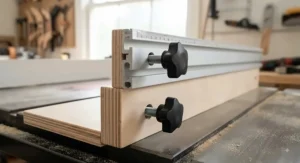
Hold-Down Clamps and Featherboards: Building a Complete Accessory Mounting System
A bare length of track is only step one — the accessory mounting slots only pay off once you’ve populated them with the hardware that actually does the work. Hold-down clamps are the workhorse: they secure a jig fence face, lock a stop block in position, or pin down a workpiece that would otherwise creep during a cut. The POWERTEC 71168-P2 clamps covered above are a reasonable default, but the buying principle holds regardless of brand — check that the T-bolt head size matches your track’s slot width before ordering, since this is the single most common compatibility mistake in this category.
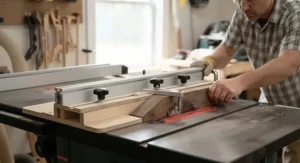
Featherboards deserve their own line item rather than an afterthought, because they solve a different problem than clamps: continuous, spring-loaded pressure against a workpiece as it feeds through a cut, specifically to prevent kickback. A t-track for featherboards and stops setup — where both accessories share the same channel — means you can position a featherboard just ahead of the blade and a stop block further down the same fence without needing separate mounting hardware for each. The BOW Products FencePRO FP4, with its EVA foam feathers, is built specifically around this kind of tool-free, track-mounted repositioning. Between the two accessory types, a shop building its first real jig setup should prioritize hold-down clamps first — they’re more broadly useful across sleds, fences, and fixtures — then add featherboards once rip-cut volume increases.
Jig Building 101: Problem → Solution Guide
Problem: Your stop block keeps sliding out of position mid-project. Solution: the friction between a hold-down clamp’s rubber pad and bare aluminum degrades with dust buildup — wipe the track channel clean and confirm the knob is snug (not over-torqued) before each session.
Problem: A shop-built jig has no accessory mounting slots at all. Solution: surface-mount a length of basic track like the POWERTEC 71372V directly to the jig face with predrilled screw holes rather than routing a dado — it’s a faster retrofit for an already-built jig.
Problem: Repeat cuts drift slightly over a long production run. Solution: switch the stop-block track to a scaled option like the INCRA T-Track Plus, so each reset references a fixed zero point instead of a tape measure reading that’s easy to misread under shop lighting.
Problem: Kickback risk on narrow rip cuts. Solution: mount a t-track featherboard, such as the BOW Products FencePRO FP4, just ahead of the blade to hold stock against the fence throughout the cut.
Problem: Factory fence flexes or lacks any track at all. Solution: rather than retrofitting piecemeal, a full replacement system like the BOW Products XT XTENDER addresses the structural issue directly.
Long-Term Cost & Maintenance
Aluminum track itself is close to maintenance-free — an occasional wipe-down and a drop of dry lubricant on T-bolt threads is typically all it needs across years of shop use. The real cost-per-use conversation is about what you build around the track: a $25 length of basic track that gets used across three or four jigs over several years works out to pennies per project, while a jig built with no track at all costs you setup time on every single use instead — time that compounds far faster than a one-time hardware purchase.
| Investment Level | Approx. Total Cost | What You Get | Long-Term Value |
|---|---|---|---|
| Budget starter | around $45-$65 | POWERTEC track + hold-down clamps | Covers 2-3 basic jigs |
| Mid-range | around $105-$140 | Rockler kit + INCRA scaled track | Precision + convenience for repeat cuts |
| Full upgrade | around $225-$305 | BOW XT XTENDER + featherboard | Solves fence problems at the source |
Comparing the tiers, the budget path makes the most sense for anyone still deciding how much jig-building they’ll actually do, while the mid-range tier is where most hobbyists land once they’ve outgrown their first sled and know they’ll keep building. The full-upgrade tier only earns its cost if the underlying factory fence is genuinely the bottleneck — buying a premium fence system to compensate for a single loose stop block is solving the wrong problem.
Safety and Regulations: Working Safely with T-Track Jigs
Table saws remain one of the most heavily regulated pieces of shop equipment for good reason, and accessory mounting hardware doesn’t change the underlying safety fundamentals — blade guarding, riving knives, and proper hand positioning still apply regardless of what’s bolted to your fence. The Occupational Safety and Health Administration’s guidance on table saw machine guarding emphasizes keeping hands clear of the cutting line and using push sticks for narrow stock — a featherboard mounted in t-track supports that goal by holding material against the fence without requiring a hand anywhere near the blade path.
Where accessories matter most from a safety standpoint is kickback prevention: a properly positioned featherboard, as detailed in independent guidance on featherboard technique from Fine Woodworking, reduces the chance of a workpiece binding and being thrown back toward the operator. No accessory eliminates risk entirely — a featherboard, hold-down clamp, or stop block is a layer of a broader safety approach that still includes a sharp blade, correct blade height, and a saw’s factory guard whenever the cut allows it.
Buyer’s Decision Framework
If you’re building your first jig on a tight budget, choose basic multi-pack track like the POWERTEC 71372V because the per-foot cost lets you outfit more than one project without overspending on a single fixture. If your jig repeats the same cut dozens of times a week, choose scaled track like the INCRA T-Track Plus because the built-in reference eliminates the re-measuring that eats into repeat-cut accuracy. If your factory fence has no track at all and flexes under pressure, choose a full replacement system like the BOW Products XT XTENDER because retrofitting a structurally inadequate fence rarely solves the real problem. And if you already own track but no way to actually hold material to it, prioritize hold-down clamps and a featherboard before buying any additional length of track — hardware, not aluminum, is usually the missing piece.
FAQ
❓ What size T-bolt fits standard universal t-track?
❓ Can I install t-track without routing a dado groove?
❓ How many hold-down clamps does a typical jig need?
❓ Does a t-track featherboard replace a table saw's factory blade guard?
❓ Is aluminum t-track durable enough for a humid garage shop?
Conclusion
A t-track fence system for table saw jigs isn’t a single product so much as a small ecosystem — track, bolts, hold-down clamps, and featherboards that only add up to something useful once they’re working together. For most home shops, that means starting cheap and building outward: a multi-pack of basic track and a set of hold-down clamps solves the majority of jig-building headaches without a big upfront spend. For shops running repeat cuts or wrestling with a genuinely inadequate factory fence, the scaled precision track or a full aftermarket fence system pays for itself in accuracy and setup time saved.
None of the seven picks here is universally “best” — the honest answer depends on whether you’re outfitting your first sled or replacing a fence you’ve outgrown. What matters more than any single spec sheet is buying track, bolts, and accessories that are actually compatible with each other, and budgeting for hold-down clamps and a featherboard as part of the same purchase rather than an afterthought. Get that right, and the track itself becomes the most boring, reliable part of your shop — exactly what it should be.
✨ Don’t Miss These Exclusive Deals!
🔍 Take your jig-building setup to the next level with the picks above. Click on any highlighted product to check current pricing and availability, and start building fixtures that actually hold their position, cut after cut.
Recommended for You
- Fence Micro Adjuster for Precision Cuts: 7 Best Picks (2026)
- 7 Best Sacrificial Fence Boards for Table Saws in 2026
- 7 Best Micro Adjustment Fence Accessories Under $50 (2026)
Disclaimer: This article contains affiliate links. As an Amazon Associate, I earn from qualifying purchases. If you purchase products through these links, we may earn a small commission at no additional cost to you.
✨ Found this helpful? Share it with your friends! 💬🤗
