
In This Article
Every nine minutes, someone in America walks into an emergency room with a table saw injury. Ten amputations happen every single day. Research published by the National Institutes of Health confirms that over 30,000 table saw injuries occur annually, with medical costs exceeding $2 billion every year. But here’s what most woodworkers don’t talk about: roughly 67% of those injuries happened with the blade guard removed, and shockingly, about 27% occurred even with traditional safety features engaged.
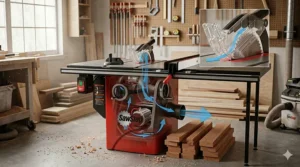
I’ve spent the last decade watching the woodworking safety landscape transform, and nothing compares to what SawStop has accomplished. The sawstop cabinet saw isn’t just another tool — it’s the difference between a nick that needs a bandaid and a life-altering amputation that ends careers. The company’s patented flesh sensing technology stops a spinning blade in less than 5 milliseconds when it detects skin contact, retracting it below the table surface before serious damage occurs.
What’s remarkable is how this technology exploits basic physics. The system continuously monitors a small electrical signal through the blade. Because human skin conducts electricity differently than wood, the moment contact happens, an aluminum brake slams into the blade with spring-loaded force. The blade stops instantly, the brake cartridge is destroyed in the process, and you walk away with a scratch instead of heading to the trauma center.
This guide examines seven real sawstop cabinet saw models currently available, comparing everything from entry-level contractor saws to industrial powerhouses. Whether you’re setting up your first serious shop or upgrading from a decades-old Delta, understanding which configuration matches your actual workflow matters more than any spec sheet suggests.
Quick Comparison: SawStop Cabinet Saw Lineup at a Glance
| Model | Motor Power | Fence Size | Weight | Best For | Price Range |
|---|---|---|---|---|---|
| PCS175-TGP236 | 1.75 HP | 36″ | ~450 lbs | Serious hobbyists | $2,400-$2,900 |
| PCS31230-TGP236 | 3 HP | 36″ | ~475 lbs | Professional woodworkers | $3,200-$3,800 |
| PCS31230-TGP252 | 3 HP | 52″ | ~500 lbs | Production shops | $3,600-$4,200 |
| ICS31230-TGI236 | 3 HP Industrial | 36″ | ~635 lbs | Heavy-duty cycles | $4,800-$5,400 |
| ICS51230-TGI252 | 5 HP | 52″ | ~685 lbs | Industrial operations | $5,800-$6,800 |
| ICS53230-TGI252 | 5 HP 3-Phase | 52″ | ~685 lbs | Commercial facilities | $6,200-$7,200 |
| CNS175-TGP236 | 1.75 HP Contractor | 36″ | ~351 lbs | Budget-conscious buyers | $1,800-$2,300 |
Looking at this comparison, the gap between the Contractor Saw at around $2,000 and the 5HP Industrial model pushing $7,000 tells you exactly what you’re paying for: mass equals stability, and horsepower determines what you can cut all day without bogging down. The Professional Cabinet Saw (PCS) series dominates the middle ground because it delivers cast-iron precision without requiring a reinforced floor or 230V 3-phase power that most home shops don’t have.
💬 Just one click — help others make better buying decisions too!😊
✨ Don’t Miss These Exclusive Deals!
🔍 Take your woodworking safety to the next level with these carefully selected sawstop cabinet saw models. Click on any highlighted item to check current pricing and availability. These tools will help you create professional-grade projects while protecting what matters most — your hands!
Top 7 SawStop Cabinet Saw Models: Expert Analysis
1. SawStop Professional Cabinet Saw PCS31230-TGP236 — The Sweet Spot
SawStop Professional Cabinet Saw PCS31230-TGP236 hits the perfect balance between serious capability and reasonable shop requirements. The 3HP motor runs on standard 230V single-phase power (configurable from 120V with an optional kit), which means you’re not rewiring your garage to use it.
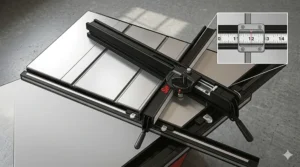
The 36-inch T-Glide fence system uses heavy-gauge steel construction that locks down without deflection — a critical detail when you’re ripping 8-foot hardwood panels and need that cut to stay square for the entire length. What the spec sheet won’t tell you is that gas piston elevation makes height adjustments smooth enough to dial in blade position within thousandths without the jerky wheel-cranking older saws demand. Table flatness measured at 0.010″ maximum diagonal gap means your reference surface stays true even after years of use.
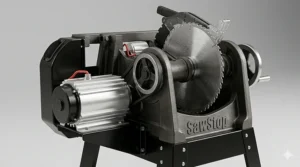
Here’s what separates this from cheaper alternatives: the trunnion and arbor assembly are built like a bridge, not a stamped-metal approximation. Under load, when you’re pushing dense maple through a 3⅛-inch depth of cut, flex becomes your enemy. This saw doesn’t flex. Professional woodworkers report that after installing this model, their joinery fits tighter because the cuts are actually perpendicular.
Customer feedback consistently highlights two things: the brake system’s peace of mind during repetitive production work, and the surprising lack of vibration even when ripping thick stock. One cabinet maker mentioned his previous saw required him to chase alignment every few months; this one stayed dialed in for over a year.
Pros:
- 3HP handles hardwoods without bogging down during full-depth cuts
- T-Glide fence stays square through heavy use
- Gas piston elevation provides precise blade height control
Cons:
- 475-pound weight requires two people for installation
- Premium fence adds $300-500 over standard options
Around $3,200-$3,800 depending on configuration, this model delivers professional results without the industrial price tag. If you’re running a one-person shop or small business where daily production matters, this is where you stop comparing and start cutting.
2. SawStop Professional Cabinet Saw PCS31230-TGP252 — Maximum Capacity
The SawStop Professional Cabinet Saw PCS31230-TGP252 extends that 36-inch fence to a full 52 inches, which sounds like a luxury until you try ripping a 4×8 sheet of plywood solo. With 52 inches of right-side capacity, you can position the fence at 24 inches and the sheet stays supported on both sides without auxiliary tables or helpers.
Same 3HP motor, same cast-iron precision, but the real-world difference shows up when you’re working with sheet goods all day. Cabinetmakers and furniture builders who dimension their own plywood report that this fence length eliminates the wobble and binding that happens when large panels overhang a shorter table. The extension table and rails add another 25 pounds to the total weight, but they’re welded steel construction that won’t sag under load.
What most buyers overlook: that extra fence capacity isn’t just for wide rips. When you’re doing narrow cuts close to the fence, having the fence positioned further right means the offcut has somewhere to go without jamming between blade and fence — a common cause of kickback on shorter tables.
Professional feedback emphasizes the versatility this configuration enables. One kitchen installer mentioned he can break down full sheets in the morning, then switch to precision joinery in the afternoon without changing setups. The larger table surface means more reference area for complex cuts.
Pros:
- 52-inch fence capacity handles full sheet goods without support tables
- Extended table surface provides better reference for large workpieces
- Same precision and safety as 36-inch model with more versatility
Cons:
- Requires 85+ inches of lateral shop space
- Price premium of $400-600 over 36-inch version
In the $3,600-$4,200 range, this configuration makes sense if at least 30% of your work involves sheet goods or you’re building large furniture. The extra capacity pays for itself in time saved not wrestling with inadequate support.
3. SawStop Professional Cabinet Saw PCS175-TGP236 — Budget Professional Option
The SawStop Professional Cabinet Saw PCS175-TGP236 proves you don’t need 3 horsepower to access sawstop pcs technology. Running on 1.75HP, this model operates on standard 120V household current (configurable to 220V), which matters if your shop shares a breaker panel with other tools.
Here’s the practical reality: 1.75HP cuts everything a 3HP model cuts, just slower. If you’re ripping 8/4 oak, you’ll feed it at a more deliberate pace. For hobbyists and weekend builders who aren’t running production schedules, that slower feed rate often improves cut quality because you’re not rushing. The motor doesn’t bog down on typical hardwoods up to 2 inches thick; it just requires more patience on dense species like hard maple or hickory.
The 36-inch T-Glide fence delivers the same precision and lockdown as the 3HP models — fence quality isn’t compromised by motor size. Same sawstop flesh detection system, same 5-millisecond reaction time, same cast-iron table flatness. What you’re sacrificing is sustained power under heavy load, not safety or accuracy.
Customer experiences reveal an interesting pattern: beginners and intermediate woodworkers actually prefer this model because the lower power demands more controlled feeding, which builds better technique. One high school shop teacher mentioned switching to this model specifically because students couldn’t force-feed material fast enough to cause kickback.
Pros:
- Runs on 120V household power (no dedicated circuit required)
- Full sawstop safety features at lower price point
- Adequate power for most hobby and small-business applications
Cons:
- Noticeably slower on thick hardwoods and full-depth cuts
- May struggle with sustained heavy use in production environment
Around $2,400-$2,900, this configuration delivers professional-grade safety and precision for serious hobbyists who work with standard lumber dimensions and don’t need industrial cutting speeds.
4. SawStop Industrial Cabinet Saw ICS31230-TGI236 — Heavy-Duty Precision
The SawStop Industrial Cabinet Saw ICS31230-TGI236 marks the jump from professional to industrial construction. At 635 pounds, this isn’t a saw you move around — it’s a saw you build the shop around. The 3HP industrial motor is engineered for continuous duty cycles, meaning you can rip all day without the heat buildup and motor stress that consumer-grade saws experience.
What separates industrial from professional beyond weight? The arbor shaft and bearings are oversized to withstand heavy production environments without developing runout. Poly V-ribbed belts provide better torque transfer and less vibration than standard V-belts. Those 7-inch chrome handwheels with gas-assisted elevation aren’t just convenience — they’re precision instruments that maintain blade position under vibration and load.
The integrated lock-out tag-out switch addresses commercial safety requirements. In educational and production settings where multiple operators share equipment, preventing unauthorized use isn’t paranoia — it’s liability management. The switch cuts power at the source before anyone can even engage the blade.
Professional shops running this model report that the stability advantage shows up in finish quality. When you’re producing dozens of identical components, dimensional consistency depends on the saw not shifting or flexing. That extra 160 pounds of mass compared to the PCS models translates directly to reduced vibration and maintained alignment.
Pros:
- 635-pound mass provides exceptional stability for precision work
- Industrial-grade motor and bearings built for continuous operation
- Lock-out tag-out switch meets commercial safety requirements
Cons:
- Requires concrete floor or reinforced support (not suitable for wood floors)
- Price point around $4,800-$5,400 targets commercial operations
This configuration makes sense for educational institutions, production cabinet shops, and commercial operations where the saw runs 6-8 hours daily. The investment in industrial construction pays back through reduced maintenance and sustained precision.
5. SawStop Industrial Cabinet Saw ICS51230-TGI252 — Maximum Power
The SawStop Industrial Cabinet Saw ICS51230-TGI252 represents the pinnacle of SawStop engineering. The 5HP single-phase motor delivers torque that doesn’t exist in consumer equipment. When you’re ripping 3-inch thick hardwood at full depth, this motor doesn’t slow down — it maintains RPM through the cut like the material isn’t there.
At 685 pounds with the 52-inch Industrial T-Glide fence assembly, this saw requires professional installation and often dedicated electrical infrastructure. The 230V single-phase requirement is manageable in most shops, but that 5HP draw demands a dedicated circuit and appropriately sized breaker. What you’re paying for is the ability to make cuts all day that would overheat and damage lesser saws.
The expanded 52-inch fence capacity combined with industrial mass creates a different cutting experience. Large panel work that feels precarious on lighter saws becomes routine. The table surface area and support structure mean sheet goods lay flat without operator assistance, enabling one-person operation of tasks that typically require two.
Industrial users emphasize the reliability factor. One furniture manufacturer running three shifts mentioned this saw operates 16 hours daily without overheating or alignment drift. The brake cartridge replacement rate is actually lower than their previous industrial saws because the superior safety system means fewer accidental triggers from metal contact or damp wood.
Pros:
- 5HP power handles any cutting task without slowing or bogging
- 685-pound mass and 52-inch fence enable single-operator sheet processing
- Built for multi-shift production environments
Cons:
- Requires professional installation and possibly floor reinforcement
- Premium pricing in $5,800-$6,800 range targets high-volume operations
This is the saw for operations where downtime costs money and cutting capacity determines throughput. If your shop processes dozens of sheets daily or works with exotic hardwoods that stress normal equipment, this investment makes economic sense.
6. SawStop Industrial Cabinet Saw ICS53230-TGI252 — Three-Phase Industrial
The SawStop Industrial Cabinet Saw ICS53230-TGI252 takes that 5HP platform and converts it to 3-phase power. If you’re unfamiliar with three-phase, it’s the electrical configuration used in commercial and industrial facilities because it delivers more efficient power transfer and smoother motor operation than single-phase.
Why does phase configuration matter? Three-phase motors run cooler, produce more torque per amp drawn, and last longer under continuous operation. In a production environment running this saw 40+ hours weekly, those efficiency gains compound into reduced electrical costs and extended motor life. The smoother power delivery also translates to reduced vibration, which matters when you’re maintaining tight tolerances across long production runs.
The challenge: three-phase power requires industrial electrical infrastructure that most home shops and small businesses don’t have. Installing three-phase service can cost thousands in electrical work, which is why this configuration targets established operations with existing commercial power.
Production managers running three-phase equipment report measurably lower maintenance costs. One millwork shop compared their single-phase and three-phase Industrial models side-by-side and found the three-phase motor required bearing replacement half as frequently despite running more hours.
Pros:
- Three-phase power provides smoother operation and reduced electrical costs
- Lower operating temperatures extend motor life in production environments
- Same 685-pound stability and 52-inch capacity as single-phase model
Cons:
- Requires three-phase electrical service (major infrastructure investment)
- Premium pricing around $6,200-$7,200 justified only in commercial settings
This configuration makes sense for established production facilities with three-phase power already installed. The operating cost savings and reliability improvements justify the higher initial investment when the saw runs thousands of hours annually.
7. SawStop Contractor Saw CNS175-TGP236 — Entry-Level Safety
The SawStop Contractor Saw CNS175-TGP236 brings sawstop safety features to the sub-$2,500 price point. At 351 pounds, this is the only model in the lineup that two people can realistically move without equipment. The 1.75HP motor runs on 120V or 230V (configurable), and the open-base contractor design sacrifices dust collection efficiency for portability.
What distinguishes this from the PCS175 Professional model? Weight, primarily. The lighter construction uses the same sawstop flesh detection system and achieves the same cutting capacity, but the reduced mass means more vibration and less inherent stability. The 36-inch T-Glide fence is the same precision design as the heavier models, but securing it to a lighter frame requires more attention to setup and maintenance.
The configurability of this model deserves emphasis — over 150 unique configurations exist through add-ons like cast-iron wing assemblies, mobile bases, and router table attachments. You can start with the base saw and incrementally upgrade as budget and needs expand. Many woodworkers begin here and add the cast-iron wing assembly (CNS-CIWA), which transforms the contractor saw into a hybrid that performs closer to the Professional Cabinet Saw for significantly less money.
Customer feedback skews toward woodworkers transitioning from entry-level saws who prioritize safety but aren’t ready to commit to full cabinet saw pricing. Several mentioned using this model for 2-3 years before upgrading to a PCS, at which point they moved the Contractor Saw to a second location or jobsite duty.
Pros:
- Most affordable sawstop cabinet saw with full safety system
- 351-pound weight enables two-person movement and positioning
- 150+ configurations allow incremental upgrades over time
Cons:
- Open-base design provides inferior dust collection compared to cabinet models
- Lighter construction means more vibration and potential alignment drift
In the $1,800-$2,300 range, this model proves that injury prevention saw technology doesn’t require industrial budgets. For serious hobbyists, part-time professionals, or anyone transitioning from portable saws, this delivers legitimate cabinet saw performance with the safety system that defines the brand.
Understanding Flesh Sensing Technology: How It Actually Works
The physics behind sawstop flesh detection is elegantly simple, but the engineering execution is sophisticated. At its core, the system treats the spinning blade as an active sensor. According to Wikipedia’s detailed technical documentation, a small 12-volt, 200-kilohertz electrical signal continuously runs through the blade via capacitive coupling — the signal generator sits on one side of the blade, transferring the charge without direct contact, and a detector plate on the opposite side monitors the signal strength.
Here’s where basic physics becomes life-saving technology: wood and human skin conduct electricity at vastly different rates. Wood is largely non-conductive; your body carries a natural electrical charge and acts like a capacitor. When skin contacts the blade, the electrical signal changes within microseconds. A digital signal processor inside the brake cartridge — think of it as a dedicated computer continuously analyzing that signal thousands of times per second — detects the change and triggers the braking mechanism.
The brake itself deserves attention because it’s mechanically brilliant in its simplicity. An aluminum block sits millimeters away from the blade, held in position by a thin wire. When the signal changes indicating skin contact, an electrical charge instantly vaporizes that wire (like a fuse blowing), and a massive spring drives the aluminum block into the spinning blade teeth. Because aluminum is softer than steel, the teeth bite deep into the brake material, transferring the blade’s kinetic energy into the brake and stopping rotation in under 5 milliseconds. Simultaneously, the blade’s angular momentum drives it below the table surface, removing it from the danger zone.
The entire sequence — contact detection, brake deployment, blade stop, and retraction — happens faster than human nerve signals can travel from your finger to your brain. By the time you’d feel pain from a normal cut, the sawstop blade has already stopped and retracted, leaving typically just a minor scratch that might need a bandaid.
What about false positives? The system can trigger on wet or pressure-treated lumber because moisture increases conductivity. That’s why every SawStop model includes a bypass mode for cutting wet material or aluminum. The operator can temporarily disable the brake system when working with conductive materials, though obviously you lose the safety benefit during that bypass period. Professional users report false triggers are rare when cutting properly dried lumber, and the cost of a brake cartridge ($60-90) beats the alternative.
The resetting process takes about 90 seconds. You replace the destroyed brake cartridge, inspect the blade for damage (often it’s fine, sometimes you need a new blade), and you’re operational again. Critics focus on this reset cost, but context matters: the average table saw amputation costs $25,000-$50,000 in medical bills alone, not counting lost wages and permanent disability. Buying new brake cartridges for occasional false triggers is dramatically cheaper than even one emergency room visit.
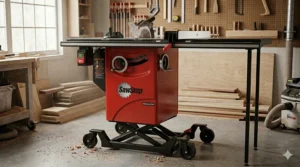
Real-World Application Guide: Matching Saw to Shop Type
Small Home Workshop (Under 200 sq ft)
If your shop occupies a single-car garage or basement corner, the CNS175-TGP236 Contractor Saw or PCS175-TGP236 Professional Cabinet Saw make the most sense. The contractor model’s 351-pound weight means you can move it for cleaning or reconfiguration without renting equipment. Add the mobile base and you can roll it against the wall when not in use, reclaiming valuable floor space.
Power requirements matter in small shops because you’re likely sharing circuits with other tools. The 1.75HP motor runs on standard 120V household power, eliminating the need for electrical upgrades. If your typical projects involve furniture, cabinets, or home improvement work with standard dimension lumber and plywood, 1.75HP provides adequate capacity.
The challenge in tight quarters isn’t power — it’s infeed and outfeed space. Consider that a 52-inch fence requires 85+ inches of lateral clearance. In a 200-square-foot shop, that fence extension might force you to open the garage door to rip full sheets. The 36-inch fence configuration leaves more room for other tools and workflow.
Medium Production Shop (200-600 sq ft)
Professional woodworkers running a sustainable one- or two-person business typically operate in this range. The PCS31230-TGP236 or PCS31230-TGP252 Professional Cabinet Saw models deliver the cutting capacity and precision production demands without requiring industrial infrastructure.
The 3HP motor provides the sustained power needed when you’re making 50-100 cuts daily across mixed materials. You’ll appreciate that extra horsepower when dimensioning hardwoods for client projects — feeding material at a comfortable pace without worrying about motor strain or blade slowdown. The difference between struggling through cuts and effortless operation compounds over a full workday.
Fence length choice depends on your product mix. If 60% or more of your work involves sheet goods — kitchen cabinets, built-ins, closet systems — the 52-inch fence justifies its footprint and cost. For furniture builders working primarily with solid lumber, the 36-inch fence provides adequate capacity while leaving room for assembly tables and finishing areas.
The 475-500 pound weight range means this saw stays planted during operation but you’ll need help positioning it initially. Most installers bring a pallet jack or appliance dolly, set the saw, level it, and it stays there permanently.
Large Commercial Operation (600+ sq ft)
Production facilities, educational institutions, and multi-employee shops require the Industrial Cabinet Saw line. The ICS51230-TGI252 or ICS53230-TGI252 models address needs that consumer-grade equipment can’t sustain: multi-shift operation, continuous duty cycles, and the reliability requirements when downtime directly costs revenue.
The 685-pound mass isn’t just stability — it’s a statement that this saw isn’t moving. Installation requires planning the shop layout around the saw rather than positioning the saw around other equipment. Many production shops place the Industrial model centrally with separate stations for jointing, thickness planing, and assembly surrounding it.
The 5HP motor combined with industrial-grade bearings and drive components means this saw can rip dense hardwoods all day without performance degradation. One production manager mentioned they dimension exotic hardwoods for custom furniture 6 hours daily — walnut, cherry, hard maple, white oak — without ever hearing the motor labor. That consistent power delivery translates to consistent cut quality across hundreds of components.
The lock-out tag-out switch isn’t a luxury in commercial settings — it’s liability protection. In environments with multiple operators, shift changes, or student/apprentice workers, preventing unauthorized or untrained use protects both personnel and equipment.
The 5 Critical Mistakes When Buying Your First SawStop
Mistake 1: Buying More Saw Than Your Shop Can Support
The most common error I see is buyers stretching budget to get the Industrial model when their shop infrastructure can’t handle it. A 685-pound saw on a residential garage floor will settle and go out of alignment unless you have a proper concrete slab. One woodworker mentioned his ICS model slowly sank into his wood floor over six months, requiring complete releveling and ultimately floor reinforcement that cost $2,000.
Before ordering any model over 500 pounds, verify your floor can handle the concentrated load. Residential floor joists might be rated for 40 pounds per square foot distributed load, but a 685-pound saw concentrated on four leveling feet creates point loads that exceed design capacity. Professional installation includes floor assessment and often recommends load-spreading plates or concrete pads.
Mistake 2: Underestimating Required Clearance Space
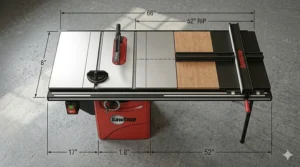
Saw dimensions listed on spec sheets don’t account for operational clearance. A PCS with 52-inch fence needs 85+ inches laterally just for the saw, but you also need 8+ feet of infeed space and 10+ feet of outfeed for handling full-length boards. That’s realistically 15 feet of clear space in one direction.
Measure your shop carefully and account for door swings, wall obstructions, and other tool placement. One cabinet maker mentioned buying the 52-inch fence model only to discover he couldn’t rip full sheets without opening his overhead door because the outfeed space conflicted with his wall-mounted lumber rack.
Mistake 3: Ignoring Electrical Requirements
Each model lists power requirements, but understanding what that means for your shop requires checking your electrical panel. The 3HP models pull significant current — the 230V configuration is heavily recommended because running 3HP on 120V puts strain on circuits designed for 15-20 amp loads.
Upgrading to 230V single-phase power typically costs $200-400 for a licensed electrician to run a dedicated circuit from your panel. Three-phase power installation can run $3,000-10,000 depending on distance from the utility transformer. Budget for electrical work as part of the saw investment, not an afterthought.
Mistake 4: Skipping the Mobile Base for “Permanent” Installations
Even if you’re convinced the saw will never move, a mobile base provides adjustment flexibility that matters during installation and maintenance. Saws settle, floors aren’t perfectly level, and periodically you’ll need access to the motor compartment or wiring. A mobile base lets you fine-tune position and access all sides without requiring three friends and pry bars.
The other factor: shop layouts evolve. The “permanent” position you choose today might become the wrong position when you add a router table, expand your workbench, or reconfigure workflow. Mobility preserves options.
Mistake 5: Not Planning for Dust Collection from Day One
Every SawStop model recommends minimum CFM (cubic feet per minute) for adequate dust extraction — 350 CFM for PCS/CNS models, 400 CFM for Industrial models. Standard shop vacuums max out around 100-120 CFM, which is completely inadequate. Under-table shrouding combined with the dust collection blade guard captures 99% of sawdust, but only if you’re moving enough air volume.
Budget for a proper dust collector (not a shop vac) rated for the required CFM. Entry-level stationary collectors start around $300-400, but the investment in respiratory health and shop cleanliness pays immediate dividends. The Centers for Disease Control (CDC) classifies sawdust as a carcinogen — effective collection isn’t optional if you’re cutting regularly.
How to Choose the Right SawStop Cabinet Saw: The 7-Point Decision Framework
1. Assess Your Average Project Scale
Track what you actually build over the next month. If 70% of your projects involve boards under 24 inches wide and 6 feet long, a 36-inch fence handles everything comfortably. If you’re regularly dimensioning plywood or building large case goods, the 52-inch fence prevents frustration and improves safety by eliminating awkward overhang situations.
2. Calculate Your Daily Cutting Volume
Hobbyists making 20-30 cuts weekly have different needs than production shops making 200 cuts daily. The 1.75HP motors handle light and medium use perfectly, but sustained heavy cutting demands the thermal capacity and bearing durability that 3HP and 5HP motors provide. Be honest about usage intensity — underpowered equipment fails faster and performs worse.
3. Inventory Your Electrical Infrastructure
Open your breaker panel and identify available circuits. If you have 230V service available (check for double-pole breakers), the Professional and Industrial models connect easily. If you’re limited to 120V household circuits, the Contractor and 1.75HP Professional models avoid expensive electrical upgrades.
4. Measure Your Shop (Realistically)
Account for wall thickness, door swings, and permanent fixtures. Map out infeed, outfeed, and lateral clearance based on actual dimensions, not optimistic estimates. Remember that comfortable workflow space exceeds minimum clearance — cramped shops create unsafe situations and frustrate daily use.
5. Consider Future Growth
If you’re currently a hobbyist planning to transition to professional work, buying the Professional Cabinet Saw now avoids the upgrade cost later. Conversely, if you’re committed to weekend woodworking with no production ambitions, the Contractor Saw serves indefinitely without unused capacity.
6. Budget Total System Cost
The saw is one component. Add realistic budgets for: mobile base ($200-400), dado insert and brake cartridge ($80-120), premium blade ($80-150), dust collection setup ($300-800), electrical work if needed ($200-500), and professional delivery/installation ($150-400). Total investment often runs 20-40% above the saw’s list price.
7. Prioritize What Actually Matters to You
Some buyers prioritize maximum safety regardless of cost — they want the industrial mass and power. Others prioritize budget and accept the performance limitations of entry-level models. Neither choice is wrong if it aligns with your actual priorities and usage. Don’t let spec-sheet comparison override what you need for the work you actually do.
Comparison: SawStop Cabinet Saw vs Traditional Alternatives
| Feature | SawStop Cabinet Saw | Traditional Cabinet Saw | Delta Unisaw | Powermatic PM2000 |
|---|---|---|---|---|
| Flesh Detection | Active 5ms brake system | None | None | None |
| Injury Prevention | Reduces amputation to scratch | Relies on guards/technique | Relies on guards/technique | Relies on guards/technique |
| Reset After Trigger | $60-90 brake cartridge | N/A | N/A | N/A |
| Precision | 0.010″ max table variance | Varies 0.015-0.030″ | ~0.020″ | ~0.015″ |
| Dust Collection | 99% with guard + shroud | 60-80% typical | 70-85% | 75-90% |
| Price Premium | +$800-1,500 | Baseline | Competitive | Competitive |
The comparison reveals an uncomfortable truth: traditional saws rely entirely on operator discipline and mechanical guards that most users remove for many cutting operations. According to the U.S. Consumer Product Safety Commission’s research, roughly 67% of table saw injuries occur with guards removed, and about 27% happen even with guards engaged. SawStop’s active safety system operates whether guards are present or not — it’s the only technology that protects against the moment of inattention that happens to even experienced woodworkers.
The price premium for SawStop technology ranges from $800-1,500 compared to equivalent traditional cabinet saws. That cost difference has generated debate, but context matters: the average table saw amputation costs $25,000-50,000 in medical bills, lost wages, and rehabilitation. One injury prevented pays for multiple saws.
What the table doesn’t show is long-term value preservation. SawStop models hold resale value exceptionally well because the safety technology doesn’t depreciate — a 5-year-old used SawStop typically sells for 60-70% of new price, while traditional saws at the same age bring 40-50%.
Long-Term Cost Analysis: Is the SawStop Premium Worth It?
Initial Investment Comparison
Entry-level traditional cabinet saw: $1,200-1,800
Comparable SawStop CNS175: $1,800-2,300
Premium: $600-700
Mid-tier traditional cabinet saw: $2,200-2,800
Comparable SawStop PCS31230: $3,200-3,800
Premium: $800-1,200
Industrial traditional cabinet saw: $3,800-4,800
Comparable SawStop ICS51230: $5,800-6,800
Premium: $1,500-2,500
Operating Cost Over 10 Years
Brake cartridge replacements (assuming 1-2 accidental triggers per year average):
20 cartridges × $75 average = $1,500
Blade replacements after triggers (50% of triggers damage blade):
10 blades × $80 = $800
Total 10-year safety system cost: ~$2,300
Traditional saw injury probability:
According to injury statistics, approximately 1 in 7 regular table saw users experiences a reportable injury requiring medical treatment over a 10-year period. Severity varies from minor lacerations ($500-2,000 in medical costs) to partial amputations ($15,000-30,000) to complete finger loss ($40,000-80,000 including lost wages).
Expected value calculation:
Even assuming a conservative 10% probability of a moderate injury ($10,000 average cost) over 10 years:
Traditional saw expected cost: $1,000 (10% × $10,000)
SawStop total cost of ownership premium over 10 years:
Initial premium ($800-2,500) + Operating costs ($2,300) = $3,100-4,800
Minus avoided injury expected value ($1,000) = $2,100-3,800
The analysis reveals that over a 10-year ownership period, the true premium for sawstop safety features is roughly $200-380 annually. That’s the cost of 2-3 premium saw blades, or one mid-tier hand tool. When framed as an annual insurance premium protecting your hands, the calculation shifts from “expensive safety feature” to “reasonable risk management.”

Frequently Asked Questions
❓ How much does a SawStop cabinet saw weigh and do I need special flooring?
❓ Can the SawStop brake system be disabled for cutting aluminum or wet wood?
❓ What is the cost to reset a SawStop after the brake activates?
❓ How does SawStop compare to the safest cabinet saw from other manufacturers?
❓ Does the SawStop Professional Cabinet Saw require three-phase power?
Conclusion: Making Your Decision
The sawstop cabinet saw represents a fundamental shift in how we approach workshop safety. For 50+ years, the table saw industry relied on blade guards that users removed, riving knives that didn’t prevent blade contact, and the assumption that proper technique eliminates risk. Meanwhile, 40,000 Americans visited emergency rooms annually with table saw injuries, and 10 amputations happened every day.
SawStop’s active flesh sensing technology doesn’t demand perfect technique or operator discipline. It monitors every revolution of that blade, waiting for the electrical signal change that indicates skin contact, and reacts faster than human reflexes when contact happens. The technology works whether you’re following every safety protocol or making that one rushed cut at the end of a long day when focus slips.
Choosing between models comes down to matching capacity to actual needs. The Contractor Saw brings the safety system to hobbyist budgets. The Professional Cabinet Saw delivers precision and power for serious woodworkers and small businesses. The Industrial models provide the mass, motor capacity, and durability that production environments demand.
What’s remarkable is that across this entire lineup — from the $1,800 Contractor model to the $7,000 Industrial powerhouse — the safety system performs identically. The same 5-millisecond reaction time, the same flesh detection sensitivity, the same injury prevention that’s saved thousands of fingers since 2000. Your choice of model determines cutting capacity, precision, and convenience, but the protection remains constant.
If you’re still operating a traditional table saw, the question isn’t whether to upgrade to SawStop — it’s when. Every cut you make is a calculated risk that proper technique and attention will prevent contact. Eventually, that calculation fails for almost everyone. The statistics are clear: regular table saw users face meaningful injury risk over a decade of use.
The investment premium — whether $600 for the Contractor Saw or $2,500 for an Industrial model — represents a different kind of value than horsepower or fence length. It’s the value of walking away from that one moment when concentration lapses, grain catches unexpectedly, or a workpiece shifts. It’s the value of finishing your career with ten fingers instead of the disability statistics that define the traditional table saw experience.
That value calculation is personal, but the mathematics are straightforward: the cost of one prevented amputation exceeds the price of any saw in this lineup. For professional woodworkers, contractors, educators, and serious hobbyists, the sawstop cabinet saw has evolved from optional safety upgrade to essential shop equipment. The real question is which model matches your work.
Recommended for You
- 7 Best Cabinet Table Saws Under $5000 (2026 Reviews)
- 7 Best Cabinet Table Saw Under 3000 in 2026
- 7 Best Hybrid Table Saw for Small Shop 2026
Disclaimer: This article contains affiliate links. As an Amazon Associate, I earn from qualifying purchases. If you purchase products through these links, we may earn a small commission at no additional cost to you.
✨ Found this helpful? Share it with your friends! 💬🤗
