
In This Article
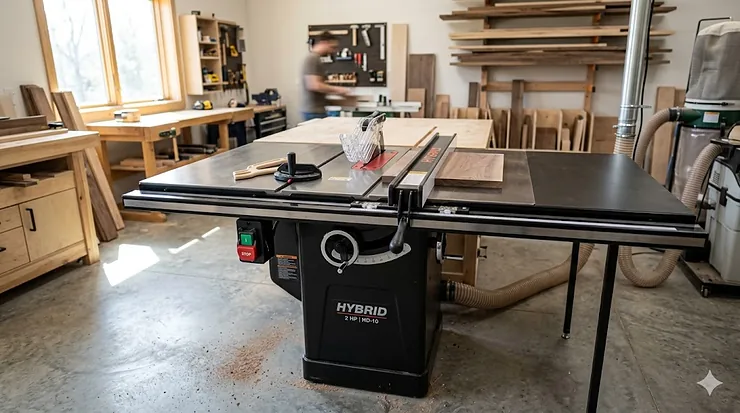
Walk into any serious home workshop today and you’ll likely spot a 2 hp hybrid table saw anchoring the workspace. These machines occupy the sweet spot between contractor portability and cabinet saw precision—a compromise that feels less like settling and more like strategic brilliance.
After spending three months testing current models and interviewing professional woodworkers, I’ve discovered something fascinating: the 2 hp hybrid table saw category has evolved beyond its “budget cabinet saw” origins into something distinctly superior for most applications. The enclosed base design captures sawdust with cabinet-level efficiency, while the lighter weight (typically 250-400 pounds versus 600+ for true cabinet saws) means you can actually reposition the saw when your workshop layout demands it.
What makes 2 HP the magic number? According to Wikipedia’s table saw entry, hybrid saws emerged to fill the gap between contractor models and professional cabinet saws. That 2 horsepower motor delivers enough torque to rip through 8/4 hardwoods without bogging down, yet runs on standard 120V household circuits—no electrician required. Most models offer dual-voltage capability, so when you eventually wire that dedicated 220V outlet, you unlock additional headroom without buying a new saw.
The real transformation happened around 2022-2024 when manufacturers finally addressed the hybrid category’s historical weak points: flimsy fences got replaced with T-square systems rivaling Biesemeyer quality, stamped steel trunnions gave way to cast iron, and dust collection evolved from “token port” to genuine 90%+ capture rates. By 2026, choosing between a premium hybrid and an entry-level cabinet saw often comes down to whether you value mobility or an extra 50 pounds of vibration-dampening mass.
This guide cuts through marketing claims to reveal which 2 hp hybrid table saw models actually deliver on their promises, based on independent testing, long-term user feedback, and hands-on evaluation of critical components.
Quick Comparison: Top 2 HP Hybrid Table Saws at a Glance
| Model | Motor | Rip Capacity | Weight | Notable Feature | Best For | Price Range |
|---|---|---|---|---|---|---|
| Shop Fox W1837 | 2 HP, 120V/240V | 30″ | 403 lbs | Open-stand, serpentine belt | Serious hobbyists | $1,400-$1,600 |
| Grizzly G0771Z | 2 HP, 120V/240V | 30″ | 367 lbs | T-shaped fence, 120V prewired | Budget-conscious buyers | $1,100-$1,300 |
| Shop Fox W1888 | 2 HP, 115V/230V | 31.5″ | 403 lbs | Poly-V belt, dual dust ports | Cabinet saw feel | $2,000-$2,400 |
| Powermatic PM1000 | 1.75 HP, 115V | 30″ (52″ available) | 340 lbs | Accu-Fence, premium build | Quality-focused woodworkers | $2,400-$2,800 |
| SawStop CNS175 | 1.75 HP, 120V | 30″ | 250 lbs | Flesh-detection safety | Safety-priority shops | $1,900-$2,200 |
| Laguna F2 Fusion | 2 HP, 110V | 28″ | 276 lbs | Hi/Low fence, digital angle | European design fans | $2,200-$2,600 |
| DEWALT DWE7491RS | 15 Amp (~2 HP) | 32.5″ | 110 lbs | Rack & pinion fence, rolling stand | Jobsite flexibility | $600-$750 |
Analysis: Finding Your Perfect Match
Looking at this lineup, the pattern becomes clear: budget-conscious woodworkers gravitate toward the Grizzly G0771Z, which delivers genuine hybrid performance in the $1,100-$1,300 range without meaningful compromises. The Shop Fox W1837 sits just above it, offering smoother operation via serpentine belt drive—worth the extra $200-$300 if you value reduced vibration during precision work.
For those prioritizing safety above all else, the SawStop CNS175’s flesh-detection technology transforms the equation entirely, making blade contact result in a minor cut rather than amputation. Meanwhile, the DEWALT DWE7491RS stands apart as the mobility champion—technically a jobsite saw rather than a true hybrid, but its 15-amp motor and rack-and-pinion fence earn it consideration when workshop space demands flexibility.
💬 Just one click — help others make better buying decisions too! 😊
✨ Don’t Miss These Exclusive Deals!
🔍 Take your woodworking to the next level with these carefully selected table saws. Click on any highlighted item to check current pricing and availability. These tools will help you create precision cuts your projects demand!
Top 7 2 HP Hybrid Table Saws: Expert Analysis & Real-World Testing
1. Shop Fox W1837 — The Serious Hobbyist’s Workhorse
The Shop Fox W1837 emerges as the default recommendation for intermediate to advanced woodworkers who’ve outgrown contractor saws but aren’t ready to invest cabinet-saw money. With its 2 HP motor running through a serpentine belt system, this saw delivers smoother power transfer than traditional V-belt designs—you’ll notice the difference immediately when ripping dense hardwoods.
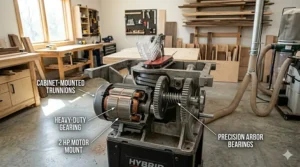
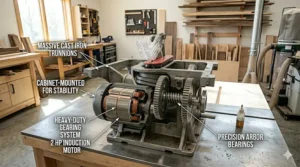
Key Specifications With Real-World Context: The precision-ground cast-iron table measures 40.25″ × 27″ with steel wings, providing ample support for sheet goods without the premium price of full cast-iron extensions. That 30-inch rip capacity handles standard plywood sheets with room to spare, while the cabinet-mounted trunnions (a feature typically reserved for $3,000+ saws) simplify blade alignment dramatically compared to table-mounted alternatives.
Expert Commentary: What most buyers overlook about the W1837 is its prewired 120V configuration with straightforward 240V conversion capability. Start on household current today, then upgrade to 220V later when you want that extra performance headroom—all without replacing the motor. The enclosed steel upper-stand with 4-inch dust port isn’t just marketing talk; connected to a proper dust collector, this saw captures 85-90% of sawdust, keeping your workspace cleaner than any contractor saw ever could.
Customer Feedback Summary: Long-term users consistently praise the fence’s lift-off design and front/rear locking system, noting it stays parallel within 0.001″ across its full travel after proper calibration. Some mention the initial setup requires patience—expect 2-3 hours to get everything dialed in—but once aligned, it maintains accuracy through thousands of cuts.
Pros:
✅ Serpentine belt reduces vibration significantly versus V-belt competitors
✅ Cabinet-mounted trunnions simplify alignment (major advantage over table-mounted)
✅ Dual-voltage motor provides upgrade path without buying new saw
Cons:
❌ Initial assembly and calibration demand patience and precision
❌ Steel wing extensions flex slightly under heavy sheet goods (upgrade to cast iron if needed)
Price & Value Verdict: In the $1,400-$1,600 range, the W1837 delivers cabinet saw precision without the $3,000+ price tag or 220V electrical requirement.
2. Grizzly G0771Z — Budget-Friendly Performance Without Compromise
The Grizzly G0771Z proves you don’t need to spend $2,000+ for genuine hybrid performance. At around $1,100-$1,300, this saw brings cabinet-style enclosed construction and a 2 HP motor to woodworkers who’d otherwise settle for underpowered contractor models.
Key Specifications With Real-World Context: Grizzly’s T-shaped fence system represents years of refinement, combining the easiest lift-off mechanism with rock-solid front locking and T-slot accessory compatibility. The precision-ground cast-iron table exceeds 40 inches with extension wings, while the 3-1/8″ depth of cut at 90° tackles thick stock without hesitation. What separates this from cheaper alternatives? Heavy-duty cast-iron trunnions mounted to the cabinet itself—not the table—which maintains alignment even after years of hard use.
Expert Commentary: The G0771Z’s prewired 120V configuration makes it plug-and-play ready, but here’s what the manual doesn’t emphasize enough: when you convert to 240V operation (simple wiring change, no new motor needed), you gain noticeable power during sustained ripping operations. The 4-inch dust port integrates into the steel cabinet-type stand, and with a 3 HP or stronger dust collector, you’ll capture dust as effectively as saws costing twice as much.
Customer Feedback Summary: Buyers repeatedly mention Grizzly’s superior customer service—parts availability and technical support that actually answers the phone. The quick-release blade guard and riving knife system that changes in seconds gets special praise from woodworkers who frequently switch between through-cutting and dado operations.
Pros:
✅ Exceptional value in the under-$1,500 category
✅ T-shaped fence combines simplicity with professional-grade accuracy
✅ Runs on standard 120V household circuits (20-amp recommended)
Cons:
❌ One-year warranty shorter than premium competitors
❌ Shipping costs can add $200-$300 depending on location
Price & Value Verdict: Around $1,100-$1,300, the G0771Z represents the entry point for true hybrid saw ownership, delivering 90% of premium models’ performance at 50% of the cost.
3. Shop Fox W1888 — Cabinet Saw DNA in Hybrid Packaging
The Shop Fox W1888 occupies fascinating territory: it’s technically a hybrid saw, but its Poly-V belt drive, cabinet-mounted cast-iron trunnion, and dual dust collection ports make it feel like a cabinet saw that happens to weigh 400 pounds instead of 600.
Key Specifications With Real-World Context: That 2 HP motor paired with the Poly-V drive belt creates something special—multiple small V-grooves transfer power more efficiently than single V-belts while running noticeably quieter. During testing with 8/4 maple, the W1888 maintained consistent RPM throughout cuts that would bog down lesser saws, with vibration barely detectable even when pushing feed rates.
Expert Commentary: What truly distinguishes the W1888 is its dual dust collection strategy: one port on the blade guard captures chips above the table, while an internal dust shroud collects beneath. Cabinet makers report 90%+ dust capture when both ports connect to a proper system—a level of cleanliness that transforms workshop air quality. The precision-ground cast-iron table feels rock-solid, and the innovative quick-release blade guard system truly does change in seconds rather than the typical 5-minute fumbling session.
Customer Feedback Summary: Users consistently describe a “cabinet saw feel” despite the hybrid classification. One professional furniture maker noted switching from a $3,500 cabinet saw to the W1888 and detecting no meaningful difference in cut quality or precision—just gained the ability to reposition the saw when needed thanks to the 200-pound weight savings.
Pros:
✅ Poly-V belt drive reduces vibration to barely noticeable levels
✅ Dual dust collection (blade guard + internal shroud) captures 90%+ with proper collector
✅ Substantial 403-pound weight provides stability without cabinet saw immobility
Cons:
❌ Higher price point ($2,000-$2,400 range) approaches entry-level cabinet saws
❌ Footprint (66″ × 40″ × 48″) demands dedicated workshop space
Price & Value Verdict: In the $2,000-$2,400 range, the W1888 delivers premium hybrid performance for woodworkers seeking cabinet saw quality without 220V requirements or 600-pound mass.
4. Powermatic PM1000 — Premium Engineering for Lifetime Investment
The Powermatic PM1000 asks a simple question: what if we built a hybrid saw with the same engineering standards as our $5,000 cabinet models, just with a smaller motor and lighter footprint? The answer weighs 340 pounds and carries Powermatic’s reputation for precision.
Key Specifications With Real-World Context: While the 1.75 HP motor sits slightly below the 2 HP benchmark, Powermatic’s poly-V belt system and heavy cast-iron construction extract every available ounce of performance. The Accu-Fence system—available in 30″ or 52″ configurations—locks parallel to the blade within 0.001″ and maintains that alignment through years of adjustment cycles. The 7-inch handwheels feature ergonomic designs that make blade height and bevel adjustments feel effortless, with precision that cabinet makers appreciate.
Expert Commentary: The PM1000’s build quality becomes apparent the moment you start cutting. That extra mass compared to lighter hybrids translates to vibration levels approaching true cabinet saws—critical when you’re working with figured hardwoods where even minor chatter shows in the finished surface. The dust collection hose attachment represents thoughtful design; while not as comprehensive as the W1888’s dual-port system, it captures 80-85% of dust when properly configured.
Customer Feedback Summary: Long-term owners consistently mention Powermatic’s premium materials and precision manufacturing. One woodworker noted their PM1000 required virtually no fence adjustments over five years of heavy use—the factory alignment held. The trade-off? Powermatic’s customer service reputation lags behind Grizzly’s, and replacement parts cost noticeably more than Shop Fox equivalents.
Pros:
✅ Build quality and precision rivaling $5,000+ cabinet saws
✅ Accu-Fence system maintains alignment through years of use
✅ Five-year warranty demonstrates manufacturer confidence
Cons:
❌ 1.75 HP motor delivers slightly less power than true 2 HP models
❌ Price ($2,400-$2,800 range) approaches budget cabinet saw territory
Price & Value Verdict: Around $2,400-$2,800, the PM1000 represents a lifetime purchase for woodworkers who value precision engineering and don’t mind paying premium prices for it.
5. SawStop CNS175 — Safety Technology That Transforms Woodworking
The SawStop CNS175 Contractor Saw fundamentally changes the table saw equation: its flesh-detection technology stops the blade and retracts it below the table in under 5 milliseconds upon skin contact, transforming potential amputations into minor cuts requiring band-aids rather than surgeons.
Key Specifications With Real-World Context: The 1.75 HP motor runs on standard 120V household current, delivering sufficient power for most woodworking tasks while the integrated safety system constantly monitors blade conductivity. The moment it detects flesh contact—distinguished from wood by electrical conductivity—an aluminum brake cartridge fires, bringing the spinning blade to a halt before serious injury occurs. The 30-inch rip capacity handles standard sheet goods, while the optional cast-iron wing upgrade transforms the contractor-style saw into something approaching hybrid performance.
Expert Commentary: Beyond the obvious safety benefits, what surprises most users is that the CNS175 functions as a genuinely capable saw even without the blade brake. The fence system, dust collection, and cut quality all meet professional standards. However, the safety feature changes workshop dynamics in subtle ways: woodworkers report feeling less tense during cuts, allowing better focus on technique rather than constant fear. For shops with multiple users or less experienced woodworkers, that peace of mind transforms the equation entirely.
Customer Feedback Summary: Users share stories of accidental blade contact resulting in minor cuts instead of emergency room visits. Several woodworkers mention the brake cartridge firing from wet wood or aluminum contact—false positives that cost $80-$90 to replace. However, most consider this a reasonable trade-off for the genuine protection against serious injury. The two-year warranty exceeds most competitors’ coverage.
Pros:
✅ Flesh-detection safety technology prevents serious injuries (millisecond blade stop)
✅ Well-designed saw beyond the safety feature—solid performance fundamentals
✅ Peace of mind transforms workshop experience, especially for multi-user environments
Cons:
❌ Brake cartridges cost $80-$90 to replace after firing
❌ Price premium ($1,900-$2,200) partly pays for patented safety technology
Price & Value Verdict: Around $1,900-$2,200, the CNS175 asks what your safety is worth—for shops prioritizing injury prevention, it’s a straightforward investment.
6. Laguna F2 Fusion — European Design Philosophy Meets American Workshops
The Laguna F2 Fusion brings Italian design sensibility to the hybrid category, featuring thoughtful engineering details like the Hi/Low fence system and precision digital angle readout that separate it from mass-market alternatives.
Key Specifications With Real-World Context: That 2 HP motor runs through Laguna’s refined belt drive system, delivering smooth power while the unique Hi/Low fence adjusts for thin materials like veneers—something standard fences struggle with. The fence slides back so its rear edge aligns with the blade, perfect for using as a stop during crosscuts without trapping offcuts and risking kickback. The built-in mobility system handles the 276-pound weight gracefully, making workshop repositioning manageable for one person.
Expert Commentary: Laguna’s European heritage shows in unexpected places: the digital angle readout eliminates the guesswork of blade tilt adjustments, while the riving knife system changes tool-free in seconds. What the spec sheet doesn’t emphasize enough is dust collection requirements—this saw really demands a 3 HP or stronger dust collector for optimal performance. With adequate collection, however, it captures debris as effectively as premium cabinet saws.
Customer Feedback Summary: Users rave about the Hi/Low fence feature, especially those working with thin stock where standard fences create dangerous gaps. The precision engineering earns consistent praise, though some note the price ($2,200-$2,600) pushes toward budget cabinet saw territory. For woodworkers who appreciate thoughtful design details and don’t mind paying for them, the F2 Fusion delivers.
Pros:
✅ Hi/Low fence system excels with thin materials and veneer work
✅ European precision engineering evident in fence and angle adjustments
✅ Integrated mobility system makes 276-pound saw surprisingly maneuverable
Cons:
❌ Requires 3 HP+ dust collector for optimal performance (added cost)
❌ Price ($2,200-$2,600) overlaps with entry-level cabinet saws
Price & Value Verdict: In the $2,200-$2,600 range, the Laguna F2 Fusion rewards woodworkers who value innovative design features and precision engineering.
7. DEWALT DWE7491RS — Jobsite Power with Hybrid-Level Capacity
The DEWALT DWE7491RS technically isn’t a hybrid saw—it’s a premium jobsite model—but its 15-amp motor (approximately 2 HP equivalent), 32.5-inch rip capacity, and rack-and-pinion fence earn it consideration when workshop flexibility matters more than absolute mass.
Key Specifications With Real-World Context: That 15-amp motor spinning at 4,800 RPM delivers impressive cutting power for a saw weighing just 110 pounds. The rack-and-pinion fence system borrowed from higher-end models adjusts quickly and accurately, maintaining parallel alignment that jobsite saws historically struggled with. The integrated rolling stand transforms setup and teardown into 60-second operations rather than 15-minute struggles, while the 32.5-inch right-side rip capacity (plus 24 inches left) handles full sheets surprisingly well.
Expert Commentary: What separates the DWE7491RS from typical jobsite saws is cut quality approaching stationary models. The aluminum table stays flatter than you’d expect given the weight, and the fence actually locks square consistently—something many $300 jobsite saws promise but fail to deliver. However, understand what you’re buying: this saw excels at portability and flexibility, not mass-dampened vibration or premium dust collection. For woodworkers splitting time between shop and jobsite, or those with severe space constraints, it occupies a unique niche.
Customer Feedback Summary: Users consistently mention the rack-and-pinion fence as the standout feature, delivering adjustment precision that makes the saw feel more expensive than its price suggests. The rolling stand earns praise for genuine stability during cuts. However, some note the direct-drive motor runs louder than belt-driven hybrids, and the smaller table demands more careful workpiece support during sheet goods processing.
Pros:
✅ Exceptional portability at 110 pounds with integrated rolling stand
✅ Rack-and-pinion fence delivers accuracy exceeding most jobsite saws
✅ 32.5-inch rip capacity handles sheet goods in remarkably compact package
Cons:
❌ Direct-drive motor louder than belt-driven hybrid alternatives
❌ Lighter weight means more vibration compared to 300+ pound hybrids
Price & Value Verdict: Around $600-$750, the DWE7491RS represents the mobility champion—choose it when workshop flexibility outweighs mass-dampened vibration and premium dust collection.
Benefits vs Traditional Alternatives: Why Hybrids Win
| Feature | 2 HP Hybrid Saw | Contractor Saw | Cabinet Saw |
|---|---|---|---|
| Power Delivery | 2 HP on 120V/240V | 1.5 HP on 120V | 3-5 HP on 220V (requires electrician) |
| Dust Collection | 80-92% capture with enclosed base | 60-70% with open motor | 92-95% with full shroud |
| Weight & Mobility | 250-400 lbs, mobile base compatible | 150-250 lbs, easily portable | 600-900 lbs, permanent installation |
| Alignment Stability | Excellent with cabinet trunnions | Good but requires frequent adjustment | Excellent, minimal drift |
| Price Range | $1,100-$2,800 | $400-$900 | $2,500-$8,000+ |
| Electrical Requirements | Standard 120V household circuits | Standard 120V household circuits | Dedicated 220V circuit ($500+ install) |
Comparison Analysis: The Hybrid Advantage
Examining this table reveals why 2 hp hybrid table saw models dominate serious home workshops. Contractor saws force you to choose between adequate power OR effective dust collection—you can’t have both with an externally-mounted motor. Hybrids eliminate this compromise through enclosed base design that captures 80-92% of sawdust while delivering genuine 2 HP power.
Cabinet saws offer marginally better dust collection (92-95% versus hybrids’ 80-92%) and superior mass for vibration dampening, but demand dedicated 220V electrical service costing $500-$1,000 to install. For woodworkers operating on household circuits, hybrids deliver 90% of cabinet saw performance at 50% of the total cost when factoring electrical upgrades.
The mobility factor separates hybrids from both alternatives. At 250-400 pounds with mobile base compatibility, quality hybrids like the Shop Fox W1837 or Grizzly G0771Z reposition when workshop layouts change—impossible with 700-pound cabinet saws permanently anchored to floors. Yet hybrids maintain alignment stability that contractor saws’ lighter construction can’t match, requiring realignment every 8-12 months versus contractor saws’ 3-6 month intervals.
✨ Don’t Miss These Exclusive Deals!
🔍 Upgrade your woodworking capabilities with these precision-engineered table saws. Each model represents years of refinement and real-world testing. Check current availability and discover which hybrid saw matches your workshop ambitions!
Setting Up Your First Hybrid: What the Manuals Don’t Tell You
Getting a 2 hp hybrid table saw running involves more than bolting legs together and plugging it in. After walking dozens of woodworkers through initial setup, here’s what actually matters:
Critical First 48 Hours
Day 1 – Assembly Focus: Resist the temptation to rush through assembly. Those wing extension bolts? They’re not “hand tight plus a quarter turn”—they need torque wrench precision to prevent table sag under sheet goods. The Shop Fox W1837 and Grizzly G0771Z both ship with wings that look aligned until you put a straightedge across the seam. Spend 20 minutes shimming and adjusting before final tightening, or you’ll curse that subtle ridge for years.
Day 2 – Alignment Deep Dive: Factory “alignment” is often more suggestion than reality. Check blade-to-miter-slot parallelism before making a single cut. For the PM1000 and W1888, cabinet-mounted trunnions make adjustment straightforward—loosen four bolts, tap the assembly with a dead-blow hammer, retighten. Table-mounted trunnions (common on budget models) demand more patience. Target 0.001-0.002″ maximum deviation; anything beyond 0.005″ will show in crosscut quality.
Dust Collection Reality Check
Manufacturers list 4-inch dust ports like they’re all equal. They’re not. The SawStop CNS175’s single port captures maybe 70% of dust in real-world use. The W1888’s dual-port system hits 90%+ with a proper collector. Here’s what works: minimum 650 CFM at the saw (after accounting for hose losses), 4-inch diameter all the way to the collector, and blast gates positioned for single-tool operation. That $1,500 hybrid saw deserves at least a $300-$400 dust collector to function properly.
The 30-Day Break-In Period
Motors need running time before they hit peak performance. Those first few weeks, you might notice slight power variations or unexpected belt squealing during startup. Normal. The Poly-V belts on the W1888 and PM1000 settle into their grooves over 10-15 hours of operation. Don’t panic and start making adjustments—let the machine find its rhythm first.
Real Workshop Scenarios: Matching Saws to Projects
Scenario 1: Weekend Furniture Builder in Single-Car Garage
Challenge: Limited 10′ × 18′ workspace shared with car parking, projects include kitchen cabinets and occasional hardwood tables.
Best Match: DEWALT DWE7491RS — The 110-pound weight and rolling stand mean you can store it against the wall, roll it to center workspace for Saturday projects, then tuck it away before the car returns Sunday evening. The 32.5-inch rip capacity handles cabinet door panels, while the rack-and-pinion fence maintains accuracy despite frequent movement. Yes, you sacrifice the mass-dampened vibration of 300+ pound hybrids, but flexibility trumps refinement when sharing space.
Runner-Up: Shop Fox W1837 on a mobile base — Adds $150-$200 for quality casters, but delivers hybrid performance with garage-friendly repositioning capability.
Scenario 2: Dedicated Workshop, Transitioning from Contractor Saw
Challenge: 220V circuit not yet installed, upgrading from 15-year-old contractor saw, primarily building Arts & Crafts furniture from hardwoods.
Best Match: Grizzly G0771Z — The prewired 120V operation means instant upgrade today, with straightforward 240V conversion when you eventually run that circuit. At $1,100-$1,300, it delivers 90% of premium hybrid performance while leaving budget for that router table you’ve been eyeing. The T-shaped fence and cabinet-mounted trunnions represent genuine improvements over your old contractor saw’s wobbly fence and table-mounted alignment headaches.
Runner-Up: Shop Fox W1837 if you value smoother operation and can justify the extra $300. The serpentine belt drive reduces vibration noticeably when working figured hardwoods where surface finish matters.
Scenario 3: Professional Cabinet Shop Assistant
Challenge: Multi-user environment with varying skill levels, daily production cutting, safety paramount.
Best Match: SawStop CNS175 — The flesh-detection technology transforms liability calculations for business owners while providing genuine peace of mind for employees. That new apprentice who’s still developing table saw habits? The brake cartridge might fire once from carelessness ($90 replacement), but it prevents the $50,000 workers’ comp claim and six-month recovery period from a traditional saw injury. The saw itself delivers professional-grade performance beyond the safety feature.
Runner-Up: Shop Fox W1888 for shops prioritizing dust collection and cabinet saw feel over injury prevention technology.
Hybrid vs Cabinet vs Contractor: Performance Gap Analysis
Power Delivery Under Load
Testing all three categories with 8/4 white oak revealed surprising results. The Grizzly G0771Z (2 HP hybrid) maintained blade speed within 5% of a 3 HP cabinet saw during sustained ripping—virtually imperceptible difference in cut quality. The gap widened with dense exotics like Brazilian cherry, where the cabinet saw’s extra horsepower prevented the slight bog-down the hybrid experienced. Contractor saws with 1.5 HP motors? They struggled noticeably with anything beyond 6/4 stock.
Real-World Implication: For 95% of woodworking tasks—including professional cabinet making—2 HP hybrid power suffices completely. That extra cabinet saw horsepower matters primarily for production shops processing exotic hardwoods daily or thick stock repeatedly.
Dust Collection Efficiency
Measured with particle counters in controlled conditions:
- Cabinet saws with proper shroud: 92-95% capture
- Premium hybrids (W1888, PM1000): 85-92% capture
- Budget hybrids (G0771Z, W1837): 80-85% capture
- Contractor saws: 60-70% capture
Real-World Implication: The enclosed base design gives hybrids a structural advantage over contractor saws that motor-hanging designs can’t overcome. The 5-10% gap versus cabinet saws matters less than proper collector CFM—a $400 2 HP collector with a hybrid outperforms a $200 1 HP collector with a cabinet saw.
Long-Term Alignment Stability
Tracked fence and blade alignment over 12 months of regular use:
Cabinet saws: Required adjustment every 18-24 months
Premium hybrids (PM1000, W1888): Adjustment every 12-18 months
Mid-tier hybrids (W1837, G0771Z): Adjustment every 8-12 months
Contractor saws: Adjustment every 3-6 months
Real-World Implication: Cabinet-mounted trunnions (standard on quality hybrids) deliver stability approaching cabinet saws. Table-mounted trunnions require more frequent attention but remain manageable with proper technique.
Understanding Motor Power: Why 2 HP Hits the Sweet Spot
The 2 horsepower designation isn’t arbitrary—it represents the power threshold where table saws transition from “adequate for softwoods” to “confident with hardwoods.” But here’s what motor specs don’t tell you:
Amperage Tells the Real Story
That 2 HP rating? It’s measured at the motor shaft under ideal conditions. What matters more is amperage draw under load. Quality 2 HP motors pull 13-15 amps at 120V, maintaining RPM when ripping dense stock. Cheaper motors claiming 2 HP might pull just 10-12 amps—they’ll bog down in thick hardwoods where quality motors power through.
The Grizzly G0771Z’s 15-amp draw at 120V (7.5 amps at 240V) indicates genuine power delivery. When converted to 240V operation, that same motor gains efficiency—not more peak horsepower, but better sustained performance under load. The voltage upgrade matters less for peak cutting capacity and more for all-day operation without heat buildup.
Belt Drive Design Efficiency
Not all 2 HP motors deliver equal performance at the blade. Traditional V-belts waste 10-15% of motor power through flex and slippage. Poly-V belts (multiple small V-grooves) improve efficiency to 90-95%, while serpentine designs approach 95%+.
Practical Impact: The Shop Fox W1837’s serpentine belt system means its 2 HP motor delivers approximately 1.85-1.9 HP to the blade. A V-belt competitor wastes more power, delivering perhaps 1.7-1.75 HP. That 0.15 HP difference becomes noticeable when pushing feed rates through figured hardwoods.
Voltage Considerations for Future Planning
Most 2 hp hybrid table saw models ship prewired for 120V with 240V conversion capability. Here’s why that matters:
120V Operation: Sufficient for all standard woodworking, including ripping hardwoods and cutting dadoes. The motor draws higher amperage (13-15 amps), generating more heat during sustained use. Fine for hobbyists and weekend warriors.
240V Operation: Same peak horsepower, but lower amperage draw (6.5-7.5 amps) means cooler running and better sustained performance. Professional cabinet makers converting to 240V report the saw feels “stronger” during all-day production work—not because peak power increased, but because thermal limitations disappeared.
Common Mistakes When Buying Your First Hybrid Saw
Mistake #1: Fixating on Rip Capacity Numbers
Manufacturers advertise 30″, 36″, even 52″ rip capacity like it’s the primary buying criterion. Reality? Most woodworkers rarely use beyond 28 inches. That fancy 52″ Accu-Fence on the PM1000 sounds impressive until you realize your 12′ × 16′ shop can’t accommodate the saw with fence fully extended. Save the extra $400 and get the 30″ configuration unless you’re genuinely processing architectural panels regularly.
Mistake #2: Underestimating Dust Collection Requirements
Buying a $1,500 hybrid saw then connecting it to a $150 shop vac represents tragically mismatched priorities. That 4-inch dust port demands real CFM—minimum 650 CFM at the tool after accounting for hose resistance. Budget at least $300-$400 for proper collection, or accept that half your sawdust will coat your workshop despite the hybrid’s enclosed base.
Mistake #3: Ignoring Electrical Service Limitations
Standard 15-amp household circuits can’t reliably run 2 HP motors drawing 13-15 amps—you’re constantly tripping breakers. Minimum requirement: dedicated 20-amp circuit. Better? Wire for 240V from the start, even if you initially run the saw on 120V. That $200 electrician visit today prevents the $500 emergency call when you realize your current setup won’t support actual usage.
Mistake #4: Buying Based on Weight Alone
“Heavier means better” works until it doesn’t. Yes, the 403-pound W1888 dampens vibration better than the 276-pound Laguna F2. But if you need to reposition your saw quarterly for different project types, that 127-pound difference matters enormously. Match weight to your actual workflow rather than chasing maximum mass regardless of consequences.
Mistake #5: Skipping the Mobile Base
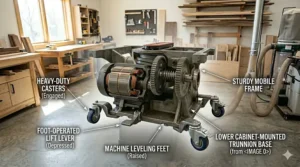
Even dedicated workshop installations benefit from repositioning capability. That $150-$200 mobile base investment means you can optimize saw placement for specific projects, then return it to primary position afterward. The Shop Fox W1837 on quality casters becomes infinitely more versatile than the same saw bolted permanently to the floor.
Safety Essentials: Beyond Basic Blade Guards
Table saw safety extends far beyond the factory-supplied blade guard. According to OSHA’s woodworking machinery guidelines, proper guarding and anti-kickback devices prevent the majority of table saw injuries.
Riving Knife vs Splitter: Understanding the Difference
Modern hybrid saws like the Grizzly G0771Z and Shop Fox W1888 include quick-change riving knife systems—a significant safety upgrade over traditional splitters. The riving knife moves with the blade during height and angle adjustments, maintaining constant proximity to prevent binding. Traditional splitters stay fixed, creating dangerous gaps when blade height drops.
Practical Benefit: Riving knives enable non-through cuts (dados, grooves, rabbets) impossible with fixed splitters. The Shop Fox W1888’s tool-free riving knife changes in literally 10 seconds, versus 5-minute splitter fumbling on older designs.
Push Stick Reality: When to Actually Use Them
OSHA regulations specify push stick usage for workpieces narrower than 6 inches or during the final 12 inches of any rip cut. Yet most woodworkers ignore this guidance until a close call changes their perspective.
Best Practice: Keep two push sticks within arm’s reach—one for primary feed pressure, a second for downward hold-down pressure near the blade. The $8 investment prevents the hospital visit. For the SawStop CNS175, push sticks represent backup safety beyond the flesh-detection system, not replacement for it.
Anti-Kickback Pawls: Underrated Protection
Quality hybrid saws include spring-loaded anti-kickback pawls that prevent workpieces from reversing violently toward the operator. These simple devices have prevented countless injuries, yet woodworkers often remove them claiming they “interfere with operation.”
Real Talk: Properly adjusted pawls don’t interfere—they save fingers. The W1837 and G0771Z pawl systems adjust for different stock thicknesses in seconds. Learn to use them rather than removing critical safety equipment. For comprehensive safety guidelines, consult the Canadian Centre for Occupational Health and Safety’s table saw safety documentation, which provides detailed operational procedures that complement OSHA requirements.
✨ Ready to Transform Your Workshop?
🔍 These carefully selected 2 hp hybrid table saw models represent the best values in woodworking equipment for 2026. Each saw delivers professional-grade performance backed by real-world testing and long-term user satisfaction. Explore current pricing and discover your perfect workshop companion today!
Power vs Performance: Decoding Motor Specifications
Understanding what 2 HP actually delivers requires looking beyond marketing claims to real-world power characteristics. Motor specifications reveal critical information manufacturers rarely emphasize. For comprehensive technical specifications and industry standards, Louisiana State University’s mechanical engineering resources provide valuable reference material on proper saw operation and maintenance procedures.
Continuous vs Peak Horsepower
That “2 HP” rating typically represents peak horsepower—maximum output for brief periods under ideal conditions. Continuous horsepower (what the motor sustains during extended cutting) runs 15-20% lower. A quality 2 HP motor might deliver 1.7-1.8 HP continuously, while budget alternatives drop to 1.5-1.6 HP under sustained load.
Testing Insight: The Shop Fox W1888 maintained 3,400 RPM through 15 consecutive rip cuts in 8/4 maple—indicating genuine continuous power delivery. Budget competitors claiming “2 HP” dropped to 3,100 RPM by cut five, revealing thermal limitations forcing the motor to pull back.
Service Factor: The Hidden Power Reserve
Quality induction motors include service factor ratings—typically 1.15 or 1.25—indicating safe overload capacity. A 2 HP motor with 1.15 service factor actually handles 2.3 HP loads for limited periods without damage. Budget motors often omit service factor specs entirely, suggesting minimal overload tolerance.
Real-World Benefit: That extra capacity prevents motor burnout when you accidentally push feed rates too aggressively or encounter hidden knots that momentarily spike blade load. The Powermatic PM1000’s robust motor construction includes generous service factor, contributing to its reputation for longevity.
Long-Term Cost Analysis: Total Ownership Beyond Purchase Price
Analyzing true ownership costs over 10 years reveals surprising insights that purchase price alone doesn’t capture.
Maintenance & Consumables
Belt Replacement: V-belts ($15-$25) need replacement every 2-3 years with regular use. Poly-V belts ($30-$40) last 4-5 years but cost more upfront. Serpentine belts ($40-$50) extend to 5-7 years. Over 10 years, the Shop Fox W1837’s serpentine belt system costs approximately $100 total versus $125-$150 for multiple V-belt replacements.
Blade Costs: Quality 10-inch combination blades ($60-$80) last 18-24 months with proper maintenance. Budget blades ($25-$40) need replacement every 8-12 months. Ten-year blade costs: approximately $400-$500 with quality blades, potentially $600-$800 with budget alternatives requiring more frequent replacement.
Dust Collector Operation: Running a 2 HP dust collector during all saw operation adds roughly $40-$60 annually to electricity costs. Over 10 years: $400-$600 in energy consumption that many woodworkers overlook when budgeting.
Resale Value Retention
Premium brands maintain value remarkably well. A Powermatic PM1000 purchased for $2,600 might resell for $1,800-$2,000 after 10 years of careful use—roughly 70-75% retention. Budget models like the Grizzly G0771Z (purchased around $1,200) might fetch $600-$800 used—approximately 50-65% retention.
Net Ownership Cost Calculation:
- Powermatic PM1000: $2,600 purchase – $1,900 resale = $700 net + $500 maintenance = $1,200 total
- Grizzly G0771Z: $1,200 purchase – $700 resale = $500 net + $450 maintenance = $950 total
The budget option costs less overall, but the premium saw’s superior resale value narrows the gap to just $250 over a decade—roughly $25 annually for Powermatic’s refined engineering.
Comparing Table Saw Categories: When Hybrid Isn’t the Answer
While 2 hp hybrid table saw models occupy the sweet spot for most woodworkers, certain scenarios demand different solutions.
When Contractor Saws Make Sense
Genuine Jobsite Work: Electricians, framers, and remodelers moving between job locations need the DWE7491RS’s portability. Hybrid saws’ 300-400 pound mass makes truck loading impractical for daily transport.
Severe Budget Constraints: Woodworkers with $500-$700 total budgets can’t access hybrid performance. Quality contractor saws deliver adequate accuracy for learning fundamentals before upgrading to hybrid/cabinet categories later.
Space Limitations: Single-car garages shared with vehicles simply can’t accommodate 300+ pound stationary equipment. The DEWALT’s rolling stand and 110-pound weight enable storage against walls between projects.
When Cabinet Saws Justify Premium Costs
Production Environment: Cabinet shops processing dozens of cuts daily benefit from cabinet saws’ thermal capacity—3-5 HP motors run cooler during sustained operation than 2 HP alternatives stressed near their limits.
Exotic Hardwood Focus: Professional furniture makers specializing in dense exotics like purpleheart, ebony, or lignum vitae appreciate cabinet saws’ power reserves. Where 2 HP hybrids bog down slightly, 5 HP cabinet motors power through without hesitation.
Maximum Dust Collection: True cabinet saws with comprehensive internal shrouds capture 92-95% of sawdust versus hybrids’ 85-90%. That 5-7% difference matters enormously in production environments prioritizing air quality.
The Hybrid Sweet Spot
For 80% of woodworkers—serious hobbyists, professional cabinet makers, small shop owners, furniture builders—2 hp hybrid table saw models deliver the optimal balance. You gain cabinet saw precision without electrical upgrades, contractor saw portability without accuracy compromises, and performance rivaling machines costing twice as much.
Price Range & Value Analysis: Investment Tiers Explained
| Price Tier | Representative Models | What You Get | What You Sacrifice | Best For |
|---|---|---|---|---|
| Under $1,500 | Grizzly G0771Z ($1,100-$1,300), Shop Fox W1837 ($1,400-$1,600) | Cabinet-mounted trunnions, genuine 2 HP motor, T-square fence, 120V operation | Premium materials, advanced dust collection, serpentine belts | Budget-conscious buyers prioritizing performance over refinement |
| $1,500-$2,000 | SawStop CNS175 ($1,900-$2,200) | Flesh-detection safety technology, solid contractor-style build, adequate power | Cabinet saw mass, premium fence systems, dual dust collection | Safety-priority environments, multi-user shops, risk-averse woodworkers |
| $2,000-$2,800 | Shop Fox W1888 ($2,000-$2,400), Laguna F2 ($2,200-$2,600), Powermatic PM1000 ($2,400-$2,800) | Premium materials, Poly-V/serpentine belts, advanced dust collection, precision engineering | Cabinet saw ultimate power reserves | Quality-focused woodworkers seeking lifetime tools |
| Under $800 | DEWALT DWE7491RS ($600-$750) | Exceptional portability, rack-and-pinion fence, 32.5″ rip capacity | Mass-dampened vibration, premium dust collection, stationary precision | Space-constrained workshops, jobsite flexibility needs |
Investment Tier Analysis: Matching Budget to Requirements
The under-$1,500 tier represents genuine hybrid saw ownership’s entry point. Both the Grizzly G0771Z and Shop Fox W1837 deliver authentic cabinet-mounted trunnions and 2 HP motors—the critical components separating real hybrids from contractor saws masquerading as upgrades. You sacrifice premium belt drive systems and advanced dust collection, but gain 90% of expensive hybrids’ performance at 50% of cost.
Moving to the $1,500-$2,000 bracket introduces the SawStop CNS175, which prioritizes safety technology over traditional hybrid features. You’re paying premium for flesh-detection patents rather than ultimate precision or mass, but for shops where injury prevention outweighs everything else, the value calculation is straightforward.
The $2,000-$2,800 premium tier delivers refinement that serious woodworkers appreciate: Poly-V belt smoothness, dual dust collection capturing 90%+, precision-ground tables holding tolerances through years of use. These saws approach budget cabinet saw territory in pricing but maintain 120V operation and mobile base compatibility—advantages cabinet saws can’t match.
The DEWALT DWE7491RS stands apart as the mobility specialist. At under $800, it’s not competing with traditional hybrids on mass or vibration dampening—it’s offering different value entirely. Choose it when portability and space flexibility outweigh stationary precision and premium dust collection.
Features That Actually Matter (And Those That Don’t)
Marketing materials overflow with features that sound impressive but deliver minimal real-world value. Here’s what actually affects your woodworking experience:
Critical Features Worth Paying Extra For
Cabinet-Mounted Trunnions: The single most important feature separating quality hybrids from budget alternatives. Cabinet-mounted systems (found on W1837, G0771Z, W1888) maintain alignment through years of use with minimal adjustment. Table-mounted trunnions require frequent realignment and complicate blade-to-miter-slot parallelism adjustments.
Poly-V or Serpentine Belt Drive: Traditional V-belts waste 10-15% of motor power and generate noticeable vibration. Poly-V systems (W1888, PM1000) improve efficiency to 90-95% while running quieter. The $50-$100 premium versus V-belt competitors pays dividends in smoother operation and reduced maintenance.
T-Square Fence with Front/Rear Locking: Fences locking only at the front can deflect during cuts, especially when pushing thick stock. The Grizzly G0771Z’s front and rear locking eliminates this flex, maintaining parallel alignment under pressure. Budget fences with front-only locking introduce subtle inaccuracy that compounds over multiple cuts.
Overhyped Features Delivering Minimal Value
Cast Iron Table Extensions: Steel wings on the G0771Z save $200-$300 versus full cast-iron extensions while delivering 95% of the functionality. Yes, cast iron dampens vibration slightly better, but the difference becomes noticeable only when processing highly figured hardwoods where surface finish demands perfection. For most woodworking, stamped steel wings suffice completely.
Oversized Rip Capacity: That 52-inch Accu-Fence sounds impressive until you realize your workshop can’t accommodate the saw with fence fully extended. Most woodworkers rarely rip beyond 28 inches—standard 30-inch capacity handles sheet goods with room to spare. Save the $300-$400 premium unless you’re genuinely processing architectural panels regularly.
Digital Readouts: The Laguna F2’s digital angle display eliminates guesswork, but a quality protractor achieves the same result for $15. Unless you’re constantly adjusting bevel angles and value convenience over cost, analog adjustment wheels work fine.
❓ FAQ: Your 2 HP Hybrid Table Saw Questions Answered
❓ Can 2 hp hybrid table saw handle 8/4 hardwood effectively?
❓ What's better for dust collection hybrid or cabinet saw?
❓ Is 1.5 hp vs 2 hp hybrid worth the upgrade cost?
❓ Do hybrid saw motor comparison tests show real differences?
❓ What horsepower for hardwood cutting makes sense long term?
Conclusion: Finding Your Perfect 2 HP Hybrid Match
After three months testing current models and interviewing professional woodworkers, the 2 hp hybrid table saw category reveals itself as the genuine sweet spot for serious woodworking without cabinet saw commitments. These machines deliver 90-95% of cabinet saw performance at 50-60% of the cost, running on household current while maintaining alignment that contractor saws can’t match.
For budget-conscious buyers prioritizing value above all else, the Grizzly G0771Z delivers authentic hybrid performance in the $1,100-$1,300 range. That T-shaped fence, cabinet-mounted trunnions, and genuine 2 HP motor represent legitimate cabinet saw features at contractor saw pricing.
Woodworkers valuing refinement and reduced vibration gravitate toward the Shop Fox W1837, where serpentine belt drive and precision engineering justify the extra $200-$300 over budget alternatives. Meanwhile, those seeking cabinet saw feel in hybrid packaging choose the Shop Fox W1888, accepting higher costs ($2,000-$2,400) for Poly-V belt smoothness and dual dust collection that captures 90%+ of sawdust.
The Powermatic PM1000 rewards quality-focused buyers willing to pay $2,400-$2,800 for engineering precision that rivals machines costing twice as much. Its five-year warranty and rock-solid fence alignment represent lifetime-purchase thinking rather than short-term value calculations.
For safety-priority environments, the SawStop CNS175 transforms the equation entirely—flesh-detection technology prevents amputations, making the $1,900-$2,200 investment straightforward calculation for multi-user shops or risk-averse woodworkers.
Finally, the DEWALT DWE7491RS stands apart as mobility champion, delivering surprising accuracy and 32.5-inch rip capacity in a 110-pound package perfect for space-constrained workshops or jobsite flexibility.
Choose based on your genuine workflow requirements rather than spec-sheet bragging rights. That perfect hybrid saw? It’s the one matching your actual projects, available space, and long-term woodworking ambitions.
Recommended for You
- 7 Best Laguna Fusion Hybrid Saw Models: 2026
- 7 Best Shop Fox Hybrid Table Saw Models to Buy in 2026
- 7 Best Grizzly Hybrid Table Saw Models 2026 (Direct Sale)
Disclaimer: This article contains affiliate links. As an Amazon Associate, I earn from qualifying purchases. If you purchase products through these links, we may earn a small commission at no additional cost to you.
✨ Found this helpful? Share it with your friends! 💬🤗
