
In This Article
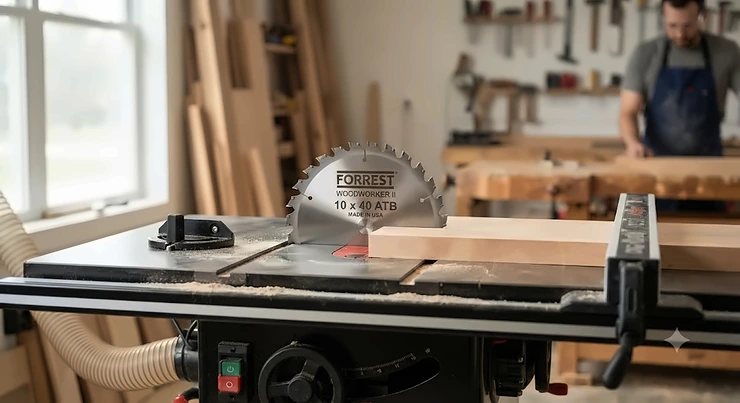
Every table saw owner eventually hits the same wall: the stock blade that came with the saw is loud, it burns oak, and it leaves crosscuts that look like they were gnawed by a beaver. That’s usually the moment someone in a woodworking forum tells you to just buy a Forrest Woodworker II and stop torturing yourself. So what is Forrest Woodworker II, exactly? It’s a 10-inch, 40-tooth ATB combination blade, hand-tensioned and hand-brazed in New Jersey, built around the same carbide-tipped tooth technology that transformed woodworking blades decades ago, engineered to rip and crosscut hardwood up to two inches thick with a surface so smooth it skips the jointer entirely. It’s also one of the most argued-about tools in the hobby, because “worth $150 for a blade” is not a sentence every woodworker agrees with
This Forrest Woodworker II review exists to settle that argument with numbers, not vibes. We’ll walk through the blade’s actual tooth geometry, put it head-to-head with Freud and Diablo alternatives that cost a third as much, and dig into whether Forrest’s famous resharpening service genuinely changes the long-term math. Along the way we’ll cover six more real, purchasable blades — including Forrest’s own Duraline and Dado King lines — so you land on the right tool for your saw, your budget, and your patience for shim kits. No invented five-star reviews here, just spec sheets, aggregated user feedback from woodworking communities, and honest analysis of where the premium price does and doesn’t earn its keep.
Quick Comparison Table
Before the deep dive, here’s the fast version for anyone standing in a shop right now trying to decide. All seven blades below fit a standard 10-inch table saw with a 5/8-inch arbor, and every one of them is available today from major tool retailers.
| Blade | Teeth | Best For | Price Range |
|---|---|---|---|
| Forrest Woodworker II (Full Kerf) | 40 ATB | All-purpose rip/crosscut in hardwood | $150-$200 |
| Forrest Woodworker II (Thin Kerf) | 40 ATB | Underpowered contractor saws (1.5 HP or less) | $140-$180 |
| Forrest Duraline Hi-A/T | 80 Hi-ATB | Melamine, plywood, veneer | $220-$290 |
| Forrest Dado King (8″) | 24T + chippers | Flat-bottom dados, box joints | $380-$430 |
| Freud Diablo D1080X | 80 Hi-ATB | Budget finish crosscuts | Under $75 |
| Freud LU84R011 | 50 Comb | Budget all-purpose combination | $75-$110 |
| Freud LM74R010 | 30 TCG | Glue-line ripping | $70-$95 |
Looking at the spread, the pattern is obvious: Forrest Woodworker II and its siblings occupy the top third of the price range, while the Freud Diablo D1080X and Freud LU84R011 compete on value rather than prestige. What the table can’t show is why that gap exists — the Forrest blades are laser-cut, then hand-straightened to a tighter tolerance than most of their competitors bother with, and that extra labor is exactly what you’re paying for. Whether that tolerance matters to your projects depends heavily on what you’re cutting and how forgiving your other tools are.
💬 Already leaning toward one blade? Skip ahead and compare current prices before they change!
💬 Just one click — help others make better buying decisions too!😊
Top 7 Table Saw Blades: Expert Analysis
1. Forrest Woodworker II — the benchmark combination blade
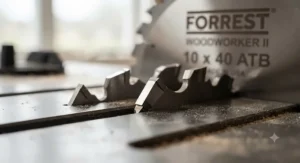
The standout feature of the Forrest Woodworker II isn’t the tooth count, it’s the tolerance: Forrest hand-straightens every plate to within .001 inches of dead flat, versus the .004-to-.010 inches common on mass-produced blades. In practice that means the 15-degree alternate-top-bevel teeth leave rip cuts that feel pre-sanded and crosscuts that are nearly free of visible mill marks. The 40-tooth full-kerf version has a .125-inch kerf and a 20-degree hook angle, and Forrest recommends it for saws running 1.75 HP or above; anything smaller wants the thin-kerf sibling instead.
Based on the spec comparison with cheaper 40-tooth combination blades, what most buyers overlook is that the C-4 submicron carbide isn’t just “harder” in a marketing sense — it genuinely holds an edge through resin-heavy stock like cherry and walnut far longer before you notice burning. This is the blade for someone who owns one table saw and wants one blade that handles 90% of what gets fed through it, from ripping 8/4 maple to crosscutting plywood shelving.
Reviewers consistently note two things across woodworking forums: the blade runs noticeably quieter than stock blades, and it’s genuinely “hand-made” in a way that shows in fit and finish, though a small minority report inconsistent runout on individual units straight from the box — enough that several longtime users recommend checking a new blade with a dial indicator before your first serious project. Forrest’s own return policy backs a 30-day money-back guarantee if that happens.
Pros:
- ✅ Best-in-class flatness reduces burning and saw noise
- ✅ Handles rip and crosscut duty without a blade swap
- ✅ Factory resharpening keeps the original edge geometry
Cons:
- ❌ Occasional unit-to-unit runout variance reported by users
- ❌ Costs roughly 2-3x a comparable Freud combination blade
At around $150-$200 depending on kerf and retailer promotions, the Forrest Woodworker II isn’t the cheapest 40-tooth blade on the market, but for a shop running one blade all day, every day, the reduced sanding time alone often justifies the price gap within a handful of projects.
2. Forrest Woodworker II Thin Kerf — lighter load for smaller motors
This is the same tooth geometry as the full-kerf original, just trimmed down to a 3/32-inch kerf instead of 1/8-inch. Forrest specifically recommends the thin-kerf version for saws rated 1.5 horsepower and under, which covers most benchtop and jobsite table saws that woodworkers actually own before they upgrade to a cabinet saw.
The 20-degree hook angle and 15-degree ATB grind carry over unchanged, so the cut quality is nearly identical to the full-kerf version — what changes is how much resistance the motor feels. On paper this means less strain and slightly faster feed rates on underpowered saws, which matters more than it sounds like it should; a motor working overtime through a thick kerf is a motor that bogs down, burns wood, and wears out belts faster. What the spec sheet won’t tell you, but reviewers note, is that thin-kerf blades of any brand benefit from a stiffener disc for perfectly flat cuts in thick hardwood, since less material means slightly more flex under load.
This blade earns its keep for the DIYer or apartment-shop woodworker running a contractor saw who still wants Forrest-level surface quality without asking a small motor to do more work than it should. It’s not the pick for someone milling rough 8/4 stock all day — that job wants the extra rigidity of the full-kerf plate.
Pros:
- ✅ Noticeably less load on 1.5 HP and smaller motors
- ✅ Same C-4 carbide and ATB geometry as the full-kerf version
- ✅ Faster feed rates without motor bog-down
Cons:
- ❌ More prone to flex without a stiffener in thick stock
- ❌ Priced within $10-$20 of the full-kerf blade, narrowing the savings
Expect to pay in the $140-$180 range, check current price before ordering since Forrest periodically runs promotional discounts through authorized retailers.
3. Forrest Duraline Hi-A/T — the melamine and plywood specialist
Cabinet builders who’ve fought with chipped melamine edges already know the Forrest Duraline Hi-A/T by reputation. Its standout feature is the 80-tooth, 40-degree high-angle ATB grind paired with a 5-degree hook, a geometry engineered so the steep tooth angle shears cleanly through both the top and bottom faces of veneered plywood, particleboard, and laminates instead of just the top.
Where a standard combination blade will tear the bottom ply on a crosscut, the Duraline’s tooth geometry shears through both faces cleanly enough that Forrest markets it as eliminating the need for a separate scoring blade on table saws. Based on the spec sheet, this matters most to anyone building cabinets or furniture from melamine-coated particleboard or two-sided veneer, where a single blown-out edge can ruin an otherwise finished panel. The double-hard C-4 submicron carbide is the same family used across Forrest’s lineup, so sharpening life claims track with the rest of the brand.
Aggregated user feedback from woodworking forums is unusually consistent here: multiple owners specifically call this “the best blade I’ve owned” for baltic birch plywood, reporting zero bottom chip-out even on 3/4-inch stock. That’s a strong signal for a blade this specialized, though it’s worth noting this isn’t a general combination blade — running solid hardwood rips through it all day is not its designed job, even though it can technically do it.
Pros:
- ✅ Virtually eliminates bottom-side chip-out in plywood
- ✅ Removes the need for a separate scoring blade setup
- ✅ Strong, consistent praise across independent user reports
Cons:
- ❌ Overkill and pricier than needed for solid-wood-only shops
- ❌ Best performance requires keeping blade height low, per Forrest’s own guidance
Priced around $220-$290 for the standard 1/8-inch kerf version, this is a specialist tool, and like most specialist tools, it earns its price only if you’re actually cutting the material it was built for.
4. Forrest Dado King — flat-bottom dados without the drama
A dado stack lives or dies on one question: does it leave a flat bottom, or does it leave the telltale ridges of a poorly matched chipper set? The Forrest Dado King 8-inch set includes two outside cutting blades plus six chippers, and by mixing chipper combinations it can produce dado widths anywhere from 1/4 inch to 29/32 inch, fine-tuned with the included magnetic shim set.
Here’s what to weigh before buying: aggregated forum feedback (notably a detailed side-by-side test on Sawmill Creek) found the Forrest’s chippers actually run slightly undersized compared to a Freud Super Dado, meaning most users add roughly .020 inches of shim to hit a true 3/4-inch width — annoying on first setup, but a one-time calibration, not an ongoing issue. The same comparison found the complete Forrest set weighs nearly 2.5 pounds less than the equivalent Freud stack, which matters more than it sounds on contractor saws with lighter motors and arbors, where the extra mass of a heavier stack can bog down the start-up or even slip a drive belt.
For furniture makers and cabinetmakers who cut dados and rabbets regularly, the case for the Dado King is really a case for consistency: flat bottoms, no chipper stagger, and — per Forrest’s usual policy — full resharpening support down the road. For someone who dados twice a year, this set is a harder sell than the standalone Woodworker II.
Pros:
- ✅ True flat-bottomed dados with no staggering
- ✅ Lighter overall stack reduces motor strain on start-up
- ✅ 1/32-inch width increments cover nearly every joinery need
Cons:
- ❌ Chippers commonly need shimming to hit exact widths
- ❌ Highest up-front cost of any product on this list
At $380-$430 for the complete 8-inch set, this is squarely a professional-shop or serious-hobbyist purchase, not an impulse buy — but for anyone who builds cabinets for a living, the math on 300+ dados a year changes fast.
5. Freud Diablo D1080X — the budget finish-crosscut option
Not every project needs a $200 blade, and the Freud Diablo D1080X exists for exactly that reality. This 80-tooth Hi-ATB blade is built for trim carpenters and finish crosscuts, with a laser-cut .098-inch thin kerf and a Perma-Shield non-stick coating meant to cut down on friction, pitch gumming, and heat warping over long production runs.
What most buyers overlook about this blade is that its 15-degree hook angle and high tooth count are tuned specifically for miter saws and crosscut sleds rather than heavy ripping — feed it long rip cuts in thick hardwood and it’ll bog down faster than a dedicated rip blade would. But for its actual job, trim, molding, and finish crosscuts in oak, pine, melamine, and veneer plywood, reviewers consistently describe cuts smooth enough to skip a sanding pass entirely, which is a meaningful claim for a blade under $75.
The honest analytical take here: this is the best-value entry point on this list for anyone who mostly needs clean crosscuts and doesn’t want to gamble $200 on a blade before they know if premium tooling actually changes their results. It won’t replace the Forrest Woodworker II as a true all-purpose combination blade, but as a finish-cut specialist at a third of the price, it’s hard to argue with.
Pros:
- ✅ Exceptional finish quality for the price point
- ✅ Perma-Shield coating resists pitch and corrosion buildup
- ✅ Works well on both miter saws and table saws
Cons:
- ❌ Not designed for heavy ripping duty
- ❌ Thin kerf flexes more under aggressive feed rates
At under $75, and often closer to $50-$55 depending on retailer, this is the blade to buy if you want to test whether premium tooth geometry changes your results before committing to Forrest-tier pricing.
6. Freud LU84R011 — the value combination blade
If the Forrest Woodworker II is the benchmark combination blade, the Freud LU84R011 is the value-conscious answer to the same question. This 50-tooth blade arranges its teeth in groups of five — one flat-top raker for ripping followed by four alternate-top-bevel teeth for crosscutting — with a generously sized gullet ahead of each raker for fast chip clearance, plus laser-cut anti-vibration slots that Freud claims remove the need for a stabilizer.
Based on the spec comparison, the extra ten teeth over the Woodworker II’s 40 give the LU84R011 a slight edge in crosscut smoothness on plywood, at a modest cost in rip speed through thick hardwood — more teeth generally means slower chip clearance when ripping. Reviewers on major retail platforms consistently describe this as a genuinely capable everyday blade, not just a budget placeholder, with the main complaint being that Freud’s stock supply and pricing fluctuate more than Forrest’s, since it isn’t sold direct-from-factory the same way.
Here’s what to weigh: this is the blade for the woodworker who wants combination-blade convenience without paying for hand-tensioning and a resharpening pipeline they may never use. It’s not going to match the Woodworker II’s flatness tolerance on a dial indicator, but most hobbyist shops will never generate cuts precise enough for that gap to show up in the finished piece.
Pros:
- ✅ Strong crosscut quality from the 50-tooth ATB pattern
- ✅ Anti-vibration slots reduce noise without a stabilizer
- ✅ Roughly half the price of a comparable Forrest blade
Cons:
- ❌ Slower rip speed in thick hardwood than a dedicated rip blade
- ❌ Sharpening life reported as shorter than Forrest’s C-4 carbide
Typically priced in the $75-$110 range depending on retailer promotions, this is the pragmatic pick for shops that want “good enough for everything” without a premium price tag.
7. Freud LM74R010 — the glue-line ripping specialist
Anyone doing serious panel glue-ups knows the appeal of a rip cut clean enough to skip the jointer entirely. The Freud LM74R010 is built for exactly that: a 30-tooth triple-chip-grind (TCG) blade whose tooth pattern is engineered to leave true, glue-ready surfaces on stock roughly 1/8 inch to 1 inch thick, without a separate finishing pass.
What the spec sheet doesn’t fully convey is how much time this blade can save in a shop that does a lot of edge-gluing for tabletops or panels — a genuinely flat glue-line rip means skipping a jointer pass entirely, which adds up over dozens of boards. The triple-chip grind alternates a beveled tooth with a flat raker, a geometry more associated with cutting laminates and composites than solid wood ripping, but Freud tuned this variant specifically for clean wood-to-wood glue joints. Reviewers report the anti-vibration slots noticeably reduce the chatter that shows up as visible mill marks on a rip cut, which is the exact defect a glue-line blade exists to eliminate.
The honest caveat: this is a specialist blade, not a combination blade, and it won’t crosscut plywood cleanly the way the Duraline Hi-A/T or Diablo D1080X will. For the specific job of ripping boards destined for edge-to-edge glue joints, though, it’s a genuinely strong, moderately priced alternative to Forrest’s more expensive Duraline line for that particular task. It’s worth noting that Forrest’s family-owned manufacturing history traces back to 1946, which is part of why its blades carry the reputation they do among longtime woodworkers.
Pros:
- ✅ Glue-ready rip cuts without a jointer pass
- ✅ Triple-chip grind resists chipping in figured grain
- ✅ Mid-range price for a specialty-grade result
Cons:
- ❌ Not intended for general crosscutting duty
- ❌ Narrower ideal stock range (1/8″ to 1″) than general rip blades
Expect to pay $70-$95 depending on retailer, making it one of the more affordable specialty blades on this list relative to what it actually accomplishes.
Practical Usage Guide: Getting the Most From a Premium Blade
Buying a premium blade and mounting it exactly the way you mounted the stock blade is the single most common way people fail to see the difference they paid for. Start by cleaning the arbor flange and blade washer before installation — even a thin layer of resin between the flange and a hand-tensioned plate like the Forrest Woodworker II can introduce runout that has nothing to do with the blade itself. Torque the arbor nut to the saw manufacturer’s spec, not “as tight as you can get it,” since over-tightening a thin plate can actually warp it slightly.
For the first 30 days, resist the urge to run the blade at full depth for every cut. Keeping blade height low, especially with high-tooth-count blades like the Duraline Hi-A/T, reduces the angle of tooth engagement and lowers chip-out risk on figured or brittle veneers. A zero-clearance insert is worth building immediately rather than eventually; nearly every forum thread praising these blades’ clean cuts also mentions a ZCI as part of the setup, and running a wide-slot factory insert with a premium blade is like putting good tires on a car with bad alignment.
Common first-month mistakes include feeding too fast when ripping (which increases heat and can cause the resin-heavy woods to gum the carbide faster than expected) and skipping regular blade cleaning. A resin buildup that would barely register on a cheap steel blade can measurably slow a fine-tolerance blade’s cutting action, since even a thin film changes the effective clearance angle. A simple oven-cleaner-and-soft-brush cleaning every few dozen cuts in resinous wood keeps the carbide edges doing what they were ground to do.
Real-World Scenarios: Which Blade Fits Your Shop
The weekend furniture builder running a 1.5 HP contractor saw in a two-car garage doesn’t need the full-kerf Forrest Woodworker II; the thin-kerf version gives the same edge quality without asking an underpowered motor to push extra material out of the way. Budget-conscious and cutting maybe one project a month, this shop benefits more from a stiffener disc and a ZCI than from the priciest blade on the list.
The cabinet shop owner cutting melamine sheet goods five days a week has a completely different calculus. Here, the Forrest Duraline Hi-A/T or the Forrest Dado King aren’t luxuries, they’re production tools — a single blown-out edge on a $150 sheet of prefinished melamine costs more than the price difference between a budget blade and a specialist one. High cut volume also means the resharpening service actually gets used regularly, which is where Forrest’s factory program earns back its reputation.
The apartment-dweller with a benchtop saw, cutting the occasional shelf or picture frame, is the ideal customer for the Freud Diablo D1080X. Low frequency of use means the payback period on a premium blade stretches out for years; a $50-$75 blade that already produces near-sandable finish crosscuts is the more rational buy, with room to upgrade later if the hobby grows into something more serious.
What to Expect: Real-World Performance After the First 100 Cuts
Spec sheets describe geometry; they don’t describe what a blade sounds or feels like after actual use. Across aggregated user reports, the Forrest Woodworker II and Forrest Duraline Hi-A/T consistently draw comments about reduced noise, which tracks with their tighter flatness tolerance — a plate with less wobble simply displaces less air and vibrates less against the workpiece. That translates to a saw that feels calmer to stand next to for a full day of cutting, which matters more than it sounds for anyone doing production work.
Cut quality on hardwood generally holds up well through the first 200-300 board feet before a noticeable dulling sets in, roughly in line with Forrest’s advertised longer-life claims relative to standard carbide. The Freud LU84R011 and Freud Diablo D1080X, while genuinely capable out of the box, tend to show that same dulling threshold somewhat earlier in resinous or abrasive material like MDF, which lines up with the density difference in their carbide formulations. None of this means the Freud options perform poorly — it means the premium tier buys you a longer runway between sharpenings, not necessarily a better first cut.
How to Choose the Right Table Saw Blade
- Match tooth count to the cut, not the marketing. Fewer teeth (24-30) rip faster with better chip clearance; more teeth (60-80) crosscut cleaner but rip slower.
- Check your motor’s horsepower before choosing kerf. Full kerf needs more power to push through the cut; thin kerf suits saws at or below roughly 1.5 HP.
- Decide if you need a combination blade or two dedicated blades. A 40-tooth combination blade like the Woodworker II covers most shops; production shops often prefer swapping dedicated rip and crosscut blades.
- Weigh resharpening support into total cost, not just sticker price. A $200 blade sharpened five times for $25 each beats buying five $80 blades, assuming the geometry holds up that long.
- Consider material, not just wood species. Melamine, veneer, and laminate all favor high-ATB-angle blades like the Duraline over a general combination blade.
- Verify arbor size and maximum RPM against your saw. Nearly every 10-inch blade on this list uses a 5/8-inch arbor, but always confirm before ordering.
- Buy one premium blade before buying a specialist collection. Most shops discover their actual cutting habits only after living with a genuinely good all-purpose blade for a few months.
Forrest Blade vs Freud vs Diablo: The Real-World Differences
The Forrest blade vs Freud debate isn’t really about which brand makes a “better” blade in the abstract — it’s about where each company spends its manufacturing budget. Forrest hand-tensions and hand-straightens every plate, chasing a tighter flatness tolerance than most factory-line production allows; Freud, including its Diablo sub-brand, leans on laser-cutting precision and coatings like Perma-Shield to hit strong, consistent results at higher volume and lower cost. Neither approach is dishonest marketing; they’re genuinely different manufacturing philosophies aimed at different price points.
On the specific Forrest blade vs Diablo comparison, the gap is starkest in finish-crosscut work: the Forrest Woodworker II and the Freud Diablo D1080X can produce visually similar results in clean pine or veneer plywood, but the Forrest blade’s tighter tolerance shows up in dense, resinous hardwoods like cherry or hard maple, where a fractionally-out-of-flat plate translates into more burning and a rougher edge under close inspection. For a trim carpenter cutting softwood molding all day, that gap may never matter. For a furniture maker fitting glue joints in figured walnut, it can be the difference between a joint that needs hand-planing and one that doesn’t.
Value-wise, the Freud LU84R011 occupies the most interesting middle ground: it borrows some of Forrest’s anti-vibration philosophy (via laser-cut slots) at roughly half the price, without matching Forrest’s hand-tensioning process. Reviewers consistently frame it as “good enough that you stop thinking about your blade,” which, for most hobbyists, is genuinely the bar that matters — not whether it beats Forrest on a dial indicator in a lab.
Forrest Blade Tooth Geometry Explained: Features That Actually Matter
Tooth geometry is where the marketing gets dense fast, so here’s the plain-language version. Alternate Top Bevel (ATB) teeth alternate a left-leaning and right-leaning bevel, which shears wood fibers from both directions on a crosscut — this is why the Forrest Woodworker II‘s 15-degree ATB grind produces such clean crosscuts. Flat-Top Grind (FTG) teeth, by contrast, are flat across the top and excel at ripping, where shearing angle matters less than raw chip removal. Triple-Chip Grind (TCG), used on the Freud LM74R010, alternates a beveled “trapezoid” tooth with a flat raker, a pattern that resists chipping in brittle or laminated material — which is why it shows up on both glue-line rip blades and laminate-cutting blades.
Hook angle is the feature most buyers underweight. A steep 20-degree hook angle, like the Woodworker II’s, feeds material aggressively and rips faster, but can be more aggressive on thin or delicate stock. A shallower 5-10 degree hook, like the Duraline Hi-A/T’s, trades some feed speed for dramatically cleaner cuts on veneers and laminates, since the teeth engage the material more gently. Kerf width matters less for cut quality than most buyers assume and more for motor strain: a thinner kerf removes less material per pass, which is genuinely just less work for a smaller motor to do.
What tends not to matter as much as marketing suggests is exotic coating branding. Perma-Shield, non-stick coatings, and similar branded finishes do meaningfully reduce pitch buildup and corrosion, and that’s a real, verifiable benefit — but they don’t change the fundamental cut quality the way tooth grind and hook angle do. A well-coated blade with the wrong tooth geometry for your task will still cut worse than an uncoated blade with the right geometry.
Is the Forrest Blade Worth the Money? Long-Term Cost & Resharpening Value
This is the question that actually decides most purchases, so let’s run real numbers. A new Forrest Woodworker II costs roughly $150-$200. Based on a documented customer example, a standard sharpening runs about $20 plus roughly $8 for return shipping, with chipped-tooth repairs billed separately when needed — call it $30-$45 per round-trip sharpening in a typical case with no damage. Several users report turnaround times of about seven to ten days for factory sharpening, which is fast enough that most shops can plan around it with a second blade in rotation.
Compare that to a $75 Freud LU84R011: local carbide sharpening services often charge similarly for a basic sharpen, but the underlying carbide’s shorter edge life means more frequent trips to the sharpener over the same number of board feet cut. Run the arithmetic over five years for a moderately active hobby shop — say 400 board feet of hardwood a month — and the Forrest blade’s higher purchase price is frequently offset by needing fewer total sharpening cycles and a longer working life before final retirement. This is genuinely a premium blade resharpening value proposition, not marketing fluff: you’re paying more upfront for a plate and carbide combination designed to survive more resharpening cycles before the plate itself needs replacing.
Forrest also publishes its own factory sharpening rate sheet for anyone who wants exact current pricing before mailing a blade in, since rates are periodically updated. That said, the Forrest blade long term review picture isn’t universally rosy. Some experienced users on forums like Sawmill Creek report inconsistent sharpening quality over the years and describe Forrest’s factory pricing as noticeably higher than independent regional sharpening shops for the same basic service — one user cited a 40-tooth sharpen at roughly $25 through Forrest versus under $10 through a local specialist. The honest takeaway: Forrest’s own sharpening service is convenient, reliable, and backed by the company that built the blade, but it is not automatically the cheapest path to a sharp edge, and price-conscious owners may reasonably choose a trusted local sharpening service instead once they’ve found one.
✨ Ready to Compare Real Prices?
🔍 Check current pricing on the blades above before you commit — availability and promotions shift often, and a sharp blade waiting in a drawer beats a dull one on the saw.
American Made Carbide Blade Quality: Common Mistakes When Buying
The phrase “American made table saw blade” gets thrown around as a quality shorthand, and there’s real substance behind it in Forrest’s case — the company has manufactured in New Jersey for decades, hand-tensioning plates rather than relying purely on automated laser-cutting. But American made carbide blade quality isn’t a guarantee stamped onto every domestically produced blade; it’s a manufacturing philosophy, and the most common buying mistake is assuming country of origin alone predicts performance.
A second common mistake is buying based on tooth count without matching it to the actual cutting task — an 80-tooth blade won’t rip hardwood as efficiently as a 24-30 tooth rip blade, regardless of how well it’s made. A third mistake is ignoring kerf-to-horsepower matching, which causes more disappointment with premium blades than any manufacturing defect does; a full-kerf Woodworker II on an underpowered saw will bog down and burn wood no matter how flat the plate is. Finally, many buyers skip the zero-clearance insert entirely, then blame the blade for tear-out that a $15 shop-made insert would have prevented. Premium tooth geometry can’t fully compensate for a factory insert with a half-inch slot around the blade.
Forrest Woodworker II for Different Woodworkers
For the hobbyist just starting out, a full-price Forrest blade is rarely the right first purchase — a Freud Diablo D1080X or Freud LU84R011 teaches what a genuinely sharp blade feels like without the financial risk, and most beginners haven’t yet developed the technique to notice the difference a flatter plate makes. For the serious hobbyist with a dedicated shop space, the Forrest Woodworker II earns its keep once projects move toward furniture-grade joinery where sanding time actually gets tracked and valued. For the working professional or small shop owner, the calculation shifts entirely toward total cost of ownership: resharpening cycles, consistent supply, and specialist blades like the Forrest Duraline Hi-A/T and Forrest Dado King stop being luxuries and start being production infrastructure that directly affects billable hours.
Safety & Regulations Guide for Table Saw Blades
No blade, however precisely ground, replaces proper safety setup on a table saw. Federal workplace safety standards require the portion of the blade above the table to stay enclosed by a self-adjusting guard that remains in contact with the material being cut, and OSHA’s full woodworking machinery standard spells out requirements for splitters, anti-kickback devices, and guarding that apply whether you’re running a $50 blade or a $400 dado set. A riving knife or splitter is not optional equipment for ripping, regardless of blade brand — kickback risk comes from the geometry of the cut, not the quality of the carbide.
Always confirm a blade’s maximum RPM rating against your saw’s arbor speed before mounting it; every blade covered here caps out around 6,000-7,000 RPM, comfortably above standard table saw speeds, but this is worth verifying with any blade purchase. Push sticks, push blocks, and standing to the side of the blade’s line of cut remain the single most effective habits for avoiding injury, more so than any feature of the blade itself.
FAQ
❓ Is the Forrest Woodworker II worth the money for a hobbyist?
❓ What's the difference between Forrest Woodworker II full kerf and thin kerf?
❓ How much does Forrest blade resharpening cost?
❓ Is the Forrest Duraline blade good for plywood?
❓ Does a more expensive blade actually cut better than a cheap one?
Conclusion
After comparing specs, aggregated user experiences, and real pricing across all seven blades, the honest verdict on Forrest Woodworker II review questions is that it earns its reputation for a specific kind of shop: one doing regular hardwood furniture or joinery work where surface quality and long-term resharpening genuinely pay for themselves. It is not automatically the right first blade for every table saw owner, and the Freud and Diablo alternatives covered here are not consolation prizes — they’re legitimately good tools built around a different manufacturing philosophy and price point.
If you take one thing from this Forrest Woodworker II review, let it be this: match the blade’s tooth geometry and kerf to your actual saw and actual materials before you match it to a brand’s reputation. A Forrest Duraline Hi-A/T on a hobbyist’s occasional furniture build is overkill; a Freud Diablo D1080X in a production cabinet shop cutting melamine all day is under-built for the job. Buy for the work in front of you, and the premium-versus-budget debate mostly answers itself.
✨ Don’t Miss These Exclusive Deals!
🔍 Take your next table saw project to the next level with a blade actually matched to the job. Click on any highlighted option above to check current pricing and availability before you buy!
Recommended for You
- Table Saw Blade for Laminate: 7 Proven Picks for 2026
- Best Table Saw Blade for Melamine in 2026: 7 Chip-Free Picks
- Best Table Saw Blade for Plywood: 7 Picks That Kill Tear-Out (2026)
Disclaimer: This article contains affiliate links. As an Amazon Associate, I earn from qualifying purchases. If you purchase products through these links, we may earn a small commission at no additional cost to you.
✨ Found this helpful? Share it with your friends! 💬🤗
