
In This Article
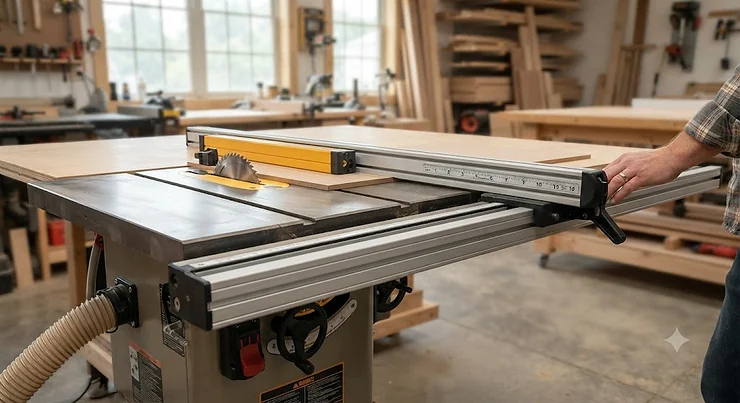
The first time a full sheet of 3/4-inch cabinet-grade plywood buckled off the end of my stock table saw fence, I learned something the manual never mentioned: a 24-inch fence is basically a suggestion once you’re dealing with 4×8 material. A table saw fence extension rail kit for large panels solves a specific, annoying problem — your factory fence rides on rails that are too short to support a full sheet, so the panel tips, binds, or drifts off your cut line right when precision matters most. In plain terms, it’s a set of aluminum or steel rails (sometimes paired with a longer fence body) that bolts onto your existing saw and stretches your usable rip capacity, often from 24-30 inches out to 50 inches or more.
This matters more in 2026 than it did a decade ago, since sheet goods prices haven’t exactly gotten friendlier and nobody wants to waste a $70 panel of Baltic birch because their fence flexed a sixteenth of an inch mid-cut. Below, I’ve dug into seven real rail and fence kits — spanning bolt-on budget accessories to full 52-inch premium systems — and broken down what each one actually does for your accuracy, your outfeed support, and your wallet. Whether you’re building kitchen cabinets in a two-car garage or running a small cabinet shop, one of these should fit.
Quick Comparison Table
| Product | Rip Capacity | Price Range | Best For |
|---|---|---|---|
| SawStop T-Glide 52″ Rail & Fence | 52.5″ | $550-$700 range | Cabinet-saw owners wanting factory-integrated precision |
| Vega U50 Utility Fence System | 50″ right / 8″ left | $300-$450 range | Best all-around retrofit for contractor saws |
| Shop Fox W2005 (Long Rails) | 54″ | $400-$550 range | Value-focused full sheet capacity |
| Woodpeckers ARF-48 | 48″ auxiliary rail | $320-$400 range | Outfeed and infeed panel support |
| BOW Products XT XTENDER 46″ | 46″ T-track add-on | $150-$250 range | Budget T-track versatility |
| Wixey Professional Fence System | 36″ | $260-$360 range | Micro-adjust precision on a mid-size saw |
| Peachtree PW1007 Extension Kit | +16″ to existing fence | $50-$90 range | Cheapest way to add a few inches |
A quick scan tells the real story here: rip capacity and price climb together, but not in a straight line. The Shop Fox W2005, for instance, edges out the pricier SawStop system on raw rip capacity while costing noticeably less — because you’re buying an aftermarket fence body rather than a manufacturer-matched precision system built into your saw’s ecosystem. Budget options like the Peachtree PW1007 and BOW XT XTENDER don’t compete on capacity, but they solve a narrower problem — a few extra inches or a T-track work surface — for a fraction of the cost.
💬 Found a fence that fits your saw already? Skip ahead to the picks below and start comparing specs.
Top 7 Table Saw Fence Extension Rail Kits: Expert Analysis
1. SawStop T-Glide 52″ Rail & Fence Assembly — factory-matched precision for cabinet saws
If you already own a SawStop Professional or Industrial cabinet saw, the T-Glide 52-inch rail and fence assembly is the logical upgrade path, and it shows in the fit and finish. The heavy-gauge steel rails are engineered specifically for SawStop’s trunnion geometry, which means you’re not fighting alignment issues that crop up with universal aftermarket kits. Rip capacity lands at 52.5 inches to the right of the blade — enough to rip a full sheet with margin to spare — and the infinitely adjustable glide plates keep the fence riding true along the entire length without the wobble that cheaper rail systems develop over time.
Based on the spec comparison, this system earns its premium price through integration rather than raw materials alone: it’s designed to work with SawStop’s optional in-line router table, so your extension table, fence, and router setup share one coherent rail platform instead of three mismatched accessories. That matters most for shop owners who plan to build out a full outfeed and router station over time. Reviewers on SawStop-focused woodworking forums consistently note that lockdown feels “rock-solid” compared to stock fences, with minimal deflection even under side pressure from a wide panel. The tradeoff is compatibility — this rail system is not built for non-SawStop saws — and the price, which puts it out of reach for hobbyists on a tight budget.
Pros:
- ✅ Purpose-engineered fit for SawStop cabinet saw trunnions
- ✅ 52.5″ rip capacity handles full 4×8 sheets with room to spare
- ✅ Compatible with SawStop’s in-line router table ecosystem
Cons:
- ❌ Only fits SawStop Professional and Industrial saws
- ❌ Premium price puts it out of reach for casual hobbyists
At the time of research, this system runs in the $550-$700 range depending on retailer stock. For a SawStop owner planning a permanent shop setup, it’s a genuinely strong long-term value; for anyone still saw-shopping, it shouldn’t be the deciding factor.
2. Vega U50 Utility Fence System — best all-around retrofit for contractor saws
The Vega U50 has quietly become something of a woodworking-forum favorite, and after digging into the specs, it’s easy to see why. It delivers 50 inches of rip capacity to the right of the blade and 8 inches to the left, using a tubular front rail and square rear rail that Vega claims requires no separate tableboard for support — a genuine departure from Biesemeyer-style systems that lean on the saw’s cast-iron wings for rigidity. What most buyers overlook about this fence is the micro-adjustment feature: a threaded rod and thumb-nut combination that lets you dial in cuts within a few thousandths of an inch, a feature many competing “utility” tier fences skip entirely.
Installation is designed around existing mounting holes on Delta Unisaws, Powermatic 66 models, and most 10-inch contractor saws, so you’re not drilling new holes into your saw table in most cases. Reviewers on woodworking forums and retail sites report that the fence “rides beautifully” on the rails with rock-solid lockdown, and that the printed instructions make a roughly two-hour install manageable even for less experienced DIYers. On paper, this makes the U50 the strongest all-rounder in this lineup: real capacity, real precision, and broad saw compatibility without cabinet-saw pricing.
Pros:
- ✅ 50″ rip capacity handles most 4×8 sheet cuts comfortably
- ✅ True micro-adjust threaded rod for fine-tuned precision
- ✅ No separate tableboard needed thanks to dual-rail rigidity
Cons:
- ❌ Some saws may still require drilling extra mounting holes
- ❌ Smaller company means parts availability can be inconsistent
Expect to pay in the $300-$450 range at the time of research, positioning the U50 as one of the better value-per-inch options in this entire roundup.
3. Shop Fox W2005 Classic Fence with Long Rails — best value for full sheet capacity
The Shop Fox W2005, when ordered with its optional long-rail configuration, stretches to 54 inches of maximum rip to the right of the blade — actually beating the pricier SawStop system on raw capacity. The fence body itself uses heavy-walled rectangular steel tubing with replaceable HDPE plastic side panels, which Shop Fox describes as smoother than Teflon for reducing sliding friction against your stock. A single cam-action lever locks the fence in place, and because the design allows lift-off removal anywhere along the rail, swapping to a miter gauge or jig setup takes seconds rather than a full re-adjustment.
Here’s what the spec sheet won’t tell you, but buyer reviews suggest: the torsion-box construction resists deflection well under lateral pressure, which is exactly the failure mode that ruins cuts on cheap stamped-steel fences when you’re pushing a heavy sheet against it. This is a genuinely capable upgrade for contractor and cabinet-style saws that didn’t ship with a rigid factory fence, and the standard-rail version (25-inch capacity) can be upgraded to the long-rail kit later if your budget doesn’t stretch that far on day one. The main catch is fit: some saws need minor modification to mount the rails cleanly, so budget an extra hour for install troubleshooting.
Pros:
- ✅ 54″ long-rail capacity beats several pricier systems
- ✅ Torsion-box fence body resists flex under side pressure
- ✅ Lift-off design speeds up switching to miter or jig setups
Cons:
- ❌ Some table saws require modification to mount rails
- ❌ HDPE side panels wear over years of heavy use
At the time of research, pricing for the long-rail configuration sits in the $400-$550 range, making this arguably the best dollar-per-inch pick in the premium tier.
4. Woodpeckers ARF-48 — dedicated outfeed and infeed panel support
Not every fence problem is about rip width — sometimes it’s about what happens to the panel after it clears the blade. The Woodpeckers ARF-48 is built specifically for that gap: a 48-inch auxiliary rip fence with a 12-inch material support surface designed to sit on the infeed or outfeed side of the blade and keep a large panel balanced instead of tipping as it exits the cut. Made in the USA in Strongsville, Ohio, it uses T-track slots and clamping blocks so it attaches to your existing fence without permanent modification, and it configures into high, low, or L-fence positions depending on whether you’re ripping thin strips or supporting a full sheet.
Reviewers consistently note the practical genius of the 2-inch total thickness design: because it adds exactly 2 inches to your fence, you can keep using your saw’s existing measurement scale and simply add 2 inches to your target width, rather than re-calibrating a whole new system. What most buyers overlook about this product is that it’s not trying to replace your rip fence — it’s solving the outfeed support problem that a longer rail alone doesn’t fix, since a wider rip capacity does nothing to stop a heavy panel from see-sawing once it’s past the blade. Pair it with an actual outfeed table for the best results.
Pros:
- ✅ 12″ support surface prevents panel tip-out mid-cut
- ✅ Adds exactly 2″ so existing fence scale stays usable
- ✅ Configurable high, low, or L-fence positioning
Cons:
- ❌ Doesn’t extend rip capacity on its own — it’s a support add-on
- ❌ Premium Woodpeckers pricing for what is essentially an accessory
At the time of research, this sits in the $320-$400 range. It’s not a rip-capacity solution by itself, but paired with a longer rail system, it closes the gap that causes most sheet-goods kickback incidents in the first place.
5. BOW Products XT XTENDER 46″ T-Track Fence System — budget-friendly T-track versatility
The BOW Products XT XTENDER line takes a different approach than a traditional rip fence: it’s a 46-inch aluminum T-track fence designed to bolt onto portable table saws, cabinet saws, and even band saws, giving you multiple T-slots for mounting feather boards, stops, and other accessories alongside your rip guide. Reviewers highlight that the fence measures over 3.5 inches tall at 48 inches long (in its larger configuration), providing genuine support for everything from plywood sheets to long boards rather than just thin stock, and the flexible positioning — ahead of, behind, or spanning the blade — makes it adaptable to whatever cutting task the day throws at you.
Based on the spec comparison, the XT XTENDER’s real advantage is versatility per dollar: because it’s a T-track system rather than a proprietary micro-adjust mechanism, it doubles as a jig-mounting platform once the ripping is done, something the more rigid precision fences in this list can’t match. That flexibility comes with a tradeoff — you won’t get the thousandths-of-an-inch micro-adjustment of a Vega or Wixey system, so cabinetmakers chasing furniture-grade tolerances may find it a step below dedicated precision fences. For jobsite carpenters and DIYers who value multi-purpose gear over lab-grade accuracy, though, it’s hard to beat.
Pros:
- ✅ Multiple T-slots double as a jig and accessory platform
- ✅ 46″ length and tall profile supports full sheet goods
- ✅ Fits portable, cabinet, and band saws
Cons:
- ❌ Lacks true micro-adjust precision of dedicated rip fences
- ❌ Fence-only listings require separate clamp hardware purchase
Expect a price in the $150-$250 range at the time of research, making it one of the more accessible entries here for anyone building a flexible jobsite setup.

6. Wixey Professional Table Saw Fence System — micro-adjust precision on a mid-size saw
Wixey built its reputation on digital measuring tools, and that DNA shows up in its Professional Table Saw Fence System, a heavy-duty aluminum rail and steel fence combo with a 36-inch rip capacity and a built-in micro-adjust feature. On paper, 36 inches sounds modest next to the 50-plus-inch systems above, but that capacity comfortably covers ripping a 4×8 sheet lengthwise into narrower strips — the more common real-world cut for most home shop projects — while keeping the whole footprint compact enough for a contractor saw that doesn’t have room for a 50-inch rail sprawling off one side.
What sets this fence apart, according to product comparisons, is the precision-first design philosophy: the micro-adjust mechanism is built to complement Wixey’s separate digital fence readout accessory, so cabinetmakers chasing repeatable, dial-in-once cuts get a system that’s more measurement-forward than most competitors in this price bracket. Here’s what the spec sheet won’t tell you: this isn’t the fence for someone who occasionally breaks down full sheets — it’s the fence for someone doing precision ripping day in and day out on stock that’s already been rough-cut to a manageable size.
Pros:
- ✅ True micro-adjust mechanism for repeatable precision
- ✅ Compact 36″ footprint suits smaller shop layouts
- ✅ Pairs well with Wixey’s digital readout accessories
Cons:
- ❌ 36″ capacity falls short of full 50″+ systems for wide rips
- ❌ Steel fence body adds weight versus aluminum-only designs
At the time of research, pricing lands in the $260-$360 range — solid value for a shop where precision matters more than maximum width.
7. Peachtree Woodworking PW1007 16″ Table Saw Extension Kit — cheapest way to add a few inches
Not everyone needs — or can afford — a full rail replacement. The Peachtree PW1007 is a modest 16-inch extension kit designed to bolt onto your existing fence and rail setup, adding incremental rip capacity without the cost or install complexity of a full system swap. It’s a straightforward accessory: aluminum extension bar hardware that mounts to your current fence body, stretching your usable capacity just enough to turn a marginal cut into a comfortable one.
Based on the spec comparison, the honest way to frame the PW1007 is as a stopgap rather than a permanent solution — it won’t get a contractor saw with a 24-inch stock fence anywhere close to full-sheet capacity, and it depends entirely on your existing fence’s rigidity, so a flimsy factory fence will still flex under a wide panel even with 16 extra inches bolted on. What most buyers overlook is that this makes it a smart budget move specifically for saws with an already-solid fence body that’s just running short on rail length, rather than a fix for a fence that’s fundamentally under-built. If your factory fence is decent but your rails are too short, this is the cheapest legitimate answer on this list.
Pros:
- ✅ Lowest-cost way to add real rip capacity
- ✅ Simple bolt-on install with existing fence hardware
- ✅ Good fit for saws with a solid fence but short rails
Cons:
- ❌ Only adds 16″ — not a full-sheet solution alone
- ❌ Effectiveness depends on your existing fence’s rigidity
At the time of research, this typically runs in the $50-$90 range, making it the most budget-friendly entry in this entire roundup by a wide margin.
Practical Usage Guide: Setup, First Cuts, and Maintenance
Installing any extension rail kit for sheet goods ripping follows a similar rhythm regardless of brand, though the details shift by manufacturer. Start by squaring your existing rails to the miter slot before you even unbox the new hardware — an extension bolted onto a saw that’s already out of alignment just extends the error across a longer distance, and you won’t notice until a 48-inch rip comes out tapered. Most kits, including the Vega U50 and Shop Fox W2005, use existing mounting holes on common saw brands, so dry-fit everything before tightening a single bolt permanently.
Once mounted, spend your first thirty days paying attention to a few things that trip up new owners. Check rail parallelism weekly at first using a dial indicator or even a tape measure at both the front and back of the blade — thermal expansion and vibration from regular use can shift alignment slightly during break-in. Wipe down aluminum rails after dusty cuts, since accumulated sawdust acts like fine sandpaper on glide surfaces over time and is the single most common cause of a fence that starts binding after a few months. A light coat of dry PTFE lubricant on the rails (never oil, which attracts more dust) keeps things gliding smoothly. Common first-month mistakes include over-tightening the locking lever, which can actually pull the fence slightly out of parallel, and forgetting to re-check squareness after transporting a jobsite saw between locations.
✨ Ready to see current pricing on today’s picks? Check availability before your next sheet-goods project.
Real-World Scenarios: Matching a Rail Kit to Your Shop
The weekend cabinetmaker. Picture someone converting a two-car garage into a part-time shop, building kitchen cabinets on weekends with a mid-range contractor saw. Budget matters, but so does repeatable accuracy across dozens of identical cuts. The Vega U50 fits this profile well — its micro-adjust feature rewards the kind of dial-in-once, cut-many-times workflow cabinet work demands, and its $300-$450 range price tag doesn’t blow a modest tool budget.
The small shop owner running a SawStop. For someone operating a small commercial shop cutting sheet goods daily, safety compliance and long-term durability outweigh upfront cost. The SawStop T-Glide 52″ system matches this use case directly, since it integrates with the safety system already protecting operators and holds tolerance under the kind of daily wear a hobbyist setup never sees.
The budget-conscious DIYer with an occasional big cut. Someone renovating their own home who breaks down a sheet of plywood maybe once a month doesn’t need a $500 rail system sitting mostly idle. The Peachtree PW1007 paired with a simple plywood support stand or roller solves 90% of that problem for under $100, freeing up budget for the actual project materials.
How to Choose a Table Saw Fence Extension Rail Kit for Large Panels
- Measure your actual rip needs first. A full 4×8 sheet ripped down the middle only needs about 24-25 inches of capacity, not 50 — don’t overbuy width you’ll rarely use.
- Check saw compatibility before anything else. Systems like the Vega and SawStop rails are engineered for specific mounting-hole patterns; confirm compatibility with your saw brand and model before purchasing.
- Decide if micro-adjust matters for your work. Furniture and cabinet work benefit hugely from thousandths-of-an-inch adjustment; rough construction cuts generally don’t need it.
- Factor in outfeed support separately. A longer rail solves side-to-side capacity, but a heavy panel still needs infeed/outfeed support like the Woodpeckers ARF-48 or a simple roller stand to stay stable front-to-back.
- Consider your shop’s floor space. A 52-inch rail system needs 52 inches of clear space to the right of your blade at minimum — measure your shop layout, not just your saw.
- Weigh rigidity over raw length. A shorter, more rigid fence beats a longer one that flexes under lateral pressure from a wide panel; check for torsion-box or tubular rail construction.
- Budget for the whole ripping system, not just the fence. Outfeed rollers, infeed support, and a sacrificial zero-clearance insert often matter more to cut quality than the rail brand you choose.
Extension Rail Kit vs Track Saw System for Sheet Goods
A long rail fence system for plywood isn’t the only path to clean full-sheet cuts, and it’s worth being honest about the alternative. Track saws — handheld circular saws riding a straight guide rail laid directly on the panel — have become genuinely popular for breaking down sheet goods, and for good reason: you cut the sheet down to size before it ever needs to balance on a table saw’s wings, which sidesteps the tipping and binding problem entirely.
That said, a table saw with a proper extension rail kit still wins on repeatability and speed for a shop doing many identical rip cuts. A track saw requires re-measuring and re-clamping the guide rail for every single cut, while a table saw fence, once dialed in, lets you rip cut after cut at the same width without touching a tape measure. Track saws also can’t easily handle repeated narrow rips as efficiently — each cut means resetting the rail from scratch. The practical answer for many serious shops is both: a track saw for the first rough breakdown of an oversized sheet into manageable pieces, and a table saw with an extended rail fence for the precision ripping that follows. If you’re outfitting a shop from scratch, according to Wikipedia’s overview of table saw design, the rip fence has remained the primary reference surface for straight, repeatable cuts since the earliest circular saw benches — which is exactly why extending it, rather than replacing it, is usually the smarter first move.
Long Rail Fence System for Plywood: What Actually Changes
Swapping in a long rail fence system for plywood changes more than just the number on your tape measure. The rails themselves need to stay dead parallel to the blade across their entire length — a 50-inch rail with even a sixteenth of an inch of misalignment at the far end translates into a visibly tapered cut on a wide panel, something a short 24-inch fence would never reveal at the same tolerance. This is why manufacturers like Vega and SawStop invest specifically in tubular or heavy-gauge steel rail stock rather than lightweight extruded aluminum alone — rigidity across distance matters more than it does on a short fence.
There’s also a real-world weight consideration that’s easy to overlook. A long rail system typically needs its own support legs or a stabilizing table board, since 50 inches of unsupported cantilevered rail can sag under its own weight over time, let alone under the lateral pressure of a plywood sheet pressed against it. According to APA – The Engineered Wood Association, standard structural plywood panels commonly run from 3/16-inch to over 1-inch thick, meaning the weight and rigidity of the sheet you’re feeding into the fence varies substantially — a thin 1/4-inch luan panel behaves very differently against a fence than a 3/4-inch cabinet-grade sheet, and your rail system needs to handle both without flexing.
Outfeed Extension Rails for Table Saw: Solving the Support Gap
Here’s a mistake that trips up even experienced woodworkers: buying a longer rip fence and assuming the sheet-handling problem is solved. Outfeed extension rails for table saw setups address a completely different failure point — what happens to the back half of the panel once it’s clearing the blade. Without outfeed support, a heavy sheet see-saws on the table’s edge as more of it hangs off the back than sits on the saw table, which is exactly when kickback risk spikes and cut lines drift.
A dedicated outfeed table, a set of roller stands, or an accessory like the Woodpeckers ARF-48 configured in its outfeed position all solve this, and the right choice depends on your space. A fixed outfeed table gives the most consistent support but eats permanent shop floor space; folding or roller-stand outfeed support trades a little stability for the ability to reclaim that space when you’re not ripping sheets. Whichever you choose, the goal is the same: keep the panel level and supported the entire time it’s moving through the cut, not just while it’s still resting on the main table.
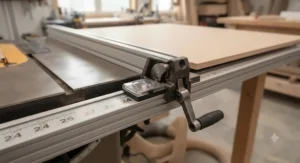
Sheet Goods Handling: Common Mistakes When Buying a Rail Kit
Sheet goods handling problems usually trace back to a handful of predictable buying mistakes. First, buyers frequently size their rail kit to the saw’s maximum theoretical capacity rather than their actual cutting habits — paying premium prices for 52 inches of rip capacity they use twice a year. Second, many overlook rail rigidity in favor of raw length, ending up with a longer fence that flexes more than their old short one under side pressure from a wide panel.
Third — and this is the one that causes the most frustration after purchase — buyers skip checking mounting-hole compatibility with their specific saw model, assuming “universal” fit claims will pan out, only to discover they need to drill new holes into a cast-iron table they’d rather not modify. Finally, plenty of shoppers budget for the fence and rails but forget outfeed and infeed support entirely, then wonder why full sheets still feel unstable even after the “upgrade.” Reading compatibility specs carefully and budgeting for support accessories alongside the rail kit itself avoids nearly all of these headaches.
Rip Capacity for 4×8 Sheets: What to Expect in Real-World Performance
On paper, rip capacity for 4×8 sheets sounds simple: a 48-inch-wide sheet needs 48 inches of capacity, right? In practice, most cuts on a full sheet are ripping it down into narrower strips — say, cutting a 48-inch sheet into two 24-inch pieces, or breaking it into cabinet-side widths — which means you rarely need the fence pushed to its absolute maximum. Where the extra capacity actually earns its keep is in ripping a sheet lengthwise along its 96-inch dimension into a wide panel, where you need the blade positioned well off-center and the fence still needs full support on both sides of that setting.
What most buyers overlook about real-world performance is that a rail system rated for 50-plus inches doesn’t automatically make a 50-inch cut effortless — you’re still managing a roughly 90-pound sheet of 3/4-inch plywood (based on APA’s published panel-weight figures) through the cut, which is a two-person job or a job for a solid outfeed/infeed support setup regardless of how good your fence is. Budget realistic expectations: a properly rigid rail system gets you a straight, accurate cut; it doesn’t make a heavy panel weightless.
Safety, Regulations, and Compliance Guide
Table saw safety isn’t optional shop-talk — it’s governed by specific federal standards that apply directly to how a fence and blade guard system should function. Under OSHA’s woodworking machinery standard, 29 CFR 1910.213, workplace table saws must maintain proper guarding, a functioning riving knife or spreader, and anti-kickback protection — requirements that matter just as much in a home shop, even without the regulatory obligation, because the physics of kickback don’t change based on whether you’re a hobbyist or a commercial operation.
A longer, more rigid fence actually improves safety in a specific way: it reduces the chance of a panel binding against the blade as it travels the full length of the cut, which is one of the primary triggers for kickback on wide rips. That said, no rail upgrade replaces basic practice — keep the blade height no more than about 1/4 inch above the material, use a push stick for narrow rips, wear ANSI-rated eye protection, and never stand directly in line with the blade during a cut. If you’re outfitting a shop that will see regular use by multiple people, it’s worth reviewing the full guarding requirements rather than assuming factory defaults cover everything.
Long-Term Cost and Maintenance
A rail extension kit is a one-time purchase, but it’s not a zero-maintenance one. Rail surfaces need periodic cleaning and light dry lubrication to keep the fence gliding smoothly — neglect this and even a premium system like the SawStop T-Glide can start to feel gritty within a year of heavy dusty use. Locking mechanisms, particularly cam-action levers like the one on the Shop Fox W2005, benefit from an annual check to make sure they’re still applying full clamping force, since repeated use can wear the cam surface slightly over years of operation.
| Cost Factor | Budget Tier (BOW/Peachtree) | Mid Tier (Vega/Wixey) | Premium Tier (SawStop/Shop Fox Long Rail) |
|---|---|---|---|
| Upfront Price | $50-$250 range | $260-$450 range | $400-$700 range |
| Expected Lifespan | 5-8 years typical use | 10-15 years typical use | 15+ years typical use |
| Maintenance Needs | Minimal, low complexity | Periodic lubrication, alignment checks | Periodic lubrication, occasional glide plate service |
| Best For | Occasional cuts | Regular weekend shop use | Daily or commercial-level use |
Looking at the numbers above, the mid-tier options generally deliver the best cost-per-year of ownership for a serious hobbyist, since the premium tier’s extra durability mostly pays off under commercial-level use frequency that most home shops never reach. Budget-tier kits make sense as a stopgap, but shop owners who upgrade saws or expand their shop within a few years often end up replacing them sooner than the mid-tier alternatives.
Benefits vs Traditional Alternatives
| Factor | Extension Rail Kit | Stock Short Fence | Handheld Track Saw |
|---|---|---|---|
| Rip Capacity | 36″-54″ typical | 24″-30″ typical | Limited by track length |
| Repeatability | High — set once, cut many | Moderate | Low — reset per cut |
| Panel Stability | Good with outfeed support | Poor on wide panels | Good — cuts flat on the sheet |
| Upfront Cost | $50-$700 range | Included with saw | $150-$500 range (saw + track) |
| Best For | Vega U50, Shop Fox W2005 for shop-based ripping | Occasional narrow rips only | Breaking down oversized sheets before shop cuts |
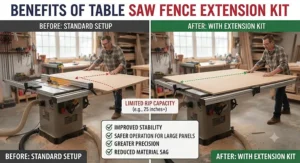
The takeaway here is that a stock short fence simply isn’t built for the job once you’re routinely handling sheet goods — it’s the baseline every product in this article improves on. A track saw genuinely competes for the initial breakdown of oversized panels, but it can’t match a properly extended table saw fence for repeatable, dial-in-once ripping across many identical cuts, which is where most cabinet and furniture work actually lives.
FAQ
❓ What size rail extension do I need for a 4x8 sheet of plywood?
❓ Can I install a table saw fence extension rail kit myself?
❓ Do longer rails make a table saw more accurate?
❓ How much does a table saw fence extension rail kit cost?
❓ Do I still need outfeed support with a longer rip fence?
Conclusion
Choosing the right table saw fence extension rail kit for large panels really comes down to matching capacity to how you actually work, not how you imagine you might work someday. If you own a SawStop and want factory-level integration, the T-Glide 52-inch system is worth the investment. If you’re after the best all-around value on a contractor saw, the Vega U50 or Shop Fox W2005 long-rail configuration both deliver serious capacity without cabinet-saw pricing. And if your budget is tight or your sheet-cutting needs are occasional, the Peachtree PW1007 or BOW XT XTENDER prove you don’t need to spend hundreds to solve a real problem.
Whatever you choose, remember that the fence is only half the equation — pairing it with proper outfeed and infeed support is what actually turns a wide rip capacity into safe, accurate cuts on full sheets. Measure your actual shop needs, check your saw’s compatibility, and pick the tier that matches how often you’re really breaking down plywood, not how often you think you might.
Recommended for You
- Budget Aftermarket Fence for Hobbyist Woodworkers: 7 Picks (2026)
- Top Rated Table Saw Fence Upgrades for Small Shops (2026)
- Precision Fence Upgrade for Accurate Rip Cuts: 7 Picks (2026)
Disclaimer: This article contains affiliate links. As an Amazon Associate, I earn from qualifying purchases. If you purchase products through these links, we may earn a small commission at no additional cost to you.
✨ Found this helpful? Share it with your friends! 💬🤗
