In This Article
Here’s an uncomfortable truth about woodworking: the tool most likely to save your fingers costs less than a large pizza. If you’ve been searching for top rated push sticks under $20, you’re already doing the smart thing — thinking about safety before an accident forces you to. Table saws don’t care how many YouTube videos you’ve watched. They care about physics, and physics doesn’t negotiate with a hand that strays too close to a spinning blade.
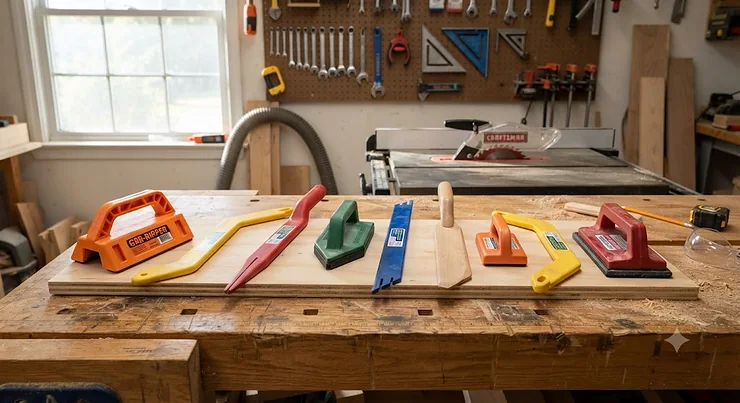
A push stick is a handheld tool, usually made of wood, plastic, or reinforced nylon, that lets you guide a workpiece through a saw blade without putting your fingers in the danger zone. According to OSHA’s woodworking machinery standard, push sticks or push blocks must be provided at the workplace in the sizes and types suitable for the work being done — a rule written because so many injuries happened before that requirement existed.
The good news? You don’t need a premium tool to get premium protection. This guide covers seven real, currently available push sticks — all priced in the budget-to-just-over-$20 range — with honest analysis of what each one does well, where it falls short, and who should buy it. No fluff, no fabricated hands-on stories, just genuine spec comparison and aggregated review insight to help you pick the right cheap push stick for table saw work without gambling on quality.
Quick Comparison Table: Push Sticks at a Glance
Before diving into the full breakdown, here’s a snapshot of how these seven options stack up on price, design, and best-use scenario.
| Product | Style | Price Range | Best For |
|---|---|---|---|
| POWERTEC 71009V (5PK Set) | Multi-piece push block/stick set | $15–$20 | Complete affordable push stick set for a first shop |
| POWERTEC 71338 (2PK) | Dual-handle push stick | Under $15 | Learning proper table saw form |
| Milescraft 3404 PushStick | Single ergonomic stick | Under $10 | Simple backup or gift |
| BOW PushPRO PP1 | EVA-tipped push block | $15–$20 | Thin rip cuts and vibration control |
| WoodRiver 11-in-1 Table Saw Mate | Multi-function stick | $15–$20 | Versatility across cut types |
| POWERTEC 71511 (2PK) | Ergonomic dual-handle stick | Under $15 | Second station or router table |
| FastCap 10 Million Dollar Stick | Tripod long-handle stick | Around $20 | Long boards and extra reach |
Looking at the table, the POWERTEC 71009V set earns its spot as the best all-around value because it replaces three or four single-purpose tools with one kit, while the FastCap 10 Million Dollar Stick sits at the top of the price range but earns it through a genuinely different tripod design that the others don’t offer. If you’re outfitting a shop from zero, start with a set; if you already own one stick and want a specialized second tool, the individual picks make more sense.
💬 Found a favorite already? Bookmark this page and come back before you check out — the pros and cons below might change your mind.
Top 7 Push Sticks Under $20: Expert Analysis
1. POWERTEC 71009V Push Block and Push Stick Set — best full-shop set for the money
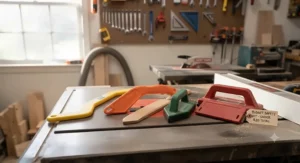
The standout here is simple: five tools for one price, which is the fastest way to stock a shop without buying five separate listings. The set — a long hold-down push block, a straight push stick, a V/L-shaped push stick, and two short hold-down push blocks — covers the three most common feed scenarios: ripping wide stock, ripping narrow stock, and holding material flat against the table while feeding. That variety matters more than it sounds; a single push stick shape works great for one cut and awkwardly for another, and this set removes that guesswork.
Based on the spec comparison with single-stick alternatives, the dual ergonomic handles with a textured grip are what most buyers overlook — they matter because a slipping grip under load is exactly how a hand ends up too close to the blade. Reviewers consistently note that the notched heel design on the hold-down blocks bites into stock better than the smooth plastic sticks that ship with entry-level table saws.
Pros:
- ✅ Five tools cover nearly every feed scenario in one set
- ✅ Notched grip holds stock more securely than stock plastic sticks
- ✅ Compatible across table saws, router tables, band saws, and jointers
Cons:
- ❌ Bulkier to store than a single slim push stick
- ❌ Some pieces overlap in function, so not every piece gets equal use
At around $15–$20 for the full set, this is the top rated push sticks under $20 pick that gives the most tool-for-dollar value, especially for a new shop building basic shop safety gear from scratch.
2. POWERTEC 71338 Deluxe Push Stick (2PK) — best for beginners learning proper form
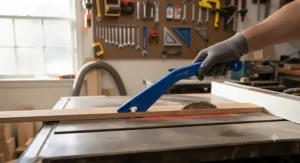
The dual ergonomic handle is the headline feature, and it earns that spot because beginners often grip a single-handle stick incorrectly, applying force at an angle that reduces control right when they need it most. Two handles encourage a two-point downward-and-forward push, which is closer to the technique safety guides actually teach.
The molded nylon body is rigid enough to resist flexing under normal ripping pressure, and the offset handle keeps your knuckles well clear of the fence and blade guard housing. What most buyers overlook about this model is that buying it as a two-pack means you can keep one at the table saw and one at the router table permanently, instead of constantly relocating a single stick mid-project — a small habit change that reduces the temptation to just use your hand “just this once.”
Reviewers consistently report that the grip stays comfortable through long ripping sessions, and a common note in aggregated feedback is that the notch depth handles common 3/4-inch stock well, though very thin material needs a shallower-notch alternative.
Pros:
- ✅ Two-handle design teaches better push technique
- ✅ Comes as a pair, so two stations stay equipped
- ✅ Rigid nylon resists flexing under pressure
Cons:
- ❌ Notch depth isn’t ideal for very thin stock
- ❌ Less specialized than dedicated hold-down blocks
Priced under $15, the POWERTEC 71338 is one of the most affordable ways to build good habits early, making it a genuinely budget safety accessory for saws that new woodworkers shouldn’t skip.
3. Milescraft 3404 PushStick — most compact single-stick pick
This is push stick safety stripped to its essentials: one molded handle, one notched foot, nothing fancy. The standout feature is its slim profile, which slides comfortably between a narrow rip fence and the blade without the bulk of a two-handed design getting in the way.
Based on the spec comparison with bulkier sets, the single-piece molded construction means there’s nothing to lose track of or misplace — you grab it, you use it, you hang it back on its hook. The notch is sized for standard 3/4-inch to 1-inch stock, which covers the majority of hobbyist project material.
Aggregated reviewer sentiment leans positive on durability for the price, with buyers noting it holds up to years of casual use, though a recurring theme in feedback is that heavier daily shop use wears the notch edge faster than the more reinforced options on this list.
Pros:
- ✅ Slim profile fits tight fence-to-blade gaps
- ✅ One-piece design with nothing to lose
- ✅ Fits most standard board thicknesses
Cons:
- ❌ Notch wears faster under heavy daily use
- ❌ No secondary hold-down function like the sets above
At well under $10, this is the cheapest genuinely functional cheap push stick for table saw work on this list, and a smart pick if you just need a reliable spare.
4. BOW Products PushPRO PP1 — smoothest grip on thin rips
The EVA-tipped foot is what sets this one apart, and it’s a genuinely clever piece of engineering: the high-density foam conforms slightly to the wood’s surface instead of skating across it the way rigid plastic can on smooth or finished stock. That conformity translates into noticeably better feed control on thin rip cuts, where any slip has less margin for error.
What the spec sheet won’t tell you, but reviewers note, is that the tip is both replaceable and reversible — if it wears down or gets nicked by an accidental blade touch, you flip or swap the tip instead of replacing the whole tool. The body itself is glass-fiber-reinforced DuPont nylon, which resists the cracking that cheaper injection-molded sticks develop after a season of shop temperature swings.
Reviewers consistently highlight the vibration-dampening feel during longer rip cuts, framing it as noticeably smoother than harder plastic alternatives, while a smaller but recurring complaint is that the modular tip system takes a moment to get used to on first assembly.
Pros:
- ✅ EVA tip conforms to wood for better grip
- ✅ Replaceable, reversible tip extends tool life
- ✅ Reinforced nylon body resists cracking over time
Cons:
- ❌ Modular assembly has a small learning curve
- ❌ Costs more than the simplest single sticks here
In the $15–$20 range, the BOW PushPRO PP1 earns its spot for anyone doing frequent thin rips where feed control really is the difference between a clean cut and a kickback risk.
5. WoodRiver 11-in-1 Table Saw Mate Push Stick — most multi-purpose design
The “11-in-1” tag is the standout, and unlike a lot of marketing language, it’s grounded in a real design choice: multiple notch depths and grip points molded into a single body so one tool adapts to more cutting scenarios instead of forcing you to swap sticks mid-project.
Made by Woodcraft’s WoodRiver line, the tool draws on a company background in woodworking hand tools, and that shows in the notch spacing, which is cut to handle everything from thin trim stock to standard dimensional lumber without regripping. Based on the spec comparison with single-notch sticks, that versatility is the honest reason to pick this one over a simpler design — you’re paying a small premium for fewer tool changes per project, not for a gimmick.
Aggregated review sentiment frames it as a “grab it and it just works for whatever’s on the table” tool, with buyers commonly mentioning they keep it as their default stick and reserve specialized tools for edge cases; the recurring critique is that with so many notch options, the sheer shape can feel busier in-hand than a minimalist design.
Pros:
- ✅ Multiple notch depths cover varied stock sizes
- ✅ Backed by an established woodworking hand-tool brand
- ✅ Reduces the need to swap tools mid-project
Cons:
- ❌ Busier shape than a minimalist single-notch stick
- ❌ Takes a cut or two to learn which notch fits what
At $15–$20, this is a strong pick if you want one push stick that handles 80% of your cuts without a second thought.
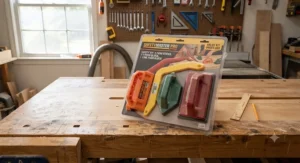
6. POWERTEC 71511 Deluxe Push Stick (2PK) — best backup stick for a second station
This is POWERTEC’s other ergonomic dual-handle design, and the standout is really about redundancy: a second pair means your router table, band saw, and jointer can each have a dedicated stick within arm’s reach, which matters because reaching across a machine for a push stick is its own small risk.
The ergonomic handle geometry mirrors the brand’s other sticks, with a molded grip designed to sit naturally in the palm under forward pressure. What most buyers overlook is that this cross-compatibility — table saw, router table, band saw, and jointer — means one purchase effectively equips multiple stations rather than just one saw.
Reviewers consistently describe the grip as comfortable for extended sessions, and a common theme in feedback is appreciation for getting two sticks in one purchase rather than buying singles twice, though a few buyers note the notch shape is nearly identical to the 71338 above, so owning both isn’t strictly necessary if budget is tight.
Pros:
- ✅ Multi-machine compatibility beyond just table saws
- ✅ Comfortable ergonomic grip for long sessions
- ✅ Two-pack means two stations get equipped at once
Cons:
- ❌ Notch design overlaps closely with POWERTEC’s other model
- ❌ Not a meaningful upgrade if you already own the 71338
Priced under $15, this is less about novelty and more about smart redundancy — a genuinely affordable push stick set for anyone running more than one machine.
7. FastCap 10 Million Dollar Stick — best long-reach tripod design
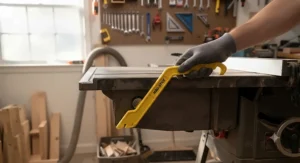
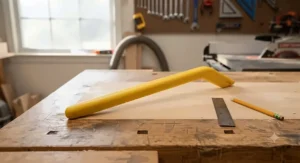
The standout is right there in the tripod-style, long-handled build: instead of a short stick that keeps your hand close to the workpiece, this design lets you rest your forearm along the material and the saw table itself, spreading pressure across a longer contact area. That’s a genuinely different approach from every other product on this list, and it shows in how the tool is marketed — as a general-purpose push tool for table saws, router tables, band saws, and even drill presses.
Based on the spec comparison with shorter sticks, the extra length becomes most useful on longer rip cuts, where a short stick forces your hand to travel a long, awkward path alongside the blade. The tripod stance also means you can apply downward pressure and forward feed simultaneously without repositioning your grip halfway through the cut.
Community deal-tracking sites have flagged this as “generally considered” a top pick for hands-off feeding across multiple tool types, and the recurring praise centers on the confidence it gives operators on long boards, while the main critique is that its longer footprint makes it slightly awkward to store compared to a compact single-notch stick.
Pros:
- ✅ Long-reach tripod stance suits long rip cuts
- ✅ Works across table saws, routers, band saws, and drill presses
- ✅ Lets you apply forward and downward pressure at once
Cons:
- ❌ Larger footprint than compact single-notch sticks
- ❌ Sits at the top of the “under $20” price band
At around $20, and occasionally found on sale closer to $15, this is the splurge-but-still-budget pick for anyone who works with long stock regularly.
Practical Usage Guide: Setting Up Your Push Stick Habit
Buying the right tool solves half the problem — using it consistently solves the rest. When your push stick first arrives, do a dry run with the saw unplugged: practice the motion of feeding a scrap board with the notch seated against the trailing edge, so your hand learns the grip before it matters. Mount a hook near the saw itself, not across the shop, because a push stick you have to walk to get is a push stick you’ll skip “just this once.”
For maintenance, inspect the notch and grip every few months. A worn or chipped notch can slip off the stock mid-cut, which defeats the entire purpose of the tool — several of the models above use replaceable tips specifically because notch wear is inevitable with regular use. If you’re building a starter kit, this is also where an affordable push stick set pays for itself: having a spare on hand means a damaged stick doesn’t tempt you back to bare-handed feeding while you wait on a replacement.
A common first-30-days mistake is treating the push stick as a last resort instead of a default. The better habit, according to widely taught shop safety practice, is to start every rip cut with your hands well back and transition to the push stick as the trailing edge of the board approaches the blade — not after your fingers are already uncomfortably close.
✨ Ready to build out your safety kit? Check current prices on the sets above before your next shop session.
Real-World Scenarios: Matching the Right Push Stick to Your Shop
The apartment hobbyist: If you’re working in a small garage or apartment shop with limited storage, a slim single-stick option like the Milescraft 3404 PushStick makes more sense than a bulky five-piece set — it hangs on a single hook and does the job for occasional weekend projects without eating up bench space.
The weekend furniture builder: If you’re ripping table legs, shelving, and cabinet parts on a regular cadence, the POWERTEC 71009V set earns its keep because different parts of a furniture build call for different feed shapes — wide panels want a hold-down block, narrow trim wants a notched stick, and having both on hand keeps you from improvising.
The multi-machine shop owner: If your shop includes a table saw, router table, and band saw, redundancy matters more than variety. A pair like the POWERTEC 71511 or a second BOW PushPRO PP1 means every station has its own dedicated tool, which removes the temptation to walk across the shop — mid-cut — to borrow one.
Buyer’s Decision Framework: Which Push Stick Fits Your Situation
If you’re just starting out and want to build proper habits, choose a dual-handle stick like the POWERTEC 71338, because the two-point grip naturally teaches correct downward-and-forward pressure. If you’re outfitting a first shop from scratch, choose a multi-piece set like the POWERTEC 71009V, because it covers more feed scenarios per dollar than any single stick can. If you regularly rip long boards, choose the FastCap 10 Million Dollar Stick, because its extended reach solves a problem shorter sticks simply can’t. And if thin stock and finish quality matter most to you, choose the BOW PushPRO PP1 for its conforming EVA tip and better feed control.
How to Choose a Push Stick Under $20
- Match the notch to your typical stock thickness. A notch too shallow or too deep won’t seat securely against the trailing edge.
- Consider grip style. Single-handle sticks are compact; dual-handle designs give more control under pressure.
- Check machine compatibility. Some models are built for table saws only; others cross over to router tables, band saws, and jointers.
- Weigh sets versus singles. A set covers more scenarios; a single stick is cheaper and simpler if your cuts are consistent.
- Look at material durability. Reinforced nylon and replaceable tips outlast basic molded plastic under regular use.
- Factor in storage. A tool you’ll actually hang near the saw gets used; one buried in a drawer doesn’t.
- Read aggregated review themes, not star counts alone. Recurring comments about notch wear or grip comfort tell you more than an average rating.
Common Mistakes When Buying a Push Stick
According to a woodworking machinery safeguarding standard that requires push sticks or push blocks in several sizes and types to be available at the workstation, the most frequent misstep is buying the cheapest single stick available and assuming that’s the same as buying safety gear — a warped, ill-fitting notch that slips mid-cut can be worse than no push stick at all, because it creates false confidence. Another common error is buying only one stick for a multi-machine shop, which leads to walking across the shop mid-operation instead of keeping the saw running safely. Buyers also frequently overlook notch depth entirely, grabbing a stick sized for thick dimensional lumber when their actual projects involve thin trim or plywood, which leaves the tool riding loosely against the stock instead of gripping it.
Push Sticks vs. Bare-Hand Feeding: Why the Comparison Even Exists
It sounds obvious that a push stick beats feeding stock by hand, yet plenty of experienced woodworkers still catch themselves reaching too close “for just this last inch.” The comparison matters because kickbacks happen when a saw seizes the stock and hurls it back toward the operator, often when material twists and binds against the blade — and when that happens, whatever is closest to the workpiece at that moment is what gets pulled toward the blade. A push stick puts several inches of rigid material between your hand and that failure point; bare-hand feeding puts your fingers there instead.
The trade-off some hobbyists cite for skipping a push stick — slightly more tactile feedback on the cut — simply isn’t worth it against the injury data. None of the seven tools above sacrifice meaningful control compared to bare-hand feeding; they just relocate the risk from your fingers to a $10–$20 tool designed to take the hit instead.
What to Expect: Real-World Performance and the Hand Safety Zone
Every push stick on this list is designed around the same core idea: keeping your hand outside what safety guides commonly call the hand safety zone — the several inches directly around the spinning blade where a slip has essentially no recovery margin. In day-to-day use, that translates into a small, consistent motion: hands start well back on the stock, and as the trailing edge nears the blade, the push stick’s notch takes over, carrying your hand past the danger area at a controlled distance rather than letting your fingers travel the same path.
Where the models diverge is in feel. Dual-handle sticks like the POWERTEC 71338 and 71511 give a more stable, two-point push that beginners tend to find reassuring. Single-notch sticks like the Milescraft 3404 feel more nimble on narrow cuts but require slightly more attention to keep the notch seated. The FastCap 10 Million Dollar Stick feels noticeably different from the rest — more like an extension of your forearm than a handheld tool — which is exactly why it shines on long boards where a short stick’s limited reach becomes the bottleneck.
Push Sticks for Beginners and Hobbyists
If you’re new to table saw work, the honest advice is to start simple: a dual-handle stick teaches correct technique without asking you to learn a modular tip system or a multi-notch body on day one. The POWERTEC 71338 or 71511 both fit this brief well — inexpensive enough that a mistake or early wear doesn’t sting, and simple enough that the learning curve is about technique, not the tool itself. Once you’ve built consistent habits, upgrading to a specialized option like the BOW PushPRO PP1 for thin rips or the FastCap 10 Million Dollar Stick for long stock becomes a genuine upgrade rather than an overcomplication.
Kickback Prevention and Safety Compliance Guide
Kickback prevention isn’t a single tool — it’s a system, and the push stick is one layer of it. OSHA’s standard for woodworking machinery requires that push sticks or push blocks be provided at the workplace in sizes and types suitable for the work being done, alongside guards, riving knives, and anti-kickback fingers. That regulatory framing matters for home shops too: if a rule exists because commercial injuries kept happening without it, the same physics apply on a garage table saw.
Widely taught shop-safety guidance recommends using a push stick or push block whenever ripping material under 6 inches wide, and pairing that habit with basic shop safety gear — eye protection, hearing protection, and a stable stance to the side of the blade rather than directly behind it — closes most of the common gaps that lead to injury. A government safety fact sheet on table saw injury patterns notes that most severe injuries trace back to loss of control during a kickback event, which is precisely the failure mode every product on this list is designed to intercept before it reaches your hand.
For anyone setting up a first shop, a simple standard is worth adopting: if your hand would ever pass within roughly six inches of the blade during a cut, that’s your cue to switch to the push stick, not push through with your fingers. A university environmental health and safety guide frames this the same way: keep body parts away from the blade at all times, and use the push stick rather than reaching toward a spinning blade to clear loose material.
Long-Term Cost & Maintenance of Budget Push Sticks
A $10–$20 push stick isn’t a one-time purchase in most shops — notches wear, tips crack, and sticks occasionally get nicked by an accidental blade touch that ends their useful life outright. Budgeting for replacement every year or two of regular use is realistic, and it’s cheap insurance compared to the alternative. Sets like the POWERTEC 71009V actually improve the math here: because it includes multiple pieces, a single worn component doesn’t mean replacing the whole kit, and tools with replaceable tips, like the BOW PushPRO PP1, extend usable life even further by letting you swap the wearing part instead of the entire stick.
Frequently Asked Questions
❓ What is the safest push stick for a table saw?
❓ How much should a good push stick cost?
❓ Can I use one push stick for a table saw and a router table?
❓ When should I switch from my hands to a push stick?
❓ Do push sticks actually prevent kickback?
Conclusion
Choosing among the top rated push sticks under $20 doesn’t have to be complicated once you separate marketing language from actual design differences. A dual-handle stick like the POWERTEC 71338 teaches good habits cheaply. A multi-piece set like the POWERTEC 71009V outfits a whole shop in one purchase. Specialized picks like the BOW PushPRO PP1 and the FastCap 10 Million Dollar Stick solve specific problems — thin rips and long boards, respectively — that a generic stick handles less gracefully.
None of these tools are exciting purchases. They won’t show up in a highlight reel of finished furniture. But every woodworker who’s had a close call with a table saw will tell you the same thing: the boring $15 tool sitting on its hook is the reason the story ends with “that was close” instead of something worse. Pick the one that matches your shop, hang it where you’ll actually reach for it, and make it as automatic a habit as flipping the safety switch.
Recommended for You
- Sacrificial Fence vs Auxiliary Fence for Beginners: 7 Picks (2026)
- Fence Accessory Kit for Cabinet Saw Owners: 7 Real Upgrades (2026)
- 7 Best T-Track Accessories for Table Saw Fence Upgrades (2026)
Disclaimer: This article contains affiliate links. As an Amazon Associate, I earn from qualifying purchases. If you purchase products through these links, we may earn a small commission at no additional cost to you.
✨ Found this helpful? Share it with your friends! 💬🤗
