

In This Article
Your cabinet saw is a hunk of cast-iron honesty. It’s also a machine that will happily introduce your hand to a spinning blade if you give it half a chance. Yet plenty of these saws spend their lives with the factory guard in a drawer, because it’s too clunky, too foggy, or too much in the way. That’s why an aftermarket blade guard for cabinet saw upgrade projects keeps landing on woodworkers’ wish lists. Done right, it solves three problems at once: protection, visibility and dust.
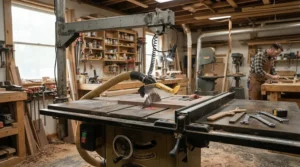
Here’s the catch. Not every guard fits every saw, and “overhead guard” can mean several different mechanical ideas. Some hang from an arm. Some clamp to a splitter. Some only exist for one brand of saw. Pick wrong and you’re drilling holes in a cabinet you can’t un-drill.
If you run a commercial shop, OSHA’s woodworking machinery rule, 29 CFR 1910.213 is the baseline. It expects a hood that encloses the blade above the table and above the material being cut. Hobbyists aren’t bound by it, but it’s a useful yardstick.
I built this guide from published specs, manufacturer documentation, retailer review pages and owner discussions on woodworking forums. I haven’t bolted any of these to a saw myself, and I won’t pretend otherwise. What you’ll get is honest analysis of what each guard does, who it suits and where owners say it falls short.
Quick Comparison: 7 Guards at a Glance
| Product | Mount Style | Dust Port | Price Range | Best For |
|---|---|---|---|---|
| Grizzly T10113 | Floor-standing overarm | 4″ | Check current price | Owners who want an overhead guard that bolts to any cabinet-style base |
| SharkGuard splitter-mounted package | Splitter-mounted | 2.5″, 3″ or 4″ option | $300-$355 range | General, King and Powermatic owners wanting a quick swap |
| SharkGuard ARK package | Riving knife-mounted | 2.5″, 3″ or 4″ option | $345-$400 range | Unisaw owners who want a knife closer to the blade |
| Delta Uniguard Deluxe 34-976 | Overhead with splitter | None | Roughly $480-$660 range | Buyers who want a classic split-basket guard |
| Exaktor EXOA-2 | Counterbalanced overarm | Integrated boom | Mid-$400s historically | Buyers who care most about sightlines |
| SawStop TSG-DC with TSA-ODC | Splitter-mounted plus overarm | 4″ combined | Under $200 plus mid-$300s | SawStop ICS/PCS/CNS owners |
| SawStop TSG-FDC | Floating overarm | 4″ | Around $600 and up | Non-through cuts and heavy dust loads |
Looking at the table, the SharkGuard splitter-mounted package and the SharkGuard ARK package are the cheapest ways to get protection plus dust capture. They trade away flexibility, because a splitter-mounted guard comes off for non-through cuts. The overarm designs (Grizzly T10113, Exaktor EXOA-2, SawStop TSG-FDC) cost more and take more floor space, but they stay in place for dados and rabbets.
💬 Just one click — help others make better buying decisions too!😊
Top 7 Aftermarket Blade Guard for Cabinet Saw Upgrade Options: Expert Analysis
1. Grizzly T10113 — universal overarm that bolts to the saw base
The headline here is flexibility. This is a self-supporting overarm that bolts to your saw base rather than hanging from the splitter, so it can stay in place for dados and rabbets.
Grizzly lists a 39-68 inch extension range and an integrated 4″ dust line. The guard is 4″ at each end and about 4-7/8″ at its widest, with dual rollers that ride the workpiece. In practice, that reach covers common 52-inch rail setups, and the 4″ line moves far more air than the 2.5″ ports on cheaper guards. The arm also pivots 90 degrees out of the way.
One flag: Grizzly states plainly that this guard provides no kickback protection. Based on the spec sheet, you must pair it with a riving knife or splitter and pawls. It’s a cover and dust hood, not a complete safety system.
Grizzly’s page shows roughly 4.5 out of 5 stars across about 50 reviews. One owner on a woodworking forum reported near-perfect above-table dust capture. The same owner said the assembly drifted after every cut until they anchored the post, and that an Incra positioner forced awkward placement.
Pros:
- ✅ Stays in place for dados and rabbets
- ✅ Integrated 4″ dust line moves serious air
- ✅ Swings 90 degrees clear for blade changes
Cons:
- ❌ No kickback protection included
- ❌ May need extra anchoring to stay put
I couldn’t verify a current price, so check before you plan a budget. Value depends on whether you already own a good riving knife.

2. SharkGuard splitter-mounted package — fastest swap for General, King and Powermatic saws
What stands out is the kit logic. It includes a clear Lexan guard, a clamp assembly, and three splitter heights cut for your exact saw. Two heights carry the guard, and a stubby one handles non-through cuts.
The splitter height matters because it chokes off airflow at the base of the guard, which helps dust capture. Splitters come in .090″, .105″ and .120″ kerf options, and dust ports in 2.5″, 3″ or 4″. The published fit list includes General 50-175, 50-185 and 50-260, King KC-10, KC-11 and KCCX, and 10″ Powermatic 62, 65 and 66.
This is the pick if nearly all your cuts are through cuts. A guard clipped to a splitter has to come off for dados, so the stubby splitter protects you from pinching, not from the blade.
Owners on forums praise the dust control and fit. Complaints are specific: long historical lead times, a 4″ flex hose that kept popping off one user’s setup, and a guard that loosened at its knife connection. Another owner found the assembly wobbly on a 12/14″ saw.
Pros:
- ✅ Cut to fit specific saw models
- ✅ Three splitter heights for varying stock
- ✅ Clear Lexan keeps the blade visible
Cons:
- ❌ Guard can’t stay on for non-through cuts
- ❌ Reports of loosening and wobble on some saws
Expect the $300-$355 range, depending on port and kerf. For through-cut shops that’s strong value.
3. SharkGuard ARK package — knife sits closer to the blade than your OEM splitter
The standout feature is geometry. The manually adjustable riving knife sits tighter to the blade than most factory splitters, and that tighter spacing is what gives better anti-kickback protection.
The catch is the throat plate. Because the knife sits closer, your OEM insert won’t work. SharkGuard sells long-slot and zero-clearance plates separately, so budget for one. Ports come in the same 2.5″, 3″ or 4″ sizes as the other kit. A reviewer at Woodworking Guild of America noted the Lexan runs about 70% thicker than the stock guard on his saw. He also noted the modular construction, which lets you replace single parts and add an LED light kit later.
Know what the knife is, too. One Unisaw owner points out that it’s a stationary, quick-adjust knife and doesn’t rise and fall with the blade like a true riving knife. You raise or lower it by hand, which is fast but not automatic.
Reviewers describe installation as easy and the overhead dust port as a real improvement. A Powermatic 63 Artisan owner needs to notch the dust chute below the bracket, according to the maker.
Pros:
- ✅ Knife sits tighter to blade than OEM splitter
- ✅ Thick, modular Lexan guard parts
- ✅ Optional LED light kit adds visibility
Cons:
- ❌ OEM throat plate won’t fit
- ❌ Knife doesn’t move with the blade
The $345-$400 range makes it a fair value for older Unisaws that lack modern guarding.
4. Delta Uniguard Deluxe 34-976 — split-basket overhead guard that stays for non-through cuts
Delta’s design has no mounting bracket behind the blade, which is why it doesn’t interfere with dados or molding cuts. The guard stays on while you do them.
The package includes the guard, a splitter with anti-kickback fingers, a table mounting bracket, a support arm and an extension. It tilts with the arbor and the Lexan split baskets lift independently, so you can raise one side for a narrow rip. That’s a real-world win, because a rigid overhead guard tends to fight your push stick. Assembled weight is about 67 pounds, and retailer listings warn of drilling or fabricating an adapter plate for non-Delta saws.
There’s no dust port. Forum owners also complain that dust capture off the top of the saw is weak. Some say the guard “looks like it belongs” on a Unisaw. Others report plastic baskets that degrade on older guards. Replacement upper-guard and guard parts appear in the $40s at one parts retailer, though a guard support part showed as no longer available.
Pros:
- ✅ Guard stays on for non-through cuts
- ✅ Independent baskets handle narrow rips
- ✅ Includes splitter with anti-kickback fingers
Cons:
- ❌ No dust collection port
- ❌ Non-Delta saws need drilling or an adapter
Pricing runs roughly $480-$660 depending on the retailer, so shop around. Value is solid for Delta owners and shaky for anyone else.
5. Exaktor EXOA-2 — counterbalanced overarm that stays out of your sightline
Here’s the clever bit: the counterweight sits behind the guard basket, out of your line of sight. You can lock the basket in place or push it out of the way.
Amazon’s listing states it accommodates a 16-inch blade raised 4 inches above the table and tilted to 45 degrees. The blade can sit as close as 1/4 inch from the rip fence with the cover in place. Infeed and outfeed wheels are designed not to mark the workpiece. At roughly 46 pounds, it’s a substantial piece.
On paper, that clearance suits tall stock and bevel cuts. What the spec sheet won’t tell you is how it behaves on your saw. Owner reports are mixed. One buyer reported a dust reduction of about 90% with a dust collector attached, and said the unit works alongside the saw’s own riving knife and pawls. Another was annoyed that, at over $400, the boom couldn’t stay horizontal. Older shop-floor comparisons ranked it behind the Excalibur for dust.
Pros:
- ✅ Counterweight sits out of your view
- ✅ Clears tall stock and 45-degree tilt
- ✅ Works with your existing riving knife
Cons:
- ❌ Boom reportedly won’t stay horizontal for some
- ❌ Dust capture reports are mixed
Historically it has sat in the mid-$400s, so check the current price. It’s a premium choice for people who prize a clear view.
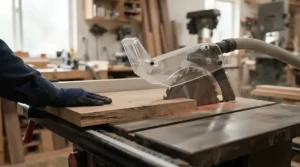
6. SawStop TSG-DC with TSA-ODC — factory-grade dust guard for ICS, PCS and CNS saws
The point here is that you’re upgrading a 1.75 HP SawStop from its basic guard. The dust collection guard comes standard on 3 HP and larger SawStop cabinet saws.
The TSG-DC is about 24 inches long with independent lateral slides and a low profile for cuts as narrow as 3/4 inch. A tool-free lever swaps between guard and riving knife. Pair it with the TSA-ODC overarm and SawStop claims 99% dust capture, and says the combination adds at least 100 CFM to your saw’s requirement. A custom Y-port merges above-table and below-table collection into one 4″ port.
Compatibility is the limit. This is for ICS, PCS and CNS saws only, so it’s a replacement path rather than a universal one.
Retail ratings are lukewarm: Rockler shows 3.8 stars across 22 reviews for the guard and 3.5 across 26 for the overarm. Forum owners say it leaves chips on the table when trimming melamine and can clog when a small offcut gets sucked in.
Pros:
- ✅ Tool-free switching between guard and knife
- ✅ Cuts as narrow as 3/4 inch
- ✅ Y-port joins above and below collection
Cons:
- ❌ Fits only SawStop ICS, PCS and CNS
- ❌ Small offcuts can clog the guard
Expect under $200 for the guard and the mid-$300s for the overarm, so roughly $500 combined. It’s good value only if you own the right saw.
7. SawStop TSG-FDC — floating overarm built for non-through cuts and heavy dust
This one’s headline is that the guard floats. It isn’t tied to a splitter, so it can stay put for dados and swing clear when you need the table.
Specs are generous. The outer tube is 4″ with a 3″ inner tube. The guard measures 3-1/2″ by 18-1/2″. Reach from blade to the end of the extension table runs 35-3/4 to 68 inches, and the tube sits 13-1/2 inches above the table. That wide pipe suits high-volume collection, but SawStop says it needs at least 400 CFM at the point of collection. It’s officially listed for ICS, PCS and CNS saws. One forum contributor says it fits any traditional cabinet saw. Verify with SawStop before you drill.
You also set the guard height yourself, unlike the TSG-DC, which adjusts to each workpiece. That’s the trade for versatility.
The review pool is small. Retailers show only a handful of ratings, so I can’t point to a strong consensus.
Pros:
- ✅ Guards non-through cuts like dados
- ✅ Wide 4″ tube moves high air volume
- ✅ Swings clear for blade changes
Cons:
- ❌ You adjust guard height manually
- ❌ Needs roughly 400 CFM to perform
At around $600 and up, it’s the priciest option here. Worth it only if your dust collector can feed it.
What Is an Aftermarket Blade Guard for Cabinet Saw Upgrade?
An aftermarket blade guard for cabinet saw upgrade is a non-factory guard system that replaces or supplements your saw’s stock guard. It shields the blade from above, often adds a dust port, and may include a splitter or riving knife. Types include overarm, splitter-mounted and riving knife-mounted.
That definition hides a useful distinction. A guard covers the blade, while a splitter or riving knife stops the wood pinching behind it. They do different jobs, and OSHA treats them as separate requirements for hand-fed ripsaws. Several overarm products here, including the Grizzly T10113, explicitly provide no kickback protection. Always check whether a guard comes with a knife.
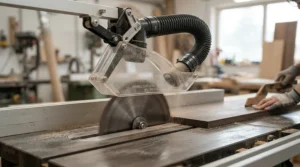
How to Choose an Aftermarket Blade Guard for Cabinet Saw Upgrade
- Confirm saw compatibility first. Check your saw’s make, model and tilt direction against the maker’s fit list. Brand-specific guards like the SawStop TSG-DC won’t bolt onto other saws.
- Decide how often you do non-through cuts. If you cut dados weekly, choose an overhead guard. Splitter-mounted guards come off for those cuts.
- Check for kickback protection. Confirm the package includes a splitter or knife with pawls, or that you already own one.
- Match the dust port to your collector. A 4″ port wants real airflow. A 2.5″ port suits a shop vac.
- Measure your floor and table space. Overarm boom reach, such as 39-68 inches on the Grizzly T10113, must clear your extension table.
- Think about sightlines. A clear, thick guard and a counterweight out of view, like on the Exaktor EXOA-2, make you more likely to use it.
- Budget for extras. Throat plates, hoses and anchoring hardware add up.
Overhead Guard Compatible With Cabinet Saws: Fit, Reach and Trade-Offs
“Overhead guard compatible with cabinet saws” is a spec you have to earn by checking, not assume. Most universal overarms assume a stable base and a cabinet-style saw. Grizzly’s instructions say the Grizzly T10113 fits most saws with a stable adjustable base and a 3″ dust connection.
| Feature | Overhead (Overarm) Guard | Splitter-Mounted Guard |
|---|---|---|
| Non-through cuts | Stays on (Grizzly T10113, Exaktor EXOA-2, SawStop TSG-FDC) | Comes off |
| Dust capture | Strong with 4″ airflow | Strong with port directly over blade |
| Install effort | More hardware, floor space | Quick clamp-on |
| Sightlines | Depends on arm and counterweight | Usually a compact clear shield |
| Best For | Dado-heavy shops | Through-cut shops with SharkGuard splitter-mounted package |
Reading the comparison, overhead guards win on versatility, but they carry more hardware and a bigger footprint. Splitter-mounted guards win on simplicity. SawStop’s own FAQ on overarm versus floating dust collection shows the same trade-off from the manufacturer’s side. One design favors dynamic guarding and high-velocity extraction, and the other favors flexibility and high airflow.
Cabinet Saw Arm Mounting: A Practical Install Guide
Cabinet saw arm mounting is where most overhead guard upgrades succeed or fail. A boom that drifts after every cut defeats the point.
Before you drill:
- Unplug the saw.
- Dry-fit the arm with clamps first. Mark and drill only once the guard sits where you want it.
- Check that the post won’t collide with a fence rail, miter slot or router table.
Mounting tips:
- Position the guard over the blade’s center or slightly forward. One owner argued a port far behind the blade collects poorly, and a central port is more effective.
- Anchor the post firmly. A Grizzly T10113 owner solved drifting by securing the post to the table end with a U-bolt and a 2×4.
- Confirm the guard rollers rest on the table when the pivot arms are fully down. Grizzly’s T10113 manual walks through this alignment.
First-30-days checklist:
- Re-check bolts after the first week.
- Add a blast gate at the guard. One owner noted losing suction when it’s left open.
- Practice raising and parking the guard so it becomes habit.
✨ Make It a Weekend Project!
🔧 Grab the right guard, clear your table and take your time with the mounting. A well-anchored arm is the difference between a guard you use and one you resent!
Real-World Scenarios: Matching a Guard to Your Shop
Scenario 1: The hobbyist with an older Unisaw. Budget is moderate and most cuts are rips and crosscuts. The SharkGuard ARK package adds a tight knife, a clear guard and a port in one kit. Add a zero-clearance throat plate.
Scenario 2: The cabinetmaker who cuts dados daily. Splitter-mounted guards keep coming off here. An overarm like the Exaktor EXOA-2 or Grizzly T10113 stays on, so protection isn’t optional per cut. Pair either with a good riving knife.
Scenario 3: The SawStop owner with a 1.75 HP saw. The cleanest path is the SawStop TSG-DC with TSA-ODC. If you do heavy non-through work and your collector delivers 400+ CFM, the SawStop TSG-FDC is the premium step up.
Scenario 4: The Delta loyalist. If you want a classic look and independent baskets for narrow rips, the Delta Uniguard Deluxe 34-976 fits. Just plan for adding dust capture separately.
Problem to Solution: Fixing Common Guard Headaches
Problem: The guard blocks narrow rips. One owner said any guard gets in the way when ripping boards under an inch. Solution: use an auxiliary short fence or raise one basket on the Delta Uniguard Deluxe 34-976, then push with a stick between guard and fence.
Problem: Hose keeps popping off. A SharkGuard splitter-mounted package owner reported this with 4″ flex. Solution: use hose clamps and a rigid riser, or route the hose overhead.
Problem: Small offcuts clog the guard. Owners with the SawStop TSG-DC report it. Solution: partly close a blast gate, as one owner did, to stop thin offcuts getting sucked up.
Problem: The arm drifts. See the mounting section. Anchor the post.
Problem: Weak dust collection. Check that your collector can supply the airflow. The SawStop TSG-FDC needs far more CFM than the TSA-ODC setup.
Guard Sightlines: Why You Can’t Cut What You Can’t See
Guard sightlines decide whether a guard stays on your saw. A cloudy, obstructive guard is the one that ends up on a shelf. One forum owner admitted forcing himself to use an Excalibur because it obstructed his view of the blade, even in plexiglass.
Here’s what to weigh. Thickness and clarity matter, and the SharkGuard ARK package uses Lexan reported at about 70% thicker than a stock guard. Counterweight placement matters too. The Exaktor EXOA-2 puts it behind the basket, out of your line of sight. Guard width matters, since a wide basket can crowd your push stick. Independent baskets, like the Delta Uniguard Deluxe 34-976, let you lift one side without losing the other.
An LED light kit, available for the SharkGuard ARK package, helps in dim shops. Test sightlines in your actual lighting before you commit.
Shop-Grade Safety Standards: What the Rules Actually Say
Shop-grade safety standards start with OSHA 29 CFR 1910.213. OSHA’s Machine Guarding eTool for table saws says to enclose the portion of the blade above the table with a self-adjusting guard that adjusts to the thickness of the material and stays in contact with it. It also says to guard the blade portion beneath the table.
SharkGuard states that a business needs all three parts to align with OSHA: the blade cover, the anti-kickback pawls and the splitter or riving knife. Hobbyists, it notes, can omit the pawls. That is the manufacturer’s interpretation, not legal advice. I’m not a safety compliance professional, so check with your safety officer or local authority if you run a commercial shop.
The practical reading is that a guard alone isn’t a complete system. A guard, a knife and pawls together are. Keep that triple in mind when comparing packages.
Cabinet Saw Blade Guard Replacement: When the Stock Guard Has to Go
Cabinet saw blade guard replacement makes sense in a few situations. Maybe your saw is a used Unisaw missing its original splitter. Maybe the plastic baskets have yellowed or cracked. Or maybe the factory guard has no dust port.
For an older Delta, you can try original parts. Upper guard and guard pieces for the Delta Uniguard Deluxe 34-976 appear in the $40s at one parts retailer. A guard support piece showed as no longer available, which is the kind of gap that pushes owners toward aftermarket replacements.
When the original is hard to find, a SharkGuard ARK package gives you a modern guard and knife for older saws. For a SawStop, the SawStop TSG-DC is the direct replacement for the micro guard. Always confirm fit before ordering.
Shop Grade Guard Upgrade for Cabinet Saw: Build Quality and Long-Term Cost
A shop grade guard upgrade for cabinet saw owners should be judged on build, not marketing. Look for thick clear shielding, rigid arms, replaceable parts and a documented fit list. The modular design of the SharkGuard ARK package and the powder-coated construction of the SawStop TSG-FDC point that way.
| Product | Price Range | Likely Add-Ons | Best For |
|---|---|---|---|
| SharkGuard splitter-mounted package | $300-$355 range | Hose, clamps | Through-cut shops |
| SharkGuard ARK package | $345-$400 range | Throat plate, light kit | Older Unisaws |
| Delta Uniguard Deluxe 34-976 | Roughly $480-$660 | Dust shroud, adapter | Delta owners |
| SawStop TSG-FDC | Around $600 and up | Dust collector upgrade | Non-through cuts |
The table shows that sticker price tells only part of the story. A cheaper guard that needs a new throat plate and hose can close the gap fast. A premium overarm can cost far more if your collector can’t supply 400 CFM. Budget for the whole system, and check current prices before you buy.
For maintenance, wipe Lexan with a soft cloth, re-check mounting hardware regularly and replace any cracked shield.
FAQ
❓ Can I fit a universal overarm guard to any cabinet saw?
❓ Do overhead guards prevent kickback?
❓ How much should I budget for a decent guard?
❓ Will an overhead guard really improve dust collection?
❓ Is a splitter-mounted guard acceptable for commercial shops?
Conclusion
The right aftermarket blade guard for cabinet saw upgrade comes down to three questions. Does it fit your saw? Will you use it on the cuts you actually make? And can your dust collector feed it?
If most of your work is through cuts, the SharkGuard splitter-mounted package or the SharkGuard ARK package is the efficient route. If you cut dados regularly, an overarm like the Grizzly T10113, Exaktor EXOA-2 or SawStop TSG-FDC keeps protection on. If you own a Delta, the Delta Uniguard Deluxe 34-976 is the familiar choice, and SawStop owners should look at the SawStop TSG-DC with TSA-ODC first.
None of these replaces good habits. A guard, a knife and a push stick together beat any single gadget. Take your time with the cabinet saw arm mounting, test your sightlines and verify fit before you drill.
Recommended for You
- Overhead Blade Guard Vs Riving Knife Comparison: 7 Proven Picks 2026
- Overhead Blade Guard For Table Saw Safety: 7 Best Picks (2026)
- Aftermarket Blade Guard Under $150: 7 Proven Picks (2026)
Disclaimer: This article contains affiliate links. As an Amazon Associate, I earn from qualifying purchases. If you purchase products through these links, we may earn a small commission at no additional cost to you.
✨ Found this helpful? Share it with your friends! 💬🤗
