
In This Article
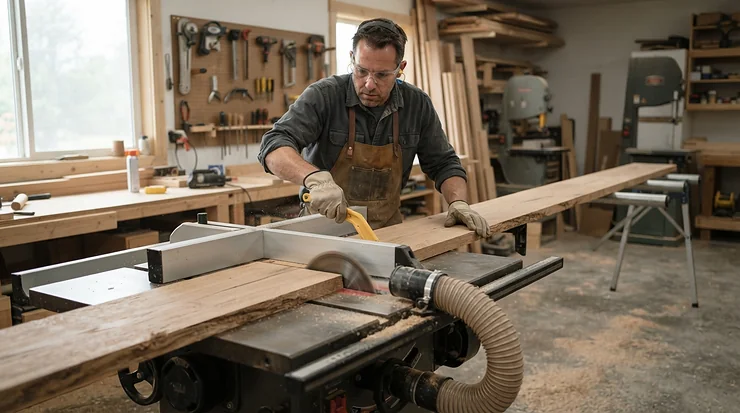
A riving knife system for contractor table saw owners is a thin, rigid steel plate mounted just behind the blade. On a true riving knife it rises, lowers, and tilts with the blade, holding the kerf open so a board can’t pinch and fire back at you. On many older saws it has to be retrofitted or approximated.
Here is the uncomfortable part. If your contractor saw was built before the modern guarding standards, it probably came with a fixed splitter or nothing at all. The riving knife rides within the kerf and pivots with the arbor. A splitter sits stationary behind the blade. That difference sounds academic until a board twists mid-rip.
The honest news comes next, and it will save you money. A true, bolt-on riving knife for every old contractor saw does not exist. The best-known aftermarket option, the BORK, fit only a limited list of saws, and one forum commenter reported it had gone away after its maker’s health problems. Anything you buy today means choosing among three paths:
- Splitter-style upgrades.
- Manually adjustable knives.
- Replacing the saw with one built around a knife.
This guide walks all three with real products, real specs, and aggregated reviewer sentiment. You’ll get a contractor saw kickback prevention upgrade plan that matches your saw, your budget, and your blades. A riving knife system for contractor table saw setups doesn’t have to mean a new saw. It does mean being honest about what your saw can accept.
Quick Comparison: Riving Knife System for Contractor Table Saw Options
| Product | Approach | Price Range (check current price) | Best For |
|---|---|---|---|
| MJ Splitter SteelPro SP-2 | Zero clearance insert splitter, full kerf | Roughly $35-$50 | Budget fix for saws with a shop-made insert |
| MJ Splitter SteelPro SP-2TK | Zero clearance insert splitter, thin kerf | Roughly $35-$50 | Thin kerf blades on lighter saws |
| Shark Guard ARK Package | Manually adjustable knife plus guard | Mid-$300s to around $400 | Older saws with a fixed splitter |
| Shark Guard Riving Knives and Splitters | Replacement knife or splitter, chosen thickness | About $75-$120 | Matching knife thickness to your blade |
| Delta 36-725T2 | New saw with factory riving knife | Roughly $700-$1,200 | Home-shop upgrade from an old contractor saw |
| JET ProShop II | New saw, quick-release and low-profile knives | Priced above the Delta | Small shops wanting more refinement |
| SawStop Contractor Saw | New saw, two riving knives included | Premium tier | Safety-first buyers with budget |
Looking at the table, the cheapest path works through your insert, so it only suits saws whose insert you can drill or replace. The middle path, Shark Guard ARK Package, tackles the splitter itself. The new-saw paths cost far more but remove compatibility guesswork entirely. If your priority is spending under $100, start with the MJ Splitter SteelPro pair. If you want the closest thing to a real knife on your old saw, look at the Shark Guard ARK Package.
💬 Just one click — help others make better buying decisions too!😊
Top 7 Riving Knife System for Contractor Table Saw Picks: Expert Analysis
1. MJ Splitter SteelPro SP-2 — full kerf splitter for under $50
The pitch is simple. This kit drops a splitter into your zero clearance insert for roughly the price of a decent blade.
The kit uses four splitters with built-in offsets, kerf keepers, and a drill guide. Rockler lists the full kerf version for kerfs between 0.118″ and 0.145″, and for 90-degree cuts only. That limit matters: if you bevel-rip often, this isn’t your answer.
On paper, the dual-splitter idea does something clever. It controls both the keeper piece and the off-cut piece, acting like a mini featherboard behind the blade. Forum users say they could feel the board snug against the fence near the end of the cut. The catch is installation. You need an insert with enough thickness and at least two inches behind the blade at its highest point.
Reviewer sentiment is mixed, and honest. Rockler shows a 4.1-star average from 21 reviews. Woodworkers praise how well it keeps the kerf open and how easy it is to remove. One caution from a forum thread: cutting 6/4 or 8/4 boards can pull the splitter from its holes. A Home Depot reviewer on an older Delta contractor saw reported the steel insert made it unusable.
Pros:
- ✅ Costs a fraction of any retrofit kit
- ✅ Automatic kerf keeper alerts you to binding
- ✅ Removes in seconds for non-through work
Cons:
- ❌ Needs a drillable zero clearance insert
- ❌ Straight, 90-degree through cuts only
Price range: roughly $35-$50, and a strong value verdict if your saw accepts a wood or phenolic insert.

2. MJ Splitter SteelPro SP-2TK — thin kerf twin built for lighter saws
This is the same system tuned for 3/32″ blades, which matters more than most buyers realize.
The kit is designed for thin kerf blades, with a kerf range of 0.090-0.118″. It includes four thin kerf splitters, four kerf keepers, a drill guide, and a drill bit. Splitters reverse for offsets of 0.000″, 0.003″, 0.006″, and 0.009″. Translation: you can compensate for blade runout, which on an old contractor saw is not a theoretical concern.
Who is this for? Anyone running a 1.5 HP contractor saw with a thin kerf rip blade to save motor load. The wrong splitter thickness is a classic trap, and this kit exists to avoid it. Pair it with a zero clearance insert, and note the 90-degree cut limitation again.
Manufacturer copy calls it America’s most popular aftermarket thin kerf splitter. Treat that as marketing, not verification. Independent users describe it as high quality and accurate, and several say it works well on older saws. The same insert incompatibility reported for the full kerf version applies here: steel-insert saws are a no-go.
Pros:
- ✅ Matched to thin kerf blade geometry
- ✅ Offset options compensate for blade runout
- ✅ Made in the USA with a steel core
Cons:
- ❌ Useless if your insert can’t be modified
- ❌ Not for bevel cuts
Price range: also roughly $35-$50, and a smart pick if thin kerf is already your habit.
3. Shark Guard ARK Package — manual knife that rides with your blade
The ARK, short for adjustable riving knife, is the nearest thing to a retrofit knife for saws that shipped with a fixed splitter.
The package pairs the guard with a knife, clamp assembly, mounting bracket, and hardware. The knife is hand-adjusted to blade height and tilts with the blade. Because it sits closer to the blade than the old splitter, the original throat plate won’t work. Thickness options are .090″, .105″, and .120″, so you can match your blade.
For a deeper take, Woodworkers Guild of America notes that a true riving knife can’t easily be retrofitted, calling this the closest option it has seen. That framing is right. Reviewers there describe installation taking about 30 minutes. A forum thread cautions that a tab between the original splitter slot and blade slot may have to be removed, and Delta 34-338 is a known exception.
Contact the maker with your exact saw model before ordering; that’s their own advice.
Pros:
- ✅ Sits close to blade for tighter kerf control
- ✅ Three knife thickness choices
- ✅ Includes guard, bracket, and hardware
Cons:
- ❌ Manual height adjustment, unlike a factory knife
- ❌ May need a new insert and tab removal
Price range: mid-$300s to around $400. It costs real money, but it’s the most serious retrofit-style option here.
4. Shark Guard Riving Knives and Splitters — right thickness without buying a new saw
Sometimes your saw already has a mount and you simply need the right plate.
The maker sells stainless knives in a brushed finish, in your choice of thickness. If your saw came with a knife, the company says you shouldn’t need a bracket or throat plate. The rule printed on the page is the one you’ll see everywhere: the knife must be thinner than the kerf of every blade you use.
Think of it as the fix for the thick-knife, thin-blade headache. Plenty of owners swap blades and forget the knife. This product exists for that mismatch. Splitters for older models, such as the low-profile Jet splitter, run lower in the range.
Review sentiment here is thin. Verified independent reviews of these individual knives are hard to find, so judge the maker’s claims accordingly. What is verifiable is the range: roughly $75-$120, from the maker’s pricing table. Ask about your saw model first. Fit varies by brand, and the maker asks buyers to inquire before ordering.
Pros:
- ✅ Stainless construction with chosen thickness
- ✅ Often needs no bracket if mount exists
- ✅ Low-profile splitters for some Jet models
Cons:
- ❌ Useless without an existing compatible mount
- ❌ Limited independent review data
Price range: about $75-$120. Good value if you’re fixing a thickness mismatch, poor value if your saw has no mount at all.
5. Delta 36-725T2 — factory riving knife in a contractor-style saw
Sometimes the best retrofit is a replacement, and this is the budget-conscious one.
The specs are friendly: a 15-amp motor, a 3,600 RPM blade speed, cast-iron table, T-square fence, and 30 inches of right rip capacity. Delta’s own page lists weight near 195 pounds, while another review puts the assembled weight at 220. The riving knife has two positions, through-cut and non-through-cut, and you adjust it with four screws. Reviewers say both the fence and knife needed adjusting out of the box.
The manual carries an important thickness warning. It calls for a minimum kerf of 0.102″ and maximum body thickness of 0.073″. Many thin kerf blades sit near 0.094″, so you may be limited to full kerf blades. Forum owners disagree about how strictly to read that. Follow the manual.
Reviewers like the cast-iron top and fence. One review flags Delta’s motor history, so check warranty terms. It is a fixed home-shop saw, not a jobsite tool.
Pros:
- ✅ Factory riving knife with two positions
- ✅ Cast iron top and T-square fence
- ✅ Five-year limited warranty
Cons:
- ❌ Knife thickness limits blade choices
- ❌ Heavy; needs alignment after assembly
Price range: roughly $700-$1,200 depending on retailer and timing. Good value, with caveats on blades.
6. JET ProShop II — quick-release knives for the compact shop
If your retrofit hunt keeps ending in compromise, this saw ends it with better ergonomics.
It’s described as a compact contractor-style saw with a cast-iron table. The quick-release riving knife can be removed or changed without a lengthy setup. A separate low-profile riving knife ships for non-through cuts like grooves and rabbets. There’s also an independent-leaf blade guard.
What does that mean in practice? Fewer excuses. The classic reason people strip a knife off, because it blocks a groove cut, is handled by the low-profile knife. Quick release means the habit of leaving the knife on is easier to keep.
I couldn’t verify enough independent owner reviews for a clean sentiment summary, so treat the editorial praise as one source, not consensus. Expect it to cost noticeably more than the Delta 36-725T2; check current price at retailers, since pricing and packages vary.
Pros:
- ✅ Quick-release knife changes in moments
- ✅ Separate low-profile knife for grooves
- ✅ Compact cast-iron contractor-style design
Cons:
- ❌ Costs more than the Delta
- ❌ Limited verified owner-review data
Price range: above the Delta, and best value for a small shop that will use it daily.
7. SawStop Contractor Saw — premium safety with two knives included
Everything about this one is expensive, and so is the injury it’s designed to prevent.
Reviewers highlight a 1.75 HP motor, skin-contact detection technology, and more than 150 possible setup arrangements. It ships with a miter gauge, micro blade guard, two riving knives, and a push stick. The weight is around 362 pounds, according to one listing, so this is not a saw you move casually.
The honest analysis: you don’t buy this for a riving knife alone. You buy it because the knife is part of a complete safety stack. Two included knives cover through-cuts and non-through-cuts without hunting for accessories.
Reviewers call out the price and bulk as drawbacks, and that’s fair. For a small shop, the footprint is a real constraint.
Pros:
- ✅ Two riving knives included in the box
- ✅ Skin-contact detection adds another layer
- ✅ Highly configurable setup options
Cons:
- ❌ Premium price puts it out of reach for many
- ❌ Heavy and bulky for tight shops
Price range: premium tier; check current price. It’s worth it only if budget and space allow.
Spec Snapshot: Seven Options Side by Side
| Product | Key Spec | Install Effort | Best For |
|---|---|---|---|
| MJ Splitter SteelPro SP-2 | Kerf 0.118″-0.145″ | Moderate (drill insert) | Full kerf blades |
| MJ Splitter SteelPro SP-2TK | Kerf 0.090″-0.118″ | Moderate (drill insert) | Thin kerf blades |
| Shark Guard ARK Package | .090″/.105″/.120″ knife | Moderate to high | Old fixed-splitter saws |
| Shark Guard Riving Knives and Splitters | Chosen thickness | Low if mount exists | Fixing thickness mismatch |
| Delta 36-725T2 | 0.102″ min kerf, 0.073″ max body | Assembly and alignment | Home-shop upgrade |
| JET ProShop II | Quick-release plus low-profile | Assembly | Compact shops |
| SawStop Contractor Saw | Two knives included | Assembly | Maximum safety |
The table shows a pattern: install effort rises as the fix gets more complete. Most of the cost sits in the Shark Guard ARK Package and the three new saws, while the MJ Splitter SteelPro kits and the Shark Guard Riving Knives and Splitters are the low-cost patches. If your blade is thin kerf, double-check the Delta 36-725T2 thickness limits before buying.
✨ Don’t Miss These Deals on Safer Cuts!
🔍 Take your shop safety to the next level with these carefully selected options. Click any highlighted product name to check current pricing and availability. A few minutes of research now is cheaper than a trip to the emergency room later! 🪚
Riving Knife Retrofit for Contractor Saw: Step-by-Step Setup and First 30 Days
A riving knife retrofit for contractor saw owners isn’t a one-evening project, but it isn’t rocket science either. Here is a practical sequence, whichever product you pick.
- Identify what you have. Is it a fixed splitter, a bare mount, or nothing? That determines everything.
- Measure your blade. Record plate thickness and kerf width with calipers. These two numbers decide which knife thickness is safe.
- Check the mount. Contact the maker with your saw model before ordering. This is the maker’s own advice for the Shark Guard ARK Package.
- Install, then align. Check the knife against the blade at full height and at tilt. Forum reviewers of the Delta 36-725T2 say knife alignment needed attention out of the box, so don’t assume factory settings.
- Test with scrap. Make a few rip cuts on cheap stock before you trust it.
Common first-month mistakes include forgetting to swap the knife when swapping blades, leaving the insert gap too wide, and removing the knife for a groove cut and never putting it back. Set a weekly reminder to check the setup. Boring, yes. Effective, also yes.
Real-World Scenarios: Which Setup Fits Which Shop
Specs are abstract. Shops are not. Here are three profiles with matching picks and reasoning.
The weekend builder with a 15-year-old contractor saw. Budget under $100, mostly pine and plywood, occasional hardwood. Start with the MJ Splitter SteelPro SP-2 or SP-2TK, depending on your blade, and make a zero clearance insert. It’s not a true knife, but it addresses the pinching problem at minimal cost.
The small-shop hobbyist who rips hardwood weekly. Budget up to the low $400s, a saw with a fixed splitter, and zero interest in buying a new machine. The Shark Guard ARK Package is the logical step. It tightens the gap behind the blade and gives you a guard, though you’ll adjust the knife by hand.
The furniture maker planning to stay for the next decade. Budget isn’t the main limit; space is. A JET ProShop II or Delta 36-725T2 gives a factory knife and a better fence. If injury avoidance is the top priority, the SawStop Contractor Saw earns a serious look.
Frequency of use matters. The more you rip, the more the extra convenience of a quick-release knife pays back.
How to Choose a Riving Knife System for Contractor Table Saw Owners
Choosing a riving knife system for contractor table saw owners comes down to seven checks. Work through them in order.
- Confirm your saw’s mounting reality. A knife must mount to something that moves with the blade. If your saw has no such mount, you’re choosing between a splitter and a new saw.
- Check your blade’s kerf and plate. The knife must be thicker than the plate and thinner than the kerf. Fine Woodworking’s forum hosts a clear discussion of the rule.
- Decide whether bevel cuts matter. The MJ Splitter SteelPro kits are for 90-degree cuts only.
- Check the insert. A steel insert can rule out the insert-based options.
- Weigh adjustability. A manually adjusted knife costs less than a factory-aligned one but demands discipline.
- Price the whole system. Include insert, blades, and guard components.
- Think about the next saw. If you’ll replace the machine in two years, don’t over-invest.
Contractor Saw Arbor Design: Why Retrofitting Is So Hard
Contractor saw arbor design is the reason a universal retrofit doesn’t exist. On a traditional contractor saw, the motor hangs off the back and the blade is carried on an arbor assembly that moves on trunnions. A true riving knife must attach to the part that rises, lowers, and tilts with the blade, so it needs a precisely placed mount.
Original manufacturers engineered those mounts into modern saws. Older designs lacked them. Forum owners of the Ridgid TS3660 and older Craftsman contractor models noted that the BORK didn’t fit because of the size and shape of the cast blade shrouds. Fabricating your own mount means drilling into precision-machined castings, which most woodworkers sensibly avoid.
That is why “fits your saw” is the most important phrase in this entire article. The same arbor geometry that makes a contractor saw compact also limits what you can bolt onto it. Before you buy any kit, find out how your arbor assembly is built, and whether the maker has a pattern for your model.
Riving Knife Compatibility for Open Stand Saws
Riving knife compatibility for open stand saws deserves its own section because open-stand contractor saws have quirks. The open base exposes the trunnions and motor, which is helpful when you need to reach underneath. It also means dust everywhere and less rigidity than an enclosed cabinet.
What this means in practice, based on the spec comparison: bracket-style retrofits like the Shark Guard ARK Package are easier to inspect and align on an open stand, since you can see the mounting area. Insert-based splitters like the MJ Splitter SteelPro SP-2 don’t depend on the base at all, which makes them universal across stand types. Check the saw’s throat opening and table geometry instead.
If your open-stand saw has a cast blade shroud, treat compatibility as unproven until the maker confirms it. Send photos. A thirty-second email beats a returned kit.
Riving Knife Thickness: Getting the Number Right
Riving knife thickness is the detail most people get wrong. The rule is simple: the knife must be thicker than the blade plate and thinner than the kerf. If it’s too thick, the board can’t pass. If it’s too thin, the kerf can close on the plate.
Modern carbide blades cut a kerf wider than the steel plate because of the tooth width. A typical thin kerf blade runs about 3/32″, and the Delta 36-725T2 manual specifies a 0.102″ minimum kerf, so thin kerf blades can fall outside spec. Shark Guard offers knife thicknesses of .090″, .105″, and .120″, which helps you match blade to knife.
Measure with calipers, not guesses. Write the numbers on masking tape and stick it to the saw. Run the same check whenever you change blades. It’s the cheapest safety step in the shop.
Contractor Saw Kickback Prevention Upgrade: Splitter vs Riving Knife vs Pawls
A good contractor saw kickback prevention upgrade stacks several defenses. Here’s how they compare.
| Defense | What It Does | Weakness | Best For |
|---|---|---|---|
| Fixed splitter | Holds kerf open behind blade | Doesn’t follow blade height | Basic through cuts |
| MJ Splitter SteelPro | Insert-based splitter plus kerf keeper | 90-degree cuts only | Budget upgrades |
| Shark Guard ARK Package | Adjustable knife plus guard | Manual adjustment | Old fixed-splitter saws |
| Factory riving knife (Delta 36-725T2, JET ProShop II, SawStop Contractor Saw) | Moves with blade | Requires a new saw | Long-term safety |
The table shows a trade: convenience rises as the defense becomes more integrated. A splitter does one job. A true knife also stays near the blade at all heights and tilts. Anti-kickback pawls are an additional layer, and Shark Guard notes that its guard needs pawls for OSHA-style compliance. No single device is a force field. Stack defenses, use a push stick, and stand out of the line of fire.
Retrofit Kits: What’s Actually in the Box
Retrofit kits vary wildly in scope. A kit like the MJ Splitter SteelPro SP-2TK includes four thin kerf splitters, four kerf keepers, a drill guide, a bit, and screws. A fuller package like the Shark Guard ARK Package adds a guard, knife, clamp assembly, bracket, and hardware, though the pawls and light kit are sold separately.
Factory-engineered kits also exist for specific machines. Woodshop News once covered a riving knife retrofit kit from General Manufacturing for its 350 and 650 cabinet saws, built from a cast-iron chute, arbor bracket, and quick-release mount. That’s a useful reminder: true retrofits exist when a manufacturer designs them for a specific saw. Don’t expect that for a generic old contractor saw.
| Product | Price Range | Value Read |
|---|---|---|
| MJ Splitter SteelPro SP-2 | Roughly $35-$50 | Highest value if insert works |
| Shark Guard Riving Knives and Splitters | About $75-$120 | Good for thickness fixes |
| Shark Guard ARK Package | Mid-$300s to around $400 | Best retrofit-style option |
| Delta 36-725T2 | Roughly $700-$1,200 | Best new-saw value |
| SawStop Contractor Saw | Premium tier | Premium protection |
The price table shows a steep jump between patching and replacing. The decision hinges on how long you’ll keep the saw and how much its mount can accept. If a kit costs more than half the value of the saw, replacement deserves a hard look.
Safety, Standards, and What the Rules Actually Say
Standards context helps explain why the market looks this way. UL 987, the standard for stationary and fixed electric tools, added riving knife requirements in its sixth edition, published in January 2005. The effective date for new products submitted for listing was January 31, 2008, with a later date for currently listed products. Underwriters Laboratories has required riving knives on all new table saw designs since 2008.
The U.S. Consumer Product Safety Commission tracks the voluntary standards activity. A voluntary standard is not a law, but it’s a practical requirement for manufacturers. That’s why new saws have knives and old ones often don’t.
For you, the practical conclusion is simple. If you own a saw made before those changes, you’re operating without the design modern guards assume. That’s not a moral failing, but it is a reason to add protection and stay disciplined.
Problem → Solution Guide for Retrofit Headaches
Problem: the board binds behind the blade. Check knife thickness against kerf. Check alignment. Check fence parallelism.
Problem: the knife blocks a groove or rabbet. Use a low-profile knife where available, like the second knife on the JET ProShop II or SawStop Contractor Saw. Otherwise remove the knife for that cut only, and restore it right after.
Problem: the insert won’t accept a splitter. Make a new zero clearance insert from a drillable material, or switch to a bracket system like the Shark Guard ARK Package.
Problem: thin kerf blades won’t work with the factory knife. Follow the manual. For the Delta 36-725T2, that means full kerf blades unless Delta specifies otherwise.
Problem: the splitter pops out on thick stock. Forum users report this on 6/4 and 8/4 boards with insert-based splitters. Slow down the feed, or choose a mounted solution.

FAQ
❓ Can you add a true riving knife to any old contractor saw?
❓ What is the cheapest contractor saw kickback prevention upgrade?
❓ Does riving knife thickness really matter?
❓ Will thin kerf blades work with a factory riving knife?
❓ Is it better to retrofit or replace a contractor saw?
Conclusion
Here is the short version. A riving knife system for contractor table saw owners is possible, but it’s rarely a plug-and-play affair. For under $50, the MJ Splitter SteelPro SP-2 and SP-2TK are sensible if your insert can be drilled. For a more serious retrofit-style upgrade, the Shark Guard ARK Package is the closest thing to a knife on an old saw, as long as the maker confirms fit. If you just need the right plate, Shark Guard Riving Knives and Splitters can fix a thickness mismatch.
If your saw can’t accept any of those, replacement is the honest answer. The Delta 36-725T2 brings a factory knife at a mid-range price. The JET ProShop II adds quick-release convenience for compact shops. The SawStop Contractor Saw goes further on safety, at a premium price and weight.
Whatever you choose, remember the basics: match knife thickness to blade, keep the knife on for through cuts, and use push sticks. Tools help, but habits finish the job.
✨ Ready to Upgrade Your Saw Safely?
🔍 Pick the option that fits your saw, check current pricing and availability through the highlighted product names, and get your setup aligned before the next big rip. Your fingers will thank you! 🪚💪
Recommended for You
- Aftermarket Blade Guard For Cabinet Saw Upgrade: 7 Best Picks 2026
- Overhead Blade Guard Vs Riving Knife Comparison: 7 Proven Picks 2026
- Overhead Blade Guard For Table Saw Safety: 7 Best Picks (2026)
Disclaimer: This article contains affiliate links. As an Amazon Associate, I earn from qualifying purchases. If you purchase products through these links, we may earn a small commission at no additional cost to you.
✨ Found this helpful? Share it with your friends! 💬🤗
