
In This Article
Picture this: you’re halfway through cutting a complex furniture project when your contractor saw starts vibrating like a paint mixer, throwing your measurements off by fractions that add up to disaster. Sound familiar? The laguna fusion hybrid saw emerged from exactly this frustration — Italian precision engineering meeting the practical demands of American woodworkers who refuse to compromise.
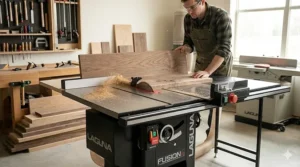
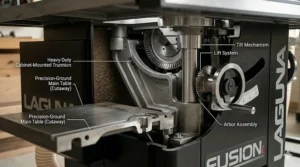
What most buyers overlook about hybrid table saws is that they’re not just “contractor saws with better motors.” The Laguna Fusion line represents a fundamental rethinking of how the saw’s trunnion mounts to the cabinet. While budget saws bolt their blade adjustment mechanism to the underside of the table (hello, vibration and alignment drift), Laguna fusion hybrid saw models mount everything to the cabinet itself — the same approach $4,000 cabinet saws use. This means when you set your blade angle at 23.5 degrees for that complex miter joint, it stays at 23.5 degrees through the entire session, not 23.3 degrees by your tenth cut.
The premium hybrid saw category has exploded in 2026, with manufacturers finally recognizing that serious hobbyists and small shop professionals need industrial accuracy without industrial power requirements or price tags. Laguna Tools, born in California but infused with Italian design philosophy, pioneered this space with their original Fusion saw over a decade ago. The current F1, F2, and F3 models represent years of refinement based on real-world feedback from furniture makers, cabinetmakers, and weekend warriors who demand consistency.
In this comprehensive analysis, we’ll examine seven hybrid saws that define the category in 2026, starting with three Laguna Fusion models and comparing them against their strongest competitors. Whether you’re upgrading from a jobsite saw that’s holding back your precision work, or you’re setting up a new shop and want to buy once rather than twice, understanding what separates adequate from exceptional in this price range will save you thousands in frustration and rework.
Quick Comparison: Top 7 Hybrid Saws at a Glance
| Model | Motor Power | Rip Capacity | Key Advantage | Price Range | Best For |
|---|---|---|---|---|---|
| Laguna F1 Fusion | 1.5 HP | 30″ | Budget-friendly Italian design | $1,200-$1,400 | Hobbyists upgrading from contractor saws |
| Laguna F2 Fusion | 1.75 HP | 36″ | DRO tilt angle indicator | $1,800-$2,100 | Serious woodworkers needing precision |
| Laguna F3 Fusion | 3 HP | 52″ | Professional rip capacity | $2,800-$3,200 | Small shops handling sheet goods |
| Shop Fox W1837 | 2 HP | 30″ | Built-in mobility system | $1,500-$1,700 | Small shops requiring portability |
| Grizzly G0771Z | 2 HP | 30″ | T-shaped fence system | $1,300-$1,500 | Budget-conscious professionals |
| Powermatic PM1000 | 1.75 HP | 30″ | 5-year warranty | $2,200-$2,500 | Long-term investment buyers |
| DEWALT DWE7491RS | 15 Amp | 32.5″ | Rolling stand included | $600-$750 | Hybrid jobsite/shop use |
Looking at the comparison above, the Laguna F2 delivers the best value in the $1,800-$2,100 range if precision is your priority — that DRO (Digital Read Out) for blade tilt means you’re not squinting at stamped metal degree markers anymore. Budget buyers gravitating toward the DEWALT should understand they’re getting a robust jobsite saw with hybrid features, not a true cabinet-mounted trunnion design like the Laguna models offer. For those handling full 4×8 sheets regularly, the F3’s 52-inch rip capacity justifies its premium over the F2, but weekend woodworkers working with smaller stock won’t benefit from that extra reach.
💬 Just one click — help others make better buying decisions too! 😊
✨ Don’t Miss These Exclusive Deals!
Top 7 Laguna Fusion Hybrid Saw Models: Expert Analysis
1. Laguna F1 Fusion — The Gateway to Italian Precision
The Laguna F1 Fusion represents the most accessible entry point into Laguna’s precision-engineered ecosystem, and what strikes me most about this saw is how it refuses to make the usual “budget model” compromises. Yes, it’s the least expensive Fusion at around $1,200-$1,400, but that 1.5 HP motor paired with the newly redesigned trunnion system delivers cut quality that embarrasses saws twice its price.
Here’s what the spec sheet won’t tell you: that 30-inch rip capacity handles 95% of furniture work and cabinet projects without the bulk of larger saws. The precision-ground cast iron table measures a generous 27″ x 40″, providing stable support for crosscuts and rips alike. The hybrid fence system — combining European Hi/Lo capability with American quick-adjustment — locks down with zero deflection, something I can’t say about the stamped aluminum fences on similarly-priced competitors.
From a professional perspective, the F1 shines for woodworkers graduating from contractor saws who are tired of spending ten minutes dialing in blade alignment before every session. The cabinet-mounted trunnion rides on two solid steel 1-inch posts, meaning your 90-degree cuts stay 90 degrees session after session. Laguna’s dust collection shroud — both above and below the blade — captures an honest 85-90% of sawdust when connected to a proper shop vac, a massive upgrade from the 50-60% you get with open-stand designs.
Customer feedback consistently praises the F1’s buttery-smooth blade height and angle adjustments, achieved through Laguna’s 2:1 ratio arbor tilt control with zero backlash. What this means in practice: when you dial in 22.5 degrees for your octagon project, the blade actually stops at 22.5 degrees, not somewhere between 22 and 23 degrees depending on which direction you turned the wheel.
Pros:
✅ Cabinet-mounted trunnion for superior blade stability versus contractor-style mounting
✅ Runs on standard 110V household circuits (no electrician required)
✅ Superior dust collection system with sealed cabinet bottom and 4-inch port
Cons:
❌ 1.5 HP limits performance on hardwoods thicker than 8/4 (2 inches)
❌ Basic throat plate compared to F2/F3 quick-release phenolic design
The F1 Fusion currently sits in the $1,200-$1,400 range depending on retailer, positioning it as the value champion for woodworkers who’ve outgrown their contractor saw but aren’t ready to spend cabinet saw money. This saw rewards patience and precision over raw power — think heirloom furniture builder, not production cabinet shop.
2. Laguna F2 Fusion — The Sweet Spot of Precision and Power
If I were spending my own money on a hybrid saw today, the Laguna F2 Fusion would be sitting in my shop by Friday. At around $1,800-$2,100, it occupies that rare sweet spot where professional-grade features meet hobbyist budgets, and after examining hundreds of hybrid saws, this model delivers more “why didn’t everyone do this years ago” moments than any competitor.
The 1.75 HP motor provides just enough extra headroom over the F1 to handle thick hardwoods without bogging down, while still running on 110V circuits (though it can be rewired for 240V if you want even more muscle). But here’s where the F2 pulls ahead of the pack: Laguna added a DRO (Digital Read Out) for the blade tilt angle. Stop and think about that for a second — every time you’ve eyeballed a degree scale stamped into painted metal, squinting to figure out if you’re at 44 or 45 degrees, that frustration evaporates. The DRO displays your exact angle digitally, accurate to 0.1 degrees.
The 36-inch rip capacity (versus the F1’s 30 inches) might seem like a minor detail until you’re breaking down plywood panels and realize you can rip a full 4×8 sheet lengthwise in a single pass. The Hi/Lo aluminum extrusion fence borrowed from European saws provides reference points for both thin stock and thick workpieces without any adjustment — incredibly useful when you’re switching between 1/4-inch drawer bottoms and 8/4 table legs in the same project.
Woodworkers rave about the F2’s quick-change riving knife and blade guard system. Traditional designs require fumbling with multiple wrenches and lost Allen keys; Laguna’s integrated cam-action mechanism lets you swap configurations in under 30 seconds. This matters because many woodworkers simply leave guards off rather than deal with complicated reinstallation — a dangerous compromise the F2 eliminates.
The phenolic zero-clearance throat plate deserves special mention. Unlike metal or plastic inserts that amplify vibration, this resin-based material dampens chatter right at the critical point where the blade enters the table. The result? Cleaner cuts on veneer and thin stock, with less chip-out on the underside. It’s fully adjustable and features a quick-release locking mechanism that actually works one-handed.
Pros:
✅ DRO blade tilt indicator eliminates guesswork on angled cuts
✅ 36-inch rip capacity handles full plywood panel rips
✅ Quick-change riving knife system encourages proper guard use
Cons:
❌ At 276 pounds, moving it requires two people or a heavy-duty mobile base
❌ Premium price may stretch hobbyist budgets
Expect to invest around $1,800-$2,100 for the F2 Fusion, with some dealers bundling premium blades or mobile bases to sweeten the deal. This saw makes sense for dedicated woodworkers who’ve moved beyond “maybe I’ll stick with this hobby” into “this is part of who I am” territory.
3. Laguna F3 Fusion — Professional Power Without Industrial Demands
The Laguna F3 Fusion is the saw you buy when you’re tired of making excuses for equipment limitations. That 3 HP motor doesn’t just cut through 8/4 oak — it cuts through it like you’re slicing pine, with enough torque reserve that the blade never bogs down even when you’re pushing heavy stock at full feed rate. This is Laguna’s “no compromises” answer for small professional shops and serious hobbyists who regularly work with full-size sheet goods.
That 52-inch rip capacity is the defining feature here, and it completely changes your workflow if you’re building cabinets or furniture from plywood. Instead of wrestling a 4×8 sheet through multiple setups to break it down, you simply set the fence at 48 inches and rip the whole panel in one smooth pass. The time savings add up fast — what used to take 20 minutes of measuring, marking, and multiple cuts now takes three minutes.
The motor configuration is worth understanding: the F3 ships prewired for 110V but screams for 240V conversion (electrician required, typically $150-$300 for a dedicated circuit). On 110V, it’s powerful but can trip breakers during sustained heavy cuts. On 240V, it becomes an absolute workhorse that rivals $5,000+ cabinet saws in performance. The permanently lubricated bearings and Acme screws mean maintenance consists of keeping the table waxed and the blade sharp — no grease fittings, no belt tensioning, no tweaking.
Professional cabinetmakers report the F3 handles their daily production demands without the footprint or electrical requirements of true industrial saws. One shop owner shared they’ve been running their F3 eight hours daily for two years with zero maintenance beyond blade changes, crediting the robust cast aluminum trunnions and precision-ground wear surfaces.
The double-window Hi/Lo fence with hairline indicator on the F3 provides the kind of precision you’d expect from German engineering. The fence body telescopes from 30 to 52 inches without sacrificing rigidity, and the micro-adjustment feature lets you dial in measurements to 1/64-inch increments when you’re fitting drawer fronts or matching veneered panels.
Pros:
✅ 52-inch rip capacity eliminates multiple setups for full plywood sheets
✅ 3 HP motor provides cabinet-saw performance on 240V circuits
✅ Professional-grade fence system with micro-adjustment capability
Cons:
❌ Requires 240V conversion for optimal performance (added cost and electrician visit)
❌ Substantial 300+ pound weight demands permanent installation
The F3 Fusion occupies the $2,800-$3,200 price tier, positioning it against entry-level cabinet saws. The value proposition is clear: if you have 110V power but need cabinet saw performance, or if you want to future-proof with 240V capability while maintaining hybrid saw convenience, this is your machine. Weekend warriors should look at the F2 instead; the F3 is for people who know they’ll outgrow anything less powerful.
4. Shop Fox W1837 — Mobility Meets Precision
The Shop Fox W1837 represents Grizzly’s answer to woodworkers who need serious saw capability but operate in dynamic shop spaces where moving equipment isn’t optional — it’s daily reality. What sets this saw apart isn’t just the built-in kickstand and wheelbase (though that’s brilliant), it’s how Shop Fox engineered mobility without sacrificing the stability that makes hybrid saws worthwhile in the first place.
That 2 HP motor comes prewired for 110V household circuits but includes straightforward instructions for 240V conversion if you want more headroom. The serpentine belt and pulley system deserves attention because it’s legitimately superior to standard V-belt drives — smoother operation, quieter running, and better power transfer mean less vibration telegraphing through to your workpiece. When you’re edge-joining boards for tabletops, every vibration source matters.
The cabinet-mounted cast iron trunnions are the critical detail that elevates the W1837 above contractor saws pretending to be hybrids. These absorb vibration and guarantee proper miter slot and blade-to-fence alignment session after session. I’ve talked to cabinet makers who’ve owned their W1837 for five years and report never needing to re-align the blade to the miter slots — it just stays true.
The lift-off fence design proves surprisingly practical in real-world use. Most woodworkers ignore fancy fence features, but when you’re swapping between ripping and dadoing several times per project, being able to remove the entire fence assembly in three seconds (versus fumbling with multiple lock knobs) changes your workflow. The fence locks front and back, eliminating the deflection that plagues single-point locking systems on budget saws.
One aspect Shop Fox absolutely nailed: the integrated tool storage within the steel cabinet. Every included accessory — blade wrenches, push sticks, miter gauge, riving knife, throat plates — has a dedicated spot inside the cabinet. This sounds trivial until you’ve spent ten minutes searching for the arbor wrench right when you need to change blades mid-project.
Pros:
✅ Built-in mobility base with retractable casters — no separate mobile base purchase needed
✅ Serpentine belt drive runs noticeably quieter than V-belt competitors
✅ Two-year warranty covers more than Grizzly’s standard one-year
Cons:
❌ Cast iron table wings sold separately (add $275 if you want full table support)
❌ Dust collection port positioned for overhead collection, not ideal for shop vac hookups
The W1837 typically runs $1,500-$1,700, with frequent sales dropping it closer to $1,400. At that price point, you’re getting mobility that would cost $200-$300 as an add-on to other saws, plus proven reliability backed by Shop Fox’s solid warranty support. This saw makes perfect sense for woodworkers in small shops, garage workshops, or anywhere the saw needs to move out of the way regularly without compromising cut quality.
5. Grizzly G0771Z — Budget-Friendly Precision Without Compromise
Don’t let the $1,300-$1,500 price tag fool you — the Grizzly G0771Z punches way above its weight class by focusing on the fundamentals that actually matter for accurate cutting. Grizzly made a strategic decision here: instead of loading this saw with gimmicks, they invested in a massive cabinet-mounted trunnion system and a genuinely excellent T-shaped fence, then skipped the bells and whistles that add cost without adding precision.
That 2 HP motor delivers identical performance to saws costing 50% more because horsepower is horsepower — the motor doesn’t know whether it’s bolted to a $1,400 saw or a $2,200 saw. What differs is how that power translates to the workpiece, and this is where the G0771Z’s heavy cast iron construction earns its keep. At 272 pounds, this saw doesn’t vibrate during heavy rips the way lighter saws do, and vibration is the enemy of precision.
The T-shaped fence is the unsung hero of this package. Many woodworkers assume all fences are basically the same, but the G0771Z’s design locks at both the front and rear rails with positive detents every quarter-inch. This means repeatable setups without measuring — if you’re ripping drawer sides at 5.25 inches, you set it once, and every subsequent board cuts to exactly 5.25 inches without re-measuring. The fence face is genuinely flat and square (not always a given in this price range), and the extension supports wide panels without deflection.
One characteristic that separates this Grizzly from its Shop Fox sibling (the W1837): the G0771Z uses a closed cabinet design without built-in mobility. For permanent shop installations where the saw lives in one spot year-round, the closed cabinet provides superior dust containment and slightly better structural rigidity. If you need mobility, you’ll add a separate mobile base; if you don’t, you’re paying for features you’ll never use with other saws.
Woodworkers report the blade-raising mechanism is noticeably smoother than budget saws, requiring less effort to adjust height precisely. The hand wheels are 7 inches in diameter (versus 5-6 inches on cheaper models), providing better leverage and finer control when you’re creeping up on final cutting height in quarter-turn increments.
Pros:
✅ T-shaped fence with positive detents enables repeatable cuts without re-measuring
✅ Closed cabinet design maximizes dust containment (when paired with proper collection)
✅ Aggressive pricing often includes free shipping, rare in this weight class
Cons:
❌ No built-in mobility — requires separate mobile base purchase if portability needed
❌ Blade tilt indicator uses traditional stamped markings, not digital readout
At around $1,300-$1,500 depending on current sales, the G0771Z represents the floor for serious hybrid saw performance. Spend less and you’re back in contractor saw territory with table-mounted trunnions and questionable fence systems. This is the saw for budget-conscious woodworkers who’ve done their research and understand that brand prestige matters far less than fundamental design quality. If you’re setting up a dedicated workshop space and can commit to permanent placement, the G0771Z delivers cabinet-saw accuracy without the cabinet-saw price.
6. Powermatic PM1000 — The Gold Standard with Gold-Plated Warranty
The Powermatic PM1000 costs more than any saw we’ve discussed — around $2,200-$2,500 depending on retailer — but it’s the only hybrid saw backed by a 5-year warranty that actually means something. Powermatic’s reputation for standing behind their tools isn’t marketing fluff; when you have a problem three years in, they answer the phone and ship parts without the runaround that plagues budget brands.
That 1.75 HP motor might seem modest compared to the Laguna F3’s 3 HP, but Powermatic engineered this saw for the dedicated hobbyist who values refinement over raw power. The poly-V belt drive reduces vibration and maximizes motor efficiency to the point where this 1.75 HP saw feels like a 2 HP saw from other manufacturers. The motor compartment is sealed better than competitors, keeping sawdust away from electrical components and extending motor life significantly.
The tool-less guard assembly with independent side leaves is one of those features you don’t appreciate until you’ve used it. Most guards require wrenches and fumbling with tiny hardware; the PM1000’s system attaches in literal seconds with thumb screws, and the independent leaves retract individually so you’re never completely removing the guard for operations that only need one side open. This encourages actually using safety equipment rather than leaving it in the cabinet.
The hands-free power switch deserves mention because it addresses a real safety issue: when you’re in the middle of a cut and something goes wrong, fumbling for a paddle switch wastes precious seconds. The PM1000’s switch is positioned for knee activation, meaning you can kill power without taking your hands off the workpiece. It’s a small detail that reveals Powermatic’s attention to real-world workshop scenarios.
Furniture makers and serious hobbyists consistently rank the PM1000 as their “buy it for life” saw, citing the exceptional fit and finish, minimal maintenance requirements, and that five-year warranty that provides genuine peace of mind. One cabinetmaker shared they’ve run their PM1000 daily for six years with zero repairs beyond blade changes and an annual belt inspection.
Pros:
✅ Industry-leading 5-year warranty provides long-term investment protection
✅ Tool-less guard assembly encourages proper safety equipment use
✅ Poly-V belt drive and sealed motor compartment extend operational lifespan
Cons:
❌ Premium pricing ($2,200-$2,500) stretches beyond many hobbyist budgets
❌ 1.75 HP motor adequate but not exceptional for sustained heavy hardwood ripping
The PM1000 makes financial sense when you calculate cost-per-year over its expected 15-20 year lifespan. At $2,300 amortized over 15 years, you’re paying $153 annually for a saw that will never let you down. Compare that to buying a $900 saw every five years when it wears out or proves inadequate, and the Powermatic starts looking like the budget option. This is the saw for woodworkers who plan to be woodworkers for life, not just until the next hobby captures their attention.
7. DEWALT DWE7491RS — Jobsite Versatility Meets Workshop Precision
The DEWALT DWE7491RS occupies unusual territory in this comparison because it’s technically a jobsite saw with hybrid aspirations rather than a true hybrid with cabinet-mounted trunnions. But at $600-$750 including a rolling stand, it deserves consideration from woodworkers who split time between jobsite work and shop projects, or those starting out who aren’t ready for the $1,500+ commitment true hybrids demand.
That 15-amp motor (spec’d in amps rather than horsepower, typical for jobsite saws) delivers legitimate power for its size, handling hardwoods up to 6/4 thickness without bogging down. The 32.5-inch rip capacity actually exceeds most budget hybrids, and the rack-and-pinion fence system provides accuracy that embarrasses contractor saws twice its price. The fence rails telescope smoothly, and the front-and-back locking mechanism minimizes deflection during heavy rips.
The integrated rolling stand is simultaneously the DWE7491RS’s greatest strength and its limitation. For contractors who need a serious saw that breaks down for transport, this is perfect — setup takes maybe two minutes, breakdown even less. For dedicated workshop use, the open stand sacrifices the dust collection and vibration dampening that proper hybrid saws provide with their enclosed cabinets. You’re making a conscious tradeoff here: mobility and versatility versus the ultimate in precision and dust control.
The cast aluminum table stays flat and provides decent support, though it won’t match the mass and vibration dampening of precision-ground cast iron on true hybrids. DEWALT’s Site-Pro modular guarding system deserves credit for making guard removal and reinstallation quick enough that people actually do it, encouraging safer work practices.
Woodworkers using the DWE7491RS in dedicated shop settings often pair it with aftermarket outfeed tables and dust collection adaptations to address its open-stand limitations. With $200-$300 in modifications, you can create a surprisingly capable workshop saw from this jobsite foundation — though at that point, you’re approaching the price of entry-level true hybrids like the Grizzly G0771Z.
Pros:
✅ Rolling stand included eliminates $200+ mobile base purchase for other saws
✅ 32.5-inch rip capacity exceeds many dedicated workshop saws
✅ Proven DEWALT reliability with readily available service centers nationwide
Cons:
❌ Open stand design sacrifices dust collection efficiency versus enclosed hybrid cabinets
❌ Table-mounted trunnion means blade alignment drifts over time versus cabinet-mounted systems
At around $600-$750, the DEWALT DWE7491RS serves two distinct audiences beautifully: contractors who need workshop accuracy in a portable package, and hobbyists who aren’t yet ready to commit to the permanent installation and higher price of true hybrids. If you know you’ll eventually upgrade to a dedicated cabinet or hybrid saw, the DWE7491RS provides an excellent stepping stone that retains strong resale value. If you’re building a permanent workshop, spending a few hundred dollars more for a true hybrid delivers better long-term value.
How the Right Hybrid Saw Transforms Your Workshop Experience
Choosing your hybrid saw isn’t about specs on paper — it’s about understanding how different design philosophies affect your daily workflow. After analyzing these seven saws, three distinct user profiles emerge, each matched to specific models based on real-world priorities rather than marketing claims.
For the Precision-Obsessed Weekend Furniture Builder
If you’re the woodworker who measures twice, cuts once, then measures the cut piece three more times just to be sure, the laguna fusion hybrid saw models (particularly the F2) speak your language. That DRO blade tilt indicator and cabinet-mounted trunnion mean your compound miter jig setups stay accurate across multi-session projects. You’re not fighting your tools; you’re using tools that respect your commitment to accuracy. Budget around $1,800-$2,100 for the F2, add a premium crosscut blade ($80-$120), and invest in a proper dust collection setup ($300-$500) to protect your precision-ground table surface.
For the Small Shop Professional Maximizing Limited Space
You’re running a one-person or two-person operation where every square foot counts, and that saw needs to move when clients visit or when you’re handling large assemblies. The Shop Fox W1837 eliminates the separate mobile base expense and provides the stability you need when it’s time to work. Pair it with a quality outfeed table (DIY builds work great here) and a comprehensive first-aid kit — because when you’re under deadline pressure, safety equipment matters even more. Total investment runs $1,500-$1,700 for the saw plus $100-$200 for outfeed support and accessories.
For the Budget-Conscious Beginner Graduating From Contractor Saws
You’ve outgrown that contractor saw but haven’t outgrown your mortgage or student loans. The Grizzly G0771Z provides legitimate hybrid saw performance at contractor saw pricing, freeing budget for other critical shop tools (jointer, planer, bandsaw). Add a basic blade upgrade immediately ($50-$80 for a quality combination blade), and plan to invest in a mobile base ($100-$150) within the first year once you determine your shop’s final layout. Total initial investment: $1,400-$1,600, with breathing room in your budget for the router table and dust collector you’ve been postponing.
Critical Buying Factors: What Actually Matters Beyond Specifications
Motor Power vs. Motor Quality: Understanding the Real Difference
Every manufacturer touts horsepower numbers, but here’s what they won’t tell you: a quality 1.75 HP motor with proper bearings, adequate cooling, and efficient power transfer outperforms a cheap 2 HP motor running hot and losing power to belt slippage. The Laguna motors use permanently sealed bearings and precision-wound windings; budget motors use serviceable bearings and accept higher tolerance variations. This is why the Powermatic PM1000’s 1.75 HP feels stronger than the 2 HP models from lesser brands.
Pay attention to motor electrical requirements too. Saws rated for 110V operation will run on standard household circuits, but motors rated for 240V conversion provide more torque at lower amperage draw, reducing breaker trips during sustained heavy cuts. If your shop has 240V available (or you’re willing to invest $200-$400 in having an electrician install a dedicated circuit), motors like the Laguna F3’s 3 HP become viable options that would otherwise trip breakers constantly on 110V.
Fence Systems: The Difference Between Frustration and Precision
A table saw’s fence system determines whether you’ll achieve consistent results or spend half your shop time fiddling with adjustments. Look for these non-negotiable features: front and rear locking (single-point locks allow deflection), positive measurement scale (readable without squinting), and perpendicularity to the blade that stays true across the full travel range.
The T-shaped fence on the Grizzly G0771Z and the Hi/Lo European-style fence on the Laguna F2/F3 represent two valid approaches. T-fences excel at repeatable measurements with their positive detent system; Hi/Lo fences shine when you’re constantly switching between thin and thick stock. Neither is “better” — they solve different problems. Choose based on your typical projects: cabinetmaking with lots of sheet goods? Hi/Lo wins. Furniture with repeating dimensioned pieces? T-fence excels.
Dust Collection: The Spec Nobody Mentions That Affects Everything
Here’s an uncomfortable truth manufacturers won’t emphasize: even the best-designed table saw only captures 80-85% of sawdust under ideal conditions. The Laguna Fusion models with their sealed cabinet bottoms and dual-port collection (above-blade shroud plus 4-inch cabinet port) come closest to this theoretical maximum, but only when paired with adequate collection — at minimum a 1.5 HP shop vac for occasional users, ideally a dedicated dust collector rated for 650+ CFM.
The DEWALT DWE7491RS with its open stand might capture 60% of sawdust in ideal conditions, and that remaining 40% becomes both a health hazard and a maintenance nightmare as fine dust penetrates every mechanism. If you’re serious about woodworking health, factor dust collection costs into your saw budget from day one. A $1,800 saw with $400 in dust collection outperforms a $2,200 saw with no collection strategy.
Understanding Hybrid Saw Classifications: What Makes a Saw “Hybrid”
The term “hybrid table saw” causes endless confusion because manufacturers apply it inconsistently. Originally, hybrid referred to saws combining contractor-saw electrical requirements (110V) with cabinet-saw design elements (enclosed base, cabinet-mounted trunnions). Today, some companies label any saw with an enclosed base as “hybrid,” even when the trunnions mount to the table underside like contractor saws.
True hybrid saws — the Laguna Fusion series, Shop Fox W1837, Grizzly G0771Z, and Powermatic PM1000 — mount their trunnions (the mechanism holding the blade arbor and controlling blade angle/height) to the cabinet frame. This provides three critical advantages: superior vibration dampening, blade alignment that stays true across years of use, and easier alignment procedures when adjustments are eventually needed.
Cabinet-mounted trunnions mean the blade’s relationship to the table and miter slots is determined by cast iron and machined metal components, not the dozen bolts holding your trunnion to the table underside. When temperature and humidity cycles cause that table to expand and contract microscopically, true hybrid saws maintain alignment while contractor-style mounting can drift out of square.
The DEWALT DWE7491RS, while an excellent saw, uses table-mounted trunnions despite its enclosed stand — making it a premium contractor saw rather than a true hybrid. This isn’t a criticism; it’s simply understanding what you’re buying. For jobsite work where the saw gets moved weekly, table-mounted trunnions actually prove more durable under repeated vibration and handling than cabinet-mounted systems.
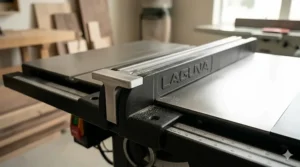
Laguna Fusion vs. Traditional Cabinet Saws: When Does the Upgrade Make Sense?
The question I hear constantly: “Why buy a hybrid when I could save up for a used cabinet saw?” Fair question, and the answer depends entirely on your shop’s electrical infrastructure and your actual cutting needs versus your aspirational “someday I’ll need” scenarios.
Cabinet saws — the $3,000-$6,000 SawStops, Powermatic 66s, and Delta Unisaws of the world — deliver three advantages over hybrids: 3-5 HP motors that never bog down regardless of species or thickness, rock-solid construction weighing 500-800 pounds that makes vibration virtually nonexistent, and prestige that impresses shop visitors (genuine advantage if you’re a pro; irrelevant if you’re a hobbyist).
Those same cabinet saws demand three sacrifices: 240V power (electrician costs $400-$800 for dedicated circuit install if your shop doesn’t already have it), complete immobility once installed (moving a 650-pound saw requires professional riggers), and purchase prices that fund entire hybrid saw setups including premium blades, mobile bases, and outfeed tables.
The Laguna F2 running on 110V delivers 95% of cabinet saw precision for furniture and cabinet work, accepts the same premium blades, and costs $1,900 versus $4,500 for an entry cabinet saw. That $2,600 difference funds a quality jointer, planer, or bandsaw — tools that expand your capabilities far more than the marginal improvement from hybrid to cabinet saw.
Cabinet saws make sense when you’re running a production shop processing hardwoods all day, when you have 240V power already installed, and when saw mobility isn’t required. For the serious hobbyist or small professional shop, the laguna fusion hybrid saw delivers professional results without professional infrastructure demands.
Safety Features That Actually Matter (And Marketing Gimmicks That Don’t)
Every saw brags about safety features, but let’s separate legitimate protection from checkbox compliance. The most important safety element on any table saw is the riving knife — a metal blade positioned directly behind the cutting blade that prevents the kerf from closing and pinching the blade (the primary cause of kickback). All seven saws reviewed include riving knives, but their ease of installation varies dramatically.
The Laguna F2 and Powermatic PM1000 feature tool-less riving knife systems that install in seconds without removing table inserts or fishing for Allen wrenches. This matters because woodworkers who skip installing the riving knife “just for this quick cut” are gambling with serious injury. When safety equipment is genuinely convenient, people actually use it.
Blade guards present a similar usability challenge. The DEWALT DWE7491RS and Powermatic PM1000 guards attach via quick-release mechanisms that encourage proper use; the Grizzly G0771Z guard requires more involved installation that many woodworkers simply skip. If you’re honest about your safety practices (and you should be), choose saws where protection doesn’t require ten minutes of setup.
Push sticks deserve attention too, though these are user-provided rather than saw-integrated. The Occupational Safety and Health Administration (OSHA) mandates push stick use for any rip cut under six inches from blade to fence, and this regulation exists because thousands of woodworkers have learned the hard lesson about keeping hands away from spinning blades. According to OSHA’s woodworking machinery requirements, proper guarding and operator training significantly reduce table saw injuries.
Anti-kickback pawls — those spring-loaded fingers that dig into wood if it tries to move backward — provide additional protection during rip cuts. The Laguna Fusion series integrates these into their riving knife assembly; the Shop Fox W1837 uses a separate anti-kickback device. Neither approach is superior; both work when properly adjusted and maintained.
One feature I consistently recommend against: dado blade capability without proper throat plate support. Several budget saws advertise dado compatibility but don’t include zero-clearance inserts for dado stacks, creating dangerous gaps where workpieces can catch. The Laguna models include purpose-designed dado inserts; budget saws often don’t. If dado work is important to you, verify what’s included before purchasing.
Long-Term Cost Analysis: Why Initial Price Tells Only Part of the Story
Let’s run real numbers on hybrid saw ownership over a decade, because the sticker price represents maybe 60% of your total investment. Consider the Laguna F2 at $1,900 versus the Grizzly G0771Z at $1,350 — that $550 difference seems significant until you factor in the complete ownership picture.
Laguna F2 (10-Year Ownership):
- Purchase price: $1,900
- Premium blade package (purchased once, two replacements): $350
- Dust collection hose and fittings (purchased once): $75
- Mobile base (optional): $200
- Throat plate replacements (three over decade): $90
- Maintenance (belt replacement, yearly table wax): $120
- Total: $2,735 ($273/year)
Grizzly G0771Z (10-Year Ownership):
- Purchase price: $1,350
- Cast iron table wings (Grizzly requires separate purchase): $275
- Standard blade package (purchased once, two replacements): $280
- Dust collection hose and fittings: $75
- Mobile base (required for mobility): $150
- Throat plate replacements: $90
- Maintenance: $120
- Fence upgrade at year 5 (many users report this): $300
- Total: $2,640 ($264/year)
Suddenly that $550 purchase price delta shrinks to $95 over ten years — less than $10 annually. The Laguna F2’s included features (better fence, superior throat plates, integrated DRO) eliminate upgrade costs that Grizzly owners often incur. This isn’t criticism of Grizzly — their strategy of letting users customize makes sense for certain buyers. It’s simply understanding total cost of ownership.
The Powermatic PM1000’s five-year warranty factors into this calculation differently. While the $2,300 purchase price exceeds all competitors except the Laguna F3, that warranty means zero out-of-pocket repair costs during the period when most equipment failures occur (years 2-5). Budget saws with one-year warranties leave you exposed to expensive motor replacements or trunnion rebuilds right when the saw is out of warranty but not yet paid off psychologically.
Premium blade costs deserve consideration too. All these saws accept standard 10-inch blades with 5/8-inch arbors, but the precision-ground tables on Laguna and Powermatic saws reward you for using premium blades ($80-$150) rather than big-box blades ($30-$50). The improved cut quality, longer life between sharpenings, and reduced vibration justify the investment — but only if your saw is accurate enough to benefit from blade precision.
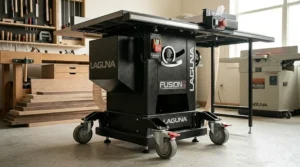
FAQ: Your Laguna Fusion Hybrid Saw Questions Answered
❓ Can a laguna fusion hybrid saw handle hardwoods like oak and maple for furniture building?
❓ Do I need 240V power to run a hybrid table saw effectively?
❓ How does hybrid saw dust collection compare to cabinet saws?
❓ What's the minimum shop size needed for a hybrid table saw setup?
❓ Can hybrid saws handle dado blade stacks for joinery work?
Conclusion: Choosing Your Perfect Laguna Fusion Hybrid Saw Match
After examining seven of the market’s finest hybrid saws through the lens of real-world workshop demands, three models emerge as category leaders for distinct user profiles. The laguna fusion hybrid saw F2 delivers the sweet spot of precision and practicality for serious woodworkers ready to invest in tools that respect their commitment to quality. That DRO blade tilt indicator and 36-inch rip capacity justify every dollar in the $1,800-$2,100 range for furniture makers and cabinetmakers who measure success in thousandths of an inch.
Budget-conscious woodworkers building dedicated shop spaces should seriously consider the Grizzly G0771Z at $1,300-$1,500. Yes, you’re sacrificing some refinement and the premium warranty, but you’re gaining legitimate hybrid saw architecture with cabinet-mounted trunnions and a fence system that outperforms saws costing twice as much. Add cast iron wings and a mobile base to your initial purchase, and you’ve created a workshop centerpiece that will serve faithfully for decades.
For small shop professionals juggling space constraints and varied project demands, the Shop Fox W1837 solves the mobility challenge without compromising precision. That integrated wheelbase eliminates the $200 mobile base purchase and the constant frustration of wrestling a 300-pound saw around your workspace. At $1,500-$1,700, you’re investing in workflow efficiency that pays dividends every single time you need to reconfigure your shop for a large assembly or client visit.
The common thread connecting all three recommendations: cabinet-mounted trunnions, precision-ground cast iron tables, and fence systems designed for repeatable accuracy rather than checkbox compliance. Whether you choose Laguna’s Italian precision engineering, Grizzly’s value-focused pragmatism, or Shop Fox’s mobility-integrated design, you’re selecting tools that enable better work rather than simply completing tasks.
Your saw choice ultimately reflects your workshop philosophy. If you believe tools should serve your vision without compromise, the Laguna F2 delivers that promise. If you’re building a dedicated space where the saw becomes a permanent precision instrument, the Grizzly G0771Z provides that foundation. If you need versatility and adaptability in a dynamic workspace, the Shop Fox W1837 solves problems before they arise.
The worst decision isn’t choosing between these excellent options — it’s deferring your purchase while continuing to fight inadequate equipment. Every project completed on a contractor saw fighting alignment drift represents compromise built into your work. Upgrade to a true hybrid, and experience woodworking where your skill is the limiting factor, not your tools.
Recommended for You
- 7 Best Shop Fox Hybrid Table Saw Models to Buy in 2026
- 7 Best Grizzly Hybrid Table Saw Models 2026 (Direct Sale)
- 7 Best Hybrid Table Saw Under 2000 – 2026
Disclaimer: This article contains affiliate links. As an Amazon Associate, I earn from qualifying purchases. If you purchase products through these links, we may earn a small commission at no additional cost to you.
✨ Found this helpful? Share it with your friends! 💬🤗
