In This Article
Rip a 3/8″ strip off a board with your bare hand hovering six inches from a spinning blade, and you’ll understand exactly why this push block system for narrow rip cuts review exists. Narrow rips are the single most nerve-wracking cut on a table saw. The offcut is skinny, the blade guard usually gets in the way, and your fingers end up closer to the danger zone than on any other cut you’ll make all week. A push block system for narrow rip cuts is a purpose-built (or purpose-adapted) tool that keeps steady downward, forward, and inward pressure on both the keeper piece and the offcut, so neither one wanders into the blade or gets flung back at you.
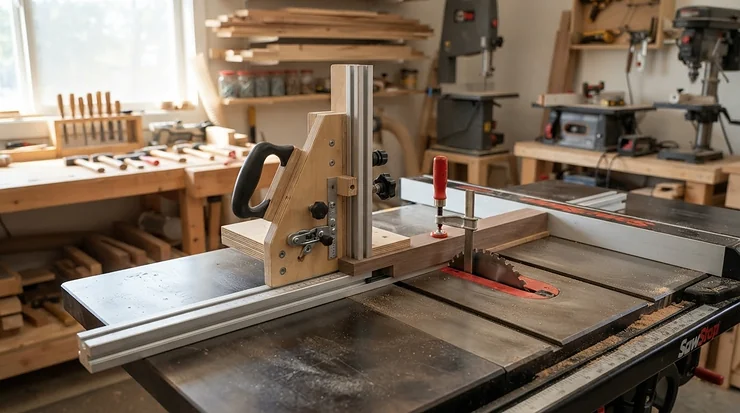
This guide breaks down seven real, currently available push block systems — from a $20 pair of grippy plastic blocks to a fully adjustable 3D pushblock with a dovetail track system — and tells you honestly what each one does well, where it falls short, and who should actually buy it. We pulled specs, manufacturer claims, and aggregated review sentiment from woodworking forums, retailer listings, and long-term user reports, and we’re upfront anywhere the data gets thin. No invented five-star testimonials here. Just what the wood and the reviewers actually say.
What is a push block system for narrow rip cuts? It’s a hand-held or jig-based tool that replaces bare-hand feeding on a table saw when the offcut or keeper piece is too thin to safely guide by hand — typically anything under about 2 inches wide, and especially anything under 3/4″.
Quick Comparison Table
| Product | Best For | Price Range |
|---|---|---|
| MicroJig GRR-RIPPER GR-100 | All-around control on narrow to medium rips | Check current price |
| MicroJig GRR-RIPPER+ GR-100+ | Buyers who want faster, repeatable setup | Check current price |
| MicroJig GRR-Rip Block Smart Hook | Simpler single-block narrow rip use | Check current price |
| Milescraft 3406 GrabberPRO | Multi-tool shops on a mid-range budget | Check current price |
| Rockler D-Handle Narrow Push Block | Dedicated narrow-rip specialists | Around $25 |
| Rockler Thin-Rip Table Saw Jig | Repetitive thin-strip production cuts | $30-$40 range |
| Bench Dog 10-033 Push-Bloc | Budget-conscious buyers, multi-tool use | Around $10 each / $20 pair |
Looking at the table, you’ll notice the price spread runs wide — from a $10 plastic block to a fully adjustable system with an add-on kit. That gap isn’t arbitrary: the cheaper options ask you to supply more hand skill and judgment, while the pricier ones build the safety margin into the mechanism itself. If narrow rips are a once-in-a-while task, the budget end covers you fine; if you’re ripping edge banding or thin trim every week, the extra cost of an adjustable system buys back a lot of risk.
💬 Just one click — help others make better buying decisions too!😊
Top 7 Push Block Systems for Narrow Rip Cuts: Expert Analysis
We picked these seven because each one represents a genuinely different approach to the same problem — bare hands too close to a spinning blade on a thin cut — spanning budget, mid-range, and premium price tiers, plus one jig that skips the “push block” format entirely.
| Product | Min. Rip Width | Multi-Tool Use | Price Range | Best For |
|---|---|---|---|---|
| MicroJig GRR-RIPPER GR-100 | Down to 1/4″ (1/8″ with add-on leg) | Table saw, router table, band saw, jointer | Check current price | Hobbyists ripping narrow stock often |
| MicroJig GRR-RIPPER+ GR-100+ | Down to 1/4″ (1/8″ with add-on leg) | Same as GR-100, plus MatchFit dovetail track | Check current price | Buyers who want faster setup dialing |
| MicroJig GRR-Rip Block Smart Hook | Narrow strips (single-block design) | Table saw, jointer, router table | Check current price | Simpler narrow-rip tasks |
| Milescraft 3406 GrabberPRO | Down to 1/8″ with leg swap | Table saw, router table, band saw, jointer | Check current price | Multi-tool shops wanting flexibility |
| Rockler D-Handle Narrow Push Block | 5/8″ fixed profile | Table saw-focused | Around $25 | Dedicated narrow-rip use |
| Rockler Thin-Rip Table Saw Jig | Down to roughly 1/16″-1/8″ strips | Table saw only (miter-slot jig) | $30-$40 range | Repetitive thin-strip batches |
| Bench Dog 10-033 Push-Bloc | No fixed spec (general push block) | Table saw, jointer, router table, band saw | Around $10 each / $20 pair | Budget multi-tool use |
Pulling the data together, the pattern is clear: adjustable multi-leg systems (MicroJig GRR-RIPPER, MicroJig GRR-RIPPER+, and Milescraft GrabberPRO) win on versatility because you’re swapping a leg rather than swapping tools. The Rockler Thin-Rip Table Saw Jig takes a fundamentally different route — instead of a hand-held pusher, it rides in your miter slot and lets the offcut drop clear of the blade on its own, which some buyers find more foolproof for repetitive work. Fixed-profile options like the Rockler D-Handle Narrow Push Block and Bench Dog 10-033 Push-Bloc trade adjustability for simplicity and a lower price tag.
1. MicroJig GRR-RIPPER GR-100 — adjustable tunnel rips as narrow as 1/4″
The GR-100 built its reputation on one clever idea: a movable center leg that slides sideways between two fixed side legs, opening a “tunnel” for the sawblade to pass through while both legs keep downward pressure on the wood. On narrow stock, an independent Fine Woodworking test found the tool’s sole stays in contact on both sides of the cut line as it works, meaning the offcut gets carried safely past the blade instead of getting flung.
Specs-wise, you get a pair of fixed side legs (roughly 1/2″ and 1″ wide), an adjustable center leg, and an optional 1/8″ leg accessory for extreme narrow work. Every foot is coated in MicroJig’s grippy green rubber, which reviewers consistently describe as effective even on rough-sawn lumber. The adjustable handle repositions left or right so your pushing force lines up with wherever the tool is actually gripping — a small detail that matters a lot when you’re applying inward pressure toward the fence at the same time.
Based on the spec comparison against fixed push blocks, the GR-100’s real advantage is that it doesn’t force a compromise between hand safety and cut control on thin rips — most fixed blocks can’t grip a 1/4″ offcut at all, so you end up bare-handing the last few inches. Reviewers who’ve used it for years, including several woodworking forum contributors, single it out specifically for narrow, repeated cuts like edge banding or thin trim strips. The same independent test flagged a real trade-off worth knowing about upfront: on narrow stock, the tool sometimes bumped into the blade guard during the review, which means you may need to remove or adjust your guard for the narrowest cuts — something to weigh against your particular saw’s guard design.
Pros:
- ✅ Adjustable tunnel handles rips down to 1/4″, 1/8″ with add-on leg
- ✅ Grippy rubber pads hold securely even on rough lumber
- ✅ Works across table saw, router table, band saw, and jointer
Cons:
- ❌ Can interfere with stock blade guards on the narrowest cuts
- ❌ Takes practice to dial in leg spacing quickly and consistently
The GR-100 sits at a premium price point relative to basic push blocks — check current price before buying — but for anyone ripping narrow stock on a regular basis, the versatility across four different tools tends to justify the cost over time.
2. MicroJig GRR-RIPPER+ GR-100+ — SafeRip indicators for faster narrow-rip setup
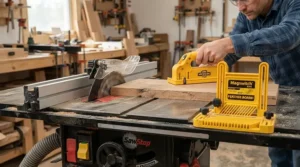
The GR-100+ starts from the same tunnel-leg design as the original GR-100 and adds the SafeRip Kit: two transparent orange indicators that clip onto the adjustable center leg so you can see exactly where your cut line will fall before you make a single test pass. According to the manufacturer, the GR-100+ applies downward, inward, and forward pressure to keep both sides of the cut running parallel to the blade — the same core mechanism as the standard model. The “+” is really about setup speed and precision, not a different way of gripping the wood.
That’s a meaningful upgrade if you’re not naturally patient with test cuts. Instead of nibbling toward your target width with a series of trial rips, the transparent indicators let you eyeball the blade-to-leg distance directly, which shaves real time off repetitive narrow-strip jobs. The GR-100+ also adds compatibility with MicroJig’s MatchFit dovetail track accessories, letting you build custom hold-down points into your saw table over time.
What most buyers overlook about the “+” version is that it’s an efficiency upgrade, not a safety upgrade over the base GR-100 — both models rely on the identical tunnel-leg mechanism for kickback resistance. If your narrow rips are occasional, the base model does the same protective job for less money. If you’re setting up narrow-rip cuts multiple times a week, the time saved on setup adds up fast enough to justify the premium.
Pros:
- ✅ Transparent SafeRip indicators speed up cut-width setup
- ✅ MatchFit dovetail track compatibility for custom hold-downs
- ✅ Same proven downward-inward-forward pressure as the GR-100
Cons:
- ❌ Premium price for what is largely a setup-speed upgrade
- ❌ Extra indicator parts add one more small piece to track
Check current price for the GR-100+ bundle, since it typically runs above the standard GR-100 given the added SafeRip Kit hardware — worth it mainly if setup time is a real bottleneck in your shop.
3. MicroJig GRR-Rip Block Smart Hook — auto-drop hooks grip the trailing end for you
Where the GR-100 and GR-100+ use a three-leg tunnel system, the GRR-Rip Block Smart Hook takes a simpler single-block approach aimed at everyday narrow cuts on the table saw, jointer, and router table. Its standout feature is a pair of spring-loaded “smart hooks” positioned at each end of the block. According to one detailed product review, the hooks automatically drop down to grip the tail end of a board for extra control, then retract on their own when you press down in the board’s center.
That auto-drop behavior solves a specific narrow-rip problem: most conventional push blocks give you plenty of downward grip but nothing to stop the trailing end of a short or thin offcut from sliding sideways as it clears the blade. The Smart Hook’s design means you don’t have to consciously reposition your hand to catch the tail of the board — it happens automatically as you push through the cut.
Reviewers researching the broader push-block category tend to position the Smart Hook as a lighter-duty, single-purpose alternative to the full GR-100 tunnel system — less adjustable, but also less to learn. If your narrow rips are mostly consistent in size rather than constantly changing widths, that simplicity is a genuine advantage rather than a compromise.
Pros:
- ✅ Auto-drop smart hooks grip the board’s trailing end hands-free
- ✅ Simpler single-block design with a shorter learning curve
- ✅ Rated for table saw, jointer, and router table use
Cons:
- ❌ Less width-adjustable than the full tunnel-leg GRR-Ripper systems
- ❌ Limited independently verified long-term review data available
Check current price for the Smart Hook — it’s generally positioned below the full 3D pushblock systems, making it a reasonable entry point into MicroJig’s ecosystem without the higher spend.
4. Milescraft 3406 GrabberPRO — four interchangeable legs for dialed-in narrow rips
The GrabberPRO takes direct aim at the same problem the GRR-Ripper solves, using a comparable interchangeable-leg concept at a different price tier. It ships with four legs — 1″, 1/2″, 1/4″, and 1/8″ — that swap in and out depending on how narrow your rip needs to be, and the whole assembly rides on a diamond-pattern TPE rubber base that Milescraft and multiple reviewers describe as non-marring and non-slip.
The inward, downward, and forward pressure provide superior control all the way through the cut, keeping you and your fingers protected, according to the manufacturer, and the tilted ergonomic handle is designed to keep your wrist in a natural position rather than forcing an awkward reach. One independently useful detail: the adjustable heel at the back of the block can be lowered for extra control on tall or narrow boards, which matters more than it sounds like on stock that wants to tip sideways mid-cut.
Here’s what to weigh against the GRR-Ripper comparison: one long-term user reported that while the GrabberPRO is their go-to for most jobs, there are a few things I can do with my Grr-ripper that I can’t do with the GrabberPRO, like using the adjustable side support to keep the wood pushed against the fence and cutting very thin rips, but still called it a “good, solid build” and their default first pick for daily use. That’s a useful, honest data point — the GrabberPRO covers most narrow-rip situations well, but the absolute thinnest, most demanding rips may still favor the pricier tunnel-leg system.
Pros:
- ✅ Four swappable legs cover rips from 1″ down to 1/8″
- ✅ Diamond-grip TPE base is non-marring and non-slip
- ✅ Adjustable heel adds control on tall, narrow boards
Cons:
- ❌ Lacks a dedicated fence-side support for the very thinnest rips
- ❌ Assembly and leg-swapping required before first real use
Check current price on the GrabberPRO — it generally lands well under the premium GRR-Ripper tier while still covering the vast majority of narrow-rip and multi-tool tasks most home shops need.
5. Rockler D-Handle Narrow Push Block — purpose-built 5/8″ profile with a spring-loaded tailhook
Where the previous three products try to do everything, the D-Handle Narrow Push Block does one thing on purpose: narrow rip cuts on the table saw, and nothing else. On its business end, it features a slender 5/8″ width, 11″ of footprint a grippy rubber bottom. A spring-loaded tailhook extends about 5/16″ below the bottom when fully deployed, to wrap effectively around the back end of workpieces.
That narrow 5/8″ profile is the entire point — it’s slim enough to ride along the fence side of a thin rip without the bulk that trips up wider general-purpose push blocks. The spring-loaded tailhook is a smart addition for narrow work specifically, since it automatically catches the trailing edge of the board without you needing a second hand or attachment. Rockler also ships it with a steel storage dock that mounts to your rip fence with screws (or magnets, sold separately), which sounds minor but genuinely helps — a push block you can’t find quickly is a push block you skip using.
Based on the spec sheet, the trade-off here is obvious and honest: this tool does narrow rips extremely well and essentially nothing else. It’s not going to help you on a router table edge profile or a band saw resaw the way the multi-tool options above can. For a shop that already owns a general push block or push stick for everything else, adding this one specifically for narrow rips is a low-cost way to close a real safety gap.
Pros:
- ✅ Slim 5/8″ profile purpose-built for narrow rip clearance
- ✅ Spring-loaded tailhook automatically wraps the board’s trailing end
- ✅ Includes steel storage dock for quick fence-mounted access
Cons:
- ❌ Fixed profile — no leg-swapping for other cut widths
- ❌ Table saw-focused, less useful on router tables or band saws
At around $25, this is one of the more affordable dedicated narrow-rip tools on this list, and the price-to-purpose ratio is hard to argue with if narrow rips are a recurring headache in your shop.
6. Rockler Thin-Rip Table Saw Jig — a miter-slot jig that skips the push block entirely
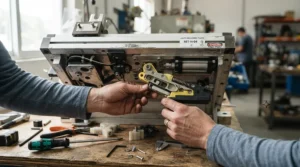
This one breaks the pattern. Instead of a hand-held pusher, the Thin-Rip Table Saw Jig rides in your saw’s miter slot and uses a hairline cursor and adjustable stop to set an exact strip width — then you feed the board along the jig’s guide rather than freehanding the offcut past the blade. Our full-featured Thin-Rip Table Saw Jig will help you cut thin strips from the edge of a wider board so the offcuts fall away safely from the blade on the left side rather than becoming potentially trapped between the blade and rip fence.
That “offcuts fall away” detail is the real safety story here. One of the nastiest narrow-rip failure modes is a thin offcut getting pinched between the spinning blade and the fence, which is a classic kickback setup. By design, the jig routes the waste piece clear of that pinch zone entirely, which is a fundamentally different safety strategy than a push block’s grip-and-control approach — it removes the hazard geometry instead of managing it.
Long-term users on woodworking forums are candid about the learning curve: I have seen the complaint that the scale is not numbered, but IMO that is not a problem since all you have to do is set the tip to the blade edge, then back it off 1/16″ or 1/8″ or 3/16″ or whatever the desired rip thickness is, and most report it becomes second nature after a few uses. Another reviewer flagged a real caution worth repeating: when I placed it any closer than that, I was getting burning on the keeper piece due to the jig pushing the piece back against the blade, and I think it drastically increases the chance of pinching the blade and kicking the piece back — so correct positioning per the manual matters more with this jig than with a simple push block.
Pros:
- ✅ Routes thin offcuts clear of the blade-fence pinch zone
- ✅ Repeatable width settings speed up batch strip production
- ✅ Fits standard 3/4″ x 3/8″ miter slots on most saws
Cons:
- ❌ Unnumbered tick-mark scale takes a few cuts to learn
- ❌ Misposition near the blade can cause burning per user reports
In the $30-$40 range, this jig is the pick for anyone who rips the same thin strip repeatedly — shelf edging, screen mold, bent laminations — rather than occasional one-off narrow cuts.
7. Bench Dog 10-033 Push-Bloc — the rugged, budget classic sold in pairs
The Push-Bloc is the simplest tool on this list by design: a rigid plastic block with a thick neoprene grip pad on the bottom and a molded handle on top, sold in pairs so you can control both the keeper piece and the offcut simultaneously. There’s no adjustable leg, no tunnel, no spring-loaded hook — just grip and control through sheer build quality. One long-term owner summed it up plainly: I really like how thick the handle is because I have fairly large hands. All in all, there’s no moving parts here, so it’s hard to find any faults with them.
That “no moving parts” simplicity is genuinely part of the appeal for narrow rip work — there’s nothing to misadjust mid-cut, and the thick neoprene pad grips rough-sawn stock reliably. The grippy material on the bottom is soft and rubbery, kind of like an older-style thick premium quality mouse pad, which multiple reviewers cite as noticeably better than the thin foam pads found on cheaper generic push blocks.
Honest caveat worth including: even people who own and like the Push-Bloc admit its limits on the table saw specifically. One long-term reviewer put it directly — I do not like them at all for use on the table saw – where I find the Grripper much better — while still finding them excellent for jointer and router table work. That’s a useful, unvarnished data point: for the very narrowest table saw rips, a fixed-shape block without a tunnel or hook simply can’t match a purpose-built narrow-rip tool, but for general multi-tool push duty at a low price, it holds up well.
Pros:
- ✅ Substantial rigid build with a thick neoprene grip pad
- ✅ Inexpensive enough to buy several pairs for different stations
- ✅ Works well across jointer, router table, and band saw
Cons:
- ❌ No adjustable tunnel or leg system for controlled narrow cuts
- ❌ Some long-term owners prefer dedicated tools for the thinnest table saw rips
At around $10 each or $20 for a pair, this is the lowest-cost entry point on this list — a smart pickup even for shops that own a premium system, just to have a spare pair on hand.
Practical Usage Guide: Setting Up Your Push Block for Narrow Rip Cuts
Buying the right tool is half the job — setup is the other half, and it’s the half most Amazon listings skip entirely. Before your first cut, dry-fit the push block against your rip fence with the saw unplugged. Adjust the leg (or the jig’s cursor, if you’re using the Thin-Rip jig) so it lines up exactly with your intended cut width, then run your hand along the full travel path to confirm nothing catches on your fence, miter gauge, or blade guard housing.
For narrow-leg systems like the GRR-Ripper or GrabberPRO, a common first-30-days mistake is over-tightening the center leg’s lock knob, which can warp the plastic housing over repeated use — snug is enough, cranked-down isn’t necessary. Another frequent early error: starting the cut with the push block already touching the blade guard, rather than a few inches back, which is exactly the interference issue flagged in independent GR-100 testing. Start your push behind the guard’s leading edge and let the tool’s momentum carry you smoothly through.
Maintenance is minimal but matters. Rubber and neoprene pads pick up sawdust and pitch over time, which quietly reduces grip exactly when you need it most on a thin, wobbly offcut. Wipe pads down monthly with a damp cloth, and inspect spring-loaded hooks or tailhooks for grit buildup that can slow their drop-and-release action. For jig-style tools like the Thin-Rip jig, a light coat of dry lubricant on the miter-slot bar keeps the slide smooth and prevents the sticking that leads reviewers to report burning on the keeper piece.
Real-World Scenarios: Matching a Push Block System to Your Shop
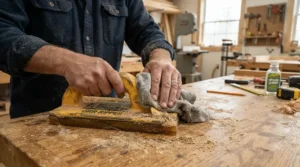
Consider a weekend furniture builder ripping 1/4″ edge banding for a set of built-in shelves, working in a two-car garage shop with a contractor saw. Budget is a factor, and the work is occasional rather than constant. A Rockler D-Handle Narrow Push Block paired with the fence-mounted storage dock is a sensible fit here — it’s purpose-built for exactly this width, costs around $25, and doesn’t demand learning a multi-leg adjustment system for a task done a few times a month.
Now picture a small cabinet shop producing batches of matching trim strips for kitchen installs — the same 3/16″ width, cut dozens of times a week. Here, the calculation flips: the Rockler Thin-Rip Table Saw Jig earns its keep through repeatability, since once the width is dialed in, every subsequent cut is identical without re-measuring, and the offcut routes safely clear of the fence every time.
Finally, think about a serious hobbyist with a well-equipped shop who moves between a table saw, router table, and band saw on the same project — say, building a set of dovetailed boxes with narrow inlay strips. That’s the profile the MicroJig GRR-RIPPER GR-100 was designed around: one tool, four machines, and a tunnel-leg system flexible enough to handle everything from a 1/4″ inlay strip to a wider panel edge, justifying its higher price through sheer versatility rather than single-task specialization.
Problem → Solution: Fixing Common Narrow Rip Cut Headaches
Problem: The offcut wobbles and drifts away from the fence mid-cut. This usually means your push block’s contact point is too far ahead of or behind the actual pressure needed. Reposition an adjustable handle (like the GRR-Ripper’s) closer to where the leg is gripping, or, with a fixed block like the Bench Dog Push-Bloc, apply pressure closer to the leading edge of the offcut rather than the trailing end.
Problem: The push block won’t clear my blade guard on a narrow rip. This is the exact issue independently reported with the GR-100 on narrow cuts. Some saws’ aftermarket or factory guards can be raised or temporarily swapped for a riving-knife-only setup that still satisfies the anti-kickback function without blocking your pushblock’s leg travel — check your saw’s manual before removing any guard component.
Problem: The offcut gets trapped between the blade and the fence. This is the classic narrow-rip kickback trigger, and it’s the specific failure mode the Rockler Thin-Rip Table Saw Jig is engineered to eliminate by routing the offcut away from the fence side entirely rather than trying to control it with grip alone.
Problem: Grip pads have gone slick and stopped holding stock securely. Sawdust and pitch buildup are almost always the cause. A denatured-alcohol wipe restores most rubber and neoprene pads to like-new grip; if the pad itself has worn smooth, several manufacturers, including MicroJig, sell replacement leg pads rather than requiring a whole new tool.
Problem: I keep second-guessing whether a cut is “narrow enough” to need a push block instead of my hands. A simple rule of thumb from safety literature: if the offcut or keeper is narrower than about 2 inches, or your fingers would need to pass within 3 inches of the blade to guide it, reach for a push block system every time — no exceptions, no “just this once.”
Detailed Push Block Buying Guide: How to Choose a System for Narrow Rip Cuts
- Start with your minimum rip width, not your maximum. If you regularly need sub-1/4″ strips, adjustable multi-leg systems like the GRR-Ripper or GrabberPRO earn their price; if 1/2″ is your practical floor, a fixed-profile block saves money without sacrificing capability.
- Count how many tools you actually use it on. A block rated for table saw, router table, band saw, and jointer only pays off its versatility premium if you genuinely rotate between those machines — a table-saw-only shop doesn’t need to pay for that flexibility.
- Factor in your blade guard’s clearance. Independently reported guard interference on narrow cuts means you should dry-fit any prospective push block against your specific saw’s guard before committing, especially on aftermarket guard setups.
- Weigh grip material against your typical stock. Rough-sawn or resinous lumber benefits from thicker, more aggressive rubber or neoprene pads; smooth pre-surfaced stock is more forgiving of thinner grip material.
- Decide between a hand-held block and a miter-slot jig. If your narrow rips are repetitive and identical, a jig like the Thin-Rip removes the offcut-pinch hazard structurally; if your rip widths vary project to project, a hand-held adjustable block adapts faster.
- Budget for at least one spare pair of basic blocks. Even shops with a premium system benefit from keeping an inexpensive pair like the Bench Dog Push-Bloc on hand for quick jointer or router table tasks that don’t need the full system.
- Read the fine print on accessory kits before assuming they’re required. The GRR-RIPPER+’s SafeRip Kit is a genuine convenience upgrade, not a safety requirement — the base GR-100 provides the same core kickback protection at a lower price.
Push Block Performance Comparison: Table Saw vs Router Table vs Band Saw
Not every push block system performs identically across every tool, and that’s a detail Amazon listings routinely gloss over. On the table saw, the deciding factor is almost always narrow-tunnel or fixed-profile clearance — this is where the GRR-Ripper’s adjustable leg and the D-Handle’s slim 5/8″ body both shine, since the blade is exposed and close to the fence.
On a router table, the priority shifts toward lateral stability against a bit rather than a blade, and simpler fixed blocks like the Bench Dog Push-Bloc perform just as well as the pricier adjustable systems, since there’s no narrow tunnel geometry to worry about — you’re mainly guarding against the bit grabbing and pulling stock sideways. On a band saw, kickback risk drops substantially since band saw blades don’t have the same “throw the workpiece back at you” failure mode as a table saw, which is why several of these tools — including the Milescraft GrabberPRO — are rated for band saw use as a secondary, lower-stakes application rather than their primary design target.
The practical takeaway: if you only own one machine, weight your buying decision heavily toward that machine’s specific hazard pattern rather than the tool’s broadest “works on everything” marketing claim.
Narrow Offcut Kickback Risk: What the Data Says
Kickback isn’t a minor inconvenience — it’s a leading cause of serious table saw injuries, and narrow offcuts are disproportionately involved. Federal data on the scope of the problem is sobering: an estimated 23,800 injuries (35.5%) occurred as a result of kickback of the material, according to a Consumer Product Safety Commission review of emergency-room-treated table saw injuries. Of those kickback-related injuries, lacerations were the most frequent (61.2%) form of injury followed by amputations (15.6%), fractures (14.2%), and avulsions (6.5%) — a stark reminder that “just be careful” isn’t a substitute for a mechanical safeguard.
Narrow offcuts specifically raise kickback risk because they’re light enough to lift or twist under blade contact, and thin enough to wedge into the small gap between the spinning blade and the rip fence — the exact pinch scenario the Rockler Thin-Rip jig is designed to route around. A push block’s job in this scenario is to maintain constant downward and forward pressure on a piece that has almost no mass of its own to resist being thrown, which is precisely why the multi-leg tunnel designs on this list emphasize continuous ground contact rather than a single grab-and-push motion.
For anyone who wants the full regulatory picture, the underlying Survey of Injuries Involving Stationary Saws from CPSC breaks down blade-contact and kickback patterns in detail and is worth a read for anyone setting up shop safety protocols.
If narrow rip cuts have caused a close call in your own shop, that’s a strong signal to add a dedicated push block system before your next project — not after.
Push Block Materials: What They’re Made Of and Why It Matters
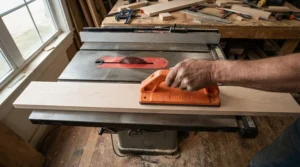
Grip material is the single most overlooked spec on any push block, and it deserves the same scrutiny you’d give a blade’s tooth count. Most premium systems, including the MicroJig line, use a proprietary textured rubber compound bonded to a rigid plastic or composite body — the rubber flexes slightly to conform to rough-sawn surfaces while the rigid core keeps the tool from deforming under downward pressure. Milescraft’s GrabberPRO uses a diamond-pattern TPE (thermoplastic elastomer) base, which reviewers describe as non-marring, meaning it won’t leave rubber residue or dent softer woods like pine or poplar the way some harder compounds can.
Budget options like the Bench Dog Push-Bloc rely on a thick neoprene pad bonded to stiffer ABS-style plastic — less refined than the multi-material builds above it, but genuinely effective, and cheap enough to replace outright rather than re-pad when it wears out. The body material matters too: rigid plastic bodies resist warping under repeated clamping pressure better than thinner, flexible plastics, which is part of why long-term owners of the heavier-bodied tools on this list report fewer fit issues after years of use than owners of ultra-lightweight generic blocks.
One practical buying tip: if you work with a lot of resinous softwood like pine or fir, prioritize a smoother rubber compound over an aggressive diamond-tread pattern — sap buildup clogs deep tread grooves faster than it fouls a smoother surface, and a clogged grip pad is a grip pad that’s quietly stopped protecting you.
Long-Term Durability: What Breaks First
Across the products on this list, the failure points cluster around a few predictable spots rather than being random. Adjustable leg-lock mechanisms — the knobs or levers that clamp a center leg in place on systems like the GRR-Ripper and GrabberPRO — take the most repeated mechanical stress and are the first thing to develop play or slip after heavy years-long use, based on aggregated long-term owner reports. Spring-loaded components, like the D-Handle Narrow Push Block’s tailhook or the GRR-Rip Block’s smart hooks, are the second most common wear point, since the spring itself can weaken gradually with thousands of drop-and-retract cycles.
Grip pads wear more predictably and are, fortunately, the cheapest thing to address — most manufacturers, including Rockler and MicroJig, sell replacement pads separately rather than forcing a full tool replacement. Fixed, simple designs like the Bench Dog Push-Bloc have almost nothing to fail mechanically, which is part of why one long-term owner specifically bought my two Push Bloc blocks nearly three years ago and would definitely buy them again — with no moving parts, there’s simply less to go wrong.
| Product | Price Tier | Long-Term Value Verdict |
|---|---|---|
| MicroJig GRR-RIPPER GR-100 | Premium | High — versatility across four tools spreads out the cost |
| MicroJig GRR-RIPPER+ GR-100+ | Premium+ | Good — worth it if setup speed matters to your workflow |
| MicroJig GRR-Rip Block Smart Hook | Mid | Solid — simpler mechanism, fewer parts to wear out |
| Milescraft 3406 GrabberPRO | Mid | High — near-GRR-Ripper capability at a lower entry cost |
| Rockler D-Handle Narrow Push Block | Budget-mid | Strong — narrow specialization justifies its low price |
| Rockler Thin-Rip Table Saw Jig | Mid | High for repetitive work, lower for occasional use |
| Bench Dog 10-033 Push-Bloc | Budget | Excellent — few moving parts, replace cheaply if needed |
Reading across the value column, the clearest pattern is that price tier and long-term value don’t move in lockstep — the budget Bench Dog blocks score just as well on durability as the premium GRR-Ripper, simply because they have almost nothing mechanical to fail in the first place. Where the premium tools earn their keep isn’t durability so much as capability: narrower minimum widths, multi-tool flexibility, and faster repeat setups that a simple fixed block can’t match regardless of how well it’s built.
Common Mistakes When Buying a Push Block System
The single most common mistake is buying based on the widest cut capacity a block advertises, when the number that actually matters for this use case is the narrowest cut it can safely handle — plenty of general-purpose push blocks handle a 3-inch rip beautifully and become useless, or actively dangerous, on a 1/4-inch strip. A close second is skipping the blade-guard clearance check before purchase; the independently reported GR-100 guard interference issue shows that even a well-reviewed tool can have real fit problems on a specific saw’s guard setup.
Buyers also frequently underestimate how much a spring-loaded tailhook or smart hook actually matters until they don’t have one — without it, your free hand ends up doing the trailing-end control job that the hook could have automated, which defeats part of the purpose. Finally, don’t assume a higher price automatically means a safer tool for your specific saw; the Rockler Thin-Rip jig, at a fraction of the GRR-RIPPER+’s cost, arguably addresses the blade-fence pinch hazard more directly for repetitive thin-strip work, simply through a different mechanical approach.
Push Block Systems vs. Traditional Push Sticks
| Factor | Push Block System | Traditional Push Stick |
|---|---|---|
| Contact area on stock | Broad, multi-point grip | Small notch, single contact point |
| Narrow rip control | Strong — many models grip both sides of cut | Weak — limited surface contact on thin offcuts |
| Learning curve | Moderate for adjustable systems | Low, but limited protection |
| Multi-tool versatility | High on most models | High, but minimal control benefit |
| Typical cost | $10-$120+ depending on model | $5-$15 |
The table makes the trade-off plain: a push stick is cheap and better than bare hands, but its single narrow contact notch simply can’t apply the broad, distributed downward pressure that keeps a thin offcut from lifting or twisting mid-cut. Push block systems cost more precisely because that extra material and mechanical complexity — legs, hooks, tunnels — is what converts “better than nothing” into genuinely reliable narrow-rip control. For occasional wide rips, a push stick remains perfectly adequate; for narrow, repeated cuts, the extra investment in a dedicated push block system is where the real safety margin lives.
Safety, Regulations, and Compliance Guide
Table saw safety isn’t just a best-practice suggestion — it’s federally regulated in workplace settings. The OSHA regulations require that table saws in the workplace include a blade guard, a spreader, and an anti-kickback device, and separately mandate that push sticks or push blocks must be provided at the workplace for guiding or pushing material past the blade. You can review the full regulation directly at OSHA 29 CFR 1910.213 if you’re setting up a shop that needs to meet workplace compliance standards.
Home shops aren’t bound by OSHA, but the underlying hazard data doesn’t change based on whether you’re a hobbyist or a professional — a blade doesn’t know the difference. The practical compliance checklist for narrow rip work is straightforward: keep your riving knife or splitter installed whenever possible, maintain a functioning blade guard except where a specific narrow-cut task genuinely requires temporary removal, and use a dedicated push block or push stick for any cut where your hand would otherwise pass within a few inches of the blade. For a broader definition of the hazard mechanism itself, the Wikipedia entry on kickback in woodworking offers a useful plain-language overview of how and why kickback events occur.
Frequently Asked Questions
❓ What is a push block system for narrow rip cuts?
❓ How narrow can a push block system safely rip?
❓ Are push block systems better than push sticks for kickback prevention?
❓ Do I need different legs or attachments for different rip widths?
❓ Can push block systems be used on router tables and band saws too?
Conclusion
If there’s one honest takeaway from this push block system for narrow rip cuts review, it’s that there’s no single “best” answer — there’s a best answer for your specific saw, your specific stock widths, and how often you’re actually making these cuts. The MicroJig GRR-RIPPER GR-100 and GRR-RIPPER+ GR-100+ earn their premium price through genuine multi-tool versatility and a proven tunnel-leg mechanism, while the Milescraft 3406 GrabberPRO delivers most of that same capability at a friendlier price point. If narrow rips are your only real pain point, the Rockler D-Handle Narrow Push Block targets that exact problem without asking you to pay for features you won’t use, and the Rockler Thin-Rip Table Saw Jig solves the underlying pinch-zone hazard structurally rather than through grip alone. And if budget is the deciding factor, a pair of Bench Dog 10-033 Push-Bloc blocks remains a genuinely solid, low-risk starting point.
Whichever system you land on, the data is unambiguous about one thing: narrow rip cuts are disproportionately involved in kickback injuries, and a dedicated push block system is one of the cheapest, most effective safeguards available for a hazard that’s otherwise entirely preventable. Don’t wait for a close call to make the upgrade.
✨ Ready to rip narrower and safer? Compare your top pick above and check current pricing before your next cut! 💬🤗
Recommended for You
- 3D Push Block System for Ripping Thin Stock: 7 Safer Picks for 2026
- Magnetic Push Stick Holder for Table Saws: 7 Picks That Work (2026)
- 7 Best Magnetic Push Sticks for Table Saw Storage in 2026
Disclaimer: This article contains affiliate links. As an Amazon Associate, I earn from qualifying purchases. If you purchase products through these links, we may earn a small commission at no additional cost to you.
✨ Found this helpful? Share it with your friends! 💬🤗
