
In This Article
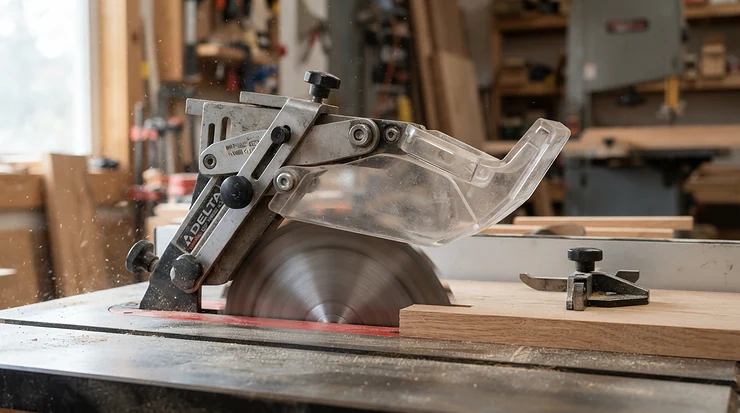
A table saw doesn’t hand out second chances. One second a board glides along the fence. The next, the rear of the blade grabs it and fires it back toward your belt buckle like a very angry javelin. A well-chosen roller system for kickback prevention on table saws can’t repeal physics. It does something humbler and more useful: it keeps stock pinned against the fence and table, and it refuses to let that stock travel backward.

The stakes are not abstract. Fine Woodworking, reporting on Consumer Product Safety Commission figures, put table saw injuries at an average of roughly 36,400 a year between 2001 and 2008. The agency’s own 2019 table saw update is still digging through injury data to see whether newer safeguards are working. Meanwhile, kickback keeps showing up in woodworking safety writing as a leading trigger for hand injuries.
This guide covers seven real, currently listed roller-based products, from budget bearing guides to premium dial-set units. Each one is judged on what its specs mean at the fence, not on how the marketing reads. A quick honesty note: everything here comes from spec-sheet analysis and aggregated reviewer commentary from woodworking publications, forums, and retailer listings. It is not a bench test. Where verified reviews were thin, we say so.
You’ll also get a clear explanation of the one way roller feed system, how one-way bearing rollers respect feed direction, kickback roller installation options, and what roller wear replacement really involves. Prices appear as ranges only, because they move constantly.
Quick Comparison: 7 Roller-Based Options at a Glance
| Product | Mount Style | Roller Design | Price Range | Best For |
|---|---|---|---|---|
| Compass RG-1 | Miter slot (T-shaped) | Spring-loaded urethane, one-way, dial pressure | Roughly $180-$300 | Daily-use shops |
| JessEm Clear-Cut Stock Guides | Fence/table guide | Precision roller wheels | Premium; check current price | Precision fence work |
| Board Buddies | Fence-mounted carriage | Two spring-loaded one-way urethane rollers | Around $80-$130 | Jobsite saws, long rips |
| POWERTEC 71935 | T-slot fence | One-way bearing roller, adjustable height | Around $50-$65 | Budget all-rounder |
| VXB Pro Grade One-Way Featherboards | Miter slot or T-slot | Spring-loaded one-way bearings, 2-pack | Under $100 | Paired setups |
| JCFANTS Roller Feather Board | 30-type T-slot track | One-way bearing, height-adjustable | Under $30 | Entry-level tinkerers |
| CPAN Double Wheel Stock Roller | Double-slider T-slot | Double wheel, listed as two-way feeding | High $30s | Feed guidance, not reverse-lock |
Looking at the comparison, POWERTEC 71935 and JCFANTS Roller Feather Board deliver the lowest cost of entry for true one-way action. Compass RG-1 and JessEm Clear-Cut Stock Guides sit in the premium lane, where adjustment quality and build matter more than price. The CPAN Double Wheel Stock Roller is the oddball: its listing describes two-way feeding, which means it guides stock but does not lock against backward travel.
💬 Just one click — help others make better buying decisions too!😊
Top 7 Roller Systems for Kickback Prevention on Table Saws: Expert Analysis
1. Compass RG-1 — dial-set pressure that stays put
The standout feature is the pressure dial. You touch the rollers to the workpiece, lock them, then dial in the force. That order is the opposite of fiddly featherboard tuning, and it’s why this unit gets a premium reputation.
The rollers are spring-loaded urethane and turn in one direction only. They mount in a T-shaped miter slot. The single-layer RG-1 can be upgraded to the RG-2, which stacks a second roller pair for taller stock at a modest premium. The guide is also reversible by flipping it over. In practice, spring loading means both rollers bear on the work even if your alignment is a little sloppy, so sloppy setups still hold.
Based on the spec comparison, this suits shops that rip all day and want repeatable settings. A Fine Woodworking reviewer said it worked better than every featherboard he owned, and a commenter running the double-roller version agreed. Both noted it isn’t cheap.
Pros:
- ✅ Dial sets roller pressure precisely and repeatably
- ✅ Spring-loaded rollers forgive imperfect alignment
- ✅ Reversible design adds flexibility across machines
Cons:
- ❌ Premium price compared with most roller guides
- ❌ Needs a T-shaped miter slot to mount
Price range: roughly $180-$300 depending on model and timing. Verdict: serious value if you rip daily, overkill if you rip monthly.
2. JessEm Clear-Cut Stock Guides — pulls stock toward the fence
Most featherboards only press sideways. The headline claim from a LumberJocks reviewer is that these roller guides actively draw the stock into the fence. That’s a different job than simply holding it.
Setup is simple: loosen the large knob, let the wheel drop onto the stock, and retighten. The reviewer even suggested pushing the wheel slightly into the board so friction bites. Forum replies indicate a table-saw-specific set exists, and the same reviewer used the guides on a router table too. Detailed spec data was thin in the sources we found, so check the manufacturer’s current listing for dimensions and fence compatibility before you buy.
On paper, a fence-seeking wheel helps most on long rips where boards drift away from the fence mid-cut. The reviewer’s confidence came from running a six-foot board through and watching it track straight. One forum member asked whether it was worth the cost, which tells you it sits above bargain tier.
Pros:
- ✅ Draws stock toward the fence, not just against it
- ✅ Reviewer praised its construction quality
- ✅ Works across table saw and router table
Cons:
- ❌ Verified review pool is small
- ❌ Knob-and-retighten setup takes a moment
Price range: premium tier; check current price. Verdict: strong for precision work, but confirm specs before ordering.
3. Board Buddies — two one-way rollers on a fence carriage
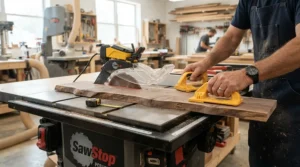
Where others mount in slots, this system clamps onto the fence. Made by Woodstock International, it uses two spring-loaded, single-direction urethane rollers that lock into a fence-mounted carriage. Each roller has its own lift lever, so you can remove stock in either direction.
A Fine Homebuilding review called it sturdy and more than adequate for a jobsite saw, though not industrial grade and not a bargain. The reviewer described letting go of long boards and pulling them through from the outfeed side. Treat that as one reviewer’s habit rather than a recommendation, and follow your saw’s manual. The rear roller keeps short stock pinned after the cut.
Commenters were split. One found it obstructive for custom work and preferred a push block. A Sawmill Creek thread, meanwhile, praised how the one-way rollers stop a board sliding back toward the operator. Forum users also noted a limit: if the rear teeth lift the board off the table, the rollers no longer help.
Pros:
- ✅ Combines hold-down and anti-kickback in one carriage
- ✅ Individual lift levers speed up stock removal
- ✅ Sturdy enough for jobsite saws
Cons:
- ❌ Reported as bulky for detailed custom work
- ❌ Not industrial grade, per the reviewer
Price range: historically around $80, so expect roughly $80-$130 now; check current price. Verdict: solid mid-range for long, repetitive rips.
4. POWERTEC 71935 — the budget one-way roller most shops start with
Its hook is price against function. Retail listings show an adjustable stock guide with a one-way roller, aimed at table saws and router tables, and mounted on a universal T-slot fence.
Two spec points matter. First, adjustable roller height lets you match stock thickness instead of forcing everything to a fixed profile. Second, the listing describes a tilt-angle pulley design meant to deliver straighter, more accurate cuts. In practical terms, a tilted wheel biases the stock toward the fence while it rolls forward, which is exactly what you want for rip accuracy.
Who is it for? Hobbyists with an auxiliary fence that already has T-track, and anyone testing whether roller guides fit their workflow before spending premium money. Be aware that no meaningful aggregated review set turned up in our research, so there’s no sentiment to report. Compare the current listing’s ratings before buying.
Pros:
- ✅ Adjustable roller height suits varied stock thickness
- ✅ One-way action for reverse resistance
- ✅ Standard T-slot mounting on common fences
Cons:
- ❌ Verified reviews weren’t found for this research
- ❌ Needs a T-slot fence or auxiliary fence
Price range: around $50-$65. Verdict: the sensible budget entry point.
5. VXB Pro Grade One-Way Featherboards — a two-pack for paired pressure
The twist here is quantity. It ships as a 2-pack, which makes two-point pressure easy: one guide ahead of the blade, a second where you need extra hold.
The listing describes spring-loaded rollers, one-way bearings that rotate forward and lock in reverse, and CNC-machined anodized aluminum construction. It lists compatibility with 3/4 x 3/8 inch or 3/8 x 1/4 inch slots. That slot flexibility matters: many contractor saws and aftermarket fences use smaller slots, and mismatched hardware is a classic buyer’s regret.
Spring-loaded rollers keep pressure even as the stock thickness varies slightly, which helps with lightly bowed boards. Aluminum bodies also resist the flex that plastic featherboards develop over time. The honest caveat: the retailer listing showed no customer reviews at the time of research, so durability claims are unproven by the buying public.
Pros:
- ✅ Two guides per pack for dual-point pressure
- ✅ Fits two common slot sizes
- ✅ Aluminum construction resists flex
Cons:
- ❌ No customer reviews found on the listing
- ❌ Brand isn’t established in woodworking circles
Price range: under $100. Verdict: reasonable value if you want a pair, but wait for reviews if you’re cautious.
6. JCFANTS Roller Feather Board — cheap, adjustable, and aluminum
What stands out is the price-to-material ratio. Aluminum alloy with an anodized surface at this cost is rare, and it should outlast plastic feathers.
Per the listing, roller height adjusts to match stock thickness, and one-way bearing action is meant to resist rebound. It installs on 30-type T-slot track, and you can swap in other M6-threaded sliders for a T-track or router fence. That swap option is a clever workaround for odd fences.
In practical terms, bearing rollers reduce the drag that makes plastic feathers feel sticky, so stock feeds more smoothly. The caution is the usual one for budget guides: the listing claims are the manufacturer’s, and we found no verified review set. Test the lock direction by hand before trusting it near a spinning blade.
Pros:
- ✅ Anodized aluminum body is durable and light
- ✅ Height adjusts to different stock thicknesses
- ✅ M6 slider swaps broaden fence compatibility
Cons:
- ❌ No verified reviews found
- ❌ Manufacturer claims about rebound are untested here
Price range: under $30. Verdict: a low-risk experiment if you accept the unknowns.
7. CPAN Double Wheel Stock Roller — a feed guide, not a reverse lock
This one earns its spot as a cautionary comparison. Its standout is the double-wheel design on dual sliders, which provides stable, smooth feeding.
The listing describes aluminum alloy with anodized finish, two tilted feed wheels, and adjustable length via nut holes. It also describes two-way feeding. That’s the red flag for anyone shopping specifically for a roller based anti kickback device. A wheel that rolls both ways guides stock beautifully but does nothing to resist backward travel.
So where does it fit? Router tables, bandsaws, and jobs where feed direction control isn’t the point. If you buy it for kickback resistance, you’ve misread the spec sheet. The retailer page showed no ratings, and the item appeared out of stock when checked.
Pros:
- ✅ Double wheels and sliders add stability
- ✅ Length adjusts via nut holes
- ✅ Works across table saws, bandsaws, and router tables
Cons:
- ❌ Two-way feeding means no reverse lock
- ❌ No reviews found; stock availability unreliable
Price range: high $30s. Verdict: skip for kickback prevention; consider only as a guide.
What Is a Roller System for Kickback Prevention on Table Saws?
A roller system for kickback prevention on table saws is a fence- or table-mounted guide that presses stock against the fence or table using spring-loaded rollers. Inside the rollers sit one-way bearings. The wheels spin freely in the feed direction but lock if the workpiece tries to travel backward, helping resist the board being thrown toward the operator.
The concept is old. Patent filings describe roller hold-down devices biased downward to inhibit kickback, and earlier designs used rollers and finger elements to restrain boards. Modern versions simply refine the idea with better bearings and quicker adjustments.
Know the limit, though. Kickback arrives through more than one door. If a board is lifted by the rear of the blade, it leaves the table, and a roller that was only resisting reverse travel on a flat board is no longer the deciding factor. Pinching from internal stress, warped stock, or a misaligned fence also triggers it. That’s why rollers are a supplement to a riving knife and good technique, not a replacement. Think of them as one layer in a stack of defenses.
One Way Roller Feed System: How One-Way Bearing Rollers Control Feed Direction
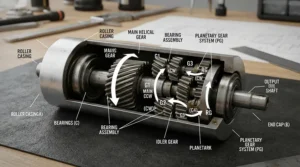
The heart of any one way roller feed system is the bearing. One-way bearing rollers contain a clutch mechanism that lets the wheel rotate freely one way and locks it the other. Feed the board forward and the wheel rolls along happily. Let the board shoot backward and the wheel binds against it.
This is why feed direction is the first thing to verify at installation. The Board Buddies review described rollers that turn clockwise only, and the Compass guide can be flipped to reverse its orientation. Mount any of these backward and you’ve built a brake on the wrong side: the wheels would lock against your forward push and spin freely against a kickback. Test with a scrap board before powering up. Push forward and the stock should glide. Pull back and it should resist.
Two more points matter. Spring tension affects how well the lock bites: too light and the roller skates over the surface, too heavy and you fight the feed. And bearing quality is the quiet differentiator between a premium guide and a bargain one, because the lock mechanism is the part that fails silently. A tilt-angle design, like the one described for the POWERTEC 71935, adds a gentle push toward the fence while you feed, which cuts the temptation to lean on the board.
How to Choose a Roller System for Kickback Prevention on Table Saws
Pick with these six steps, each backed by what the research showed:
- Confirm one-way action. Look for explicit language about locking in reverse. If a listing says two-way feeding, it’s a guide, not a reverse lock.
- Match your mounting. Check whether you have a T-slot fence, a miter slot, or a smooth fence needing a clamp-on carriage. A great guide that won’t mount is a paperweight.
- Check slot dimensions. Standard miter slots are 3/4 x 3/8 inch, but some saws use smaller slots. The VXB Pro Grade One-Way Featherboards list both common sizes.
- Weigh adjustment style. Dial-set pressure (Compass RG-1) is more repeatable than knob-and-retighten (JessEm Clear-Cut Stock Guides), but costs more.
- Consider material. Aluminum bodies and urethane rollers generally outlast plastic.
- Be honest about frequency. Daily rippers should invest. Occasional users can start cheaper.
For deeper context, Fine Woodworking’s review of Compass roller guides explains why a reviewer found roller guides easier to dial in than traditional featherboards. Their comparison is useful even if you buy something else.
Kickback Roller Installation Options: Five Ways to Mount Your Guide
Your fence decides your options. Here are the main kickback roller installation options, with trade-offs.
- Miter-slot mount. Guides like the Compass RG-1 sit in a T-shaped miter slot. It’s fast and removable, and the position is easy to repeat.
- T-slot fence or auxiliary fence. The POWERTEC 71935 targets universal T-slots, and the JCFANTS Roller Feather Board installs on 30-type T-slot track. An auxiliary fence with T-track is a cheap way to give a plain fence the mounting points it lacks.
- Fence-mounted carriage. Board Buddies clamps to the fence on a carriage, which suits jobsite saws without T-slots.
- Hybrid with M6 sliders. The JCFANTS Roller Feather Board lists M6-thread slider swaps, handy for odd track profiles.
- Shop-made or printed guides. Makers have published designs that use two HF1216 one-way bearings in a spring-loaded printed body. Respect licensing, and be cautious: a plastic body carries load differently than aluminum.
Whichever route you take, follow the same placement logic as a featherboard. Apply pressure ahead of the blade’s leading edge, press the fence-side piece rather than the offcut, and keep the guide out of your push stick’s path. Always defer to your saw manual and the guide manufacturer’s instructions.
✨ Don’t Miss These Exclusive Deals!
🔍 Take your fence safety to the next level with these carefully selected roller guides. Click on any highlighted product name to check current pricing and availability. The right guide helps you build cleaner, safer rips your whole shop will appreciate!
Real-World Scenarios: Matching a Roller Guide to Your Shop
Scenario 1: The weekend builder. Picture a garage with a contractor saw, a plain fence, and a few hours on Saturdays. Frequency is low, budget is tight. A POWERTEC 71935 on a simple auxiliary T-track fence covers the basics. Total spend stays modest, and if roller guides prove useful, you’ve lost little.
Scenario 2: The jobsite carpenter. A portable saw rides in a truck, rips are long, and setup time is gold. A fence-mounted carriage like Board Buddies needs no slots and no auxiliary fence, and the reviewer described it as adequate for jobsite use. The trade-off is bulk, which a framing carpenter won’t mind but a trim carpenter might.
Scenario 3: The custom cabinet shop. Dozens of rips daily, repeated settings, expensive hardwood. Here the Compass RG-1 or JessEm Clear-Cut Stock Guides justify their price. Repeatable pressure and fence-seeking wheels protect both stock and sanity. The premium amortizes over thousands of cuts.
A pattern emerges: the more cuts you make, the more adjustment quality matters, and the less the sticker price does.
Problem and Solution: Fixing Common Roller Guide Headaches
Problem: the stock still wanders. Solution: add pressure before the blade, and try a tilt-angle guide like the POWERTEC 71935 or a fence-seeking design like JessEm Clear-Cut Stock Guides.
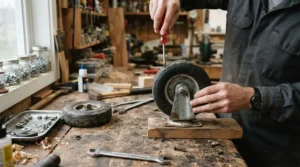
Problem: the roller slips in both directions. This signals a worn or contaminated one-way bearing. Spin the roller by hand: it should turn freely one way and lock the other. If it spins both ways, it’s time for roller wear replacement.
Problem: the guide blocks your push stick. Reposition it further ahead of the blade, or use a lower-profile design. The Fine Homebuilding commenters who found rollers obstructive were describing exactly this.
Problem: the guide won’t lock in my miter slot. Check slot dimensions. Some saws use smaller slots, and one owner on a retailer page reported needing to drill or re-bolt a featherboard to fit.
Problem: marks on finished stock. Lighten spring pressure, and clean glazed urethane with a mild solvent per the manufacturer’s guidance.
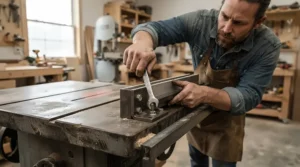
Roller Based Anti Kickback Device vs Featherboards, Pawls, and Riving Knives
A roller based anti kickback device isn’t competing with a riving knife. They guard against different failures.
| Device | What It Does | Resists Backward Travel? | Best For |
|---|---|---|---|
| Roller guide | Presses stock down or sideways, locks in reverse | Yes (one-way models) | Long rips, repetitive work |
| Standard featherboard | Presses stock sideways with flex fingers | Partially (angled fingers) | Budget side pressure |
| Riving knife | Keeps kerf open behind blade | N/A (prevents pinching) | Every cut it fits |
| Push block | Controls stock and keeps hands away | No | Narrow rips and finishing a cut |
The takeaway: the riving knife stops the kerf from closing on the blade, the single biggest pinching trigger. A roller guide resists backward travel on a flat board and adds consistent fence pressure. Push blocks, as one Fine Homebuilding commenter noted when recommending the Grr-Ripper style, handle the hands-and-control side. Use them together. If you must choose one thing to buy first, make sure your saw has a properly fitted riving knife.
Common Mistakes When Buying and Using a Roller System
Buying two-way rollers. The CPAN Double Wheel Stock Roller listing states two-way feeding. If reverse resistance is the goal, that’s the wrong tool.
Mounting backward. Because one-way bearing rollers have a lock direction, reversing the guide builds resistance into your forward push. Always run a scrap test.
Setting pressure too high. Heavy pressure makes you shove, and shoving is how hands drift toward the blade. Pressure should hold, not fight.
Placing the guide past the blade. Pressing the offcut behind the blade can pinch it. Keep pressure ahead of the leading edge unless the manual says otherwise.
Assuming rollers replace technique. Forum voices were blunt that kickback often traces back to setup and operator error. A misaligned fence or warped stock will beat a roller guide every time.
Ignoring wear. A bearing that quietly stops locking gives you a false sense of safety, which is worse than having no guide at all.
Long-Term Cost, Roller Wear Replacement, and Value
Roller guides are low-maintenance, but not no-maintenance. Urethane glazes and picks up pitch, and one-way bearings can wear or foul. For roller wear replacement, follow this routine, which is general bearing-care practice rather than a manufacturer schedule:
- Monthly in heavy use: spin each roller and confirm free forward rotation and firm reverse lock.
- When stock slips: clean the roller surface, then re-test.
- At the first sign of slippage in the lock direction: replace the roller or bearing. Don’t gamble on a worn clutch.
Replacement is easiest where the design uses off-the-shelf parts, such as the HF1216 one-way bearings used in shop-made guides. Sealed premium units may require manufacturer parts, so check availability before you commit.
| Tier | Price Range | What You Get | Best For |
|---|---|---|---|
| Entry | Under $30-$65 | JCFANTS Roller Feather Board, POWERTEC 71935 | Casual users |
| Mid | $80-$130 | Board Buddies, VXB Pro Grade One-Way Featherboards (pair) | Jobsite and frequent use |
| Premium | $180-$300 | Compass RG-1, JessEm Clear-Cut Stock Guides | Daily production |
Cost per use favors premium for high-volume shops: a $250 guide used on 5,000 cuts costs pennies per rip. For a weekend woodworker, the cheap tier wins on pure arithmetic. Spend where your frequency lives.
Safety, Regulations, and Where Rollers Fit
Federal rules shaped today’s saws. Riving knives became standard on new US saws in 2005 as part of updated safety standards, according to Fine Woodworking’s history in Table Saws Under Siege. SawStop’s flesh-sensing brake, which the CPSC recognized when it was first developed, addresses a different risk: blade contact rather than kickback.
Roller guides sit outside all of that. They aren’t a regulated safeguard, and none of the product pages we reviewed claim to replace a riving knife, guard, or technique. Keep your riving knife installed, use the blade guard when the cut allows, and wear eye and hearing protection.
Two practical limits apply. Don’t use fence-mounted guides for crosscuts with a miter gauge, since stock isn’t running along the fence. And never reach over a spinning blade to adjust a roller. Stop, wait for the blade to spin down, then adjust.
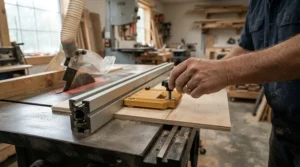
FAQ
❓ Can a roller guide replace a riving knife?
❓ Do one-way bearing rollers work for crosscuts?
❓ How tight should roller pressure be?
❓ How do I know a roller needs replacement?
❓ Are roller feather boards better than regular featherboards?
Conclusion
A roller system for kickback prevention on table saws won’t make a careless operator safe, but it makes a careful one more consistent. The best of them hold stock against the fence, lock against reverse travel, and take thinking out of the feed. The research points to a simple map. POWERTEC 71935 and JCFANTS Roller Feather Board serve budget buyers. Board Buddies and the VXB Pro Grade One-Way Featherboards fill the middle for jobsite and paired setups. Compass RG-1 and JessEm Clear-Cut Stock Guides reward high-volume shops. The CPAN Double Wheel Stock Roller is a useful guide, but its two-way feeding keeps it off the kickback-prevention list.
Whatever you pick, verify feed direction on scrap, keep pressure ahead of the blade, inspect rollers for wear, and keep your riving knife installed. Check current pricing and availability before you buy, and confirm the mounting style fits your fence.
✨ Ready to upgrade your fence?
🔍 Pick the guide that matches your saw and your shop, click the highlighted product name to check current pricing, and make your next rip a calmer one. 🪚
Recommended for You
- Anti Kickback Roller Kit For Contractor Saws: 7 Proven Picks 2026
- Anti Kickback Device For Ripping Hardwood: 7 Safest Picks (2026)
- Pawl System Vs Roller System For Kickback Safety: 7 Best Picks 2026
Disclaimer: This article contains affiliate links. As an Amazon Associate, I earn from qualifying purchases. If you purchase products through these links, we may earn a small commission at no additional cost to you.
✨ Found this helpful? Share it with your friends! 💬🤗
