
In This Article
You stand in your workshop, measuring that cramped corner where your table saw lives, and you know it’s time. That entry-level benchtop has served its purpose, but now you’re tackling bigger projects—full sheets of plywood, hardwood furniture builds, maybe even client work. The question isn’t whether to upgrade anymore. It’s which path leads to the saw that matches how you actually work.
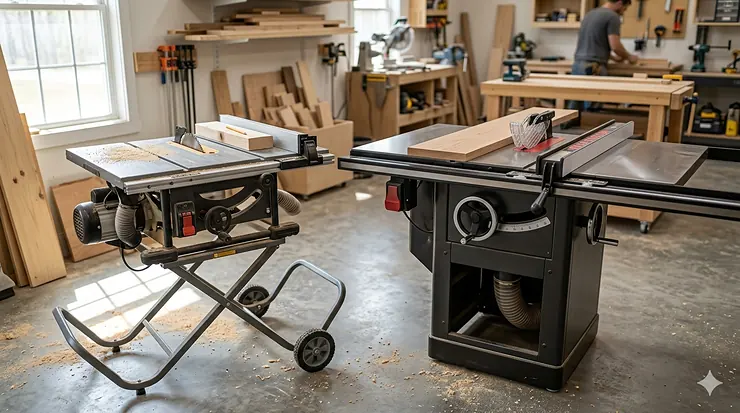
Here’s what most buying guides won’t tell you upfront: contractor saw vs hybrid table saw isn’t really about which one is “better.” It’s about matching power requirements, space constraints, and budget realities to your specific workflow. A contractor saw delivers serious cutting power in a semi-portable package that runs on standard 120V household circuits. A hybrid table saw bridges the gap between contractor mobility and cabinet saw precision, offering enclosed bases for better dust collection and cabinet-mounted trunnions for superior alignment—usually at a higher price point.
After researching dozens of models and analyzing real user feedback from woodworkers running everything from weekend projects to small production shops, I’ve identified seven saws that represent genuine value across both categories. Whether you’re framing houses on job sites or building furniture in a dedicated workshop, one of these machines will transform how you work without breaking your tool budget.
Quick Comparison Table
| Category | Contractor Saw | Hybrid Table Saw |
|---|---|---|
| Motor Power | 1.5-2 HP, 120V standard | 1.75-3 HP, dual voltage capable |
| Portability | Semi-portable with stands | Stationary or mobile base |
| Dust Collection | Open base, 60-75% efficiency | Enclosed cabinet, 80-90% efficiency |
| Price Range | $500-$1,000 | $1,400-$3,200 |
| Best For | Job sites, mobile work, space-limited shops | Dedicated workshops, precision work |
| Trunnion Mount | Table-mounted | Cabinet-mounted for better alignment |
| Typical Weight | 60-90 lbs | 250-350 lbs |
💬 Just one click – help others make better buying decisions too! 😊
Top 7 Contractor and Hybrid Table Saws: Expert Analysis
1. DeWalt DWE7491RS – Best Overall Contractor Saw
The DeWalt DWE7491RS dominates construction sites across America for one simple reason: it balances professional-grade features with genuine portability. This 10-inch jobsite saw packs a 15-amp motor delivering 4,800 RPM, enough grunt to rip through pressure-treated lumber and hardwoods without bogging down.
Key Specifications:
- 15-amp motor, 4,800 RPM
- 32.5-inch rip capacity
- Rolling stand with easy setup
- Rack and pinion fence system
- Price range: $549-$649
The rack and pinion telescoping fence system sets this saw apart from budget competitors. Adjustments glide smoothly and lock down tight—no wrestling with measurement scales or tapping the fence into position. The 32.5-inch rip capacity handles full plywood sheets, and those telescoping rails retract for surprisingly compact storage.
Customer feedback consistently praises fence accuracy straight from the box. One Oregon cabinet maker mentioned zero fence alignment adjustments after unboxing—parallel to within 0.005 inches. That precision level in a portable saw is remarkable. The rolling stand deploys in under 30 seconds with a one-person setup that actually works.
✅ Pros:
- Exceptional fence accuracy for the price point
- True one-person portability with rolling stand
- 32.5″ rip capacity handles sheet goods
❌ Cons:
- Dust collection adequate but not exceptional
- Open base design allows sawdust escape
2. Bosch GTS15-10 – Premium Jobsite Performance
The Bosch GTS15-10 introduces genuine innovation to the contractor saw category with its Gravity-Rise wheeled stand. Unlike traditional folding stands that require awkward lifting and latching, Bosch’s mechanism uses physics to your advantage—one smooth foot-pedal motion and you’re set up.
Key Specifications:
- 15-amp motor with electronic speed regulation
- 32.125-inch rip capacity
- Gravity-Rise wheeled stand
- Smart Guard System with riving knife
- Approximate retail: $700-800
The electronically regulated motor maintains blade speed under load, preventing bog-down in thick hardwoods. Those ClampZone areas on the table transform this saw into a secondary work surface for light assembly tasks—a clever feature that maximizes utility on cramped job sites.
Contractors appreciate the rack and pinion fence with color-coded index pins. No more squinting at measurement scales—match the colors and you’re dialed in. The Smart Guard System features a three-position adjustable riving knife that’s actually quick to remove and reinstall, unlike older designs that discourage safety feature use.
✅ Pros:
- Gravity-Rise stand is genuinely innovative
- Electronic speed regulation prevents motor bog-down
- ClampZone work surface versatility
❌ Cons:
- Higher price point than DeWalt competitor
- Slightly heavier for daily transport
3. SawStop CNS175-PFA30 – Safety-First Contractor Saw
The SawStop CNS175-PFA30 represents a different approach to contractor saws: revolutionary safety technology in a professional package. SawStop’s flesh-sensing system stops the blade within 5 milliseconds of skin contact—fast enough to prevent serious injury.
Key Specifications:
- 1.75 HP motor
- 30-inch Professional T-Glide fence
- Revolutionary flesh-sensing safety system
- Cast iron table and wings
- Price: $1,999
Beyond the safety system, this is a legitimate professional saw. The T-Glide fence glides smoothly across precision-ground cast iron, delivering cabinet-saw-level accuracy. The 1.75 HP motor handles dado stacks and hardwood ripping without strain, running on standard 120V circuits.
Users consistently note peace of mind when family members use the saw. One weekend woodworker mentioned his teenage son can work independently without constant supervision anxiety. The safety cartridge replacement takes 90 seconds after activation—simple enough for immediate return to work.
✅ Pros:
- Unmatched safety technology
- Professional-grade fence and table
- Peace of mind for mixed-skill-level shops
❌ Cons:
- Significantly higher initial investment
- Cartridge replacement costs after activation
4. Shop Fox W1837 – Best Budget Hybrid
The Shop Fox W1837 delivers hybrid saw features at a price point that doesn’t require financing. This 10-inch saw features cabinet-mounted cast-iron trunnions and an enclosed steel cabinet—typically found only on more expensive models.
Key Specifications:
- 2 HP motor, prewired for 120V
- 30-inch rip capacity
- Enclosed cabinet with 4-inch dust port
- Quick-release blade guard system
- Price: $1,637
The prewired 120V operation is significant for home woodworkers without electrician budgets. Most hybrid saws this powerful require 240V circuits, but Shop Fox designed this saw to run on standard household power—though 240V conversion is available for those who upgrade later.
Woodworkers praise the lift-off fence design. When you need the fence out of the way for specialized cuts, it removes in seconds without tools. The enclosed cabinet with bottom-facing dust port captures significantly more dust than open contractor saws, though you’ll need a decent shop vacuum for best results.
✅ Pros:
- Hybrid features at contractor-saw pricing
- Runs on standard 120V household power
- Cabinet-mounted trunnions improve alignment
❌ Cons:
- Fence less refined than premium models
- Some users report table flatness variations
5. Grizzly G0771Z – Precision Hybrid Value
The Grizzly G0771Z represents Grizzly’s decades of table saw refinement distilled into an affordable hybrid package. This saw blends contractor-saw mobility with cabinet-saw precision through careful engineering of every component.
Key Specifications:
- 2 HP motor, 120V/240V dual voltage
- 31-inch rip capacity
- Precision-ground cast iron table
- Innovative quick-release blade guard
- Price: $1,599-$1,649
The precision-ground cast iron table exceeds 40 inches with extension wings, providing stable support for large workpieces. The innovative T-shaped fence combines the best features from previous Grizzly designs—easy lift-off adjustment, rock-solid front locking, and accessory T-slots for featherboards and stops.
Users report excellent value for hobby and small professional shops. One furniture maker mentioned the saw handles 8/4 maple without complaint, though he recommends taking your time with the thickest stock. The quick-release blade guard and riving knife system changes in seconds without tools—encouraging safe operation rather than discouraging it.
✅ Pros:
- Excellent price-to-performance ratio
- Cast iron table with precision grinding
- Quick-release safety features
❌ Cons:
- Some quality control inconsistencies reported
- Fence alignment may require initial adjustment
6. Powermatic PM1000 – Premium Hybrid Excellence
The Powermatic PM1000 brings legendary Powermatic quality to the hybrid saw category. This saw looks like a cabinet saw, feels like a cabinet saw, and cuts like a cabinet saw—but runs on 115V household power.
Key Specifications:
- 1.75 HP motor, dual voltage capable
- 30-inch Accu-Fence system
- Heavy cast iron throughout
- Poly-V belt drive system
- Price: $2,969-$3,299
The Accu-Fence slides smoothly and locks securely—Powermatic’s legendary fence design that’s been refined over decades. Heavy 7-inch hand wheels turn with satisfying momentum, making blade height and bevel adjustments effortless even after hours of work. The poly-V belt drive system reduces vibration and noise while maximizing motor efficiency.
Serious woodworkers appreciate the hands-free power button with safety key. In emergency situations, your foot hits that button instantly. The arbor lock allows one-handed blade changes with minimal tools—a time-saver when switching between ripping and crosscut blades throughout a project.
✅ Pros:
- Cabinet-saw quality in hybrid package
- Legendary Accu-Fence precision
- Exceptional build quality and durability
❌ Cons:
- Premium pricing
- Heavy weight limits mobility
7. Laguna Fusion F2 – High-End Hybrid Innovation
The Laguna Fusion F2 represents Laguna’s commitment to precision and innovation. This hybrid saw incorporates European design elements—particularly the Hi/Low fence face—with American power expectations.
Key Specifications:
- 1.75 HP TEFC motor
- 36-inch rip capacity
- Cast iron table with aluminum trunnions
- Integrated wheel system
- Estimated price: $2,200-2,800
The one-piece cast aluminum trunnion bolts directly to the cabinet, simplifying blade-to-miter-slot alignment adjustments. The totally enclosed steel base with above-and-below dust collection shrouding captures nearly everything, making this saw workshop-neighbor-friendly in shared spaces.
The integrated wheel system inside the cabinet means no separate mobile base purchase. When you need to move the saw, just engage the wheels. The Hi/Low Euro-style fence face pulls back for short-fence ripping or flips flat for veneer work—versatility that adapts to different cutting techniques.
✅ Pros:
- Superior dust collection system
- European-inspired fence versatility
- Integrated mobility without separate base
❌ Cons:
- Higher price point
- Dealer network required for purchase
✨ Don’t Miss These Exclusive Deals!
🔍 Take your workshop to the next level with these carefully selected table saws. Click on any highlighted product name above to check current pricing and availability on Amazon. These tools will help you create professional results that exceed client expectations!
Understanding Contractor Saw vs Cabinet Saw Differences
The table saw originated in the late 18th century when Samuel Miller patented the first circular saw in 1777, according to woodworking historians. Modern contractor saws evolved from this legacy as a middle ground between portable benchtop saws and heavy industrial cabinet saws.
Contractor saws typically feature open-base designs with the motor hanging off the rear of the saw. This configuration provides adequate dust collection while keeping weight manageable—usually 60 to 90 pounds without the stand. The motor connects to the blade through one or more belts, and the entire saw can be loaded into a truck bed or transported between job sites.
Cabinet saws, by contrast, mount the motor inside a fully enclosed cabinet below the table. This enclosed design improves dust collection efficiency to 95% or better when connected to proper dust collection systems. The motor typically runs on 240V single-phase or three-phase power, delivering 3 to 5 horsepower for production work.
Hybrid saws bridge this gap by incorporating cabinet-style enclosed bases and cabinet-mounted trunnions while maintaining motor power levels compatible with standard household circuits. This compromise delivers significantly better dust collection than contractor saws—typically 80 to 90% efficiency—without requiring expensive electrical upgrades.
Which Stationary Saw to Buy: Critical Factors
Power Requirements and Circuit Compatibility
Contractor saws typically run on standard 120V household circuits, drawing 15 amps maximum. This makes them accessible for home workshops without electrical upgrades. The 1.5 to 2 horsepower motors handle most cutting tasks including dado stacks, though they may slow slightly in very thick hardwoods.
Hybrid saws often feature dual-voltage motors: they ship prewired for 120V but can be converted to 240V for increased power. At 120V, expect 1.75 to 2 horsepower. Convert to 240V and many hybrid saws deliver 2 to 3 effective horsepower with reduced amp draw and cooler motor operation.
Cabinet saws demand 240V circuits as standard, typically drawing 10 to 20 amps depending on motor size. This requires hiring an electrician for most home workshops—factor $300 to $800 for circuit installation when budgeting for a true cabinet saw.
Dust Collection Capabilities
Contractor saws with open bases allow significant dust escape despite 2.5 to 4-inch dust ports. Even with a quality shop vacuum attached, expect 60 to 75% collection efficiency. The remaining dust settles throughout the workshop, requiring more frequent cleaning.
Hybrid saws improve collection through enclosed cabinets that contain dust better. The sealed bottom and cabinet-mounted motor create a contained environment where dust has fewer escape routes. Most hybrid saws achieve 80 to 90% collection efficiency with proper shop vacuum connection—a noticeable improvement over contractor saws.
Cabinet saws with fully enclosed cabinets and dedicated dust collection systems capture 95% or more when properly configured. This makes them essential for professional shops where dust control affects both health and productivity. According to OSHA workplace safety guidelines, proper dust collection in woodworking environments reduces respiratory hazards and maintains cleaner, safer work areas.
Trunnion Mounting and Long-Term Accuracy
Table-mounted trunnions on contractor saws attach to the underside of the table. This design simplifies manufacturing but can affect long-term accuracy as table flexing impacts blade alignment. Adjusting blade-to-miter-slot parallelism requires loosening table bolts and tapping the table into position.
Cabinet-mounted trunnions bolt directly to the saw cabinet, isolating blade alignment from table attachment. This configuration maintains accuracy better over time and simplifies alignment adjustments. You adjust the trunnion assembly rather than repositioning the entire table—a more precise process that professional woodworkers appreciate.
Hybrid saws use cabinet-mounted trunnions despite lower prices than true cabinet saws. This represents one of their primary value propositions: cabinet-saw precision mechanisms without cabinet-saw prices or power requirements.

Contractor Saw Comparison: Jobsite vs Workshop Models
Jobsite contractor saws prioritize portability and durability for construction environments. They feature rolling stands with large wheels for rough terrain, tool storage compartments, and weather-resistant components. The DeWalt DWE7491RS and Bosch GTS15-10 exemplify this category—designed for daily transport between job sites.
Workshop contractor saws sacrifice some portability for improved stability and features. They might use heavier cast iron tables, longer fence rails, or more refined fence mechanisms. These saws expect to stay in one location most of the time, moving only occasionally for cleaning or reconfiguration.
The distinction matters when choosing. If you’re a trim carpenter moving between houses daily, the jobsite model’s quick setup and breakdown justify any stability tradeoffs. If you’re a weekend woodworker with a dedicated garage shop, the workshop model’s refined features improve every cut without the portability tax.
Stationary Saw Categories: Beyond the Binary Choice
Table saw classifications extend beyond contractor saw vs hybrid table saw. Benchtop saws offer genuine portability at under 50 pounds but sacrifice rip capacity and power. These suit apartment woodworkers or contractors needing occasional cuts on-site.
Compact table saws bridge benchtop and contractor categories, offering more power than benchtops with better portability than full contractor saws. They typically feature smaller table surfaces and reduced rip capacities—acceptable compromises for smaller projects.
Industrial cabinet saws represent the apex of table saw evolution. These machines feature 5 to 10 horsepower motors, cast iron tables exceeding 50 inches, and industrial-grade components designed for continuous production work. Prices start around $5,000 and climb quickly with options. For professional woodworking operations, Wood Magazine’s comprehensive equipment guides provide detailed comparisons of industrial-grade machinery specifications and performance benchmarks.
Sliding table saws incorporate European design elements, adding a sliding table that moves the workpiece past a stationary blade. This design excels at crosscutting large panels and sheet goods—though American woodworkers traditionally prefer miter gauges and crosscut sleds for this work.
Shop Saw Decision Guide: Matching Tools to Workflow
For Mobile Contractors and Job Site Work
Choose a contractor saw with robust rolling stand, large rip capacity, and durable construction. The DeWalt DWE7491RS or Bosch GTS15-10 deliver professional results with genuine mobility. Prioritize features like tool storage, easy fence removal for transport, and weather-resistant components.
Budget $600 to $1,000 including the saw and any necessary accessories. Factor in quality dado stacks, additional blades, and a mobile dust collection solution. Your saw will take more abuse than workshop saws—choose accordingly.
For Dedicated Workshop Spaces
Hybrid saws make more sense when the saw stays put. The enclosed cabinet improves dust collection significantly, and cabinet-mounted trunnions maintain accuracy longer. The Shop Fox W1837 or Grizzly G0771Z provide excellent value for smaller workshops, while the Powermatic PM1000 or Laguna Fusion F2 suit serious hobbyists and small professional operations.
Budget $1,500 to $3,500 depending on features desired. Include a quality mobile base for occasional repositioning, proper dust collection system, and premium blades matched to your typical work. The hybrid saw’s superior dust collection pays dividends in reduced shop cleaning time.
For Growing Professional Operations
Cabinet saws become necessary when production demands exceed hybrid saw capabilities. Continuous ripping of thick hardwoods, dado stack work all day, or high-volume panel processing justify the power and precision investment. Expect to budget $2,500 to $7,000 for serious cabinet saws plus electrical installation.
Alternatively, consider the SawStop CNS175-PFA30 contractor saw with safety technology. For small professional shops where multiple people use the saw—particularly those with varying skill levels—the safety investment protects both workers and business liability.
Upgrade Path Planning: Growing Your Tool Investment
Most woodworkers progress through table saw categories as skills and budgets develop. A typical upgrade path might begin with a benchtop saw for initial projects, move to a contractor saw when space and budget allow, then transition to a hybrid or cabinet saw as work becomes more serious.
Timing these upgrades strategically maximizes value. Don’t rush to buy a hybrid saw if a quality contractor saw meets current needs—invest the difference in other tools or wood stock. Conversely, don’t cling to an inadequate saw that limits project quality or wastes time on fence adjustments.
Consider resale value when upgrading. Quality contractor saws and hybrid saws retain value well in used markets. A well-maintained DeWalt or Powermatic saw might recoup 50 to 70% of original cost when sold—effectively reducing upgrade costs significantly.
Plan for complementary tools alongside saw upgrades. A hybrid saw with excellent dust collection demands a proper shop vacuum or dust collector to realize its full benefit. A contractor saw on job sites needs quality extension cords, additional supports, and protective cases for accessories.
FAQ
❓ Can hybrid table saws run on regular household power?
❓ What's the real difference between contractor and cabinet saw dust collection?
❓ Are SawStop safety systems worth the premium price?
❓ How much rip capacity do I actually need?
❓ Should I buy contractor saw or save for hybrid model?
Conclusion: Making Your Workshop Upgrade Decision
The contractor saw vs hybrid table saw decision ultimately reflects your specific situation rather than absolute quality rankings. Contractor saws excel when portability matters, budgets are constrained, or electrical infrastructure limits options. Hybrid saws shine in dedicated workshops where dust collection, precision, and long-term accuracy justify higher investment.
Quality saws exist across both categories. The DeWalt DWE7491RS and Bosch GTS15-10 represent contractor saw excellence with features rivaling much more expensive machines. The Shop Fox W1837 and Grizzly G0771Z deliver hybrid saw benefits at prices approaching contractor saw territory. Premium options like the Powermatic PM1000, Laguna Fusion F2, and SawStop CNS175-PFA30 justify higher costs through exceptional precision, safety, or construction quality.
Focus on matching saw capabilities to your actual work patterns. A mobile contractor running trim work benefits more from the DeWalt’s portability than from a stationary hybrid’s superior dust collection. A furniture maker in a basement workshop prioritizes the Grizzly hybrid’s precision and dust containment over any portability features.
Your table saw serves as the centerpiece of your woodworking operation for years or decades. Choose thoughtfully based on real needs rather than aspirational projects. Every saw profiled here represents genuine value when matched appropriately to user requirements. The right saw makes every cut easier, every project more enjoyable, and every finished piece something you’re proud to sign.
Recommended for You
- 7 Best Contractor Table Saw with Extension Table 2026
- 7 Best Delta Contractor Table Saw Models 2026
- Best Contractor Table Saw Under 1000: 7 Pro Picks 2026
Disclaimer: This article contains affiliate links. If you purchase products through these links, we may earn a small commission at no additional cost to you.
✨ Found this helpful? Share it with your friends! 💬🤗
