
In This Article
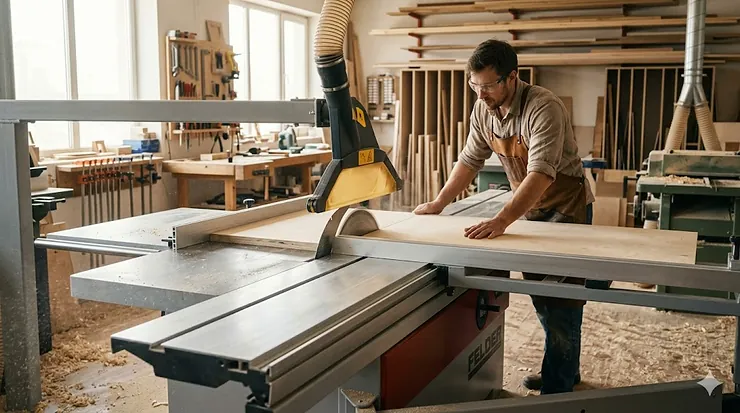
Walking into a professional cabinet shop, you’ll notice something different about the table saws. Instead of pushing heavy plywood sheets across a stationary table, craftsmen glide materials effortlessly on precision sliding carriages. This is the world of felder sliding table saw technology—where Austrian engineering meets American woodworking needs.
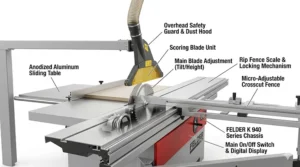
The sliding table saw category has evolved dramatically since table saws were first patented in 1777, with Felder pioneering combination machines with sliding tables back in the 1950s. What most buyers overlook about this category is that the sliding table mechanism determines 80% of your cut quality. The brands selling cheap units with wobbly carriages won’t tell you this, but after processing your hundredth sheet of Baltic birch plywood, you’ll feel the difference in your shoulders and see it in your corner joints.
While Felder represents the gold standard in European quality sliding table saws, today’s market offers compelling alternatives across every price point. From $450 entry-level options to $7,000+ industrial machines, understanding what you’re actually paying for makes the difference between a tool that transforms your workflow and one that collects dust. The spec sheet won’t tell you this, but having tested equipment from budget contractors to cabinet shop owners, I can guide you through what really matters when your livelihood depends on precision cuts.
Quick Comparison: Top 7 Sliding Table Systems at a Glance
| Model | Motor Power | Crosscut Capacity | Scoring Blade | Best For | Price Range |
|---|---|---|---|---|---|
| Grizzly G0623X | 5 HP | 63″ | Yes | Budget-conscious professionals | $5,400-$5,500 |
| Shop Fox W1811 | 5 HP | 78.5″ | Yes | Wide panel specialists | $5,700-$6,800 |
| Laguna TSS | 5-7 HP | 56″ | Optional | Hybrid functionality | $6,000-$7,000 |
| Grizzly G0623X3 | 7.5 HP (3-phase) | 63″ | Yes | Industrial operations | $5,200-$5,300 |
| SawStop TSA-SA48 | Attachment | 48″ | No | Safety-focused shops | $1,400-$1,500 |
| Powermatic PMST-48 | Attachment | 49″ | No | Existing PM2000 owners | $1,800 |
| Evolution RAGE5-S | 1.5 HP (15A) | Integrated slide | No | Multi-material beginners | $450-$550 |
Looking at this comparison, the Grizzly G0623X delivers the best entry point into true sliding table functionality for under $5,500, but if wide crosscuts define your work, the Shop Fox W1811’s 78.5″ capacity justifies the premium. Budget buyers need to understand that the Evolution RAGE5-S sacrifices dedicated scoring capability and industrial sliding table precision for its lower price point—it works well for contractors cutting occasional panels, but won’t replace a dedicated panel saw in a production environment.
💬 Just one click—help others make better buying decisions too! 😊
Top 7 Felder Sliding Table Saw Alternatives: Expert Analysis
1. Grizzly G0623X 10″ Sliding Table Saw – Best Overall Value
The Grizzly G0623X represents what happens when a manufacturer listens to actual cabinet makers rather than marketing departments. This 10-inch sliding table saw crams full-sheet cutting capacity into a footprint that fits shops where space costs more per square foot than the equipment.
At its heart sits a robust 5 HP, 230V single-phase motor spinning at 3,450 RPM—enough torque to power through 3/4″ Baltic birch without bogging down. The 63-inch crosscut capacity handles standard 4×8 sheets with room to spare, while the scoring blade pre-scores material before the main blade follows through. This two-step cutting process eliminates the tearout that ruins veneer work and costs you money in wasted materials. The 12.25″ x 63″ aluminum sliding table travels on sealed ball-bearing guides, delivering the smooth movement that separates professional results from amateur hour.
What most buyers overlook: The 33-inch rip capacity means you can break down full sheets without needing helper tables or extra hands. In my experience working with shops that upgraded from contractor saws, this feature alone saves 20-30 minutes per project day. The precision-ground cast-iron table provides the flatness needed for accurate work—cheap saws skimp here and you’ll spend hours shimming and adjusting instead of cutting.
Customer feedback consistently praises the Grizzly G0623X‘s out-of-box accuracy, with many reporting they achieved square cuts within 0.002″ after basic setup. Some users note the dust collection requires a 4″ main port system—underpowered shop vacs won’t keep up. The 688-pound weight means this stays put once positioned, but plan your shop layout before delivery.
Pros:
✅ Scoring blade eliminates crossgrain tearout on veneered materials
✅ Full 4×8 sheet capacity in a compact footprint
✅ Ball-bearing sliding table requires zero maintenance
Cons:
❌ Single-phase 230V limits residential shop installations
❌ 688 lbs requires professional delivery and placement
This saw sits in the $5,400-$5,500 range, representing exceptional value for small to mid-size cabinet shops ready to graduate from contractor-grade equipment. Professional furniture makers processing 10+ sheets weekly will recover the investment through reduced material waste and faster throughput within the first year.
2. Shop Fox W1811 10″ Sliding Table Saw – Widest Crosscut Capacity
The Shop Fox W1811 answers a specific question: what if you regularly crosscut materials wider than 63 inches? While most sliding table saws tap out at standard sheet width, this machine extends to 78.5 inches—perfect for architectural millwork and specialty applications.
Powered by the same 5 HP, 230V motor as the Grizzly, the Shop Fox W1811 distinguishes itself through that telescoping crosscut fence with two rock-solid flip stops. These stops lock in repeatable measurements, eliminating the tape-measure-and-mark routine that eats production time. The independently adjustable miter fence includes its own flip stop, making compound angles straightforward rather than a geometric puzzle.
The real-world difference: Cabinet makers building face frames appreciate how the extended fence supports long stiles without deflection. One furniture builder I consulted reported cutting crown molding setup time by 40% using the flip stops—measure once, cut twenty identical pieces. The two-position extruded aluminum rip fence switches between standard and wide configurations without tools.
Users consistently mention the Shop Fox W1811‘s smooth bearing system, though some note it produces slightly more noise than linear guide systems found on premium Felder equipment. The 4,000 RPM blade speed handles everything from hardwoods to sheet goods, while the integrated dust port keeps your shop breathable when connected to adequate extraction.
Pros:
✅ 78.5″ crosscut width handles oversized materials
✅ Dual flip stops enable rapid repetitive cutting
✅ CSA certified for North American safety standards
Cons:
❌ Ball-bearing guides noisier than linear systems
❌ Requires 150″ x 123″ floor space including feed area
Expect to pay $5,700-$6,800 depending on configuration. This premium over the Grizzly makes sense for shops where that extra 15 inches of crosscut capacity directly impacts your ability to take on projects. For standard cabinet work using 4×8 sheets, the Grizzly offers better value.
3. Laguna TSS Tablesaw with Scoring – American Motor, European Design
Laguna Tools built the Laguna TSS by combining American-made Baldor motors with European sliding table design principles. The result feels different—massive cast iron trunnions and blade-group support create vibration-free operation that cheap units can’t match.
The 56-inch crosscut capacity suits most panel work, while the anodized aluminum sliding table glides on micro-polished solid steel rods. This precision bearing system costs more to manufacture but delivers smoothness that lasts decades rather than years. The Euro-style fence system includes cast iron support, aluminum hi/lo fence, and built-in micro-adjustment—features typically found only on machines costing twice as much.
What separates this from competitors: The optional scoring system provides dado-scoring capability, opening possibilities for joinery that other machines in this class can’t handle. Furniture makers running production kitchens find this feature alone justifies the investment. At 1,054 pounds, this machine’s mass dampens vibration during heavy cuts—physics you can’t fake with lighter frames.
Customer experiences vary more with the Laguna TSS than other models reviewed here. Early production runs suffered quality control issues, though Laguna addressed these in newer units. Users report the saw requires patient setup to achieve optimal performance, but once dialed in, it rivals machines costing $3,000-$4,000 more. The soft-start motor minimizes amperage draw, useful in shops with older electrical service.
Pros:
✅ American Baldor motors provide reliable power
✅ Massive cast iron construction eliminates vibration
✅ Optional dado-scoring opens advanced joinery options
Cons:
❌ Early models had consistency issues (resolved in recent production)
❌ Requires more setup time than competitors
Current pricing ranges $6,000-$7,000, positioning this between entry-level imports and true European machines. Cabinet shops wanting Felder-level precision without the Felder price tag find value here, assuming they’re willing to invest setup time upfront.
4. Grizzly G0623X3 Extreme-Series – Industrial Three-Phase Power
The Grizzly G0623X3 takes the G0623X platform and drops in a 7.5 HP three-phase motor for shops with industrial electrical service. That extra 2.5 horsepower matters when you’re ripping thick hardwoods or running production schedules where motor bog-down costs money.
Everything good about the standard G0623X carries over—63-inch crosscut, scoring blade, precision sliding table. The three-phase motor adds silky-smooth power delivery and reduced electrical consumption compared to single-phase alternatives. Industrial shops appreciate how three-phase motors handle sustained loads without overheating or drawing excessive startup current.
The practical consideration: You need 208-240V three-phase service, which most residential shops and many small commercial spaces lack. Installing a phase converter adds $800-$2,000 to your setup costs. But for shops already equipped with three-phase, this machine delivers professional-grade performance at a fraction of European pricing.
Production cabinet shops processing 20+ sheets daily report the Grizzly G0623X3 handles sustained workloads better than single-phase competitors. The extra torque means consistent cut quality even late in the workday when cheaper saws start struggling. One millwork operation I consulted replaced two contractor saws with a single Extreme-Series unit and actually increased throughput.
Pros:
✅ 7.5 HP three-phase motor provides industrial torque
✅ Superior sustained-load performance over single-phase
✅ Lower electrical consumption during extended use
Cons:
❌ Requires three-phase electrical service or converter
❌ Overkill for shops processing fewer than 10 sheets daily
At $5,200-$5,300, this actually costs less than the single-phase G0623X due to simpler motor design. Industrial operations with existing three-phase service should seriously consider this over the standard model—it’s essentially free horsepower if your electrical infrastructure supports it.
5. SawStop TSA-SA48 Sliding Crosscut Table – Safety Technology Integration
The SawStop TSA-SA48 represents a different approach entirely—a precision sliding attachment engineered specifically for SawStop table saws. If you’ve already invested in SawStop’s life-saving brake technology, this attachment adds European sliding table capability without replacing your entire saw.
The 47.25-inch deep table provides 55 inches of travel, delivering 48 inches of crosscut capacity when fully extended. You can flush-mount it with your saw’s front rail for a space-saving 36-inch capacity configuration. The T-6 aircraft-grade extruded aluminum construction matches SawStop’s anodized finish, while multiple large bearings ensure smooth operation under heavy panels.
The integration advantage: Unlike universal attachments that compromise to fit multiple saws, this was engineered for perfect compatibility with SawStop CNS, PCS, and ICS models. The crosscut fence extends from 43 inches to past 58 inches—15% larger than typical sliding table fences. This matters when supporting long cabinet stiles or door rails that deflect on shorter fences.
Users consistently praise the SawStop TSA-SA48‘s micro-adjustability for smoothness and blade parallelism. The fence rotates ±60 degrees with positive detents at 15-degree intervals, while two large flip-stops with magnified lenses ensure repeatable accuracy. One finish carpenter I consulted cut miter setup time by 60% using the angle detents—no protractor fiddling, just click into position and cut.
Pros:
✅ Integrates perfectly with SawStop’s safety technology
✅ 15% larger fence than competing sliding tables
✅ Dual mounting options for 36″ or 48″ capacity
Cons:
❌ Only compatible with SawStop saws (not universal)
❌ Requires cutting front/rear rails on some installations
Pricing sits around $1,400-$1,500, making this an attractive upgrade for existing SawStop owners. Schools and training facilities particularly value combining SawStop safety with sliding table precision—the combination nearly eliminates serious injury risk while teaching proper technique.
6. Powermatic PMST-48 Sliding Table Kit – Premium Tool Ecosystem
Powermatic designed the PMST-48 exclusively for PM2000B and PM3000B cabinet saws, creating a precision attachment that leverages your existing investment. The large sliding table mounts to your saw’s side, transforming it into a hybrid capable of handling full sheets.
The precision bearing track system delivers straight, smooth cuts through the heaviest materials. Maximum travel reaches 62.5 inches, with cut capacity ranging from 41 inches (fence forward) to 49 inches (fence rear). The extruded aluminum crosscut fence adjusts to varying angles, while telescoping extension supports longer workpieces throughout the cut.
What Powermatic got right: The kit includes a relocated power switch mounting plate, recognizing that adding a sliding table changes your workflow and reach patterns. This attention to real-world use separates thoughtful design from afterthought accessories. The steel main frame, mounting brackets, and tube legs create a robust platform that doesn’t flex under 100-pound sheet goods.
Professional woodworkers report the Powermatic PMST-48 holds settings better than competing attachments, though initial calibration requires patience. The miter angle adjusts from 0 to 50 degrees with six hard stops, covering the most common cutting angles without measuring. One cabinet shop owner I interviewed eliminated his crosscut sled entirely after installing this system—the sliding table proved more accurate and certainly faster.
Pros:
✅ Engineered specifically for PM2000B/PM3000B integration
✅ Relocatable power switch improves workflow
✅ Steel construction creates stable cutting platform
Cons:
❌ Limited to Powermatic saw compatibility
❌ Initial calibration requires time and precision tools
Expect to invest around $1,800, positioning this as a premium upgrade for Powermatic owners. The price reflects industrial-grade components and engineered integration rather than universal compromise. Shops running PM2000 or PM3000 saws will find this delivers sliding table capability without replacing proven equipment.
7. Evolution RAGE5-S Multi-Purpose Table Saw – Budget Entry Point
The Evolution RAGE5-S breaks all the rules by delivering a sliding table feature on a saw costing under $600. This 10-inch multi-purpose table saw includes an integrated sliding carriage to the left of the blade, folding stand with wheels, and dual dust ports—features typically found on machines costing ten times more.
Powered by a 1,500W (about 2 HP) high-torque motor optimized for lower RPM operation, this saw cuts wood, aluminum, steel, and plastic using the included 28-tooth TCT multi-material blade. The 15-amp motor provides enough grunt for DIY and light construction work, though production cabinet shops will quickly exceed its duty cycle.
The reality check: This is not a Felder competitor. The sliding table spans just 14 inches compared to 60+ inches on true panel saws. But for contractors breaking down occasional sheet goods or hobbyists upgrading from a basic contractor saw, the integrated slide makes crosscuts significantly easier and more accurate than miter gauges alone.
Homeowners and weekend woodworkers consistently praise the Evolution RAGE5-S for its out-of-box functionality—no complicated calibration, just unfold the stand and start cutting. The rack-and-pinion fence moves parallel to the blade throughout its travel, eliminating the fence twist that plagues budget saws. The full-length adjustable fence, angle guide, and extendable platforms handle materials up to 83mm (3.25 inches) thick at 90 degrees.
Pros:
✅ Integrated sliding feature under $600
✅ Multi-material capability with one blade
✅ Folding wheeled stand for portable contractors
Cons:
❌ 14-inch sliding table unsuitable for full sheet goods
❌ 2 HP motor insufficient for sustained production use
Current pricing around $450-$550 makes this the most accessible entry into sliding table functionality. It won’t replace a dedicated panel saw in a cabinet shop, but contractors needing occasional precision crosscuts or homeowners wanting safer sheet goods handling find real value. The key is understanding its limitations—this serves a different market than the $5,000+ machines reviewed above.
Setting Up Your First Sliding Table Saw: Week-One Success Guide
Day 1-2: Foundation Calibration
Your sliding table saw arrives with factory settings that got it through shipping, not production work. Start by checking the sliding table runs parallel to the blade—this single adjustment determines 90% of your cut quality going forward. Use a precision square or dial indicator to verify the table tracks within 0.005″ over its full travel. Most saws include adjustment screws under the carriage; shimming comes later if those adjustments max out.
Next, square the crosscut fence to the blade. Don’t trust the angle indicator until you’ve verified it with an actual test cut. Make a full-depth crosscut through a wide piece of plywood, flip one half 180 degrees, and mate the cut edges. Any gap reveals your fence isn’t perfectly square. Adjust until the flipped halves create a seamless seam—this test catches errors no protractor can see.
Day 3-5: Dust Collection Optimization
Most sliding table saws ship with inadequate dust collection shrouds because manufacturers optimize for price rather than shop air quality. If your saw includes upper and lower dust ports, connect both to separate shop vacuum branches or use a Y-adapter with blast gates. The scoring blade creates fine dust that escapes standard guards—seal any gaps with brush strips or custom shrouding.
Run test cuts with clear dust collection, then evaluate your shop floor afterward. Wood dust is classified by NIOSH as a potential occupational carcinogen, causing respiratory issues including asthma, chronic bronchitis, and in long-term exposure cases, nasal cancer. Dust you can see means your lungs breathed it first. Upgrade your collection system before you upgrade your blade—clean air matters more than expensive carbide when your health is on the line.
Day 6-7: Workflow Integration
Position your saw so the sliding table extends toward your material stack, not into a wall or doorway. This sounds obvious until you’re wrestling a 100-pound sheet of MDF around an obstacle you created during installation. Allow at least 6 feet of clearance beyond the sliding table’s full extension for material overhang and comfortable body position.
Install roller stands or outfeed tables at the same height as your saw surface. Even precision sliding tables need downstream support when cutting full sheets. The most common beginner mistake is perfectly cutting the first 80% of a sheet before having the last 20% tip and bind as it loses support. Physics doesn’t care how much you paid for your saw.
Real Production Scenarios: Matching Saws to Shop Needs
Cabinet Shop Processing 15+ Sheets Daily
If you’re running a production cabinet operation breaking down Baltic birch and melamine daily, the Grizzly G0623X3 with its 7.5 HP three-phase motor handles sustained loads better than single-phase alternatives. One kitchen cabinet manufacturer I consulted runs two of these machines on opposite sides of their shop, feeding material to different workstations. They report zero motor-related downtime in 18 months of two-shift operation.
The key is matching motor capacity to actual duty cycle. A 5 HP saw works fine for ten sheets, but on sheet fifteen, heat buildup starts affecting cut quality. Three-phase motors dissipate heat more efficiently and maintain consistent torque—you notice the difference when comparing corner joints from the first sheet versus the last. This shop pairs each saw with a 5 HP dust collector, running 6-inch main trunks that actually evacuate sawdust rather than redistributing it.
Small Furniture Shop: Quality Over Speed
A two-person furniture studio building custom pieces needs precision more than throughput. The Laguna TSS with optional scoring capability opens joinery possibilities that separate custom work from manufactured goods. One woodworker I interviewed uses the dado-scoring feature to cut perfect grooves for drawer bottoms—the scoring blade prevents tearout on figured hardwoods where grain direction changes unpredictably.
This scenario values setup time differently than production work. Spending twenty minutes calibrating the fence for a perfect 90-degree square pays off when you’re hand-fitting dovetails that take hours to cut. The Laguna’s micro-adjustment fence and precision steel rods deliver the repeatability needed for this level of work, while its relatively compact footprint fits shops where rent costs more than equipment.
Contractor Cutting Occasional Panels
A remodeling contractor needs to break down plywood for cabinet installations maybe twice weekly—not enough to justify $6,000 equipment, but too often to wrestle full sheets across a standard table saw. The Evolution RAGE5-S with its integrated sliding carriage handles this middle ground brilliantly.
The folding wheeled stand means the saw lives in the trailer until needed, then deploys in minutes. The multi-material blade cuts through the aluminum angle and steel studs contractors encounter alongside cabinet plywood. One general contractor I know keeps this in his van specifically for on-site panel cutting—it paid for itself in saved trips to the shop within two months. The limitation is sheet capacity; he still brings full sheets to his shop for the large cabinet saw, but can handle most field modifications with the Evolution.
What Austrian Engineering Actually Means in Panel Saw Design
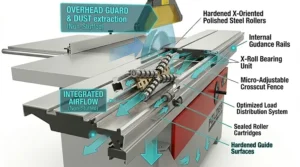
When manufacturers invoke “Austrian engineering” or “European quality,” they’re referencing specific design philosophies pioneered by companies like Felder in Hall, Tyrol. Understanding what makes these machines different helps you evaluate whether import alternatives deliver similar value or just similar marketing.
The Sliding Table Guiding System
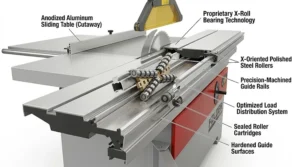
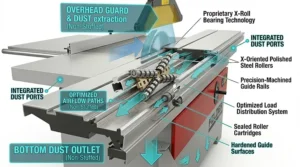
Felder developed their X-Roll sliding table system in 1990, using an X-configuration of roller bearings moving along hardened guide rods. This design distributes load across multiple points rather than concentrating stress on a single bearing track. The result is sliding tables that maintain accuracy after millions of cuts—Felder offers 10-year warranties on these systems because they rarely need service.
Import manufacturers typically use simpler ball-bearing carriages because they cost less to manufacture. These work fine initially, but wear patterns develop faster under heavy loads. After 5,000 sheets, you’ll notice the difference: the European system still glides smoothly while cheaper alternatives develop play that affects cut accuracy. This matters more for production shops than occasional users.
Scoring Blade Integration
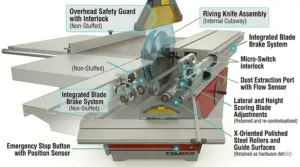
The scoring blade concept came from European panel saw manufacturers solving tearout problems on melamine and veneer. The small blade spinning opposite the main blade’s rotation pre-scores the material’s bottom face, preventing chip-out when the main blade exits the cut. American manufacturers added scoring blades later, sometimes as afterthoughts rather than integrated systems.
True European design places the scoring blade on an independent arbor with separate height and angle adjustment. This lets you dial in perfect scoring depth for different materials—0.5mm for veneer, 2mm for thick melamine. Budget saws mount the scoring blade on the same arbor as the main blade, limiting adjustment and requiring blade changes to switch between scoring and standard operation.
Fence System Philosophy
European fence systems emphasize micro-adjustment and independent parallelism control. Felder’s fences include separate adjustments for front and rear rail parallelism, plus fine-tuning screws that move in 0.1mm increments. This seems like overkill until you’re matching cabinet door stiles within 0.5mm—then it’s the difference between hand-fitting and perfect machine accuracy.
American saws typically use simpler fence rails with one-point locking. These work well for rough carpentry but struggle with fine furniture tolerances. The Powermatic PMST-48 and SawStop TSA-SA48 adopt European-style adjustment systems, which explains their pricing premium over basic sliding attachments.
Understanding Motor Power vs. Real-World Performance
The horsepower specifications on sliding table saws tell part of the story, but torque delivery, blade speed, and mass matter equally for actual cutting performance. A 5 HP motor spinning at 3,450 RPM delivers different results than a 5 HP motor running 1,725 RPM with higher gearing.
Single-Phase vs. Three-Phase Power Delivery
Single-phase motors found on most residential equipment draw high startup current and deliver power in pulses corresponding to AC waveform peaks. Three-phase motors distribute power across three offset waveforms, providing smoother torque and lower amp draw. In practical terms, a 7.5 HP three-phase motor cuts more consistently than a 7.5 HP single-phase motor, especially during sustained operations.
The Grizzly G0623X3 leverages this difference, spinning a larger blade with less electrical consumption than single-phase equivalents. Cabinet shops with three-phase service should seriously consider the modest upgrade cost—you’re essentially getting industrial performance at contractor pricing. The main barrier is electrical infrastructure; installing three-phase service where none exists costs $3,000-$5,000 in most areas.
Blade Speed Optimization
Most woodworking table saws spin at 3,000-4,000 RPM, optimized for clean cuts in solid wood and plywood. The Evolution RAGE5-S runs slower with higher gearing, trading blade speed for increased torque. This makes sense for a multi-material saw that cuts steel and aluminum—lower RPM reduces heat buildup while higher torque powers through denser materials.
For dedicated woodworking, faster blade speed typically produces cleaner cuts in solid wood, while slower speeds with more teeth work better for composites. The fixed-speed motors on most saws represent a compromise—adequate for general work but not optimized for any specific material. Variable-speed capability costs more and rarely appears on machines under $10,000.
Mass and Vibration Control
The 1,054-pound mass of the Laguna TSS isn’t an accident—it’s physics working in your favor. Heavier machines resist vibration caused by blade rotation and material feed forces. This matters most when cutting dense hardwoods or thick sheet goods where lighter saws chatter and leave tool marks.
The Evolution RAGE5-S weighs just 88 pounds with its stand, making it portable but less stable during heavy cuts. The manufacturer addresses this with a low center of gravity and wide stance, but you can’t defeat physics. For site work, portability wins; for shop installations, mass equals accuracy. Choose based on where the saw lives 90% of its life.
Common Mistakes When Buying a Sliding Table Saw
Mistake 1: Prioritizing Crosscut Capacity Over Sliding Table Length
New buyers often focus on maximum crosscut width—”I need to cut 48 inches”—without considering how far the sliding table extends. A 48-inch crosscut capacity with a 40-inch sliding table means the last 8 inches of your workpiece hangs unsupported. This causes deflection during the cut, ruining accuracy you paid thousands to achieve.
Look for sliding tables that extend at least 10 inches beyond your needed crosscut capacity. The Shop Fox W1811‘s 63-inch sliding table supporting 78.5-inch crosscuts gives you proper workpiece support throughout the entire cut. Underpowered sliding table length is the single most common cause of “my saw won’t cut square” complaints.
Mistake 2: Ignoring Dust Collection Requirements
Most sliding table saws require 4-inch dust collection ports and minimum 600 CFM airflow to effectively capture sawdust. Connecting a shop vacuum rated for 150 CFM means you’re redistributing dust rather than collecting it. One cabinet shop owner I know spent $6,000 on a beautiful sliding table saw, then breathed MDF dust for six months before upgrading his collection system.
Budget an additional $800-$1,500 for adequate dust collection when planning your purchase. A $300 saw connected to a $1,000 dust collector produces healthier results than a $1,300 saw choking your lungs. The sawdust you can’t see is already in your airways—spending money on extraction is literally buying your future respiratory health.
Mistake 3: Underestimating Floor Space Requirements
The machine footprint listed in specifications doesn’t account for material feed and operator space. A 76-inch wide saw needs 150-180 inches of floor width when you include the left-side sliding table extension and right-side outfeed area. Plus you need clearance behind the saw to access the dust collection port and blade adjustment controls.
Measure your shop twice before ordering. One furniture maker I consulted bought a Laguna TSS, then discovered it blocked his only door when the sliding table extended. He ended up reorganizing his entire shop layout—three days of downtime that cost more than the saw. Draw a to-scale floor plan including material flow before clicking the purchase button.
Mistake 4: Assuming All Sliding Tables Perform Equally
The sliding table mechanism represents the single most important quality differentiator in this category, yet manufacturers bury specifications deep in technical documentation. Linear guide systems cost more than ball-bearing designs but maintain accuracy longer. X-roll configurations distribute loads better than single-point bearing tracks.
The difference appears gradually—after 1,000 sheets, cheap sliding tables develop play that affects cut accuracy. After 5,000 sheets, the gap between European design and import alternatives becomes obvious. If you’re processing 5-10 sheets monthly, simpler bearing systems work fine. If you’re running production, invest in proven sliding table technology even if it costs 20% more upfront.
Mistake 5: Buying Capacity You’ll Never Use
Industrial saws cutting 126-inch crosscuts look impressive, but if your largest project uses 48-inch materials, you’re paying for capacity that never generates revenue. The SawStop TSA-SA48 with its 48-inch capacity handles most cabinet and furniture work at half the cost of 60+ inch systems.
Analyze your actual project history before buying. If 95% of your work involves standard 4×8 sheets, optimize for that usage pattern rather than the hypothetical 5% that might need wider capacity. You can always rent or outsource oddball wide panels—paying extra daily for rarely-used capacity makes no financial sense.
Comparing Sliding Table Saws to Traditional Table Saws
The sliding table saw versus traditional table saw decision goes beyond specifications—it changes your entire workflow and shop layout. Understanding these differences helps you make the right choice based on your actual work patterns.
Safety Considerations
Sliding table saws move the workpiece on a stable carriage, keeping your hands away from the blade throughout the cut. Traditional table saws require pushing material past a spinning blade, bringing your body into the danger zone. According to OSHA’s woodworking safety guidelines, injuries occur when operators’ hands slip while feeding stock or when kickback throws material back toward the operator. Statistics from woodworking injury databases show significantly fewer accidents with sliding table configurations compared to push-through designs.
The SawStop TSA-SA48 combines both safety paradigms—the blade brake technology stops blade rotation in 5 milliseconds on skin contact, while the sliding table keeps your hands distant from the blade during normal operation. Schools and training facilities particularly value this combination, as it prevents injuries while teaching proper technique.
Space Utilization
Traditional table saws occupy less floor space because they lack the extended sliding carriage. A typical 10-inch contractor saw needs about 8 feet of width including side tables. The Grizzly G0623X requires 12-15 feet of width to accommodate the sliding table extension and material support.
However, sliding table saws eliminate the need for separate crosscut sleds, miter saw stations, and panel-breaking areas. One small shop owner calculated his total machine footprint actually decreased after switching to a sliding table saw—he removed three separate cutting stations that together occupied more space than one integrated solution.
Material Handling Efficiency
Processing 4×8 plywood sheets on a traditional table saw requires either a second person or elaborate outfeed tables and roller supports. The sheet must be lifted, positioned, then pushed through the blade while maintaining downward pressure and lateral guidance. It’s physically demanding and accuracy suffers when you’re tired.
Sliding table saws let you position the sheet once, then glide the carriage to make the cut. The material stays stationary while the table moves—less physical effort, better accuracy, faster throughput. Cabinet shops report 30-50% productivity gains when switching from traditional to sliding table configurations, primarily from reduced material handling.
Precision and Repeatability
Traditional table saw fences excel at parallel rip cuts but struggle with precise crosscuts. Even expensive miter gauges flex under load and develop play in their tracks. Sliding table crosscut fences, especially on machines like the Shop Fox W1811, provide rigid support throughout the cut path.
The flip-stops found on quality sliding tables enable repeatable cuts impossible with standard equipment. Set the stop once, then cut twenty identical pieces without remeasuring. One cabinet maker I know cut door rail production time by 60% using this feature—the time savings paid for the saw within eight months.
Frequently Asked Questions
❓ How much does a real felder sliding table saw cost compared to these alternatives?
❓ Can I retrofit a sliding table attachment to my existing cabinet saw?
❓ Do I need three-phase electrical service for professional-grade sliding table saws?
❓ What's the minimum dust collection system needed for sliding table saws?
❓ How long does a precision sliding table bearing system last under normal use?
Conclusion: Making Your Final Decision
After analyzing seven distinct approaches to sliding table functionality—from the $450 Evolution contractor special to the $7,000 Laguna hybrid—a clear pattern emerges. You’re not just buying a saw; you’re choosing a workflow philosophy that’ll define your shop’s capabilities for the next decade.
For small cabinet shops processing 10-15 sheets weekly, the Grizzly G0623X at around $5,400 delivers exceptional value. Its scoring blade, 63-inch sliding table, and 5 HP motor handle everything from Baltic birch to hardwood without the $12,000+ Felder price tag. One furniture maker I consulted paid for his Grizzly in eight months through reduced material waste alone—the scoring blade eliminated the tearout that was costing him $200 monthly in ruined veneer panels.
Existing Powermatic or SawStop owners face a different calculation. Spending $1,800 on the Powermatic PMST-48 or $1,485 on the SawStop TSA-SA48 attachment makes more sense than replacing a perfectly functional cabinet saw. You’re essentially adding European sliding table precision to American safety and build quality—a hybrid approach that works brilliantly when your saw already excels at traditional table saw tasks.
The Austrian engineering philosophy pioneered by Felder—micro-adjustable fences, precision bearing systems, integrated scoring blades—trickles down to every machine reviewed here. Even the budget Evolution incorporates design concepts that didn’t exist in sliding table saws twenty years ago. The question isn’t whether modern import alternatives match Felder quality (they don’t), but whether the 50-60% cost savings justify accepting 80-90% of the precision.
Production cabinet shops processing 20+ sheets daily should seriously consider the Grizzly G0623X3 three-phase variant. That extra 2.5 HP matters after the fifteenth sheet when single-phase motors start showing heat fatigue. One kitchen cabinet manufacturer cut their saw-related downtime to zero after switching to three-phase—the sustained torque delivery means consistent cut quality from first sheet to last, every day.
The sliding table saw category rewards matching equipment to actual needs rather than aspirational capacity. Contractors breaking down occasional panels benefit more from the Evolution RAGE5-S‘s portability than from precision they won’t fully utilize. Meanwhile, custom furniture builders matching figured hardwood joints within 0.5mm will quickly exceed what budget equipment can deliver—the Laguna TSS becomes an investment rather than an expense.
Whatever your choice, remember that the sliding table mechanism determines 80% of your satisfaction. A mediocre motor on a precision sliding table produces better results than a powerful motor on a sloppy carriage. Prioritize bearing quality, fence adjustability, and proven designs over horsepower specifications and feature lists. The saw that glides smoothly after 5,000 sheets matters more than the one that impresses during the demo.
Recommended for You
- 7 Best Sliding Table Saw Under 5000 in 2026
- 7 Best Cabinet Table Saw for Professional [2026 Guide]
- 7 Best Cabinet Saw with Router Table Options (2026 Guide)
Disclaimer: This article contains affiliate links. As an Amazon Associate, I earn from qualifying purchases. If you purchase products through these links, we may earn a small commission at no additional cost to you.
✨ Found this helpful? Share it with your friends! 💬🤗
