
In This Article
So you’re finally ready to make the leap from contractor saws to the big leagues? Smart move. A cabinet table saw for professional use isn’t just another tool—it’s the foundation of everything you’ll build for the next two decades. Unlike their lighter cousins, true cabinet saws deliver vibration-free cuts through 3-inch oak like it’s balsa wood, all while collecting 90% of the dust that would otherwise coat your lungs.
What most buyers overlook is that the motor power alone doesn’t tell the whole story. That 3HP motor matters, sure, but the real magic happens in the trunnion system—those cast iron guts mounted to the cabinet that keep your blade tracking true after 10,000 cuts. When you’re pricing premium hardwood by the board foot, a fence that drifts even 1/32 inch over a 50-inch rip translates to hundreds of dollars in wasted material annually. The professionals I work with have learned this the hard way: buy once, cry once. A quality cabinet saw outlasts three contractor models and holds its accuracy longer than most marriages.
The 2026 market has brought fascinating changes. Safety technology that once cost $5,000 extra now comes standard on several models, while overseas manufacturing has finally caught up with American quality standards on mid-tier options. This guide cuts through the marketing fluff to reveal which cabinet table saw for professional applications actually delivers on the promises—and which features you’re better off skipping to save $800 you can spend on premium blades instead.
Quick Comparison: Top 7 Professional Cabinet Saws at a Glance
| Model | Motor Power | Rip Capacity | Key Feature | Best For | Price Range |
|---|---|---|---|---|---|
| SawStop PCS31230-TGP252 | 3HP | 52″ | Flesh-sensing safety | Safety-first shops | $3,800-$4,500 |
| Powermatic PM2000B | 3HP | 50″ | Hydraulic casters | Professional shops | $3,200-$3,900 |
| Grizzly G1023RLX | 3HP | 53″ | Value pricing | Budget-conscious pros | $2,100-$2,600 |
| JET Deluxe XACTA | 3HP | 50″ | Digital readout | Precision work | $3,000-$3,600 |
| Shop Fox W1819 | 3HP | 36″ | Cast iron build | Small shop pros | $1,800-$2,300 |
| Delta UNISAW 36-L336 | 3HP | 36″ | Single-cast trunnion | Traditional craftsmen | $3,400-$4,200 |
| Grizzly G1023RLX5 | 5HP | 60″ | Maximum power | Production shops | $2,800-$3,400 |
Looking at this lineup, the pattern becomes clear: you’re trading dollars for safety innovation (SawStop), legacy engineering (Delta), or maximum value (Grizzly). The sweet spot for most professional shops sits between $2,800-$3,600, where you get industrial-grade components without paying the premium for a brand name that’s been around since your grandfather’s apprenticeship. Notice how rip capacity clusters around 50 inches—that’s no accident. It’s the magic number that handles full plywood sheets with a single helper, while anything over 60 inches demands dedicated outfeed support that most shops can’t accommodate.
💬 Just one click — help others make better buying decisions too! 😊
Top 7 Cabinet Table Saws for Professional Use: Expert Analysis
1. SawStop Professional Cabinet Saw PCS31230-TGP252
The SawStop Professional Cabinet Saw with its 52-inch T-Glide fence represents the gold standard when your insurance company starts asking uncomfortable questions about shop safety protocols. This isn’t hyperbole—the flesh-sensing technology stops the spinning blade within 5 milliseconds of skin contact, fast enough that you’ll walk away with a Band-Aid instead of a trip to the emergency room. The 3HP motor delivers 4,800 RPM through a precision-ground cast iron table that stays flatter than a millpond in a drought.
What the spec sheet won’t tell you is how the T-Glide fence system eliminates the micro-deflection that plagues cheaper rails. When you’re cutting veneer-grade plywood where thickness tolerance matters down to thousandths, that rigidity translates to finished pieces that actually fit together without gaps you could park a nickel in. The Professional Cabinet Saw draws 230V single-phase power, which means most shops need an electrician visit before installation—budget an extra $300-$600 for that reality check.
This saw serves professional cabinetmakers and educational institutions where multiple operators of varying skill levels will be running cuts. The safety cartridge costs around $90 to replace after activation, but that’s considerably cheaper than workers’ compensation claims. Production woodworkers appreciate how the enclosed cabinet with 4-inch dust port captures 99% of sawdust when paired with a proper dust collector—your shop stays cleaner and your lungs stay pinker.
Customer feedback consistently praises the out-of-box accuracy and the peace of mind that comes from knowing your most dangerous tool has a built-in guardian angel. Some users note the blade brake activation can be triggered by wet lumber or certain resin-heavy woods, though this is more feature than bug when you consider the alternative.
Pros:
✅ Revolutionary flesh-detection safety system stops blade in 5ms
✅ T-Glide fence maintains accuracy across full 52″ capacity
✅ 99% dust collection with proper setup
Cons:
❌ Requires 230V dedicated circuit ($300-600 installation)
❌ Replacement cartridges run $90 per activation
The SawStop PCS31230-TGP252 typically sits in the $3,800-$4,500 range depending on dealer and freight considerations. For shops where safety isn’t negotiable and precision matters more than saving a grand, this cabinet table saw for professional use justifies every dollar through insurance premium reductions alone.
2. Powermatic PM2000B with 50-Inch Accu-Fence
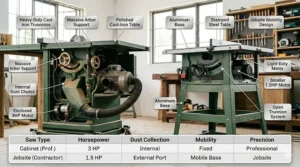
The Powermatic PM2000B earns its reputation through features that solve real-world problems most manufacturers ignore. The integrated retractable hydraulic caster system means you’re not bolting this 600-pound beast permanently to your floor—crank the handwheel and the saw lifts high enough to roll over door thresholds and shop debris. That alone saves hundreds compared to buying a separate mobile base that never quite fits right. The 3HP motor drives through a Poly-V belt system that runs smoother and quieter than the old triple-belt designs that sounded like angry hornets trapped in a coffee can.
What sets this apart is the arbor lock lever positioned above the table surface. No more crawling underneath with two wrenches while your back reminds you that you’re not 25 anymore. Change blades standing up like a civilized human being. The quick-release riving knife pops out without tools, and the blade tilt scale features both digital readout and adjustable angle indicators for repetitive bevel cuts—essential when you’re running 40 identical pieces for a cabinet job.
This cabinet table saw for professional applications shines in dedicated shops where the saw stays in one location most of the time but occasionally needs to shift for large projects or when the HVAC guy needs access to that vent you forgot was back there. The oversized cast iron table resists warping through humidity cycles, and the wide-stance trunnion system means blade height and angle adjustments turn smoothly even after years of sawdust infiltration.
Woodworkers consistently highlight the dead-flat table surface and the fence that locks down with enough authority to inspire confidence on expensive hardwood. The saw runs noticeably quieter than competing models, which matters during those 10-hour days when every decibel counts. Some note the digital readout isn’t backlit, making it harder to read in dim shop lighting—a minor complaint on an otherwise exceptional machine.
Pros:
✅ Integrated hydraulic casters eliminate separate mobile base expense
✅ Above-table arbor lock for civilized blade changes
✅ Poly-V belt system runs quieter than traditional designs
Cons:
❌ Digital readout lacks backlighting for dim shops
❌ 600+ pound weight demands concrete floor
Expect to invest in the $3,200-$3,900 range for the PM2000B with 50-inch fence. For professional shops where the saw needs occasional mobility without sacrificing accuracy, Powermatic delivers features competitors charge extra for.
3. Grizzly G1023RLX Cabinet Saw with Shop Fox Fence
The Grizzly G1023RLX proves you don’t need to mortgage the shop to get professional-grade performance. Wood Magazine awarded this the “Top Value” designation for good reason—the 53-inch rip capacity beats saws costing twice as much, while the serpentine belt drive system transfers power more efficiently and quietly than cheaper V-belt arrangements. The 3HP motor spinning at 4,200 RPM pushes through dense hardwoods without bogging down, and the precision-ground cast iron table arrives flat enough to pass the nickel test right out of the crate.
What’s remarkable is how Grizzly engineered cost out of the package without compromising where it counts. The Shop Fox Classic fence that comes standard rivals the precision of brand-name systems selling for $500 separately. The enclosed cabinet with 4-inch dust port captures the majority of sawdust, though it doesn’t quite reach the 99% levels of premium models—you’ll still want to run a floor sweep after a day of ripping. The quick-release blade guard and interchangeable riving knife meet modern safety standards without the complexity of flesh-sensing systems.
This saw targets budget-conscious professionals and serious hobbyists who understand that value means getting 90% of the performance for 60% of the cost. The G1023RLX handles production cabinet work, furniture building, and daily shop tasks without complaint. At 508 pounds, it’s substantial enough to dampen vibration but not so heavy that delivery becomes a logistical nightmare requiring a loading dock and forklift.
User reviews consistently mention the exceptional value proposition and surprisingly refined finish quality. The fence locks square and stays square through hundreds of cuts. Some woodworkers note the miter gauge could be more robust, though most professionals upgrade to an aftermarket sled system anyway. Initial setup requires careful calibration, but once dialed in, the saw holds its accuracy impressively.
Pros:
✅ Exceptional value at $2,100-$2,600 price point
✅ 53″ rip capacity handles full sheet goods
✅ Serpentine belt runs quieter than V-belt systems
Cons:
❌ Dust collection good but not premium-level
❌ Miter gauge feels economy-grade
The G1023RLX typically lists in the $2,100-$2,600 range, delivering cabinet saw performance at hybrid saw pricing. For professionals who prioritize results over brand prestige, Grizzly’s offering represents the smart money choice.
4. JET Deluxe XACTA Cabinet Saw (JTAS-10XL50-DX)
The JET Deluxe XACTA targets woodworkers who measure twice, cut once, then measure again because precision matters that much. The integrated digital angle readout displays blade tilt to 0.1-degree accuracy, eliminating the squinting-at-stamped-metal routine that wastes time and breeds mistakes. The commercial-grade XACTA fence system incorporates a digital display showing exact blade-to-fence distance, invaluable when you’re cutting matching sets where 1/32-inch variance ruins the whole batch. The 3HP motor delivers consistent power through a Poly-V belt system that stays cooler and quieter than traditional drives.
What distinguishes this cabinet table saw for professional use is the attention to workflow efficiency. The redesigned quick-release riving knife changes in seconds without tools, and the improved dust shroud channels debris directly to the 4-inch collection port rather than letting it drift around the cabinet interior. The magnetic paddle switch includes a safety key that prevents unauthorized startup—critical in shops with apprentices or when you’ve got a client touring the workspace.
This saw serves furniture makers, custom cabinetmakers, and small production shops where repeatability determines profitability. The cast iron wings provide stable support for wide panels, and the 50-inch rip capacity accommodates full sheet goods with room to spare. At 230V single-phase, it plugs into standard industrial circuits without requiring three-phase conversion that adds thousands to installation costs.
Professionals appreciate the smooth blade height and angle adjustments that stay precise through years of use. The fence locks down with positive engagement you can feel, and the digital readout remains accurate over time. Some users mention the dust collection works well but benefits from a cyclone separator to handle the volume a busy shop generates. The saw arrives partially assembled, requiring several hours of setup with a helper to attach wings and align components.
Pros:
✅ Digital angle readout provides 0.1-degree precision
✅ Integrated fence distance display for repeatability
✅ Quick-release riving knife changes without tools
Cons:
❌ Digital displays drain batteries faster than mechanical indicators
❌ Assembly requires 3-4 hours with helper
The JET Deluxe XACTA falls in the $3,000-$3,600 range depending on rip capacity configuration. For precision-focused professionals who value repeatable accuracy over manual calculations, the digital features justify the investment.
5. Shop Fox W1819 3HP Cabinet Saw
The Shop Fox W1819 delivers professional cabinet saw performance in a package that doesn’t require a loading dock and crane for delivery. At 539 pounds, it’s substantial enough to absorb vibration and stay planted during heavy cuts, yet manageable enough that three determined friends can wrestle it into a basement shop without hiring riggers. The 3HP Leeson motor pushes 4,300 RPM through a triple-belt drive system that transfers power smoothly even when you’re leaning into dense hardwood that would stall lesser machines.
The cast iron construction extends throughout—table, wings, trunnions—which means this saw will outlive your mortgage. The camlock T-fence system locks square with satisfying authority, and the 36-inch rip capacity handles the majority of professional woodworking tasks without requiring an extension table that eats precious floor space. The integrated riving knife and quick-release blade guard meet modern safety standards, while the magnetic switch with thermal overload protection prevents motor burnout during extended use.
This cabinet table saw for professional applications serves small shop operators and serious hobbyists who need commercial-grade results without commercial-grade pricing. The W1819 excels at furniture building, custom cabinetry, and general woodworking where precision and reliability matter more than maximum rip capacity. The enclosed cabinet with 4-inch dust port works effectively with shop vacs or dedicated dust collectors, keeping the workspace breathable during all-day milling sessions.
Users consistently praise the exceptional build quality at this price point and the smooth, vibration-free operation that inspires confidence on delicate cuts. The triple-belt drive runs noticeably quieter than single-belt systems. Some mention initial setup requires careful alignment of wings and fence, though this one-time investment pays dividends through years of accurate cutting. The standard miter gauge works adequately, though most professionals eventually upgrade to a precision sled system.
Pros:
✅ Heavy cast iron construction throughout for vibration control
✅ Manageable 539-pound weight for basement shops
✅ Triple-belt drive delivers smooth, reliable power
Cons:
❌ 36″ rip capacity limits full sheet goods without extension
❌ Standard miter gauge adequate but not exceptional
The Shop Fox W1819 typically runs $1,800-$2,300, positioning it as the value leader for serious woodworkers who need true cabinet saw performance without the premium price tag. For small shop professionals, this represents the sweet spot between quality and affordability.
6. Delta UNISAW 36-L336 with Biesemeyer Fence
The Delta UNISAW carries nine decades of engineering refinement that you can feel in every cut. The single-cast trunnion system eliminates the multi-bolt assembly that plagues cheaper saws, delivering vibration control that keeps a nickel standing on edge anywhere across the table surface during full-speed operation. The legendary Biesemeyer fence system moves smoothly across the full 36-inch capacity and locks with 1/64-inch accuracy—ask any old-timer what fence to trust when precision matters, and “Biesemeyer” is the answer before you finish the question.
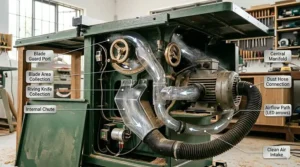
What separates this cabinet table saw for professional use from the competition is the cumulative effect of premium components working in harmony. The American-made Marathon motor delivers consistent 3HP power without the voltage sag that overseas motors exhibit under sustained load. The push-button arbor lock positioned above the table means blade changes happen standing up with a single wrench, while the tool-free split guard system with true rise-and-fall riving knife adjusts in seconds. The bi-level dust extraction system with sloped cabinet floor channels debris to a single 4-inch port more effectively than flat-bottom designs.
This saw serves traditional craftsmen, professional cabinetmakers, and woodworkers who view their tools as lifetime investments rather than depreciating assets. The UNISAW handles everything from delicate veneer work to ripping thick hardwood slabs, maintaining accuracy that newer competitors struggle to match even with digital assistance. At 624 pounds, this is a permanent installation that rewards proper setup with decades of reliable service.
Woodworkers consistently highlight the smooth, precise operation and the confidence that comes from using a saw trusted by generations of professionals. The single-cast trunnion eliminates alignment drift over time, and the fence stays true through years of daily use. Some note the premium pricing and that modern safety features like flesh-sensing don’t come standard, though the traditional guard system meets all OSHA requirements. Setup requires expertise—many buyers hire professional riggers for delivery and initial alignment.
Pros:
✅ Single-cast trunnion system for ultimate vibration control
✅ Legendary Biesemeyer fence accurate to 1/64″
✅ American-made Marathon motor for consistent power
Cons:
❌ Premium pricing at $3,400-$4,200
❌ 624-pound weight requires professional delivery
The Delta UNISAW 36-L336 represents the traditional choice for professionals who value proven engineering and lifetime durability. The $3,400-$4,200 investment buys a saw that will outlast most careers.
7. Grizzly G1023RLX5 5HP Cabinet Saw
The Grizzly G1023RLX5 brings serious industrial muscle to shops that process large volumes or work with dense exotics that laugh at underpowered motors. The 5HP motor maintains blade speed through cuts that would bog down 3HP competitors, while the massive 60-inch rip capacity handles full sheets and oversized panels without auxiliary support tables cluttering your workspace. The serpentine belt drive transfers that extra horsepower efficiently and quietly, and the precision-ground cast iron table provides the stable platform needed to manage large workpieces accurately.
What makes this exceptional is Grizzly’s value equation—specifications that typically demand $5,000+ saws delivered for thousands less through direct-sales efficiency. The Shop Fox Classic fence included with the package rivals premium systems, and the quick-release blade guard with interchangeable riving knife meets modern safety standards. The enclosed cabinet with optimized dust collection captures the majority of debris when paired with appropriate collection systems, though at high cutting rates you’ll generate sawdust faster than any 4-inch port can fully manage.
This cabinet table saw for professional applications serves production shops, custom millwork operations, and woodworkers who regularly tackle oversized projects or dense hardwoods. The extra horsepower means cleaner cuts through 3-inch+ thick stock without burning, and the extended rip capacity eliminates the awkward dance of repositioning large panels mid-cut. At 558 pounds, it’s substantial without being immovable—four people can wrestle it into position with furniture dollies and determination.
Users consistently praise the impressive power and the stability that comes from heavy-duty construction. The fence system holds accuracy across the full 60-inch travel, and the motor handles sustained production runs without overheating. Some mention initial setup requires careful alignment and patience, and the 240V 20-amp circuit demands professional electrical work if your shop isn’t already wired for industrial equipment. The larger footprint means you need adequate floor space—measure twice before ordering.
Pros:
✅ 5HP motor maintains speed through dense hardwoods
✅ 60″ rip capacity eliminates sheet repositioning
✅ Industrial performance at value pricing
Cons:
❌ Larger footprint requires adequate shop space
❌ Demands 240V 20A dedicated circuit
The G1023RLX5 typically runs $2,800-$3,400, delivering 5HP performance for less than competitors charge for 3HP models. For production-oriented professionals who need maximum power and capacity, this represents exceptional value.
How to Choose the Right Cabinet Saw: Decision Framework for Professionals
Making the leap to a cabinet table saw for professional use requires matching your specific needs to the saw’s capabilities rather than simply buying the most expensive model and hoping it works out. I’ve watched too many woodworkers drop $4,000 on a saw with features they’ll never use while skimping on the blade quality that actually determines cut quality. Let’s break this down into a decision tree that saves you from expensive regrets.
If you’re operating a one-person shop in a residential garage: Consider the Shop Fox W1819 or Grizzly G1023RLX. The smaller footprint and 36-53 inch rip capacity handle typical furniture and cabinet work without eating your entire workspace. Both deliver true cabinet saw performance for under $2,600, leaving budget for quality blades and accessories that matter more than brand names.
If multiple operators use the saw or you’re running a teaching workshop: The SawStop Professional Cabinet Saw isn’t optional—it’s liability insurance. The flesh-sensing technology prevents the catastrophic injuries that shut down shops and ruin lives. Yes, it costs $1,000-$1,500 more than comparable models, but your insurance company will likely reduce premiums enough to recoup that premium within three years.
If you work primarily with sheet goods and need maximum rip capacity: The Grizzly G1023RLX5 with 60-inch capacity or the Powermatic PM2000B with 50-inch fence eliminate the awkward gymnastics of repositioning plywood mid-cut. The extra horsepower on the G1023RLX5 becomes essential when you’re ripping twenty 4×8 sheets of MDF in a single afternoon—lesser motors bog down and burn edges.
If precision and repeatability determine your profit margins: The JET Deluxe XACTA’s digital readouts eliminate the measurement errors that compound across multiple identical pieces. When you’re cutting matching components for ten identical cabinets, the digital fence position display alone saves enough time to justify the premium pricing.
If traditional quality and lifetime durability matter more than modern features: The Delta UNISAW represents proven engineering that will outlast most careers. The single-cast trunnion and Biesemeyer fence deliver accuracy that newer competitors struggle to match, and parts availability remains excellent decades after purchase.
The real decision often comes down to electrical requirements. If your shop lacks 230V circuits, budget $400-$800 for professional installation before buying any of these saws. Don’t run a 3HP cabinet saw on 120V through extension cords—that’s how motors burn out and circuit breakers develop neuroses.
Common Mistakes When Buying Your First Professional Cabinet Saw
The biggest mistake I see is buying based on motor power alone while ignoring fence quality. A 5HP motor paired with a fence that deflects 1/16 inch under side pressure delivers worse results than a 3HP motor with a rigid fence system. The fence determines accuracy—the motor just determines whether you wait three seconds or five for the cut to complete. Every professional saw in this guide includes a quality fence, but aftermarket upgrades cost $300-$600 if you cheap out initially.
Another critical error is underestimating dust collection requirements. These saws generate massive amounts of fine particulate that will coat your lungs, rust your precision tools, and turn your shop into a sneezing nightmare without proper collection. A cabinet saw’s 4-inch dust port demands a dedicated dust collector rated for at least 650 CFM—shop vacs don’t cut it beyond hobby use. Budget $400-$800 for proper dust collection that will actually work at the volumes these saws produce.
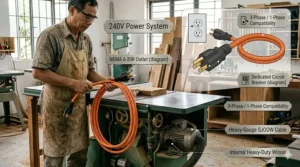
Many buyers fail to account for the electrical requirements until the saw arrives. Every model listed here requires 230V single-phase power, which means a dedicated 20-30 amp circuit run by a licensed electrician. If your shop currently runs on household 120V circuits, add $400-$800 to your budget for proper wiring. Running these motors on inadequate circuits leads to nuisance tripping, voltage drops that burn windings, and the kind of frustration that makes you question your life choices.
The floor surface matters more than most realize. Cabinet saws weighing 500-650 pounds will sink into wood floors, creating vibration and alignment issues. They need concrete or engineered floor systems to perform properly. If you’re setting up in a second-floor space or garage with wood joists, budget for structural reinforcement or accept that your precision will suffer as seasonal humidity cycles shift the foundation.
Don’t skip the mobile base decision until after purchase. Models like the Powermatic PM2000B include integrated casters, but most saws require a $200-$400 aftermarket mobile base if you need occasional mobility. Trying to retrofit one later often means disassembling and realigning the entire saw—ask me how I know.
Finally, resist the temptation to use the saw immediately upon arrival. Proper setup—aligning the blade parallel to miter slots, truing the fence, setting blade stops—requires 3-4 hours and determines whether you’ll spend the next decade fighting your tool or trusting it. Make test cuts on scrap lumber and verify your measurements before committing expensive hardwood to questionable alignment.
Cabinet Saw vs Hybrid vs Contractor: What You’re Actually Paying For
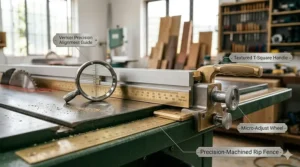
The terminology confuses buyers because manufacturers deliberately blur the lines—some “hybrid” saws cost more than entry-level cabinet models, while premium contractor saws approach hybrid pricing. Here’s what actually differentiates these categories beyond marketing labels.
True cabinet saws mount the motor inside a fully enclosed cabinet, with the trunnion assembly bolted directly to the cabinet rather than hanging from the underside of the table. This configuration delivers superior dust collection (the cabinet contains it), dramatically reduced vibration (the mass absorbs it), and better blade alignment stability (the mounting system doesn’t flex). Weight runs 500-650 pounds, requiring permanent or semi-permanent installation. Every saw in this guide qualifies as a true cabinet saw.
Hybrid saws attempt to bridge contractor and cabinet designs by enclosing the motor area while hanging the trunnions from the table. They weigh 275-350 pounds—heavy enough for decent vibration damping, light enough to move occasionally. Dust collection works better than open-frame contractor saws but doesn’t match true cabinet designs. They typically run on 120V household circuits, making them accessible for shops without industrial power. Expect to spend $800-$1,800 for quality hybrids.
Contractor saws hang the motor outside the saw frame on a hinged bracket, with trunnions suspended from the underside of the table. This open design makes dust collection challenging—most chips fall directly onto the floor. Vibration control suffers because the motor hangs where it amplifies rather than absorbs movement. They’re portable at 200-275 pounds and run on 120V power, making them suitable for jobsites or shops with limited infrastructure. Budget $600-$1,200 for decent contractor models.
The practical difference shows up in cut quality and operational efficiency. Cabinet saws maintain blade alignment through years of use, deliver glass-smooth cuts that need minimal sanding, and keep your shop cleaner through superior dust containment. Contractor saws work fine for occasional use but struggle with precision over time as hanging components settle and flex. Hybrids split the difference—adequate for serious hobbyists and light professional use, but they’ll never match cabinet saw accuracy and longevity.
For a cabinet table saw for professional use, the extra weight and permanent installation requirements pay dividends through superior performance and decades of reliable service. If you’re running a business where cutting accuracy affects profitability, cabinet saws eliminate the variables that contractor and hybrid models introduce.
Real-World Performance: What 3HP Actually Means in Dense Hardwood
Motor specifications sound impressive until you try ripping 3-inch Brazilian walnut and discover your “3HP” motor bogs down halfway through the cut. Not all horsepower ratings are created equal—actual performance depends on motor design, electrical supply quality, and belt drive efficiency.
A quality 3HP motor should maintain 4,000+ RPM while ripping 2-inch thick hardwood at a steady feed rate. You’ll feel the motor working, but blade speed shouldn’t drop noticeably. If you’re hearing RPM fluctuation or seeing burn marks on cut edges, either your motor is undersized for the task or you’re forcing the feed rate too aggressively. The sweet spot comes from matching feed pressure to motor capacity—push hard enough to keep sawdust flowing, but not so hard that you’re fighting the blade.
The 5HP option in saws like the Grizzly G1023RLX5 becomes essential when you’re working with extremely dense exotics like cocobolo or ebony, or when production demands require sustained heavy cutting. The extra power maintains blade speed during aggressive rips that would stall 3HP motors, and it recovers faster between cuts when you’re processing large quantities. Most professionals find 3HP adequate for typical hardwoods—oak, maple, cherry, walnut—but appreciate 5HP when tackling projects in dense tropical species.
Motor amp draw reveals more than horsepower ratings. A 3HP motor drawing 15 amps at 230V delivers approximately 3,450 watts of actual power. Cheaper motors claiming 3HP while drawing only 12 amps can’t possibly deliver equivalent performance—they’re gaming the specifications. The saw models recommended here use quality motors that meet their rated specifications honestly.
Belt drive systems significantly impact power delivery efficiency. Modern serpentine belts (like those in Powermatic and Grizzly models) transfer 98%+ of motor power to the blade with minimal slippage and vibration. Traditional V-belt systems lose 5-8% through friction and flex, especially as belts age and stretch. Poly-V drive systems run quieter, cooler, and require less maintenance than multi-belt arrangements.
Real-world blade performance depends equally on blade quality. A premium 40-tooth combination blade transforms how any saw cuts—smoother edges, less splintering, reduced tear-out on veneers. Don’t compromise here. Budget $50-$80 for a quality Freud or Forrest blade that will make your cabinet saw perform like it cost twice as much.
Safety Features That Actually Matter: Beyond Marketing Hype
Cabinet saw manufacturers love advertising safety features, but some matter considerably more than others. Let’s separate the critical protections from the marketing decoration.
Riving knives prevent the nightmare scenario that sends woodworkers to emergency rooms. When you’re ripping long boards, internal stresses sometimes cause the kerf to close behind the blade, pinching it and launching the workpiece backward at speeds that can break ribs or worse. The riving knife—a curved piece of metal positioned right behind the blade—keeps the kerf open and prevents catastrophic kickback. Every saw in this guide includes a quick-release riving knife that adjusts with blade height. Never remove it. Ever.
Blade guards shield your hands from the spinning blade above the table. Quality guards mount independently from the riving knife so you can use them together (as OSHA requires in commercial settings). The temptation to remove guards for certain cuts is strong, but that’s when accidents happen. Modern quick-release systems make it easy to reinstall guards between cuts—use them.
Push sticks and push blocks aren’t fancy, but they keep fingers away from blades during the last 12 inches of cuts where most injuries occur. Keep at least two within arm’s reach. When your hands get closer than 6 inches to the blade, switch to push devices. No workpiece is worth risking fingers.
Emergency stop switches should be accessible from your normal operating position and large enough to knee-activate if your hands are occupied. Magnetic switches prevent accidental restarts after power interruptions. Test your switch monthly—it’s the one safety device you need to work perfectly during emergencies.
The SawStop flesh-detection system deserves special mention because it represents a genuine breakthrough rather than incremental improvement. Detecting electrical conductivity through the blade, it triggers a brake cartridge that stops the blade and retracts it below the table in under 5 milliseconds—faster than your pain nerves can signal your brain. You’ll get a nick instead of an amputation. For shops with multiple operators, apprentices, or educational settings, this technology prevents the catastrophic injuries that close businesses and ruin lives. The $90 replacement cartridge after activation is insurance you’ll be happy to pay.
According to OSHA statistics, table saws cause over 30,000 injuries annually in the United States, with thousands resulting in amputations. Most occur during moments of distraction, fatigue, or unfamiliarity with the material. Safety devices don’t eliminate the need for proper technique and constant attention, but they significantly reduce injury severity when mistakes happen.
Dust Collection: Why Your Lungs Will Thank You Later
Here’s the uncomfortable truth: the fine dust generated by table saws contains particles small enough to bypass your nose’s natural filtration and embed deep in lung tissue. Years of exposure leads to chronic respiratory conditions that no amount of coughing will clear. Quality dust collection isn’t optional for professional woodworkers—it’s essential for long-term health and OSHA compliance.
Cabinet saws offer inherent dust collection advantages through their enclosed design. The sawdust generated below the table can’t escape—it’s captured inside the cabinet and channeled to a single 4-inch port. Compare this to contractor saws where dust rains directly onto the floor, or hybrid saws where some escapes around the motor. But “better” doesn’t mean “adequate” without proper extraction equipment.
A cabinet saw generating fine dust at full cutting speed produces 300-500 cubic feet per minute of debris-laden air. Your shop vacuum rated at 120 CFM can’t keep up—it’s like using a straw to empty a swimming pool. You need a dedicated dust collector rated for minimum 650 CFM at the tool, accounting for losses through hoses and fittings. Budget $400-$800 for entry-level collectors that actually work, or $1,500+ for two-stage systems with cyclonic separators that capture fine particles more effectively.
Hose sizing matters critically. A 4-inch dust port demands 4-inch hose all the way to the collector—any reduction creates bottlenecks that collapse suction. Smooth interior walls flow better than corrugated hose, though they cost more. Keep runs short and minimize bends where possible. Each 90-degree elbow reduces airflow by approximately 10%.
The SawStop, Powermatic, and Delta saws in this guide include optimized dust collection shrouds that channel debris directly toward collection ports. The Grizzly models work well but don’t quite reach premium levels—expect slightly more ambient dust during heavy cutting. The JET and Shop Fox saws fall in the middle, capturing the majority of debris with proper collector setup but allowing some fine particles to escape during aggressive rips.
Beyond the cabinet port, consider overhead blade guards with integrated dust collection. These capture the fine particles thrown upward by blade teeth—the ones most likely to become airborne and get inhaled. They’re expensive ($200-$400) and slightly awkward to work around, but dramatically improve air quality in enclosed shops.
Long-Term Costs: The Real Price of Cabinet Saw Ownership
The sticker price represents only the down payment on cabinet saw ownership. Let’s calculate the actual five-year cost so you’re not blindsided by expenses that should have been predictable.
Electricity consumption for a 3HP motor running 230V at 15 amps draws approximately 3.5 kilowatts. At typical industrial rates of $0.12 per kWh, that’s $0.42 per hour of operation. A professional shop running the saw 20 hours weekly pays roughly $440 annually in electricity costs. The 5HP Grizzly model draws proportionally more—budget $600-$700 annually for heavy use.
Blade replacement depends on usage intensity and material types. A quality 40-tooth combination blade lasts 6-12 months in typical professional use before dulling enough to affect cut quality. Budget $60-$80 for premium blades, or $40-$50 if you’re willing to compromise on brand names. Serious production shops cycle through 3-4 blades annually—$200-$300 yearly expense. Specialized blades for dadoes, plywood, or metal-cutting add $150-$300 to annual costs.
Maintenance and consumables remain minimal if you follow proper care routines. Table wax costs $15-$20 annually. Drive belts last 3-5 years at $40-$60 for replacements (less for premium serpentine belts that outlast traditional V-belts). Riving knife and insert replacement runs $50-$100 over five years. Budget approximately $100-$150 annually for routine maintenance supplies.
The SawStop brake cartridge deserves separate mention. At $90 per activation, it’s expensive insurance. Most woodworkers never trip the sensor, but those who do consider it $90 well spent versus emergency room bills and lost fingers. Budget conservatively for one replacement every 2-3 years if multiple operators use the saw, though many professionals never need replacement.
Electrical infrastructure requires one-time investment if your shop lacks 230V circuits. Professional electrician charges run $400-$800 for running a dedicated 20-30 amp line from your panel, depending on distance and local code requirements. This isn’t optional—don’t attempt to run these motors on inadequate circuits.
Mobile bases cost $200-$400 for aftermarket systems if you need occasional mobility. The Powermatic PM2000B includes integrated casters, saving this expense. Other models require separate purchase unless you’re planning permanent installation.
Over five years of professional use, total ownership costs approximate:
- Initial saw purchase: $2,000-$4,500
- Electrical installation: $400-$800 (one-time)
- Electricity (5 years): $2,000-$3,500
- Blades and maintenance: $1,000-$1,500
- Dust collection system: $400-$1,500
- Total: $5,800-$11,800
This calculation excludes the saw’s resale value, which remains substantial for quality brands. A well-maintained SawStop or Powermatic retains 50-60% of original value after five years, while Grizzly and Shop Fox models retain 40-50%. Factor in $1,000-$2,500 recoverable value when upgrading or retiring the saw.
Setup and Calibration: Getting Your Saw Running True
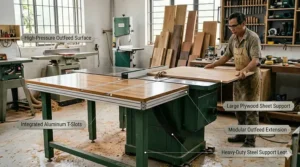
The difference between a cabinet table saw for professional use and an expensive frustration machine lies entirely in proper setup. Every saw arrives from the factory with adequate alignment for shipping, but “adequate” won’t cut casework joints that actually fit together. Plan 3-4 hours for initial calibration, preferably with a helper to lift heavy components.
Step 1: Verify table flatness. Use a precision straightedge or dial indicator to check the main table and extension wings. Acceptable flatness is 0.005 inches or less across the entire surface. Most quality saws arrive within tolerance, but shipping damage occasionally warps wings. Check before installing—returning a 600-pound saw for warranty work hurts more than catching issues early.
Step 2: Align blade parallel to miter slots. This is non-negotiable for accuracy. Raise the blade to maximum height and mark a tooth at the front of the blade with a marker. Measure distance from that tooth to the left miter slot. Rotate the blade 180 degrees until the marked tooth reaches the rear of the table. Measure again to the same miter slot. The measurements should match within 0.003 inches—any more deviation and your cuts will drift. Adjust by loosening cabinet-mounted trunnion bolts and shifting the entire mechanism until aligned.
Step 3: Set 90-degree and 45-degree blade stops. Use a precision square or digital angle gauge to verify blade perpendicularity to the table. Most saws include adjustment screws that stop blade tilt at precise angles. Set these carefully—furniture corners and cabinet miters depend on this accuracy. Check both positive and negative stops (left and right tilt) on saws with adjustable arbors.
Step 4: Align and square the fence. The fence face must run perfectly parallel to the blade—or slightly toe-out (1-2 thousandths of an inch wider at the back) to prevent binding. Use the same miter slot reference from step 2. Measure distance from slot to fence at front and rear positions across the full fence length. Adjust mounting bolts until parallel or with minimal toe-out. Lock everything down torque-tight once aligned.
Step 5: Verify with test cuts. Rip a straight-grained hardwood board 24 inches long and measure width at both ends. They should match within 1/32 inch. Make a 90-degree crosscut on scrap and check with a precision square. Make a 45-degree miter and assemble two pieces into a right angle. Gaps reveal alignment problems that need correction before starting real work.
Ongoing maintenance includes weekly table cleaning with mineral spirits to remove pitch buildup, monthly belt tension checks, and quarterly blade alignment verification. Lubricate height and tilt mechanisms with dry lubricant or specialized saw wax every 3-6 months depending on usage. Keep detailed records of adjustments—patterns reveal wear in specific components.
Practical Workflow Optimization: Making Your Saw Work Smarter
Owning a premium cabinet table saw for professional use doesn’t automatically improve your workflow—you need to optimize your process around the tool’s capabilities. Here are strategies that separate efficient professionals from those constantly fighting their equipment.
Dedicate the saw to ripping and crosscutting only. Don’t waste time converting it for dado operations or specialty cuts unless absolutely necessary. The setup time—adjusting blade height, changing inserts, swapping guards—kills productivity. Build a dedicated router table or invest in a dado-specific saw if you’re running production work requiring frequent changeovers.
Organize cutlists by operation type. Batch all rip cuts together, then all crosscuts, then angled cuts. Each operation type requires specific fence positioning and safety setups. Switching between operations mid-project wastes time and increases error rates when you’re mentally shifting between different techniques.
Use story sticks and stop blocks instead of measuring each piece individually. For production runs requiring identical lengths, clamp a stop block to your fence or crosscut sled at the exact measurement. Cut all identical pieces in sequence without measuring—this eliminates accumulating errors and dramatically speeds throughput.
Maintain multiple fence positions for common widths. If you’re repeatedly ripping 3/4-inch edge banding or 1-1/2-inch rails, mark those positions on your fence scale or add micro-adjustable stop collars. Quick repositioning between stored settings saves minutes per project that compound into hours monthly.
Keep a sacrificial plywood surface screwed to your table for operations that might score the cast iron. It’s cheaper to replace a sheet of 1/2-inch Baltic birch annually than repair gouges in precision-ground iron. This also provides a smooth, slippery surface that helps workpieces glide through cuts.
Zero-clearance throat plates reduce tearout dramatically on veneered plywood and cross-grain cuts. Buy blanks and cut custom plates for different blade angles rather than struggling with the factory insert’s wide gaps. The 30 minutes spent making proper inserts pays back instantly in improved edge quality.
Outfeed support isn’t optional when working alone with sheet goods. Roller stands, extension tables, or dedicated outfeed benches prevent workpieces from tipping off the back edge mid-cut—the moment when most binding and kickback occurs. Position support at exact table height to avoid workpiece rocking during cuts.
Dust collection timing matters for air quality. Start your collector before beginning cuts and let it run 3-5 minutes after finishing to clear fine particles from the air. Don’t shut down immediately—that lingering dust settles on everything and gets inhaled with each breath.
FAQ: Expert Answers to Common Cabinet Saw Questions
❓ How much should I spend on a cabinet table saw for professional use?
❓ Can I run a cabinet table saw on 120V household circuits?
❓ What's the difference between left-tilt and right-tilt cabinet saws?
❓ How often do I need to replace blades on a professional cabinet saw?
❓ What size dust collector do I need for a cabinet table saw?
Conclusion: Investing in Your Workshop’s Foundation
A cabinet table saw for professional use represents the largest single tool investment most woodworkers make—and rightfully so. This isn’t just another tool to stick in the corner; it’s the foundation upon which you’ll build every project for the next 20 years. The difference between adequate and excellent manifests in every joint that fits perfectly without adjustment, every miter that closes tight without gaps, and every career you build without catastrophic injury.
The seven saws profiled here represent the genuine leaders in their respective categories. The SawStop Professional Cabinet Saw delivers unmatched safety for environments where multiple operators or educational settings demand maximum injury prevention. The Powermatic PM2000B combines premium features with practical mobility through integrated casters. The Grizzly G1023RLX proves exceptional value doesn’t require compromising performance. The JET Deluxe XACTA targets precision-focused professionals who trust digital accuracy over mechanical indicators. The Shop Fox W1819 delivers cast iron quality at accessible pricing for small shop operators. The Delta UNISAW represents nine decades of proven engineering for traditionalists who value lifetime durability. The Grizzly G1023RLX5 brings industrial power to production-focused shops.
Your choice ultimately depends on matching specific needs to appropriate features. Safety-conscious operations gravitate toward SawStop. Budget-conscious professionals appreciate Grizzly’s value proposition. Precision-focused woodworkers value JET’s digital features. Traditionalists trust Delta’s proven engineering. There’s no single “best” option—only the best option for your specific situation, workspace, and budget.
What matters most is moving beyond contractor-grade compromises to equipment that delivers accuracy worthy of your craftsmanship. The investment pays dividends through superior cut quality, reduced waste, improved efficiency, and the confidence that comes from trusting your tools. Choose wisely, set up properly, and your cabinet saw becomes the reliable partner that elevates everything you build.
Recommended for You
- 7 Best Cabinet Saw with Router Table Options (2026 Guide)
- 7 Best 5 HP Cabinet Table Saw Models — 2026
- Best Powermatic Cabinet Saw 2026: 7 Models That Transform Your Workshop
Disclaimer: This article contains affiliate links. As an Amazon Associate, I earn from qualifying purchases. If you purchase products through these links, we may earn a small commission at no additional cost to you.
✨ Found this helpful? Share it with your friends! 💬🤗
