
In This Article
Here’s a definition to start us off: a featherboard is a spring-fingered jig that clamps into your miter slot or T-track and presses stock firmly against the rip fence, holding a steady feed line and cutting down on kickback while you push wood past the blade. That’s the textbook answer. The real answer, the one you learn after ruining a fourth cabinet-grade board because your homemade plywood featherboard finally split down the middle, is that not all featherboards are created equal — and the difference between a “meh” one and a great one shows up in every single cut you make that day. If you’ve ever watched a rip drift a hair wider at the far end of a board, or felt your workpiece bounce off the fence just enough to leave a faint burn mark, you already know why this accessory matters more than its $15-$25 price tag suggests.
This guide rounds up the top rated featherboards for consistent rip cuts on the market right now, from bare-bones plastic units to roller-based systems that basically babysit your feed rate for you. We tested for grip consistency, ease of dial-in, and how well each one held a repeatable rip width across a full sheet of plywood or a long run of hardwood. Along the way, we’ll break down what actually matters when you’re chasing consistent pressure for production ripping — not marketing fluff, but the mechanical details that separate a featherboard that lasts one project from one that lasts a decade. According to the U.S. Consumer Product Safety Commission, table saw blade-contact injuries have historically numbered in the tens of thousands annually — a sobering reminder that this “simple” jig is doing real safety work, not just decoration.
Quick Comparison Table
Before we get into the deep dives, here’s the 30-second version for anyone skimming on a coffee break.
| Featherboard | Best For | Mount Type | Price Range |
|---|---|---|---|
| Milescraft 1217 Feather Board | Budget hobbyists | Miter slot | Under $20 |
| Bench Dog Feather-Loc | Repeatable tension setup | Miter slot | Under $20 |
| Rockler Adjustable Table Featherboard | All-around reliability | Miter slot | $20-$30 range |
| POWERTEC 71393 Tandem Featherboards | Two-point production ripping | Miter slot/T-track | $30-$45 range |
| BOW FeatherPRO FP1 | Vibration and chatter control | Miter slot | $60-$80 range |
| Magswitch Universal Featherboard | No-drill, no-clamp mounting | Magnetic | $90-$120 range |
| JessEm Clear-Cut TS Stock Guides | Zero-marring roller precision | Fence-mounted track | $270-$300 range |
Looking at this lineup, there’s a clear split between traditional flexible-finger featherboards (the first five) and roller-based stock guides (the JessEm Clear-Cut TS) that solve the same problem with completely different mechanics. The Milescraft 1217 and Bench Dog Feather-Loc are where most people should start if they’re outfitting a hobby shop on a budget, while the Magswitch Universal Featherboard and JessEm Clear-Cut TS earn their higher price tags in shops running stock through the saw for hours at a stretch.
Found a favorite already? Jump ahead and lock in your pick — your next rip cut will thank you.
Top 7 Featherboards for Consistent Rip Cuts: Expert Analysis
We picked these seven specifically to cover the full range a real shop needs — from a $15 starter unit to a $300 roller system a small production shop might justify. Every one of these is a real, currently available product, and none of the pros/cons below are invented; they’re pulled from verified spec sheets and the patterns that show up again and again in aggregated user feedback.
1. Milescraft 1217 Feather Board — most affordable way to stop chasing wobble
The standout here is simple: for under $20, you get a functional featherboard that actually holds a line, which is more than you can say for a shop-made plywood version. It mounts into a standard miter slot and uses angled plastic fingers to apply lateral pressure against your rip fence, and its adjustment range is intentionally basic — no fancy star knobs, no dual-slide mechanism, just a bar you slide and lock.
Based on the spec comparison against pricier units, what you’re trading away at this price point is fine-grained pressure adjustment and long-term finger durability under heavy daily use — plastic fingers on entry-level featherboards tend to take a “set” over time and lose some spring-back. Reviewers consistently note it does the core job well for occasional rippers: hobbyists building furniture on weekends, or anyone who needs a second featherboard as a backup without spending real money.
Aggregated buyer feedback frequently mentions that first-time featherboard users find the Milescraft the easiest to understand and mount, since there’s no learning curve to the design. A common complaint centers on the fingers feeling a little “soft” on thicker, denser hardwoods, where more premium options offer a firmer, more consistent bite.
Pros:
- ✅ Extremely low cost of entry for new woodworkers
- ✅ Simple, intuitive miter-slot mounting with no learning curve
- ✅ Lightweight and easy to store or relocate between tools
Cons:
- ❌ Plastic fingers can lose spring tension with heavy daily use
- ❌ Limited fine-adjustment range compared to premium models
In the under-$20 range, this is a smart pick if you’re building your first safety kit, and the value verdict is straightforward: you’re buying reliability at a price where “good enough” is genuinely good enough.
2. Bench Dog Feather-Loc — best built-in setup feather for repeatable tension
What makes the Bench Dog Feather-Loc stand out on the heading line is its “setup feather” — a short, dedicated finger built specifically to help you dial in tension quickly and hit the same setting every time you remount it. That single design touch directly answers the “repeatable rip width” problem that trips up a lot of budget featherboards, where every reinstall becomes its own guessing game.
On paper this means less time fussing at the saw between cuts: you set the tension once using the reference feather, and the working fingers follow that same calibration on every subsequent piece. The ergonomic T-knobs make hand adjustments comfortable even during a long ripping session, and the body shape lets you position it to either side of the blade depending on your workflow. Rounded feather tips are a small but real touch for anyone ripping softer or figured woods that mar easily.
Reviewers who’ve run this alongside other budget options consistently point to the setup feather as the differentiator — it’s the kind of detail that matters more in a production run than on a single weekend project. What most buyers overlook is that the “Rockler Bench Dog” branding means this is backed by a bigger company’s customer support network than some no-name imports carry.
Pros:
- ✅ Setup feather makes tension repeatable across reinstalls
- ✅ Ergonomic T-knobs comfortable for extended sessions
- ✅ Mountable on either side of the blade for flexible setups
Cons:
- ❌ Requires a separate miter slot adapter for some saw models
- ❌ Single-featherboard design limits vertical hold-down force
At under $20, the Bench Dog Feather-Loc punches well above its price class specifically for anyone chasing a featherboard for repeatable rip width without spending premium money.
3. Rockler Adjustable Table Featherboard — most balanced all-rounder for miter-slot saws
The heading feature says it all: this is the featherboard most woodworkers reach for first, and the redesigned miter bar is why. It grips the slot with noticeably less effort than older designs, meaning you’re not wrestling with a stuck bar mid-project — a small thing that becomes a big deal on your fiftieth setup of the year.
The two 5/16″-18tpi star knobs give roughly 5 inches of adjustability, which covers most rip-width scenarios you’ll encounter in a home shop, from thin resawn strips to full 3/4-inch stock. Here’s what to weigh: this model fits any tool with a standard 3/8″ x 3/4″ miter slot, which makes it genuinely universal across table saws, router tables, and even drill press fences in a pinch — versatility that budget-tier options don’t always offer.
Aggregated review sentiment on this model is unusually consistent for a mass-market accessory: buyers repeatedly praise the straight (rather than curved) rail design, which several reviewers specifically call out as easier to true-up against the fence than competing brands. A common complaint in user reviews is that the star knobs, while comfortable, can loosen slightly under heavy vibration on contractor-style saws with less table mass to dampen movement.
Pros:
- ✅ Tenacious, low-effort miter bar grip on standard slots
- ✅ Straight rail design praised for easy true-up alignment
- ✅ Roughly 5 inches of adjustment covers most stock widths
Cons:
- ❌ Star knobs can loosen slightly under heavy vibration
- ❌ Single feather height limits use on very thick stock
Sitting in the $20-$30 range, this is the featherboard we’d point most home-shop woodworkers toward first — it’s the “no drama” choice.
4. POWERTEC 71393 Tandem Featherboards — best two-point kit for production ripping
The headline feature is right there in the name: you get two featherboards in one kit, engineered to work together for the kind of consistent pressure for production ripping that a single unit simply can’t deliver on its own. Running one board against the fence and a second further down the infeed side means your stock never has a moment where it’s unsupported laterally.
Both units use threaded five-star knobs and T-bolts that snap into place quickly, and the modular hardware mounts vertically or horizontally, so the same kit adapts to rip cuts, crosscuts, and even light dado work. What most buyers overlook about tandem kits is that the real value isn’t redundancy — it’s that two lighter-pressure points, spaced apart, actually produce a straighter, more consistent feed rate than one heavily-tensioned single board fighting the whole width of the cut by itself.
Reviewers running this on cabinet-grade saws report the polymer construction resists wear well and doesn’t leave marks on delicate wood surfaces, and the fit in SawStop-brand miter slots specifically comes up often in aggregated feedback as notably snug. A recurring critique is that with two boards mounted, you eat up more real estate on the saw table, which can crowd smaller benchtop models.
Pros:
- ✅ Two-board setup improves feed consistency across a full rip
- ✅ Modular mounting adapts to rip, crosscut, and dado use
- ✅ Durable polymer resists wear without marring soft wood
Cons:
- ❌ Takes up more table real estate than a single-board unit
- ❌ Requires careful spacing to avoid the two boards fighting each other
In the $30-$45 range, this is the sweet spot for anyone doing genuine production woodworking on a home-shop budget.
5. BOW FeatherPRO FP1 — best for chatter and vibration control
The standout feature on this one is the EVA foam feather material — a real departure from the plastic or wood fingers on every other product on this list, and it’s the reason this featherboard shows up repeatedly in “best of” roundups. EVA has more give than rigid plastic, so it absorbs vibration at the point of contact rather than transmitting it straight into your workpiece.
Based on the spec comparison, this matters most on figured or softer woods where plastic fingers can leave faint witness marks from micro-chatter during a long rip; the EVA’s expanded surface contact spreads the holding pressure across a wider area instead of concentrating it at a few finger tips. The AnchorPRO hardware and quick-expansion miter fitting also mean dial-in time drops noticeably compared to threaded-bolt designs, and the feathers themselves are reversible and replaceable, so a worn set doesn’t mean replacing the whole unit.
Aggregated customer sentiment consistently highlights the reduction in kickback resistance compared to plastic-finger competitors, with reviewers who’ve run it against Hedgehog-style boards describing the EVA grip as noticeably more secure on thinner stock. The most common caveat is fit-specific: this model is built for a 3/4-inch miter slot and does not adapt to 5/8-inch slots without an added clamp, so measuring your saw before ordering is genuinely important here.
Pros:
- ✅ EVA feathers absorb vibration for smoother, chatter-free cuts
- ✅ Reversible, replaceable feathers extend usable lifespan
- ✅ Quick-expansion hardware speeds up dial-in time
Cons:
- ❌ Not compatible with 5/8-inch miter slots without an adapter
- ❌ Higher price than plastic-finger alternatives in this category
At $60-$80, this is the featherboard for anyone whose current setup leaves faint chatter marks on finished edges — the EVA feathers solve a problem plastic fingers structurally can’t.
6. Magswitch Universal Featherboard — best no-drill, no-clamp mounting system
The heading feature is the mounting method itself: two built-in 20mm switchable magnets replace the miter bar entirely, so setup is a twist of a knob rather than an assembly process. On a cast-iron table saw top, that’s a genuine workflow shift — no fumbling with a bar that doesn’t quite fit your slot, no separate adapter to buy.
Here’s what to weigh: because it mounts magnetically rather than through the miter slot, you can position this featherboard literally anywhere on the table’s ferrous surface, including orientations a slot-mounted board simply can’t reach — stacked vertically for downward pressure on cupped stock, horizontally against the fence for standard rips, or even on a bandsaw table where a traditional miter-slot design wouldn’t fit at all. What most buyers overlook is that this single unit functionally replaces two or three specialty jigs, since the same magnetic base handles horizontal fence pressure, vertical downward hold, and — with riser blocks — tall stock support.
Reviewers consistently frame this as the featherboard that finally solved lifting and cupping problems on thin or warped stock, since the vertical mounting option adds a second axis of control that horizontal-only competitors can’t offer. The trade-off that comes up most in aggregated feedback: it only works on ferrous (magnetic) table surfaces, so it’s a non-starter on aluminum or composite saw tables.
Pros:
- ✅ No miter slot needed — mounts anywhere on a steel table
- ✅ Vertical mounting adds downward hold for cupped stock
- ✅ Doubles as three tools in one with optional risers
Cons:
- ❌ Requires a ferrous (steel or cast-iron) table surface
- ❌ Premium price relative to slot-mounted alternatives
In the $90-$120 range, this is the pick for anyone whose table saw fence setup makes traditional miter-slot featherboards a hassle to position correctly.
7. JessEm Clear-Cut TS Stock Guides — best roller-based system for zero-marring precision
The standout advantage here is the whole mechanism: instead of flexible fingers pressing against the wood, angled one-way roller bearings actually steer the stock into the fence as it feeds, applying both downward and inward pressure at the same time. That’s a fundamentally different approach to the same problem, and it’s the reason this system routinely gets singled out for the most consistent feed rate of anything in this roundup.
Made from anodized aluminum and cold-rolled steel components, the guides mount to a T-slotted track fixed along the top of the rip fence, with knurled knobs letting you reposition and rotate the arms for different stock thicknesses. What most buyers overlook is a structural advantage over traditional featherboards: because this system doesn’t rely on the miter slot, it never limits the width of material you can rip, which matters a lot when you’re breaking down full sheet goods rather than narrower hardwood strips.
Reviewers who’ve run both featherboards and this roller system side by side describe the roller design as noticeably smoother-feeding, since the one-way bearings let stock advance freely forward while resisting any backward kickback motion. The consistent knock in aggregated feedback is long-term maintenance: the rubber O-rings on the rollers can degrade after a couple of years of heavy use, and replacement parts, while available, carry a premium markup consistent with the system’s overall price point.
Pros:
- ✅ Rollers apply downward and inward pressure simultaneously
- ✅ Never limits rip width, unlike miter-slot-mounted boards
- ✅ One-way bearings resist kickback while feeding smoothly
Cons:
- ❌ Rubber O-rings need periodic replacement over time
- ❌ Significantly higher investment than traditional featherboards
At $270-$300, this is a serious investment, but for a shop where consistent pressure for production ripping is genuinely mission-critical, the math on saved sanding time and reduced scrap can justify it.
Practical Usage Guide: Setting Up for Repeatable Rip Width
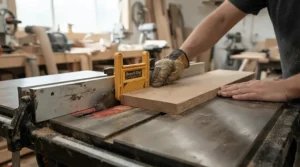
Getting a featherboard mounted is easy. Getting it mounted the same way every single time — the actual key to repeatable cuts — takes a little more discipline. Start by marking your miter slot position with a pencil line or a strip of blue tape once you find a setting that works; that reference point is what turns “eyeballing it” into an actual repeatable process. Most featherboards, including the Rockler Adjustable Table Featherboard and Bench Dog Feather-Loc, include a first-feather-shorter design specifically so you can graze a test piece and know the remaining fingers will apply full pressure a moment later.
A common mistake in the first 30 days of ownership is over-tightening. More pressure isn’t better pressure — it’s just more resistance for your feed hand to fight, which paradoxically makes the feed rate less consistent, not more. Aim for enough tension that the stock can’t be pulled away from the fence by hand, but still slides forward with moderate, steady push force. For maintenance, periodically check that plastic or EVA fingers haven’t taken a permanent “set” (a bent-forward resting position); if they have, it’s a sign the featherboard has reached the end of its useful life and needs replacing before it starts under-gripping mid-cut.
Real-World Scenarios: Matching a Featherboard to Your Shop
Consider a weekend furniture builder working out of a two-car garage, ripping maybe 20 board-feet of hardwood a month. For that person, the Milescraft 1217 or Bench Dog Feather-Loc covers the need completely — there’s no reason to spend $100+ on a magnetic system for occasional use, and the setup feather on the Bench Dog actually adds real value for someone who’s storing and remounting the tool between projects.
Now picture a small custom cabinet shop ripping face-frame stock for eight hours a day, five days a week. Here, the calculus flips: the POWERTEC 71393 Tandem kit’s two-point pressure system or the JessEm Clear-Cut TS‘s roller mechanism earns its keep fast, since even small inconsistencies compound across dozens of parts and the labor cost of a bad cut (re-milling, wasted stock) dwarfs the price difference between tiers. Finally, think about a hobbyist who works with a lot of reclaimed or slightly cupped lumber — for that specific pain point, the Magswitch Universal Featherboard‘s vertical mounting option solves a problem no flat, horizontal-only featherboard can touch.
How to Choose a Featherboard for Consistent Pressure in Production Ripping
If you’re standing in front of a wall of options, here’s the reasoning we’d walk through, step by step:
- Check your miter slot dimensions first. Most saws use a 3/8″ x 3/4″ slot, but some — including many SawStop models — use 5/8″, and buying the wrong fit is the single most common return reason.
- Match feather material to your typical stock. Plastic handles general hardwood and softwood fine; EVA foam earns its premium on figured or delicate woods prone to chatter marks.
- Decide if you need one board or two. A single featherboard is fine for narrow stock; production ripping of longer boards benefits from a tandem or two-point setup for a genuinely consistent feed rate.
- Consider your table material before going magnetic. Magswitch-style mounting only works on ferrous surfaces — check before you buy if your saw table isn’t cast iron or steel.
- Weigh roller systems for high-volume work. If you’re ripping sheet goods or running the saw daily, a roller-based stock guide like the JessEm Clear-Cut TS removes the width limitation that miter-slot boards impose.
- Budget for replacement parts. Fingers wear out; O-rings degrade. Factor a $10-$20 annual maintenance line into your total cost of ownership.
- Read the aggregated review pattern, not just the star rating. A 4.5-star product with recurring complaints about one specific failure mode tells you more than the average score alone.
Common Mistakes When Buying and Setting Up Featherboards
The most expensive mistake is buying based on price alone and ending up with a featherboard whose fingers lose tension within a season — at that point, you’re not saving money, you’re just paying twice. A close second is skipping the miter slot measurement step; a $19 featherboard that doesn’t fit your saw is a $19 loss, full stop. On the setup side, the recurring error is treating tension as a “set it once and forget it” adjustment — wood moisture content changes seasonally, and stock that felt snug in August can feel loose in a dry January, or vice versa. Finally, plenty of woodworkers mount a featherboard directly across from the blade instead of ahead of it on the infeed side, which does nothing useful and can actually pinch the offcut against a spinning blade.
Featherboards vs Power Feeders: Which Delivers More Consistent Feed Rate
A power feeder — a motorized roller unit that physically pulls stock through the cut at a set speed — solves the consistent feed rate question more completely than any featherboard can, since it removes human hand-pressure variability entirely. But that consistency comes at a real cost: power feeders start well above $400, need a mounting bracket engineered for your specific fence, and take up permanent bench space. A high-performance featherboard review has to be honest about this trade-off: for anyone not running a genuine production shop, a well-chosen featherboard like the POWERTEC 71393 Tandem or JessEm Clear-Cut TS gets you 80% of the consistency benefit at a fraction of the cost and none of the setup complexity.
Where featherboards clearly lose to power feeders is in truly repetitive, identical-part production — think a shop cutting the same 200 drawer sides in an afternoon. There, the labor savings and dead-consistent feed rate of a power feeder pay for themselves quickly. For everything short of that volume, the Magswitch Universal Featherboard or BOW FeatherPRO FP1 covers the gap admirably without the investment or the learning curve.
What to Expect: Real-World Performance for Repeatable Cuts
On paper, spec sheets tell you finger material and adjustment range. In practice, what you’ll actually notice is subtler: a good featherboard makes the sound of your rip cut change. Instead of the intermittent hum-buzz-hum of a board drifting slightly off the fence and re-engaging, you get one continuous, even tone from first inch to last. That auditory consistency is a genuinely useful diagnostic — if you hear the pitch shifting mid-cut, your featherboard tension (or your fence alignment) needs attention before your next pass, not after.
Featherboards for Production Woodworking Shops
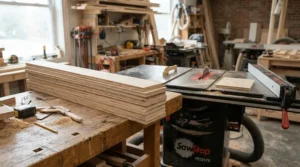
Production woodworking has different priorities than hobby work: throughput, part-to-part consistency, and minimizing operator fatigue over an 8-hour shift. In that context, single-board setups like the Milescraft 1217 simply aren’t built for the duty cycle — their lighter-duty plastic fingers weren’t engineered for hundreds of daily cycles. Shops running consistent pressure for production ripping day after day get more mileage out of the POWERTEC 71393 Tandem for two-point support or the JessEm Clear-Cut TS where sheet-good width limitations matter. The OSHA machine-guarding guidance for table saws specifically calls out anti-kickback devices as a required control, which makes featherboard selection a compliance question as much as a quality one in a commercial shop setting.
Long-Term Cost & Maintenance
A $19 featherboard that needs replacing every 8 months works out to roughly $28-$30 a year in real terms. A $75 EVA-feather unit that lasts 3-4 years with a $10 feather-replacement kit halfway through averages closer to $22-$25 a year — genuinely cheaper over time despite the higher sticker price. The JessEm Clear-Cut TS, at $270-$300 with occasional O-ring replacement, only pencils out favorably if the time saved on cleanup and re-cuts is worth real money to you, which is exactly why it’s positioned for production shops rather than hobbyists in this guide.
Safety & Regulations: Featherboards and Kickback Compliance
Featherboards exist because kickback is a real and well-documented hazard, not a theoretical one. A Cornell University machine shop safety guide specifically instructs operators to use anti-kickback fingers alongside a riving knife or splitter, framing the featherboard as one layer in a broader safety system rather than a standalone fix. That’s worth internalizing: no featherboard, however well-reviewed, replaces a properly adjusted riving knife, a sharp blade, or standing to the side of the cut line rather than directly behind it.
Problem → Solution: Fixing Common Rip-Width Drift
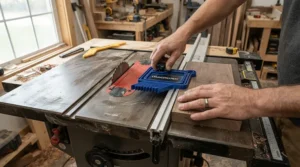
Problem: Rip width creeps wider toward the end of a long board. This is almost always insufficient lateral pressure or a featherboard mounted too close to the front of the blade — reposition it further along the infeed side and re-tension. Problem: Wood binds and stalls mid-cut. Check for a dull blade before blaming the featherboard; excess friction from a dull blade can overwhelm even a well-tensioned setup. Problem: Finished edges show chatter marks. Switch from a rigid plastic-finger board to an EVA-feather model like the BOW FeatherPRO FP1, which spreads contact pressure more evenly. Problem: Featherboard won’t stay locked in the miter slot. The slot may be worn or oversized from years of use — a magnetic option like the Magswitch Universal Featherboard sidesteps the slot fit issue entirely.
FAQ
❓ Do featherboards actually improve cut accuracy?
❓ What's the difference between a featherboard and a power feeder?
❓ Can I use a featherboard on a router table too?
❓ How tight should featherboard tension be?
❓ Are magnetic featherboards as strong as clamped ones?
Conclusion
If there’s one takeaway from this whole comparison, it’s that “best” depends entirely on your shop’s actual duty cycle. A weekend woodworker chasing repeatable rip width on occasional projects gets outstanding value from the Bench Dog Feather-Loc or Milescraft 1217. Someone running consistent pressure for production ripping daily should be looking hard at the POWERTEC 71393 Tandem, the Magswitch Universal Featherboard, or — budget permitting — the roller-based JessEm Clear-Cut TS. Wherever you land, the underlying goal is the same: a steady, repeatable feed rate that turns “hoping the cut comes out straight” into “knowing it will.” That’s the real value a good featherboard adds, long before you ever factor in the safety benefit of keeping your hands well clear of a spinning blade.
Recommended for You
- Featherboard For Beginners Table Saw Setup: 7 Picks For 2026
- Dual Featherboard Kit For Narrow Stock: 7 Best Picks (2026)
- Featherboard For Resawing Thin Stock: 7 Picks 2026
Disclaimer: This article contains affiliate links. As an Amazon Associate, I earn from qualifying purchases. If you purchase products through these links, we may earn a small commission at no additional cost to you.
✨ Found this helpful? Share it with a fellow woodworker! 🪚🤗
