
In This Article
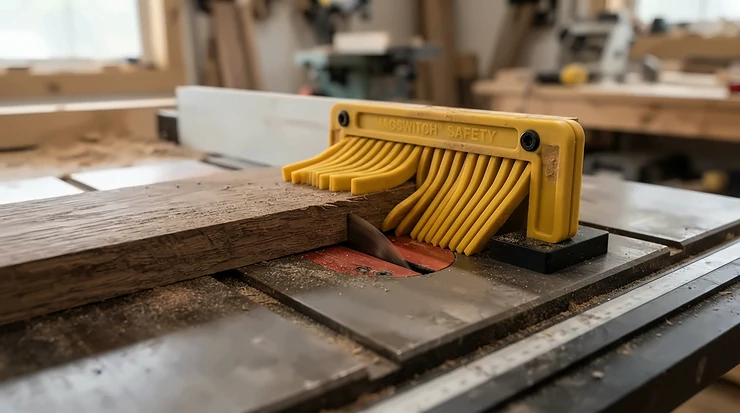
Thin stock has a mind of its own on a table saw. Feed a strip that’s a quarter-inch or thinner without help, and it wanders, chatters, and sometimes lifts right off the table the second the blade bites in. That’s the exact moment a featherboard for resawing thin stock earns its keep. It’s a simple wedge of angled fingers — plastic, foam, or wood — that presses your workpiece flat against the fence and table with steady, forward-only pressure, so the strip can’t drift sideways or ride up into the blade.
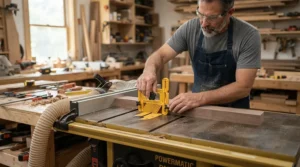
For anyone slicing veneer, bookmatched panels, or thin trim strips, that steady pressure is the difference between a clean, repeatable cut and a ruined board (or worse, a kicked-back one). This guide walks through seven real, current featherboards — from budget clamp-on models to magnetic setups that mount anywhere — and breaks down which one actually earns a spot on your saw table.
What is a featherboard for resawing thin stock? It’s a safety accessory with flexible, angled fingers that hold narrow or thin material firmly against a table saw’s fence, applying consistent forward pressure that resists the cutter’s rearward force while still allowing the stock to feed through smoothly. For thin resaw cuts specifically, the featherboard also keeps a strip from lifting off the table as it thins out mid-cut — arguably the single most dangerous moment in the whole operation.
Quick Comparison Table
| Featherboard | Mount Type | Best For | Price Range |
|---|---|---|---|
| MicroJig GRR-RIPPER | Handheld 3D pushblock | Thin rips down to 1/8″ | $50-$100 |
| Bow Products FeatherDUO FP3 | Miter slot, stackable | Resaw specialists / veneer | $60-$70 |
| Magswitch Universal Featherboard | Magnetic (no slot needed) | Fast setup, cast-iron tables | $70-$90 |
| Rockler Adjustable Double Table Featherboard | Miter slot | Budget resaw / on-edge stock | $20-$35 |
| Kreg True-FLEX Twin Pack | Miter slot or T-track | Consistent flex, dual setup | $35-$45 |
| Milescraft 1407 Dual/Tandem | Miter slot | Table saw + router table combo | $25-$30 |
| Bosch 2-Pack (RA1171 + RA1181) | Miter slot / auxiliary fence | Entry-level, first-time buyers | $20-$30 |
Looking at the spread above, the pricing tells its own story: you’re paying a premium for either mounting flexibility (Magswitch’s magnets skip the miter slot entirely) or for purpose-built resaw geometry (the Bow Products FeatherDUO FP3‘s stackable EVA feathers). Budget picks like the Bosch 2-Pack and Milescraft 1407 get the job done on standard rips but ask more of your setup skills once stock drops under 3/16″. If thin resawing is a recurring task rather than an occasional one, the extra $30-$50 for a dedicated system pays for itself the first time it saves a strip — or a finger.
Just one click — help others make better buying decisions too! 😊
Top 7 Featherboards for Resawing Thin Stock: Expert Analysis
1. MicroJig GRR-RIPPER — precision thin rips down to 1/8″
The standout here isn’t the pushblock body — it’s the accessory ecosystem built around it. Pair the base GRR-RIPPER with the 1/8″ leg accessory and you can rip strips as thin as 1/8″ safely, accurately, and consistently on a table saw, which is a genuinely different category of thin-stock control than a stationary featherboard offers.
Spec-wise, the base unit is a 3D pushblock system offering guidance, accuracy, and safety, fully adjustable to tackle tough cuts, with 3-directional force for total control of the workpiece. In practice, that means the block grips from above and the side simultaneously, so even after your fingers would normally be too close to the blade, the tool is still doing the holding. Add the 1/8″ leg and it converts from a general-purpose pushblock into a dedicated thin-rip guide — no separate accessory purchase, no swapping jigs mid-project.
Who’s this for? Anyone making repeated thin strips — edge banding, inlay, model parts, or veneer test cuts — where the workpiece is too narrow to safely hand-feed with just a fence and a push stick. Reviewers on woodworking deal boards consistently call it their favorite pushblock for the table saw, citing the combination of grip and control as the reason it stays mounted permanently rather than getting pulled out only for special cuts.
Pros:
- ✅ Rips consistently down to 1/8″ with the leg accessory
- ✅ Three-directional grip virtually eliminates kickback risk
- ✅ Works across table saw, router table, and band saw
Cons:
- ❌ 1/8″ leg accessory sold separately from the base unit
- ❌ Handheld design needs practice to feed smoothly at first
Pricing for the base GRR-RIPPER typically runs in the $50-$100 range depending on model (Standard vs. Advanced vs. MAX bundles), with the 1/8″ leg accessory adding roughly $15-$20 more — check current price, as bundle deals surface often. For anyone regularly slicing thin strips, the combined cost still lands well under what a dedicated power feeder would run, and the value case is strong.
2. Bow Products FeatherDUO FP3 — stackable EVA feathers built for resaw
What most buyers overlook about this model is that it isn’t really “one featherboard” — it’s a modular system. The standout feature is that its high-density EVA foam feathers provide 5x greater kickback resistance than traditional materials, and the modular design allows for easy stacking and feather replacement, which matters enormously once you’re resawing stock that starts thick and finishes thin mid-cut.
Based on the spec comparison with plastic-fingered competitors, the EVA foam construction changes the physics of the pressure: foam compresses and rebounds instead of flexing rigidly, so it can track a workpiece that’s shrinking in thickness as material peels away, without losing contact. Patented AnchorPRO hardware guarantees a secure, ergonomic fit, and because feathers are replaceable, a worn set doesn’t mean replacing the whole unit.
Reviewers consistently report that the foam fingers grip better than plastic and hold up longer without snapping — a common failure point on cheaper boards after repeated use. Customer reviews average 4.7 out of 5 stars across 316 ratings, which is a strong signal of reliability at scale, not just a happy early-adopter sample. Separately, professional reviewers testing the related GuidePro system for bandsaw resawing found it both locks down securely and keeps boards tight to the fence, delivering outstanding performance during heavy resaw work — the same engineering philosophy carries into the FP3’s table saw configuration.
Pros:
- ✅ EVA foam feathers track thinning stock without losing grip
- ✅ Stackable design adapts to different resaw thicknesses
- ✅ Feathers are replaceable instead of replacing the whole unit
Cons:
- ❌ Higher price point than basic plastic featherboards
- ❌ Bulkier footprint takes more table real estate
Expect to pay in the $60-$70 range for the FP3. Given the combination of durability, resaw-specific engineering, and the strong review base, this is arguably the best value pick for anyone who resaws thin veneer regularly rather than occasionally.
3. Magswitch Universal Featherboard — mount anywhere, no miter slot required
The standout advantage of this board is total freedom from the miter slot. Unlike conventional featherboards, which are tied into the miter slot, Magswitch Universal Featherboards can be placed anywhere on a steel table or fence surface, using an easy on/off knob. For resaw setups where the featherboard needs to sit unusually close to the blade — right where the thinning offcut needs support — that flexibility is a real advantage over a rail-locked design.
Here’s what to weigh: the mounting system uses two 20mm rare earth magnets, each providing 95 lb of hold force, so grip strength isn’t the tradeoff for flexibility — it’s arguably stronger than most miter-slot bars, which can loosen over time. The design works on both sides of the blade and even directly on the fence, with easy on/off operation that lets you reposition mid-project without tools.
A common theme in owner discussions is understanding what the board actually does and doesn’t do: it holds stock snugly against the fence and table for accuracy, but as one experienced user put it, once a board wants to kick back, no featherboard stops the motion after it’s already started — the real value is preventing the binding that causes kickback in the first place. That’s true of every featherboard on this list, not a knock unique to Magswitch, but it’s worth understanding before you rely on any featherboard as your sole safety net.
Pros:
- ✅ No miter slot needed — mounts on any ferrous surface
- ✅ 95 lb hold force per magnet resists shifting under load
- ✅ Reposition instantly without loosening hardware
Cons:
- ❌ Requires a ferrous (steel) table surface to work
- ❌ Premium price relative to slot-mounted alternatives
Pricing sits around $70-$90 depending on retailer and bundle. If your saw table is cast iron and you frequently reposition your featherboard for different resaw widths, the tool-free setup alone can justify the premium over a rail-mounted board.
4. Rockler Adjustable Double Table Featherboard — purpose-built for on-edge resawing
This one earns its spot on the list simply by being designed for exactly this job. The standout feature: it’s extra-tall, perfect for feeding vertical workpieces such as when resawing or raising panels vertically, exerting pressure both at table level and 3″ up to keep work snug against the fence. That dual-height pressure point is the detail generic single featherboards miss — thin stock fed on edge wants to tip and wander at the top, not just slide at the base.
The spec sheet won’t tell you this, but the tall geometry solves a specific frustration: single-height boards let a tall or on-edge board rock forward at the top even while the base is held tight, throwing off the cut line. Rockler’s engineering addresses that directly by adding a second pressure point higher up the fence face. Meanwhile, the miter slot bars fit any tool with a standard 3/8″ x 3/4″ miter slot, redesigned for a more tenacious grip with less effort required to lock into place.
Reviewers describe it as an easy upgrade over shop-made versions, with several long-time woodworkers on Rockler’s own product page noting it’s held up reliably across years of small-project use. It’s a straightforward, mechanically simple design — nothing exotic, just correctly executed.
Pros:
- ✅ Dual-height pressure purpose-built for resaw and panel-raising
- ✅ Fits standard 3/8″ x 3/4″ miter slots on most saws
- ✅ Redesigned bars grip tighter with less lock-down effort
Cons:
- ❌ Miter-slot mounting limits positioning flexibility
- ❌ Plastic construction feels less substantial than metal options
Price runs from around $20 on sale up to $35 regular price — genuinely one of the most affordable ways to get a resaw-specific featherboard rather than adapting a general-purpose one. For anyone on a budget who resaws only occasionally, this is the sensible starting point.
5. Kreg True-FLEX Featherboard Twin Pack — engineered for consistent feed pressure
The standout claim on this one is right in the name. Kreg’s pitch is that many featherboards apply too much or too little pressure to the workpiece, resulting in imperfect cuts or unsafe operation, while the True-FLEX design provides consistent, optimum pressure instead. For thin resawn strips, pressure consistency matters more than raw grip strength — too much force on a 1/8″ strip can bow or crack it before it even reaches the blade.
Based on the spec comparison, the composite plastic body and Wedge-Lock System lets the featherboard secure to a variety of shop tools without additional hardware, adjusting whether you’re using a miter slot or a T-slot, on a table saw or router table. That cross-compatibility is genuinely useful if your shop mixes table saw and router table resaw setups rather than sticking to one tool. The twin pack configuration means you get two stand-alone featherboards along with spacers and hardware to stack them for thick workpieces or those supported on edge — which covers both flat resawing and on-edge veneer work with a single purchase.
What most buyers overlook is that the reversible, ambidextrous design (no dedicated left/right unit) simplifies storage and setup, since you’re never hunting for “the other one” mid-project.
Pros:
- ✅ Consistent flex pressure reduces cracked or bowed thin strips
- ✅ Works on miter slots or T-track — table saw or router table
- ✅ Twin pack stacks for both flat and on-edge resaw setups
Cons:
- ❌ Plastic composite lacks the durability of foam or metal designs
- ❌ Wedge-Lock adjustment has a learning curve for first-time users
Expect the twin pack to run $35-$45, with the single unit available separately for around $25. It’s a solid mid-range pick that splits the difference between the Rockler board’s simplicity and the Bow Products board’s premium engineering.

6. Milescraft 1407 Dual/Tandem FeatherBoard — one board, two tools
The short version of the standout feature: this is a dual/tandem featherboard designed to reduce kickback by applying proper and consistent tension between a workpiece and the fence, built for routers, table saws, and band saws in a single unit rather than requiring separate boards per tool.
Here’s what to weigh: the “dual/tandem” design essentially bundles two featherboard functions — one hold-down oriented toward the fence, one oriented for table pressure — onto a shared mounting bar. For a hobbyist shop where the table saw and router table share limited floor space and the same operator moves back and forth between them, having one accessory that migrates between tools without a full re-purchase is a meaningful convenience, not just a marketing angle.
Reviewers on woodworking retailer sites describe the value proposition plainly: it’s priced to compete with basic single featherboards while doing double duty. That said, on a purely thin-resaw basis, it doesn’t offer the specialized tall or stacked geometry that Rockler’s double board or Bow’s stackable EVA system bring to that specific task — it’s a generalist, and a good one, rather than a resaw specialist.
Pros:
- ✅ One board covers table saw, router table, and band saw use
- ✅ Budget-friendly relative to buying separate tool-specific boards
- ✅ Simple miter-slot mounting, no tools-within-tools setup
Cons:
- ❌ Not purpose-built for tall or on-edge thin-resaw geometry
- ❌ Fewer pressure points than dedicated resaw designs
Pricing lands consistently around $25-$30. It’s a smart pick for a shop that needs one flexible board rather than a resaw specialist, and a reasonable stepping stone before investing in a dedicated system.
7. Bosch 2-Pack Featherboards (RA1171 + RA1181) — the entry-level starting point
The standout here is simply accessibility — this is where most woodworkers’ featherboard journey actually begins. Coming from a household power-tool brand rather than a boutique woodworking specialist, the Bosch Feather Boards 2-Pack offers a simple yet effective solution for smoother, safer table saw operation at one of the lowest price points on this list.
Based on the spec comparison with the rest of this roundup, the Bosch pair trades specialized resaw geometry (no tall double-pressure design, no EVA foam, no magnetic mounting) for pure fundamentals: two miter-slot-mounted boards that apply angled-finger pressure, full stop. For someone resawing thin stock only occasionally — a single veneer project, a one-off inlay strip — that’s not a weakness, it’s appropriately scaled.
What most first-time buyers overlook is that a basic two-pack like this still solves the core problem: unsupported thin stock drifting or lifting mid-cut. The tradeoff is durability and precision under repeated heavy use, not safety on any individual cut.
Pros:
- ✅ Lowest price point among dedicated commercial featherboards
- ✅ Two boards cover both hold-down and fence-pressure roles
- ✅ Recognizable, widely available brand for easy replacement parts
Cons:
- ❌ No specialized geometry for tall or on-edge resaw stock
- ❌ Standard plastic fingers wear faster under heavy daily use
At around $20-$30 for the pair, this is the natural first purchase for anyone testing whether featherboards fit their workflow before committing to a premium system.
Looking at the full lineup, a clear pattern emerges: the MicroJig GRR-RIPPER and Bow Products FeatherDUO FP3 pull ahead specifically for thin, sub-1/4″ resaw work, while the Rockler Double Featherboard offers the best value for anyone doing occasional on-edge cuts. The Magswitch Universal Featherboard is the pick if your table surface allows magnetic mounting and you value setup speed above all else, and the Bosch, Milescraft, and Kreg options serve shops that need dependable, general-purpose hold-down more than resaw-specific engineering.
Benefits vs. Traditional Alternatives
| Approach | Kickback Risk | Cut Consistency | Setup Time |
|---|---|---|---|
| Hand-feeding (no aid) | High | Low | None |
| Shop-made wooden featherboard | Medium | Medium | Moderate |
| Commercial featherboard (this list) | Low | High | Low-Moderate |
| Power feeder | Very Low | Very High | High |
The gap between hand-feeding and any featherboard is the widest jump in the table, and it’s not close. A shop-made board — two pieces of scrap plywood glued and screwed at right angles, kerfed to accept flexing plastic laminate that applies pressure to hold the work against the fence — genuinely works, and plenty of experienced woodworkers still build and swear by their own versions. But commercial boards win on consistency because the flex characteristics are engineered and repeatable, not eyeballed. A power feeder closes the remaining gap further, but at a cost and footprint that doesn’t make sense for most hobbyist resaw work.
Practical Usage Guide: Setting Up a Featherboard for Thin Resaw Cuts
Getting a featherboard properly dialed in for thin stock takes about five minutes the first time, and thirty seconds every time after. Start by setting your rip fence to the target width, then place your workpiece against the fence without the featherboard engaged — this gives you a true reference for where “flush” actually sits. Position the featherboard’s body so its first, slightly-shorter finger just grazes the workpiece edge, then slide it forward until the leading fingers sit roughly even with — or just ahead of — the front edge of the blade, never behind it.
A common mistake in the first 30 days of using any new featherboard is mounting it too close to the blade itself, where a kickback event could pinch the board against a spinning tooth. Keep several inches of clearance between the featherboard’s nearest finger and the blade’s leading edge. Another frequent error: over-tightening. Thin stock, especially anything under 3/16″, can bow or crack under excess finger pressure before it even reaches the cut — snug is sufficient; crushed is a mistake.
For true resawing, add a support board or “partner board” alongside your thin stock the same width as your workpiece, positioned just past the blade — this eliminates the dip in pressure as stock thins out and keeps pressure against the fence high through the entire cut. Maintenance is minimal: wipe down feathers periodically to remove sawdust buildup that can reduce grip, and replace worn plastic or foam fingers (on models that allow it) the moment you notice reduced flex-back after use — a tired featherboard is a featherboard that’s stopped doing its job.
Real-World Scenario: Matching the Board to the Woodworker
Picture three different shops tackling the same basic task — resawing 3/4″ stock down to 1/8″ veneer strips — and needing three different setups.
The weekend hobbyist with a single benchtop table saw and a tight budget is best served by the Bosch 2-Pack or Rockler Adjustable Double Table Featherboard. Low cost, straightforward miter-slot mounting, and enough pressure control for occasional projects — a holiday gift box, a one-off inlay strip — without overspending on capability that won’t get used regularly.
The serious hobbyist making their own veneer for furniture panels, cutting thin stock weekly rather than occasionally, should look hardest at the Bow Products FeatherDUO FP3 or the MicroJig GRR-RIPPER with the 1/8″ leg. Both are built around the exact failure mode that ruins veneer — stock thinning mid-cut and losing contact with the fence — and the investment pays back quickly in reduced scrapped material.
The small custom shop running a mixed queue of resaw jobs across table saw, router table, and band saw benefits most from either the Kreg True-FLEX Twin Pack, for its cross-tool compatibility, or the Magswitch Universal Featherboard, if the shop’s saw tables are cast iron and setup speed between jobs matters more than mounting cost.
How to Choose a Featherboard for Resawing Thin Stock
- Match the mounting style to your saw. Miter-slot boards (Rockler, Kreg, Milescraft, Bosch) need a standard 3/8″ x 3/4″ slot; magnetic boards (Magswitch) need a ferrous table surface.
- Prioritize consistent flex over raw grip strength. Thin, brittle-feeling strips crack under excessive pressure before they crack under too little.
- Look for tall or stacked designs if resawing on edge. A single low-profile board lets tall stock rock at the top even while the base holds firm.
- Check for replaceable feathers. Worn fingers lose flex-back and stop applying real pressure — replaceable parts extend the tool’s life significantly.
- Consider a handheld pushblock system for the thinnest cuts. Below 1/4″, a stationary board alone often isn’t enough — pair it with a pushblock like the GRR-RIPPER for the final pass.
- Factor in cross-tool use. If you resaw on both a table saw and a router table, a T-track/miter-slot hybrid design avoids buying twice.
- Budget for a partner board. Thin resaw cuts benefit from a support board alongside the featherboard — factor this shop-made add-on into your setup, not just the purchased tool.
Common Mistakes When Buying a Featherboard for Thin Stock
The single most common purchasing mistake is buying a general-purpose ripping featherboard and expecting resaw-grade performance from it. Standard boards are built to hold stock flat on the table during a rip cut — a fundamentally different geometry problem than holding a tall, thin strip on edge against a fence while its thickness shrinks mid-pass. If resawing is a regular task, budget for a board explicitly designed or marketed for it (the Rockler Double board and Bow FeatherDUO both qualify).
A second frequent misstep: assuming any featherboard replaces a splitter or riving knife. It doesn’t. Anti-kickback fingers hold stock down in the event the saw kicks back the material, but a spreader or splitter is the separate engineering control meant to prevent material from squeezing the blade and kicking back in the first place. Skipping the splitter because “the featherboard will handle it” is a real and dangerous gap in table saw safety practice.
Finally, buyers sometimes skip the fit-check on miter-slot dimensions before purchasing. Not every saw uses the standard 3/8″ x 3/4″ slot, and a board that doesn’t seat properly won’t apply reliable pressure no matter how good its feather design is.
Featured-Snippet Q&A: Thin-Resaw Performance in the Real World
What most spec sheets skip: a featherboard’s rated “hold force” or “kickback resistance” number tells you almost nothing about how a strip feels mid-cut once it’s dropped below 3/16″ thick. At that thickness, the material itself becomes the limiting factor — pine and poplar tolerate firm featherboard pressure well; brittle or highly figured hardwoods (curly maple, some exotics) can crack under the same pressure that a straight-grained board shrugs off. This is where reviewers’ aggregated experience matters more than any single spec: owners of foam-fingered boards like the Bow FeatherDUO consistently report better results on figured or brittle species specifically because the foam compresses rather than grips rigidly.
Safety, Regulations, and Compliance Guide
Featherboards sit inside a broader, well-documented set of table saw safety engineering controls. Federal workplace safety standards require that ripsaws use a spreader to prevent material from squeezing the saw or kicking back during ripping, and anti-kickback fingers to hold the stock down in the event that the saw does kick back the material. A commercial featherboard functions as that anti-kickback finger requirement in a home or small-shop context, though it’s worth noting these standards were written with production shop equipment in mind, not hobbyist benchtop saws specifically. For a full technical breakdown of table saw hazard controls, the OSHA machine guarding standards for table saws are a useful primary reference beyond what any product page will tell you.
Beyond the featherboard itself, additional practices matter for thin resaw work specifically: standing to the side of the blade rather than directly behind it, guiding wood parallel to the fence, and using a filler piece when clearance is tight on the fence side all reduce risk further. None of these replace a featherboard — they work alongside it.
Frequently Asked Questions
❓ Can a featherboard fully prevent table saw kickback?
❓ What's the safest way to resaw very thin veneer strips?
❓ Do magnetic featherboards work on all table saws?
❓ How much pressure should a featherboard apply to thin stock?
❓ Are shop-made featherboards as safe as commercial ones?
Conclusion
Resawing thin stock safely comes down to one simple idea: keep the material pinned flat and tight to the fence from the first inch of the cut to the last, even as it thins out and wants to wander. Every board on this list solves that problem, just with different tradeoffs. The MicroJig GRR-RIPPER and Bow Products FeatherDUO FP3 are the specialists for genuinely thin, veneer-grade work. The Rockler Double Featherboard and Kreg True-FLEX Twin Pack offer purpose-built resaw geometry at a friendlier price. The Magswitch Universal Featherboard trades a higher price tag for setup freedom, and the Milescraft 1407 and Bosch 2-Pack are sensible, affordable entry points for anyone still deciding how central resawing will be to their shop work.
Whichever board you choose, remember it’s one piece of a larger safety system — not a replacement for a splitter, a sharp blade, and good technique. Buy the one that matches how often you’ll actually resaw thin stock, set it up carefully using the guide above, and it’ll quietly do its job for years.
Recommended for You
- Adjustable Featherboard For Cabinet Saw Fence: 7 Safest Picks (2026)
- Adjustable Featherboard For Router Table And Table Saw Combo: 7 Best
- Standard Featherboard For Miter Slot Table Saws: 7 Best Picks (2026)
Disclaimer: This article contains affiliate links. As an Amazon Associate, I earn from qualifying purchases. If you purchase products through these links, we may earn a small commission at no additional cost to you.
✨ Found this helpful? Share it with your friends! 💬🤗
