In This Article
Here’s a confession every table saw owner eventually makes, usually right after a board decides to leap sideways and smack them in the ribs: featherboards are cheap insurance, and most of us buy them one panic-purchase too late. If you’re hunting for a featherboard set under $40, you’re already doing this smarter than the average garage warrior — you’re shopping before the “incident,” not after.
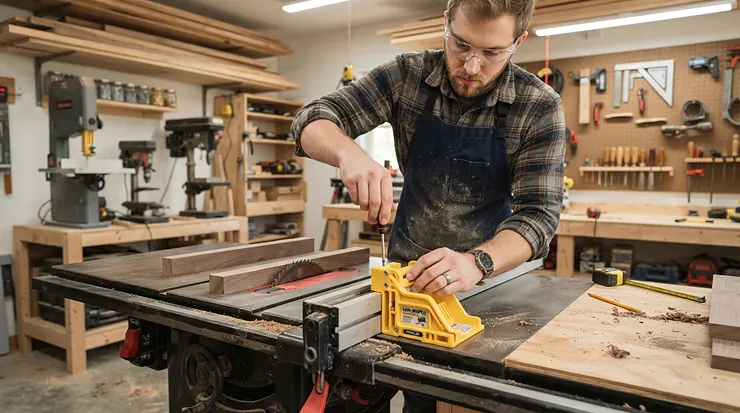
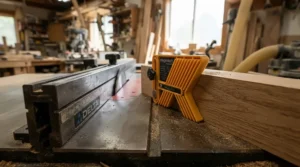
A featherboard is a slotted plastic, wood, or EVA-foam board with angled fingers that press your workpiece against the fence or table, keeping it tracking straight and resisting the backward shove that causes kickback. What is a featherboard set under $40, exactly? It’s a budget-tier accessory — usually a pack of two — that mounts to your miter slot or T-track and holds stock steady without a motor, a battery, or a learning curve.
The good news: this price bracket isn’t the compromise zone it used to be. Brands like POWERTEC and Milescraft now build sub-$40 kits that rival pricier “pro” featherboards in raw holding power, even if they skip the fancy EVA feathers. This guide breaks down seven real, currently-sold options — budget, mid-range, and a couple of premium picks worth the stretch — so you can match a featherboard to your shop instead of just grabbing whatever shows up first in search results.
Quick Comparison Table
| Product | Type | Mount | Price Range | Best For |
|---|---|---|---|---|
| POWERTEC 71393 Dual Universal (2-Pack) | Plastic tandem | T-track & miter slot | Under $30 | Best overall value |
| Milescraft 1406 FeatherBoard | Plastic, split-rail | 5/8″ & 3/4″ miter | Under $25 | Beginners |
| POWERTEC 72027 4-Piece Combo | Plastic tandem + fence | T-track & miter slot | Under $40 | Full-setup starter kit |
| BOW Products FeatherPRO FP1 | EVA living-hinge | AnchorPRO miter/T-track | $35-$40 range | Kickback safety priority |
| Milescraft 1407 D/T FeatherBoard | Plastic, dual-slide | 5/8″ & 3/4″ + spacer | Under $30 | Tall stock / resawing |
| POWERTEC 71468 Universal (1-Pack) | Plastic, single | T-track & miter slot | Under $20 | Cheapest true starter |
| Hedgehog Spiral Featherboard | DuPont nylon spiral | Standard 3/4″ miter slot | $35-$40 range | One-hand quick adjustment |
The spread above tells its own little story: you can outfit an entire table saw with two mounting points for under $40 total (the POWERTEC 71393), or spend that same money on a single premium unit (the BOW Products FeatherPRO FP1) built around safety-first EVA feathers. Neither choice is wrong — it depends on whether you value redundancy (two boards, two mounting points) or engineering (one board, better material). If you’re outfitting your first shop, the comparison above should nudge you toward multi-piece kits; if you’ve already got basics covered and want to upgrade one weak point, the single premium units earn their keep.
Found a pick you like already? Save this list before you forget which one had the better warranty. 💬
Top 7 Featherboards Under $40: Expert Analysis
1. POWERTEC 71393 Dual Universal Featherboards — best all-around value for two mounting points
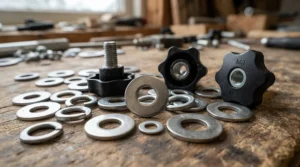
The two-pack format alone justifies the “best overall value” tag — you get infeed and outfeed coverage from a single purchase, which is the whole reason featherboard sets under $40 exist in the first place. Each board mounts via a miter bar slot bracket or T-bolt system, with locking knobs, washers, and spacers included for stacking two boards for extra height. That stacking hardware is the detail Amazon’s bullet points bury: it means this “cheap plastic featherboard” scales up to hold tall stock, something most sub-$30 kits can’t do without buying a second accessory.
Based on the spec comparison against pricier EVA models, the tradeoff here is material — molded plastic instead of foam — which means slightly less vibration dampening but noticeably more rigidity for repetitive rip cuts. Reviewers consistently note the orange color-alert housing makes it easy to spot when a board has drifted out of position mid-cut, a small but genuinely useful safety touch. This is the pick for beginners setting up their first table saw safety station and for anyone who wants both boards from one box rather than buying singles twice.
Pros:
- ✅ Two boards cover infeed and outfeed in one purchase
- ✅ Stackable spacers add height for tall stock
- ✅ Works on miter slots and T-track alike
Cons:
- ❌ Plastic fingers wear faster than EVA foam
- ❌ Knobs require a hex key for first-time tightening
Priced around $28-$30, this set delivers roughly double the mounting flexibility of a single-board kit for barely more money — which is why it’s the value benchmark the rest of this list gets measured against.
2. Milescraft 1406 FeatherBoard — simplest setup for total beginners
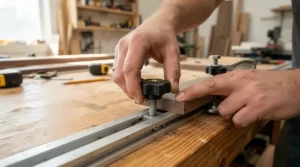
If your table saw came with zero accessories and you just want one board that works without a manual, this is it. The 1406 uses split-rail miter bar construction that provides maximum hold, plus a pre-load tension design that keeps cuts consistent with reduced kickback risk. What most buyers overlook about this model is that it ships with both 5/8″ and 3/4″ miter bars, so it fits older contractor saws with narrower slots — a compatibility detail that trips people up on other budget boards.
Milescraft has been building jigs and safety accessories since 2002, and the 1406 reflects that maturity: it’s a “does one thing well” tool rather than a modular system trying to be everything. Reviewers consistently point out the dual slide motion makes width adjustments genuinely one-handed, which matters when your other hand is holding a board against the fence. At around $17-$22, this is the cheapest legitimate featherboard set under $40 that isn’t a no-name import — a real consideration when durability and safety are on the line.
Pros:
- ✅ Fits both 5/8″ and 3/4″ miter slots out of the box
- ✅ One-handed dual-slide width adjustment
- ✅ Established brand with a real warranty process
Cons:
- ❌ Single board only — no outfeed coverage
- ❌ Plastic fingers, not EVA foam
At under $22, this is less a “budget featherboard for table saw” compromise and more a genuinely well-engineered single-board starter — just budget for a second one down the line.
3. POWERTEC 72027 4-Piece Combo Set — most complete starter kit for the money
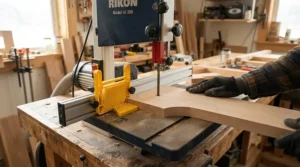
This is the “buy once” option for anyone tired of researching separate router table and table saw accessories. The kit bundles two featherboards with threaded 5-star knobs, T-bolts, and miter slot brackets for table saw and band saw use, plus two additional featherboards optimized specifically for router fences. On paper this means one purchase covers three tools instead of one — a meaningful shift for a hobbyist woodworker running a table saw, router table, and band saw off the same handful of accessories.
Here’s what the spec sheet won’t tell you, but the review pattern suggests: buyers consistently rate this combo near 4.6 stars specifically because it eliminates the “wait, which featherboard fits my router fence” research problem entirely. The horizontal and vertical mounting options — plus the plastic spacers for stacking — mean this single box adapts to almost any home shop layout. It’s the strongest pick for someone building a woodworking safety station from scratch rather than patching one gap.
Pros:
- ✅ Covers table saw, band saw, and router fence in one kit
- ✅ Both horizontal and vertical mounting supported
- ✅ Strong review volume backing durability claims
Cons:
- ❌ Sits right at the $40 ceiling, less room for extras
- ❌ Four separate pieces means more setup time upfront
For shops running more than one machine, the per-tool cost here beats buying three single-purpose boards separately — the math on this “cheap featherboard kit” actually favors going bigger.
4. BOW Products FeatherPRO FP1 — best kickback resistance in this price range
This is the one worth stretching your budget toward $40 for. The FP1 swaps rigid plastic fingers for EVA feathers combined with a living-hinge design, which the company states delivers roughly 5x greater resistance to kickback than traditional plastic or wood feathers. In practice, what that “living hinge” language means for your workpiece is simple: the feathers compress and grip harder the more force pushes back against them, instead of just flexing and releasing tension like stiff plastic does.
Based on the spec comparison, the EVA material also solves a problem specific to SawStop and other flesh-detection saw owners — the feathers won’t trigger sensitive SawStop systems and won’t damage carbide blades on accidental contact, unlike some rigid materials. Reviewers and retailers alike frame this as the “safety-first” pick rather than the “cheapest” one, and the AnchorPRO miter hardware is specifically engineered for a faster, tighter expansion fit than standard T-bolts. If you’ve had a near-miss kickback before, this is where that anxiety gets addressed directly.
Pros:
- ✅ EVA feathers rated for roughly 5x kickback resistance
- ✅ Won’t trigger SawStop flesh-detection sensors
- ✅ Feathers are replaceable and reversible
Cons:
- ❌ Single-board unit, near the top of the $40 ceiling
- ❌ EVA feathers cost more to replace than plastic
At $35-$40, this is the premium ceiling of this list — pay the extra $10-$15 over a plastic board specifically for the kickback-resistance claim, not for convenience features.
5. Milescraft 1407 D/T FeatherBoard — best for tall stock and resawing
Sibling to the 1406 above, the 1407 adds one feature that matters a lot more than it sounds: a spacer included to adequately guide tall stock through the blade, along with dual slide motion and S-style knobs for quick installation. That spacer is the detail that separates “fine for flat boards” from “actually usable for resawing” — a common pain point when ripping thick stock on edge for veneers or thin strips.
The dual/tandem naming isn’t marketing fluff, either: this board can be configured as either a dual setup or a tandem setup depending on whether you’re feeding stock through a table saw, band saw, or router table. What most buyers overlook is that this flexibility means you don’t need to own two different featherboard styles for band saw resawing versus table saw ripping — one board, reconfigured. Reviewers who resaw regularly single this model out specifically for that reason, over the otherwise similar 1406.
Pros:
- ✅ Includes spacer specifically for tall/resaw stock
- ✅ Reconfigures between dual and tandem setups
- ✅ Fits 5/8″ and 3/4″ miter slots
Cons:
- ❌ Costs more than the base 1406 for one extra part
- ❌ Overkill if you never resaw thick stock
At roughly $25-$30, this is the pick specifically for anyone whose projects involve resawing or unusually tall stock — everyone else should save the difference and buy the 1406.
6. POWERTEC 71468 Universal Featherboard — cheapest legitimate starter option
Sometimes the honest answer to “what’s the best budget featherboard” is “the cheapest one from a brand that won’t fall apart.” The 71468 is a single-board version of the 71393 above, running the same miter lock system that works with any standard t-slot or miter slot at 3/4″ by 3/8″, just without the second board or stacking hardware. It typically lists under $16-$20, making it the entry point for someone who genuinely just wants to stop a board from wandering off the fence.
Here’s the honest tradeoff: this is not the board for someone running a router table and a band saw off the same accessory drawer. It’s the board for someone who has exactly one table saw, makes occasional rip cuts, and needs the single cheapest reliable safety accessory available. Reviewers treat it as a “does the job, nothing fancy” purchase — which, at this price, is precisely the right expectation to have.
Pros:
- ✅ Lowest price point of any option on this list
- ✅ Same miter lock hardware as the pricier 2-pack
- ✅ Works across table saw, router table, and band saw
Cons:
- ❌ Single board, no outfeed or fence coverage
- ❌ No stacking spacers included
Under $20, this is the floor of what a “consistent workpiece pressure” accessory should cost — go lower than this and you’re likely buying an unbranded import with no warranty support.
7. Hedgehog Spiral Featherboard — fastest one-hand adjustment
The Hedgehog earns its spot for a single, genuinely clever mechanical trick: its unique spiral shape and single knob let it pivot into position with one hand, instead of the usual process of loosening two knobs, repositioning the board, and retightening each one. If you’ve ever fought a stubborn double-knob featherboard mid-cut with a board sliding out of your other hand, you understand immediately why this matters more than any spec sheet number.
Built from DuPont nylon per the manufacturer, it’s designed to fit standard 3/4″ miter slots popular among brands like Bosch and Ryobi, though it’s worth noting it isn’t compatible with 5/8″ slots without a separate clamp adapter — a compatibility gap worth checking against your specific saw before buying. Reviewers consistently praise the ease of one-handed repositioning for repetitive cuts of varying widths, which makes this the pick for anyone who changes cut widths constantly throughout a project rather than running one width all day.
Pros:
- ✅ Single-knob, one-hand repositioning
- ✅ Doubles as resaw support on band saws
- ✅ Durable DuPont nylon construction
Cons:
- ❌ Not compatible with 5/8″ miter slots by default
- ❌ Single board, sits near the $40 ceiling alone
At $35-$40, this is a convenience purchase more than a value purchase — pay for it specifically because you reposition featherboards often, not because you need raw holding power.
Practical Setup Guide for Your First Featherboard
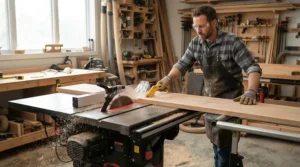
Getting a featherboard right the first time saves you the “why isn’t this working” frustration most beginners hit in week one. Start by positioning the board so its fingers make contact with the workpiece before the leading edge reaches the blade — place your featherboard entirely in front of the blade, never alongside or behind it, since a board positioned near the back of the blade can pinch the kerf and cause the exact kickback you’re trying to prevent.
Set tension by feel: the fingers should flex noticeably when you slide stock underneath but never so much that feeding the wood takes real effort. Too loose and the board does nothing; too tight and you’re fighting your own safety equipment. Check the tension again after your first ten cuts — plastic fingers relax slightly as they break in, and knobs on cheaper mounts can loosen from vibration. A common first-30-days mistake is mounting the featherboard against the fence for rip cuts when it should be pressing down onto the table instead (or vice versa, depending on your cut type) — get this backwards and the board provides zero kickback resistance despite looking correctly installed.
Real-World Scenarios: Which Featherboard Fits Your Shop
Picture three different weekend woodworkers, because “best featherboard” genuinely depends on who’s asking. A college student building furniture in a shared garage, cutting maybe twice a month on a hand-me-down contractor saw, doesn’t need EVA foam or spiral one-hand adjustment — the POWERTEC 71468 single board covers the actual risk (a wandering board on infrequent rip cuts) without wasting money on features that assume daily use.
Now picture a hobbyist with a dedicated shop running a table saw, router table, and occasional band saw resaws on weekends. That’s the POWERTEC 72027 4-piece combo territory — the router fence boards alone justify the price over buying single-purpose accessories piecemeal, and the flexibility matches someone actually rotating between machines. Finally, picture someone who had a real kickback scare last month and now treats every cut with new caution. That’s exactly who the BOW Products FeatherPRO FP1 is built for — the EVA living-hinge kickback resistance directly addresses the fear, not just the inconvenience, of a board getting away from them.
How to Choose a Featherboard Set Under $40
- Match the mount to your saw first. Check whether your miter slot is 3/4″ or 5/8″ before anything else — a board that doesn’t fit is a wasted purchase regardless of how good its specs read.
- Decide single board vs. multi-piece kit. One board covers one contact point; if you need infeed and outfeed pressure, a two-pack like the POWERTEC 71393 costs less per board than buying two singles.
- Weigh plastic against EVA foam. Plastic fingers cost less and last plenty long for occasional use; EVA foam like the BOW Products FeatherPRO FP1 costs more but flexes and grips harder under kickback force.
- Check SawStop compatibility if relevant. Some featherboard materials can register as contact on flesh-detection saws — EVA is specifically marketed as safe here, worth confirming for your model.
- Consider adjustment speed for your workflow. If you change cut widths often, one-hand designs like the Hedgehog save real time; if you set once and cut all day, that convenience matters less.
- Factor in multi-tool use. If you also own a router table or band saw, a combo kit spreads cost across tools better than single-purpose boards bought separately.
- Leave room in the $40 budget for hardware quality. A board that’s $5 cheaper but ships with flimsy T-bolts will cost you more in frustration than the savings are worth.
Featherboard vs. Push Stick: Do You Need Both?
This comparison trips up a lot of first-time buyers because the two tools look like they solve the same problem — keeping hands away from the blade — but they don’t overlap as much as it seems. A featherboard applies continuous, hands-free lateral pressure holding stock against the fence or table throughout the entire cut; it’s a passive, always-on safety device. A push stick is an active tool you hold and push with, specifically for finishing a cut on narrow stock where your hand would otherwise pass too close to the blade.
OSHA’s machine guarding guidance treats these as complementary rather than interchangeable — a featherboard prevents the workpiece from drifting or kicking back, while a push stick prevents your hand from entering the danger zone during the final inches of a cut. The honest answer is you need both, not one instead of the other: a featherboard without a push stick still leaves your fingers exposed at the end of a narrow rip, and a push stick without a featherboard does nothing to stop the board itself from binding and kicking back mid-cut. Several kits on this list, like the POWERTEC 72027, get bundled with push sticks specifically because manufacturers know buyers eventually need both.
Common Mistakes When Buying a Budget Featherboard
The most common misstep is buying based on price alone without checking miter slot width first — a $15 board that doesn’t fit your saw is a $15 loss, full stop. Second is assuming “featherboard set” always means two boards; some listings use “set” loosely to describe hardware bundled with a single board, so read the actual piece count before comparing prices. Third, buyers often skip checking whether a board is rated safe for their specific saw’s flesh-detection system, which matters increasingly as SawStop and similar technologies become standard rather than premium.
A fourth mistake is under-buying for actual shop needs — grabbing a single $18 board when the workflow genuinely calls for infeed and outfeed coverage, then buying a second board a month later at a worse combined price than a two-pack would have cost upfront. Finally, some buyers assume all plastic featherboards perform identically; wall thickness, finger flexibility, and knob quality vary meaningfully between brands even at similar price points, which is exactly why established brands with real warranty support tend to outperform unbranded imports long-term.
Long-Term Cost and Maintenance
A featherboard set under $40 is about as close to a “buy it once” tool as woodworking accessories get, but it’s not entirely maintenance-free. Plastic fingers on budget boards do wear and lose tension over months of regular use — expect gradually looser grip somewhere in year two or three of consistent cutting, at which point a $20-$30 replacement is cheaper than most single power tool accessories. EVA foam boards like the BOW Products FeatherPRO FP1 hold up somewhat differently: the feathers themselves are designed to be replaceable rather than requiring a whole-unit swap, which lowers the long-term cost of ownership if you’re using the board heavily.
The real ROI calculation isn’t about the featherboard’s lifespan at all — it’s about what one prevented kickback incident is worth in terms of a ruined workpiece, a damaged blade, or worse. At $20-$40, this is one of the cheapest genuine safety investments available for a table saw, cheaper than a single replacement blade and far cheaper than an ER visit. Budget for knob and hardware wear rather than the board itself; loose T-bolts or stripped knobs are the more common failure point than the fingers themselves.
Safety and Regulatory Context
Featherboards aren’t just a nice-to-have accessory — they’re explicitly recognized in federal workplace safety standards. OSHA’s woodworking machinery standard requires combs or featherboards at the workplace for use when a standard blade guard cannot be used, such as during dadoing, grooving, jointing, moulding, and rabbeting. That’s not a home-shop suggestion — it’s a codified requirement in commercial and industrial settings, which tells you how seriously safety engineers treat the basic function this cheap accessory performs.
For home shops, the practical takeaway from OSHA’s kickback prevention guidance is that featherboards work best layered with other controls — riving knives, push sticks, and proper stock support — rather than as a standalone fix. No featherboard, regardless of price, replaces the basic practice of standing to the side of the blade line rather than directly behind the workpiece during a cut.
Frequently Asked Questions
❓ What is a good price for a featherboard set?
❓ Do featherboards actually prevent kickback?
❓ Can I use a featherboard on a router table too?
❓ Are plastic or EVA foam featherboards better?
❓ How many featherboards do I actually need?
Conclusion
A featherboard set under $40 isn’t a compromise purchase — it’s genuinely the sweet spot where price and function meet for most home shops. Whether you land on the budget-friendly POWERTEC 71393 two-pack, the beginner-simple Milescraft 1406, or stretch toward the kickback-focused BOW Products FeatherPRO FP1, every option on this list solves the same core problem: keeping your hands out of the blade’s path while your stock stays exactly where you want it.
The right pick really does come down to your specific setup — how many machines you’re running, how often you resaw thick stock, and whether you’ve already had a scare that makes EVA foam’s extra kickback resistance worth the extra ten dollars. What matters more than which exact board you choose is that you choose one at all; an unguarded rip cut on a table saw is one of the more preventable ways to get hurt in a home shop, and $20-$40 is a remarkably small price for that peace of mind.
Recommended for You
- Push Blocks for Jointer and Table Saw Combo: 7 Best Picks (2026)
- Push Block System for Narrow Rip Cuts Review: 7 Safest Picks (2026)
- 3D Push Block System for Ripping Thin Stock: 7 Safer Picks for 2026
Disclaimer: This article contains affiliate links. As an Amazon Associate, I earn from qualifying purchases. If you purchase products through these links, we may earn a small commission at no additional cost to you.
✨ Found this helpful? Share it with your friends! 💬🤗
