
In This Article
An adjustable featherboard for router table and table saw combo setups is a spring-fingered hold-down jig that clamps into a miter slot, T-track, or magnetic base and presses stock firmly against a fence or tabletop, typically covering both machines with one accessory. Here’s the thing nobody tells you when you buy your first combo table: the fence is only half the safety equation. The other half is whatever’s holding your board against that fence while your hands are somewhere else entirely.
I’ve watched more than one hobbyist white-knuckle a narrow strip of maple through a router bit, one palm flat on the wood, the other hovering two inches from a spinning cutter because “it’s fine, I’m being careful.” It’s never fine. A featherboard does the boring, unglamorous job of being careful for you, every single pass, without getting tired or distracted around the fourth cup of shop coffee.
The tricky part with a combo setup — one table doing router duty on Tuesday and rip-cut duty on Thursday — is that a featherboard built for a single tool often doesn’t travel well. Miter slots vary, T-tracks aren’t universal, and mounting one jig twice a week gets old fast. That’s exactly the gap this guide fills: which adjustable featherboards genuinely move between a router table and a table saw combo without a fight, and which ones just claim to. Per the OSHA machine-guarding standard for table saws, anti-kickback devices are a recognized engineering control specifically because they hold stock down against the direction a saw wants to fling it — which is exactly what a well-adjusted featherboard is built to do, on either machine.
Below, we’ve broken down seven real, currently available featherboards spanning budget miter-slot basics to premium magnetic systems, backed by specs, real aggregated review sentiment, and honest analysis of who each one actually suits. Prices shift constantly on Amazon, so every figure here is a range — check the current listing before you buy.
Quick Comparison Table: Adjustable Featherboard for Router Table and Table Saw Combo Options
| Featherboard | Mounting Style | Price Range | Best For |
|---|---|---|---|
| POWERTEC 71553 | Miter slot | Under $20 | Absolute budget starter |
| Milescraft 1406 | Miter slot (dual size) | Under $25 | Mixed 5/8″ and 3/4″ slots |
| POWERTEC 71832-P2 | T-track & miter slot | $25-$35 range | Stacking for tall stock |
| Rockler Adjustable Table Featherboard | Miter slot | $25-$35 range | Widest single-board adjustment |
| Kreg PRS3020 True-FLEX | Wedge-Lock, no hardware | $30-$45 range | Tool-free swap between machines |
| The Hedgehog HH-100 | Miter slot, single knob | $30-$40 range | Fastest one-handed resets |
| Magswitch Universal Featherboard | Magnetic, no slot needed | $70-$105 range | Cast-iron tables with no matching slot |
A quick glance at that table tells you most of what you need to know about where your money goes: mounting hardware, not fancier feathers. The POWERTEC 71553 and Milescraft 1406 get you into the game for less than a fast-food lunch, while the Magswitch Universal Featherboard costs four to five times as much because it skips the miter slot entirely and clamps to any cast-iron surface with rare-earth magnets. Between those poles sit the POWERTEC 71832-P2, Rockler Adjustable Table Featherboard, Kreg PRS3020 True-FLEX, and The Hedgehog HH-100 — all variations on the same miter-slot theme, differentiated by how fast and how confidently they lock down.
💬 Just one click — help others make better buying decisions too!😊
Top 7 Adjustable Featherboard for Router Table and Table Saw Combo Picks: Expert Analysis
Coverage below spans true budget options, dependable mid-range workhorses, and two premium picks that solve specific combo-table headaches — miter slot mismatches and tables with no slot at all.
1. POWERTEC 71553 — most affordable way to add kickback protection
The POWERTEC 71553 is proof that safety gear doesn’t need a fancy price tag to earn its keep. This two-pack ships with a standard 3/8″ x 3/4″ miter bar, a molded polymer feather body, and enough hardware to bolt straight into most router tables and contractor-style table saws without hunting down extra parts. The angled fingers apply steady one-directional pressure — press a board in, and it can slide forward but resists creeping backward toward you, which is the entire point of the design.
Based on the spec comparison against pricier options on this list, the POWERTEC 71553 trades adjustment range and finger count for pure affordability; it’s a no-frills unit, not a precision instrument. It’s aimed squarely at the woodworker who’s still building out a shop and needs both machines protected on a beer-and-pizza budget, or the teacher setting up a classroom full of shared stations. Reviewers consistently report the featherboard holds thin stock securely for edge-routing and ripping alike, with a handful of comments describing the plastic as “well made” and “not cheap stuff” despite the price point.
Pros:
- ✅ Lowest cost entry point on this list
- ✅ Simple bolt-in mounting fits most 3/4″ miter slots
- ✅ Reliable one-directional pressure for basic ripping and routing
Cons:
- ❌ Narrower adjustment range than premium competitors
- ❌ Plastic fingers show wear faster under daily shop use
Expect to pay under $20 for the pair at the time of research, which makes this the easiest yes on the list if you just need both machines covered without overthinking it.
2. Milescraft 1406 FeatherBoard — best dual-slot fit for mixed shops
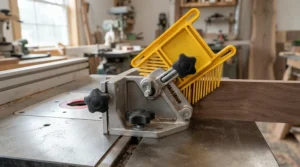
If your router table and your table saw happen to have different miter slot widths — a common headache with imported benchtop machines — the Milescraft 1406 FeatherBoard solves that mismatch directly. It ships with both 5/8″ and 3/4″ miter bars plus T-slot bolts, so the same body genuinely crosses over between two different combo pieces instead of forcing you to buy two separate featherboards.
What most buyers overlook about this model is the “dual slide motion” adjustment: two independent knobs let you set both the horizontal position and the pre-load tension separately, which the manufacturer’s pre-load tension design is built to keep consistent from cut to cut rather than backing off after a few passes. That consistency matters more than raw finger count once you’re running repeated production cuts — say, a batch of drawer fronts — where uneven pressure shows up as chatter marks on every third piece. Based on aggregated retailer review data, the Milescraft 1406 FeatherBoard earns solidly high marks (multiple listings show 4.7-4.8 out of 5), with buyer comments praising the confidence it adds when resawing or ripping narrow strips.
Pros:
- ✅ Includes both 5/8″ and 3/4″ miter bars in one box
- ✅ Independent pre-load tension stays consistent across passes
- ✅ High-visibility yellow body is easy to spot in a busy shop
Cons:
- ❌ Dual-knob setup takes slightly longer than single-knob designs
- ❌ Single unit only — buy two if you need infeed and outfeed pressure
At around $18-$25 depending on retailer, this is arguably the smartest budget pick for anyone running two machines with slightly different hardware.
3. POWERTEC 71832-P2 Stackable Featherboard — best for tall stock and stacked pressure
Ripping 4/4 lumber is one thing; feeding a 2-inch-thick table leg blank past a router bit is another animal entirely. The POWERTEC 71832-P2 answers that problem with a stackable body — two featherboards from the same two-pack can be mounted one above the other, doubling the contact surface against thick or irregular stock. It mounts to either a T-track or a standard miter slot, which is the detail that actually earns it a spot on a combo-table list: most router table fences run T-track, most table saws run miter slots, and this unit doesn’t care which one it’s bolted into.
Here’s what the spec sheet won’t tell you outright: stacking isn’t just about thickness. On a table saw combo where the outfeed side lacks support, a second stacked featherboard set slightly behind the first keeps a long board from wandering sideways as it clears the blade — something a single featherboard placed too close to the front simply can’t manage alone. Reviewers consistently note the “universal T-Track & Miter Slot Mount” branding holds up in practice, describing the mounting bracket as genuinely reversible between the two systems rather than needing extra adapters, with the aggregate rating sitting around 4.4 out of 5 across dozens of buyers.
Pros:
- ✅ Stacks two units for thick or irregular stock
- ✅ Fits both T-track and standard miter slots out of the box
- ✅ Reversible slide bracket needs no separate adapter kit
Cons:
- ❌ Full stacked setup requires buying a second two-pack
- ❌ Slightly bulkier footprint than single-height competitors
Expect a price in the $25-$35 range for the two-pack, which is fair value once you factor in how often thick stock and long outfeed runs come up on a combo table.
4. Rockler Adjustable Table Featherboard — longest single-board adjustment range
Rockler redesigned this featherboard specifically to fix the two biggest complaints people have with cheaper miter-slot units: weak grip and fiddly adjustment. The result is a 5-1/2″ total adjustment range on the slotted body, which on paper sounds like a spec-sheet footnote but in practice means you can dial in pressure on stock from paper-thin trim to thick hardwood blanks without swapping to a different jig. The redesigned miter bars grip more tenaciously with less knob-cranking than the earlier version, according to the manufacturer’s own product notes.
On a shared router table and table saw combo, that adjustment range is the whole story. Based on the spec comparison, most competitors top out around 3-4 inches of usable slot travel; the Rockler Adjustable Table Featherboard‘s extra couple of inches means fewer re-mounts per week when you’re bouncing between a 3/4″ edge-routing job in the morning and a 2-inch rip cut in the afternoon. The first, shorter feather is intentionally sized to graze the workpiece first during setup — a small touch that makes initial alignment noticeably less fussy than boards where every finger engages at once.
Pros:
- ✅ 5-1/2″ adjustment range covers thin trim to thick blanks
- ✅ Redesigned miter bars grip tighter with less effort
- ✅ Shorter lead finger simplifies initial setup
Cons:
- ❌ Fits standard 3/8″ x 3/4″ slots only — no narrow-slot hardware included
- ❌ Sold as a single unit at this price tier, not a pair
Budget roughly $25-$35 at the time of research for one unit — reasonable given how much fiddling it saves over a full week of switching machines.
5. Kreg PRS3020 True-FLEX Featherboard — best tool-free mounting system
Kreg’s angle here is speed of setup, and the Kreg PRS3020 True-FLEX Featherboard delivers it through what the company calls a Wedge-Lock System — a mechanism that clamps into a 3/8″ x 3/4″ miter slot or T-slot without any separate bolts, washers, or brackets to fumble with. For a combo table where you might remount a featherboard two or three times in a single project, skipping the hardware step adds up fast.
Honest analysis here has to include a real caveat pulled from buyer feedback: at least one verified purchaser reported the unit wouldn’t lock securely into their specific router table slot out of the box, eventually rigging a supplemental clamp to keep it in place, while several other reviewers described it as gripping “great” and holding tight on both a table saw and a router table. That split suggests slot tolerance varies enough between manufacturers that the Wedge-Lock’s fit isn’t universal — worth test-fitting before you commit to it as your only featherboard. When it fits properly, the “True-FLEX” polymer fingers are noted by multiple buyers as durable and well worth the money relative to lesser-quality alternatives at a similar price.
Pros:
- ✅ Tool-free Wedge-Lock mounting speeds up machine swaps
- ✅ Sold as a two-pack for infeed and outfeed pressure
- ✅ Durable polymer fingers hold up under repeated use
Cons:
- ❌ Wedge-Lock fit isn’t guaranteed on every miter slot tolerance
- ❌ A poor-fitting slot may need a supplemental clamp
Pricing typically lands in the $30-$45 range for the pack, positioning it as a mid-to-premium pick worth test-fitting against your specific tables first.
6. The Hedgehog HH-100 Spiral Featherboard — fastest one-handed adjustments
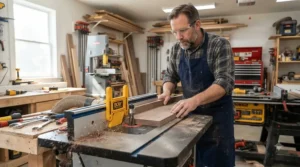
Every featherboard on this list except one uses two knobs. The The Hedgehog HH-100 Spiral Featherboard uses exactly one, paired with a spiral body shape and a single pivot point that lets you loosen the knob, spin the board into the stock until the fingers flex, and re-tighten — all with one hand, while the other hand keeps the workpiece steady. On a combo table where you’re constantly repositioning between operations, that single-knob design isn’t a gimmick; it’s a genuine time saver across dozens of setups per session.
What most buyers overlook is how much friction two-knob designs add over a full day of work — a woodworking-magazine reviewer who’d used conventional featherboards for years noted that thick, stiff fingers on standard models frequently release tension the moment you relax your grip while tightening the second knob, a frustration the single-pivot Hedgehog design was built to eliminate. The cast CNC-milled aluminum miter clamp fits standard 3/4″ slots and works reversibly on either side of a blade or bit. Reviewer sentiment is largely enthusiastic — “great accessory for the table saw and router table” is a common theme — tempered by at least one buyer flagging the roughly $35-$50 price as steep “for a piece of plastic,” even while recommending it for anyone who uses a featherboard often enough to justify the convenience.
Pros:
- ✅ Single-knob, one-handed adjustment on the fly
- ✅ CNC-milled aluminum miter clamp resists wear
- ✅ Reversible for left- or right-side blade or bit use
Cons:
- ❌ Premium price relative to simple two-knob competitors
- ❌ Stacking for thicker stock requires a separate accessory purchase
Expect to pay in the $30-$40 range for a single unit at the time of research, climbing higher for multi-board bundles with the stacking accessory included.
7. Magswitch Universal Featherboard — best for tables with no matching slot
The last pick throws out the miter-slot-and-T-track playbook entirely. The Magswitch Universal Featherboard clamps to any cast-iron surface using two 20mm rare-earth magnets rated for serious hold force, which means it works on either side of a blade or bit, on the fence itself, or on a table that has no compatible slot at all — a real scenario on some benchtop router tables and older cast-iron saws with nonstandard miter channels.
Based on the spec comparison, this is the only featherboard here that solves the “my router table and my table saw don’t share a mounting standard” problem completely, rather than partially, since magnets don’t care what shape the slot is. That said, honest analysis demands a real caveat straight from woodworking-forum discussion: at least one user reported being surprised at how easily a board could still be pulled backward against the magnetic hold, prompting a broader community discussion clarifying that featherboards — magnetic or otherwise — work by keeping stock from drifting into a bind in the first place, not by physically arresting a kickback that’s already underway. That’s a useful reality check for buyers expecting magnets to be a stronger kickback stopper than a mechanically clamped board; in practice, both styles serve the same preventive role.
Pros:
- ✅ No miter slot or T-track required — works on any cast iron
- ✅ Usable on either side of the blade or directly on the fence
- ✅ Fast on/off positioning without loosening bolts
Cons:
- ❌ Highest price point on this list by a wide margin
- ❌ Requires a ferrous (steel or cast iron) surface to grip
Pricing generally runs $70-$105 depending on retailer, making it the splurge pick for anyone whose combo table setup genuinely can’t be solved any other way.
Setting Up a Shared Featherboard Setup for Router Table and Table Saw Combo Shops
A shared featherboard setup for shop use only works if the transition between machines takes seconds, not minutes. Start by measuring both miter slots and T-tracks with calipers before you buy anything — a 3/4″ slot that’s actually 0.748″ can make a “universal” featherboard bind or rattle, and you won’t know until it’s already on your bench. Once mounted, set tension using the short-lead-finger trick most of these boards share: slide the board in until the first, slightly shorter finger just grazes the workpiece, then lock down; the longer fingers behind it will engage with proper pressure as the stock feeds through.
For the first 30 days, the single most common mistake is over-tightening. Cranking a featherboard down hard enough to dent softwood doesn’t add safety — it adds resistance that fights your feed rate and can actually cause the stock to skip or chatter. A properly tensioned finger should flex noticeably when you push the workpiece past it, not lock it rigid. Build a five-minute swap habit into your workflow: mark your usual featherboard position on the fence or table with a strip of painter’s tape so resetting between router and saw sessions becomes a quick eyeball job instead of a fresh measurement every time. According to Highland Woodworking’s hands-on tool review, the reduced friction of faster-adjusting designs specifically encourages woodworkers to actually reach for the featherboard instead of skipping it under time pressure — which is really the whole safety argument in one sentence.
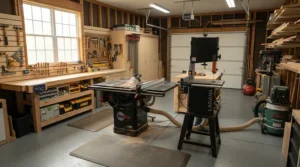
Real-World Scenarios: Who Actually Needs a Dual Purpose Featherboard for Router Table Work
Picture three woodworkers sharing the same basic shop layout. The first is a weekend hobbyist with a single benchtop combo unit, limited storage, and maybe four hours a week at the tools — for that buyer, a dual purpose featherboard for router table and table saw duty like the Milescraft 1406 FeatherBoard or POWERTEC 71553 makes sense because it’s one accessory doing double duty in a small footprint, and the budget stays low while the shop stays uncluttered.
The second is a semi-pro doing batch production — cabinet doors, drawer boxes, repeatable runs — who needs consistent, repeatable pressure across dozens of identical cuts without babysitting the setup. That’s the POWERTEC 71832-P2 or Kreg PRS3020 True-FLEX territory: stackable or tool-free mounting that survives frequent repositioning without drifting out of tolerance. The third is a shop owner or serious hobbyist running mismatched vintage or import machinery where slot dimensions don’t line up between the router table and the saw. For that buyer, the Magswitch Universal Featherboard earns its premium price by sidestepping the slot problem entirely, while the Rockler Adjustable Table Featherboard‘s extended range covers a wide swing of stock thicknesses on whichever machine still has a usable standard slot.
Problem to Solution: Getting Adjustable Angle Mounting Right on Any Combo Setup
Problem: The featherboard fights the fence angle on angled or bevel cuts. Most featherboards are designed for square, 90-degree stock against a straight fence. When you tilt a blade or bit for a bevel, a rigidly mounted featherboard can start pinching unevenly. Solution: mount the featherboard slightly ahead of where the cut narrows, and back off tension until the fingers flex freely rather than binding against the new angle.
Problem: The board loosens mid-cut on vibration-heavy machines. Adjustable angle mounting only holds if the base clamp itself doesn’t creep. Solution: check knob torque before every session rather than assuming last week’s setting held, and consider a stackable unit like the POWERTEC 71832-P2 for extra contact area on machines with more vibration.
Problem: Thin stock slips past the fingers entirely. Standard finger spacing is tuned for 3/4″ hardwood, not 1/8″ veneer strips. Solution: add a sacrificial backer board behind the stock to bring it up to a thickness the featherboard fingers can actually grip.
Problem: Switching from router table to table saw resets your angle every time. Solution: a magnetic option like the Magswitch Universal Featherboard repositions in seconds without recalculating slot alignment, since it isn’t tied to a fixed miter channel at all.
Problem: Kickback risk on narrow rip cuts feels high even with a featherboard installed. Solution: pair the featherboard with a push stick and, per the mechanics of table saw kickback, keep the featherboard positioned ahead of the blade rather than beside or behind it, since pressure applied before the cutting point is what keeps the stock from drifting into a bind in the first place.
How to Choose an Adjustable Featherboard for Router Table and Table Saw Combo Setups
- Measure your slots first. A 5/8″ bar in a 3/4″ slot rattles; a 3/4″ bar forced into a 5/8″ slot won’t fit at all. Confirm both machines’ dimensions before adding anything to your cart.
- Decide if you need dual-slot hardware. If your router table and table saw use different miter standards, a dual-fit unit like the Milescraft 1406 FeatherBoard saves you from buying two separate jigs.
- Weigh mounting speed against mounting strength. Tool-free systems like the Kreg PRS3020 True-FLEX save time but can vary in grip depending on slot tolerance; bolted systems are slower but more consistently secure.
- Check the adjustment range. Wider ranges, like the Rockler Adjustable Table Featherboard‘s 5-1/2 inches, mean fewer remounts as your stock thickness changes.
- Consider stacking capability for thick stock. If you regularly work with material over an inch thick, a stackable design like the POWERTEC 71832-P2 adds real value.
- Factor in your table’s material. Magnetic options like the Magswitch Universal Featherboard only work on ferrous surfaces — check whether your tabletop is cast iron, aluminum, or laminated MDF before choosing one.
- Match price to frequency of use. A weekend hobbyist rarely needs a $100 featherboard; a shop running daily production cuts will earn that cost back in saved setup time within weeks.
Adjustable Featherboard for Multiple Tools vs Fixed Shop-Made Featherboards
| Factor | Adjustable Commercial Featherboard | Fixed Shop-Made Featherboard |
|---|---|---|
| Setup time | Seconds to minutes with slide mounts | Requires clamping or screwing in place |
| Multi-machine use | Moves between router table and saw | Usually built for one specific fence |
| Consistency | Engineered pre-load tension | Depends on woodworker’s cut angle |
| Cost | $15-$105 depending on model | Free if scrap hardwood is on hand |
| Adjustable angle mounting | Built-in slide or magnetic repositioning | Manual reclamping every time |
An adjustable featherboard for multiple tools wins decisively on anything involving repeated repositioning, and the numbers above explain why: a shop-made board built from scrap oak or ash costs nothing but has to be reclamped by hand every time you change setups, with pressure that varies based on how tired your hands are that day. A commercial unit like the Kreg PRS3020 True-FLEX or Milescraft 1406 FeatherBoard trades that zero-dollar cost for repeatable, engineered tension and a slide mechanism built specifically for the back-and-forth of combo-table work. The one place shop-made boards still win is total customization — nothing stops you from cutting one to an oddball shape for a one-off jig — but for day-to-day router-table-and-saw duty, the commercial options simply save more time than they cost.
Common Mistakes When Buying a Featherboard for Router Table and Table Saw Combo Use
Buyers new to featherboards frequently make the same handful of errors. The biggest is guessing at miter slot size instead of measuring — a mismatch means returning the product or living with a loose, unsafe fit. A close second is assuming “universal” hardware fits every machine; as the split reviews on the Kreg PRS3020 True-FLEX demonstrate, tolerance stack-up between manufacturers is real, and a wedge-style mount that locks perfectly on one table saw can feel loose on a different brand’s router table.
Another common misstep is buying a single featherboard when the job actually calls for two — one for fence pressure, one for downward pressure against the table, especially on a router table where bit-lift forces differ from a table saw’s blade rotation. Buyers also frequently overlook material compatibility on magnetic options; a Magswitch Universal Featherboard purchased for a laminate-topped benchtop router table simply won’t grip, since there’s no ferrous surface for the magnets to hold onto. Finally, plenty of shoppers chase the cheapest listing without checking finger count or flex quality, then find the fingers go rigid and stop flexing after a few months of daily use — a false economy when a slightly pricier unit like the POWERTEC 71832-P2 or Rockler Adjustable Table Featherboard would have outlasted it by years.

Multi-Machine Compatibility: Features That Actually Matter (And Those That Don’t)
Multi-machine compatibility comes down to exactly three things that matter and a long list of marketing language that doesn’t. What matters first is mounting standard — miter slot width, T-track presence, or a ferrous surface for magnets — because no amount of finger flex compensates for a jig that physically won’t attach. What matters second is adjustment range, since a featherboard that only handles 3/4″ stock is useless the day you need to route a 1/4″ strip of trim. What matters third is tension consistency across repeated cuts, which separates units like the Milescraft 1406 FeatherBoard with dedicated pre-load design from cheaper boards that loosen after a dozen passes.
What doesn’t matter nearly as much: finger count beyond roughly 10-13, since more fingers past that point mostly add marketing appeal rather than measurably better hold; and color, despite every manufacturer’s insistence on high-visibility yellow or orange — it’s a nice-to-have for spotting the jig in a cluttered shop, not a functional safety feature. Buyers frequently pay a premium for “patented” or “advanced” language on packaging without asking whether the actual mounting standard fits their machines, which is backwards — the boring measurement question should always come before the exciting feature list.
Router Table Safety and Table Saw Regulations: What Every Woodworker Should Know
Router table safety and table saw safety share the same underlying physics: a spinning cutter wants to grab material that isn’t held firmly and fling it in the direction of rotation. OSHA’s machine-guarding standards for table saws specifically call out anti-kickback devices — the category featherboards fall into — as an engineering control for exactly this hazard, working alongside splitters and riving knives rather than replacing them. None of these devices exist in isolation; a featherboard supplements a splitter, it doesn’t substitute for one.
The safety math here isn’t abstract. Injury-surveillance research published through the National Center for Biotechnology Information has tracked table saw injuries in the tens of thousands annually in the United States, with kickback consistently identified as a leading mechanism. On a router table specifically, the equivalent risk is a workpiece lifting off the table or drifting away from the fence mid-cut, which a properly tensioned featherboard prevents by maintaining constant downward and lateral pressure regardless of how steady your hands are on any given pass. Regulatory language aside, the practical takeaway is simple: keep the featherboard positioned ahead of the cutting point, never behind it, and never remove it to “save time” on a quick cut — that’s precisely when accidents cluster, according to safety analysts who track incident patterns across woodworking shops.
What to Expect: Real-World Performance on a Router Table and Table Saw Combo
On paper, every featherboard on this list claims to reduce kickback and improve cut quality. In daily use, the differences show up in smaller, more personal ways. A budget unit like the POWERTEC 71553 performs admirably on straightforward rip cuts and edge routing but will make you work slightly harder tightening two separate knobs every time you reposition it — not a dealbreaker, just a texture of daily use you should expect going in. A single-knob design like The Hedgehog HH-100 Spiral Featherboard genuinely changes that rhythm; you’ll notice yourself repositioning it more often simply because it’s fast enough not to be annoying, and more frequent, better-placed pressure tends to translate into cleaner, more consistent cuts.
Stackable and magnetic units earn their keep in the situations that don’t come up every day but matter a lot when they do — the oversized glue-up, the oddly thin resawn strip, the one router table with a mismatched slot you inherited from a previous owner. Expect the Magswitch Universal Featherboard to feel almost suspiciously fast to reposition the first time you use it, and expect a small adjustment period getting used to trusting a magnetic hold instead of a mechanically bolted one — both work, they simply feel different under your hands.
Long-Term Cost and Maintenance for Featherboard-Equipped Combo Tables
Featherboards are low-maintenance by design, but they’re not maintenance-free. Plastic fingers on any budget unit — the POWERTEC 71553 and Milescraft 1406 FeatherBoard included — gradually lose flex after months of daily flexing, the same way a rubber band eventually goes slack. Budget on replacing a heavily used budget featherboard every one to two years in a busy shop; at $15-$25 a pair, that’s a trivial ongoing cost compared to a single ER visit from a kickback injury.
Total cost of ownership tells a more interesting story than sticker price alone. A $20 unit replaced every 18 months works out to roughly $13 a year. A $75 Magswitch Universal Featherboard, built around a magnet rather than a wear-prone plastic hinge, may realistically outlast three or four budget units — meaning its effective annual cost isn’t dramatically higher once you stop comparing shelf price and start comparing years of service. Maintenance itself is minimal across the board: keep miter bars free of sawdust buildup so they slide smoothly, check knob tightness before each session, and inspect fingers periodically for cracks near the base, which is where flex fatigue shows up first.
Adjustable Featherboards for Every Skill Level: Beginners, Weekend Warriors, and Pros
Beginners benefit most from simplicity over sophistication. A two-knob budget board like the POWERTEC 71553 teaches the fundamentals of tension and finger flex without an intimidating price tag attached to the learning curve, and the mistakes you’ll inevitably make while dialing in your first few setups cost you nothing but a little time. Weekend warriors — the group probably reading this most closely — tend to value versatility per dollar spent, which points toward dual-fit designs like the Milescraft 1406 FeatherBoard or wide-range options like the Rockler Adjustable Table Featherboard that flex to whatever project shows up that Saturday.
Professionals and serious hobbyists running frequent batch work should weigh their time savings more heavily than sticker price. The tool-free convenience of the Kreg PRS3020 True-FLEX, the one-handed speed of The Hedgehog HH-100 Spiral Featherboard, or the total slot-independence of the Magswitch Universal Featherboard each shave seconds off dozens of daily repositions — seconds that compound into real hours over a working year. None of these tiers are rigid; plenty of careful beginners jump straight to premium gear, and plenty of pros keep a $15 backup board in a drawer for quick jobs. The point is matching the tool to how often you’ll actually reach for it.
FAQ: Adjustable Featherboard for Router Table and Table Saw Combo
❓ Can one featherboard really work on both a router table and a table saw?
❓ What miter slot size do most adjustable featherboards fit?
❓ Do featherboards actually stop kickback?
❓ How tight should I set an adjustable featherboard?
❓ Is a magnetic featherboard better than a miter-slot featherboard?
Conclusion
Choosing the right adjustable featherboard for router table and table saw combo work really comes down to answering two honest questions: how often will you actually swap it between machines, and what does your specific hardware demand. Budget picks like the POWERTEC 71553 and Milescraft 1406 FeatherBoard cover the fundamentals for less than the cost of a dinner out, while stackable and tool-free options like the POWERTEC 71832-P2 and Kreg PRS3020 True-FLEX earn their higher price through genuine time savings on frequent repositioning. The Rockler Adjustable Table Featherboard and The Hedgehog HH-100 Spiral Featherboard split the difference with range and speed respectively, and the Magswitch Universal Featherboard exists specifically for the shop where nothing else will physically fit.
None of these seven are the wrong choice in isolation — they’re each the right choice for a slightly different shop, budget, and workflow. What matters more than which one you pick is that you pick one at all, mount it correctly ahead of the cutting point, and actually use it on every relevant cut rather than only when you remember to. That single habit does more for your fingers than any spec sheet on this page.
Recommended for You
- Standard Featherboard For Miter Slot Table Saws: 7 Best Picks (2026)
- Magnetic Featherboard vs Clamp On Featherboard: 7 Best Picks for 2026
- Magnetic Featherboard for Table Saw: 7 Proven Picks for 2026
Disclaimer: This article contains affiliate links. As an Amazon Associate, I earn from qualifying purchases. If you purchase products through these links, we may earn a small commission at no additional cost to you.
✨ Found this helpful? Share it with your friends! 💬🤗
