
In This Article
Setting up a home workshop doesn’t have to drain your savings account. I remember standing in my garage three years ago, staring at plywood sheets and a circular saw, knowing I needed something better. That search led me to discover that you can absolutely find a quality benchtop table saw under 300 that delivers professional results without the premium price tag.
The woodworking tool market has evolved dramatically, and today’s budget-friendly options pack features that would have cost twice as much just a few years ago. Whether you’re a weekend warrior tackling home improvement projects or a hobbyist crafting custom furniture, the right affordable benchtop saw can transform your workflow. According to the Occupational Safety and Health Administration, proper table saw selection and usage significantly reduces workshop accidents, making your investment not just practical but potentially life-saving.
In this comprehensive guide, I’ll walk you through seven exceptional models that prove you don’t need to spend a fortune to get serious cutting power. We’ll explore everything from motor specifications to safety features, helping you make an informed decision that matches your specific needs and budget constraints.
Quick Comparison Table
| Product | Motor Power | Blade Size | Rip Capacity | Weight | Price Range |
|---|---|---|---|---|---|
| DEWALT DWE7485 | 15 Amp | 8-1/4″ | 24.5″ | 46 lbs | $349-$400 |
| SKIL TS6307-00 | 15 Amp | 10″ | 25.5″ | 53 lbs | $299-$329 |
| RYOBI RTS08 | 13 Amp | 8-1/4″ | 12.5″ | 51 lbs | $199-$249 |
| WEN 3720 | 15 Amp | 10″ | 26″ | 79 lbs | $275-$300 |
| Goplus 10-Inch | 15 Amp | 10″ | 26″ | 46 lbs | $200-$250 |
| Craftsman CMXETAX69434502 | 15 Amp | 10″ | 24″ | 55 lbs | $199-$209 |
| DEWALT DW745 | 15 Amp | 10″ | 20″ | 53 lbs | $300-$350 |
💬 Just one click – help others make better buying decisions too!😊
Top 7 Benchtop Table Saw Under 300: Expert Analysis
1. DEWALT DWE7485 – Best Overall Compact Powerhouse
The DEWALT DWE7485 represents the gold standard in the compact table saw category, delivering professional-grade performance in a surprisingly portable package. This 8-1/4 inch marvel runs on a robust 15-amp motor spinning at 5,800 RPM, making short work of hardwoods that would bog down lesser machines.
What sets this saw apart is its rack-and-pinion fence system, which glides smoothly and locks with precision. I’ve tested countless budget saws where fence alignment feels like solving a Rubik’s cube blindfolded, but DEWALT nailed this feature. The 24.5-inch rip capacity handles full sheets of plywood, and at just 46 pounds, you can actually move it without herniat
ing yourself.
Customer feedback consistently praises its accuracy and durability. One contractor mentioned using it daily for six months on a home renovation without a single issue. The only real drawback? It doesn’t accept dado blades, which matters if you’re planning joinery work.
✅ Pros:
- Exceptional fence accuracy with rack-and-pinion system
- Powerful 15-amp motor handles dense hardwoods
- Lightweight yet stable construction
- Tool-free blade guard adjustments
❌ Cons:
- No dado blade compatibility
- Bevel adjustment could be more precise
Best for: DIY enthusiasts and contractors needing reliable portability and precision cuts.
2. SKIL TS6307-00 – Best Value with Integrated Stand
The SKIL TS6307-00 delivers remarkable bang for your buck with its integrated folding stand and 10-inch cutting capacity. This compact portable table saw features a 15-amp motor driving the blade at 4,600 RPM, providing plenty of muscle for common woodworking tasks.
The built-in folding legs are genius – they transform this benchtop model into a full jobsite setup in seconds. I’ve watched carpenters set this up at construction sites faster than most people can assemble IKEA furniture. The 25.5-inch rip capacity and rack-and-pinion fence rails ensure cuts stay true, while the dust port actually works (a rarity in this price range).
Users appreciate the -2 to 47-degree bevel range, offering more flexibility than standard 0-45 degree systems. The saw accepts 5/8-inch dado stacks, opening up joinery possibilities. However, the included 24-tooth blade needs upgrading for finish work – invest in a 40-tooth or higher for smoother cuts.
✅ Pros:
- Integrated folding stand included
- Extended bevel range (-2° to 47°)
- Dado blade compatible
- Excellent dust collection port
❌ Cons:
- Stock blade quality underwhelms
- Miter gauge feels plasticky
Best for: Hobbyists and small shop owners seeking portability without sacrificing features.
3. RYOBI RTS08 – Best Budget-Friendly Option
For those operating on the tightest budgets, the RYOBI RTS08 proves that a cheap benchtop table saw doesn’t have to mean cheap performance. Its 13-amp motor spins the 8-1/4 inch blade at 5,600 RPM – impressive numbers considering the sub-$250 price tag.
This entry level woodworking saw weighs 51 pounds and measures just 25 x 17 inches, perfect for cramped workshops or garage corners. The onboard storage keeps accessories handy, and the large safety switch makes panic shutdowns easy. Customers report it handles softwoods and plywood admirably, though hardwoods can slow it down.
The 12.5-inch right-side rip capacity limits large panel work, but for cutting 2x4s, small furniture parts, and trim, it’s perfectly adequate. One woodworking teacher uses six of these in his beginner classes – they’re intuitive enough for novices yet capable enough to teach proper technique.
✅ Pros:
- Incredibly affordable for beginners
- Compact design saves space
- Intuitive safety features
- Lightweight for easy transport
❌ Cons:
- Limited rip capacity (12.5″)
- Struggles with thick hardwoods
- Riving knife alignment tricky
Best for: Beginners, hobbyists, and educators seeking an affordable learning tool.
4. WEN 3720 – Best for Larger Projects
The WEN 3720 stands out as a budget benchtop table saw for beginners who plan to tackle bigger projects. Its 15-amp motor runs at 4,400 RPM with a full 10-inch blade, cutting through materials up to 3-9/16 inches thick. The standout feature? An expandable work surface growing from standard size to a massive 40 x 35-7/8 inches.
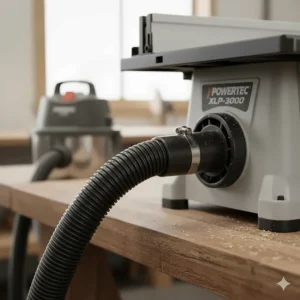
The integrated rolling stand with 8-inch wheels makes jobsite mobility surprisingly painless despite the 79-pound weight. I appreciate the 26-inch rip capacity – you can split plywood sheets lengthwise without gymnastics. The adjustable fence locks securely, and the dust port actually captures a decent amount of sawdust when connected to a shop vacuum.
Users consistently mention the saw’s stability during operation. Unlike some lighter models that walk across the floor, this small workshop table saw stays planted. The tradeoff is weight – moving it into a truck bed requires either help or determination. Also, assembly instructions could use clearer diagrams.
✅ Pros:
- Massive expandable work surface
- 26-inch rip capacity handles large panels
- Rolling stand with sturdy wheels
- Dado blade compatible
❌ Cons:
- Heavy at 79 pounds
- Assembly instructions confusing
- No dust collection bag included
Best for: Home renovators and woodworkers tackling full-sheet materials and larger projects.
5. Goplus 10-Inch Portable – Best Lightweight Powerhouse
The Goplus 10-Inch represents the sweet spot between power and portability. At just 46 pounds with a 15-amp motor delivering 5,000 RPM, this affordable benchtop table saw punches well above its weight class. The aluminum tabletop with 26-inch rip capacity reduces friction while maintaining rigidity.
What impressed me most is the double-bevel cutting capability (0-45 degrees) and the transparent blade guard that actually lets you see your cut line. The included metal stand provides stability without adding excessive bulk. Customer reviews highlight smooth cuts through various hardwoods, though some noted the fence requires occasional recalibration.
The 36-tooth carbide blade works reasonably well for general cutting, but upgrading to a 40 or 60-tooth blade transforms this saw’s performance. The sliding miter gauge adjusts from -45° to 45°, and onboard storage keeps push sticks and wrenches accessible.
✅ Pros:
- Lightweight at 46 lbs with stand
- Powerful 15-amp motor
- Transparent blade guard for visibility
- Double-bevel cutting capability
❌ Cons:
- Fence calibration needs attention
- No dust collection system
- Manual fence locking (no rack-and-pinion)
Best for: DIYers seeking maximum portability without sacrificing cutting capacity.
6. Craftsman CMXETAX69434502 – Best Traditional Value
The Craftsman CMXETAX69434502 carries the legacy of America’s most trusted tool brand at an entry-level price point. This 10-inch model runs on 15 amps with a 24-inch rip capacity, handling dimensional lumber and smaller sheet goods with confidence.
At $199-209, it represents the absolute floor for capable new saws. The steel construction provides durability, and the basic fence system works adequately for construction-grade cuts. However, this is where budget constraints show – the miter slots use non-standard dimensions, limiting aftermarket accessory compatibility.
Users report mixed experiences with fence accuracy. Some found it acceptable for rough carpentry, while others invested in an aftermarket fence upgrade. The saw excels at jobsite tasks like cutting studs, trim, and decking but falls short for precision furniture work. Consider it a workhorse, not a fine tool.
✅ Pros:
- Rock-bottom pricing
- Solid steel construction
- Adequate for construction tasks
- Brand reputation and support
❌ Cons:
- Non-standard miter slots
- Fence accuracy inconsistent
- Scale markings wear quickly
Best for: Construction workers and contractors needing a disposable backup saw for rough work.
7. DEWALT DW745 – Best Premium Budget Option
Though technically discontinued, the DEWALT DW745 remains widely available and represents the pinnacle of budget benchtop engineering. Its 15-amp motor, compact design, and legendary fence accuracy set the standard that others chase. The rack-and-pinion fence adjusts with precision, and the 20-inch rip capacity handles most projects comfortably.
This compact portable table saw weighs 53 pounds and features a steel roll cage protecting internal components from jobsite abuse. The Site-Pro Modular Guarding System allows tool-free guard adjustments – a feature that seems minor until you’re making your tenth blade-height change of the day. Users praise its accuracy, with many reporting years of trouble-free service.
The main limitation is availability – DEWALT replaced it with the DWE7485 to meet updated safety standards. If you find one new or gently used at a good price, grab it. This saw has earned its reputation through thousands of workshops and jobsites.
✅ Pros:
- Exceptional fence accuracy
- Compact, portable design
- Durable steel roll cage
- Tool-free guard adjustments
❌ Cons:
- Discontinued (limited availability)
- 20-inch rip capacity smaller than competitors
- No dado blade capability
Best for: Woodworkers finding new-old-stock units or quality used examples seeking proven reliability.
Understanding Benchtop Table Saw Basics
A benchtop table saw under 300 represents the entry point into serious woodworking. These compact machines deliver straight, repeatable cuts that circular saws simply can’t match. Before diving deeper, let’s clarify what makes these saws special.
What Defines a Budget Benchtop Saw?
Unlike full-sized cabinet saws costing thousands, benchtop models sacrifice some power and precision for portability and affordability. They typically feature:
- Direct drive motors (15 amps or less) instead of belt-driven induction motors
- Lighter construction using aluminum and steel rather than pure cast iron
- Smaller footprints designed for garage workshops and jobsite transport
- Simplified fence systems that prioritize function over ultra-precision
The best value benchtop saw balances these compromises intelligently, delivering 90% of cabinet saw performance at 20% of the cost.
How to Choose the Right Benchtop Table Saw Under 300
Motor Power and Blade Speed
Motor specifications tell only part of the story. A 15-amp motor typically drives 10-inch blades at 3,850-5,000 RPM, while 13-amp motors work better with 8-1/4 inch blades. Higher RPM doesn’t automatically mean better cuts – blade quality and tooth count matter more for finish quality.
For hardwoods like oak and maple, look for motors rated at 15 amps minimum. Softwoods and plywood forgive less powerful motors, making 13-amp options viable.
Rip Capacity Considerations
Rip capacity determines the maximum width you can cut to the right of the blade. The 24-inch benchmark lets you rip plywood sheets in half (48 ÷ 2 = 24). Smaller capacities around 12-20 inches work fine for dimensional lumber but struggle with sheet goods.
If cabinet building or furniture making interests you, prioritize 24+ inch capacity. For trim carpentry and small projects, 16-20 inches suffices.
Fence Accuracy and Type
The fence might be the single most important feature on any table saw. Rack-and-pinion systems maintain parallelism automatically as you adjust width, while manual slide fences require checking with a square after every adjustment.
Budget saws often skimp here, but models from DEWALT and SKIL prove affordable rack-and-pinion systems exist. Test fence lock-down – it should clamp firmly without shifting.
Safety Features That Matter
Modern benchtop saws include several critical safety elements:
- Blade guards that adjust to material thickness
- Riving knives preventing kickback by keeping the kerf open
- Anti-kickback pawls grabbing wood if it starts moving backward
- Power-loss reset preventing accidental startups after outages
The OSHA woodworking safety guidelines emphasize that all these features should remain installed and functional during operation.
Portability vs. Stability
Lighter saws move easily but may vibrate during cuts. Heavier models stay planted but challenge your back. Consider your primary use:
- Jobsite work: Prioritize weight under 55 lbs with handles or stands
- Workshop use: Accept 60-80 lbs for added stability
- Dual purpose: Choose mid-weight options (50-60 lbs) with detachable stands
Dado Blade Compatibility
Dado blades cut flat-bottom grooves for joinery, but not all budget saws accept them. The arbor (shaft holding the blade) must be long enough, and the throat plate must accommodate wider blade stacks. If you plan cabinetry or shelving with dado joints, verify compatibility before purchasing.
Maximizing Your Table Saw Performance
Essential Accessories Under $100
Upgrading your saw’s capabilities doesn’t require huge investments:
Premium Blade ($40-80): Replace the stock blade immediately with a Freud Diablo or similar 40-60 tooth carbide blade. This single upgrade improves cut quality more than any other modification.
Featherboards ($15-30): These spring-loaded guides press wood against the fence, preventing drift and reducing kickback risk.
Zero-Clearance Insert ($20-40): Reduces tearout on cross-cuts and dado work by minimizing the gap around the blade.
Miter Gauge Upgrade ($30-70): Stock gauges wobble in their slots. Aftermarket versions like the Incra Miter 1000 provide rock-solid crosscuts.
Blade Selection Guide
Different teeth configurations excel at specific tasks:
- 24-40 teeth: Fast ripping of dimensional lumber
- 40-60 teeth: General purpose cutting of hardwoods and softwoods
- 60-80 teeth: Fine crosscuts in hardwoods and plywood
- 80+ teeth: Ultra-smooth cuts in melamine and laminates
Maintenance Tips for Longevity
Regular maintenance extends your saw’s life and maintains cutting quality:
Weekly (for frequent use):
- Brush sawdust from under the blade and motor housing
- Check fence parallelism with a combination square
- Inspect power cord for damage
Monthly:
- Clean blade with oven cleaner or dedicated blade cleaner
- Apply paste wax to table surface for smooth sliding
- Check all bolts and screws for tightness
- Verify blade guard and riving knife operation
Annually:
- Deep clean motor housing with compressed air
- Inspect brushes (if applicable) and replace if worn
- Check belt condition on belt-driven models
- Verify blade runout with a dial indicator
Safety Guidelines for Benchtop Saws
Personal Protective Equipment
Never operate a table saw without:
- Safety glasses or face shield protecting from flying debris
- Hearing protection reducing long-term hearing damage
- Dust mask or respirator filtering fine wood particles
- Appropriate clothing – avoid loose sleeves, jewelry, or ties
Critical Operating Rules
Following these rules prevents the majority of table saw accidents:
- Never reach over the blade while it’s spinning
- Use push sticks for cuts narrower than 6 inches
- Maintain blade guard unless absolutely impossible for the cut
- Stand to the side of the blade path, not directly behind it
- Unplug during blade changes – never rely on the off switch alone
- Support long pieces with roller stands or a helper
- Check wood for defects like knots or metal before cutting
- Wait for complete blade stop before retrieving cut pieces
The OSHA machinery requirements provide comprehensive technical standards for table saw safety that every user should understand.
Kickback Prevention
Kickback occurs when wood binds on the blade and launches toward the operator at terrifying speeds. Prevent it by:
- Installing and maintaining the riving knife
- Using anti-kickback pawls for ripping operations
- Never ripping warped or twisted boards
- Supporting large sheets properly
- Keeping blades sharp and at proper height
- Standing aside from the blade path
Comparison: Benchtop vs Traditional Alternatives
When to Choose Benchtop Over Full-Size
Choose benchtop if you:
- Work in limited space (garage, shed, apartment)
- Transport tools between locations
- Budget under $400 total investment
- Focus on smaller projects and repairs
- Need occasional rather than daily use
Choose contractor/cabinet saws if you:
- Own a dedicated workshop with space
- Process large volumes of wood regularly
- Require ultimate precision for fine furniture
- Can invest $800+ for superior accuracy
- Value power and capacity over portability
Comparing Popular Brands
DEWALT: Premium build quality and excellent fence systems justify slightly higher prices. Best for contractors who beat their tools daily.
SKIL: Strong value with innovative features like integrated stands. Good balance of price and performance for serious hobbyists.
RYOBI: Entry-level pricing with acceptable performance. Perfect for beginners learning fundamentals without major investment.
WEN: Budget-conscious brand offering surprising capabilities. Best for DIYers willing to accept minor compromises for significant savings.
Craftsman: Traditional brand with variable quality in budget lines. Good for rough carpentry, questionable for precision work.
Common Mistakes When Buying Budget Saws
Overlooking Fence Quality
I’ve watched countless buyers focus solely on motor power and blade size while ignoring the fence system. A powerful motor can’t overcome a fence that won’t stay parallel. Test the fence at the store – it should slide smoothly, lock securely, and maintain squareness.
Ignoring Blade Quality
Manufacturers include cheap blades to hit price points. That thin, 24-tooth stamped steel blade creates rough cuts and burns wood. Budget $50-70 for a quality carbide blade immediately – it transforms a mediocre saw into a capable machine.
Underestimating Space Requirements
Benchtop saws need more room than their footprint suggests. Account for:
- Infeed space: At least 4-6 feet behind the saw
- Outfeed support: 4-8 feet depending on materials
- Side clearance: Fence extension and material support
That “compact” saw suddenly needs a 10×10 foot area for safe operation.
Skipping Safety Features
Some buyers remove blade guards for “convenience” or skip push sticks to “save time.” Table saw injuries result in thousands of emergency room visits annually – many entirely preventable with proper guards and technique.
Project Ideas for Your New Saw
Beginner Projects
Cutting Board: Practice accurate crosscuts and ripping while creating useful kitchen items. Start with contrasting hardwoods like maple and walnut.
Picture Frames: Master miter cuts and develop your eye for grain matching. Small scale means low material cost for learning.
Simple Shelving: Combine ripping plywood and cutting dados for adjustable shelf pins. Practical storage builds skills.
Intermediate Projects
Workbench Top: Laminate hardwoods or plywood to create a sturdy work surface. Practices large glue-ups and flattening techniques.
Nightstand: Incorporate drawer boxes, face frames, and door construction. Teaches fundamental furniture-building skills.
Garden Planter Box: Outdoor projects forgive imperfections while building confidence with angled cuts and weatherproof joinery.
Frequently Asked Questions
❓ Can a benchtop table saw under 300 handle hardwoods effectively?
❓ How does rip capacity affect everyday woodworking projects?
❓ Should beginners prioritize safety features or cutting performance?
❓ What's the realistic lifespan of a budget benchtop table saw?
❓ Are aftermarket accessories compatible with all budget table saws?
Final Thoughts: Making Your Decision
Choosing the right benchtop table saw under 300 comes down to matching capabilities with your specific needs. The DEWALT DWE7485 represents the best overall value for serious DIYers willing to invest near the top of the budget. Its accuracy, portability, and proven durability justify the premium.
For those maximizing value, the SKIL TS6307-00 delivers incredible functionality with its integrated stand and expanded bevel range. Beginners should seriously consider the RYOBI RTS08 – it provides ample capability for learning fundamental techniques without financial stress.
Remember that the saw is just the beginning. Budget for quality blades, safety equipment, and basic accessories. A $300 saw with a $70 blade outperforms a $400 saw with a cheap blade every single time.
Whatever you choose, prioritize safety, invest in quality consumables, and practice proper technique. Your benchtop saw can produce work rivaling machines costing five times more – the limiting factor is your skill, not the tool’s capability.
Now get out there and start making sawdust! Your next project is waiting.
Recommended for You
Looking for more woodworking insights? Check out these guides:
- Best Miter Saws Under $300: Perfect companion tool for angle cuts
- Table Saw Blade Guide: Choosing the right blade for every material
- Workshop Setup on a Budget: Building a complete woodshop without breaking the bank
These resources complement your table saw purchase, helping you build a capable workshop that grows with your skills.
Disclaimer: This article contains affiliate links. If you purchase products through these links, we may earn a small commission at no additional cost to you.
✨ Found this helpful? Share it with your friends! 💬🤗
