
In This Article
There’s a moment every woodworker knows well. You’re staring at a sheet of 3/4-inch plywood, a circular saw in hand, and a string line you’ve triple-checked — and you still end up with a cut that drifts half an inch by the time it exits the far end. That’s the moment you realize you need a table saw.
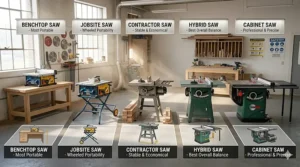
But here’s where it gets complicated: walk into any hardware store or scroll through Amazon for five minutes, and you’ll be staring at a wall of 15-amp motors, rip capacities, rack-and-pinion fences, and price tags that range from “impulse purchase” to “second mortgage.” This table saw buying guide cuts through all of that. Not just specs — but what those specs actually mean when you’re standing in your garage at 7 p.m. trying to rip a 4×8 sheet of oak plywood by yourself.
This table saw buying guide for 2026 covers seven real, currently available models on Amazon — from a sub-$350 beginner-friendly jobsite saw to a $2,000+ cabinet saw built for serious craftsmen. Whether you’re a weekend DIYer building raised garden beds or a professional contractor who lives on a job site, there’s a right saw on this list. The wrong one can cost you far more in frustration than it saves in dollars.
According to OSHA’s power tool safety guidelines, table saws account for more workshop injuries than any other stationary tool — which makes understanding what you’re buying before you buy it more than just smart. It’s essential.
Quick Comparison: Top 7 Table Saws at a Glance
| Model | Type | Blade | Motor | Rip Capacity | Price Range | Best For |
|---|---|---|---|---|---|---|
| SKIL TS6307-00 | Jobsite | 10″ | 15A | 25.5″ | ~$300–$360 | Budget beginners |
| DeWalt DWE7485 | Compact Jobsite | 8-1/4″ | 15A | 24.5″ | ~$280–$350 | Tight spaces |
| DeWalt DWE7491RS | Jobsite | 10″ | 15A | 32.5″ | ~$550–$650 | Best all-rounder |
| Bosch GTS15-10 | Jobsite | 10″ | 15A | 32-1/8″ | ~$600–$700 | Hardwood pros |
| Metabo HPT C10RJS | Contractor | 10″ | 15A | 35″ | ~$450–$550 | Mid-range upgrade |
| Milwaukee M18 FUEL 2736-20 | Cordless | 8-1/4″ | Brushless | 24.5″ | ~$450–$700 | Cord-free job sites |
| SawStop PCS175-TGP236 | Cabinet | 10″ | 1.75 HP | 36″ | ~$2,000–$2,500 | Ultimate safety + precision |
What this table actually tells you: The DeWalt DWE7491RS and Bosch GTS15-10 are neck-and-neck on paper — both 15A, both 10-inch, very similar rip capacities — but they serve different cutting styles. The Bosch holds speed under load better for dense hardwoods, while the DeWalt rips long boards faster. Budget buyers will notice that the SKIL TS6307-00 delivers nearly the same rip capacity as the DWE7491RS at almost half the price, though you give up fence precision and build quality in the trade.
💬 Just one click — help others make better buying decisions too! 😊
Top 7 Table Saws for 2026: Expert Analysis
1. SKIL TS6307-00 15-Amp 10-Inch Jobsite Table Saw
If you’ve been woodworking with a circular saw and a prayer, the SKIL TS6307-00 is your graduation gift to yourself — without breaking the bank. It runs on a 15-amp motor spinning a 10-inch blade at 4,600 RPM, with a 25.5-inch rip capacity that handles full plywood sheets with room to spare.
What most beginners overlook about this model is the rack-and-pinion fence system. Budget saws typically ship with a T-style fence that drifts out of square the moment you sneeze near it. The SKIL’s fence locks down reliably — not DeWalt-level crisp, but dramatically better than anything at this price point. The built-in folding stand keeps setup under five minutes, and the 10-inch blade means you can run dado stacks for cutting grooves and rabbets, a feature that the compact 8-1/4″ saws in this category can’t offer.
Customers consistently praise the value — many describe it as “85% of a DeWalt at 60% of the cost,” which is a fair characterization. The fence isn’t as stiff after repeated adjustments, and the table surface is slightly smaller than competitors, which makes handling wide panels a bit awkward solo.
✅ Dado stack compatible (10″ blade)
✅ Rack-and-pinion fence — rare at this price
✅ Folds flat for compact storage
❌ Fence can loosen over heavy, repeated use
❌ Smaller table surface than mid-range rivals
Price range: Around $300–$360 — exceptional value for a first serious table saw.
2. DeWalt DWE7485 8-1/4-Inch Compact Jobsite Table Saw
Small workshop? Cramped garage? The DWE7485 was engineered for exactly your situation. It weighs just 48 pounds, fits in the trunk of a sedan, and still delivers a 15-amp motor spinning at 5,800 RPM — which is actually faster than most 10-inch saws. That speed matters: higher RPM on a smaller blade translates to smoother crosscuts in trim, finish lumber, and hardwood.
Here’s what the spec sheet won’t tell you: the DWE7485 uses an 8-1/4-inch blade, which is increasingly the standard on jobsite saws. But it cannot accept a dado stack. If you ever plan to cut dadoes or rabbets — standard joints in cabinetry, bookcase construction, or drawer boxes — this limitation will frustrate you within a year. It’s a significant trade-off for the compact form factor.
The 24.5-inch rip capacity handles most dimensional lumber and narrower sheet goods, but you’ll hit the wall with full-width plywood rips. Where the DWE7485 earns its place is in the remodeling contractor’s van: light, powerful, and precise. Customers report that the blade guard is one of the better-designed ones in the class, actually staying on during normal use rather than being immediately removed and lost forever like on most budget saws.
✅ Extremely portable — 48 lbs, compact footprint
✅ 5,800 RPM for ultra-smooth finish cuts
✅ DeWalt build quality at a reasonable price
❌ No dado stack capability (8-1/4″ blade)
❌ Rip capacity limited to 24.5″ — not ideal for full sheets
Price range: Around $280–$350 — best compact saw in its class.
3. DeWalt DWE7491RS 10-Inch Jobsite Table Saw with Rolling Stand
This is the saw that professional contractors reach for when accuracy and reliability are non-negotiable. The DWE7491RS pairs a 15-amp, 4,800 RPM motor with a 32.5-inch rip capacity and DeWalt’s legendary rack-and-pinion telescoping fence system — a combination that makes cutting full 4×8 plywood sheets feel almost effortless.
The rack-and-pinion fence is the DWE7491RS’s defining feature, and it’s worth dwelling on. Unlike clamp-style fences that require you to check and re-check squareness every time you move them, this system locks parallel to the blade every single time with a single hand motion. Over the course of a full project, that consistency saves you 15–20 minutes of measuring and probably a couple pieces of expensive hardwood you would have otherwise ruined with a drifting fence.
The rolling stand deserves credit too. It deploys in seconds, locks rock-solid, and folds back down without a fight — something not every “rolling stand” design can claim. At 90 pounds, this isn’t a one-hand carry, but the stand makes job-to-job transport manageable. Intermediate hobbyists who’ve outgrown entry-level saws will find this hits the sweet spot: shop-worthy performance without the footprint or price of a cabinet saw.
Customer feedback across thousands of Amazon reviews points to one consistent theme: this saw just works, day after day, without needing constant adjustment. The dust collection port (2-inch) keeps cleanup reasonable, though serious shops will want a proper shop vac connection.
✅ Industry-leading rack-and-pinion fence accuracy
✅ 32.5″ rip capacity — handles full plywood sheets
✅ Rolling stand for easy site-to-site transport
❌ At 90 lbs, not truly one-person portable
❌ Dust collection is functional but not exceptional
Price range: Around $550–$650 — the best all-around jobsite saw money can buy at this price point.
4. Bosch GTS15-10 10-Inch Portable Jobsite Table Saw with Gravity-Rise Stand
When a woodworker tells you the Bosch GTS15-10 costs more than the DeWalt and is worth it, they’re probably talking about one thing: electronically regulated speed under load. Most jobsite saws slow down when you push a tough piece of 8/4 hard maple through them — the blade bogs, the cut quality drops, and you’re left chasing tearout with a hand plane. The Bosch’s soft-start motor maintains blade speed more consistently through demanding material, which means better surface quality straight off the saw.
The GTS15-10 runs at 3,800 RPM (lower than the DeWalt’s 4,800), but that’s intentional — Bosch engineers tuned this motor for torque over raw speed. Think of it as the difference between a diesel truck and a sports car; for ripping thick hardwoods, torque wins every time. The 32-1/8-inch rip capacity is nearly identical to the DeWalt, and the gravity-rise wheeled stand is genuinely one of the best deployment systems in the class — one kick and it’s rolling.
The ClampZone feature on the left side of the tabletop is a clever bonus: it lets you clamp workpieces for light finishing work like sanding or routing without setting up a separate bench. Niche? Sure. But useful when your shop is a one-car garage. Customers highlight the fence micro-adjustment knob as a standout — it allows you to dial in exact positioning in a way that the DeWalt’s system, excellent as it is, simply doesn’t offer.
✅ Electronically regulated speed under load
✅ Micro-adjustment knob for precise fence positioning
✅ Gravity-rise stand — fastest setup/breakdown in class
❌ Higher price than the DeWalt without dramatically better overall performance
❌ 3,800 RPM can leave slightly rougher crosscuts on soft, splintery materials
Price range: Around $600–$700 — worth every dollar for hardwood-focused work.
5. Metabo HPT C10RJS 10-Inch Jobsite Table Saw
The Metabo HPT C10RJS occupies an interesting space: it’s not quite a portable jobsite saw, and not quite a cabinet saw. Call it a contractor’s hybrid — it’s heavier and more stable than the DeWalt or Bosch, but still wheel-around portable with its stand. The payoff is a 35-inch rip capacity (larger than either of the DeWalt or Bosch options) and a table surface measuring nearly 29 inches wide, which provides noticeably more support when you’re handling large panels alone.
The 15-amp motor runs at 4,500 RPM, and while that falls between the Bosch and DeWalt in speed, what stands out is the vibration control. The C10RJS runs notably smoother and quieter than most jobsite saws, and over a full day of cutting that makes a real difference in fatigue. Woodworkers who’ve transitioned from hobbyist to semi-professional use will appreciate the increased table real estate and capacity without jumping to the $2,000+ cabinet saw category.
The fence system is good — not rack-and-pinion, but the cam-lock design holds square reliably. Customers frequently mention that out-of-box calibration on the Metabo is better than average, meaning you spend less time with a square and an Allen wrench before you can make your first cut.
✅ 35-inch rip capacity — largest in this price tier
✅ Exceptionally smooth, low-vibration operation
✅ Large table surface for solo panel handling
❌ Heavier than the DeWalt and Bosch — less truly portable
❌ No rack-and-pinion fence (cam-lock instead)
Price range: Around $450–$550 — the most table for your money in the mid-range.
6. Milwaukee M18 FUEL 8-1/4-Inch Table Saw (2736-20)
Cord management on a job site is a genuine hazard. Tripping, tangling, running out of outlet distance — the Milwaukee M18 FUEL table saw eliminates all of it. The 2736-20 (tool-only; battery sold separately) runs on the M18 FUEL brushless motor platform, spinning an 8-1/4-inch blade at 6,300 RPM — that’s actually faster than most corded 10-inch saws at the blade tip, which means the smaller blade doesn’t sacrifice cut quality.
What makes the Milwaukee’s performance remarkable is that on a fully charged 12.0 Ah High Output battery, it delivers up to 600 linear feet of cutting per charge. That’s two full sheets of plywood ripped into strips, with power to spare. Multiple professional reviewers have described the cut quality as indistinguishable from a corded model in normal use — high praise for a battery-powered saw.
The rack-and-pinion fence with 24.5-inch rip capacity is accurate and repeatable. Like the DeWalt DWE7485, no dado capability — the 8-1/4-inch blade is the trade-off for cordless convenience. This saw makes the most sense for contractors already invested in the M18 ecosystem who want to consolidate to one battery platform, or for remote worksites where running a cord is impractical or impossible.
✅ True cordless freedom — no extension cords, no trip hazards
✅ 6,300 RPM tip speed rivals corded 10″ performance
✅ Deep integration with Milwaukee’s M18 ecosystem
❌ Battery cost adds significantly to total investment
❌ No dado stack capability (8-1/4″ blade)
Price range: Tool-only around $450–$500; kit with battery around $600–$700.
7. SawStop PCS175-TGP236 10-Inch Professional Cabinet Saw
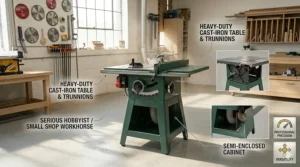
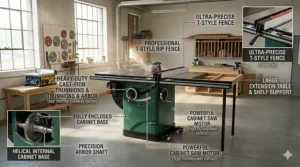
Every other saw on this list is a compromise. The SawStop PCS175-TGP236 is not. It’s a 1.75 HP cabinet saw with a 36-inch T-Glide fence, a cast-iron table measured flat to within 0.01 inches diagonally, and the only flesh-sensing safety system that will stop a spinning blade in less than 5 milliseconds upon skin contact — reducing a potential finger amputation to a minor scratch.
The SawStop’s safety technology deserves its own paragraph. An onboard computer continuously monitors the blade’s electrical signal. When it detects the change in conductivity caused by skin contact, it fires an aluminum brake cartridge into the blade, stopping it and dropping it below the table surface almost instantaneously. According to the Consumer Product Safety Commission, table saw injuries cost the U.S. healthcare system over $4 billion annually. The SawStop’s system has saved over 10,000 fingers since its introduction. For anyone who works with this tool regularly — especially those teaching younger family members or running a shared shop — that’s not a luxury feature. It’s insurance.
Beyond safety, the PCS175-TGP236 is simply a magnificent cutting machine. The T-Glide fence is heavy-gauge steel that locks without deflection for years. The gas piston elevation system makes blade height adjustment smooth enough to do one-handed. Dust collection above and below the table approaches 99% with the optional blade guard. This is the saw you buy once and pass down.
✅ Flesh-sensing safety system — stops blade in <5 milliseconds
✅ Cast-iron table, 0.01″ flatness tolerance
✅ 36″ T-Glide fence — professional cabinetry-grade accuracy
❌ Heavy (over 200 lbs) — not remotely portable
❌ Price puts it out of reach for most hobbyists
Price range: Around $2,000–$2,500 — significant investment, exceptional return for serious woodworkers.
How to Set Up Your Table Saw for the First Time (And the Mistakes to Avoid)
🔧 Getting your new table saw dialed in before the first cut is more important than most buyers realize. A misaligned blade can make an expensive saw perform worse than a cheap one — and it can do it while looking completely normal.
Step 1: Level the saw and check the stand. Before you do anything else, get your saw on a flat surface with all four legs or wheels touching the ground. A rocking saw vibrates more and accelerates wear on every component.
Step 2: Check blade-to-miter slot parallelism. Put a combination square against the miter slot and measure the distance to the front and back of the blade. If they don’t match, adjust the trunnion per your manual. Most saws arrive within tolerance, but don’t assume — verify.
Step 3: Set the fence square to the blade. Place a reliable square (not the plastic one that came with the saw) against the fence. Lock it, then re-check from multiple points along the fence length. The far end of the fence drifting even 1/32-inch creates errors that multiply over a 96-inch board.
Step 4: Check your blade for runout. Spin the blade by hand with a dial indicator touching the flat plate of the blade. More than 0.005-inch runout means your arbor may be bent or the blade is warped — both fixable before you’ve made a single cut.
Step 5: Make a test cut, measure, adjust. Rip a 12-inch piece of scrap, flip one piece end-for-end, and press the cut edges together. A perfectly square cut produces a perfectly straight seam. Any gap at the top or bottom means your fence needs a minor tweak.
Common mistake to avoid: Skipping the dust collection setup. Most table saw injuries happen when visibility is poor. Even a basic shop vac connected to the 2-inch port on a jobsite saw dramatically reduces the airborne debris that impairs your view of the cut line.
Which Table Saw Type Is Right for You? Real-World Scenarios
The table saw buying guide that tells you which saw to get without knowing your situation isn’t helping — it’s guessing. Here are three specific buyer profiles matched to the right saw from our list.
🏠 The Weekend DIYer (Budget: under $400, Space: one-car garage) If you’re building furniture, fixing up the house, and occasionally doing a home improvement project, the SKIL TS6307-00 is your saw. It folds flat, stores against a wall, and handles 95% of what a hobbyist will ever cut. The 25.5-inch rip capacity gets you through plywood with no issue. Save the $200–$300 difference from a mid-range saw and put it toward better blades — which will improve your cut quality more than any other upgrade.
🔨 The Remodeling Contractor (Budget: $550–$700, Needs: portability + precision) You’re moving between job sites, cutting trim, ripping decking, installing cabinets. The DeWalt DWE7491RS was built for you. The rolling stand survives daily loading and unloading. The rack-and-pinion fence doesn’t need to be re-set every time someone bumps the saw. The 32.5-inch rip capacity handles full sheets. This is the professional standard for a reason.
🪵 The Serious Hobbyist or Woodshop Owner (Budget: $2,000+, Needs: precision + safety) You’re building heirloom furniture, teaching family members, or running a shared community woodshop. The SawStop PCS175-TGP236 is not just the best saw — it may be the most defensible purchase you make. The flesh-sensing technology isn’t a novelty; it’s the difference between an accident that’s a story you tell and one that permanently changes your life. The precision is unmatched in its class. Buy it once.
How to Choose a Table Saw: 7 Selection Criteria That Actually Matter
Understanding what to look for separates a smart purchase from an expensive mistake. Here are the seven factors worth your full attention, ranked by how often buyers underweight them.
1. Rip Capacity This is the distance from the blade to the locked fence on the right side. If you ever plan to rip a 4×8 sheet of plywood down the middle (a 24-inch rip), you need at least 24.5 inches of rip capacity. The 32.5-inch capacity on the DWE7491RS is the sweet spot — it handles full sheets with clearance to spare. According to Fine Woodworking magazine, insufficient rip capacity is the #1 buyer regret in table saw purchases.
2. Fence Quality A bad fence ruins good wood. Full stop. Rack-and-pinion systems (DeWalt, Bosch, Milwaukee) lock square repeatedly without adjustment. T-style cam-lock fences (Metabo HPT, SKIL) require more care but are perfectly serviceable for general use. Avoid saws where the fence slides on the table rail with just a wing-nut tightened by hand — those are false economy.
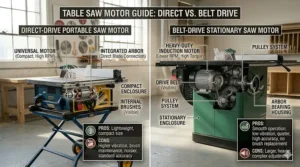
3. Motor Power and Type All the saws in this guide run 15-amp motors. But amps don’t tell the full story. RPM, motor design (direct-drive vs. belt-drive in cabinet saws), and electronic speed regulation under load matter more in practice. The Bosch GTS15-10’s electronically regulated speed is worth real money if you’re cutting dense hardwoods regularly.
4. Portability vs. Mass More mass means more stability and less vibration. A SawStop cabinet saw is a dream to use precisely because it weighs 200+ pounds and doesn’t move when you push material through it. A 48-pound jobsite saw trades that stability for the ability to fit in your car. Know which you need before you buy.
5. Blade Diameter: 8-1/4″ vs. 10″ Ten-inch saws cut deeper (3-1/8″ vs. approximately 2-9/16″) and can run dado stacks for joinery. Eight-and-a-quarter-inch saws are more compact and increasingly common in cordless platforms. Unless storage is your primary constraint, the 10-inch format gives you more capability for the same or lower price.
6. Dado Stack Compatibility Often overlooked by beginners, dado blades are wide-kerf blade sets that cut grooves and rabbets in a single pass. If you plan to build drawers, shelving, or any joinery project, dado compatibility matters enormously. Verify before purchasing — 8-1/4″ blades typically cannot accept dado stacks due to arbor length constraints.
7. Safety Features At minimum, look for a blade guard with a riving knife (keeps the kerf open so wood can’t bind on the blade), anti-kickback pawls, and an accessible on/off switch reachable with your knee. At the premium level, SawStop’s flesh-sensing technology is in a category of its own.
Common Mistakes When Buying a Table Saw
🚫 Buying by horsepower alone. Hobbyists often fixate on HP ratings, but a well-designed 15-amp motor in a jobsite saw outperforms a poorly engineered 3 HP contractor saw every time. The motor design, RPM curve, and electronic regulation matter more than peak horsepower.
🚫 Ignoring the fence and assuming you’ll “figure it out.” The fence is the most-used component of a table saw, and a bad one adds 10–15 minutes of setup frustration to every session. It’s the single most common reason experienced woodworkers upgrade from budget saws.
🚫 Buying a saw without accounting for total cost. A $300 table saw paired with a $60 quality blade, a $40 zero-clearance insert, and a proper push stick setup delivers better results than a $300 table saw used with the stock blade straight out of the box. Budget for accessories.
🚫 Choosing compact when you needed capacity. The compact 8-1/4-inch saws are brilliant for remodeling. They’re limiting for furniture-making. Know your primary use case before committing.
🚫 Skipping the calibration step. New saws — even expensive ones — can arrive slightly out of alignment. Spending 20 minutes on setup before your first cut prevents hours of troubleshooting mysterious measurement errors later.
Table Saw vs. Track Saw: When a Table Saw Isn’t the Answer
Not every workshop needs a table saw, and being honest about that makes this table saw buying guide more useful. A track saw — a circular saw riding on a precision aluminum rail — excels at breaking down full sheet goods accurately without the dedicated floor space a table saw requires. If your primary work is cutting down full plywood sheets into smaller panels, a track saw might genuinely serve you better.
| Feature | Table Saw | Track Saw |
|---|---|---|
| Ripping long boards | ⭐⭐⭐⭐⭐ | ⭐⭐ |
| Breaking down sheet goods | ⭐⭐⭐⭐ | ⭐⭐⭐⭐⭐ |
| Bevel cuts | ⭐⭐⭐⭐ | ⭐⭐⭐⭐ |
| Dado/groove cuts | ⭐⭐⭐⭐⭐ | ❌ |
| Shop space required | High | Low |
| Price (entry level) | ~$300 | ~$400 |
The data above reveals an important truth: if your work is 80% sheet goods and 20% ripping solid lumber, a track saw is a legitimate alternative. But the moment you need dadoes, rabbets, or consistent precision rip cuts in solid hardwood on a regular basis, the table saw wins without contest.
Long-Term Cost and Maintenance: What Ownership Actually Looks Like
The sticker price on your table saw is just the beginning. Understanding the total cost of ownership helps you decide whether a $300 saw or a $650 saw is actually the better value.
Blades: The stock blade on any saw in this guide should be replaced within the first few months of regular use with a quality aftermarket blade. A Freud Diablo or Forrest Woodworker II in the $50–$80 range will transform your saw’s cut quality more dramatically than upgrading the entire saw. Budget one to two blade replacements per year for regular use.
Arbor bearings and motor maintenance: Jobsite saws live in dusty, abusive environments. Blowing out the motor housing monthly with compressed air and keeping sawdust out of the arbor bearing extends motor life significantly. Well-maintained, the DeWalt DWE7491RS can run 10+ years in a professional environment.
Brake cartridges (SawStop only): The SawStop’s safety brake activates when it contacts skin — but also when it contacts certain wet or conductive woods, or when the blade touches the aluminum miter gauge. Replacement cartridges run around $70–$80 each. This is a known cost of ownership that SawStop buyers should factor in.
Fence wear: On lower-priced saws, the fence rail wears over years of heavy use. Budget saws often need fence replacement at the 3–5-year mark. On mid-range and premium models with hardened steel rails, this is rarely an issue within a normal ownership window.
🔍 Ready to upgrade your woodworking game?
Click on any highlighted product in this guide to check current pricing and availability on Amazon. Whether you’re outfitting a first workshop or upgrading to professional-grade precision, the right table saw is waiting — and checking the current price takes exactly one click.
FAQ: Table Saw Buying Guide
❓ What size table saw do I need for a beginner?
❓ How to choose a table saw for home use vs. professional use?
❓ What is rip capacity and why does it matter when buying a table saw?
❓ Is a cordless table saw as good as a corded one?
❓ What table saw selection criteria should I prioritize if I have a small budget?
Conclusion
The table saw buying guide you actually need doesn’t end with a list of specs — it ends with a decision you feel confident about. Here’s how to use everything in this guide to make yours.
If you’re new to woodworking and working with a limited budget, start with the SKIL TS6307-00. It will not let you down for years of hobby use, and the money you save goes toward better blades and better wood — both of which improve your results more than a premium saw would at this stage.
If you work in the trades or your projects have genuinely outgrown your current setup, the DeWalt DWE7491RS is the professional standard. The fence is flawless, the capacity is generous, and it survives daily job-site abuse with dignity.
If you’re running a serious woodshop and safety is a non-negotiable, the SawStop PCS175-TGP236 isn’t extravagant — it’s responsible. Every serious woodworker who has ever had a close call understands, viscerally, why the technology matters.
For a deeper look at wood selection and project planning resources, The Wood Database is one of the best free references available for understanding how different species behave under a table saw blade — knowledge that makes every saw perform better.
Whatever you choose, calibrate it before your first cut, invest in a quality blade, and respect the machine. The best table saw in the world is the one that helps you make something you’re proud of — safely.
Recommended for You 📖
- 7 Best Used Cabinet Table Saw Deals 2026 (Save Big!)
- 7 Best SawStop Alternative Options for Safe Cutting in 2026
- 7 Best SKILSAW Worm Drive Table Saw Models (2026 Guide)
Disclaimer: This article contains affiliate links. As an Amazon Associate, I earn from qualifying purchases. If you purchase products through these links, we may earn a small commission at no additional cost to you.
✨ Found this helpful? Share it with your friends! 💬🤗
