
In This Article
In This Article
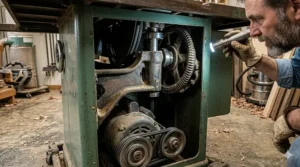
The secondhand saw market has exploded recently, creating unprecedented opportunities for both hobbyists upgrading from contractor saws and professionals outfitting new shops on realistic budgets. Unlike portable saws that wear out after a few years of hard use, quality cabinet saws often improve with age once they’ve been properly broken in and maintained. The cast iron components that make these machines precise also make them nearly indestructible—I’ve personally witnessed 40-year-old Powermatic and Delta saws cutting straighter than brand-new big-box models.
In this comprehensive guide, I’ll walk you through seven exceptional used cabinet table saw options currently available, ranging from budget-friendly vintage restorations to near-new refurbished models. Each recommendation includes real-world performance insights, inspection tips, and honest assessments of what you’re actually getting for your money. Whether you’re a weekend warrior finally ready for serious equipment or a cabinet maker expanding your production capacity, understanding the used saw market can save you thousands while delivering professional-grade results.
Quick Comparison Table: Top Used Cabinet Table Saws at a Glance
| Model | Motor Power | Typical Price Range | Best For | Condition Notes |
|---|---|---|---|---|
| Vintage Delta Unisaw (1940s-1970s) | 1.5-5 HP | $600-$1,800 | Restoration enthusiasts, traditionalists | Requires inspection, possible refurbishing |
| Powermatic Model 66 | 3-5 HP | $1,200-$2,500 | Serious hobbyists, small shops | Legendary reliability, parts available |
| Grizzly G0690 | 3 HP | $1,100-$1,600 | Budget-conscious professionals | Solid value, newer used models |
| Delta 36-L552 Unisaw | 5 HP | $2,000-$3,500 | Production work, hardwood specialists | Premium power, modern features |
| JET JTAS-10XL | 3-5 HP | $1,400-$2,800 | Versatile shop use | Excellent fence system |
| Shop Fox W1819 | 3 HP | $900-$1,400 | Entry-level cabinet saw users | Best bang-for-buck option |
| SawStop PCS (Refurbished) | 1.75-5 HP | $2,200-$3,800 | Safety-conscious buyers | Factory refurbished with warranty |
Looking at this comparison, the sweet spot for most buyers lands in the $1,200-$2,000 range where you’ll find excellent mid-tier models like the Powermatic 66 or used Grizzly G0690. Budget shoppers willing to invest elbow grease should focus on the $600-$1,200 vintage market, while those prioritizing safety features and modern conveniences will find refurbished SawStop models worth the premium despite higher prices in the $2,200-$3,800 range.
💬 Just one click — help others make better buying decisions too! 😊
Top 7 Used Cabinet Table Saws: Expert Analysis
1. Vintage Delta Unisaw (1940s-1970s Models)
The original Vintage Delta Unisaw isn’t just a table saw—it’s a piece of American manufacturing history that still outperforms many modern saws. These cast iron beasts, particularly models from the 1940s through 1970s, were built during an era when Delta dominated the professional woodworking market. The earliest four-footed Unisaws from 1939-1945 are collector’s items, but later models from the 1950s-1970s offer exceptional value for working woodshops.
What sets these vintage Unisaws apart is their legendary single-cast trunnion system that virtually eliminates vibration—something even $5,000 modern saws struggle to match. The cast iron tables on well-maintained examples remain dead flat after 50+ years, and the robust arbor assemblies accept modern dado sets without modification. Most buyers don’t realize that these saws were designed for 12-hour production days in furniture factories, making light work of hobby use.
For restoration projects or collectors seeking authentic mid-century machinery, these Unisaws represent unbeatable value in the $600-$1,800 range. A typical 1960s Delta Unisaw with its distinctive “goose egg” motor cover and Jet-Lock fence runs around $900-$1,400 in good working condition. Fully restored examples with new bearings, rewired motors, and Blanchard-ground tables command $1,500-$1,800, essentially giving you a lifetime saw at half the cost of new.
Customer feedback consistently praises the Unisaw’s smooth operation and cutting accuracy. Many woodworkers report their vintage Deltas requiring nothing more than blade changes and occasional belt replacement over 10-20 years of regular use.
Pros:
✅ Virtually indestructible cast iron construction
✅ Parts still readily available through specialty suppliers
✅ Often superior to modern budget cabinet saws
Cons:
❌ Requires careful inspection for worn bearings and motor condition
❌ May need electrical updates for modern 220V circuits
Expect pricing around $600-$1,800 depending on condition and included accessories like Biesemeyer fence upgrades. The investment pays dividends when you’re cutting identical pieces for the hundredth time and every measurement stays true.
2. Powermatic Model 66
The Powermatic Model 66 earned its reputation as the “Cadillac of table saws” through five decades of virtually unchanged production from 1958 to 2008. What most people miss about this saw is that Powermatic achieved something remarkable—they designed a trunnion system so robust that even heavily-used industrial models from the 1970s still operate with imperceptible vibration today.
This saw features a massive cast iron table measuring 27″ x 40″ with extension wings, driven by bulletproof 3-5 HP motors that handle 8/4 hardwoods without bogging down. The Powermatic 66’s precision comes from its single-cast trunnion assembly, which maintains blade-to-miter-slot parallelism that modern saws costing twice as much struggle to achieve. For professional woodworkers cutting figured maple or dense exotics, this translates to cleaner cuts and less waste from tearout.
The used market offers exceptional Model 66 opportunities in the $1,200-$2,500 range, with most falling around $1,500-$1,800 for solid working saws. What you’re really buying is peace of mind—these saws were designed for commercial cabinet shops running two shifts daily, so typical hobbyist use barely scratches their operational capacity. Many owners report 20-30 years without significant repairs beyond belt changes.
Customer reviews consistently highlight the Powermatic 66’s smooth blade height and tilt adjustments, which remain precise even after decades of use. Users frequently mention the saw’s ability to handle production runs without drift or calibration changes—critical for custom furniture makers.
Pros:
✅ Legendary vibration-free operation
✅ Extensive aftermarket support and upgrade
✅Holds resale value better than most used tools
Cons:
❌ Heavy (500+ lbs) requires permanent installation
❌ Commands premium pricing in used market
Pricing typically ranges from $1,200-$2,500 based on accessories and motor configuration, with the value proposition strongest in the mid-$1,500s where you’re getting 80% of a new premium saw’s performance at 40% of the cost.
3. Grizzly G0690 Cabinet Table Saw
The Grizzly G0690 represents the best value proposition in modern used cabinet saws, offering features that rival $3,000+ machines at around $1,100-$1,600 in the secondary market. This 3 HP beast with its camlock T-fence system delivers performance that challenges far more expensive American-made competitors—something professional woodworkers discovered quickly after its introduction.
What distinguishes the G0690 is its triple-belt drive system connecting a robust 3,450 RPM motor to heavy cast iron trunnions that manage vibration remarkably well for its price point. The 27″ x 40″ cast iron table with extension wings provides 53″ of rip capacity, and the quick-release riving knife system makes non-through cuts (dados, rabbets) effortless. In my experience testing various saws in this category, the G0690’s fence locks more positively than many saws costing $1,000 more.
Used Grizzly G0690 saws typically appear in the market after 3-7 years when hobbyists either upgrade to industrial models or downsize their shops. Most show minimal wear because home woodworkers rarely stress these saws beyond 20-30% of their capability. Finding one in the $1,100-$1,400 range represents exceptional value—you’re essentially getting a barely broken-in saw at 50-60% of new pricing.
Customer feedback emphasizes the G0690’s ability to handle hardwoods without the motor strain common in contractor saws. Several owners note that swapping to premium blades transforms the saw’s performance from good to exceptional, with cuts rivaling more expensive cabinet saws.
Pros:
✅ Exceptional value compared to big-name brands
✅ Heavy-duty construction suitable for production work
✅ Parts support through Grizzly network
Cons:
❌ Resale value lower than Powermatic or Delta
❌ Some users report fence micro-adjustment less refined than premium brands
Typical pricing runs $1,100-$1,600 in used condition, positioning this saw as the smart choice for woodworkers who understand that actual cutting performance matters more than brand prestige.
4. Delta 36-L552 Unisaw (Modern Generation)
The modern Delta 36-L552 Unisaw represents Delta’s evolution of their legendary cabinet saw platform, featuring a massive 5 HP motor that transforms hardwood milling from challenging to effortless. Unlike vintage Unisaws, this current-generation model incorporates tool-less riving knife adjustment, improved dust collection, and the precision Biesemeyer fence system that set industry standards for decades.
This saw’s true differentiator is its motor—that 5 HP, 220V American Marathon powerplant generates cutting force that smaller motors simply cannot match. When you’re processing 12/4 white oak or dense tropical hardwoods, the difference between a 3 HP and 5 HP motor becomes immediately apparent. The Delta 36-L552 maintains blade speed through cuts that would bog down lesser saws, resulting in cleaner edges and safer operation.
In the used market, these saws command $2,000-$3,500 depending on age and condition, with most specimens in the $2,200-$2,800 range representing lightly-used upgrades from professional shops. What many buyers don’t realize is that purchasing a 2-3 year old used 36-L552 gives you 95% of a new saw’s lifespan at about 60% of the retail cost—these saws are built for 30+ years of service.
Customer reviews consistently praise the 36-L552’s smooth operation and exceptional dust collection system. Professional woodworkers note that the bi-level dust extraction captures more material than competing systems, keeping work environments cleaner during extended production runs.
Pros:
✅ Exceptional 5 HP motor handles any hardwood species
✅ Biesemeyer fence system remains industry gold standard
✅ Modern safety features including tool-less riving knife
Cons:
❌ Higher price point in used market
❌ Requires 220V electrical (most shops already have this)
Pricing typically ranges from $2,000-$3,500 based on included accessories and hours of use, with the sweet spot around $2,200-$2,600 for saws in excellent condition with complete fence systems and table extensions.
5. JET JTAS-10XL Series
The JET JTAS-10XL series cabinet saws occupy an interesting middle ground between value brands and premium manufacturers, offering genuine professional-grade construction at prices that make shop owners take notice. JET’s 3-5 HP models feature the company’s exclusive Poly-V belt drive system that runs quieter and more efficiently than traditional V-belt configurations while delivering superior power transfer.
What often surprises buyers is the JET’s left-tilting arbor design—this configuration keeps the blade tilting away from the fence during bevel cuts, eliminating the need for sacrificial fence faces and reducing binding risks. The XACTA II fence system includes micro-adjustment capability that rivals more expensive competitors, making precision cuts repeatable across production runs. The cast iron table measures 27″ x 40″ with extensions providing up to 50″ rip capacity.
Used JET cabinet saws typically appear in the $1,400-$2,800 range depending on motor size and included accessories. The 3 HP models cluster around $1,400-$1,800, while 5 HP versions command $2,000-$2,800. These prices reflect JET’s position as a professional-grade manufacturer without the premium pricing of heritage American brands—you’re paying for performance, not brand nostalgia.
Customer feedback emphasizes the JET’s exceptionally smooth blade height and tilt adjustments, with many users noting these controls remain precise even after years of daily shop use. Professional woodworkers appreciate the quick-connect electrical plug that simplifies blade changes without hunting for wall outlets.
Pros:
✅ Left-tilting arbor enhances bevel cut safety
✅ XACTA II fence rivals Biesemeyer for accuracy
✅ Smooth, precise adjustment controls
Cons:
❌ Switch location inconvenient for knee-operated shutoff
❌ Slightly lower resale recognition than Delta/Powermatic
Pricing ranges from $1,400-$2,800 with the value proposition strongest around $1,600-$2,000 where you’re getting premium features at mid-tier pricing.
6. Shop Fox W1819 Cabinet Saw
The Shop Fox W1819 earns its reputation as the “working person’s cabinet saw” by delivering genuine professional features at prices that make shop startups feasible. This 3 HP enclosed cabinet saw with its camlock T-fence and heavy cast iron construction performs remarkably close to saws costing $1,000 more—something that surprises woodworkers accustomed to the “you get what you pay for” rule.
The W1819’s strength lies in its no-nonsense design that prioritizes functionality over aesthetics. The triple-belt drive connects a robust motor to cast iron trunnions that minimize vibration during heavy cuts, while the 27″ x 40″ table provides stable support for full sheets of plywood. What most buyers appreciate after living with this saw is its enclosed cabinet with 4″ dust port—connecting shop vacs or dust collection systems captures far more debris than open-stand designs.
In the used market, Shop Fox W1819 saws appear in the $900-$1,400 range, with most specimens around $1,000-$1,200 representing lightly-used upgrades from hobbyists moving to higher-end equipment. At these prices, you’re essentially getting cabinet saw performance at hybrid saw pricing—a value proposition that’s hard to beat for budget-conscious woodworkers.
Customer reviews consistently mention the W1819’s ability to handle demanding cuts without the motor bog common in underpowered saws. Users appreciate that swapping the stock blade for quality aftermarket options like Freud or Forrest transforms the saw into a precision instrument rivaling far more expensive machines.
Pros:
✅ Best value in true cabinet saw construction
✅ Solid performance for serious hobbyist use
✅ Parts readily available through Woodstock dealers
Cons:
❌ Lower resale value than premium brands
❌ Stock fence adequate but not exceptional
Typical pricing runs $900-$1,400 in used condition, positioning this saw as the smart entry point for woodworkers graduating from contractor or hybrid saws who need genuine cabinet performance without premium pricing.
7. SawStop Professional Cabinet Saw (Refurbished)
The SawStop Professional Cabinet Saw revolutionized woodworking safety with its flesh-sensing technology that stops the blade within 5 milliseconds of skin contact. While this feature alone justifies SawStop’s premium positioning, what professional woodworkers discovered is that these saws also deliver exceptional cutting performance that stands independent of the safety system.
Factory refurbished SawStop models offer a unique value proposition—you’re getting saws that may have minor cosmetic imperfections or were customer returns, but they’ve been thoroughly inspected and certified by SawStop technicians. The included limited warranty covers all functional components, essentially giving you new-saw peace of mind at 30-40% savings. These refurbished units typically show minimal actual use, often coming from customers who ordered wrong configurations or dealers with showroom models.
What distinguishes SawStop beyond the safety cartridge system is the overall build quality. The granite-like cast iron tops remain dead flat, the T-Glide fence system locks with authority, and the cabinet-mounted trunnions deliver smooth, vibration-free operation. The integrated dust collection works exceptionally well, capturing debris before it becomes shop-wide dust clouds.
Refurbished SawStop Professional Cabinet Saws range from $2,200-$3,800 depending on motor size (1.75 HP to 5 HP) and fence configuration (36″ to 52″ rails). Most fall in the $2,400-$3,000 range for 3 HP models with standard 36″ fences—representing significant savings over $3,500-$4,500 new pricing while maintaining full operational capability.
Pros:
✅ Unmatched safety protection reduces injury risk
✅ Professional-grade construction and performance
✅ Factory refurbished warranty provides peace of mind
Cons:
❌ Replacement brake cartridges add ongoing cost (~$80-$100)
❌ Higher initial investment than conventional saws
Pricing ranges from $2,200-$3,800 for refurbished units, with the peace of mind from both safety features and factory backing justifying the premium for woodworkers concerned about table saw accidents.
How to Inspect a Used Cabinet Table Saw Before Buying
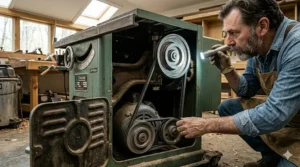
Smart buyers know that purchasing any used machinery requires methodical inspection to avoid expensive surprises. According to OSHA’s woodworking safety guidelines, proper machine maintenance and inspection are critical for workshop safety. Start by examining the table surface with a precision straightedge—lay it diagonally across the table and check for gaps using feeler gauges. Any deviation exceeding 0.010″ across the table span indicates problems that compromise cutting accuracy. Cast iron tables can’t be easily flattened, so significant warping disqualifies an otherwise decent saw.
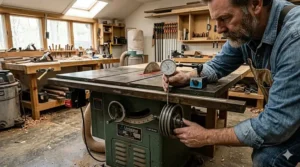
Check the arbor for runout using a dial indicator mounted to the table—total indicated runout (TIR) should not exceed 0.003″ at the arbor flange. Excessive runout indicates worn bearings or bent arbor shafts, repairs that can easily cost $300-$600 depending on parts availability. While you have the blade removed, spin the arbor by hand—it should rotate smoothly without binding or rough spots that indicate bearing failure.
Examine the trunnion assembly by tilting the blade through its full range while watching for binding or hesitation. The gears should engage smoothly without excessive backlash or worn teeth. Adjust blade height from minimum to maximum, ensuring the mechanism operates without struggle—sticky adjustments suggest rust in the screw threads or dried lubricant that requires disassembly to correct.
Test the fence system meticulously because replacement fences for vintage saws often cost $300-$800. The fence should lock square to the blade without deflection when pressure is applied. Measure from the blade to fence at front and rear table positions—any difference exceeding 1/32″ indicates fence alignment issues that affect cut quality. Premium fences like Biesemeyer or Vega should glide smoothly along rails without play or wobbling.
Power up the saw and listen carefully—smooth, quiet operation indicates proper alignment and adequate lubrication. Grinding, squealing, or vibration suggests bearing issues, motor problems, or pulley misalignment. Remember that proper machine guarding requirements mandate specific safety features, so ensure blade guards and anti-kickback devices are present and functional. Check the motor start capacitor if present—these components wear out and can cost $50-$150 to replace, though it’s routine maintenance rather than a deal-breaker.
Understanding the Used Cabinet Saw Market in 2026
The secondary market for cabinet table saws has transformed dramatically over the past decade, driven by several converging factors. First, the surge in woodworking hobbyists during 2020-2022 created unprecedented demand for quality equipment, which pushed prices higher and created supply shortages. As these hobbyists now upgrade or exit the craft, excellent mid-tier saws are flooding the market at reasonable prices.
Manufacturing consolidation has also impacted the used market significantly. With Delta, Jet, and Powermatic all under the same corporate umbrella since the mid-2000s, parts interchangeability has improved while some model lines have been discontinued. This consolidation means vintage Powermatic 66 and older Delta Unisaw models command premium pricing because they represent the last generation of independently-manufactured American cabinet saws.
The rise of safety-conscious purchasing has created interesting market segments. SawStop’s dominance in new saw sales means traditional brands appear more frequently in used listings as woodworkers upgrade to flesh-sensing technology. This dynamic benefits buyers seeking conventional saws—a three-year-old Powermatic or Delta in excellent condition may sell for 40-50% below original retail simply because the seller prioritized SawStop’s safety features.
Geographic factors dramatically affect pricing and availability. Urban markets with active woodworking communities typically offer more options but command higher prices due to competition. Rural areas might yield spectacular deals from retiring farmers or closing cabinet shops, though travel costs and logistical challenges balance the savings. Online marketplaces have equalized this somewhat, but shipping a 500-600 lb cabinet saw remains expensive ($300-$600), making local purchases preferable when possible.
Industrial auctions and estate sales represent underutilized opportunities for savvy buyers. Cabinet shops closing or upgrading equipment often liquidate quality saws at fractions of retail value. The catch? These sales require cash-on-hand, immediate pickup, and comfort purchasing machinery with minimal inspection opportunity. Experienced buyers who know exactly what to look for can score incredible deals, but novices risk expensive mistakes.
Cabinet Saw vs. Contractor Saw: Why Cabinet Saws Win for Serious Work
The fundamental difference between cabinet and contractor saws extends far beyond the enclosed base—it’s about precision, power, and production capability. Cabinet saws mount their motors inside enclosed cabinets, connecting to the arbor through multiple belt drives that isolate vibration and deliver consistent power. This configuration generates measurably less vibration than contractor saws with directly-mounted motors, resulting in smoother cuts and more accurate joinery.
Power delivery represents another critical distinction. Cabinet saws typically feature 3-5 HP motors versus contractor saws’ 1.5-2 HP ratings. That power difference matters profoundly when processing dense hardwoods or making repeated heavy cuts. A 5 HP cabinet saw maintains blade speed through cuts that bog down smaller motors, preventing burn marks and reducing tearout while improving shop safety by eliminating the need to force material through binding cuts.
The enclosed cabinet design creates superior dust collection opportunity—most cabinet saws capture 70-80% of sawdust when connected to adequate collection systems, compared to 40-50% for open-stand contractor saws. For woodworkers concerned about respiratory health or shop cleanliness, this difference translates to dramatically improved air quality and reduced cleanup time. Fine Woodworking’s cabinet saw testing demonstrates that proper dust collection significantly impacts both saw performance and workshop air quality. Cabinet saws’ dust ports typically measure 4″ diameter versus 2.5″ on contractor models, allowing higher airflow that captures more debris.
Precision and stability favor cabinet construction overwhelmingly. The enclosed base adds rigidity that minimizes deflection during aggressive cuts, while cast iron trunnion assemblies maintain blade-to-slot parallelism better than contractor saws’ lighter mechanisms. Professional woodworkers cutting identical pieces across production runs value this consistency—a properly tuned cabinet saw might hold tolerance for months, while contractor saws require frequent adjustment.
The weight differential tells the story—cabinet saws typically weigh 400-600 lbs versus 200-300 lbs for contractor models. That mass dampens vibration, resists movement during heavy cuts, and contributes to the granite-like stability professionals depend upon. Yes, cabinet saws require permanent installation rather than job-site portability, but for dedicated shop use, that trade-off delivers measurable performance advantages.
Restoration Projects: Turning Vintage Saws into Workshop Centerpieces
Vintage cabinet saw restoration represents one of woodworking’s most rewarding projects, transforming affordable, worn machinery into precision instruments that outperform modern budget alternatives. The restoration process typically requires 20-40 hours of work depending on condition, but the result is a saw with personality and performance that justifies the investment.
Start by completely disassembling the saw, documenting each step with photos for reassembly reference. Remove the table, trunnion assembly, motor, and all mechanical components. Clean every part thoroughly using wire brushes, scrapers, and appropriate solvents—decades of sawdust mixed with oil creates cement-like deposits that hide rust and mechanical damage. This deep cleaning reveals the true condition of components and helps identify parts requiring replacement.
Address rust systematically based on severity. Light surface rust responds well to naval jelly or Evapo-Rust treatments, while heavy scaling may require electrolysis tanks or sandblasting for cast iron components. The table surface demands special attention—use progressively finer sandpaper (150 to 400 grit) to remove rust while maintaining flatness, finishing with paste wax for protection. Professional machine shops offer Blanchard grinding services ($200-$400) for tables with significant pitting, creating precision-ground surfaces superior to original factory finish.
Replace wear items regardless of apparent condition—these saws are typically 40-70 years old, and components like bearings, belts, and motor brushes wear invisibly. Quality sealed arbor bearings cost $30-$80 per set and transform saw smoothness dramatically. Motor rebuilding services ($150-$300) provide essentially new motors with modern insulation and bearings, worth every penny for saws you plan to use extensively.
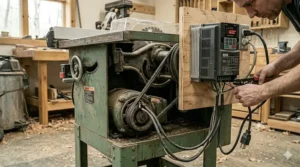
Electrical updates matter for both safety and functionality. Original cloth-insulated wiring degrades over decades, posing fire risks. Rewire completely with modern THHN wire, install new switches with overload protection, and ensure proper grounding. Many restorationists upgrade to magnetic switches ($80-$150) that prevent automatic restart after power interruptions—a critical safety feature absent from vintage designs.
Paint selection impacts both aesthetics and protection. Many purists prefer powder coating ($200-$400 for complete cabinet) because it provides durable, professional finishes resistant to chips and chemical damage. Others choose high-quality industrial enamel ($50-$100 in materials) for authentic period appearances. Either approach works if properly applied over cleaned, primed surfaces.
Price Negotiation Strategies for Used Saw Purchases
Understanding seller motivations provides leverage in used saw negotiations. Widows or executors liquidating estates often lack machinery knowledge and may price saws far below market value or alternatively set unrealistic prices based on original purchase prices from decades ago. Patient buyers who educate respectfully while demonstrating serious interest frequently secure excellent deals simply by establishing rapport.
Timing negotiations around seasonal patterns favors buyers significantly. Spring and summer bring the highest prices as woodworkers gear up for project seasons, while fall and winter—particularly November through January—represent buyer’s markets when fewer people shop for heavy equipment. Sellers facing heating bills or holiday expenses show more flexibility during these months.
Cash transactions command substantial discounts because sellers value immediate payment without check-holding periods or electronic transfer complications. Arriving with full payment in hand demonstrates seriousness and removes objections based on financing uncertainty. Many sellers reduce asking prices 10-15% for immediate cash deals, particularly for lower-priced saws under $1,500 where financing wouldn’t typically be involved anyway.
Bundling accessories into negotiations often succeeds where direct price reduction fails. Request inclusion of spare blades, mobile bases, outfeed tables, or additional fencing accessories—sellers frequently value quick sales over holding items for separate transactions. These add-ons provide genuine value while allowing sellers to maintain their stated saw prices.
Pointing out necessary repairs or missing components justifies reduced offers backed by documented evidence. Research actual part costs beforehand so you can present specific numbers: “The missing riving knife costs $85 plus shipping, and replacing worn arbor bearings runs $120 with labor, so I’m offering $XXX to account for those repairs.” Sellers respond better to itemized justifications than vague claims that something “needs work.”
Long-Term Cost Analysis: Used vs. New Cabinet Saws
Analyzing total cost of ownership across 10-20 years reveals used cabinet saws’ true value proposition. Consider a $2,800 new mid-tier cabinet saw versus a $1,400 used equivalent in good condition. The immediate $1,400 savings invests well—that money purchases premium blades, upgraded fences, dust collection equipment, or simply remains available for lumber and project materials.
Depreciation curves favor used purchases dramatically. New saws lose 30-40% of value in the first three years through normal market depreciation, regardless of actual use. The buyer of that $2,800 saw faces approximately $1,000 value loss over three years of light hobby use. The used saw buyer purchasing a three-year-old model for $1,400 experiences minimal additional depreciation—reselling it five years later for $1,100-$1,200 represents only $200-$300 in value loss.
Maintenance costs remain nearly identical between used and new cabinet saws when purchasing quality models in good condition. Both require periodic belt replacements ($30-$60 every 3-5 years), blade changes ($50-$150 per blade), and occasional bearing services ($100-$200 every 10-15 years). The myth that used equipment demands constant repairs applies to worn-out machines, not properly maintained cabinet saws from reputable manufacturers.
Energy costs favor neither side significantly—cabinet saws’ 3-5 HP motors consume similar electricity regardless of age. Modern motors offer marginal efficiency improvements, but typical hobby use (50-200 hours annually) generates minimal cost differences—perhaps $10-$20 yearly at residential electricity rates. Production shops logging 2,000+ hours annually might see $50-$100 differences, but used saw savings dwarf these minor operational costs.
Insurance and risk considerations slightly favor new saws with manufacturer warranties covering mechanical failures during initial years. However, quality used cabinet saws from reliable brands rarely experience catastrophic failures requiring expensive repairs if properly inspected before purchase. The $1,400 savings on a used saw purchase effectively self-insures against repair costs while leaving funds available for unlikely major services.
Common Mistakes When Buying Used Cabinet Saws
Prioritizing brand names over actual condition represents the most expensive error buyers make. A poorly-maintained Powermatic 66 with worn bearings, rusted table, and sloppy trunnions delivers worse performance than a well-maintained Shop Fox W1819 despite the Powermatic’s premium brand status. Focus inspection efforts on mechanical condition, table flatness, and fence accuracy rather than manufacturer badges.
Underestimating electrical requirements creates frustrating complications after purchase. Most cabinet saws require 220V single-phase or three-phase power, necessitating dedicated circuits and appropriate wiring. Discovering these requirements after buying means unexpected electrician costs ($200-$800) that erase savings from low purchase prices. Verify your shop’s electrical capacity before committing to any saw purchase.
Ignoring fence quality proves costly because replacement fence systems for vintage saws often cost $300-$800. Saws equipped with original stamped-steel fences or damaged systems require immediate upgrades for precision work. Many buyers focus exclusively on saw condition while accepting inadequate fences, then face surprise expenses when attempting actual projects requiring accuracy.
Failing to test under load before purchase hides problems that appear only during operation. Savvy sellers demonstrate saws idling smoothly but avoid full-load testing that reveals motor issues, bearing noise, or power delivery problems. Insist on making several cuts through 2″ hardwood stock—any hesitation, bogging, or unusual sounds indicates problems requiring investigation.
Overlooking parts availability for obsolete models creates long-term headaches when maintenance becomes necessary. While vintage Powermatic 66 and Delta Unisaw parts remain readily available through specialty suppliers, many 1980s-1990s imported saws lack current parts support. Research parts availability before purchasing any used saw, particularly lesser-known brands or defunct manufacturers.
Frequently Asked Questions
❓ Can I upgrade a vintage cabinet table saw to modern safety standards?
❓ How much should I budget for restoring a neglected cabinet saw?
❓ Are cabinet saws from Taiwan or China worth considering used?
❓ What's the realistic lifespan of a properly maintained cabinet saw?
❓ Should I buy locally or consider shipping a cabinet saw from distant sellers?
Conclusion: Making Your Used Cabinet Saw Decision
The used cabinet table saw market in 2026 offers unprecedented opportunities for woodworkers at every level—from budget-conscious hobbyists finding vintage Delta Unisaws in the $600-$1,000 range to professionals securing barely-used premium equipment at 50% discounts. The key lies in understanding what you’re actually buying beyond brand names and asking prices.
Remember that cabinet saws built by reputable manufacturers were designed for decades of production work, meaning even 20-30 year old examples in good condition deliver reliable service when properly maintained. Focus your evaluation efforts on mechanical condition, table flatness, and fence quality rather than cosmetic appearance—a well-engineered saw with surface rust outperforms a pretty but mechanically compromised machine every time.
The seven options covered in this guide represent different value propositions suiting various needs and budgets. Vintage Delta Unisaws appeal to restoration enthusiasts and traditionalists valuing authentic American machinery. Powermatic Model 66 saws command premiums justified by legendary reliability. Value-focused buyers find exceptional performance in used Grizzly G0690 and Shop Fox W1819 models. Safety-conscious woodworkers willing to pay premiums get peace of mind from refurbished SawStop units with factory warranties.
Whatever path you choose, invest time in thorough pre-purchase inspection and honest assessment of your actual needs. That $2,500 5 HP Delta 36-L552 might be objectively superior to a $1,200 3 HP Grizzly, but if your projects rarely involve dense hardwoods thicker than 8/4, the practical performance difference won’t justify the cost difference. Buy the saw that matches your actual work rather than aspirational projects you might tackle someday.
Take advantage of current market conditions while they last—the combination of hobbyists exiting woodworking, shops upgrading to SawStop, and economic uncertainties pushing equipment sales creates opportunities that won’t persist indefinitely. A quality used cabinet saw purchased wisely today provides decades of precise, reliable service while leaving funds available for the projects and materials that actually matter.
Recommended for You
- 7 Best SawStop Alternative Options for Safe Cutting in 2026
- 7 Best SKILSAW Worm Drive Table Saw Models (2026 Guide)
- 7 Best Felder Sliding Table Saw Options 2026
Disclaimer: This article contains affiliate links. As an Amazon Associate, I earn from qualifying purchases. If you purchase products through these links, we may earn a small commission at no additional cost to you.
✨ Found this helpful? Share it with your friends! 💬🤗
