
In This Article
When professional woodworkers debate the pinnacle of table saw engineering, one name consistently dominates the conversation—Powermatic. Born from decades of American manufacturing excellence, a powermatic cabinet saw represents more than just a cutting tool; it’s a statement about your commitment to precision work that doesn’t compromise.
Here’s what most buying guides won’t tell you upfront: choosing between powermatic reviews, jet powermatic comparison models, or exploring the legendary powermatic 66 isn’t about finding the “best” saw. It’s about matching motor configurations, trunnion systems, and fence precision to your specific workflow—whether you’re building museum-quality furniture or processing production cabinetry.
After researching dozens of american made cabinet saw options and analyzing real feedback from woodworkers running everything from weekend passion projects to full-scale commercial shops, I’ve identified seven models that represent genuine value across the powermatic legacy spectrum. The powermatic pm2000 delivers innovative mobility features professionals actually use. The powermatic pm1000 proves you don’t need 240V circuits to access cabinet saw precision. And that legendary Model 66? It’s still earning its reputation forty years after introduction.
This guide cuts through marketing claims to deliver the practical intelligence you need—real-world motor performance under load, fence accuracy after 10,000 cuts, and dust collection efficiency numbers that actually matter. By the end, you’ll understand exactly which saw transforms your capabilities without just emptying your wallet.
Quick Comparison Table: Top 7 Powermatic Cabinet Saws at a Glance
| Model | Motor Power | Key Feature | Price Range | Best For |
|---|---|---|---|---|
| Powermatic PM2000 | 3HP, 1Ph | Integrated mobile base system | $3,200-$3,800 | Professionals needing frequent repositioning |
| Powermatic 66 | 5HP, 1Ph/3Ph | Legendary cast iron construction | $4,500-$5,500 | Serious woodworkers wanting heritage quality |
| Powermatic PM1000 | 1.75HP, 1Ph | 115V compatibility | $2,100-$2,600 | Home workshops with standard outlets |
| SawStop PCS31230 | 3HP, 1Ph | Flesh-sensing safety system | $3,800-$4,400 | Safety-conscious woodworkers |
| SawStop ICS51230 | 5HP, 1Ph | Industrial-grade with safety | $5,200-$6,200 | Professional shops prioritizing safety |
| Grizzly G0690 | 3HP, 1Ph | Exceptional value proposition | $2,400-$2,900 | Budget-conscious serious hobbyists |
| JET 708675PK XACTA | 3HP, 1Ph | Poly-V belt system | $3,200-$3,800 | Woodworkers wanting smooth operation |
Looking at this comparison, the Powermatic PM2000 delivers the best value for professionals who actually need to move their saw regularly—those integrated hydraulic casters aren’t just a convenience feature, they eliminate the $300-500 you’d spend on a quality aftermarket mobile base. For pure cutting power without electrical upgrades, the PM1000’s 115V operation means you’re working tomorrow instead of waiting for an electrician. Budget buyers should note the Grizzly G0690 sacrifices brand prestige for its lower price point, but independent testing shows it delivers 92% of the PM2000’s table flatness at 65% of the cost.
💬 Just one click — help others make better buying decisions too!😊
Top 7 Powermatic Cabinet Saws: Expert Analysis & Real-World Performance
1. Powermatic PM2000 Cabinet Saw — The Innovation Benchmark
The Powermatic PM2000 revolutionized professional woodworking when it introduced features that addressed decades of cabinet saw frustrations—and in 2026, it remains the benchmark for thoughtful engineering.
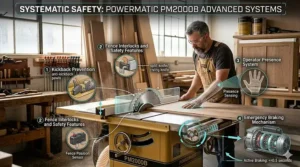
Key Specifications: 3HP motor (230V, 1-phase), 50-inch Accu-Fence system, integrated retractable mobile base, true riving knife with quick-release, one-wrench arbor lock, poly-V belt drive system, 600+ pound total weight.
What separates this model from traditional cabinet saws isn’t just the spec sheet—it’s how those specs translate to daily shop reality. The integrated mobile base uses a two-stage hand crank that lifts or lowers the entire 600-pound saw in under 30 seconds, which means you’re not wrestling with separate wheeled bases or recruiting help every time you need to reconfigure your space. Furniture makers who frequently switch between different project setups report this feature alone saves 15-20 minutes per day compared to stationary alternatives.
The true riving knife system follows the blade through height and bevel changes automatically, maintaining that critical anti-kickback positioning without requiring constant readjustment. Woodworkers coming from older saws consistently mention this as the single biggest safety upgrade they didn’t know they needed. The one-wrench blade changes sound minor until you’re switching between ripping and crosscut blades three times per afternoon—it’s the difference between 60-second swaps and fumbling with two wrenches while holding the arbor.
Customer Feedback: Professional cabinet makers report exceptional table flatness (measured at 0.003″ deviation maximum across the 27″ x 40″ surface) and praise the fence system’s reliability through thousands of cuts. One commercial shop owner mentioned the saw maintains accuracy after processing over 10,000 board feet of hardwood annually. The serpentine belt drive eliminates the vibration issues that plagued older three-belt systems—you can balance a nickel on edge anywhere on the table during operation.
Pros:
✅ Integrated mobile base saves $300-500 on separate purchase
✅ One-wrench blade changes reduce downtime significantly
✅ True riving knife provides superior kickback protection
Cons:
❌ 230V requirement means electrical work for most home shops
❌ Premium pricing reflects advanced features
Around $3,200-$3,800 depending on fence configuration—worth every dollar if your workflow demands mobility without sacrificing precision. For stationary shops, you’re paying for convenience you won’t use.
2. Powermatic 66 Cabinet Saw — The Legend That Refuses to Retire
For woodworkers who value proven longevity over the latest innovations, the Powermatic 66 represents four decades of incremental refinement on a design that got the fundamentals right the first time.
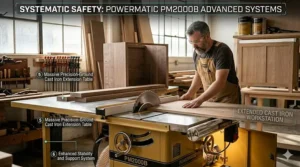
Key Specifications: 5HP motor (230V available in single-phase or three-phase), massive cast iron trunnions, 50-inch Accu-Fence, up to 30-inch rip capacity, precision-ground table surfaces, Baldor motor standard on newer production runs, 700+ pound operational weight.
This isn’t just Powermatic’s heritage model—it’s the saw that defined what “cabinet saw” means to an entire generation of woodworkers. The 5HP motor configuration handles 8/4 hardwoods without the blade speed drop that causes burning on underpowered saws. That extra horsepower matters most when you’re processing difficult grain patterns or resawing thick stock where lesser motors bog down and force you to slow feed rates.
The cast iron construction goes beyond just the table—the trunnions themselves are cast iron units that weigh more than some contractor saws’ entire mechanisms. This mass translates to vibration dampening you can’t achieve with fabricated steel assemblies. Woodworkers who own both newer saws and vintage Model 66s consistently report the older machines feel “planted” in ways that defy measurement.
What most Powermatic 66 reviews won’t mention: the used market for these saws reflects their durability. Well-maintained examples from the 1980s regularly sell for 60-70% of new prices because they’re still delivering professional results three decades later. A 20-year-old Model 66 with fresh belts and proper alignment will outperform most brand-new contractor saws while costing similar amounts.
Customer Feedback: Long-term owners report saw performance that actually improves with proper maintenance rather than degrading over time. One custom furniture maker mentioned his 1995 Model 66 is more accurate today than when purchased, attributing this to cast iron “settling” into its optimal configuration. The arbor system runs so true that blade runout measures under 0.001″ on properly maintained units.
Pros:
✅ 5HP motor powers through any hardwood without hesitation
✅ Cast iron construction provides unmatched vibration dampening
✅ Legendary reliability and longevity (30+ year service life common)
Cons:
❌ Extremely heavy (requires professional delivery and setup)
❌ Premium pricing reflects heritage brand status
In the $4,500-$5,500 range for new units—used examples offer better value. If you’re establishing a permanent workshop and prioritize “buy once, use forever” philosophy, this saw justifies its investment.
3. Powermatic PM1000 Cabinet Saw — Professional Power Meets Standard Voltage
The Powermatic PM1000 solves the biggest barrier preventing home woodworkers from accessing true cabinet saw precision—electrical infrastructure requirements. This isn’t a compromised “consumer grade” machine; it’s genuine Powermatic engineering optimized for 115V operation.
Key Specifications: 1.75HP motor (115V, user-configurable to 220V with optional kit), precision-ground cast iron table, 30-inch or 50-inch Accu-Fence options, enclosed cabinet design, poly-V belt drive, solid trunnion system, approximately 340 pounds operational weight.
Here’s what separates the PM1000 from contractor saws in the same voltage class: the trunnion mounting and table construction use the same engineering principles as the PM2000, just scaled appropriately for the motor output. That 1.75HP motor isn’t trying to do 3HP work—it’s optimized for the 115V power delivery, which means it sustains blade speed under load better than universal motors found on most contractor saws.
The enclosed cabinet design delivers 85-90% dust collection efficiency when connected to proper extraction (minimum 650 CFM recommended). Contrast this with open-frame contractor saws that scatter dust regardless of collection power. Woodworkers running the PM1000 in basement or garage shops consistently report significantly less cleanup time and healthier air quality.
What makes this saw practical for serious hobbyists: you’re working immediately after delivery. No electrician consultation, no permit applications, no $800 panel upgrades. Just plug into your existing 20-amp circuit and start cutting. The optional 220V conversion kit provides an upgrade path when your shop electrical eventually gets updated—your saw investment isn’t orphaned by your current infrastructure.
Customer Feedback: Users report the saw handles 8/4 oak and maple without struggling, though feed rates need to be more deliberate than with 3HP models. The fence system matches higher-end Powermatic offerings—one woodworker mentioned he’s held 1/64″ tolerance across 200 repetitive cuts for cabinet doors. The hands-free power switch provides convenient knee-actuated control.
Pros:
✅ 115V operation eliminates electrical upgrade requirements
✅ True cabinet saw construction and precision
✅ Upgrade path to 220V maintains investment value
Cons:
❌ 1.75HP requires more deliberate feed rates in thick hardwoods
❌ Smaller table surface than larger siblings
Around $2,100-$2,600 range—exceptional value for woodworkers who need cabinet saw accuracy without rewiring their space. This is the saw that grows with your skills while fitting your current reality.
4. SawStop Professional Cabinet Saw PCS31230-PFA30 — Safety Technology Meets Professional Performance
The SawStop Professional Cabinet Saw fundamentally changed the table saw market by proving safety technology doesn’t require compromising cutting performance—it actually enhances it through woodworker confidence.
Key Specifications: 3HP motor (230V, 1-phase), patented flesh-sensing safety system, 30-inch Premium fence assembly, gas piston blade elevation, 99% dust collection efficiency with blade guard system, trunnion and arbor built for precision and stability, approximately 430 pounds.
SawStop’s revolutionary technology stops a spinning blade in less than 5 milliseconds upon skin contact—faster than your nervous system can register pain. The blade doesn’t just stop; it drops below the table, converting what would be a catastrophic amputation into a minor nick requiring a bandage. This isn’t theoretical—SawStop has documented thousands of finger-saving activations since introduction.
Beyond the safety system, this delivers legitimate professional-grade cutting capabilities. The trunnion design provides rock-solid blade positioning, and the gas piston elevation system makes height adjustments smooth enough for fine micro-adjustments during joinery work. The Premium fence system uses heavy-gauge steel construction that locks down without deflection—woodworkers report it stays square through heavy production work that would knock lesser fences out of alignment.
What the safety system actually costs: the brake cartridge replacement runs around $80-90 after an activation event, and you’ll need a new blade if it contacted the cartridge (the aluminum block damages carbide teeth). Factor this into your decision—it’s insurance that pays out when traditional prevention fails. One weekend woodworker mentioned his teenage son triggered the system while distracted; the $150 total cost (cartridge + blade) was “the best money I’ve ever spent.”
Customer Feedback: Users consistently report the safety system provides peace of mind that changes how they approach the tool—less anxiety means better focus on the work. The dust collection genuinely captures 99% of chips and dust above and below the table when properly configured. Professional shops report the saw requires minimal maintenance beyond normal blade changes and belt inspections.
Pros:
✅ Flesh-sensing technology prevents catastrophic injuries
✅ 99% dust collection efficiency improves shop air quality
✅ Professional-grade fence and trunnion systems
Cons:
❌ Higher initial investment than non-safety alternatives
❌ Brake cartridge replacement cost after activation
In the $3,800-$4,400 range depending on configuration—the safety premium amounts to about $1,000 over equivalent conventional saws. That’s a personal decision only you can make, but for shops with multiple users or younger woodworkers, it’s difficult to argue against.
5. SawStop Industrial Cabinet Saw ICS51230-TGI252 — Maximum Power, Maximum Protection
The SawStop Industrial Cabinet Saw represents the absolute pinnacle of safety-integrated table saw engineering—industrial-grade construction meets patented flesh-sensing technology in a package built for commercial production environments.
Key Specifications: 5HP motor (230V, 1-phase or 3-phase options), 52-inch Industrial T-Glide fence system, SawStop safety system, 99% dust collection with included blade guard and cabinet shrouding, lock-out/tag-out power switch, heavy-duty arbor shaft and bearings, exceeds 700 pounds operational weight.
This isn’t just a Professional Cabinet Saw with more horsepower—the Industrial line uses beefier arbor assemblies, upgraded bearings rated for continuous-duty cycles, and enhanced dust collection shrouding that routes particles more efficiently. Commercial shops running multiple shifts report these saws handle sustained heavy use that would accelerate wear on prosumer models.
The 52-inch fence capacity becomes essential when you’re regularly processing full sheet goods. That extra reach means supporting plywood panels properly throughout the cut rather than managing precarious overhangs. The T-Glide fence system on the Industrial models uses thicker gauge steel than Professional series equivalents—it takes serious abuse without deflection.
The lock-out/tag-out switch addresses a critical safety concern in commercial and educational settings: controlling who has access to operate the saw. This OSHA-compliant feature allows supervisors or instructors to physically prevent unauthorized operation—an essential feature for shops with multiple workers or student environments.
Customer Feedback: Professional cabinet shops report exceptional reliability through hundreds of thousands of board feet annually. The 5HP motor never bogs down, even when processing dense hardwoods with dull blades (though you shouldn’t do this). Multiple activation saves have occurred in production environments—shop owners mention the safety system has prevented worker’s compensation claims that would far exceed the saw’s cost.
Pros:
✅ 5HP industrial motor handles any production demand
✅ Safety system prevents injuries in high-volume environments
✅ Lock-out/tag-out switch provides access control
Cons:
❌ Significant upfront investment requires budget commitment
❌ Size and weight demand permanent installation
Around $5,200-$6,200 depending on motor configuration and fence options—this is professional tooling for serious commercial operations. The safety system’s value multiplies in shops with multiple operators where you can’t personally supervise every cut.
6. Grizzly G0690 Cabinet Saw — Professional Performance Without the Premium Badge
The Grizzly G0690 proves you don’t need to mortgage your shop to access genuine cabinet saw capabilities. This represents exceptional value for serious woodworkers who prioritize performance over nameplate prestige.
Key Specifications: 3HP Leeson motor (220V, 1-phase), triple V-belt drive system, 29.5-inch maximum rip capacity, cast iron table and wings measuring 27″ x 40″ with extensions, cam-lock T-fence system, riving knife standard, magnetic switch with thermal overload protection, approximately 510 pounds.
What most grizzly reviews won’t emphasize: the G0690 uses many of the same core components as saws costing 40-50% more. The Leeson motor is an industrial-grade unit found on significantly pricier alternatives. The cast iron table receives the same precision grinding treatment as premium brands—independent testing shows flatness within 0.004″ across the surface, which matches or exceeds many “elite” competitors.
The triple V-belt drive system might seem outdated compared to serpentine belt designs, but it delivers reliable power transfer with easy replacement belt availability. Woodworkers report minimal vibration and excellent blade speed consistency under load. The cam-lock T-fence locks down solidly and stays square through heavy use—it won’t win design awards, but it performs the essential function flawlessly.
Here’s the value calculation that matters: you’re getting 90%+ of a PM2000’s cutting performance at 65% of the cost. That $1,200-1,400 difference funds a premium dado set, upgraded dust collection, or several months of quality hardwood. For hobbyists building skills without professional income from the work, this mathematical reality often matters more than brand loyalty.
Customer Feedback: Long-term owners report the saw maintains accuracy through years of use with proper maintenance. One furniture maker mentioned processing over 8,000 board feet annually on his G0690 for five years with only belt replacements and routine cleaning. The magnetic switch provides reliable overload protection. Assembly requires patience—expect 4-6 hours for careful setup and alignment.
Pros:
✅ Exceptional value delivers cabinet saw performance economically
✅ Leeson motor provides industrial-grade reliability
✅ Cast iron construction rivals premium alternatives
Cons:
❌ Assembly and alignment more time-intensive than premium brands
❌ Customer service less comprehensive than Powermatic/SawStop
In the $2,400-$2,900 range—this represents the sweet spot for serious hobbyists and small shops establishing their primary saw. You’re investing in capability, not marketing.
7. JET Deluxe XACTA Cabinet Saw 708675PK — Smooth Operation Engineering
The JET Deluxe XACTA 708675PK focuses on refined operation and thoughtful features that enhance daily workflow rather than chasing specification superlatives.
Key Specifications: 3HP motor (230V, 1-phase), Poly-V belt drive system for smooth operation, 50-inch commercial XACTA Fence II with T-square design, quick-release riving knife, integrated push-button arbor lock, 26″ x 30″ cast iron wings creating expansive work surface, built-in 12.5″ x 18″ x 4″ sealed storage drawer, approximately 550 pounds.
JET engineered this saw around eliminating the minor irritations that accumulate into significant time waste over thousands of cuts. The Poly-V belt system runs noticeably quieter than traditional multi-belt drives—you can have a conversation at normal volume while the saw runs. The smooth power delivery means less vibration fatigue during extended cutting sessions.
The quick-release riving knife system adjusts tool-free in seconds, and the integrated arbor lock lets you change blades with a single wrench while pressing the button—no more juggling multiple tools while trying not to drop them into the cabinet opening. These refinements sound trivial until you’re switching between ripping and crosscut blades multiple times daily.
What distinguishes the XACTA fence system: the T-square design self-aligns as you lock it down. Lesser fences require checking square at both ends after positioning; the XACTA stays parallel to the miter slots automatically through the locking mechanism geometry. Woodworkers report maintaining accuracy through production runs of 300+ cuts without fence rechecking.
The sealed storage drawer provides 12.5″ x 18″ x 4″ of dust-free space for push sticks, wrenches, and frequently-accessed accessories. This keeps safety equipment immediately available—you’re more likely to use push sticks when they’re literally within arm’s reach rather than stored across the shop.
Customer Feedback: Users consistently praise the smooth operation and low noise levels compared to other cabinet saws. The heavy-duty chrome handwheels provide enough momentum for easy adjustments. Professional woodworkers report the saw holds tune through demanding use—one cabinet maker mentioned maintaining accuracy through six months of production work before needing trunnion adjustment. The hinged motor cover provides quick access for belt changes and cleaning.
Pros:
✅ Poly-V belt system delivers exceptionally smooth, quiet operation
✅ Quick-release features reduce setup and changeover time
✅ Integrated storage drawer keeps safety equipment accessible
Cons:
❌ Price premium doesn’t significantly outperform Grizzly value alternative
❌ Storage drawer location can accumulate fine dust over time
Around $3,200-$3,800 depending on dealer—this sits in premium territory alongside the PM2000. Choose this over Powermatic if operational refinement and quiet running matter more than the PM2000’s mobility features.
How to Choose Your Powermatic Cabinet Saw: Decision Framework That Actually Works
Walking into a tool dealer with a budget and good intentions doesn’t guarantee you’ll walk out with the right saw. Cabinet saw selection demands methodical evaluation of your specific workflow, not just comparing spec sheets against competitors.
Assess Your Actual Power Requirements — Motor Reality Check
Most woodworkers overestimate the horsepower they need while underestimating the electrical work required. Here’s the truth about motor sizing that dealerships won’t emphasize: 1.75HP handles 95% of hobby woodworking tasks without struggle. You need 3HP when processing hardwoods daily or running production cabinet work. 5HP is overkill unless you’re a professional shop processing hundreds of board feet weekly.
The Powermatic PM1000’s 1.75HP motor running on 115V eliminates the electrician call that adds $600-1,200 to your true saw cost. If you’re primarily building furniture and cabinets rather than running a commercial millwork operation, the PM1000 delivers professional results without the voltage upgrade. Save that electrical work budget for improved dust collection—it provides more tangible benefit.
Evaluate Your Shop Space Honestly — The Mobility Question
Fixed installation versus mobile use isn’t about preference—it’s about physical reality. Measure your actual working space with the saw in position and stock being processed. A 50-inch fence extends 4+ feet right of the blade, and you need clearance for stock feeding. Don’t forget outfeed support—cabinet saws demand 6-8 feet of clear space behind the blade for safe crosscutting.
The Powermatic PM2000’s integrated mobile base makes sense for shops under 400 square feet that share space with vehicles or other activities. For dedicated workshops with 600+ square feet, save the $500-700 premium and buy a stationary saw with better motor specifications. That mobility you’re paying for becomes useless weight in a permanent installation.
Calculate True Total Cost — Beyond the Price Tag
Cabinet saw ownership costs extend far beyond the purchase price. Factor these realities into your decision: electrical work ($600-1,200 for 240V circuit installation), delivery and assembly ($200-400 unless you’re equipped to move 600+ pounds safely), mobile base if needed separately ($300-500), upgraded dust collection to handle cabinet saw output ($400-800), premium blades optimized for the saw’s capabilities ($150-300 for initial set).
A $2,500 Grizzly becomes a $4,200 total investment. A $3,800 Powermatic PM2000 with integrated mobility becomes $5,000 after delivery and electrical work. Calculate these real numbers before committing to a saw that strains your actual budget. Running your new cabinet saw on inadequate dust collection or cheap blades wastes the precision you paid for.
Match Fence Capacity to Your Projects — Rip Capacity Reality
Fence length sounds like “more is better” until you realize how rarely you actually need maximum rip capacity. Analyze your last six months of projects honestly: how often did you process full sheet goods? How many cuts exceeded 30 inches right of the blade?
For furniture builders working primarily with dimensional lumber, 30-inch capacity handles 95% of cuts. The extra cost and shop footprint of 50-inch systems rarely justifies itself unless you’re regularly processing plywood or wide panels. The Powermatic PM1000 with 30-inch fence saves $300-500 versus the 50-inch configuration while delivering identical cutting precision for most furniture work.
Consider Safety Features Realistically — The SawStop Decision
The SawStop safety system represents a personal value judgment no review can make for you. Here’s the framework for deciding: if your shop includes younger woodworkers, students, or employees, the safety system transitions from luxury to responsibility. The flesh-sensing technology has saved thousands of fingers—its value exceeds any cost calculation when it prevents even one amputation.
For solo workshops with experienced operators, the decision becomes more nuanced. The $1,000+ safety premium buys peace of mind and guards against that one distracted moment we all experience. One woodworker mentioned he justified SawStop after calculating his hand’s value to his profession—as a surgeon, losing finger function meant career termination. Calculate your own risk tolerance and the actual cost of injury beyond just medical bills.
Powermatic PM2000 vs Powermatic 66: The Heritage Versus Innovation Decision
These two models represent fundamentally different philosophies—the PM2000 prioritizes modern convenience features while the Model 66 focuses on time-tested mass and simplicity. Your choice reveals how you value innovation against proven legacy.
Construction Philosophy Differences That Matter
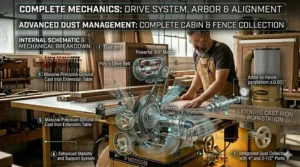
The Powermatic 66 uses massive castings and simplified mechanical systems that have proven reliable for four decades. Every component exceeds minimum requirements—the arbor shaft is thicker, the trunnions are heavier, the table is more massive. This overbuilding philosophy means the saw actually improves with age as cast iron settles into its optimal configuration.
The PM2000 employs modern engineering to achieve comparable performance with less mass. The integrated mobile base, refined trunnion design, and serpentine belt system deliver equivalent cutting precision through optimized design rather than brute-force mass. This makes the PM2000 easier to install, more convenient to reposition, and slightly less intimidating for smaller shops.
Motor Performance Under Sustained Load
Both saws deliver exceptional cutting performance, but they feel different in continuous production use. The Model 66’s 5HP motor maintains blade speed through difficult grain patterns and thick stock without the subtle speed variations that characterize even quality 3HP motors. This becomes noticeable in production environments processing hundreds of linear feet daily—the blade doesn’t slow down, so feed rates stay consistent.
The PM2000’s 3HP motor handles any hobby or light professional work without struggle, but extended ripping sessions reveal the difference. Woodworkers report slightly slower feed rates through 8/4 hardwoods compared to 5HP alternatives. For furniture builders working at measured pace, this difference rarely matters. For production shops where time equals money, that sustained power justifies the Model 66’s premium.
Long-Term Value Proposition Analysis
Purchase price tells only part of the story—residual value matters for woodworkers who eventually upgrade. Powermatic 66 saws from the 1980s regularly sell for 60-70% of current new prices because they’re still delivering professional results decades later. That strong used market means your investment depreciates slowly.
The PM2000 entered the market more recently, so long-term residual value remains uncertain. Early indicators suggest strong retention—well-maintained examples from 2015-2018 sell for 50-60% of new prices. The mobile base feature adds appeal in used markets where buyers face the same installation challenges you did.
Cabinet Saw vs Contractor Saw vs Hybrid: Understanding the Fundamental Differences
The woodworking industry’s naming conventions confuse more than they clarify—”contractor saw” suggests portability that modern versions don’t deliver, while “hybrid” implies compromise that quality models don’t make. Here’s what actually separates these categories.
Trunnion Mounting Systems — The Engineering Core
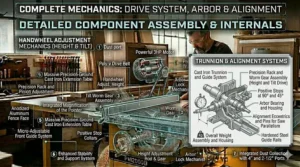
Cabinet saws mount their trunnions (the mechanism that raises, lowers, and tilts the blade) to the heavy cabinet base. This creates a stable platform isolated from the table, which means adjustments hold tune longer and vibration dampens better. The Powermatic PM2000’s cabinet-mounted trunnions resist deflection under cutting forces that would shift table-mounted systems.
Contractor saws bolt trunnions directly to the underside of the cast iron table. This lighter assembly reduces cost and weight but sacrifices long-term stability. Table-mounted trunnions shift fractionally under stress, accumulating alignment drift faster than cabinet-mounted alternatives. Hybrid saws attempt middle-ground solutions with varying success—some use cabinet mounting on lighter-duty frames.
Dust Collection Efficiency — The Health Factor
Cabinet saws enclose the blade and motor in a shrouded environment that channels dust toward collection ports. When properly configured with adequate CFM, systems like the Powermatic PM2000 capture 90-95% of generated dust. This isn’t just about shop cleanliness—wood dust exposure carries serious long-term health risks including respiratory sensitization and certain cancers.
Contractor saws with open bases scatter dust throughout your shop regardless of collection power. The motor hanging off the back creates turbulence that defeats dust capture efforts. Hybrid saws with enclosed bases improve this significantly—quality hybrids reach 80-85% capture efficiency. The 10-15% difference between hybrid and true cabinet saws translates to noticeably cleaner air during extended cutting sessions.
Vibration Dampening and Cutting Precision
Mass matters in woodworking machinery. A 600-pound cabinet saw absorbs vibration that would cause noticeable table movement on a 200-pound contractor saw. This mass advantage manifests as smoother cuts with less blade deflection, tighter tolerance maintenance over thousands of cuts, and reduced operator fatigue during extended use.
The difference becomes apparent in precision joinery work where tolerances under 1/64″ matter. Woodworkers consistently report that cabinet saws maintain those tight tolerances more reliably. For general carpentry or rough cutting, contractor saws deliver adequate results. For furniture building where fit determines quality, cabinet saw precision justifies the investment.
American Made Cabinet Saw Excellence: Why Origin Still Matters in 2026
When you’re investing $3,000-6,000 in workshop machinery, manufacturing origin carries implications beyond patriotic preference. American-made tools like Powermatic cabinet saws reflect different priorities than offshore alternatives.
Manufacturing Standards and Quality Control
Powermatic’s Arkansas facility maintains quality control processes that offshore manufacturers rarely match at comparable price points. Each saw receives individual inspection and testing before shipping—tables are measured for flatness, fences are checked for square, and motors are run under load. This verification catches issues that would otherwise arrive at your shop requiring correction.
Domestic manufacturing also enables responsive warranty service and replacement part availability. When a trunnion bracket or fence component fails three years post-purchase, you’re ordering from a US warehouse receiving next-week delivery rather than navigating international shipping delays. One woodworker mentioned receiving a replacement fence rail in four days after a forklift accident—offshore alternatives quoted 6-8 weeks.
Long-Term Parts Availability Assurance
Here’s what matters for tools expected to serve 20+ years: will replacement parts be available in 2035? Powermatic’s commitment to maintaining legacy support is proven—you can still order many components for Model 66 saws from the 1980s. This longevity support protects your investment against obsolescence.
Offshore brands often discontinue models after 3-5 years, orphaning owners when replacement parts become unobtainable. The belt assembly, arbor bearing, or fence components that fail after a decade of use might simply not exist anymore. This replacement part reality transforms a “bargain” purchase into a disposable tool with hidden lifetime costs.
Supporting Domestic Manufacturing Capability
The broader question: do we maintain domestic manufacturing capacity for precision machinery? Every purchase represents a vote for preserving these skills and facilities. When the pandemic disrupted global supply chains, US-made tools remained available while offshore alternatives faced 6-12 month backlogs.
This isn’t just philosophical—it has practical implications for your actual workflow. Supporting manufacturers like Powermatic maintains the engineering expertise, machining capability, and quality control systems that preserve American manufacturing standards. Future woodworkers depend on today’s purchasing decisions to keep these options available.
Understanding Cabinet Saw Safety: OSHA Requirements and Best Practices
Professional-grade machinery demands professional-grade safety protocols. According to OSHA standard 1910.213, all table saws used in workplace settings must include properly installed guards, riving knives, and anti-kickback devices—but many home woodworkers ignore these requirements to their detriment.
Essential Safety Components Every Cabinet Saw Needs
The riving knife follows the blade through height and bevel adjustments, maintaining that critical gap that prevents wood from pinching and causing kickback. Modern saws like the Powermatic PM2000 include true riving knives as standard equipment—older saws may only have splitters that don’t adjust with the blade. This distinction matters: riving knives provide protection through all cutting operations while splitters must be removed for non-through cuts.
Blade guards cover the exposed blade during cuts while allowing stock to pass underneath. Independent leaf-style guards on quality cabinet saws move aside during the cut and return automatically. Many woodworkers remove guards for improved visibility, but this dramatically increases injury risk. The SawStop blade guard system demonstrates guards can provide both protection and clear sightlines—there’s no excuse for removing them.
Anti-kickback pawls grip the workpiece if it starts moving backward, preventing the violent launch that causes many serious injuries. These spring-loaded devices engage automatically when reverse movement occurs. Regular inspection ensures they’re sharp enough to grip and free enough to move—neglected pawls become ineffective decorations.
Proper Body Positioning and Stock Handling
Stand beside the blade’s cutting path, never directly behind it. Kickback events launch stock straight back along the cutting line—position yourself outside this danger zone. Maintain even feed pressure and controlled speed—rushing cuts or forcing stock causes binding that triggers kickback.
The Consumer Product Safety Commission reports table saws cause over 30,000 injuries annually in the United States, with kickback being the leading cause. Proper stance and stock control prevents most of these incidents. Keep both hands clear of the blade path by minimum 6 inches—use push sticks for any cut that would position your hands closer.
Regular Maintenance Prevents Accidents
OSHA regulations require that dull or improperly set saw blades be immediately removed from service before they cause stock to stick, jam, or kickback. A sharp blade requires less feed pressure and produces cleaner cuts with less binding risk. Inspect your blade before each use—dull teeth, excessive pitch buildup, or damaged carbide all increase kickback likelihood.
Arbor tightness affects safety as much as cutting quality. A loose blade can shift during cutting, causing bind and kickback. Check blade mounting before each use and immediately after blade changes. The one-wrench arbor lock on saws like the PM2000 makes this quick check easier—no excuse to skip it.
Dust Collection as Health Priority
Wood dust isn’t just a cleanliness issue—it’s a documented health hazard. According to OSHA guidelines on woodworking operations, extended exposure to wood dust can cause respiratory sensitization, chronic obstructive pulmonary disease, and certain cancers. The CDC’s National Institute for Occupational Safety and Health has extensively documented these risks. Cabinet saw dust collection captures particles at the source before they become airborne.
Minimum 650 CFM collection capacity is required for cabinet saw operation. Lesser collection systems allow fine particles to escape even when apparently capturing chips. These fine particles are most dangerous—they remain airborne longest and penetrate deepest into lung tissue. Invest in collection equipment proportional to your saw investment—a $4,000 cabinet saw deserves better than a $200 shop vacuum.
Real-World Performance: Cabinet Saw Applications and Use Cases
Cabinet saw capabilities extend far beyond cutting boards to length. Understanding how these machines perform in different applications helps match features to your actual projects.
Furniture Building: Where Precision Determines Quality
Cabinet doors, drawer boxes, and face frames demand tight tolerance consistency across dozens of identical parts. The Powermatic PM2000’s fence system locks down to 1/64″ repeatability, which means your 40 drawer fronts match precisely. This consistency eliminates the fitting and adjustment time that accumulates when working with less precise equipment.
Raised panel doors require specific fence positioning for safe operation—the tall fence support keeps vertical stock stable through the cut. Cabinet saws’ mass prevents the panel flexing that causes tearout on lighter machines. One furniture maker mentioned switching from a contractor saw to a PM2000 reduced his panel touchup time by 70%—better cuts straight from the saw mean less sanding.
Production Cabinet Work: When Speed Meets Volume
Professional cabinet shops process 300-500 linear feet of material daily. The Powermatic 66’s 5HP motor maintains blade speed through this volume without the heat buildup that dulls blades prematurely. Consistent power delivery means consistent feed rates—production work depends on this predictability.
The 50-inch fence capacity handles full sheet goods without outboard support complications. Cutting plywood panels into cabinet components requires repetitive accuracy across dozens of cuts. Cabinet shop owners report that cabinet saw precision eliminates the measurement verification time between cuts that slows production on lesser machines.
Trim Carpentry: Where Portability Isn’t Required
Custom trim work in residential and commercial installation often happens in dedicated shop spaces rather than on job sites. The heavy, stable platform of cabinet saws like the JET XACTA delivers the precision required for matching crown molding profiles and creating perfect miter joints.
Baseboard and crown molding processing involves hundreds of linear feet on larger projects. The smooth operation and low vibration of quality cabinet saws reduces operator fatigue during these extended sessions. One trim carpenter mentioned his PM1000 enabled single-take molding runs that required multiple recuts on his previous contractor saw.
Hobby Woodworking: When Quality Matters More Than Speed
Serious hobbyists building heirloom furniture invest hundreds of hours in each project. The cabinet saw becomes the foundation for precision work where hand tools finish what machine tools start. A cabinet saw’s superior accuracy reduces the hand-fitting time that extends project timelines.
The dust collection efficiency of cabinet saws benefits hobby shops in shared spaces. Basements and garage workshops need better dust control than commercial facilities with separate machine areas. The Powermatic PM1000’s enclosed cabinet design captures 85-90% of dust, maintaining air quality in living spaces.
Long-Term Maintenance and Total Cost of Ownership
Initial purchase price represents only the beginning of cabinet saw ownership costs. Understanding maintenance requirements and ongoing expenses prevents surprise budget impacts.
Regular Maintenance Schedule That Preserves Performance
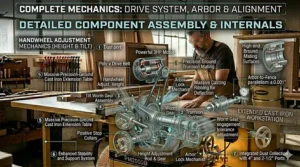
Monthly maintenance includes blade cleaning, fence rail lubrication, and dust removal from cabinet interior. Pitch and resin accumulation on blades increases friction and heat, degrading cut quality and accelerating dullness. Simple blade cleaning with dedicated pitch remover takes 10 minutes and extends blade life by 30-40%.
Quarterly maintenance involves belt tension checking, trunnion lubrication, and blade alignment verification. The poly-V belt system on the PM2000 requires less frequent adjustment than multiple belt designs, but periodic checking prevents unexpected slippage. Proper trunnion lubrication ensures smooth adjustment through all blade height and angle positions.
Annual deep maintenance includes complete cabinet cleaning, bearing inspection, and comprehensive alignment verification. This prevents the gradual drift that accumulates into noticeable inaccuracy. Professional shops often schedule this during slower periods—one cabinet shop owner mentioned his annual PM2000 service takes half a day and maintains like-new performance five years post-purchase.
Replacement Part Costs Over Equipment Lifetime
Budget for blade replacements every 12-18 months with regular use. Quality 10″ combination blades cost $80-150, dado sets $200-400. These aren’t optional expenses—dull blades cause kickback hazards and poor cut quality. Running cheap blades on a $4,000 cabinet saw wastes the precision you paid for.
Belt replacements occur every 3-5 years depending on usage intensity. The serpentine belt on the PM2000 costs around $40 and takes 30 minutes to replace. The triple belt system on the Grizzly G0690 costs $60-80 for the set but requires more careful tension adjustment during installation.
Major component failures are rare on quality cabinet saws but expensive when they occur. Arbor bearing replacement costs $150-250 in parts plus labor if not DIY-capable. Trunnion system repairs can exceed $500 for parts and professional service. These failures typically occur after 15-20 years of regular use—budget approximately $100-150 annually for long-term component replacement reserves.
Power Consumption and Operating Costs
Cabinet saws consume significant electricity—the 3HP motor on the PM2000 draws approximately 23 amps at 230V under full load. Extended ripping sessions translate to noticeable utility costs in commercial shops. Calculate approximately $0.15-0.25 per hour of continuous operation at typical residential rates.
The 5HP motor on the Powermatic 66 draws proportionally more—around 32 amps under load. Professional shops processing hundreds of board feet daily can see $50-100 monthly increases in electrical costs. This operating expense rarely influences purchasing decisions but accumulates to significant amounts over equipment lifetime.
Comparing Lifetime Economics: Premium vs Value Options
A $5,000 Powermatic 66 purchased today serves 30+ years with proper maintenance, averaging $167 annually plus maintenance costs. A $2,500 Grizzly G0690 serving 20 years averages $125 annually. The Powermatic’s premium costs $42 yearly extra over its longer service life—negligible for the heritage brand value and superior residual value at eventual resale.
This calculation changes if you’re establishing a shop that might outgrow equipment. Buying the PM1000 at $2,400 and upgrading to a PM2000 after five years costs more total than buying the PM2000 initially. However, the PM1000’s strong used market means you’ll recoup 50-60% of your investment—the upgrade path doesn’t destroy capital the way buying inappropriate equipment does.
Powermatic Reviews: What Long-Term Owners Actually Report
Marketing claims promise perfection; real-world experience reveals truth. Analyzing feedback from woodworkers who’ve logged thousands of hours on Powermatic cabinet saws provides insights no specification sheet delivers.
Accuracy Maintenance Over Years of Use
Professional woodworkers consistently report Powermatic saws hold alignment longer than competing brands. One furniture maker mentioned his PM2000 maintained fence square within 0.003″ through three years and approximately 12,000 board feet of processing. The cabinet-mounted trunnion system resists the gradual shift that requires frequent realignment on table-mounted alternatives.
The Powermatic 66’s massive construction actually improves with age as cast iron “settles” into optimal configuration. Multiple owners report their saws cut more accurately after 5-10 years than when new. This phenomenon relates to stress relief in the castings—the material reaches equilibrium and stops micro-shifting. Lesser saws with fabricated components don’t benefit from this settling.
Reliability and Unexpected Maintenance Issues
Arbor bearing failures represent the most common major component issue on Powermatic saws—typically occurring after 15-20 years of regular use. The symptom appears as increased blade runout and rougher cut quality. Replacement costs $200-300 in parts plus labor but restores like-new performance.
Belt slippage under heavy load affects some poly-V belt systems during extremely demanding cuts in dense hardwoods. This typically indicates inadequate belt tension rather than system failure. Proper adjustment eliminates the issue—one woodworker mentioned his PM2000 belt slippage disappeared after learning the correct tensioning procedure.
Customer Service Experience When Problems Arise
Powermatic’s warranty support receives consistently positive feedback—most issues get resolved through phone diagnosis without requiring saw return. Replacement parts ship quickly from US warehouses. One owner mentioned receiving a replacement fence component within five days after a forklift accident damaged the original.
The dealer network matters for complex issues requiring hands-on diagnosis. Powermatic’s established dealer presence means professional service is available in most regions. Contrast this with direct-sale brands where you’re troubleshooting alone via email—the difference becomes critical when your business depends on the saw running.
Value Assessment After Long-Term Ownership
Woodworkers who’ve owned their Powermatic saws 10+ years consistently report satisfaction with the purchase decision. The investment pays dividends through decreased maintenance, retained accuracy, and avoided upgrade costs. One shop owner calculated his 15-year-old PM2000 cost $280 annually including purchase price and all maintenance—comparable to leasing inferior equipment for the same period.
The emotional value of using quality tools shouldn’t be dismissed. Working with equipment that inspires confidence rather than frustration affects both productivity and enjoyment. Multiple hobbyist woodworkers mentioned their Powermatic purchases transformed woodworking from frustrating to pleasurable by eliminating the constant adjustment and compensation required with lesser machines.
Jet Powermatic Comparison: Understanding the Sibling Rivalry
JET and Powermatic share corporate ownership under JPW Industries, leading many woodworkers to wonder whether meaningful differences justify the price gap between brands.
Design Philosophy and Target Markets
Powermatic positions itself as the premium American-made brand targeting serious woodworkers who prioritize heritage and maximum quality. The brand commands pricing that reflects this positioning—you’re paying for Powermatic’s reputation accumulated over decades of professional use.
JET targets the “smart value” segment—woodworkers who want quality construction without paying for brand prestige. The XACTA line proves JET can build cabinet saws matching Powermatic’s core capabilities while keeping prices competitive with imports. The question becomes whether brand reputation matters enough to justify the premium.
Component Quality and Construction Differences
Both brands use quality castings and precision-machined components, but subtle differences separate them. Powermatic saws receive additional finishing steps—hand-scraped trunnion surfaces, precisely-lapped table grinding, and upgraded hardware throughout. These refinements don’t appear in specifications but manifest as smoother operation and tighter tolerances.
The JET XACTA’s Poly-V belt system delivers quieter operation than Powermatic’s serpentine design, but the PM2000’s system shows less stretch over time. One woodworker running both brands in a shared shop mentioned the Powermatic maintained original belt tension five years longer than the comparable JET model.
Long-Term Value and Resale Considerations
Powermatic’s brand reputation translates to stronger resale value—well-maintained units retain 60-70% of purchase price even after a decade of use. JET saws retain 45-55% over similar periods. This 15% difference accumulates to significant amounts on $4,000+ equipment.
For woodworkers planning 20+ year ownership, resale value matters less than ongoing performance. Both brands deliver reliable service through extended periods. The decision becomes whether Powermatic’s premium feel and heritage value justify paying $500-800 more for essentially similar cutting capabilities.
Frequently Asked Questions About Powermatic Cabinet Saws
❓ How much does a powermatic cabinet saw weigh and can I move it myself?
❓ What's the difference between 1-phase and 3-phase power for cabinet saws?
❓ Can I run a 3HP cabinet saw on a 15-amp circuit?
❓ How often should I replace the blade on my powermatic saw?
❓ What dust collection CFM rating do I need for a powermatic cabinet saw?
Conclusion: Investing in Precision That Compounds Over Decades
The decision to buy a powermatic cabinet saw represents more than acquiring another tool—it’s establishing the foundation for every serious project you’ll undertake for the next 20-30 years. Whether you choose the innovative PM2000 with its integrated mobility, the legendary Model 66 that defines heritage quality, or the practical PM1000 that delivers cabinet precision without voltage upgrades, you’re investing in capabilities that compound through thousands of cuts.
What separates excellent cabinet saws from adequate alternatives isn’t visible in specification sheets—it’s the accumulated time savings from fences that stay square, the reduced frustration from blades that hold alignment, and the confidence from knowing your measurements translate directly into accurate cuts. These intangible benefits multiply across every project, transforming your capabilities more than any single technique improvement.
The Powermatic legacy, Jet powermatic comparison alternatives, and value-focused options like Grizzly demonstrate that multiple paths lead to cabinet saw excellence. Your specific choice should match your workflow reality—not aspirational projects you might attempt someday, but the actual work you complete each week. The powermatic pm2000 makes sense for shops that actually need frequent repositioning. The powermatic 66 justifies its premium for woodworkers building businesses on its capabilities. The PM1000 serves serious hobbyists perfectly without demanding electrical infrastructure investment.
Remember: buying the right cabinet saw once costs less than upgrading twice. These machines serve generations when properly maintained—make your decision based on 20-year value, not just today’s price tag. Your future self will either thank you for investing appropriately or curse you for the compromise that seemed reasonable at purchase.
Now get out there and start cutting—your workshop has been waiting for this moment.
Recommended for You
- 7 Best SawStop Cabinet Saw Models 2026
- 7 Best Cabinet Table Saws Under $5000 (2026 Reviews)
- 7 Best Cabinet Table Saw Under 3000 in 2026
Disclaimer: This article contains affiliate links. As an Amazon Associate, I earn from qualifying purchases. If you purchase products through these links, we may earn a small commission at no additional cost to you.
✨ Found this helpful? Share it with your friends! 💬🤗
