
In This Article
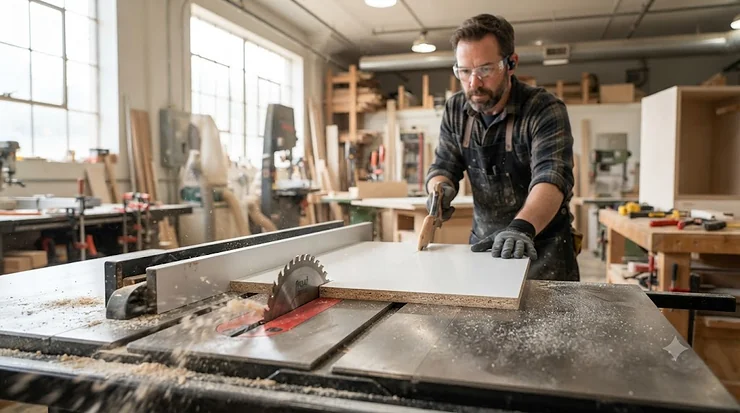
Melamine has a reputation problem. Ask around any cabinet shop and you’ll hear the same groan: gorgeous white or wood-grain panels, ruined in a single pass by a blade that wasn’t built for the job. The best table saw blade for melamine isn’t a mystery once you know what to look for, but the wrong blade turns a $60 sheet of two-sided panel into an expensive coaster collection. Chipping happens because melamine is really a resin-coated skin bonded to particleboard or MDF, and that skin shatters instead of slicing when the wrong tooth geometry rips through it. According to Wikipedia’s overview of melamine resin, the sheets are heavy for their size and the resin coating is inherently prone to chipping under conventional table saw blades — which is exactly why a dedicated blade matters so much more here than it does for solid hardwood.
This guide breaks down seven real, currently available blades — from a $50-ish home-center option to a hand-tensioned Forrest blade that cabinet shops keep for decades — and explains not just which one wins, but why, in terms of tooth count, grind geometry, hook angle, and how each interacts with the brittle top layer of a melamine panel. You’ll also get a practical usage guide, real-world buying scenarios, a troubleshooting section for chip-prone cuts, and answers to the buying questions that come up most. Whether you’re building kitchen cabinets, closet systems, or a one-off bookshelf, by the end you’ll know exactly which blade belongs on your arbor.
Quick Comparison Table
| Blade | Teeth / Grind | Best For | Price Range |
|---|---|---|---|
| Forrest Duraline Hi-A/T | 80T Hi-A/T | Best overall, pro shops | $150-$220 |
| Freud LU97M010 | 80T TCG | Double-sided production runs | $100-$140 |
| Amana MB10800C | 80T Hi-ATB | Purpose-built melamine specialist | $110-$150 |
| CMT 210.080.10 | 80T Hi-ATB (40°) | Best value pro-grade | $90-$120 |
| Infinity 010-080 | 80T Hi-ATB (40°) | Best hobbyist upgrade | $85-$110 |
| Diablo D1080X | 80T Hi-ATB | Best under $100 | under $60 |
| Freud LU80R010 | 80T Hi-ATB | Best all-rounder (plywood + melamine) | $90-$130 |
Look at that spread for a second: every single blade worth recommending lands at 80 teeth, and every one uses some flavor of alternate top bevel or triple chip grind — there’s no 40-tooth combo blade sneaking onto this list, because those just don’t have the tooth count to shear melamine’s brittle face cleanly. The real differentiator isn’t teeth count at all; it’s grind geometry and hook angle, which is why two blades with identical 80T specs can produce noticeably different results. Budget shoppers should note that the Diablo undercuts the rest of the field by a wide margin without sacrificing the core geometry that prevents chipping.
💬 Just one click — help others make better buying decisions too!😊
Top 7 Best Table Saw Blades for Melamine: Expert Analysis
Picking a melamine blade comes down to matching grind geometry to your workload — high-volume shops want longevity, weekend woodworkers want forgiving cut quality, and everyone wants to avoid that sickening crunch of a chip tearing loose mid-cut. Here’s how the seven leading real-world options stack up, drawn from manufacturer specs and the aggregated experience of woodworkers who’ve actually run these blades through sheet after sheet of two-sided panel.
1. Forrest Duraline Hi-A/T — best overall, no scoring blade needed
The Duraline Hi-A/T earns its “Cadillac of blades” reputation the hard way: through a grind specifically engineered to eliminate the need for a separate scoring pass. Its 80 teeth use a high alternate top bevel with a steep 40-degree point angle, and Forrest builds each blade with double-hard C-4 submicron carbide that’s hand-brazed and tensioned rather than machine-stamped. What that means in practice is that the very sharp wing tips slice the bottom laminate skin cleanly on the way through, so you get finish-quality edges on both faces without the extra step scoring blades usually require. Reviewers on woodworking forums consistently describe the cut quality as “chip-free” even on double-sided melamine, and several report using it without a zero-clearance insert at all — something almost no other blade in this list can claim. This is the blade cabinet shops reach for when a client is standing in the showroom watching the demo cut. It’s best suited to shops running enough melamine to justify the investment and the periodic professional sharpening Forrest’s service is built around; a hobbyist cutting two shelves a year won’t recoup the premium. Aggregated buyer sentiment does flag one recurring theme: the Hi-A/T grind, while flawless on quality, dulls faster in melamine specifically than a triple chip grind would, simply because melamine’s resin coating is abrasive on fine, high-bevel edges. Forrest’s own sharpening program exists largely to offset that tradeoff.
Pros:
- ✅ Hi-A/T grind eliminates the need for a scoring blade or pass
- ✅ Hand-tensioned C-4 carbide holds a cleaner edge than stamped blades
- ✅ Manufacturer resharpening service extends the blade’s working life for years
Cons:
- ❌ Premium pricing sits well above general-purpose 80T blades
- ❌ Fine bevels dull faster on abrasive melamine than a triple chip grind
At the time of research, the Duraline Hi-A/T sits in the $150-$220 range depending on kerf and retailer — pricey, but for a shop cutting daily, the reduced re-sharpening frequency and eliminated scoring step often pay that difference back.
2. Freud LU97M010 — best for double-sided, high-volume production
Freud built the LU97M010 to solve a specific problem: getting a flawless finish on both the top and bottom face of double-sided laminate without a scoring blade, in a shop that’s cutting enough panels that feed rate matters. It uses a full 80-tooth triple chip grind with a positive hook angle, which is the opposite philosophy from the Forrest above — positive hook angles feed material through faster and with less resistance, ideal for production runs where operators are pushing dozens of sheets a day. The TiCo Hi-Density carbide tips and Silver I.C.E. anti-corrosion coating keep the blade running cooler and resisting pitch buildup, which matters more than most buyers realize; a gummed-up blade generates friction heat that warps the plate and ruins cut accuracy long before the carbide actually dulls. Freud specifically markets this as needing no scoring blade for melamine ranging from 1/4-inch to 1-5/8-inch thick, which covers the vast majority of cabinet-grade panel. Who should care: shops or serious hobbyists doing repetitive melamine cuts where consistent feed speed matters as much as finish quality. Aggregated reviewer sentiment is largely positive on chip resistance, though a handful of buyers cutting the most delicate high-gloss finishes note that a pure triple chip grind can trail a Hi-ATB grind by a hair on the very finest finish work — the tradeoff for that faster, more aggressive positive-hook feed.
Pros:
- ✅ TCG geometry purpose-built for flawless double-sided melamine cuts
- ✅ Positive hook angle keeps feed rate brisk in production settings
- ✅ Silver I.C.E. coating resists heat buildup and pitch/resin gumming
Cons:
- ❌ Pure TCG can trail a Hi-ATB grind on the most delicate finish work
- ❌ Full 1/8-inch kerf demands more motor power than thin-kerf blades
Expect this blade in the $100-$140 range at the time of research.
3. Amana Tool MB10800C — best purpose-built melamine specialist
Amana didn’t adapt a general crosscut blade for melamine; the MB10800C was engineered from the ground up specifically for double-face melamine, and it shows in the unusual -6-degree negative hook angle paired with an aggressive 25-degree high-ATB bevel. That negative hook is the detail worth understanding: it makes each tooth strike the material more like a scraper than a slicer, which dramatically reduces the tearing action that causes chipping on brittle resin surfaces. Copper plugs dampen vibration during the cut, and a thicker .102-inch plate adds stability that thinner blades lack, which matters because any flex in the plate translates directly into an uneven, chip-prone edge. Long-time users on woodworking forums describe running this blade for a decade or more with periodic resharpening and still getting zero-tearout results, and one shop owner specifically called it “simply the best blade I’ve used for melamine” with zero tearout even without a riving knife installed. This is the blade to reach for if melamine and high-gloss MDF panels are the bulk of your daily work rather than an occasional job. The negative hook does mean feeding feels a little slower and more deliberate than a positive-hook blade, which some production shops find less convenient, and aggregated review sentiment shows an occasional complaint about inconsistent quality control on individual units — worth inspecting the blade for flatness before the first cut.
Pros:
- ✅ Negative hook angle and 25° Hi-ATB bevel engineered specifically for melamine
- ✅ Thicker .102-inch plate resists flex-induced chipping
- ✅ Copper plug vibration dampening improves cut consistency
Cons:
- ❌ Negative hook feeds more slowly than positive-hook alternatives
- ❌ A minority of buyer reviews cite inconsistent unit-to-unit quality
At the time of research, this blade runs in the $110-$150 range.
4. CMT 210.080.10 — best value professional-grade pick
CMT’s approach to melamine is a 40-degree alternate top bevel — essentially a Hi-ATB grind under a different name — machined into a German steel plate hardened to 46-48 Rockwell, which is genuinely stiffer than the mild steel used in many budget blades. That extra plate rigidity translates directly into cut consistency: a plate that doesn’t flex under load produces a straighter kerf and fewer chip-out surprises on the exit side of the cut. The micrograin carbide teeth are brazed using a tri-metal copper-silver-copper bond, a detail that sounds like marketing fluff until you realize it’s what keeps carbide tips from popping loose under the heat cycling that melamine’s dense resin coating generates. What most buyers overlook about this blade is that it delivers cut quality genuinely competitive with Forrest and Amana at a noticeably lower price point, which is exactly why woodworking forum veterans routinely list it alongside those premium names as an equal rather than a budget substitute. A PTFE non-stick coating keeps pitch from building up, extending the interval between cleanings. This is the pick for shops that want Hi-ATB-level finish without paying the full premium-brand tax. The 5-degree hook angle is on the conservative side, meaning feed rate is a touch slower than combination blades, and the blade ships in a specialty plastic case that can bump shipping costs slightly on some retailers.
Pros:
- ✅ 40° ATB grind matches premium-brand finish quality at a lower price
- ✅ German steel plate (46-48 HRC) resists warping and flex
- ✅ Tri-metal brazing keeps carbide tips secure under heat cycling
Cons:
- ❌ Conservative 5° hook angle feeds more slowly than combo blades
- ❌ Specialty packaging adds modestly to shipping cost at some retailers
Expect the CMT in the $90-$120 range depending on retailer.
5. Infinity Tools 10″ Ultra-Smooth (010-080) — best hobbyist upgrade
If you’ve been running the stock combination blade that came with your table saw and you’re tired of babysitting every melamine cut with tape and prayer, the Infinity Ultra-Smooth is the upgrade path woodworking forums recommend more consistently than almost any other single blade. It uses an aggressive 40-degree Hi-ATB grind with a 5-degree hook angle — a middle ground between the aggressive positive hooks on production blades and the slow negative hooks on pure melamine specialists — which makes it forgiving for someone who isn’t cutting sheet goods eight hours a day. The Chrome Armor coating is Infinity’s answer to pitch buildup and corrosion, and it holds up well according to long-term owner reports. What’s notable here is how often experienced woodworkers who’ve tried blades from Forrest, Freud, Tenryu, and Ridge Carbide single out this specific Infinity blade as “best in class” for the money, which is a meaningful signal in an industry full of brand loyalty. Reviewers describe cleaner cuts than their Forrest Woodworker II and Ridge Carbide TS2000 in side-by-side testing, which is a bold claim given those blades’ pedigree, though it doesn’t rip quite as aggressively as some combination blades. For a serious hobbyist building a kitchen’s worth of melamine cabinets as a one-time project, this blade closes most of the gap to the premium names at a meaningfully lower entry cost. The tradeoff is availability — it’s sold primarily direct from Infinity rather than through big-box retailers, and the full kerf design does ask more of underpowered contractor saws.
Pros:
- ✅ 40° Hi-ATB grind with a forgiving 5° hook balances smoothness and feed
- ✅ Chrome Armor coating extends resistance to pitch and corrosion
- ✅ Repeatedly rated “best in class” against premium competitors by experienced users
Cons:
- ❌ Primarily sold direct, harder to find at brick-and-mortar retailers
- ❌ Full-kerf design pulls more power from underpowered contractor saws
At the time of research, this blade sits in the $85-$110 range.
6. Diablo D1080X — best melamine blade under $100
Every list needs a blade that a weekend DIYer can grab at a home center on a Saturday morning without a special order, and the Diablo D1080X is that blade. Despite its accessible price, it isn’t a stripped-down afterthought: it uses the same 80-tooth Hi-ATB geometry as blades costing twice as much, paired with TiCo Hi-Density carbide tips and a Perma-Shield non-stick coating that resists heat and pitch buildup. The thin .098-inch kerf is actually an advantage for this category of buyer — it puts less strain on smaller contractor and jobsite saws that don’t have the horsepower of a cabinet shop’s 5-horsepower unit, which matters enormously if your table saw is a portable jobsite model rather than a stationary cabinet saw. Manufacturer testing and independent retailer descriptions both note it’s designed to deliver flawless finish crosscuts in melamine, veneered plywood, and MDF with minimal rework needed afterward. Who should care: anyone building one or two projects a year who doesn’t want to spend more on a blade than the project’s total lumber budget, or anyone who needs a reliable backup blade to keep on the shelf. Reviewers do note the thinner plate is a bit more prone to minor vibration on saws that aren’t perfectly tuned, and it won’t hold an edge as long under daily production cutting as the full-kerf industrial options above — but for occasional use, that’s a fair trade for the price.
Pros:
- ✅ Same 80T Hi-ATB geometry as premium blades at a fraction of the cost
- ✅ Thin .098-inch kerf reduces strain on portable jobsite saws
- ✅ Widely available at home centers for same-day replacement
Cons:
- ❌ Thinner plate shows more vibration on poorly tuned saws
- ❌ Edge life trails full-kerf industrial blades under daily production use
Based on current retailer listings, this blade typically runs under $60 — genuinely one of the best-value entries in this whole comparison.
7. Freud LU80R010 — best all-rounder for plywood and melamine
Not every shop cuts melamine exclusively — most cabinet builders are switching between veneered plywood, moldings, solid wood crosscuts, and melamine panels within the same day, and buying a dedicated specialist blade for each material gets expensive fast. The LU80R010 is Freud’s answer: an 80-tooth Hi-ATB blade engineered to deliver flawless, chip-free edges across that entire mixed workload rather than excelling at melamine alone. Laser-cut anti-vibration slots calm the plate during the cut, and the same TiCo carbide formula used across Freud’s higher-end lines gives it real edge retention rather than the soft carbide found in disposable-grade blades. What most buyers overlook about a true all-rounder blade like this is the math: if you’re currently swapping between two or three specialized blades depending on material, the time saved not changing blades mid-project often outweighs the small finish-quality gap versus a pure melamine specialist. It’s genuinely well-suited to small shops and serious DIYers building out a kitchen where the job involves plywood carcasses, melamine interiors, and solid-wood face frames in the same afternoon. The honest tradeoff, confirmed by aggregated reviewer sentiment, is that on the most demanding double-sided melamine cuts, the true specialists above (Forrest, Amana, Freud’s own LU97 series) will out-finish this blade by a small but noticeable margin — you’re trading a sliver of peak performance for versatility.
Pros:
- ✅ One blade handles plywood, moldings, and melamine without swapping
- ✅ Laser-cut anti-vibration slots stabilize the cut across material types
- ✅ TiCo carbide formula holds an edge well across mixed workloads
Cons:
- ❌ Dedicated melamine specialists edge it out on the toughest double-sided cuts
- ❌ Full kerf asks more of smaller, underpowered saws
Expect the LU80R010 in the $90-$130 range at the time of research.
Practical Usage Guide: Setting Up Your Saw for Chip-Free Melamine Cuts
Buying the right blade solves maybe 70% of the chipping problem — the rest comes down to setup, and this is the part most product listings skip entirely. Start with a zero-clearance throat plate; the stock insert on most table saws has a gap wide enough that unsupported material fibers on the underside of the cut flex downward and snap instead of shearing cleanly. A shop-made or purchased zero-clearance insert closes that gap to almost nothing, which dramatically reduces bottom-side chipping even with a mid-tier blade. Next, dial in blade height correctly — this is the single most under-discussed variable in melamine cutting. Set the blade too low and you’ll get chipping on the top face; set it too high and the bottom face chips instead, because the tooth angle of entry changes with height. Most experienced woodworkers settle on roughly 3/8 to 1/2 inch of tooth exposure above the material as the sweet spot, though it’s worth testing on scrap first since saw and blade combinations vary. Feed rate matters just as much as blade choice: rushing a cut through melamine is the fastest way to chip an otherwise perfect blade’s work, so aim for slow, steady, consistent pressure rather than pushing hard to finish faster. In your first month with a new melamine blade, the most common mistake is skipping a masking-tape pass over the cut line on any panel with a high-gloss or dark finish — the tape holds surface fibers down and adds a meaningful buffer against chip-out, especially near the very start and end of each cut where blowout is most likely.
Real-World Scenarios: Which Blade Fits Your Kitchen Cabinets or Closet Project
The weekend closet-system builder. You’re cutting maybe 8-10 sheets of white melamine over a single weekend project, budget matters, and your saw is a benchtop or contractor model rather than a cabinet saw. The Diablo D1080X is the right call here — its thin kerf won’t bog down a lower-horsepower motor, and the price means you’re not investing more in the blade than the melamine itself.
The serious hobbyist building kitchen cabinets from scratch. You’re looking at 30+ sheets of two-sided melamine for cabinet boxes plus plywood for face frames and moldings, and you want one blade that handles it all without constant swapping. The Freud LU80R010 or the Infinity 010-080 both make sense here — the former for its all-around versatility across materials, the latter if melamine is the clear majority of the cut list and you want that extra edge in finish quality.
The small cabinet shop running melamine daily. Volume changes the math entirely. At this frequency, the Forrest Duraline Hi-A/T or Amana MB10800C justify their higher upfront cost through reduced resharpening frequency, elimination of the scoring pass, and consistent chip-free results that protect your reputation with clients who are watching every cut. For pure double-sided production speed, the Freud LU97M010’s positive hook and TCG geometry keep panels moving through the shop faster than negative-hook specialists.
Melamine Chipping Solutions: Fixing the Five Most Common Problems
Problem: Chipping on the top face only. This almost always means your blade height is set too low relative to the material. Raise the blade so roughly 3/8 to 1/2 inch of tooth clears the top of the panel, and retest on scrap.
Problem: Chipping on the bottom face only. The opposite issue — the blade is likely set too high, or you’re missing a zero-clearance insert entirely, letting unsupported fibers snap downward as the teeth exit the cut.
Problem: Chipping near the very start or end of a cut. This is a feed-rate issue combined with lack of support. Apply masking tape over the cut line before starting, and make sure infeed and outfeed support keeps the panel flat and steady through the entire pass rather than letting it dip at the edges.
Problem: A previously clean blade suddenly starts chipping. Check for pitch and resin buildup on the carbide teeth first — melamine’s resin coating gums up blades faster than solid wood does, and a gummed blade behaves like a dull one. A dedicated blade cleaner or simple degreaser restores performance instantly in most cases.
Problem: Chipping on double-sided (two-face) melamine specifically. Standard single-scoring approaches won’t cut it here. This is exactly the scenario a triple chip grind blade or a Hi-A/T grind blade (like the Freud LU97M010 or Forrest Duraline) was engineered to solve — both faces need their own clean shear, which is what those specific geometries deliver without a separate scoring pass.
✨ Don’t Miss These Exclusive Deals!
🔍 Take your melamine cutting to the next level with these carefully selected blades. Click on any highlighted item to check current pricing and availability. The right blade turns a nerve-wracking cut into a routine one — and protects every sheet of panel you invest in.
How to Choose the Best Table Saw Blade for Melamine
Choosing the right blade comes down to matching a handful of specs to your actual workload rather than chasing the highest tooth count you can find. Here’s the process, step by step:
- Start with tooth count. Anything below 60 teeth will chip melamine’s brittle surface almost guaranteed; 80 teeth is the sweet spot most manufacturers converge on for a 10-inch blade, balancing smooth cuts against excessive cutting resistance.
- Decide between Hi-ATB and TCG grind. Hi-ATB (high alternate top bevel) generally delivers the cleanest possible finish but dulls a bit faster in abrasive melamine; triple chip grind trades a small amount of finish quality for meaningfully longer edge life — pick based on whether finish or longevity matters more to your workflow.
- Match hook angle to your priorities. Positive hook angles (5-10°) feed faster, which favors production shops; negative hook angles (as low as -6°) shear more gently, which favors the cleanest possible cut on delicate double-sided panel.
- Check kerf thickness against your saw’s horsepower. Thin-kerf blades (under .100″) ask less of portable and contractor saws; full-kerf blades (.125″+) generally hold straighter and vibrate less on cabinet saws with more available power.
- Confirm arbor size and diameter match your saw. Nearly all consumer table saws use a 5/8-inch arbor and 10-inch blade diameter, but always verify before ordering — this is a frequently overlooked step that leads to returns.
- Weigh resharpening support. Premium brands like Forrest and Amana offer dedicated sharpening services that extend blade life for years; budget blades are often more cost-effective to simply replace than resharpen.
- Set a realistic budget against your cutting volume. If you’re cutting melamine daily, the premium blades pay for themselves in reduced downtime and re-sharpening; if you’re cutting a handful of sheets a year, a well-reviewed budget blade like the Diablo delivers nearly identical results for a fraction of the cost.
| Priority | Recommended Grind | Recommended Hook | Example Pick |
|---|---|---|---|
| Cleanest possible finish | Hi-ATB / Hi-A/T | Negative to neutral | Forrest Duraline, Amana MB10800C |
| Fastest production feed | TCG | Positive | Freud LU97M010 |
| Balance for occasional use | Hi-ATB | Slightly positive | Diablo D1080X, Infinity 010-080 |
The pattern in that table is worth internalizing: there’s no single “best” grind in the abstract, only a best grind for your specific mix of volume, saw power, and how forgiving you need the setup process to be. A shop cutting 40 sheets a week genuinely benefits from the negative-hook precision of a dedicated melamine specialist, while a hobbyist cutting four sheets a year gets essentially the same visible result from a well-chosen budget blade paired with careful technique.
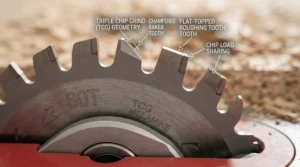
Triple Chip Grind vs Hi-ATB: Tooth Geometry Explained
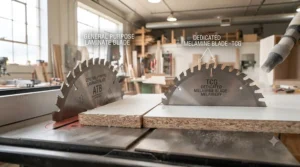
The two dominant grinds for melamine blades look similar from across the shop but behave very differently at the tooth level, and understanding why changes how you’ll shop for a blade. A triple chip grind (TCG) alternates a flat-topped “raker” tooth with a beveled “trapeze” tooth that has its corners chamfered off — the raker widens the kerf slightly while the trapeze tooth does the actual shearing work on the material’s edges. This geometry is inherently more durable because the trapeze tooth’s chamfered corners are less fragile than a full sharp point, which is exactly why TCG blades tend to hold an edge longer when cutting abrasive materials like melamine’s resin coating. Hi-ATB (high alternate top bevel), by contrast, uses every tooth ground to a steep angle — often 30 to 40 degrees — alternating left and right so each tooth acts almost like a knife point slicing into the material’s surface fibers before the body of the tooth follows through. That steep bevel is what produces the glass-smooth, almost polished finish Hi-ATB blades are known for, but those same fine points are more delicate and wear faster against an abrasive resin surface than TCG’s chunkier geometry. As one long-running discussion among professional woodworkers on Fine Woodworking’s community forum puts it, the tradeoff essentially comes down to choosing superior blade life with TCG or superior cut quality with a high-bevel ATB grind — and for shops working primarily with melamine and laminates, going with a lower hook angle TCG blade is often the better call precisely because it holds up better under sustained blade life demands. Neither grind is objectively “better” — TCG suits high-volume shops prioritizing edge life, while Hi-ATB suits anyone whose top priority is the cleanest possible visible finish on a showcase project.
Melamine Blade vs Laminate Blade: What’s the Difference
Shoppers frequently assume “melamine blade” and “laminate blade” are interchangeable marketing terms, and while there’s real overlap, the distinction matters more than most retail listings let on. Melamine, technically, is a resin-coated decorative paper thermally fused directly onto a particleboard or MDF substrate — the resin layer is thin and brittle, sitting right at the surface. High-pressure laminate (the material behind Formica-style countertops) is a thicker, denser stack of resin-saturated paper layers compressed under far higher pressure, which makes it noticeably tougher and more resistant to chipping than melamine’s single thin skin. Because of that density difference, blades genuinely marketed for laminate work — countertop fabrication blades in particular — often use a more aggressive negative-rake TCG geometry designed to shear through that thicker, harder material without excessive tooth wear, while blades marketed specifically for melamine can afford a slightly finer Hi-ATB edge since they’re cutting a thinner, more delicate skin. In practice, most of the 80-tooth blades in this guide are dual-purpose and explicitly rated for both materials — Freud, Amana, and CMT all market their melamine blades as suitable for veneered plywood and laminate work too — so the practical difference for most buyers is smaller than the marketing suggests. Where it does matter is at the extremes: if you’re exclusively fabricating thick countertop laminate in a commercial shop, a dedicated laminate-trimming blade with a more negative rake will outlast a general melamine blade; if you’re cutting cabinet-grade melamine sheet goods, any of the seven blades reviewed above will serve you better than a laminate-specific blade optimized for much denser material.
Best Table Saw Blades for Cabinet Work and Kitchen Cabinets
Kitchen cabinet construction puts a unique set of demands on a blade that differs from general shop work: you’re cutting the same 3/4-inch two-sided melamine repeatedly for cabinet boxes, shelves, and drawer components, edges need to look factory-clean since they’re often visible inside open shelving, and a single bad chip on a face-visible panel can mean scrapping an entire sheet. For this exact use case, the negative-hook, purpose-built melamine specialists earn their keep — the Amana MB10800C’s -6-degree hook and 25-degree Hi-ATB bevel combination was specifically engineered around this scenario, and reviewers building full kitchens report zero-tearout results across hundreds of linear feet of cuts. The Forrest Duraline Hi-A/T is the other standout here, particularly for shops that build enough cabinetry to justify eliminating the separate scoring pass entirely — that alone can shave meaningful time off a full kitchen’s cut list. For cabinet builders working primarily solo or part-time, the calculus shifts slightly: the Freud LU80R010 handles the melamine cabinet interiors and the plywood or solid-wood face frames with a single blade change avoided, which matters when you’re managing an entire kitchen’s cut list without a dedicated production crew. Whichever blade you choose, pair it with a zero-clearance insert religiously for cabinet work specifically — visible interior shelving and cabinet sides get scrutinized up close by clients in a way that hidden structural cuts never do, so the margin for chip-out is essentially zero.
Long-Term Cost & Maintenance: Sharpening, Blade Life, and Real ROI
The sticker price on a melamine blade tells only part of the cost story, and shops that only compare upfront price often end up spending more over a year of use than they would have with a pricier blade. A premium blade like the Forrest Duraline or Amana MB10800C, purchased in the $150-plus range, can realistically deliver a decade or more of service life when paired with periodic professional resharpening — several long-time owners on woodworking forums report using the same blade for over twenty years with occasional sharpening. Resharpening a quality carbide-tipped blade typically costs a fraction of a new blade’s price and restores most of the original cutting performance, whereas a budget blade often isn’t worth resharpening at all once it dulls — the carbide is thinner and the return on a sharpening service call doesn’t pencil out, so replacement becomes the more economical path. That reframes the real comparison: it’s not “$60 Diablo vs. $180 Forrest,” it’s “$60 every year or two vs. $180 plus periodic $30-40 sharpenings stretched across a decade.” For a shop cutting melamine daily, the premium blade wins that math clearly. For a hobbyist cutting a handful of sheets annually, the total lifetime cost gap narrows dramatically, and the budget blade’s lower upfront cost combined with its “good enough for occasional use” performance makes far more sense. Either way, keeping teeth clean of pitch buildup with a regular blade-cleaner treatment is the single cheapest thing you can do to extend any blade’s working life, regardless of price point.
Features That Actually Matter (And Those That Don’t)
It’s easy to get distracted by marketing language on a blade’s packaging, so here’s an honest filter for what genuinely affects your cut quality versus what’s mostly noise. Tooth count and grind geometry matter enormously — this is the core mechanism that determines whether melamine chips or shears cleanly, and it’s worth spending real research time on. Hook angle matters, though it’s more about matching your priorities (speed versus finish quality) than one angle being objectively superior. Plate thickness and rigidity matter more than most buyers realize, since a plate that flexes under load translates directly into inconsistent cut quality regardless of how sharp the teeth are. On the other hand, exotic coating names — Silver I.C.E., Chrome Armor, Perma-Shield, Electro-Blu — sound like meaningfully different technologies but functionally do the same job across every major brand: they reduce friction, resist pitch buildup, and fight corrosion. None of them will save a poorly-geometry-matched blade, and the differences between competing coating brands in independent testing are marginal at best. Similarly, RPM ratings printed prominently on packaging rarely matter for home and small-shop table saw use, since virtually every consumer table saw operates well within any quality blade’s rated speed range — this spec matters far more for industrial radial-arm or panel-saw applications running at higher speeds. Spend your research time on grind and hook angle; treat coating branding and RPM ratings as tie-breakers at most.
Safety and Setup: Working Confidently with High-Tooth-Count Blades
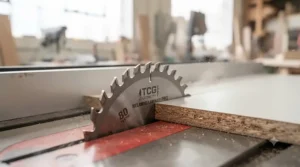
High-tooth-count blades like the 80-tooth options in this guide cut more slowly per rotation than an aggressive 24-tooth rip blade, which actually makes them somewhat more forgiving in terms of kickback risk when used correctly — but proper guarding and technique remain non-negotiable regardless of blade choice. Federal workplace safety standards require that circular table saws be equipped with guards that automatically adjust to material thickness and remain in contact with the stock being cut, along with anti-kickback devices on ripping operations; the OSHA machine guarding guidance for table saws lays out the specific requirements in detail and is worth reviewing even for a home shop, since the underlying safety logic applies regardless of whether you’re legally required to comply. Always use a push stick for narrow cuts, keep hands well clear of the blade’s line of travel, and inspect a new blade for flatness and proper arbor fit before the first cut — a warped or improperly seated blade is a far more common cause of kickback than tooth geometry ever is. For melamine specifically, remember that the material is genuinely heavy for its size; a full 3/4-inch sheet can weigh close to 90 pounds, so proper infeed and outfeed support isn’t just about cut quality, it’s about maintaining control of a heavy panel throughout the entire pass. Keep your zero-clearance insert in good condition and replace it once the slot widens from wear, since a worn insert reintroduces exactly the chip-out risk it was installed to prevent.
Frequently Asked Questions
❓ What is the best tooth count for cutting melamine on a table saw?
❓ Do I need a scoring blade to cut melamine cleanly?
❓ What's the difference between TCG and Hi-ATB for melamine blades?
❓ Can I use a regular plywood blade to cut melamine?
❓ How much should I expect to spend on a good melamine blade?
Conclusion
If there’s one takeaway from this whole comparison, it’s that “best” depends entirely on how often melamine crosses your saw table. For a shop running panels daily, the Forrest Duraline Hi-A/T and Amana MB10800C justify their premium pricing through eliminated scoring passes, longer service life with professional resharpening, and the kind of consistent chip-free results that protect a shop’s reputation cut after cut. For high-volume double-sided production specifically, the Freud LU97M010’s TCG geometry and faster positive-hook feed make it the practical production-floor choice. Somewhere in the middle, the CMT 210.080.10 and Infinity 010-080 deliver genuinely close-to-premium finish quality without the full premium-brand price tag, which is exactly why experienced woodworkers keep recommending them as smart value picks rather than compromises. And for anyone building a single project, upgrading from a stock blade, or just not ready to invest triple-digit dollars in a specialty tool, the Diablo D1080X proves that under-$100 doesn’t have to mean under-quality — it uses the same core Hi-ATB geometry as blades twice its price. Match the blade to your actual cutting volume and finish standards rather than simply chasing the most expensive option, pair whichever blade you choose with a zero-clearance insert and correct blade height, and melamine stops being the material that ruins your Saturday project.
✨ Found the right blade for your next build?
Grab it before your next cut list — a properly matched blade turns melamine from a chip-prone headache into just another material you cut with confidence.
Recommended for You
- Best Table Saw Blade for Plywood: 7 Picks That Kill Tear-Out (2026)
- 7 Best Dado Blade Sets for Table Saws in 2026
- Full Kerf Table Saw Blade: 7 Best Picks for Stability in 2026
Disclaimer: This article contains affiliate links. As an Amazon Associate, I earn from qualifying purchases. If you purchase products through these links, we may earn a small commission at no additional cost to you.
✨ Found this helpful? Share it with your friends! 💬🤗
