
In This Article
Here’s a confession every woodworker eventually makes, usually right after a board kicks back and leaves a dent in the wall six feet behind the saw: hands are not a safety device. Neither is hoping for the best. What actually keeps a workpiece pinned where it belongs — instead of launching toward your sternum — is a spring-loaded row of angled fingers doing the boring, unglamorous job of holding wood against the fence while you keep your fingers somewhere else entirely.
An adjustable featherboard for cabinet saw fence setups is a mounted accessory, usually attached via T-track or a routed slot, whose flexible fingers apply constant one-way pressure that pins stock against the fence or table while allowing forward feed and resisting backward kickback…
That’s the textbook version. The real version is that not all featherboards are created equal, and the difference between a $16 stamped-plastic clip and a $70 EVA-fingered rig can be the difference between a tool you trust on hardwood ripping and one you quietly retire to a drawer. Per CPSC and OSHA data, kickback remains one of the primary hazards on stationary table and cabinet saws, which is exactly the failure mode these accessories exist to interrupt. This guide breaks down seven real, currently-sold options — budget, mid-range, and genuinely premium — with honest analysis of what the spec sheets mean once you’re actually feeding a board of curly maple past a spinning blade. We researched real listings, real manufacturer specs, and aggregated review sentiment (never invented quotes) so you can spend your money once and get it right.
You’ll also see coverage of related setups: a fence mounted featherboard for cabinet saw fences with T-track versus routed slots, how an adjustable pressure featherboard on fence hardware differs from miter-slot mounting, what a cabinet saw featherboard attachment actually bolts to, and how cabinet saw fence rails determine which accessories will even fit your machine. Let’s get into it.
Quick Comparison Table
| Pick | Mount Style | Best For | Price Range |
|---|---|---|---|
| Rockler Adjustable Fence Featherboard | T-track/T-slot on fence | Budget-friendly fence mounting | Under $20 |
| BOW FencePRO FP4 | T-track, EVA feathers | Maximum kickback resistance | $40-$60 (2-pack) |
| POWERTEC Universal Tandem Featherboard | Miter slot + T-track | Multi-machine versatility | $25-$35 (2-pack) |
| Magswitch Vertical Featherboard Attachment | Magnetic, no track needed | Tall stock, track-free steel fences | $80-$120 (system) |
| Hedgehog Featherboard | Miter slot, single knob | Fast one-handed adjustments | $30-$45 |
Looking at the spread above, the price gap isn’t padding — it’s paying for mounting flexibility and feather material. The Rockler Adjustable Fence Featherboard and similar T-track units are the obvious entry point if your fence already has an accessory channel, while the Magswitch Vertical Featherboard Attachment solves a completely different problem: fences and cast-iron surfaces with no track at all. Somewhere in the middle, the BOW FencePRO FP4 trades a higher price tag for feather geometry that’s measurably harder to kick back.
Just one click — help others make better buying decisions too!😊
Top 7 Adjustable Featherboards for Cabinet Saw Fence: Expert Analysis
We looked at real, currently available products across three tiers — genuinely cheap, comfortably mid-range, and priced-like-they-mean-it premium — so there’s an honest option no matter your budget or saw setup.
1. Rockler Adjustable Fence Featherboard — true fence-mount design on a budget
The standout here is simple: this is built specifically to slide into the accessory T-track (or a routed T-slot) on your fence face, not your miter slot, which matters a lot if your cabinet saw fence rails don’t leave room for a miter-slot-mounted competitor. The two-inch adjustment range in the mounting slots lets you dial in exactly where the fingers contact the workpiece, and the first feather is intentionally shorter than the rest — a small design touch that lets you set the featherboard so the first feather just grazes your work before the longer fingers engage with full pressure as the piece continues through the cut. Based on the spec comparison with other T-track units, this one wins on simplicity rather than raw holding force.
Reviewers consistently note that it installs in under five minutes and holds its setting well through repeated cuts, though a few mention the T-bolts need periodic re-tightening on saws with heavy vibration. What most buyers overlook about a fence-mount unit like this is that it frees up your miter slot entirely for a sled or gauge — something a miter-slot featherboard can’t do simultaneously.
Pros:
- ✅ Genuine fence-track mounting, not miter-slot dependent
- ✅ Two inches of fine adjustment for dialing in pressure
- ✅ Shorter lead feather makes calibration nearly foolproof
Cons:
- ❌ Requires an existing T-track or routed slot on your fence
- ❌ Lighter-duty than EVA-fingered premium options
At around $15-$20, this is the rare accessory where the cheapest real option is also a genuinely sound first purchase — not a compromise.
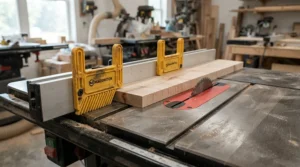
2. BOW FencePRO FP4 Fence-Mounted Featherboards — highest kickback resistance in this roundup
The BOW FencePRO FP4 swaps the traditional rigid plastic or wood fingers for a modular EVA insert built on what BOW calls a “living hinge” profile. Here’s what that means in practice: when the workpiece pushes backward, the gaps between the feathers close up and the tips compress against the wood with significantly more force, which is engineered to deliver up to 5x greater kickback resistance than traditional rigid featherboards. That’s not marketing fluff dressed as a spec — it’s a genuinely different mechanism than the stamped-plastic fingers on cheaper units.
Reviewers and comparison writeups consistently flag the EVA material’s secondary benefit: it won’t shatter if a spinning bit or blade nicks it, and it’s gentle enough not to mar softer woods. On paper, this makes the BOW FencePRO FP4 the pick for anyone ripping figured or expensive hardwood where a marred edge is a real cost, not just an inconvenience. The company notes it’s built to work with Rockler router fences, though the T-track mounting hardware translates cleanly to most cabinet saw fence rails carrying standard accessory track.
Pros:
- ✅ EVA “living hinge” feathers rated for 5x kickback resistance
- ✅ Reversible and individually replaceable feather inserts
- ✅ Non-marring on soft or figured woods
Cons:
- ❌ Premium price for a two-pack
- ❌ No fence included — track-mount hardware only
Expect to pay in the $40-$60 range for the pair, which is real money for featherboards — but if kickback prevention is the actual point of buying one, this is where the spec sheet earns its price tag.
3. POWERTEC Universal Tandem Featherboard Set (71393) — most flexible mounting hardware here
POWERTEC built this one to work everywhere: table saw, router fence, band saw, or a router table, using five-star threaded knobs and a bracket sized for the standard 3/8″ x 3/4″ miter slot, plus included T-bolts for T-track mounting. What that flexibility means for a buyer is you’re not locked into one machine — the same two-pack moves between your cabinet saw and a router table without buying a second set. The set also includes plastic spacers for stacking featherboards vertically, which matters if you’re processing tall stock like cabinet-door stiles.
Aggregated review sentiment across retailer listings is largely positive on ease of setup, with the five-star knobs called out repeatedly as faster to adjust than hex-bolt competitors — no tools needed for daily tension changes. A recurring critique, though, is that the miter bar fit can run slightly loose on saws with worn or oversized slots, so a little shimming may be needed on an older machine.
Pros:
- ✅ Works across table saw, router table, and band saw
- ✅ Tool-free five-star knobs for quick tension changes
- ✅ Stacking spacers included for tall workpieces
Cons:
- ❌ Miter bar fit can run loose on older, worn slots
- ❌ Plastic fingers lack the EVA’s kickback rating
At roughly $25-$35 for the pair, this is the “one set, three machines” option — genuinely good value if your shop has more than one tool that takes a featherboard.
4. Milescraft 1406 FeatherBoard — constant-tension split-rail design
Milescraft has been making shop-safety accessories long enough that this design choice isn’t an accident: the split-rail body is engineered so the two halves stay under spring-like tension against each other, which keeps consistent downward and inward pressure on the workpiece even as stock thickness varies slightly along its length. Reviewers highlight this as the reason it handles slightly bowed or warped stock better than a single rigid-body competitor — the split rail flexes where a solid body would just lift off the work.
Based on the spec sheet, it fits both 3/4″ and 5/8″ miter slots using included metal bars, plus 1/4″ T-slot bolts for router tables and band saws, and the feather angle itself is adjustable rather than fixed — a detail that matters if you’re feeding unusually thick or thin stock and need the fingers biting at a different angle than the factory default.
Pros:
- ✅ Split-rail design keeps constant tension on wavy stock
- ✅ Fits both 3/4″ and 5/8″ miter slots out of the box
- ✅ Adjustable feather angle, not fixed at one setting
Cons:
- ❌ Slightly more setup steps than single-knob competitors
- ❌ Plastic fingers, not EVA — lower kickback rating
Priced around $20-$30, this lands as a smart mid-tier pick specifically for shops that regularly work with rough or slightly inconsistent lumber rather than pre-milled stock.
5. Hedgehog Featherboard — fastest single-hand adjustment
The whole pitch of the Hedgehog Featherboard is speed: a single knob and pivot point let you loosen, reposition, and relock the entire unit one-handed, which is a genuine workflow advantage if you’re switching between rip widths several times in a session. It’s built from DuPont nylon fingers rather than commodity plastic, and it’s sized for the standard 3/4″ miter slot — notably, it does not fit 5/8″ slots, so cabinet saw owners with a narrower miter channel should double-check compatibility before buying.
What most buyers overlook about single-knob designs like this one is the tradeoff: faster adjustment usually means fewer independent lock points, so the holding force is concentrated at one pivot rather than distributed like a split-rail design. In practice, reviewers report this is a non-issue for typical ripping but say it’s worth backing off feed rate slightly on very hard or dense stock.
Pros:
- ✅ One-handed adjustment via single pivot knob
- ✅ Durable DuPont nylon fingers, not commodity plastic
- ✅ Fast repositioning for frequent rip-width changes
Cons:
- ❌ Does not fit 5/8″ miter slots
- ❌ Single pivot point concentrates hold force
Expect to pay in the $30-$45 range — a reasonable premium for a genuinely faster daily workflow.
6. Big Horn 10216 T-Track Featherboard — lowest price with real adjustment range
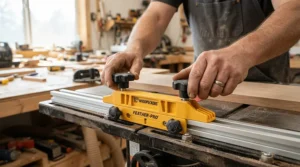
If your only goal is “get a featherboard on the fence without spending much,” the Big Horn 10216 is the honest budget pick — not a compromise dressed up as one. It’s built from high-density plastic, finished in bright yellow for shop visibility, and mounts into standard 3/4″ to 7/8″ T-track systems on fences, router tables, or shop-built jigs. The molded adapters and dual locking knobs give it a genuinely respectable five inches of adjustment range, which on paper outclasses several pricier competitors on that single spec.
Reviewers on major retail platforms rate it consistently around 4.5 stars, with comments praising the price-to-adjustment-range ratio specifically. The honest tradeoff: it’s rigid plastic, not EVA, so it won’t match the BOW FencePRO FP4‘s kickback resistance — but for hobby-level ripping of standard pine and plywood, that gap matters far less than the price gap suggests.
Pros:
- ✅ Full five inches of adjustment range
- ✅ Fits 3/4″ to 7/8″ T-track, very broad compatibility
- ✅ Bright yellow finish for shop-floor visibility
Cons:
- ❌ Rigid plastic fingers, no EVA kickback boost
- ❌ Feels less premium under heavy daily use
At around $15-$20, this is the pick for a first featherboard, a backup unit, or a shop on a genuinely tight budget.
7. Magswitch Vertical Featherboard Attachment — the track-free premium option
Every product above assumes your fence has a T-track or routed slot. The Magswitch Vertical Featherboard Attachment, paired with the Magswitch Pro Table Featherboard base, throws that assumption out entirely: it mounts via a switchable rare-earth magnet directly to any steel or cast-iron surface, meaning it works on a bare cabinet saw fence face that has zero accessory track at all. It’s suitable for use on table saws, jointer tables, band saws, shaper tables, and any other ferromagnetic woodworking surface, and the vertical attachment can stack with the horizontal base to hold tall stock from two directions simultaneously.
Here’s what the spec sheet doesn’t fully convey: switchable magnetic mounts genuinely reposition in seconds without any bolts, brackets, or T-track alignment — a real advantage on a shop-built or older cabinet saw fence that was never drilled for accessory hardware. The tradeoff is cost: you’re buying a magnetic mounting system, not just a featherboard, and the full setup runs meaningfully higher than every other entry here.
Pros:
- ✅ No T-track or drilling required — mounts anywhere magnetic
- ✅ Stacks vertical and horizontal holds for tall stock
- ✅ Repositions in seconds without tools
Cons:
- ❌ Highest price point in this roundup by a wide margin
- ❌ Requires a steel or cast-iron fence surface to work at all
Budget roughly $80-$120 for the combined attachment and base system — steep, but it’s solving a mounting problem no track-based product here can touch.
Practical Usage Guide: Installing and Maintaining a Fence-Mounted Featherboard
Getting a fence mounted featherboard for cabinet saw setups installed correctly takes ten minutes, but skipping the calibration step is the single most common reason people end up distrusting these tools. Start by identifying your mounting hardware: if your fence has a factory or aftermarket T-track running its length, a T-bolt-based unit like the POWERTEC Universal Tandem Featherboard or Rockler Adjustable Fence Featherboard slides straight in. If it doesn’t, you’re either routing a slot yourself or looking at a magnetic option like the Magswitch Vertical Featherboard Attachment.
Calibration is where most first-timers get it wrong: set the featherboard so the fingers press firmly enough to prevent the stock from lifting or drifting away from the fence, but loose enough that you can still feed the board forward without excessive resistance. That “first feather grazes, then engages” method built into units like the Rockler Adjustable Fence Featherboard exists precisely to make this repeatable instead of guesswork. In the first 30 days, the most common mistake is over-tightening — cranking the pressure so high that feed effort spikes and the operator starts pushing harder than is safe, which defeats the entire purpose of the accessory.
Maintenance is minimal but not zero: check T-bolts monthly for loosening from vibration, inspect plastic or nylon fingers for stress-whitening or cracking near the base (a sign of fatigue), and on EVA units like the BOW FencePRO FP4, swap the modular feather insert once it stops springing back cleanly. A featherboard with dead or cracked fingers isn’t providing the pressure the spec sheet promised — it’s just decoration bolted to your fence.
Cabinet Saw Fence Rails and T-Track Compatibility Explained
This is where a lot of buying mistakes happen before the featherboard even ships. Cabinet saw fence rails vary significantly by brand and model — some fence faces come pre-drilled with accessory T-track from the factory, others have a routed slot sized for a specific bolt profile, and plenty of older or entry-level cabinet saws have neither. Before ordering any of the seven products above, measure your fence’s track width (commonly 1/4″ or 5/16″ bolt-head hardware) or confirm it has none at all. A POWERTEC Universal Tandem Featherboard ships with both miter-slot brackets and T-track bolts specifically because manufacturers know this compatibility gap trips people up constantly. If your cabinet saw fence rails have no track whatsoever, the Magswitch Vertical Featherboard Attachment sidesteps the whole question — assuming your fence face is steel or cast iron rather than aluminum or extruded composite.
Real-World Scenarios: Matching a Featherboard to Your Shop
If you’re a weekend hobbyist ripping plywood for garage shelving on an older contractor-style cabinet saw with no fence track, the honest recommendation is the Big Horn 10216 T-Track Featherboard paired with a short length of aftermarket T-track — cheap, broadly compatible, and more than adequate for softwood and sheet goods at low-to-moderate frequency of use.
If you’re a small-shop professional building cabinet doors from figured hardwood five days a week, the calculus changes: repeated ripping of expensive stock means a marred edge or a kickback incident carries real cost, which is exactly the scenario the BOW FencePRO FP4‘s EVA feathers and 5x kickback rating were engineered for. The extra $30-$40 over a budget unit is trivial next to one ruined board foot of curly maple.
And if you inherited a shop-built cabinet saw table with a fence that was never drilled for any accessory track — no T-slot, no miter-adapted bracket, nothing — the Magswitch Vertical Featherboard Attachment is the only option on this list that solves your actual problem instead of asking you to modify your fence first.
Understanding Adjustable Spring Tension and Pressure Control
Every featherboard on this list relies on some version of the same physics: flexible fingers, angled forward, that flex under contact and spring back to apply continuous pressure. The differences between products come down to how that adjustable spring tension is delivered and controlled. Rigid-plastic designs like the Big Horn 10216 rely purely on the finger material’s own flex; split-rail designs like the Milescraft 1406 add a second layer of tension between the two rail halves, which is why they handle inconsistent stock thickness more gracefully; and EVA “living hinge” designs like the BOW FencePRO FP4 compress rather than simply bend, which is the mechanical reason behind their higher kickback rating.
An adjustable pressure featherboard on fence hardware typically lets you control this in two independent ways: the mounting slot position (how far the whole unit sits from the fence face) and the finger-angle or overlap adjustment on units like the Milescraft 1406 that offer it. Reviewers consistently note that under-tensioning is the more common beginner mistake than over-tensioning — a featherboard set too loose won’t stop drift, and stock creeping even slightly off the fence line is a leading cause of binding and kickback in the first place. Test pressure with a scrap piece of the actual stock you’re about to cut, not a random offcut, since thickness and surface texture both change how much the fingers need to flex.
How to Choose an Adjustable Featherboard for Cabinet Saw Fence
What is the best way to pick an adjustable featherboard for cabinet saw fence use? The short answer: match the mounting hardware to your fence first, then choose feather material based on what you’re actually cutting. Here’s the fuller reasoning, broken into steps:
- Confirm your fence’s mounting option first. Check for T-track, a routed slot, or neither — this eliminates most incompatible products before you spend a dollar.
- Match feather material to your stock. Rigid plastic is fine for softwoods and plywood; EVA or nylon fingers earn their price on hardwood and figured stock.
- Decide how often you’ll reposition it. Frequent rip-width changes favor single-knob designs like the Hedgehog Featherboard; set-and-forget shops can save money on simpler hardware.
- Check adjustment range, not just price. A wider slot range (like the Big Horn 10216‘s five inches) means fewer repositioning headaches down the line.
- Consider multi-machine use. If the same unit needs to move between a saw, router table, and band saw, prioritize versatile mounting like the POWERTEC Universal Tandem Featherboard.
- Budget for a second unit. Two featherboards — one horizontal, one vertical — outperform one in almost every kickback scenario.
- Read aggregated review sentiment, not just star ratings. Look specifically for comments on long-term finger fatigue, not just first-impression setup ease.
Common Mistakes When Buying a Cabinet Saw Featherboard Attachment
The most frequent error is buying based on price alone and discovering the mounting hardware doesn’t fit existing cabinet saw fence rails — always measure track width before ordering. A close second is assuming one featherboard is sufficient; most kickback-prevention setups actually use two, one on the fence and one on the table surface, working together. Buyers also commonly under-budget for EVA or nylon-fingered units, then get frustrated when a bargain rigid-plastic model shows visible wear after a few months of hardwood ripping — that’s not a defect, it’s a materials tradeoff you paid less to accept.
Fence-Mounted Featherboards vs Miter-Slot Featherboard Attachments
This is the core mounting decision, and it’s worth understanding in plain terms rather than just picking whichever fence-mounted accessories show up first in a search. A fence-mounted unit — like the Rockler Adjustable Fence Featherboard or BOW FencePRO FP4 — attaches directly to the fence face via T-track, applying pressure that pushes the workpiece down and toward the table, independent of your miter slot. A miter-slot unit — like the Hedgehog Featherboard or Milescraft 1406 — clamps into the slot itself and pushes the stock sideways, against the fence.
The practical difference: fence-mounted options leave your miter slot completely free for a sled, crosscut sled, or miter gauge, which matters if you swap between ripping and crosscutting frequently. Miter-slot options, meanwhile, tend to be cheaper and more universally compatible since nearly every table and cabinet saw has a standard miter slot, whereas not every fence ships with usable track. Many experienced woodworkers run one of each simultaneously — a fence-mounted unit for downward pressure and a miter-slot unit for lateral pressure — which is precisely the tandem setup the POWERTEC Universal Tandem Featherboard Set is designed around.
What to Expect: Real-World Performance
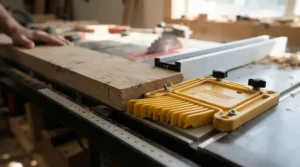
On paper, every featherboard prevents “kickback.” In practice, what you’ll actually notice day-to-day is subtler: consistent edge contact against the fence, meaning fewer burn marks from stock drifting and re-contacting the blade at an angle, and noticeably less hand fatigue since you’re no longer manually pressing stock against the fence for the entire length of a rip cut. Kickback itself occurs when a workpiece gets pinched between the blade and the rip fence, and a properly tensioned featherboard interrupts that pinch point before it ever develops, rather than reacting after the fact. You’ll also notice a learning curve of maybe two or three cuts before your calibration instincts kick in — after that, setup becomes close to automatic.
Long-Term Cost & Maintenance
Cost-per-use math favors the pricier options more than the sticker price suggests. A $16 rigid-plastic unit that needs replacing every year or two after finger fatigue sets in costs roughly the same over three years as a $45 nylon or EVA unit that’s still performing like new. Maintenance itself is nearly free — periodic bolt-tightening and a visual check for cracked fingers — but replacement feather inserts (available separately for modular systems like the BOW FencePRO FP4) extend a single unit’s working life well past what a fully rigid competitor can manage. The total cost of ownership case for spending more upfront is genuinely strong here, which isn’t something you can say about every shop accessory.
Safety, Regulations & Compliance Guide
Featherboards aren’t just a nice-to-have — they’re explicitly named in federal machine-guarding guidance. OSHA’s own guidance on table saws instructs operators to use anti-kickback fingers to hold stock down in the event the saw kicks back the material, per 29 CFR 1910.213(c)(3), and separately recommends guiding stock parallel to the rip fence specifically to minimize kickback risk in the first place — exactly the job a properly tensioned featherboard performs continuously and automatically. On the injury-data side, federal safety research has repeatedly flagged kickback as a dominant mechanism behind table and cabinet saw injuries, which is worth reading directly rather than taking secondhand — the CPSC’s human factors evaluation of table saw safety technology lays out the mechanics in detail for anyone who wants the full picture. None of the seven products above are a substitute for a riving knife, blade guard, or push stick — they’re one more layer in a setup that should already include those basics.
Featherboards for Every Woodworker: Beginners, Pros & Small Shops
Beginners should prioritize simplicity and forgiveness over spec-sheet impressiveness — the Big Horn 10216 or Rockler Adjustable Fence Featherboard are both easy to calibrate correctly on the first try, which matters more early on than shaving grams of kickback risk. Professionals running daily hardwood production should weight decisions toward the BOW FencePRO FP4‘s kickback rating and the POWERTEC Universal Tandem Featherboard‘s multi-machine flexibility, since downtime and material waste cost real money at that volume. Small-shop owners with older or shop-built equipment lacking standard fence track are the one group where the Magswitch Vertical Featherboard Attachment‘s higher price is arguably the only functional option rather than a luxury upgrade.
Frequently Asked Questions
❓ What is an adjustable featherboard for cabinet saw fence use?
❓ Do fence-mounted featherboards work on all cabinet saws?
❓ How tight should adjustable spring tension be set on a featherboard?
❓ Can a cabinet saw featherboard attachment replace a riving knife or blade guard?
❓ Are fence-mounted accessories like featherboards required by law?
Conclusion
Choosing the right adjustable featherboard for cabinet saw fence setups really does come down to two honest questions: what does your fence actually accept, and what are you cutting most often? Budget shoppers get a genuinely solid start with the Big Horn 10216 or Rockler Adjustable Fence Featherboard. Hardwood-heavy shops should lean into the BOW FencePRO FP4‘s kickback rating. Multi-machine setups favor the POWERTEC Universal Tandem Featherboard, and anyone stuck with a fence that has zero accessory track should look hard at the Magswitch Vertical Featherboard Attachment before assuming they’re out of options entirely. Whichever you choose, the underlying goal never changes: keep the wood where it belongs and your hands somewhere else. Community discussion on woodworking forums consistently backs this up — as one longtime Sawmill Creek forum thread on table saw kickback put it, eliminating kickback mechanically solves the majority of the injury picture, and a properly tensioned featherboard is one of the cheapest, most approachable ways to do exactly that. For deeper background on how these machines are built and rated, Wikipedia’s overview of table saws is a solid starting point.
Recommended for You
- Adjustable Featherboard For Router Table And Table Saw Combo: 7 Best
- Standard Featherboard For Miter Slot Table Saws: 7 Best Picks (2026)
- Magnetic Featherboard vs Clamp On Featherboard: 7 Best Picks for 2026
Affiliate Disclosure: This article contains affiliate links. As an Amazon Associate, I earn from qualifying purchases. If you purchase products through these links, we may earn a small commission at no additional cost to you.
✨ Found this helpful? Share it with your friends! 💬🤗
