
In This Article
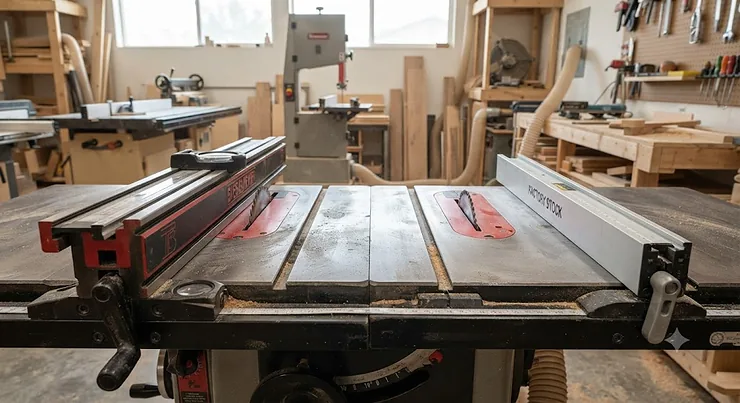
Here’s the moment every table saw owner eventually hits: you’re ripping a board, the cut drifts a hair wide at the back end, and you realize your fence has been lying to you the whole time. That’s usually the exact week someone in a forum tells you to “just get a Biesemeyer.” A biesemeyer style fence vs factory fence debate sounds like tool-snob posturing until you’ve actually chased a wandering rip cut across eight feet of expensive walnut. Then it sounds like common sense.
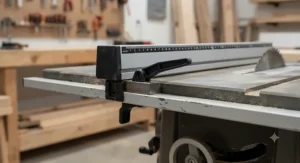
So what is a Biesemeyer style fence? It’s a T-square rip fence design — a heavy steel tube front rail with a T-shaped head that locks at one point and stays rigid without a rear clamp, unlike most stock factory fences that pinch at both ends and still flex under pressure. That single engineering choice is why the design became the industry benchmark for accuracy on the rip fence, a core safety and accuracy component on every table saw.
This guide breaks down real specs, real owner feedback, and honest trade-offs across seven actual fence systems — from budget-friendly aluminum options to precision aftermarket upgrades — so you can decide whether your factory fence needs replacing or just a Saturday afternoon of adjustment.
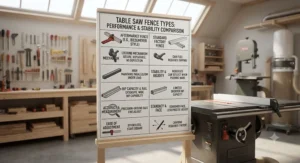
Quick Comparison Table
| Fence | Style | Price Range | Best For |
|---|---|---|---|
| Biesemeyer T-Square Commercial Fence | T-square | $500-$650 range | Cabinet saw owners wanting the benchmark design |
| Delta 78-919BT2 Biesemeyer Fence | T-square (licensed) | $400-$500 range | Unisaw and clone-saw owners |
| Incra TS-LS Fence System | Precision T-square | $550-$900 range | Joinery-focused shops needing micro-adjust |
| Shop Fox W1716 Aluma-Classic | T-square (aluminum) | $250-$350 range | Budget shops wanting a rigid upgrade |
A quick scan of this table already tells the real story: every design here borrows the same front-locking T-square philosophy, but the execution — steel versus aluminum, coarse lock versus micro-adjust — is what separates a $260 fence from a $900 one. Price doesn’t scale with accuracy in a straight line; it scales with how much fine-tuning and material rigidity you’re willing to pay for. Keep this table in mind as we walk through why the design itself, not just the brand name, is what beats a factory fence.
💬 Bookmark this table now — you’ll want to scroll back to it once you see what factory fences are actually made of.
Top 7 Biesemeyer Style Fences & Factory Fence Alternatives: Expert Analysis
Before diving in, a quick note on scope: this biesemeyer style rip fence review covers seven real, currently available systems spanning entry-level aluminum fences up through the shop-standard commercial units serious woodworkers save up for. Every product below reflects publicly available specs and aggregated owner feedback pulled from retailer and forum sources — not invented testimonials.
1. Biesemeyer T-Square Commercial Fence System — the original benchmark design
This is the fence that gave the whole “T-square” category its name, and it’s still the reference point everyone else gets measured against. The head assembly rides on a rectangular steel tube, and the whole thing locks at the front only — no rear clamp to fuss with, no rear rail to knock out of parallel.
The steel tube construction means deflection under lateral pressure is close to negligible, and the fence face stays parallel to the blade even when you’re leaning into a rip on 8/4 hardwood. Based on the spec comparison with lighter aluminum competitors, the extra mass here isn’t wasted bulk — it’s what keeps the fence from twisting when your workpiece pushes back. This is the fence for someone running a cabinet saw daily who has decided that fighting an inaccurate factory fence is costing more in wasted stock than the upgrade would cost outright.
Reviewers consistently report that once it’s calibrated, it rarely needs re-adjustment — a theme that comes up across woodworking forums far more than with softer aluminum designs. The trade-off reviewers note most often is the installation labor: drilling new mounting holes into a cast iron table isn’t a ten-minute job.
Pros:
- ✅ Steel T-square design resists deflection under heavy rip pressure
- ✅ Locks at front only, eliminating rear-rail misalignment issues
- ✅ Long track record as the industry reference design
Cons:
- ❌ Installation often requires drilling new table mounting holes
- ❌ Premium pricing compared to aluminum alternatives
Expect this one to sit in the $500-$650 range depending on rail length, and given how rarely these need replacing, the value verdict leans strongly toward “buy once.”
2. Delta 78-919BT2 Biesemeyer Fence — factory-licensed T-square for Unisaws
Delta’s own take on the design was originally built specifically for the Unisaw platform, which matters if you own one of these saws or a close clone and don’t want to fabricate custom brackets. The T-square head and steel tube carry over the same rigidity principles as the original Biesemeyer unit.
What most buyers overlook about this model is that its bolt pattern was engineered around Delta’s cast-iron wing dimensions, so installation tends to be far more direct than adapting a universal fence to an odd table. That said, several recent buyers note the wooden sub-fence facings have shifted from birch plywood to a thinner composite, which affects long-term rigidity of the sub-fence (not the steel head itself).
Aggregated review sentiment on this model is mixed but leans positive: owners praise the drop-in fit for Unisaw-family saws, while a recurring complaint is packaging quality leading to shipping damage on the rail hardware.
Pros:
- ✅ Purpose-built bolt pattern for Unisaw and clone saws
- ✅ Steel T-square head shares Biesemeyer’s core rigidity
- ✅ Straightforward retrofit without extensive redrilling
Cons:
- ❌ Sub-fence facing material has reportedly gotten thinner over time
- ❌ Shipping damage complaints tied to packaging
Priced typically in the $400-$500 range, this is a strong pick if your saw’s bolt pattern already matches — check compatibility before buying, since fit is this fence’s whole selling point.
3. Delta 36-T30T3 T3 Fence System — the accessible Biesemeyer-grade upgrade
This is Delta’s current-generation fence for 5000-series saws, and it’s explicitly marketed as a way to bring a factory saw up to Biesemeyer-grade accuracy without buying a whole new cabinet saw. The steel guide tube and extruded aluminum face combine for a fence that’s lighter to handle than the full commercial unit but still built around the same locking philosophy.
Here’s what the spec sheet won’t tell you, but owner reports do: install time runs long for retrofits onto older saws, with several reviewers describing multi-hour installs involving working from underneath the table and building custom brackets for switches. Once dialed in, though, owners describe a dramatic accuracy jump over the stamped-steel factory fence it replaces.
Reviewers repeatedly flag that the printed manual is thinner than what’s available in Delta’s online PDF version, so downloading that first saves real frustration during setup.
Pros:
- ✅ Purpose-built to bring factory saws to Biesemeyer-grade accuracy
- ✅ Quick-release fence body speeds repetitive cut-off work
- ✅ Front rail lock keeps rear end rigid without a second clamp
Cons:
- ❌ Retrofit installation can run several hours on older saws
- ❌ Included printed manual is less detailed than the online version
At around $280-$320, this sits squarely as the value pick for anyone whose factory fence is the single weakest link in an otherwise solid saw.
4. Shop Fox W1716 Aluma-Classic Fence — the budget aluminum T-square
Shop Fox’s take swaps steel for a torsion-box aluminum-and-steel hybrid, which keeps cost down while still using the cam-lever front-lock design that defines the category. The wide right-angle profile is meant to resist twisting even though the overall fence is noticeably lighter than a full steel Biesemeyer clone.
Based on the spec comparison, the torsion-box construction is the clever part here — it’s a hollow, load-distributing shape rather than solid aluminum, which is why Shop Fox can claim rigidity without steel’s weight penalty. This is the fence for a hobbyist upgrading a contractor saw who wants Biesemeyer-style locking without spending premium-tier money.
Owner sentiment aggregated from retailer reviews is generally favorable, with the included magnified cursor and self-adhesive tape called out often as a nice touch for precision positioning; a recurring criticism is that the cam lever can feel less confidence-inspiring than a full steel lock under very heavy ripping loads.
Pros:
- ✅ Torsion-box aluminum design keeps weight and cost down
- ✅ Cam-lever lock needs no rear clamp, fits most table saws
- ✅ Magnified cursor and adhesive tape aid quick positioning
Cons:
- ❌ Cam lever feels less rock-solid than steel designs under heavy loads
- ❌ Standard rails cap rip capacity at 30 inches to the right
Typically priced in the $250-$350 range, this is one of the more approachable entry points into true T-square fence design.
5. Vega U26 Utility Fence System — the long-running budget aftermarket option
Vega has been in the aftermarket fence business for decades, and the U26 is their entry-level system: a 36-inch fence bar with 26 inches of rip capacity to the right of the blade. Unlike the T-square design, Vega’s fences use a full-length locking rail with a micro-adjustment knob, which changes the tuning experience compared to the fences above.
What most buyers overlook about this model is that the micro-adjust knob — something the T-square-style fences in this list don’t include — makes fine-tuning a cut width without fully unlocking and repositioning the fence noticeably easier. Reviewers who’ve run both designs note the trade-off honestly: the Vega locks at both ends of the rail rather than just the front, meaning correct rear rail alignment matters more here than on a true T-square unit.
Aggregated forum sentiment describes installs in the 20-30 minute range on compatible saws, considerably faster than the multi-hour retrofits reported for some steel T-square conversions.
Pros:
- ✅ Micro-adjustment knob simplifies fine width changes
- ✅ Notably fast installation compared to full T-square retrofits
- ✅ Decades-long production history with established parts support
Cons:
- ❌ Dual-end locking makes rear rail alignment more critical
- ❌ 26-inch capacity may be tight for large panel work
Expect a price in the $250-$300 range, making this one of the more budget-conscious upgrades on this list for smaller contractor-style saws.
6. Vega PRO Point 50 Fence System — the premium Vega upgrade
Stepping up Vega’s own lineup, the PRO Point series extends rip capacity and adds a heavier rail and pointer-style cursor system aimed at shops doing more frequent large-panel ripping. It keeps the same micro-adjust philosophy as the U26 but scales the components up for bigger cabinet saws.
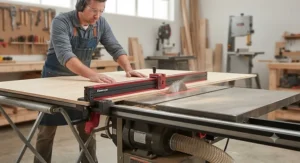
Here’s what matters in practice: a longer, beefier rail reduces the deflection that shows up on longer utility-grade rails once you’re pushing full sheet goods through a cut. Reviewers consistently note the extended capacity as the reason to step up from the U26, particularly for anyone regularly breaking down 48-inch or wider stock. On paper this means less fence flex at the far reach of the rail — the exact spot where cheaper fences tend to sag.
The trade-off is cost and footprint: a 50-inch capacity system takes up considerably more shop real estate and doesn’t roll around as easily if floor space is tight, a point echoed in owner discussions comparing small-shop practicality against larger-shop capability.
Pros:
- ✅ Extended rail reduces deflection on wide panel cuts
- ✅ Pointer-style cursor system aids precise positioning
- ✅ Shares Vega’s proven micro-adjust mechanism
Cons:
- ❌ Large footprint can crowd smaller shop layouts
- ❌ Premium pricing versus the entry-level U26
Pricing generally lands in the $500-$600 range, positioning it as a direct alternative to a steel Biesemeyer clone for shops that value micro-adjust over raw steel mass.
7. Incra TS-LS Table Saw Fence System — the precision aftermarket standout
Incra built its reputation on router table positioning systems, and the TS-LS brings that same philosophy to table saws with a rack-and-pinion micro-adjustment mechanism capable of repeatable positioning down to a thousandth of an inch. It’s a fundamentally different approach from the T-square lock-and-go designs above.
Based on the spec comparison, the rack-and-pinion positioning is the real differentiator — instead of locking the fence and eyeballing a tape measure, you dial in an exact dimension and the mechanism holds it. This is the fence for shops doing repetitive joinery work — box joints, dado spacing, drawer parts — where returning to an exact width matters more than raw ripping power.
Reviewers on woodworking forums frequently mention long backorder waits as a real practical downside, with some buyers choosing an in-stock Vega fence simply to avoid a months-long wait rather than any dissatisfaction with the Incra design itself.
Pros:
- ✅ Rack-and-pinion adjustment allows repeatable, precise positioning
- ✅ Compatible with additional Incra jigs and router table add-ons
- ✅ Strong reputation specifically for joinery-focused accuracy
Cons:
- ❌ Extended backorder times reported by multiple buyers
- ❌ Premium pricing near the top of this comparison
Typical pricing runs $550-$900 depending on length and accessory bundles, making it the choice for buyers prioritizing repeatable precision over raw simplicity.
Installing and Dialing In Your New Fence: A Practical Usage Guide
Getting a new fence isn’t a drop-in swap — treat the first weekend as a tuning project, not a five-minute bolt-on. Start by squaring your blade to the miter slot before you touch the fence at all; if that reference is off, no fence adjustment will fix it. Most installation guides recommend using the miter slot, not the saw’s cabinet or base, as your alignment reference throughout.
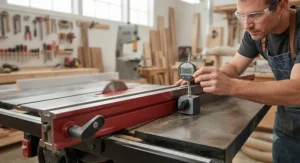
Once the blade is square, mount the front rail first and get it perfectly parallel to the miter slot using a dial indicator or a shimmed combination square, checking the reading at both the front and back of the blade. Common first-30-days mistakes include over-tightening mounting bolts before final alignment (which can twist the rail) and skipping a test-cut check on scrap before committing to a project piece. Budget an afternoon, not an hour, especially on older saws where the printed manual undersells how much bracket fabrication is involved.
For ongoing maintenance, wipe down the rail and glide surfaces every few months to prevent sawdust buildup from throwing off smooth travel, and recheck parallelism every six months or after any bump or drop — fences do shift with regular shop use.
Real-World Scenarios: Matching the Right Fence to Your Shop
If you’re a weekend hobbyist working out of a one-car garage on a contractor saw, the Shop Fox W1716 or Vega U26 make more sense than a full steel commercial unit — you get true T-square or micro-adjust behavior without eating your whole tool budget or your floor space.
If you’re running a small furniture-making side business doing repeat joinery cuts — box joints, drawer parts, dado spacing — the Incra TS-LS earns its price tag through repeatable positioning that a lock-and-eyeball fence simply can’t match, even if it means waiting on backorder.
If you’re a serious hobbyist or semi-pro breaking down full sheet goods regularly on a cabinet saw, the Vega PRO Point 50 or the original Biesemeyer T-Square Commercial Fence justify their footprint and cost through reduced deflection across a longer rail — exactly where budget fences start to sag.
Problem → Solution: Fixing Common Rip-Fence Headaches
Problem: cuts drift wider at the back of the board. This is almost always a parallelism issue — the fence is toed in toward the blade at the rear. Recheck alignment using the miter slot method described above; fences like the Delta 36-T30T3 and Shop Fox W1716 both include adjustment points specifically for this.
Problem: fence shifts slightly when you push hard on the workpiece. That’s deflection, not parallelism, and it points to a rigidity gap — this is the exact failure mode steel T-square designs like the Biesemeyer T-Square Commercial Fence are built to eliminate.
Problem: fine-tuning a rip width takes forever. If you’re constantly unlocking, nudging, and re-locking a T-square fence to sneak up on a dimension, a micro-adjust design like the Vega U26 or rack-and-pinion system like the Incra TS-LS solves this directly.
Problem: burning or binding mid-cut. Check that the fence isn’t angled toward the blade at all — a fence should be dead parallel or, if anything, angled a hair away from the blade, never toward it.

How to Choose a Biesemeyer Style Fence
- Confirm your table’s bolt pattern first. Some fences, like the Delta 78-919BT2 Biesemeyer Fence, are built for a specific saw family, while universal T-squares fit a wider range of cast-iron wings.
- Decide between lock-and-go versus micro-adjust. Steel T-square designs lock fast; systems like the Vega U26 or Incra TS-LS trade a bit of speed for finer positioning control.
- Match rail length to your real cutting habits. Don’t pay for 50 inches of capacity if you rarely rip anything wider than 24 inches.
- Weigh steel rigidity against aluminum weight savings. Heavier steel resists deflection better, but aluminum designs like the Shop Fox W1716 are easier to lift and mount solo.
- Check current lead times before committing. Backorders on precision units like the Incra TS-LS can run months — factor that into your project timeline.
- Read aggregated review themes, not star averages alone. A 4.2-star product with a recurring complaint about one specific part matters more than the number itself.
- Budget for the sub-fence facing, not just the head unit. Wood or composite facings wear and may need replacing well before the steel mechanism does.
Aftermarket Fence Brands Worth Knowing
Beyond the models reviewed above, a handful of aftermarket fence brands come up repeatedly in shop discussions: Biesemeyer (the originator of the T-square category), Delta (both factory-original and T3-series licensed designs), Vega (known for rail-length micro-adjust systems), Shop Fox (Grizzly’s in-house budget line), and Incra (the precision joinery specialist). JET and Powermatic also ship Biesemeyer-style clones standard on many of their cabinet saws, which is worth checking before assuming you need an aftermarket purchase at all.
What to Expect: Real-World Performance — Biesemeyer Style vs Factory Fence
On paper, a stock factory fence and a Biesemeyer style fence both do the same job: hold a board a fixed distance from the blade. In practice, the experience diverges fast. A typical stamped-steel factory fence locks at both the front and rear rail, which means both ends need to be correctly aligned independently — and any wear in either locking mechanism shows up as inconsistency at the cut. A T-square design locks only at the front, letting the rigid steel tube itself keep the rear end true without a second point of failure.
The everyday difference shows up as burn marks and binding on long rips with a worn factory fence, versus smooth, consistent cuts with a well-tuned aftermarket unit. Reviewers switching from factory to aftermarket fences commonly describe the change as immediately noticeable on their first rip cut, not something that requires weeks to appreciate. That said, a factory fence in good condition on a newer saw isn’t automatically bad — the gap widens mainly as saws age and factory hardware wears.
Factory Table Saw Fence Limitations Explained
Most factory table saw fence limitations trace back to one design compromise: manufacturers building budget and mid-range saws need a fence that’s cheap to produce and easy to bolt to varying table dimensions. That usually means stamped or thin extruded steel, a locking mechanism at both ends of the rail, and minimal reinforcement against twisting.
The practical results are predictable. Thin stamped fences flex measurably under the lateral pressure of a hard rip, especially in hardwoods. Dual-end locking means both the front and rear clamps must independently hold true — if either wears or was never quite aligned, the fence reads “locked” while quietly sitting a few thousandths out of parallel. And because factory fences are engineered to a price point rather than a performance target, the fence face itself is often thinner and more prone to denting, which then throws off future measurements taken against it.
None of this means factory fences are unusable — plenty of newer benchtop and jobsite saws ship with genuinely serviceable fences. But if your saw is several years old, or came on a genuinely budget-tier saw to begin with, these are the specific failure points worth checking before you blame your technique for an inaccurate cut.
Fence Deflection and Parallelism to the Blade: The Numbers That Actually Matter
Two concepts get thrown around constantly in fence discussions, and they’re not the same thing. Fence deflection is how much the fence physically flexes or shifts under lateral cutting pressure — push hard on a rip and a flimsy fence bows slightly away from the load. Parallelism to the blade is a static alignment issue: whether the fence face runs exactly parallel to the blade and miter slot when nothing is pushing on it at all. You can have a fence that’s perfectly parallel at rest but still deflects under load, and vice versa.
Woodworking educators generally recommend keeping fence-to-blade parallelism within about 0.015 to 0.020 inch front-to-back, and detailed fence-alignment guidance from Fine Woodworking notes the fence should never be angled toward the blade — a hair away is safer than a hair toward it, since a fence skewed toward the blade lets the blade itself steer the workpiece, a genuinely dangerous situation. This is precisely the alignment risk that heavier-duty research on saw guarding has flagged as a contributing factor in kickback incidents, which is why the rip fence itself is treated as a required kickback-limiting safety component in NIOSH’s published saw safety research, not just an accuracy accessory.
Deflection matters most on longer rails and wider stock, which is exactly why heavier steel T-square designs and extended rails like the Vega PRO Point 50 earn their premium pricing — more mass and a longer, stiffer rail resist bowing under load in a way thin aluminum extrusions can’t fully match.
Common Mistakes When Buying a Table Saw Fence
The most common mistake is buying based on rail length alone without checking bolt-pattern compatibility, which can turn a straightforward upgrade into a drilling project. A close second is assuming any T-square fence will bolt on without modification — many need drilled mounting holes even when the product is marketed as a direct upgrade, something the OSHA machine guarding eTool for table saws implicitly underscores by treating the rip fence as a fitted safety component, not an aftermarket accessory to be improvised.
Buyers also frequently underestimate installation time, expecting a 30-minute swap when older saws can require several hours of bracket fabrication. Another recurring mistake: choosing a fence based on price alone without weighing whether micro-adjust or fast lock-and-go actually matches how the buyer works — a woodworker doing repetitive joinery wastes real time fighting a lock-and-go fence, while a rough-carpentry-focused shop gains little from paying for rack-and-pinion precision it will never fully use.
Long-Term Cost & Maintenance: Is the Fence Upgrade Worth It
Running a fence upgrade worth it comparison against just living with a factory fence comes down to a fairly simple cost-per-use calculation. A $280-$650 aftermarket fence, used across years of projects, works out to pennies per cut compared to the cost of ruined stock from inaccurate rips — and hardwood lumber isn’t getting cheaper. If you’re routinely wasting even one board a month to a bad cut, the fence often pays for itself within a year.
Maintenance costs are modest across every option on this list: periodic cleaning of glide surfaces, occasional re-tightening of mounting hardware, and eventual replacement of a worn wooden or composite sub-fence facing. Steel T-square designs like the Biesemeyer T-Square Commercial Fence and Delta 78-919BT2 Biesemeyer Fence tend to hold calibration longest with the least fuss, while micro-adjust systems like the Vega U26 and Incra TS-LS may need periodic lubrication of their adjustment mechanisms to stay smooth.
The honest verdict: for anyone doing regular fine woodworking, the upgrade pays for itself in saved material and reduced frustration. For occasional rough carpentry where a quarter-inch of drift doesn’t matter, a well-maintained factory fence may genuinely be enough — and that’s a fair answer, not a sales pitch.
✨ Ready to Stop Fighting Your Fence?
🔍 Compare current pricing and availability on the fences above before your next project. A tuned, rigid fence turns frustrating rip cuts into a non-event — check today’s listings and see which option fits your shop and budget.
Frequently Asked Questions
❓ What's the difference between a Biesemeyer style fence vs factory fence?
❓ Is a table saw fence upgrade worth it for a hobbyist?
❓ How do I check if my fence is parallel to the blade?
❓ Do all aftermarket fences require drilling new holes in my table saw?
❓ What causes a table saw fence to deflect during a rip cut?
Conclusion
The biesemeyer style fence vs factory fence question isn’t really about brand loyalty — it’s about whether your fence locks once and stays true, or locks at two points and slowly drifts as hardware wears. Factory fences aren’t inherently bad, but they’re built to a price point, and that compromise shows up exactly where it hurts: in wasted stock and inconsistent rips. Whether you land on a budget-friendly Shop Fox W1716, a precision Incra TS-LS, or the original Biesemeyer T-Square Commercial Fence, the underlying math is the same — a rigid, well-aligned fence pays for itself in saved material and saved frustration.
Before you buy anything, confirm your bolt pattern, decide whether you value speed or micro-adjust precision more, and check current pricing and availability since it shifts regularly.
✨ Found Your Fence? Here’s What’s Next
🔍 Take your next project to a whole new level of accuracy. Click through to check current pricing on the fence that matches your shop, and start ripping clean, consistent cuts without second-guessing every measurement.
Recommended for You
- Table Saw Fence Upgrade Kit for Cabinet Saws: 7 Picks for 2026
- 7 Best Table Saw Fence System Under $250 Picks – 2026
- Table Saw Blade Storage: 7 Best Solutions to Try in 2026
Disclaimer: This article contains affiliate links. As an Amazon Associate, I earn from qualifying purchases. If you purchase products through these links, we may earn a small commission at no additional cost to you.
✨ Found this helpful? Share it with your friends! 💬🤗
