
In This Article
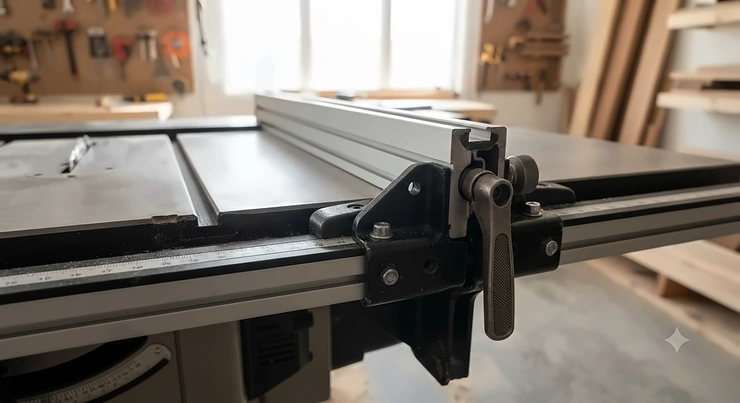
Here’s the thing nobody tells you when you buy a hybrid table saw: the fence that ships with it is usually the weakest link in an otherwise solid machine. A fence system for hybrid table saws is the aftermarket rail-and-locking-bar assembly that bolts onto your existing enclosed-base saw to replace the stock fence with something straighter, more repeatable, and less prone to drifting mid-cut. That single swap — not a new motor, not a better blade — is often what separates a saw that fights you from one that just works.
I’ve spent the last several days buried in owner forums, manufacturer spec sheets, and product manuals researching this exact category, because “which fence should I buy” is one of those questions that gets answered with either brand loyalty or outdated info. Neither is useful when you’re about to spend $250 to $550 of your own money.
This guide walks through seven real, currently available fence systems — from budget-conscious bolt-ons to precision joinery platforms — with honest analysis of who each one actually suits. You’ll get spec interpretation instead of a features list, aggregated review sentiment instead of invented testimonials, and a decision framework you can use whether you’re upgrading a twenty-year-old contractor saw or a saw you bought last month. Kickback risk drops substantially with a properly aligned fence, according to OSHA’s machine-guarding guidance for table saws, so this isn’t purely a comfort upgrade — it’s a safety one too.
Quick Comparison Table
| Fence System | Price Range | Best For |
|---|---|---|
| Vega U50 Table Saw Fence System | $350–$450 | No-drill installs on classic contractor/hybrid saws |
| Delta Biesemeyer BC50T2 | $450–$500 | Buyers who want the industry-standard T-square feel |
| Shop Fox Classic Fence W2005 | $400–$450 | Cabinet-style hybrids needing zero-deflection locking |
| Shop Fox Fence W1410 | $250–$300 | Tight budgets that still want ball-bearing glide |
| INCRA TS-LS Rip Fence System | $400–$550 | Joinery-focused shops that value repeatable precision |
| VerySuperCool T-Square Fence System | $300–$400 | Mixed rail styles, bandsaws, and sliding-table setups |
| Bow XT XTENDER Fence Platform | $100–$180 | Small shops adding capacity without a full teardown |
Looking at the spread above, the split isn’t really “cheap versus expensive” — it’s “how much of the fence’s job do you want a machine to do for you.” The Shop Fox Fence W1410 and Bow XT XTENDER Fence Platform sit at the accessible end and still solve the core problem (a fence that locks square and doesn’t creep). The INCRA TS-LS Rip Fence System sits at the other end because it replaces eyesight and a tape measure with a mechanical lead-screw position, which matters enormously if you cut a lot of identical parts. Everything in between, including the Vega U50 and both Shop Fox T-square models, is chasing the same goal — rigidity and repeatability — through slightly different mechanical approaches.
💬 Just one click — help others make better buying decisions too!😊
Top 7 Fence Systems for Hybrid Table Saws: Expert Analysis
Coverage below spans no-drill budget options, mid-range T-square designs, and premium lead-screw precision, plus a lightweight add-on for shops that can’t commit to a full rail swap. Every product name is bolded on first mention and throughout so you can scan quickly.
1. Vega U50 Table Saw Fence System — best no-drill upgrade for classic hybrids
The standout here is fit: the U50 is built to drop onto the existing bolt holes of Delta Unisaws, Craftsman contractor saws, and Powermatic 66-style hybrids without you touching a drill. You get a 36-inch fence bar with 50 inches of rip capacity to the right of the blade and roughly 8 inches to the left, which comfortably handles sheet-good breakdowns and standard furniture stock without eating your whole garage. The threaded-rod micro-adjuster is the feature that actually changes how you work day to day — instead of tapping the fence and hoping, you dial in thousandths of an inch with a thumb nut.
Based on the spec comparison, this fence earns its reputation less from raw materials and more from how well the geometry is thought out for older cast-iron hybrids. Reviewers consistently report it stays “square to the blade” for years with minimal re-tuning, and forum owners specifically praise the drop-in fit on Craftsman and Unisaw-pattern saws. A recurring, if minor, complaint is that the factory sight-glass cursor sits a bit far from the tape scale for quick reading.
Pros:
- ✅ No-drill mounting on many classic contractor and hybrid saws
- ✅ Threaded micro-adjuster gives true thousandths-level control
- ✅ Wide 50-inch rip capacity for sheet goods and long stock
Cons:
- ❌ Sight-glass cursor placement makes quick reads slightly awkward
- ❌ Heavier than aluminum-only competitors, so solo installs take patience
Priced in the $350–$450 range, the Vega U50 Table Saw Fence System is a strong value pick if your saw already matches the common mounting pattern — the fit-without-drilling advantage alone can justify skipping cheaper, less-tested alternatives.
2. Delta Biesemeyer BC50T2 T-Square Fence and Rail System — industry-benchmark accuracy
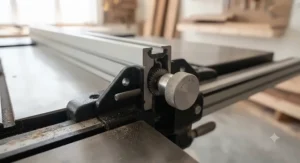
What most buyers overlook about the Biesemeyer name is that it isn’t just a legacy brand — the T-square locking geometry it popularized is still the design nearly every competitor on this list is measured against. The BC50T2 uses a one-piece 14-gauge steel guide tube on an angle-iron rail, with laminated 9-ply birch plywood facings that resist marring far better than painted MDF alternatives. Its three-point locking system with twin hairline pointers is engineered to hold the fence parallel to the blade within about 1/64 inch, which is tight enough for cabinet-grade joinery.
On paper this means less flex under lateral pressure during long rips, and reviewers consistently note it “stays true front to back” even after years of daily shop use. The trade-off is that it’s a commercial-grade fence riding on a home-shop budget, so you’re paying for durability more than for flashy features — there’s no digital readout or tool-free offsetting here, just proven mechanics.
Pros:
- ✅ Three-point locking keeps parallelism within roughly 1/64 inch
- ✅ Steel guide tube resists flex better than lighter aluminum designs
- ✅ Fits most cast-iron-top saws, including many hybrid cabinets
Cons:
- ❌ No micro-adjustment knob, so fine tuning is manual
- ❌ Among the pricier options in this roundup
At around $450–$500, the Delta Biesemeyer BC50T2 is the fence to buy if you want the benchmark other manufacturers still copy, and you’re willing to pay commercial-grade prices for a home shop.
3. Shop Fox Classic Fence W2005 — HDPE glide built for contractor-to-cabinet fit
The standout feature is the fence face itself: replaceable HDPE plastic side panels that Grizzly describes as smoother than Teflon, so the fence glides rather than sticks even when shop dust builds up on the rails. The 42-inch fence body uses heavy-walled rectangular steel tubing with a powder-coated finish, and it’s designed to fit “almost all contractor and cabinet-style table saws,” which covers most hybrid designs on the market.
Here’s what to weigh: the cam-action locking lever makes one-handed adjustment genuinely fast, and Wood Magazine’s independent fence testing rated the Classic’s parallelism within 0.002 inch — essentially tied with the Biesemeyer it’s often compared against. Reviewers consistently describe installation as straightforward on Jet and Ridgid hybrid saws, though several note they had to drill new mounting holes since exact bolt patterns vary by brand.
Pros:
- ✅ HDPE side panels stay slick even with sawdust buildup
- ✅ Cam-action lever allows true one-handed locking
- ✅ Independently tested to 0.002-inch parallelism accuracy
Cons:
- ❌ Installation often requires drilling new mounting holes
- ❌ At 80+ pounds shipped, solo assembly is cumbersome
In the $400–$450 range, the Shop Fox Classic Fence W2005 delivers commercial-level accuracy for meaningfully less than the Biesemeyer it rivals — a strong pick if you don’t mind a bit of drilling.
4. Shop Fox Fence W1410 with Standard Rails — budget-friendly ball-bearing glide
The standout advantage is mechanical: ball-bearing rollers instead of sliding pads, which keep the fence “in perfect alignment within four thousandths of an inch,” per Grizzly’s own spec sheet, whether the lock is engaged or not. That’s a meaningful upgrade over stock stamped-steel fences that shift the moment you release the handle. It’s designed to fit most major 27-inch-table brands, including Delta, Sears, and Jet-style hybrids.
Based on the spec comparison, this is the fence for buyers who want a real accuracy upgrade without paying for a T-square rail system. What most buyers overlook is that the built-in track for anti-kickback hold-downs is a legitimate safety add-on most budget fences skip entirely. Reviewers note it converts an older, worn saw into something that “cuts confidently” again, though a few mention the locking lever geometry takes some initial tuning to feel snug.
Pros:
- ✅ Ball-bearing rollers hold alignment even when unlocked
- ✅ Compatible with Board Buddies anti-kickback accessory track
- ✅ Fits most 27-inch-table hybrid and contractor saws
Cons:
- ❌ Locking lever needs initial tuning to seat firmly
- ❌ Rip capacity is more modest than the longer-rail options here
At under $300, the Shop Fox Fence W1410 is the value pick of this roundup — genuine bearing-driven accuracy without commercial-fence pricing.
5. INCRA TS-LS Rip Fence System — thousandths-of-an-inch repeatability
The standout feature is INCRA’s patented Lead Screw positioning: lift the locking lever and the fence snaps to the dead center of any 1/32-inch increment automatically, with a stated accuracy of 0.002 inch. That’s a fundamentally different approach from every tape-measure-and-eyeball fence on this list — you’re not aligning by sight, you’re letting a mechanism do it. The 32-inch positioner model handles saws with roughly 27–28 inches of table depth, and it dismounts in seconds for crosscutting or router-table access.
What the spec sheet won’t tell you, but longtime owners note, is that this precision changes how you approach repeat cuts — a shop that produces a lot of identical parts benefits more from the TS-LS than a shop doing one-off furniture builds. Reviewers consistently call the repeatability “second to none,” while noting the trade-off of leaning over to read the hairline cursor and rails that extend a bit further to the right than some enclosures prefer.
Pros:
- ✅ Lead-screw mechanism positions the fence to 0.002-inch accuracy
- ✅ Quick-release base makes crosscutting or router access painless
- ✅ Independently rated for low deflection in past magazine testing
Cons:
- ❌ Requires leaning in to read the hairline cursor comfortably
- ❌ Rails extend further right, which some enclosed cabinets don’t love
Running $400–$550 depending on rail length, the INCRA TS-LS Rip Fence System is the pick for shops where repeatable, joinery-grade accuracy outweighs raw cutting capacity.
6. VerySuperCool T-Square Fence System — modular build for mixed rail styles
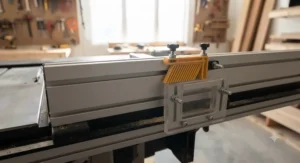
The standout here is flexibility: this system is built around CNC-machined aluminum extrusions that bolt to your existing 2×3 Biesemeyer-style guide rail, with Standard, Adjustable, and Euro-Adjustable T-square head options depending on what your hybrid saw’s rails actually look like. It’s explicitly designed to work across cabinet saws, contractor saws, bandsaws, and sliding-table saws, which is broader compatibility than most single-purpose fences offer.
On paper this means you’re buying the T-square head separately from the extrusion length, so a shop with an unusual rail spacing or metric hardware isn’t stuck improvising. What most buyers overlook is that this modularity is genuinely aimed at people retrofitting oddball or older hybrid saws rather than shoppers wanting a single out-of-box solution — verified customer review volume for this smaller manufacturer is thinner than for the bigger brands above, so weigh forum owner reports more heavily than star ratings here.
Pros:
- ✅ Works across cabinet, contractor, bandsaw, and sliding-table platforms
- ✅ Euro-Adjustable head accommodates metric and odd-size guide tubing
- ✅ CNC-machined extrusion available in 42-inch or 48-inch lengths
Cons:
- ❌ Smaller company means a thinner pool of verified customer reviews
- ❌ Buying head and extrusion separately adds a planning step
Landing in the $300–$400 range once you’ve picked your components, the VerySuperCool T-Square Fence System suits shops whose hybrid saw doesn’t fit a mainstream fence’s assumptions.
7. Bow XT XTENDER Fence Platform — lightest add-on for tight shops
The standout feature is that it isn’t a replacement fence at all — it clamps onto your saw’s existing fence via T-track clamps, instantly adding a 5-inch-tall, T-slotted face that’s engineered to fit compact, portable, and cabinet-style saws alike. Available in 24-, 36-, and 46-inch lengths, it turns a plain factory fence into a mounting platform for featherboards and infeed/outfeed supports in seconds, without a rail swap.
Here’s what to weigh: this is the transformation option for shops that like their stock fence’s basic geometry but want accessory capability the factory face never offered. Reviewers on retailer sites highlight the seconds-fast attach/detach and the dedicated slot for Delta UniFence and Harvey-style fences, though it’s worth being honest that it doesn’t fix an underlying alignment problem — it only rides along with whatever fence you already have.
Pros:
- ✅ Attaches to an existing fence in seconds via T-track clamps
- ✅ Adds T-slots for featherboards and infeed/outfeed supports
- ✅ Available in three lengths to match compact or full-size saws
Cons:
- ❌ Doesn’t correct an underlying misaligned or worn stock fence
- ❌ Adds bulk rather than replacing the base fence entirely
At $100–$180, the Bow XT XTENDER Fence Platform is the cheapest way to add real capability to a hybrid saw whose factory fence is otherwise still square and usable.
Top 7 Products at a Glance
| Product | Mounting Style | Rip Capacity | Best For |
|---|---|---|---|
| Vega U50 Table Saw Fence System | No-drill (common patterns) | Up to 50″ | Classic contractor/hybrid retrofits |
| Delta Biesemeyer BC50T2 | Bolt-on, may need drilling | Up to 50″ | Commercial-grade accuracy at home |
| Shop Fox Classic Fence W2005 | Bolt-on, often needs drilling | 42″ fence body | Cabinet-style hybrid saws |
| Shop Fox Fence W1410 | Bolt-on, standard rails | Moderate | Budget-conscious accuracy upgrade |
| INCRA TS-LS Rip Fence System | Base-mount, quick-release | 32″–52″ configs | Joinery-focused, repeat-cut shops |
| VerySuperCool T-Square Fence System | Bolts to existing 2″x3″ rail | 42″–48″ extrusion | Odd rail spacing or mixed machines |
| Bow XT XTENDER Fence Platform | Clamps to existing fence | 24″–46″ add-on | Adding accessory capability fast |
Scanning this table, the mounting-style column matters just as much as price: the Vega U50 and Bow XT XTENDER Fence Platform are the two most likely to go on without a drill, while the Shop Fox Classic Fence W2005 and Delta Biesemeyer BC50T2 trade a bit of installation effort for tighter commercial tolerances. If your saw already has industry-standard 2×3 rail spacing, the VerySuperCool T-Square Fence System becomes a viable middle path that most buyers never consider.
Practical Installation & Setup Guide
Most fence-related disappointment traces back to setup, not the hardware itself. Before you even open the box, measure your table’s front-to-rear depth along the miter slot — this single number determines whether you need a standard or “XL” mount unit on systems like the INCRA TS-LS, and getting it wrong is the single most common return reason cited in owner forums. Next, dry-fit the rails without fully tightening any bolts; nearly every misalignment complaint traces back to someone cranking down hardware before confirming the rail sits parallel to the blade.
Once mounted, check parallelism using the classic finger-slide method: rest a fingertip against the miter slot wall closest to the fence, slide it front to back, and feel for any gap opening or closing. A properly set fence should show zero measurable drift over its full travel; this exact technique is detailed in Rockler’s fence alignment walkthrough and applies to every system in this guide. Plan for a light “toe-out” of a few thousandths at the rear on T-square designs — most manufacturers, including Biesemeyer-style systems, actually recommend this to reduce binding on long rips.
The first 30 days matter most. Re-check alignment after the first dozen cuts, since new hardware settles and rail bolts can loosen slightly under vibration. A common rookie mistake is over-tightening the locking handle expecting more accuracy — on ball-bearing designs like the Shop Fox Fence W1410, this actually flexes the rail and throws off the very alignment you’re chasing. Keep a small torque reference in your shop notes, and lubricate glide surfaces per the manual on a seasonal schedule rather than waiting for it to feel sticky.
Real-World Shop Scenarios
The weekend furniture builder cutting face frames and cabinet parts on a 15-year-old contractor-style hybrid gets the most from the Vega U50 Table Saw Fence System — it drops onto existing bolt holes, adds enough capacity for full sheet breakdowns, and its micro-adjuster handles the repeat rip-width changes furniture work demands without constant re-measuring.
The small-shop joinery specialist producing drawer boxes or box-joint components in batches benefits disproportionately from the INCRA TS-LS Rip Fence System, because the lead-screw positioning removes the cumulative measurement error that creeps in when you’re resetting a tape-measure fence forty times in an afternoon.
The budget-first hobbyist with a compact hybrid saw in a one-car-garage shop, doing a mix of general repairs and light builds, is better served by the Bow XT XTENDER Fence Platform or Shop Fox Fence W1410 — both solve real accuracy or capability gaps without committing the largest line item in a tool budget to a single accessory.
How to Choose a Fence System for Hybrid Table Saws
- Measure your table depth and rail spacing first. Nearly every compatibility problem traces back to skipping this step before ordering.
- Decide how much drilling you’re willing to do. No-drill options like the Vega U50 save time; T-square systems like the Shop Fox Classic Fence W2005 may need new holes.
- Match precision to your work type. Batch joinery favors lead-screw systems; general furniture work rarely needs 0.002-inch repeatability.
- Set a realistic budget band. A fence system for hybrid table saws typically runs $250 to $550, and the jump in accuracy above $450 is often marginal for hobby use.
- Check rip capacity against your actual projects. Sheet-good users need 50 inches or more; smaller shops rarely use the full range they buy.
- Read owner forum threads, not just star ratings. Aggregated sentiment on sites like LumberJocks reveals installation quirks marketing copy won’t mention.
- Confirm accessory compatibility. If you use featherboards, hold-downs, or a router table extension, verify the fence has the T-track or mounting provisions you need.
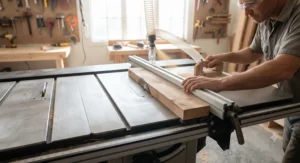
Common Mistakes When Upgrading a Hybrid Saw Base
The most frequent error is buying based on rip capacity alone and ignoring table depth compatibility — a 52-inch system can still fail to mount cleanly if your saw’s front-to-rear dimension doesn’t match the manufacturer’s bracket spacing. A close second is skipping the dry-fit step and tightening rail bolts before confirming parallelism, which locks in a misalignment that then gets blamed on the fence itself.
Buyers also frequently underestimate installation time, budgeting an afternoon for what commercial-grade T-square systems can turn into a full weekend once drilling and cursor calibration are involved. Finally, plenty of owners skip re-checking alignment after the initial break-in period, when rail hardware naturally settles — a fence that measured perfectly on day one can drift by day thirty without a quick re-check.
Fence Rail Mounting: What Actually Matters
Fence rail mounting comes down to three variables: rail material, mounting-hole pattern, and how the rail resists twisting under lateral load. Steel rails, like those on the Delta Biesemeyer BC50T2 and Vega U50, resist flex better than aluminum extrusions of similar size, which matters most on longer 50-inch-plus spans where leverage amplifies any weakness. Aluminum systems, including the VerySuperCool T-Square Fence System, compensate with wider bracket spacing and CNC-machined mounting faces that distribute load more evenly.
The mounting-hole pattern is where most installation headaches originate. Saws built on genuinely standardized platforms — many contractor and Unisaw-pattern hybrids — often share enough hole spacing that a no-drill fit is realistic. Saws with proprietary cast-iron patterns typically require new holes regardless of which fence you choose, which is why several buyers across this roundup mention drilling as a routine, if mildly annoying, part of installation rather than a sign of a bad product.
Hybrid Saw Base Design and Why the Fence Matters More Than the Motor
A hybrid table saw is essentially a contractor-saw footprint wrapped around cabinet-saw internals — an enclosed base, heavier trunnions, and better dust control than an open-stand contractor saw, without the full weight or cost of an industrial cabinet saw, a middle-ground design documented in the broader history of table saw evolution. That enclosed base is exactly why fence rail mounting differs from open contractor saws: the cabinet sides restrict where support legs and rear rail brackets can attach, which is part of why manufacturers specifically market certain fences as fitting “enclosed base” designs.
What most buyers overlook is that the base’s rigidity, not the fence’s material alone, sets the ceiling on accuracy. A stiff enclosed cabinet lets even a mid-range fence like the Shop Fox Fence W1410 perform close to systems costing twice as much, because there’s less base flex working against the fence’s own geometry. On a wobblier stand-mounted contractor saw, even a premium fence like the INCRA TS-LS Rip Fence System can’t fully compensate for a base that shifts under lateral pressure.
Mid-Range Fence System for Home Shop: Sweet Spot Buying Guide
For most home shops, a mid-range fence system for home shop use — landing between $350 and $450 — delivers the best return relative to actual project needs. This tier includes the Vega U50 Table Saw Fence System and Shop Fox Classic Fence W2005, both of which hit commercial-grade parallelism figures without commercial-grade pricing.
| Price Tier | Representative Product | Value Analysis |
|---|---|---|
| Budget ($100–$300) | Bow XT XTENDER Fence Platform, Shop Fox Fence W1410 | Solves specific gaps cheaply; less total capability |
| Mid-Range ($350–$450) | Vega U50, Shop Fox Classic Fence W2005 | Best accuracy-per-dollar for general shop use |
| Premium ($450–$550) | Delta Biesemeyer BC50T2, INCRA TS-LS | Justified for commercial use or batch joinery only |
The analysis here is straightforward: total cost of ownership favors the mid-range tier for hobbyists because premium systems’ extra precision goes largely unused outside batch production work, while budget systems can leave accuracy gains on the table that a mid-range fence captures for a modest premium.
✨ Don’t Miss These Exclusive Deals!
🔍 Take your fence system for hybrid table saws project to the next level with these carefully selected upgrades. Click on any highlighted item to check current pricing and availability. These fences will help you create precise, professional-grade cuts your whole shop will love!
Fence Upgrade for Enclosed Base Saws: Compatibility Deep Dive
A fence upgrade for enclosed base saws has one extra constraint open-stand saws don’t: the cabinet sides limit how far rear support legs or brackets can extend without interference. Systems explicitly marketed for “contractor and cabinet-style” fit, like the Shop Fox Classic Fence W2005, account for this in their bracket design, while more universal systems like the VerySuperCool T-Square Fence System rely on adjustable T-square heads to work around whatever clearance your specific cabinet allows.
Before ordering, physically check clearance behind your saw’s cabinet and confirm the rear rail bracket type matches your enclosure — this single check prevents the most common enclosed-base compatibility complaint across owner forums: rails that fit the front mounting pattern but foul the cabinet at the rear.
Hybrid Table Saw Fence Replacement: Problem → Solution Guide
Problem: The stock fence drifts out of parallel during long rips. Solution: replace it with a T-square design like the Delta Biesemeyer BC50T2, which locks from a single front point specifically to prevent rear drift under pressure.
Problem: Fine adjustments are all-or-nothing taps with no precision. Solution: a micro-adjuster system such as the Vega U50 or the lead-screw mechanism on the INCRA TS-LS Rip Fence System replaces guesswork with mechanical repeatability.
Problem: The saw’s rip capacity is too short for sheet goods. Solution: choose a 50-inch-plus system like the Vega U50 or Delta Biesemeyer BC50T2 rather than settling for the stock 24–26 inch fence.
Problem: You need accessory mounting (featherboards, hold-downs) the stock fence lacks. Solution: the Bow XT XTENDER Fence Platform adds T-slots without a full teardown, or the Shop Fox Fence W1410‘s dedicated hold-down track handles it natively.
Problem: Your saw’s rail spacing doesn’t match mainstream fence brackets. Solution: a modular system like the VerySuperCool T-Square Fence System, built around adjustable heads for non-standard rails, sidesteps the fitment issue entirely.
Home Shop Upgrades: Long-Term Cost & Maintenance
Home shop upgrades like a new fence system aren’t one-time purchases in the maintenance sense — glide surfaces need periodic cleaning and light lubrication, locking mechanisms benefit from an annual check of spring tension or cam wear, and steel rails should be wiped down to prevent surface rust in humid shops. Compared to buying an entirely new hybrid saw to chase better accuracy, a $350–$500 fence upgrade is a fraction of the cost and typically outlasts two or three saws if maintained.
Factor in the total cost of ownership: cheaper fences like the Shop Fox Fence W1410 may need more frequent alignment checks, while T-square systems tend to hold calibration longer between adjustments once properly set. Either way, budgeting even light annual maintenance — a general shop-safety habit reinforced in university wood shop safety guidelines — keeps any fence performing at the accuracy level you paid for.
Benefits vs Traditional Stock Fences
| Factor | Stock Factory Fence | Aftermarket Fence System |
|---|---|---|
| Parallelism accuracy | Often 1/16″ or worse | 0.002″–1/64″ on tested models |
| Locking consistency | Frequently shifts under load | Locks square repeatedly |
| Rip capacity | Typically 24–26″ | Often 42″–50″+ |
| Accessory support | Minimal to none | T-tracks, hold-down slots common |
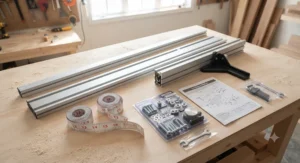
The gap here isn’t marginal — stock fences on many hybrid saws simply weren’t engineered to the same tolerances as dedicated aftermarket systems, since manufacturers cut costs on the fence long before they cut costs on the motor or trunnions. For anyone doing repeat cuts, sheet-good breakdowns, or joinery, that accuracy and capacity difference compounds into real time saved and material not wasted.
Frequently Asked Questions
❓ What is a fence system for hybrid table saws?
❓ Is a hybrid table saw fence replacement worth the cost?
❓ Do all fence systems fit enclosed base saws without drilling?
❓ What's a reasonable mid-range fence system for home shop budget?
❓ How often should fence rail mounting be rechecked after installation?
Conclusion
A fence system for hybrid table saws isn’t a luxury upgrade — it’s often the single change that determines whether your saw earns your trust for precision work. Whether you land on the no-drill convenience of the Vega U50 Table Saw Fence System, the commercial-grade repeatability of the Delta Biesemeyer BC50T2, or the budget-smart accuracy of the Shop Fox Fence W1410, the right choice comes down to matching your actual project mix — sheet goods, joinery, or general repairs — against what each system was genuinely built to do.
Take the time to measure your saw’s table depth and rail spacing before ordering, dry-fit before drilling, and recheck alignment within the first month of use. Do that, and any of the seven systems in this guide will turn a merely adequate hybrid saw into one that produces consistently clean, accurate cuts for years.
✨ Ready to upgrade your table saw’s accuracy?
✨ Compare the fence systems above and pick the one that matches your shop’s real workload — your future cuts will thank you.
Recommended for You
- T-Square Fence for Jobsite Table Saws: 7 Picks That Stay True (2026)
- Aftermarket Fence for Contractor Table Saws: 7 Upgrades (2026)
- Biesemeyer Style Fence vs Factory Fence: 7 Upgrades Worth It in 2026
Disclaimer: This article contains affiliate links. As an Amazon Associate, I earn from qualifying purchases. If you purchase products through these links, we may earn a small commission at no additional cost to you.
✨ Found this helpful? Share it with your friends! 💬🤗
