
In This Article
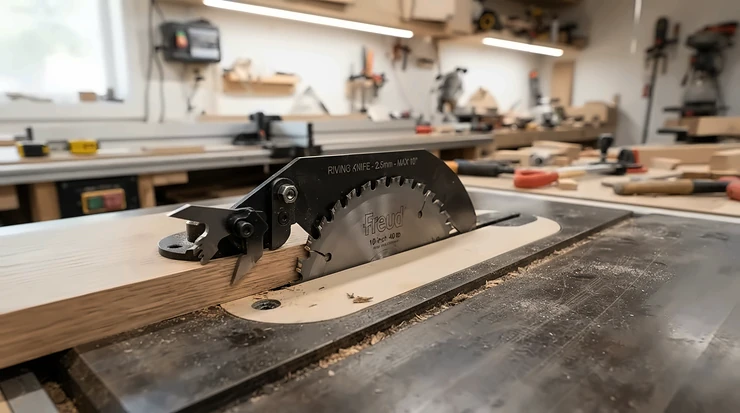
A splitter for table saw kickback prevention is a thin, fixed blade or peg mounted directly behind the saw blade, in line with the cut. It keeps the two halves of a ripped board from drifting together and pinching the blade, which is the mechanism behind most kickbacks. Think of it as a doorstop for the kerf.
Here’s the uncomfortable truth about kickback: it doesn’t announce itself. One second you’re feeding a board, the next it’s a projectile headed for your midsection. The usual culprit is wood that closes on the back of the blade, and a riving knife or splitter exists precisely to stop that pinch before it starts.
If your saw shipped with a modern riving knife, you’re ahead of the game. But plenty of contractor saws, older cabinet saws and hand-me-down machines have a clunky guard-and-splitter assembly that people strip off and never reinstall. Others have lost it entirely. That’s where a simple splitter upgrade for saws earns its keep: a small accessory that drops into a zero-clearance insert and quietly goes to work.
This guide covers seven real options, from budget plastic splitters to full aftermarket guard systems, plus a companion insert you’ll almost certainly need. We’ll cover how a standalone splitter for table saw setups differs from a riving knife, how kerf binding actually happens, and where the non-through cut limitations bite. The research behind it is based on manufacturer specs and genuine woodworking-community feedback as of 2026. Prices below are ranges only, so always check the current listing.
Let’s start with the cheat sheet.
Quick Comparison Table: Five Picks at a Glance
| Pick | Why It Stands Out | Best For |
|---|---|---|
| MJ Splitter SteelPro Full Kerf | Stainless core plus dual offset splitters | Best overall for 1/8″ blades |
| MJ Splitter SteelPro Thin Kerf | Same system tuned for thin blades | Best for thin-kerf blade owners |
| MJ Splitter Original Full Kerf | Simplest, cheapest plug-in design | Best budget entry point |
| Delta 34-868 Pop-Up Splitter | Stays with the saw, lifts when needed | Best for compatible Delta-style saws |
| Shark Guard Splitter / ARK | Metal splitter, optional guard and dust shroud | Best premium upgrade for older saws |
Looking at the table, the MJ Splitter SteelPro Full Kerf and MJ Splitter SteelPro Thin Kerf are the safest bets for most people, with the deciding factor being your blade’s kerf width. The MJ Splitter Original Full Kerf is the “I just need something on the saw today” pick. Meanwhile, the Shark Guard Splitter / ARK costs far more, but it’s the only option here that tries to replace the entire factory guard.
💬 Just one click — help others make better buying decisions too!😊
Top 7 Splitters for Table Saw Kickback Prevention: Expert Analysis
A quick note on method: the commentary below is analysis built from manufacturer specifications and the aggregated feedback of real woodworkers in forums and retailer listings. Nothing here claims hands-on testing. Where review data is thin, I say so.
1. MJ Splitter SteelPro Full Kerf (SP-2) — best all-round upgrade for 1/8″ blades
The standout here is the dual-splitter approach. Each kit includes four splitters and four kerf keepers, and the splitters are used in pairs to fill the entire kerf from both sides.
Key specs: a stainless steel core wrapped in ABS plastic, designed for kerf widths of 0.118″–0.145″. Each splitter is marked “+” through “+++” for offsets of roughly 0.003″ to 0.009″. In practice, that means you can dial in the fit to your blade rather than hoping a single size works. The kerf keepers are meant to stop warped, reactive solid wood from clamping the blade.
Based on the spec sheet, this suits anyone running a standard full-kerf blade who wants to stop pulling a factory guard on and off. It’s less about luxury and more about removing the excuse to run the saw bare.
Reviewers consistently describe MicroJig’s splitters as simple to install and effective at keeping boards against the fence. A recurring caveat from woodworking forums is that older plastic-peg versions sometimes pulled out when wood closed hard on them, which is the reason the steel-core design exists.
Pros:
- ✅ Stainless core resists pull-out when wood closes
- ✅ Offset markings let you fine-tune the fit
- ✅ Kerf keepers help with reactive, warped stock
Cons:
- ❌ Works for 90-degree cuts only
- ❌ Requires drilling into a zero-clearance insert
Price range: typically the upper-$30s to $50 range, so check the current listing. For a system that handles two blade families’ worth of tolerance, that’s solid value.
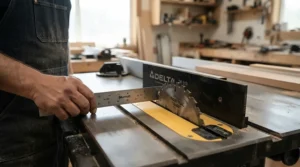
2. MJ Splitter SteelPro Thin Kerf (SP-2TK) — built for thin-kerf blades
Here’s the twist most buyers miss: thin-kerf blades are more prone to grabbing, so the splitter has to match them closely. The MJ Splitter SteelPro Thin Kerf is the same steel-core design sized for kerf widths of 0.090″–0.118″.
Specs worth translating: four thin-kerf splitters and four kerf keepers, the same graduated offsets, and a recommendation for a zero-clearance insert with at least 2″ of room behind the blade at its highest point. That last detail matters. On a compact saw with a short insert, you may not have the real estate, so measure before buying.
My analysis: if your blade is 3/32″ thin kerf (common on lighter saws), this is the right sibling to buy rather than the full-kerf kit. Mixing them up leaves the splitter too fat to fit the cut or too thin to do its job. Retailer listings for this model have appeared out of stock at times, so availability is worth confirming.
Customer-review data on the thin-kerf version is sparser than on the full-kerf kit; the splitter’s behavior is assumed similar based on shared design, but I couldn’t verify a deep review pool.
Pros:
- ✅ Sized exactly for 0.090″–0.118″ kerfs
- ✅ Same steel-core durability as its sibling
- ✅ Includes kerf keepers for reactive wood
Cons:
- ❌ Needs roughly 2″ of insert behind the blade
- ❌ Stock can be inconsistent at retailers
Price range: around the high-$30s to $50 range. A fair price for a precise fit.
3. MJ Splitter Original Full Kerf (Green) — the cheapest way to stop running bare
This is the simple one. A small semicircle of tough, high-density plastic pushes into holes you drill in your zero-clearance insert, and it acts as both a splitter and a mini-featherboard against the fence.
Specs with meaning: it’s made for 1/8″ kerf blades and installs with a drill guide, so you aren’t eyeballing alignment. One early magazine review noted the splitter is about 7/8″ tall, which means it sits low enough to be unobtrusive but high enough to catch a closing kerf. It also pops out in seconds, a real advantage when you need to make a different cut.
The honest take: this is a good fit for hobbyists on a budget who want a starting point. The compromise is durability. Woodworking-forum users have reported broken feet or pulled-out pegs when wood closes hard on the plastic. That’s why the SteelPro line exists.
Pros:
- ✅ Lowest-cost way to add a splitter
- ✅ Doubles as a mini-featherboard
- ✅ Quick to remove for special cuts
Cons:
- ❌ Plastic pegs can pull out under heavy pinch
- ❌ Ninety-degree cuts only
Price range: historically in the $20s to low-$30s range, so check current price. Cheap insurance for a saw with no splitter at all.
4. MJ Splitter Original Thin Kerf (Yellow, SP-0100-TK) — entry pricing for thin blades
The yellow version is the original design for thin-kerf blades, covering kerf widths of 0.090″–0.118″. Each package contains two splitters, plus an installation guide, drill guide and bit.
The practical reading of those specs: you’re paying for a splitter that installs in phenolic, wood or plastic inserts and can be moved between inserts if you drill each one. It does not include a zero-clearance insert, so factor that into your total cost.
My analysis: this is the logical pick for someone whose saw runs thin-kerf blades and whose budget rules out the SteelPro kit. The trade-off mirrors the green version, since the plastic design is gentler on blades but less rugged when boards pinch.
User feedback skews positive across forums, with the main complaints being durability under hard pinching rather than fit or installation.
Pros:
- ✅ Matches thin-kerf blades closely
- ✅ Installs in phenolic, wood or plastic inserts
- ✅ Low cost compared with the SteelPro kits
Cons:
- ❌ Insert not included
- ❌ Less rugged than steel-core designs
Price range: generally the $20s to low-$30s range, check current price. Great value if your needs are simple.
5. Delta 34-868 Pop-Up Splitter — the “disappearing” option for compatible saws
The standout feature is clever: this splitter stays with the saw, tucked under the table insert, and lifts into place when needed. Woodworkers on forums describe it as easy to pull up and push back down.
Specs with meaning: since it lives under the insert, you never lose it, and you don’t need to drill pegs. The catch is that if you use inserts other than the original Delta one, you’ll need to cut a slit behind the blade slot so the splitter can rise. That’s a small shop job, but a real one.
Here’s the nuance: this is a fixed-position splitter on compatible saws, which means it’s the right fit for owners of Delta Unisaw-style machines or saws with a matching mounting arrangement. Verify compatibility before buying, because I couldn’t confirm the full list of saws it fits.
Reviewer sentiment in forums leans favorable among long-time owners, who like that it stays out of the way until needed.
Pros:
- ✅ Stays attached to the saw permanently
- ✅ No pegs to drill or lose
- ✅ Quick to raise and lower
Cons:
- ❌ Compatibility is limited to certain saws
- ❌ Custom inserts need an extra slit cut
Price range: I couldn’t verify a current price, so check the listing. Value depends entirely on whether it fits your saw.
6. Shark Guard Splitter / ARK — premium overhaul for older cabinet saws
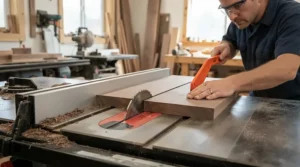
The headline: you can start with just a metal splitter and scale up to the adjustable ARK model, which adds a blade guard with a dust-collection shroud.
Specs, translated: the ARK fits many older Delta Unisaws, some older Grizzly cabinet saws and Unisaw clones. Woodworkers praise the machining quality and customer service, while noting that installation may require modification, such as new cap bolts or a bit of grinding. One owner reported the stock insert wouldn’t allow the blade to tilt to 45 degrees without further modification, which is an important reality check.
The analysis: this is a different class of purchase than the MJ kits. A trade magazine review makes a fair point that even a good splitter can’t match a true riving knife, but compared with an old factory guard that gets removed and forgotten, a well-built replacement is a vast safety improvement. For a saw you plan to keep for years, the premium can make sense.
Pros:
- ✅ Scalable from splitter to full guard
- ✅ Praised machining and support
- ✅ Dust-collection shroud option
Cons:
- ❌ Fit varies and may need modification
- ❌ Costs far more than plug-in splitters
Price range: the full guard assemblies sit well above the MJ options, in the premium tier. Check current pricing and exact saw compatibility before ordering.
7. Rockler Phenolic Zero-Clearance Insert Blanks (2-Pack) — the foundation every plug-in splitter needs
Strictly speaking, this isn’t a splitter. It’s the part that makes the first four options possible, and that’s why it earns a slot.
Specs with meaning: each blank is roughly 4-5/8″ wide by 18″ long by 13mm (about 1/2″) thick, generously sized so you can trim to fit many saw models. Phenolic is durable, stays flat and supports the wood right up to the teeth, which cuts tear-out. Rockler’s own note stresses measuring your throat plate’s thickness, length and width before ordering, and that’s good advice.
My analysis: if your saw only has a wide-open steel throat plate, a splitter like the MJ Splitter SteelPro Full Kerf can’t mount without a ZCI. Buying two blanks lets you dedicate one to the splitter and keep the other for plain zero-clearance cuts. Peachtree-type phenolic inserts also exist for specific saws; one buyer reported mounting an MJ splitter in one without trouble.
Pros:
- ✅ Durable phenolic that stays flat
- ✅ Two-pack covers a splitter insert and a spare
- ✅ Trimmable to fit many saw models
Cons:
- ❌ Needs careful measuring and cutting
- ❌ Not a splitter by itself
Price range: usually a modest two-pack price, so check current price. Cheap, but essential.
Top 7 Spec Comparison
| Product | Kerf Range / Fit | Mounts To | Best For |
|---|---|---|---|
| MJ Splitter SteelPro Full Kerf | 0.118″–0.145″ | Drilled ZCI | Standard 1/8″ blades |
| MJ Splitter SteelPro Thin Kerf | 0.090″–0.118″ | Drilled ZCI | Thin-kerf blades |
| MJ Splitter Original Full Kerf | 1/8″ blades | Drilled ZCI | Budget buyers |
| MJ Splitter Original Thin Kerf | 0.090″–0.118″ | Drilled ZCI | Budget, thin-kerf |
| Delta 34-868 | Saw-specific | Under insert | Compatible Delta-style saws |
| Shark Guard Splitter / ARK | Matched to blade | Saw-specific mount | Older cabinet saws |
| Rockler Phenolic Insert Blanks | Trim-to-fit blank | Throat plate opening | Any saw needing a ZCI |
The table shows a clear split: four of the seven products depend on a zero-clearance insert, which makes the Rockler Phenolic Insert Blanks a hidden cost for many buyers. If you own a saw that accepts a factory-style splitter, the Delta 34-868 or Shark Guard Splitter / ARK route avoids drilling altogether, though at higher complexity or price. For everyone else, the right MJ Splitter kit is the most straightforward path.
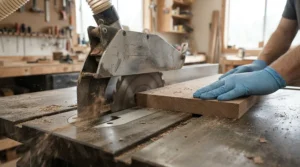
How to Choose a Splitter for Table Saw Kickback Prevention
Wondering how to pick? Work through these six steps in order.
- Check whether your saw has a riving knife mount. If it does, a true riving knife beats any plug-in. As the Fine Woodworking team explains in its guide to why kickback happens, the knife travels with the blade, which is why it prevents more kickbacks than a stationary splitter.
- Measure your blade’s kerf. Thin-kerf versus full-kerf is the number-one fitment decision. Mismatch it and the splitter either binds or fails to hold the kerf open.
- Confirm you have a zero-clearance insert, or budget for one. Most plug-in options need it.
- Verify clearance behind the blade. Some kits want at least 2″ of insert behind the blade at full height.
- Decide how often you make non-through cuts. If you frequently cut grooves or dados, you’ll be removing the splitter often, so a quick-release design matters.
- Match durability to your lumber. Reactive, warped boards punish plastic pegs; steel-core designs hold up better.
Kickback Prevention Splitter Accessory: Features That Actually Matter
Marketing copy loves adjectives. Here’s what actually moves the safety needle.
Correct thickness. A splitter has to be thicker than the blade body and thinner than the kerf. Get that wrong and you either can’t enter the cut or you don’t hold it open. This is why graduated offsets, like those on the MJ Splitter SteelPro Full Kerf, are worth more than a pretty color.
Mounting rigidity. A kickback prevention splitter accessory that wobbles is worse than useless, because it gives you false confidence. Steel cores, secure pegs and solid inserts beat clever cosmetics.
Kerf-keeper behavior. Features that flex slightly against the board, like mini-featherboard effects, help keep stock tight to the fence and reduce burning.
What doesn’t matter much: color-coding trivia and extra spare pieces you’ll never use. Do note that the MJ Splitter Original Thin Kerf and the MJ Splitter Original Full Kerf share nearly identical installation, so choose by blade, not by hype.
One reality check: a splitter prevents kickback, not blade contact. Fine Woodworking’s own guidance is blunt that you still need a blade guard.
Kerf Binding: How Boards Pinch the Blade (and Why It Matters)
Kerf binding is the quiet villain behind most rip-cut kickbacks. The cut closes behind the blade, squeezing the plate, and the spinning teeth grab the wood and fling it back at you.
Why does it happen? Internal stress in the lumber is a common cause. As you rip, a board that was holding tension releases it, and the kerf narrows. A fence that points inward toward the blade has the same effect, as does wet or knotty stock. A dull blade makes everything worse, since it forces you to push harder.
This is where the splitter earns its rent. By sitting in the kerf behind the blade, it holds the two halves apart. The MJ Splitter SteelPro Full Kerf goes a step further with kerf keepers, small pieces designed to stop reactive wood from clamping the blade.
Here’s the nuance beginners miss: a poorly aligned splitter can cause binding rather than prevent it. If it sits out of line with the blade, it pushes the board sideways into the teeth. That’s why the manufacturers include drill guides, and why you should always test on scrap.
Also worth noting, ripping is riskier than crosscutting. A Washington State workplace safety rule explains that kickbacks occur more often when cutting parallel to the grain, and it names an unsharpened blade among common contributors.
Splitter Installation: A Step-by-Step Guide
Good news: splitter installation is a half-hour job for most plug-in kits. Here’s the practical version.
- Unplug the saw. Always, before touching anything near the blade.
- Choose your insert. Use a phenolic, wood or plastic zero-clearance insert. Avoid cheap thin material that cracks, because cutting a long splitter slot in brittle inserts can crack them, as one Fine Woodworking reader answer warns.
- Cut the blade slot. Seat the blank, then raise the blade through it slowly with the saw set up per its manual.
- Position the drill guide. Align the included guide behind the blade slot, with the blade raised to its highest point so the guide sits correctly.
- Drill the holes. Use the bit provided; don’t improvise sizes.
- Press in the splitter. Pick the correct kerf size, and for SteelPro kits, start with the smallest “+” offset that fits.
- Test on scrap. Run a dry pass with the saw off, then a live test on cheap lumber.
- Re-check alignment after your first few cuts.
A common first-month mistake is installing a splitter without verifying it sits dead in line with the blade. Another is forgetting that these inserts are for 90-degree cuts only. Tilt the blade and the splitter no longer lines up, so remove it.
If your saw’s factory arrangement is already sound, a Delta 34-868 or a similar saw-specific part may bypass this process entirely.
Standalone Splitter for Table Saw vs. Riving Knife vs. Factory Guard
A standalone splitter for table saw use is the budget-friendly cousin of the riving knife. They solve the same problem differently.
A splitter is fixed to the table and stays put when the blade rises or tilts, which is why it must come off for non-through cuts. A riving knife rides with the blade, maintaining the gap at any height. Wikipedia notes that blades with a narrow kerf relative to their body are more susceptible to grabbing, which is one reason fit matters so much.
| Option | Stops Kickback? | Handles Non-Through Cuts? | Best For |
|---|---|---|---|
| Standalone splitter (e.g., MJ Splitter SteelPro Full Kerf) | Yes, for through-cuts | No, must be removed | Older saws without riving-knife mounts |
| Factory riving knife | Yes, for most cuts | Yes, low-profile knives work | Modern saws |
| Old guard-and-splitter assembly | Yes, if used | No | Saws that already have one |
| Shark Guard Splitter / ARK | Yes, for through-cuts | Partly, quick conversion | Upgrading older cabinet saws |
The table makes the trade-off plain. A factory riving knife wins on convenience, but if your saw has no mount, a plug-in splitter is a far better answer than running bare. The Shark Guard Splitter / ARK narrows the convenience gap for older saws, though it can’t match a purpose-built riving knife. For beginners, the simplest path is whichever device you will actually leave installed.
Industry guidance supports this thinking: a Popular Woodworking guard comparison notes that quick-swap systems matter because people skip safety gear that takes tools to install.
Non-Through Cut Limitations: When a Splitter Gets in the Way
Let’s be straight about non-through cut limitations, because this is where plug-in splitters disappoint people.
A non-through cut doesn’t pass fully through the board: think grooves, dados, rabbets and stopped cuts. A fixed splitter sits in the path of the board’s top surface in those cuts, so it must be removed. The original review of the MJ Splitter Original Full Kerf admitted it would impede some cuts, such as a shallow kerf cut, though it pops out in seconds.
Safety rules agree. The Washington rule exempts dadoing, grooving and rabbeting from the spreader requirement, but it also says to replace the spreader immediately afterward. That second half is the part people forget.
Practical advice: keep a dedicated “splitter insert” and a plain zero-clearance insert in your shop. The Rockler Phenolic Insert Blanks two-pack makes that easy. Swap inserts rather than pulling pegs repeatedly, since constant removal can wear plastic pegs.
Also remember that kits like the MJ Splitter SteelPro Thin Kerf are for 90-degree cuts only. For bevel cuts, you’re back to a riving knife or a saw-specific splitter.

Real-World Scenarios: Which Splitter Fits Which Woodworker?
Scenario 1: The garage hobbyist. You own a contractor saw with a flimsy original guard that lives in a drawer. Budget is tight, projects are mostly 3/4″ plywood and pine. The MJ Splitter Original Full Kerf plus one Rockler Phenolic Insert Blank gets you running safely for a modest outlay. Use it every cut.
Scenario 2: The furniture builder with a thin-kerf blade. You rip hardwood and see occasional reactive boards. The MJ Splitter SteelPro Thin Kerf is the logical fit, since its kerf keepers handle warping and its steel core resists pull-out.
Scenario 3: The restorer of an old cabinet saw. You inherited a vintage machine in good mechanical shape but with a missing guard. The Shark Guard Splitter / ARK is worth pricing out, and compatibility checks are essential. A Delta 34-868 may suit a similar machine if the mounting matches.
Scenario 4: The school or shared-shop supervisor. Many people, many cuts, constant swapping between blades. Standardize on one kerf and one splitter family so everyone’s insert behaves the same way.
Each scenario comes down to frequency of use and blade type. The more often you rip, the more a rugged design pays back.
✨ Don’t Miss These Exclusive Deals!
🔍 Take your shop safety to the next level with these carefully selected splitters. Click on any highlighted item to check current pricing and availability. These upgrades will help you create safer, cleaner cuts you’ll feel confident about!
Problem → Solution: Common Splitter Headaches
Problem: The splitter pops out mid-cut. Solution: Wood is closing hard on it. Stop, back out, and check the board for tension. Upgrade from plastic pegs to a steel-core design like the MJ Splitter SteelPro Full Kerf.
Problem: The cut burns. Solution: Check fence alignment and splitter offset. Too much side pressure causes friction. A SteelPro offset one “+” smaller can ease it.
Problem: The insert cracked. Solution: Phenolic is sturdier than MDF. The Rockler Phenolic Insert Blanks are a better foundation.
Problem: The blade won’t tilt to 45 degrees. Solution: A fixed insert or splitter blocks it. Remove the splitter, or accept that bevel work needs a different safety setup.
Problem: Thin blade, full-kerf splitter. Solution: Match them. The MJ Splitter Original Thin Kerf exists for exactly this reason.
Simple Splitter Upgrade for Saws: Cost and Value Analysis
A simple splitter upgrade for saws costs less than a decent push stick set, yet it addresses the most violent failure mode on the machine. That’s remarkable ROI.
| Product | Price Range | Value Verdict | Best For |
|---|---|---|---|
| MJ Splitter Original Full Kerf | $20s to low-$30s | Excellent entry value | Budget buyers |
| MJ Splitter Original Thin Kerf | $20s to low-$30s | Excellent entry value | Thin-kerf budget |
| MJ Splitter SteelPro Full Kerf | High-$30s to $50 | Best long-term value | Frequent rippers |
| MJ Splitter SteelPro Thin Kerf | High-$30s to $50 | Best long-term value | Thin-kerf pros |
| Rockler Phenolic Insert Blanks | Modest two-pack | Required foundation | Everyone using plug-ins |
| Delta 34-868 | Check current price | Value if compatible | Matching Delta saws |
| Shark Guard Splitter / ARK | Premium tier | Worth it on keeper saws | Older cabinet saws |
The takeaway: spending an extra $15–$20 on a MJ Splitter SteelPro kit makes sense if you rip often, since you’re buying durability and tuning. The MJ Splitter Original kits are perfect for occasional use. The Shark Guard Splitter / ARK only pays off on a saw worth keeping for decades.
Also consider total cost: add the insert, and replacement splitters if plastic pegs wear. Over several years, the steel-core kits often cost the same or less.
Common Mistakes When Buying a Splitter
- Buying by price alone. A cheap splitter that pulls out under load is worse than a pricier one that holds.
- Ignoring kerf width. The most frequent error. Measure the blade, not the box.
- Skipping the insert. Plug-ins don’t work on open throat plates.
- Leaving it off after dado work. Make “splitter back on” a habit, ideally by dedicating an insert.
- Assuming a splitter replaces a guard. It doesn’t. Guards and push sticks still matter.
- Trusting forum fit claims. One person’s saw isn’t yours. Verify dimensions.
Safety, Standards and Compliance: What the Rules Say
Workplace standards treat kickback seriously. A Cornell machine shop safety guide identifies a riving knife or splitter and anti-kickback pawls as core guarding, while the Washington rule spells out that a spreader or riving knife should be hard-tempered steel, thinner than the kerf and aligned with the saw when tilted. It also calls for a gap of no more than half an inch behind the blade.
Home shops don’t face inspectors, but those specs make an excellent checklist. Is your splitter thinner than your kerf? Does it align? Is it close enough behind the blade? Notice that the MJ Splitter SteelPro Full Kerf is engineered around precisely those considerations.
Wikipedia adds context that modern saw designs increasingly include riving knives, and that Underwriters Laboratories has required them on new designs since 2008. If you’re shopping for a new saw, that’s a point in favor of buying current.
FAQ
❓ Can I use a splitter on a saw that already has a riving knife?
❓ Do splitters work for dado cuts?
❓ What size splitter do I need for a thin-kerf blade?
❓ How long does installing a splitter take?
❓ Will a splitter stop all kickback?
Conclusion
Here’s the bottom line. A splitter for table saw kickback prevention is one of the cheapest, simplest safety upgrades you can make, and it targets the exact moment a rip cut turns dangerous. If your saw has no riving knife mount, a plug-in splitter beats running bare by a wide margin.
For most woodworkers, the right answer is one of the MJ Splitter SteelPro kits, matched to your blade’s kerf. Budget shoppers can start with the MJ Splitter Original versions, then upgrade if the plastic proves too fragile. Owners of compatible older machines should price the Delta 34-868 or the Shark Guard Splitter / ARK, and nearly everyone will want a Rockler Phenolic Insert Blank two-pack to hold it all together.
Remember the limits: 90-degree cuts only, removal for non-through work, and no replacement for a blade guard or good technique. Measure twice, drill once, test on scrap, and then keep the thing on the saw.
✨ Ready to upgrade your saw?
🔧 Click any highlighted product above to check current pricing and availability, and give your next rip cut the safeguard it deserves. Your fingers will thank you!
Recommended for You
- Riving Knife Kit For Older Table Saws Without One: 7 Safe Fixes 2026
- Riving Knife System For Contractor Table Saw: 7 Proven Upgrades 2026
- Aftermarket Blade Guard For Cabinet Saw Upgrade: 7 Best Picks 2026
Disclaimer: This article contains affiliate links. As an Amazon Associate, I earn from qualifying purchases. If you purchase products through these links, we may earn a small commission at no additional cost to you.
✨ Found this helpful? Share it with your friends! 💬🤗
