
In This Article
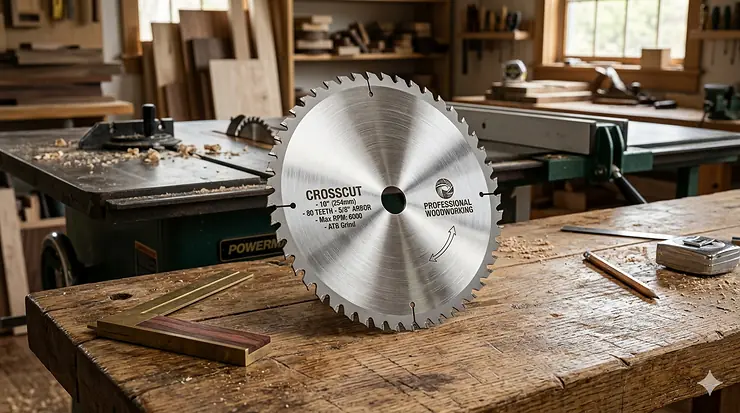
Here’s the short version: a crosscut blade for table saw work is built to slice cleanly across the grain of wood, not with it. More teeth, shallower gullets, and a gentler hook angle work together so the blade shears fibers instead of tearing them. The payoff is a glassy-smooth edge on miters, trim, and panel cuts that would otherwise come out looking like a beaver got to them first.
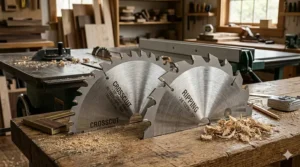
I’ve burned through enough blades — and enough sandpaper trying to fix what a bad blade left behind — to know this isn’t a “just buy whatever’s cheapest” decision. A rip blade barrels through wood along the grain with big, aggressive teeth and wide gullets built to clear out fast-moving chips. A crosscut blade does the opposite job: it’s patient, fine-toothed, and obsessed with the exit side of the cut, where splintering loves to happen. Most of that comes down to tooth geometry — the alternating bevel pattern ground into each carbide tip is what decides whether a blade slices fibers cleanly or just shoves them out of the way. If you’ve ever cut a beautiful piece of red oak and watched the back edge blow out into a ragged mess, that’s a tooth-count and geometry problem, not an operator problem.
This guide walks through seven real, currently available blades — from budget combo packs to a hand-tensioned American-made option that costs as much as a decent power tool — plus the buying logic, the maintenance habits, and the mistakes that turn a perfectly good blade into a perfectly good paperweight.
Quick Comparison Table: Crosscut Blades at a Glance
| Blade | Teeth | Best For | Price Range |
|---|---|---|---|
| Freud D1080X Diablo | 80 ATB | All-around fine crosscuts, trim work | $40–$60 range |
| Forrest Duraline Hi-A/T DH10807125 | 80 Hi-A/T | Melamine, veneer plywood, furniture-grade panels | $160–$220 range |
| DeWalt DW3106P5 (2-pack) | 60 + 32 | Budget shops needing two blades at once | $30–$45 range |
| IRWIN Marples 1807370 | 80 Hi-ATB | Trim carpentry on a budget | $35–$50 range |
| Tenryu PR-25580D | 80 TCG | Professional finish carpentry, laminate edges | $70–$100 range |
| Oshlun SBL-100080 | 80 Hi-ATB, negative hook | Melamine, laminate, chip-free panel cuts | $45–$65 range |
| CMT 219.080.10 | 80 ATB | Crosscuts that also need to do miter-saw duty | $50–$75 range |
A quick read on that table: tooth count alone won’t tell you the whole story — the Forrest and the Oshlun both run 80 teeth, but one is hand-built for furniture-grade panel work and the other is purpose-ground for melamine with a negative hook angle for extra control. Budget shoppers should look hard at the DeWalt combo pack, since two usable blades for the price of one premium blade is genuinely good math. If your work leans toward cabinetry and veneered panels rather than framing lumber, the price gap between the Diablo and the Forrest starts to make a lot more sense once you’ve seen what tear-out does to a $40 sheet of birch ply.
💬 Just one click — help others make better buying decisions too!😊
✨ Don’t Miss These Exclusive Deals!
🔍 Take your table saw setup to the next level with these carefully selected crosscut blades. Click on any highlighted item to check current pricing and availability. These blades will help you get furniture-grade cuts your whole shop will be proud of! 😊
Top 7 Crosscut Blades for Table Saws: Expert Picks
1. Freud D1080X Diablo 10″ 80-Tooth ATB Finish Blade
The Freud D1080X is the blade I’d hand a friend who just wants one good crosscut blade and doesn’t want to think about it again for a year. Its 80 Hi-ATB teeth and roughly 15° hook angle are tuned for fine finish work, and the PermaShield coating actually does something useful — it sheds pitch and resin instead of letting it bake onto the plate, which matters a lot if you’re cutting pine trim in a hot garage all afternoon.
In practice, this means clean miters on crown molding and minimal blowout on veneered plywood without babying your feed rate. Owners and trim crews consistently mention how little sanding is needed afterward, which, if you’ve ever sanded a long miter joint by hand, is basically a love letter.
Best for: DIYers and trim carpenters who want one dependable blade for both shop and jobsite work.
✅ Pros:
- Excellent finish-to-price ratio
- Coating resists gumming on resinous softwoods
- Works well on both table saws and miter saws
❌ Cons:
- Thin kerf can deflect slightly in underpowered saws
- Not the blade for melamine specialists chasing zero chip-out
Price sits in the $40–$60 range at the time of research — solid value for a blade this versatile.
2. Forrest Duraline Hi-A/T DH10807125
The Forrest Duraline Hi-A/T is the blade woodworkers buy after they’ve already ruined a few sheets of expensive plywood and decided they’re done gambling. Forrest hand-tensions every plate and hand-brazes C-4 carbide teeth onto it — slow, old-fashioned manufacturing that shows up as a blade with almost no runout and teeth that survive a lot of resharpenings.
What that means on your bench: this blade is built specifically for two-sided laminates, melamine, and veneer plywood, where tear-out on either face ruins the piece. Forest blade owners in long-running woodworking forums routinely describe it as the last blade conversation they ever needed to have — high praise from a notoriously picky crowd.
Best for: Cabinetmakers and furniture builders who can’t afford a single blown-out panel edge.
✅ Pros:
- Virtually zero top/bottom tear-out on plywood and melamine
- Forrest’s resharpening service keeps it performing like new for years
- Exceptionally quiet, smooth running blade
❌ Cons:
- Premium price tag relative to mass-market blades
- Overkill if you’re mostly cutting framing lumber
Expect a premium price, typically in the $160–$220 range — steep, but cost-per-cut over a decade of resharpening tells a different story than the sticker price does.
3. DeWalt DW3106P5 Combination Pack (60T + 32T)
The DeWalt DW3106P5 isn’t a single dedicated crosscut blade — it’s a two-blade pack pairing a 60-tooth fine-finish blade with a 32-tooth general-purpose blade, and for a lot of weekend woodworkers, that combination quietly solves more problems than one expensive blade would.
In real-world use, the 60-tooth blade handles crosscuts in hardwood, softwood, and sheet goods competently, while the 32-tooth blade takes over for faster rip cuts and rough work where finish quality matters less. The thin-kerf design means less strain on smaller benchtop saws, which is exactly the audience this pack is built for.
Best for: Budget-conscious DIYers refreshing a worn-out blade collection in one purchase.
✅ Pros:
- Two usable blades for less than most single premium blades
- Thin kerf is easy on lower-horsepower saws
- Great starter set for someone outgrowing a stock blade
❌ Cons:
- Finish quality trails dedicated 80-tooth fine-finish blades
- Carbide doesn’t hold an edge as long as premium tiers
This pack lands in the $30–$45 range, making it one of the better cost-per-blade deals on this list.
4. IRWIN Marples 1807370 10″ 80-Tooth Hi-ATB
The IRWIN Marples 1807370 is manufactured in Udine, Italy — a region with a long history of precision blade-making — and it shows in the laser-cut plate and oversized, resharpenable carbide teeth. The aluminum-matrix heat-resistant coating helps dissipate heat fast enough that gumming and pitch buildup stay manageable even during longer cutting sessions.
What stands out here is the price-to-performance ratio: 80 Hi-ATB teeth at this price point is unusual, and reviewers frequently note that it outperforms the stock blade that ships with most contractor saws by a wide margin on trim and finish carpentry tasks.
Best for: Trim carpenters and remodelers who need fine-finish results without premium-blade pricing.
✅ Pros:
- Strong finish quality for the price tier
- Resharpenable oversized carbide extends usable life
- Heat-dissipating coating reduces mid-cut gumming
❌ Cons:
- Kerf width can feel slightly inconsistent batch to batch, per some user reports
- Not designed for melamine-specific chip control
Typically priced in the $35–$50 range — a strong budget pick for anyone doing regular finish carpentry.
5. Tenryu PR-25580D 10″ 80-Tooth TCG
The Tenryu PR-25580D uses a triple-chip grind (TCG) rather than standard ATB, which trades a little bit of crosscut sheen for serious durability when cutting laminate edges, plastic-coated panels, and abrasive composite materials — situations where a standard ATB blade would dull noticeably faster.
Tenryu has built a strong reputation among professional finish carpenters for blades that run quietly with minimal vibration, thanks to a fully hardened, precisely tensioned steel body. Wood Magazine’s own blade comparisons have rated Tenryu’s combination lines as competitive with — sometimes ahead of — far more expensive American blades on smoothness and noise.
Best for: Pros cutting a mix of hardwood, plastic laminate edging, and composite trim who need one blade that survives all of it.
✅ Pros:
- TCG grind resists wear on abrasive laminate edges
- Noticeably quiet, low-vibration cutting
- Holds an edge longer than typical ATB blades on composite materials
❌ Cons:
- TCG geometry isn’t the absolute sharpest option for pure hardwood crosscuts
- Pricier than Diablo or Irwin Marples in the same tooth count
Price generally falls in the $70–$100 range, positioning it as a serious mid-tier professional option.
6. Oshlun SBL-100080 10″ 80-Tooth Hi-ATB (Negative Hook)
The Oshlun SBL-100080 is purpose-built around a negative hook angle, which sounds technical but solves a very specific problem: melamine and laminate panels chip out far less when the blade’s teeth meet the material at a less aggressive angle. Pair that with the Hi-ATB grind and you get a blade engineered almost entirely around chip-free results on both faces of a panel.
This negative hook angle also adds a layer of control on double-sided laminates — the blade tends to “shave” rather than “punch” through the surface layer, which is exactly what you want when both sides of the cut are visible in the finished piece.
Best for: Shops cutting a lot of melamine, laminate countertop stock, or veneered panel furniture.
✅ Pros:
- Negative hook angle dramatically reduces chip-out on laminates
- Precision-ground micro-grain carbide holds an edge well
- Copper-plugged expansion slots cut down on vibration noise
❌ Cons:
- Negative hook design feeds slower than positive-hook blades on solid hardwood
- Not the ideal first blade if most of your work is framing lumber
Price typically sits in the $45–$65 range, a fair ask for a blade this specialized.
7. CMT 219.080.10 10″ 80-Tooth Compound Saw Blade
The CMT 219.080.10 was originally positioned for compound miter and radial arm saws, but its 80-tooth ATB geometry crosses over cleanly to table saw crosscut duty — which is exactly why it shows up on so many finish carpenters’ benches doing double duty between two machines.
CMT’s Italian manufacturing background leans on titanium-enhanced carbide for extended edge life, and the dual-machine versatility means shops that run both a miter saw and a table saw can standardize on one blade design instead of stocking two separate inventories.
Best for: Shops that want one blade profile working across both a table saw and a miter saw.
✅ Pros:
- Crosses over well between miter saw and table saw use
- Titanium-enhanced carbide resists wear
- Clean finish on crosscuts and compound miters alike
❌ Cons:
- Not specifically optimized for melamine or laminate chip control
- Mid-pack pricing without a standout “specialist” feature
Expect a price in the $50–$75 range — reasonable for a blade doing two jobs reasonably well.
How to Choose a Crosscut Blade for a Table Saw
Five things actually move the needle here, in order of importance:
- Tooth count. Sixty teeth is a fine baseline for general crosscuts in solid wood; 80 teeth is where you land for furniture-grade finish work and sheet goods.
- Hook angle. Positive hook angles feed faster and suit solid hardwood; negative hook angles trade speed for control, which matters most on melamine and laminate.
- Kerf width. Thin-kerf blades ask less of underpowered saws but flex more under load — fine for a benchtop saw, less ideal for a cabinet saw doing precision joinery.
- Material match. A blade built for melamine isn’t the same tool as one built for hardwood crosscuts — buying based on tooth count alone ignores half the equation.
- Resharpening economics. A $200 blade that gets sharpened five times for $20 each beats a $40 blade you replace five times, both on cost and on landfill guilt.
Practical Usage Guide: Setup, Break-In, and Maintenance
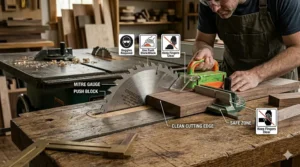
A new crosscut blade deserves five minutes of setup before it ever touches wood. Check that your blade height clears the material by about a quarter inch — any more and you’re exposing more spinning steel than the cut needs, which both hurts safety and increases tear-out risk on the underside of the cut. OSHA’s own woodworking safety guidance backs this up, recommending minimal blade exposure above the material as standard practice on every cut. Confirm your rip fence and miter gauge are square to the blade; even a hair of misalignment shows up as burning or binding on a high-tooth-count blade faster than it would on a coarse rip blade.
For the first few cuts, feed slightly slower than feels natural — a fresh blade is sharp enough to grab if pushed too aggressively, especially on a Hi-ATB or negative-hook design. Keep a dedicated brush and blade-cleaning solution on hand; pitch and resin buildup is the single biggest silent killer of crosscut performance, and a five-minute cleaning every few dozen cuts keeps the teeth shearing instead of burning. When cuts start looking scorched rather than sliced, that’s your blade telling you it needs cleaning or sharpening — not a feed-rate problem.
Real-World Scenarios: Matching the Blade to the Job
The weekend trim carpenter installing baseboard and crown molding in a few rooms doesn’t need a $200 blade — the Freud D1080X or IRWIN Marples 1807370 will deliver finish-grade miters without the premium price.
The cabinetmaker building melamine or veneered plywood cabinets for resale needs chip-free results on both faces of every panel — this is squarely where the Forrest Duraline Hi-A/T or Oshlun SBL-100080’s negative hook angle earns its keep.
The mixed-use shop running both a table saw and miter saw for finish carpentry jobs benefits most from a blade like the CMT 219.080.10 or Tenryu PR-25580D, which hold up across both machines and a wider range of materials, including laminate edging.
Crosscut Blade Splintering: Problem → Solution Guide
Splintering on the underside of a cut almost always traces back to one of three causes, and each has a specific fix. The science behind this is well documented by the USDA’s Forest Products Laboratory, which has studied wood fiber behavior under cutting and machining stress for over a century — fibers near an exit surface lack support from the wood beneath them, and that’s precisely where tear-out happens.
- Problem: Bottom-side tear-out on plywood. Solution — switch to a higher tooth-count Hi-ATB blade like the Forrest Duraline or Oshlun SBL-100080, and use a sacrificial backer board or zero-clearance insert.
- Problem: Splintering at the start of the cut on hardwood. Solution — score the cut line first with a utility knife, or switch to a blade with a steeper hook angle that shears rather than chisels into the fibers.
- Problem: Melamine edges chipping on both faces. Solution — a negative hook angle blade specifically designed for laminates, paired with masking tape over the cut line, dramatically reduces chip-out.
If you’re still seeing splintering after switching blades, check your zero-clearance insert — a worn or oversized throat plate lets fibers flex downward right as the blade exits, undoing even a great blade’s work.
60 Tooth vs 80 Tooth: Which Crosscut Blade Wins?
| Factor | 60 Tooth | 80 Tooth |
|---|---|---|
| Cut speed | Faster | Slower |
| Finish smoothness | Good | Excellent |
| Best material | Solid hardwood, general trim | Plywood, melamine, fine furniture work |
| Feed tolerance | More forgiving | Less forgiving of fast feed rates |
The honest answer is that 60-tooth blades win on general-purpose speed, while 80-tooth blades win on anything destined to be seen up close — face frames, visible joinery, veneered panels. If you’re cutting two-by lumber for a deck, an 80-tooth blade is solving a problem you don’t have; if you’re building a display cabinet, a 60-tooth blade is leaving finish quality on the table.
ATB and Negative Hook Angle: The Geometry That Actually Matters
Alternate top bevel (ATB) teeth are ground at alternating angles, left-right-left-right, so each tooth slices through one side of the fiber bundle like a knife rather than chiseling straight through it — that’s the geometry behind every clean crosscut on this list. A combination blade with 40 teeth suits a wide range of crosscut and rip-cut tasks, but as tooth count and bevel angle increase toward 80 teeth, that slicing action gets finer and the finish gets correspondingly smoother.
Hook angle is the other half of the equation, and it’s frequently overlooked. Negative hook angles combined with a high alternate top bevel grind are specifically engineered to produce smooth, chip-free cuts in single and double-sided melamine, laminates, and veneers. In plain terms: a negative hook angle makes the blade approach the material more like a paring knife and less like an axe, which is exactly the control you want when both faces of a panel will be visible in the finished piece. Fine Woodworking’s own deep dive on reading grain direction makes the same point from the wood’s side of the equation — fight the fiber direction and even a sharp blade tears; work with it and the cut almost finishes itself. The tradeoff is feed speed — negative-hook blades ask you to slow down, and fighting that instinct is the single most common reason people think a quality blade “isn’t working.”
Crosscut Blades for Trim Work vs Furniture Making
Trim work — baseboard, crown molding, door casing — rewards speed and a forgiving feed tolerance, since most cuts get caulked, painted, or tucked into a corner where minor imperfections vanish. The Freud D1080X and IRWIN Marples 1807370 are built for exactly this rhythm: fast enough for a job site, clean enough that touch-up sanding stays minimal.
Furniture making is a different sport entirely. Every face is visible, every glue joint depends on a flat, splinter-free edge, and a blown-out corner on a $90 sheet of walnut ply isn’t something caulk fixes. That’s where the Forrest Duraline and Oshlun SBL-100080 justify their slower feed rates and higher price tags — furniture work trades speed for certainty, and certainty is worth paying for once you’ve thrown away a ruined panel.
Crosscut vs Rip vs Combination Blades
| Blade Type | Teeth | Cuts Best | Tradeoff |
|---|---|---|---|
| Rip blade | 24–30 | With the grain | Rough finish, fast feed |
| Combination blade | 40–50 | Both directions reasonably well | Compromise on both ends |
| Crosscut blade | 60–80 | Across the grain | Slower feed, finer finish |
A rip blade is a sprinter; a crosscut blade is a surgeon. For rip cuts, a lower tooth count enables fast cutting and leaves a good enough edge for gluing, while avoiding tear-out on a crosscut requires a much higher tooth count — sometimes as high as 80 teeth. A combination blade splits the difference reasonably well for a shop with only one saw and one blade, but anyone doing serious furniture or trim work eventually ends up owning at least one dedicated blade of each type, swapping as the job demands.
Common Mistakes When Buying a Crosscut Blade
The biggest one: buying purely on tooth count and ignoring hook angle and grind type entirely. An 80-tooth ATB blade and an 80-tooth TCG blade behave very differently on the same material — assuming “80 teeth” guarantees a specific result is how people end up disappointed with an otherwise good blade.
The second mistake is matching the wrong kerf to the saw. A full-kerf blade on a small benchtop saw can bog the motor down on thicker stock, while a thin-kerf blade on a powerful cabinet saw sometimes deflects more than necessary for precision joinery — the saw’s horsepower should inform the kerf choice, not just the wallet.
The third, and most common: skipping a zero-clearance insert. Even the best crosscut blade on this list will show some bottom-side tear-out on plywood if the factory throat plate’s gap is too wide. It’s also worth a glance at OSHA’s broader woodworking machinery standard before swapping blades on a shared or workplace saw — guard and riving-knife requirements apply regardless of which blade is mounted.
Long-Term Cost & Maintenance
Carbide-tipped blades aren’t disposable the way a lot of buyers treat them. A quality 80-tooth blade can typically be resharpened four to six times before the carbide is worn past useful life, and professional sharpening services — Forrest’s own service is a well-known example — routinely bring blades back to near-original tolerances. Run the math on a $180 Forrest blade resharpened five times at roughly $20–$25 a visit, and the effective cost per “fresh blade equivalent” lands well under $50 — competitive with budget blades that get tossed after dulling once.
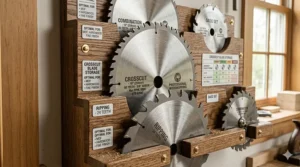
Storage matters too: hanging blades individually rather than stacking them prevents tooth-to-tooth contact that dulls carbide edges before they ever cut a single board.
FAQ
❓ What is the best tooth count for a crosscut blade for table saw use?
❓ Does a negative hook angle crosscut blade cut slower?
❓ Can I use a crosscut blade for ripping?
❓ How often should a crosscut blade be sharpened?
❓ What causes tear-out with a fine crosscut blade?
Conclusion
There’s no single best crosscut blade for every shop — there’s a best blade for your shop, your saw, and the material sitting on your bench right now. If you want one dependable, do-it-all option, the Freud D1080X earns its spot through sheer consistency. If melamine and veneered panels are your bread and butter, the negative hook angle on the Oshlun SBL-100080 or the hand-built precision of the Forrest Duraline will save you more ruined sheet goods than their price tags suggest. And if you’re just trying to stop fighting a stock blade without breaking the bank, the DeWalt combo pack or IRWIN Marples option will quietly fix 90% of your splintering headaches.
Buy based on what you’re actually cutting, not just the tooth count printed on the box — that one habit will save more money and more ruined material than any single blade recommendation ever could.
✨ Don’t Miss These Exclusive Deals!
🔍 Take your table saw projects to the next level with these carefully selected crosscut blades. Click on any highlighted item to check current pricing and availability. These tools will help you create the clean, furniture-grade cuts your shop has been missing!
Recommended for You
- Best Ripping Blade for Table Saw in 2026: 7 Proven Picks
- Which Table Saw Blade Do I Need? 7 Best Picks (2026)
- Best Table Saw for Cutting Plywood: 7 Expert Picks
Disclaimer: This article contains affiliate links. As an Amazon Associate, I earn from qualifying purchases. If you purchase products through these links, we may earn a small commission at no additional cost to you.
✨ Found this helpful? Share it with your friends! 💬🤗
