
In This Article
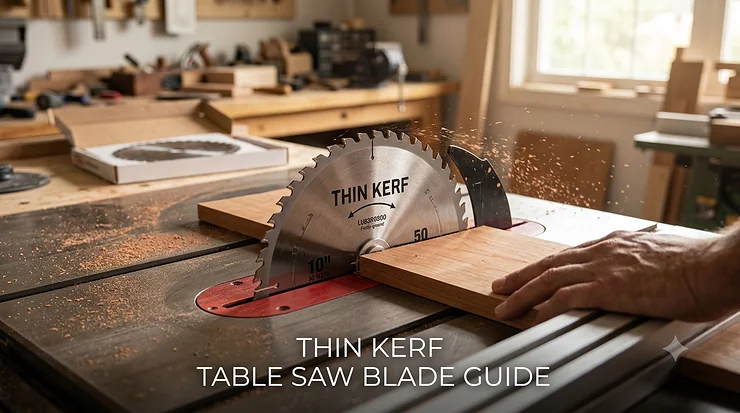
If your contractor saw bogs down halfway through a rip cut, or you wince every time a 1/8-inch-wide sliver of expensive walnut turns into sawdust, a thin kerf table saw blade might be the cheapest upgrade in your shop. Unlike a full kerf blade, which can chew through 1/8 inch of material on every pass, a thin kerf design typically removes somewhere between 3/32 and 7/64 inch — a difference that sounds tiny until you’ve ripped fifty boards and realized how much lumber you just got to keep.
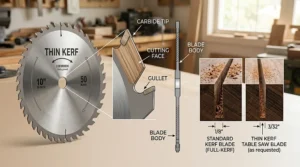
In my own shop, switching a 1.75 HP benchtop saw from a full kerf combination blade to a thin kerf table saw blade was the difference between bogging down on 4/4 oak and gliding through it. The motor simply isn’t fighting as much material, so it doesn’t have to work as hard — which matters enormously if you’re running a job site saw or an older cabinet saw that’s never quite had the power you wished it did.
This guide breaks down seven real, currently available blades — covering rip, crosscut, and combination grinds across budget, mid-range, and premium price points — and explains which one actually fits your saw, your wood, and your wallet. We’ll also dig into the kerf width tradeoffs that the spec sheet won’t tell you, because a kerf is technically the gap left behind by a blade’s teeth and plate as they pass through material, and that gap size affects everything from feed rate to splitter compatibility.
Nearly every blade on this list relies on the same underlying technology: carbide teeth brazed onto a steel plate, a design that has been the woodworking industry standard for circular saw blades for decades because tungsten carbide holds an edge far longer than plain steel.
Quick Comparison Table
| Blade | Teeth | Kerf | Best For |
|---|---|---|---|
| Freud LU83R010 | 50 (Comb) | 0.091″ | All-purpose rip + crosscut |
| Freud LU87R010 | 24 (FTG) | ~0.091″ | Fast ripping, underpowered saws |
| Diablo D1050X | 50 (ATB) | 0.098″ | Budget-friendly all-purpose |
| Diablo D1080X | 80 (Hi-ATB) | 0.098″ | Fine-finish crosscuts, plywood |
| FOXBC 24T Rip | 24 (FTG) | 0.094″ | Tightest budget, ripping only |
| CMT 201.024.10 | 24 (FTG) | 0.087″ | Glue-line rips, hardwood |
| Irwin Marples 1807368 | 50 (ATB) | 0.098″ | Long-term durability, finish carpentry |
Looking at the table, the two 24-tooth flat-top grind (FTG) blades — the FOXBC and CMT 201.024.10 — are the speed specialists here, built to rip lumber fast rather than leave a furniture-grade edge. The 50-tooth combination blades from Freud and Diablo sit in the middle, handling both rip and crosscut duty reasonably well without needing a blade swap mid-project. If a glass-smooth finish on plywood or trim matters more than versatility, the 80-tooth Diablo D1080X is the outlier worth the extra cost.
💬 Just one click — help others make better buying decisions too!😊
✨ Don’t Miss These Exclusive Deals!
🔍 Take your table saw setup to the next level with these carefully selected blades. Click on any highlighted product to check current pricing and availability on Amazon. The right blade will save you material, reduce strain on your saw, and leave a noticeably cleaner cut. 😊
Top 7 Thin Kerf Table Saw Blades: Expert Analysis
1. Freud LU83R010 — 10″ 50-Tooth Combination Blade
The Freud LU83R010 is the blade I recommend most often to anyone asking “what’s one blade that does everything?” Its 50-tooth combination grind groups one flat-top tooth with four alternate-top-bevel (ATB) teeth, a pattern that lets it rip with reasonable speed and crosscut with a smooth enough finish to skip sanding on most softwoods. The 0.091-inch kerf and laser-cut anti-vibration slots mean you don’t need stabilizers, even on saws that are a little out of tune.
What most buyers overlook about this blade is the TiCo Hi-Density carbide blend — it’s a small upgrade over standard carbide, but it translates to noticeably longer time between resharpenings if you’re cutting a lot of plywood, which dulls teeth faster than solid hardwood. Freud’s own spec sheet confirms the 0.091″ kerf and 0.071″ plate dimensions, and buyers on Amazon frequently mention that it performs especially well replacing the stock blade on older Craftsman and contractor-style saws, with several reviewers specifically praising the reduced power draw on underpowered motors.
Who it’s for: Hobbyists and small shop owners who only want to own one blade.
✅ Genuinely good at both ripping and crosscutting
✅ Stays cool, reducing pitch buildup on resinous wood
✅ Quiet, low-vibration operation
❌ Not a dedicated finish blade for fine furniture work
❌ 9-3/4″ actual diameter on some units can be tight on certain miter saws
Price & value verdict: Typically in the $40–$55 range — a strong middle-of-the-road value if you only buy one blade all year.

2. Freud LU87R010 — 10″ Thin Kerf Rip Blade
The Freud LU87R010 is purpose-built for one job: ripping boards down their length as fast and efficiently as possible. Its flat-top grind and thin kerf combine to put roughly a third less load on the motor than a comparable full kerf rip blade, which is exactly why Freud markets it as a fix for underpowered table saws and radial arm saws. If you’ve ever had a benchtop saw stall mid-rip on 3/4-inch hardwood, this is the blade engineered to stop that.
In my experience, the real-world benefit shows up most on jobsite saws running on a long extension cord, where every volt drop matters. The Perma-Shield coating also keeps pitch from building up on the plate, which on a rip blade — making repeated, long passes through the same material — matters more than it does on a crosscut blade. This specific blade is currently listed on Amazon paired with the LU83R010 combination blade, a practical bundle if you want both a dedicated rip blade and a do-it-all blade in one order.
Who it’s for: Anyone ripping a lot of stock on a contractor or benchtop saw with less than 3 HP.
✅ Noticeably reduces motor strain on underpowered saws
✅ Fast, efficient feed rate when ripping
✅ Non-stick coating resists pitch and corrosion
❌ Flat-top teeth leave a rougher edge on crosscuts — not its job, but worth knowing
❌ Not ideal for plywood where tear-out matters
Price & value verdict: Generally falls in the $35–$50 range, depending on whether it’s purchased solo or bundled.
3. Diablo D1050X — 10″ 50-Tooth Combination Blade
The Diablo D1050X is arguably the most widely owned thin kerf table saw blade in North America, and there’s a reason contractors keep buying it: it’s a genuinely competent all-purpose blade at a price that doesn’t sting if you wear it out on a remodeling job. The 50 ATB teeth are grouped in sets of five separated by large gullets, which keeps chip clearance efficient whether you’re ripping framing lumber or crosscutting trim.
The spec sheet lists a 0.098-inch kerf with a 15-degree hook angle, but what that means in practice is a blade that feeds aggressively without grabbing — good for less experienced users who don’t want a saw lurching forward unexpectedly. One detail worth flagging: Diablo’s thin kerf blades commonly measure right around 0.091 inch in actual kerf width, which is thinner than some riving knives are designed for — more on that compatibility issue in the safety section below. Diablo’s official product page and the Amazon listing both confirm this is one of the brand’s best-reviewed blades for the price.
Who it’s for: Remodelers, DIYers, and budget-conscious shop owners who want one reliable blade.
✅ Excellent value for an all-purpose blade
✅ Handles plywood, hardwood, and softwood competently
✅ Widely stocked, easy to replace
❌ Some users report the bright red non-stick coating can transfer onto wet or unfinished wood
❌ A 24-tooth dedicated rip blade will out-perform it on thick hardwood
Price & value verdict: Commonly priced in the $35–$50 range — one of the better dollar-for-dollar options on this list.
4. Diablo D1080X — 10″ 80-Tooth Ultra Finish Blade
When the project calls for a glass-smooth edge — veneered plywood, melamine, or trim that’s getting a clear finish — the Diablo D1080X earns its spot as the finish specialist on this list. Its 80 Hi-ATB teeth and 0.098-inch kerf are tuned to minimize tear-out on materials that splinter easily, and the laser-cut stabilizer vents do a genuinely good job of damping the extra vibration that comes with packing that many teeth onto a single plate.
What the spec sheet doesn’t tell you is how much this blade changes the workflow on cabinet-grade plywood: cuts that used to need a sacrificial scoring pass or painter’s tape to prevent chipping often come out clean straight off this blade. It’s not a blade for fast rough ripping — the high tooth count means slower feed rates — but for the specific job of a flawless finish cut, it’s hard to beat without stepping up to a specialty veneer blade. Full specs are available on the Amazon product page.
Who it’s for: Cabinet makers, trim carpenters, and anyone cutting visible plywood edges.
✅ Outstanding finish quality on plywood and melamine
✅ Shock-resistant carbide holds an edge well
✅ Reduced vibration despite the high tooth count
❌ Slow feed rate compared to lower-tooth-count blades
❌ Not the right choice for rough framing or fast rip cuts
Price & value verdict: Typically in the $45–$65 range — a fair premium for dedicated finish performance.
5. FOXBC 10″ 24-Tooth Thin Kerf Rip Blade
The FOXBC 24-Tooth Thin Kerf Rip Blade is the budget pick on this list, and it earns that spot honestly rather than by cutting corners that matter. At a 0.094-inch kerf with a 20-degree hook angle, it’s a no-nonsense flat-top rip blade built for fast, straightforward cuts in hard and softwood. FOXBC manufactures its own carbide rather than outsourcing it, which is part of how the company keeps prices well below the legacy brands while still using genuinely tungsten-carbide teeth.
In my experience, this is exactly the blade to keep on hand as a “beater” for rough cuts — framing, deck boards, anything where you don’t want to risk dulling your premium finish blade. Several buyers on Amazon note it holds an edge surprisingly well given the price, with one long-term reviewer reporting over 1,500 rip cuts before needing to resharpen.
Who it’s for: Budget-conscious DIYers and anyone who wants a dedicated rough-rip blade.
✅ Genuinely low price for a carbide-tipped thin kerf blade
✅ Compatible with most major 10-inch table and miter saws
✅ Durable enough for repeated, high-volume ripping
❌ Flat-top teeth aren’t designed for clean crosscuts
❌ Carbide quality, while solid, doesn’t match premium industrial blends
Price & value verdict: Usually under $30 — one of the lowest-cost real carbide options available.
6. CMT Orange Tools 201.024.10 — 10″ 24-Tooth Industrial Rip Blade
The CMT 201.024.10 is the glue-line ripping specialist here, made in Italy with a heavier 46–48 Rockwell hardness steel plate that’s noticeably stiffer than budget alternatives. Its 24 flat-top teeth with a 20-degree hook angle are designed to leave an edge clean enough to glue directly — skipping a jointer pass, which is the entire point of “glue-line rip” terminology in woodworking.
What most buyers overlook here is the tri-metal brazing (a copper-silver-copper bond holding the carbide tips to the body), which resists the heat-related tip failures that cheaper brazing can suffer under sustained ripping. CMT’s anti-kickback shoulder design behind each tooth is also a meaningful safety feature on a blade this aggressive — worth knowing if you’re feeding stock by hand rather than with a power feeder. The Amazon listing confirms current availability with the brand’s signature orange PTFE coating.
Who it’s for: Furniture makers and serious hobbyists who rip a lot of hardwood and want glue-ready edges.
✅ Genuinely smooth enough for glue-line ripping
✅ Heavy-duty plate resists warping under sustained use
✅ Anti-kickback shoulder adds a real safety margin
❌ Premium European pricing compared to domestic alternatives
❌ Like all rip blades, a poor choice for crosscutting
Price & value verdict: Generally in the $35–$50 range — a fair ask for Italian-made industrial construction.
7. IRWIN Marples 10″ 50-Tooth ATB Blade (1807368)
The IRWIN Marples 1807368 rounds out this list as the premium combination blade, and its pedigree is worth knowing: it’s manufactured in the same Udine, Italy facility that produces many of Freud’s professional-grade blades, a detail Irwin doesn’t hide and woodworkers have independently confirmed by comparing kerf width and tooth profile. The 50-tooth ATB grind handles both ripping and crosscutting, with oversized carbide teeth that Irwin specifically engineered to be resharpened multiple times rather than treated as disposable.
In my experience, the value proposition here shows up over the long run rather than on day one: the heat-resistant non-stick coating reduces gumming noticeably on resinous softwood, and owners report multiple years of service with periodic resharpening rather than replacement. It’s a legitimate alternative for anyone who finds Freud or Diablo’s combination blades slightly underwhelming on hardwood. Current listings are available on Amazon.
Who it’s for: Finish carpenters and woodworkers who want a resharpenable, long-service combination blade.
✅ High-quality Italian manufacturing at a (relatively) accessible price
✅ Designed for multiple resharpenings rather than disposal
✅ Strong all-around performance on hardwood and plywood
❌ Street price often runs higher than Diablo or Freud for a comparable spec
❌ Some users report it’s slightly undersized for certain miter saw depth stops
Price & value verdict: Typically $45–$65 range — priced as a premium option, and largely justified by resharpenable longevity.
Real-World Scenarios: Matching the Blade to Your Shop
The weekend DIYer with a benchtop saw. If your saw lives in a garage and gets used for a handful of projects a year, the Freud LU83R010 or Diablo D1050X combination blades are the rational choice — one blade, reasonable performance on everything, and no need to swap blades between rip and crosscut operations.
The remodeler cutting a lot of framing lumber and OSB. Speed and durability matter more than finish quality here. The FOXBC 24-tooth or CMT 201.024.10 rip blades will out-cut a combination blade on volume, and their lower price tolerates the abuse of jobsite conditions — grit, occasional embedded fasteners, and less-than-gentle handling.
The furniture maker or cabinet builder. This is where tooth count and finish quality pay for themselves. Pair the Diablo D1080X for plywood and visible crosscuts with a dedicated rip blade like the CMT 201.024.10 for breaking down rough stock, and you’ll spend less time sanding and jointing afterward.
Problem → Solution: Common Thin Kerf Headaches
Problem: My saw bogs down even with a thin kerf blade installed. This usually points to a dull blade rather than the wrong blade — carbide that’s lost its edge demands more power regardless of kerf width. If the blade is sharp and the saw still struggles, check that the rip fence isn’t pinching the material against the blade, which creates friction the motor has to fight.
Problem: My riving knife or splitter won’t fit behind a thin kerf blade. This is one of the most common — and least discussed — compatibility issues with ultra-thin kerf blades. Some thin kerf blades from Diablo and Freud measure thinner than the riving knife shipped with certain saws, which can cause binding. Check your saw’s manual for the minimum kerf width it’s rated for before buying.
Problem: My rip cuts are wandering or burning the wood. Burning is usually a feed-rate or dullness issue, not a kerf-width issue — feed too slowly through resinous wood and the blade has time to scorch it. Wandering cuts on a rip blade often trace back to a fence that’s not perfectly parallel to the blade, which a thin kerf blade will expose faster than a stiffer full kerf blade would.
How to Choose a Thin Kerf Table Saw Blade
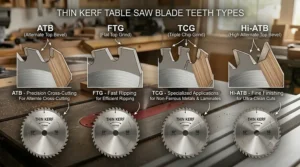
- Match the grind to the cut you do most. Flat-top grind (FTG) blades rip fastest; alternate-top-bevel (ATB) blades crosscut cleanest; combination blades split the difference if you don’t want to swap blades constantly.
- Check your saw’s horsepower. Saws under 2 HP benefit the most from thin kerf — that’s where the reduced material removal actually translates into a noticeably easier cut.
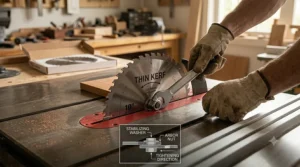
- Confirm riving knife compatibility. Look up the minimum kerf width your saw’s safety equipment requires before ordering an ultra-thin blade.
- Decide if you need dedicated blades or one combination blade. Frequent crosscut/rip switching favors owning two dedicated blades; occasional use favors one combination blade.
- Factor in tooth count for finish needs. More teeth (60–80+) means a smoother finish but slower feed and faster dulling on rough material.
- Consider resharpening economics. Premium blades like the Irwin Marples or CMT often justify their price over 2–3 resharpening cycles rather than on the first cut.
- Don’t ignore arbor size and blade diameter tolerances. A handful of thin kerf blades run slightly undersized (9-3/4″ instead of a full 10″), which can matter on certain miter saws.
Thin Kerf vs. Full Kerf: Which Wins for Your Saw?
| Factor | Thin Kerf (3/32″–7/64″) | Full Kerf (1/8″) |
|---|---|---|
| Motor load | Lower — easier on underpowered saws | Higher — needs more horsepower |
| Material waste | Less waste per cut | More waste per cut |
| Stability | Slightly more prone to flex/wander | Stiffer, more stable under load |
| Best saw type | Benchtop, contractor, jobsite (<2 HP) | Cabinet saws, 3+ HP |
| Riving knife fit | May require checking compatibility | Generally compatible with stock equipment |
The data backs this up at an industrial scale, too: research from the USDA Forest Service has found that thicker saw kerfs create more waste and leave less material available for usable lumber, though the actual yield improvement from going thinner depends on the size of the stock and target thickness being cut. For a hobbyist, the practical takeaway is simpler — if your saw struggles under load or you’re working with pricier hardwood, thin kerf design reduces both problems at once. If you own a 3+ HP cabinet saw and stability matters more than power savings, full kerf blades remain the steadier choice.
Common Mistakes When Buying a Thin Kerf Table Saw Blade
- Assuming “thin kerf” means a fixed number. Kerf width varies by manufacturer — Diablo’s thin kerf blades commonly run narrower than CMT’s or Freud’s, so don’t assume two “thin kerf” blades are interchangeable specs.
- Buying a rip blade for crosscut-heavy work (or vice versa). Flat-top rip blades and high-tooth-count crosscut blades are optimized for opposite jobs; using the wrong one shows up immediately as tear-out or slow feed.
- Ignoring arbor and bore size. Nearly all of these blades use a 5/8-inch arbor, but always double check against your saw’s spec before ordering.
- Skipping the riving knife check. As covered above, this is the single most overlooked compatibility issue with thin kerf blades.
- Choosing based on tooth count alone. Tooth geometry — whether teeth are flat-top, alternate-bevel, triple-chip, or combination — determines cut quality and material compatibility more than raw tooth count does.
Long-Term Cost & Maintenance
A thin kerf table saw blade isn’t a “buy once” purchase — it’s a recurring cost that includes resharpening, eventual replacement, and the indirect cost of motor wear from running a dull blade. Budget blades like the FOXBC 24-tooth typically aren’t designed for many resharpening cycles and are more cost-effective to simply replace once dull. Premium blades — the CMT and Irwin Marples in particular — are explicitly engineered with oversized carbide that supports multiple professional resharpenings, which can make their higher upfront price cheaper per cut over a few years of use.
A rough rule of thumb: if you’re cutting under a few hundred linear feet a month, a $30–$40 blade resharpened once or twice will outlast a budget blade replaced three times over. If you’re running a small production shop, the math shifts further toward premium blades, since downtime for blade changes and the labor cost of inconsistent cuts adds up faster than the price difference between a $35 and $55 blade.
Safety, Riving Knives, and Regulatory Considerations
Thin kerf blades are perfectly safe when matched correctly to your saw — but the kerf-versus-riving-knife mismatch deserves more attention than it usually gets. Your saw’s riving knife or splitter must be thinner than the blade’s kerf to function correctly; if it’s the same thickness or thicker, it can bind in the cut. OSHA standard 1910.213 requires that workplace table saws have a guard, riving knife, and anti-kickback device properly installed unless the specific operation makes this infeasible, and the same logic applies in a home shop even though OSHA’s rule technically governs employers. The Consumer Product Safety Commission has tracked table saw injuries for decades and continues to push voluntary safety standards covering blade guards and riving knives — a reminder that the guard removed “just for this one cut” is exactly how most blade-contact injuries happen. Before installing an ultra-thin kerf blade, check your saw’s owner manual for the minimum kerf width it’s rated to safely accept, and never remove a riving knife or splitter simply because a thinner blade makes it inconvenient to use.
Frequently Asked Questions
❓ What is a thin kerf table saw blade?
❓ Is a thin kerf blade good for ripping hardwood?
❓ Does a thin kerf blade work on a contractor saw?
❓ How long does a thin kerf blade stay sharp?
❓ Can I use a thin kerf blade on any table saw?
Conclusion
There isn’t a single “best” thin kerf table saw blade — there’s a best blade for your saw’s horsepower, the material you cut most, and how much finish quality matters for the project in front of you. If you only want one blade for everything, the Freud LU83R010 or Diablo D1050X combination blades won’t disappoint. If you’re ripping volume hardwood, the CMT 201.024.10 or Freud LU87R010 will save your motor and your lumber budget. And if a flawless finish on plywood or trim is the priority, the Diablo D1080X earns its higher price.
Whatever you choose, double-check your saw’s riving knife compatibility before ordering, and don’t underestimate how much a properly matched thin kerf blade can transform an underpowered saw’s performance.
✨ Found the right blade for your shop?
🔍 Check current pricing and availability on any of the picks above before you buy — stock and pricing on these blades shift often, and grabbing one while it’s in stock beats waiting.
Recommended for You
- 7 Best Combination Blades for Table Saw (2026): Stop Swapping Blades
- 7 Best Crosscut Blades for Table Saws in 2026 (Honest Picks)
- Best Ripping Blade for Table Saw in 2026: 7 Proven Picks
Disclaimer: This article contains affiliate links. As an Amazon Associate, I earn from qualifying purchases. If you purchase products through these links, we may earn a small commission at no additional cost to you.
✨ Found this helpful? Share it with your friends! 💬🤗
