
In This Article
Here’s a truth most woodworkers learn the hard way: you can have a $2,000 cabinet saw humming in your shop, and a $15 bargain blade will still burn through your oak like it’s dragging a cheese grater across the grain. The ripping blade for table saw is the single most important consumable in your workshop. Full stop.
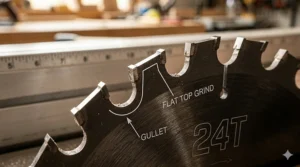
A dedicated ripping blade is engineered for one specific task — slicing wood with the grain, parallel to the wood fibers, over and over again at high feed rates. That’s a fundamentally different mechanical challenge than crosscutting. Where crosscut blades use many fine teeth to sever fibers cleanly, a ripping blade uses fewer, bigger, more aggressive teeth with deep gullets to scoop material out of the kerf like a mini excavator. Get this geometry right, and 8-foot boards practically beg to go through your saw. Get it wrong, and you’re fighting burning, binding, and surfaces so rough they look like a beaver was in charge.
A proper ripping blade for table saw work features 24 teeth (sometimes as few as 20 for thick stock), a flat top grind (FTG) or straight top raking (STR) geometry, and a hook angle between 15° and 20° that aggressively feeds material forward. The result? Faster cuts, less motor strain, and surfaces that can often go straight to glue-up without a jointer pass in between.
In this guide, we’ve done the research so you don’t have to. We’ve identified seven real, currently available blades on Amazon — from a sub-$20 framer’s workhorse to a near-$200 heirloom-quality blade that professional furniture makers swear by. We’ll tell you exactly who each one is for, what its specs actually mean in practice, and which one you should buy based on your saw, your wood, and your budget.
Ready to stop fighting your material and start ripping with authority? Let’s get into it. 🪵
Quick Comparison Table: 7 Best Ripping Blades for Table Saw at a Glance
| Blade | Teeth | Grind | Kerf | Best For | Price Range |
|---|---|---|---|---|---|
| Freud D1024X Diablo | 24T | ATB | Thin (.098″) | Budget framing & general ripping | Under $20 |
| Freud LU87R010 | 24T | FTG | Thin (.094″) | Underpowered saws, hardwood | $40–$55 range |
| Freud LM72R010 | 24T | FTG | Full (.125″) | Heavy-duty industrial ripping | $60–$80 range |
| Ridge Carbide TS21024FT | 24T | FTG/STR | Full (.125″) | Aggressive shop ripping | $65–$85 range |
| Freud LM74R010 | 30T | TCG | Full (.145″) | Glue-line precision ripping | $75–$95 range |
| Forrest WW10307125 | 30T | ATB | Full (.125″) | Premium all-around ripping | $150–$180 range |
| Ultra-Shear US1020RIPFK | 20T | FTG | Full (.125″) | Thick stock, dense hardwood | $85–$110 range |
What this table tells you: The sub-$20 Diablo D1024X is the obvious entry point, but notice how stepping up to the LU87R010 or LM72R010 unlocks true FTG geometry — the reason dedicated rip blades exist in the first place. If you’re ripping more than a few boards a week, the mid-range options ($60–$95) are where the real value lives. The Forrest is the clear premium pick, but its price is justified only if your projects demand glue-ready surfaces directly off the saw.
💬 Just one click — help others make better buying decisions too!😊
✨ Don’t Miss These Exclusive Deals!
🔍 Take your woodworking to the next level with these carefully selected ripping blades. Click on any highlighted product name to check current pricing and availability on Amazon. These tools will transform your rip cuts from rough and slow to fast and furniture-ready!
Top 7 Ripping Blades for Table Saw: Expert Analysis
1. Freud D1024X Diablo 10-Inch 24-Tooth ATB Ripping Saw Blade
The D1024X is Diablo’s entry-level ripping offering, and for casual DIYers or contractors who spend more time building decks than furniture, it punches well above its price point. It features 24 ATB (alternate top bevel) teeth on a thin .098″ kerf plate with a 15° hook angle — not a true flat top grind, but aggressive enough for general ripping duties through framing lumber, plywood, OSB, and hardboard siding.
Here’s what the ATB geometry actually means for you: instead of the dead-flat cutting edge of a true FTG blade, each tooth is slightly beveled left and right, alternating. This improves the finish quality slightly compared to budget FTG blades, but sacrifices some of the raw material-clearing aggression. For dimensional lumber and construction-grade work, you’ll never notice. For hardwood furniture boards where surface quality matters, you might. The thin kerf is a legitimate benefit — your saw will thank you for it when ripping 8/4 oak.
Freud protects these teeth with their TiCo Hi-Density Carbide formula and wraps the whole blade in Perma-Shield non-stick coating, which genuinely reduces heat buildup and resin sticking compared to uncoated competitors at this price. Buyers consistently report it cutting cleanly out of the box with zero setup drama, and the laser-cut stabilizer vents keep vibration impressively quiet.
✅ True value for framing and construction applications
✅ Thin kerf reduces motor strain on contractor saws
✅ Laser-cut stabilizer vents for quieter operation
❌ ATB geometry isn’t optimal for glue-ready rip surfaces
❌ Not ideal for dense hardwood over 2″ thick
Best for: Contractors, DIYers, and hobbyists who need a capable ripping blade under $20 for general lumber, plywood, and framing tasks. If you’re building decks, sheds, or rough furniture and don’t need furniture-grade surfaces off the saw — this is your blade. Price range: under $20.
2. Freud LU87R010 10-Inch Thin Kerf Rip Blade
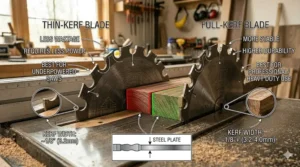
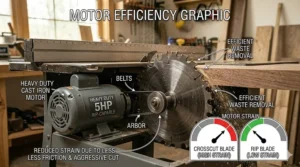
This is the blade that Freud describes as giving “new life to underpowered table saws,” and that’s not marketing fluff — it’s physics. The LU87R010’s .094″ thin kerf literally removes less material per pass, which translates to roughly 33% less load on your motor. For anyone running a contractor saw or benchtop saw under 3HP, that’s the difference between the saw screaming through a rip and bogging down mid-cut on 8/4 hard maple.
What sets this blade above the D1024X is the tooth geometry: a proper flat top grind (FTG) on 24 oversized TiCo carbide teeth. FTG teeth have a dead-flat cutting face that acts like a tiny chisel, shearing wood fibers cleanly and leaving a much flatter kerf floor than ATB designs. That flat kerf floor is why experienced woodworkers say a good rip blade can deliver “glue-line” cuts — surfaces smooth enough to glue directly without jointing. Whether you achieve that depends on your saw’s alignment and feed rate, but the LU87R010 is built to make it possible.
The 20° positive hook angle is notably aggressive — picture the tooth leaning forward into the cut — which accelerates feed rate dramatically. Pair that with anti-kickback design shoulders on the teeth, and you’ve got a blade that rips fast but doesn’t bite back. Shop woodworkers who’ve switched to this blade from combo blades consistently report being shocked by the speed improvement.
✅ FTG geometry delivers near-glue-line rip surfaces
✅ 33% less motor load vs. full kerf blades — essential for saws under 3HP
✅ Anti-kickback shoulder geometry for safer aggressive feed rates
❌ Thin kerf can deflect slightly on very thick, dense exotics
❌ Not the best choice for crosscutting duties — dedicated rip only
Best for: Hobbyists and woodworkers running contractor-style or benchtop table saws who want true FTG performance without maxing out their saw’s motor. Ideal for ripping hardwoods like oak, maple, and cherry up to 2¾” thick. Price range: $40–$55.
3. Freud LM72R010 10-Inch Heavy-Duty Rip Blade
Step up to the LM72R010 and you’re entering professional territory. This is Freud’s heavy-duty industrial rip blade — the one you reach for when you’re ripping 100 board-feet of 8/4 white oak before lunch. The full .125″ kerf plate is noticeably stiffer than the LU87R010, which matters for high-feed-rate gang ripping operations where blade flex would turn your kerf into a lazy S-curve instead of a straight line.
Like its thinner sibling, it sports 24 FTG teeth with TiCo carbide — but the Perma-Shield coating here feels particularly relevant given that heavy ripping generates serious heat. The larger, chunkier tooth bodies also take longer to dull, meaning resharpening intervals are longer than the LU87R010. One thing most buyers overlook: this blade doesn’t need stabilizers in gang-rip setups, which saves time and money on accessories if you’re processing a lot of dimensioned lumber.
The anti-vibration laser-cut slots are a real differentiator here. At aggressive feed rates — the kind you’ll naturally push when you trust a blade — vibration normally telegraphs through the entire saw. With this blade, cabinet-saw users consistently report dramatically quieter, smoother operation even when pushing thick hardwood fast.
✅ Full kerf rigidity ideal for high-feed industrial ripping
✅ Glue-line precision cuts — no stabilizers needed in gang-rip ops
✅ Longer tooth life between sharpenings vs. thin-kerf competition
❌ Requires a saw with 3HP+ for best results
❌ Full kerf generates more sawdust than thin-kerf alternatives
Best for: Serious woodworkers and professionals on cabinet saws (3HP+) who rip hardwood regularly and want a blade that can genuinely serve as a production tool. The go-to for oak, walnut, and hard maple in furniture and cabinetry shops. Price range: $60–$80.
4. Ridge Carbide TS21024FT-5/8 10-Inch Super Ripping Full Kerf Saw Blade
Ridge Carbide is a smaller, American-made brand that flies under the radar compared to Freud and Forrest — and that’s a shame, because the TS21024FT consistently tops Amazon’s bestseller list in the table saw blade category. It has a near-perfect rating across hundreds of verified reviews, which for a blade at this price point is genuinely remarkable.
The specs: 24 teeth with FTG/STR (flat top grind / straight top rake) geometry, a 20° hook angle, full .125″ kerf, and a .087″ plate. That STR geometry is slightly different from pure FTG — the tooth face is optimized for maximum chip ejection speed, with deeper gullets than even the Freud LM72R010. What that translates to in practice is a blade that can sustain higher feed rates for longer before gullets pack up with sawdust. In dense, long-grain hardwoods like hickory or hard maple, that matters enormously — packed gullets cause burning and can stall even powerful saws.
Ridge Carbide uses C-3 carbide with a proprietary grind tolerance, and what many users notice after extended use is that this blade sharpens exceptionally well — it comes back to near-new performance after a professional sharpening, which extends its effective lifespan well beyond cheaper alternatives. This is how you think about a rip blade as an investment rather than a consumable.
✅ Deep FTG/STR gullets — outstanding chip evacuation at speed
✅ Best-selling, near-perfect rated blade on Amazon
✅ American-made with excellent resharpening longevity
❌ Full kerf requires adequate saw horsepower (2.5HP minimum)
❌ Less known brand may be harder to find locally for service
Best for: Workshop woodworkers who want a serious shop ripping blade without paying Forrest premium prices. Outstanding for anyone ripping dense domestic hardwoods like hickory, hard maple, or white oak in volume. Price range: $65–$85.
5. Freud LM74R010 10-Inch Industrial Glue Line Ripping Blade
If you’ve ever tried to glue up a panel from boards ripped on a standard combo blade and had to spend 20 minutes at the jointer getting flat glue surfaces, the LM74R010 is what you’ve been missing. This blade features 30 teeth in a Triple Chip Grind (TCG) geometry — a design borrowed from industrial panel processing where glue-ready surfaces off the saw are not a nice-to-have, they’re a production requirement.
TCG geometry alternates a high trapezoidal tooth with a flat raker tooth. The high tooth shears the outer wood fibers, and the flat raker cleans the floor of the kerf to a glass-smooth finish. On properly aligned cabinet saws, the rip surfaces this blade produces genuinely don’t need jointing before glue-up — which in a busy shop represents a significant time saving across hundreds of panel glue-ups per year. The .145″ kerf is notably wider than other options here, which means this blade needs real horsepower (3HP minimum), but on a proper cabinet saw it feels like cutting air through 4/4 cherry or walnut.
At 30 teeth, feed rate is slightly slower than 24-tooth alternatives — you’re trading speed for surface quality. The sweet spot for this blade is cabinetry, instrument making, and fine furniture where the glue surface quality directly impacts the final product’s integrity.
✅ TCG geometry delivers genuine glue-line surfaces — skip the jointer
✅ 30 teeth balance speed and finish better than crosscut blades
✅ Ideal for cabinetry, instrument makers, fine furniture production
❌ Wide .145″ kerf requires 3HP+ cabinet saws only
❌ Slower feed rate vs. 24-tooth FTG alternatives
Best for: Fine furniture makers, cabinetmakers, and luthiers who need glue-ready rip surfaces directly off the saw. If your work involves lots of edge-glued panels and you want to minimize jointer time, this blade pays for itself within a few projects. Price range: $75–$95.
6. Forrest WW10307125 Woodworker II 10-Inch 30-Tooth Circular Saw Blade
Here it is. The blade that professional furniture makers, fine woodworking instructors, and anyone who’s serious about their craft seems to end up with eventually. The Forrest Woodworker II (model WW10307125) is, by any reasonable measure, among the finest production saw blades available to the American market — and it’s been proving that for decades.
What separates Forrest from every other blade manufacturer on this list isn’t marketing; it’s manufacturing process. Each Woodworker II is essentially hand-made: the plate is hand-tensioned for up to 15 minutes per blade, C-4 carbide teeth are hand-brazed (not machine-set), and the blade is straightened and restraightened multiple times through the production process. The result is a blade with side wobble held to .001″ — most budget blades run .004″ to .010″, which seems small until you realize that wobble becomes tear-out, and tear-out becomes sanding time.
The 30-tooth ATB geometry at .125″ full kerf balances ripping aggression with surprisingly smooth finish quality. You won’t get a glue-line rip from the WW10307125 in the way the LM74R010 delivers, but you’ll get surfaces that need minimal jointing — and the crosscut quality is exceptional too. Forrest’s sharpening service brings this blade back to new-blade tolerances, meaning this is genuinely a once-in-a-decade purchase if maintained properly. The $150–$180 price tag looks very different when amortized over 10+ years of professional use.
✅ Hand-tensioned, hand-brazed construction — near-zero runout
✅ Exceptional versatility: outstanding rip AND crosscut performance
✅ Forrest resharpening service restores exact factory tolerances
❌ High upfront cost — a significant investment for hobbyists
❌ ATB geometry doesn’t match the pure glue-line rip of FTG blades
Best for: Serious hobbyists and professionals who want a heirloom-quality blade they’ll keep for a decade or more. The Woodworker II earns its reputation in furniture and cabinetry shops where cut quality and longevity justify every dollar. Price range: $150–$180.
7. Ultra-Shear US1020RIPFK 10-Inch Thick Stock Rip Blade
Counter-intuitive but true: when you need to rip through 8/4 or 12/4 dense hardwood — think 2-inch-thick hard maple, heavy ash, or 3-inch walnut slabs — you actually want fewer teeth, not more. The Ultra-Shear US1020RIPFK has just 20 teeth for exactly this reason.
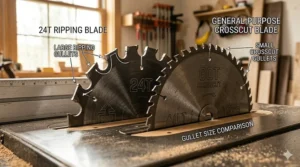
Here’s the physics: more teeth means smaller gullets between them. In thick stock, those small gullets fill with sawdust faster than they can evacuate, which means the blade starts dragging through packed chips instead of cutting cleanly through wood. The result is heat, burning, and a struggling motor. Ultra-Shear’s 20-tooth blade solves this with deeply curved gullets that can clear enormous chip volumes with each revolution. The flat top grind geometry and .125″ full kerf complete the picture — this is a blade designed to be pushed hard through material that would make lesser blades weep.
Ultra-Shear builds these in the USA and has won considerable loyalty among serious woodworkers for their carbide quality and plate consistency. The blade is available in both full kerf and thin kerf versions, which is smart: the thin kerf version (.094″) makes it approachable on saws in the 2–3HP range, while the full kerf suits cabinet saws running 3HP+. Customer feedback consistently mentions being surprised by how cool the blade runs even in prolonged thick-stock ripping sessions.
✅ 20-tooth design purpose-built for thick, dense hardwood ripping
✅ Deep gullets prevent chip packing on 8/4+ stock
✅ USA-made with exceptional plate consistency
❌ Not ideal for thinner stock (¾”) where 24T delivers better results
❌ Smaller brand with less widespread availability than Freud
Best for: Woodworkers regularly processing thick hardwood slabs — 8/4 and heavier — in species like hard maple, hickory, wenge, or similar demanding materials. If thick exotic stock is your thing, this blade handles it better than anything else on this list. Price range: $85–$110.
How to Use a Ripping Blade Correctly: A Practical Usage Guide
Buying the right blade is only half the equation. Plenty of woodworkers have excellent ripping blades that they’re running incorrectly, and the results are predictably disappointing — burning, binding, rough surfaces, or worse.
Blade height matters more than most people realize. The common woodworking advice to raise your blade just above the stock thickness is actually wrong for aggressive ripping. For a dedicated rip blade running through hardwood, raise the blade so the gullets clear the top of the workpiece — approximately ¾” of blade exposure above the wood. This gives the gullets room to fully evacuate chips rather than packing them back into the kerf. You’ll hear the difference immediately: a clean, consistent tone versus the irregular chatter of chip packing.
Feed rate is your most important variable. Too slow, and the blade generates friction heat that burns your wood (and dulls your carbide faster). Too fast, and you’re overloading the motor and potentially deflecting the blade. The right feed rate sounds like a consistent, moderate roar with no variation in pitch. If the saw slows down or the pitch drops, you’re feeding too fast. If you see burn marks on the cut surface, feed faster — counterintuitive but accurate.
Featherboard placement on rip cuts keeps the workpiece registered firmly against the fence throughout the cut. Position one featherboard just before the blade, on the fence side of the stock. This prevents the wood from wandering away from the fence mid-cut, which causes wavy, inaccurate surfaces that no blade can compensate for.
Don’t forget the splitter or riving knife. Long rip cuts in hardwood are exactly the situation where wood can close in behind the blade due to internal stress release, pinching the blade and causing dangerous kickback. Your saw’s riving knife or splitter is your insurance policy — keep it in place for every rip cut, every time. The U.S. Consumer Product Safety Commission estimates table saws cause over 30,000 injuries annually, and kickback during rip cuts is a leading mechanism.
Cleaning your blade after every session with a blade cleaner or simple pitch solvent takes 90 seconds and noticeably extends carbide edge life. Resin and pitch buildup on teeth acts as an insulating layer that traps heat — the enemy of sharp carbide.
Who Should Buy Which Blade: A Buyer’s Decision Framework
Stop guessing. Answer two questions and your blade choice becomes obvious.
Question 1: What’s your saw’s horsepower?
- Under 2HP (benchtop/jobsite saw): You need a thin kerf blade. The Freud LU87R010 or D1024X are your best options. Full kerf blades on underpowered saws = slow cuts, hot motor, and frustrated woodworking sessions.
- 2–3HP (contractor saw): Either kerf works. The LU87R010 (thin) or TS21024FT (full, push it a bit) are ideal. Avoid the LM74R010’s .145″ kerf at this power level.
- 3HP+ (cabinet saw): Welcome to the full kerf world. Every blade on this list performs optimally for you. The LM72R010, Ridge Carbide TS21024FT, and Ultra-Shear US1020RIPFK are all excellent choices.
Question 2: What is the output quality you need?
- Rough lumber, framing, construction: → Diablo D1024X (save your money)
- Clean shop ripping, furniture parts: → Freud LU87R010 or Ridge Carbide TS21024FT (the sweet spot)
- Glue-ready panels, skip the jointer: → Freud LM74R010 (TCG geometry is non-negotiable here)
- Thick slabs and dense exotics: → Ultra-Shear US1020RIPFK (fewer teeth, deeper gullets)
- Heirloom quality, long-term investment: → Forrest WW10307125 (buy once, sharpen indefinitely)
If you can only own one ripping blade and you run a mid-range cabinet saw, the Ridge Carbide TS21024FT is probably the most honest answer for the widest range of users. It’s serious enough for a professional, affordable enough for a serious hobbyist, and American-made to boot.
How to Choose the Best Ripping Blade for Table Saw: 6 Expert Criteria
Not all ripping blades are equal, and the specifications you’ll see on Amazon listings range from genuinely useful to completely irrelevant marketing noise. Here’s what actually matters:
1. Tooth Count (24T is the magic number for most ripping) For standard ripping of ¾” to 2¾” stock, 24 teeth represents the proven sweet spot between chip clearance and surface quality. Go lower (20T) for thick stock; go higher (30T with TCG) for glue-line precision. Ignore the instinct to buy higher tooth counts thinking more teeth = better results — for ripping, it’s the opposite.
2. Tooth Geometry (FTG vs. ATB vs. TCG) Flat Top Grind (FTG) is the gold standard for dedicated ripping. Each tooth acts like a tiny flat-faced chisel. ATB (alternate top bevel) works fine for general-purpose blades but produces a slightly more textured rip surface. TCG (triple chip grind) is the choice for glue-line precision. See our comparison table below.
3. Hook Angle (Higher = More Aggressive) A 20° positive hook angle leans the tooth forward aggressively, pulling material into the cut and accelerating feed rate. Most serious rip blades run 15–20°. Stay in this range and you’ll be fine. Negative hook angles are for crosscutting and miter work — entirely the wrong tool for ripping.
4. Kerf Thickness (Match to Your Saw’s Horsepower) We covered this above, but it bears repeating: thin kerf (.094″–.098″) for saws under 3HP; full kerf (.125″+) for cabinet saws. The power savings on thin-kerf blades are real — measurable, not theoretical.
5. Carbide Quality (Look for TiCo or C-4 Designations) Standard carbide wears relatively quickly in hardwood. TiCo (Titanium Cobalt) carbide from Freud and C-4 carbide from Forrest are harder and more wear-resistant, staying sharper longer between resharpenings. On a blade you’ll use weekly, carbide quality is the biggest determinant of total cost of ownership.
6. Plate Stability and Anti-Vibration Features Laser-cut expansion slots in the plate serve a real engineering purpose: they allow the plate to expand with heat without warping. On long rip cuts through dense hardwood, blade temperature can rise significantly — Fine Woodworking magazine has documented temperature rise in extended ripping sessions. Expansion slots keep the blade running true even as it heats up. This is why quality blades feel smoother in long cuts than budget alternatives — it’s not just carbide; it’s plate engineering.
FTG vs. ATB vs. TCG: The Tooth Geometry That Actually Determines Your Results
| Grind Type | Rip Performance | Surface Quality | Best Application |
|---|---|---|---|
| FTG (Flat Top Grind) | ⭐⭐⭐⭐⭐ | ⭐⭐⭐⭐ | Dedicated ripping, shop work |
| ATB (Alternate Top Bevel) | ⭐⭐⭐ | ⭐⭐⭐⭐⭐ | General purpose, crosscuts |
| TCG (Triple Chip Grind) | ⭐⭐⭐⭐ | ⭐⭐⭐⭐⭐⭐ | Glue-line ripping, panel work |
| STR/FTG Combo | ⭐⭐⭐⭐⭐ | ⭐⭐⭐⭐ | Aggressive fast-feed ripping |
The table tells the story clearly: FTG and its variants dominate for dedicated ripping applications, while ATB shines in crosscutting and general work. The key takeaway? A 24-tooth ATB blade is not a ripping blade — it’s a general-purpose blade. You wouldn’t use a Phillips screwdriver for a flathead screw and call it a compromise. Tooth geometry matters just as much as tooth count.
Common Mistakes When Buying a Ripping Blade for Table Saw
Mistake 1: Assuming more teeth = better for everything. The ripping blade for table saw with 24 or even 20 teeth is faster and cleaner for rip cuts than a 60-tooth crosscut blade. Beginners universally make this mistake because “more teeth” intuitively sounds like “more precision.” In ripping, fewer, larger teeth with deep gullets is the engineering truth.
Mistake 2: Ignoring the saw’s horsepower when choosing kerf. Putting a .145″ full kerf blade on a 1.5HP contractor saw is like trying to drive a Mack truck engine on a motorcycle frame. The saw works, but it’s laboring — cuts are slower, quality suffers, and motor life shortens. Match kerf to horsepower and you’ll instantly notice the difference.
Mistake 3: Running a combo blade for dedicated ripping. Combo blades are genuinely impressive engineering compromises, but they’re compromises. If you’re ripping board after board of hardwood, a dedicated ripping blade will outperform even the best combo blade in speed, surface quality, and heat management. A two-blade setup (rip blade + crosscut blade) is the standard approach in any serious shop, and it costs less than most people assume.
Mistake 4: Skipping blade maintenance. Carbide teeth dull gradually — so gradually that most woodworkers don’t notice until the blade is markedly degraded. A dull rip blade burns wood, strains the motor, and can cause dangerous kickback as it requires more force to feed. Clean your blade after every session, and have it professionally sharpened at the first sign of burning or resistance. According to Popular Mechanics, a properly maintained carbide blade can be resharpened 5–10 times before needing replacement — an economics argument for buying quality.
Mistake 5: Neglecting fence alignment. The best ripping blade on earth will produce wavy, inaccurate cuts if your fence isn’t parallel to the blade. Before blaming the blade, verify your fence alignment with a reliable square. This is the most common culprit behind unexplained ripping problems and is almost always misdiagnosed as a blade issue.
Ripping Blade for Hardwood vs. Softwood: Does It Actually Matter?
Short answer: yes, more than most people expect. Here’s the nuance.
Softwoods (pine, fir, cedar) have long, relatively soft wood fibers that compress and yield easily. An ATB blade like the D1024X handles softwood ripping adequately because the fiber structure doesn’t demand maximum chip-clearance efficiency — the wood is cooperative. Feed rates are faster, heat buildup is less aggressive, and surface quality differences between blade types are smaller.
Hardwoods are a different animal entirely. Species like oak, maple, walnut, hickory, and cherry have tight, interlocked grain that resists the blade and generates significantly more heat and cutting resistance per linear inch. This is where a dedicated ripping blade for hardwood earns its keep — the deeper gullets of a 24T FTG blade clear chips fast enough that the cutting zone doesn’t accumulate heat, and the flat top geometry shears the fibers cleanly rather than tearing them. The ripping blade for oak specifically benefits from the 20° positive hook angle found on the Freud LM72R010 and Ridge Carbide TS21024FT — oak’s interlocked grain needs that forward-leaning tooth to initiate the cut reliably without the blade chattering in the kerf.
For exotic hardwoods (wenge, ipe, purpleheart, ebony), the Ultra-Shear US1020RIPFK’s 20-tooth design becomes genuinely important. These species are so dense that standard 24-tooth blades pack their gullets before the chips can clear, leading to burning and dramatically reduced blade life.
A useful resource for understanding wood species properties and how they affect machining: The Wood Database provides detailed hardness, grain, and machinability data for hundreds of species — essential reading before you choose a blade for unfamiliar material.
Long-Term Cost & Maintenance: The Real Economics of Quality Ripping Blades
The upfront price of a ripping blade is the wrong number to focus on. The right number is cost per rip foot over the blade’s useful life.
A $15 no-name blade that dulls after 200 linear feet of oak ripping and can’t be resharpened has a cost of roughly 7.5 cents per foot before factoring in the labor of blade changes, the burned wood you have to sand or joint off, and the motor strain. A $65 Ridge Carbide blade that stays sharp for 2,000 feet, resharpens for $20–$25 per service, and does so five times before replacement has a cost of approximately 1.5–2 cents per foot — less than a quarter of the cheap blade’s cost over its lifetime.
For the Forrest WW10307125, that economics argument is even stronger. At $150–$180 upfront, resharpened to factory tolerance for around $25–$30, and serviceable for a decade or more of regular use, this is genuinely the most economical blade available for anyone who rips hardwood weekly. The OSHA Woodworking Safety Guidelines also note that sharp, properly maintained blades are a fundamental safety requirement — a dull blade that requires more force to feed is statistically more likely to kick back.
Budget blades don’t just cost more per cut — they cost more in time, in safety risk, and in wood waste from inferior cut quality.
✨ Don’t Miss These Exclusive Deals!
🔍 Ready to upgrade your shop? Click any highlighted blade name in this article to check current pricing and availability on Amazon. Your table saw deserves a blade that matches its potential!
FAQ: Ripping Blade for Table Saw
❓ What is a ripping blade for table saw and how does it differ from a crosscut blade?
❓ What is the best tooth count for a ripping blade on a 10 inch table saw?
❓ Can I use a flat top grind ripping blade for hardwood like oak?
❓ Is a thin kerf or full kerf ripping blade better for my table saw?
❓ How often should I sharpen or replace my ripping blade for table saw?
Conclusion: Stop Compromising — Get the Right Ripping Blade
There are few upgrades in a woodworking shop with a higher immediate impact than switching from a dull combo blade to a dedicated ripping blade for table saw work. The difference is visceral: lumber that was slow, smoky, and rough suddenly goes through with a satisfying, effortless purr. Surfaces that used to require an extra jointer pass come off the saw ready to glue. Your motor stops sounding like it’s suffering.
The seven blades on this list represent the full spectrum of what’s available in 2026 — from the workhorse Diablo D1024X that costs less than a bag of hardware store sandpaper, to the Forrest Woodworker II that professional furniture makers treat like a family heirloom. The right choice depends on your saw, your wood, and your standards for output quality.
Our honest overall recommendation for most workshop woodworkers: the Freud LU87R010 or LM72R010 depending on your saw’s horsepower. They deliver genuine FTG performance, real industrial carbide quality, and Freud’s decades of blade engineering at a price that makes sense whether you’re a weekend hobbyist or running a small production shop. If you want the absolute best and price is secondary, save up for the Forrest. You’ll thank yourself later.
Buy the right blade. Your saw — and your wood — will immediately tell you the difference. 🪵✨
✨ Don’t Miss These Exclusive Deals!
🔍 Take your woodworking to the next level with these carefully selected ripping blades. Click on any highlighted product to check current pricing and availability. These tools will transform your workshop results — fast, clean rip cuts every time!
Recommended for You
- Which Table Saw Blade Do I Need? 7 Best Picks (2026)
- Best Table Saw for Cutting Plywood: 7 Expert Picks
- 7 Best Table Saws Under $2000 in 2026
Disclaimer: This article contains affiliate links. As an Amazon Associate, I earn from qualifying purchases. If you purchase products through these links, we may earn a small commission at no additional cost to you.
✨ Found this helpful? Share it with your friends! 💬🤗
