
In This Article
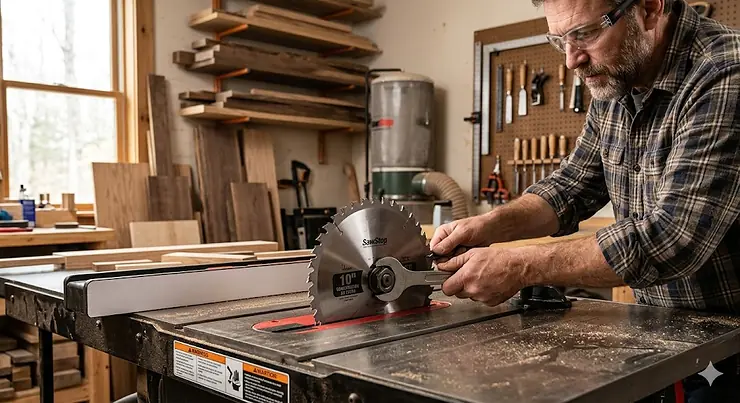
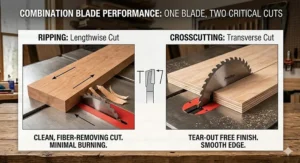
There’s a particular kind of shop-floor regret that comes from owning four blades and reaching for the wrong one anyway. You’re three cuts deep into a rip, your crosscut blade is mounted, and the wood is tearing out like it personally resents you. A combination blade for table saw use exists precisely to end that cycle. It’s the one disc that rips with your grain and crosscuts against it without making you choose a side — a tradesperson’s compromise, not a beginner’s shortcut.
This isn’t a blade that wins every category. A dedicated 24-tooth ripper will out-pace it on long boards, and a 80-tooth crosscut blade will leave a cleaner edge on delicate veneer. What a good combination blade does is remove the friction of switching tools mid-project, which for most hobbyists, weekend builders, and even busy contractors matters more than chasing the theoretical best result for one specific cut. According to the Occupational Safety and Health Administration, table saws remain one of the most common sources of power-tool injuries in American workshops — and unnecessary blade changes, rushed because someone’s tired of swapping discs, are exactly the kind of moment where corners get cut and fingers don’t forgive it.
Below, we dig into seven real blades you can buy on Amazon right now, why each one earns its spot, and how to figure out which one actually belongs on your arbor.
What Is a Combination Blade for Table Saw Use?
A combination blade is a single carbide-tipped disc engineered to handle both rip cuts (with the wood grain) and crosscuts (against it) without swapping blades. It typically uses an alternating tooth bevel pattern with 40 to 50 teeth, balancing the aggressive material removal of a rip blade with the cleaner finish of a crosscut blade — a practical middle ground for general-purpose woodworking.
Quick Comparison Table
| Blade | Teeth | Best For | Price Range |
|---|---|---|---|
| Diablo by Freud D1050X | 50 | Best overall pick | $30–$40 |
| IRWIN Marples 1807368 | 50 | Premium feel, lower cost | $30–$40 |
| DEWALT DW7615 | 50 | Dependable mid-range | $25–$35 |
| CMT 256.050.10 ITK Xtreme | 50 | Underpowered saws, low vibration | $35–$45 |
| Freud P410 Premier Fusion | 40 | Pro-grade finish quality | $90–$110 |
| WEN BL1040 | 40 | Tightest budget | $15–$25 |
| FOXBC 10″ Combination | 50 | Backup / occasional use | $20–$30 |
Here’s the honest read on that table: the Diablo D1050X and the IRWIN Marples 1807368 are nearly tied for best all-around value, and which one you pick may come down to whether your local hardware store stocks Diablo or Irwin — both are made on similar Italian production lines and perform almost identically. The Freud P410 costs roughly three times as much as the budget options, and it earns that premium mostly in resharpening life and finish quality, not in raw versatility. If your saw struggles to push through hardwood without bogging down, the thin-kerf CMT 256.050.10 deserves a longer look than its price tag suggests.
💬 Just one click — help others make better buying decisions too! 😊
Top 7 Combination Blades for Table Saws: Expert Analysis
1. Diablo by Freud D1050X — The Default Answer
The Diablo D1050X is the blade most experienced woodworkers reach for when someone asks “just tell me what to buy.” It runs 50 alternate-top-bevel teeth on a .098-inch thin kerf with a 15-degree hook angle, which in plain English means it removes wood fast enough for ripping without leaving the rough, splintery edge you’d expect from a low-tooth-count ripping blade. The thin kerf also matters more than people give it credit for — it means your saw’s motor isn’t fighting through as much material per pass, so underpowered contractor saws don’t bog down the way they might on a full-kerf blade.
What stands out in practice is how forgiving it is. You can run 3/4-inch plywood through it and get a cut clean enough to skip sanding, then immediately rip a 2×4 without noticing a performance cliff. That’s the entire point of a combination blade, and the D1050X nails it better than blades costing twice as much.
Best for: Anyone who wants one blade that handles 90% of table saw work without drama.
✅ Excellent balance of rip and crosscut performance
✅ Thin kerf reduces strain on smaller motors
✅ Widely available, easy to find replacement stock
❌ Not the smoothest finish on delicate veneers
❌ Carbide is good, not premium-grade — expect moderate resharpening intervals
Price range: around $30–$40 — Verdict: hard to beat at this price.
2. IRWIN Marples 1807368 — The Quiet Overachiever
The IRWIN Marples 1807368 doesn’t get the brand recognition of Diablo, but it’s manufactured in Udine, Italy, on equipment that produces blades for several premium European brands — and it shows. This 50-tooth ATB blade with raker tooth geometry includes a heat-resistant, non-stick coating reinforced with an aluminum matrix, which sounds like marketing language until you notice your blade isn’t gumming up with resin after three hours of cutting pine.
What most buyers overlook about this blade is that it’s frequently rated by long-term users as outperforming the Diablo combination blade in actual cut quality, possibly because Irwin tensions the plate more precisely. It costs a few dollars more, and depending on where you shop, sometimes less — pricing between Irwin and Diablo flips depending on retailer promotions.
Best for: Buyers who want premium European manufacturing without paying premium-blade prices.
✅ Precision-tensioned plate reduces wobble
✅ Heat-resistant coating limits pitch buildup
✅ Strong reputation among long-term shop owners
❌ Slightly less common at big-box stores than Diablo
❌ Raker tooth design means marginally rougher crosscuts than a pure ATB blade
Price range: $30–$40 — Verdict: a genuine alternative to the category leader, not a knockoff.
3. DEWALT DW7615 — The Dependable Workhorse
DEWALT’s reputation runs on reliability rather than flash, and the DEWALT DW7615 fits that mold exactly. It’s a 50-tooth ATBR (alternate top bevel with raker) combination blade on a 5/8-inch arbor — DEWALT’s standard fit for most contractor and benchtop table saws. The practical upside here is consistency: DEWALT’s carbide formulation holds an edge a bit longer under repeated framing-lumber cuts, which matters if you’re cutting pressure-treated stock that chews through lesser carbide faster than kiln-dried hardwood would.
What most buyers overlook about this model is that it pairs naturally with DEWALT’s miter saw blade lineup, so if you already own DEWALT crosscut or framing blades, the carbide grade and kerf width will feel familiar across tools.
Best for: DEWALT tool owners who want brand consistency across their blade collection.
✅ Reliable carbide hold-up on rough lumber
✅ Standard 5/8″ arbor fits most consumer table saws
✅ Competitively priced for the DEWALT name
❌ Finish quality is good, not exceptional, on fine plywood
❌ Raker tooth pattern slightly limits crosscut smoothness vs. pure ATB blades
Price range: $25–$35 — Verdict: solid, unglamorous, and exactly what most garages need.
4. CMT 256.050.10 ITK Xtreme — The Underpowered-Saw Specialist
If your table saw is a benchtop or jobsite model that occasionally struggles under load, the CMT 256.050.10 is the blade built specifically for that problem. CMT’s Industrial Thin Kerf design uses a .098-inch kerf on a .071-inch plate, and the tooth configuration alternates four ATB teeth with one flat-top tooth — a hybrid pattern that splits the difference between aggressive material removal and clean edges. The plate is hardened to 46–48 Rockwell, with laser-cut expansion slots that genuinely reduce the high-pitched whine you get from cheaper steel under heat.
In practice, this blade runs noticeably cooler than thicker-kerf alternatives, which translates to less binding and fewer burn marks on slower feed rates — the exact failure mode beginners hit most often.
Best for: Benchtop and contractor saws with motors under 2 HP, or anyone who’s tired of scorch marks.
✅ Thin kerf reduces motor strain dramatically
✅ Anti-vibration laser-cut slots noticeably quiet the cut
✅ Trimetallic brazing improves carbide retention over time
❌ Premium positioning means a higher price than Diablo or DEWALT
❌ Less commonly stocked in physical stores; mostly an online purchase
Price range: $35–$45 — Verdict: worth the upgrade if your saw has ever bogged down mid-cut.
5. Freud P410 Premier Fusion — The Pro-Shop Splurge
The Freud P410 sits in a different weight class entirely. It’s a 40-tooth hi-ATB general-purpose blade marketed as Freud’s “next generation” combination design, and the carbide grade is noticeably harder than what you’ll find in the sub-$40 blades on this list. The real-world payoff is resharpening life — shops that run this blade daily report stretching the interval between sharpenings well beyond what budget blades manage, which matters more than the sticker price once you calculate cost per cut over a few years.
The spec sheet won’t tell you this, but the trade-off is fragility at the tip: several long-term owners report occasional chipped teeth, likely because the harder carbide formulation that extends edge life also makes individual teeth slightly more brittle on impact with knots or embedded debris.
Best for: Production shops and serious hobbyists who run hundreds of board feet a month and want to minimize sharpening trips.
✅ Exceptional cut quality on hardwood and plywood alike
✅ Long resharpening intervals reduce long-term cost per cut
✅ Premium carbide grade holds an edge longer under heavy use
❌ Triple the price of budget combination blades
❌ Harder carbide is somewhat more prone to chipping on hidden nails or knots
Price range: $90–$110 — Verdict: overkill for occasional use, genuinely worth it for daily shop work.
6. WEN BL1040 — The Backup Blade Everyone Should Own
Every shop needs one blade it doesn’t feel guilty about ruining, and the WEN BL1040 fills that role better than anything else on this list. It’s a 40-tooth combination blade with heat expansion slots and a thin-kerf, anti-gumming coating, priced low enough that buying a second one as insurance against a hidden nail doesn’t sting. The honest pitch here isn’t “this performs like a $40 blade” — it’s “this performs well enough that you’ll forget it cost less than a fast-food meal until you check the receipt.”
What most buyers overlook is that keeping a cheap combination blade like this mounted specifically for scrap, reclaimed, or unknown-origin lumber protects your good blades from the carbide-chipping damage embedded fasteners cause.
Best for: Budget-conscious DIYers, students, and anyone cutting reclaimed or salvaged wood.
✅ Genuinely low price point
✅ Performs respectably on hardwood, softwood, and sheet goods
✅ Great as a sacrificial blade for questionable lumber
❌ Carbide doesn’t hold an edge as long as pricier options
❌ Noticeably more vibration on dense hardwoods than premium blades
Price range: $15–$25 — Verdict: not a forever blade, but an excellent one to keep around anyway.
7. FOXBC 10″ Combination Blade — The Capable Stand-In
The FOXBC 10″ Combination Blade has quietly built a following among buyers who want Diablo-level versatility without the brand markup. Its 50-tooth design uses FoxCarbide tips with a large gullet for efficient chip clearance, and it’s compatible across table saws, miter saws, and even radial arm saws — useful if your shop has more than one machine sharing blade duty. Owners frequently note that the 5/8-inch arbor fits snugly without needing a reducer ring, a small detail that matters more than it sounds when you’re under a saw at 11 PM trying to finish a project.
Best for: Buyers furnishing a multi-saw shop on a budget, or anyone wanting a Diablo-style blade without the Diablo-style price.
✅ Large gullet design clears chips well, reducing burning
✅ Cross-compatible with miter and radial arm saws
✅ Strong value relative to name-brand combination blades
❌ Less brand recognition means fewer long-term reviews to lean on
❌ Slightly thicker plate than ultralight thin-kerf competitors
Price range: $20–$30 — Verdict: a smart budget pick if you’re equipping more than one saw.
Practical Usage Guide: Getting the Most From Your Combination Blade
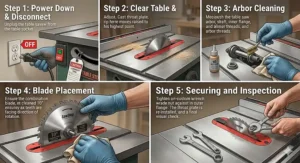
Mounting the blade correctly is half the battle — and it’s the half people rush. Make sure the arbor washer seats flush, check that the blade’s rotation arrow matches your saw’s spin direction, and resist the urge to crank the arbor nut down with a four-foot cheater bar; snug is sufficient, and over-torquing can warp thinner-kerf plates over time.
For the first 30 days, watch your feed rate more than usual. New carbide edges are sharper than you’re used to, and pushing material through at your old speed often causes overheating before you’ve built a feel for the blade’s actual cutting capacity. A burning smell or dark scorch line on the cut edge is your saw telling you to slow down, not a defect in the blade.
Maintenance is refreshingly simple: clean pitch and resin buildup with a dedicated blade cleaner every few dozen cuts, store the blade flat or hung vertically rather than stacked under other tools, and resharpen before the cut quality visibly degrades rather than after — waiting until a blade is fully dull stresses your motor and bearings unnecessarily.
Real-World Scenarios: Matching the Blade to the Builder
The weekend furniture hobbyist building a bookshelf out of plywood and pine on weekends, with a contractor-grade saw in a garage, should look at the Diablo D1050X or IRWIN Marples 1807368. Both deliver furniture-grade finish without demanding premium-blade money for a hobby that doesn’t run daily.
The jobsite framer cutting pressure-treated lumber and OSB all week on a benchtop saw that occasionally strains under load benefits most from the CMT 256.050.10 — the thin kerf and anti-vibration design directly address the bogging-down problem that plagues underpowered saws on a busy site.
The small production shop turning out cabinet components or trim daily, where sharpening downtime costs real money, justifies the Freud P410. The math changes when you’re running board feet by the hundreds rather than the dozens — resharpening intervals become a line item, not a footnote.
How to Choose a Combination Blade for Table Saw Work
- Match tooth count to your typical cut. Closer to 40 teeth favors ripping speed; closer to 50–60 favors crosscut smoothness. Most general use sits comfortably at 50.
- Check your saw’s horsepower before buying full-kerf. Underpowered saws (under 2 HP) almost always perform better with thin-kerf blades like the CMT or Diablo.
- Confirm arbor size before checking out. Nearly all consumer 10-inch table saws use a 5/8-inch arbor, but it’s a five-second check that saves a return shipment.
- Decide if resharpening interval matters to your budget. Daily users should weight premium carbide higher; occasional users gain little from paying for longevity they won’t use.
- Consider a sacrificial blade for unknown lumber. Reclaimed wood and scrap often hide nails or screws; a cheap combination blade protects your primary blade’s carbide from damage.
- Read for vibration complaints, not just cut quality. A blade that cuts beautifully but vibrates badly will eventually throw off your accuracy and wear your saw’s bearings faster.
- Don’t assume more expensive always means more versatile. The $100 Freud P410 isn’t more versatile than the $35 Diablo D1050X — it’s more durable under heavy use. Versatility plateaus quickly; durability keeps climbing with price.
Combination Blades vs. Dedicated Rip and Crosscut Blades
A dedicated 24-tooth flat-top-grind ripping blade will out-cut any combination blade on long, fast rips through thick stock — fewer teeth mean bigger gullets, and bigger gullets clear chips faster without binding. Similarly, an 80-tooth crosscut blade leaves a noticeably cleaner edge on hardwood plywood than any 40-to-50-tooth combination blade can manage, because more teeth simply contact less material per tooth, reducing tear-out.
The trade-off is obvious once you frame it that way: specialization wins on a single metric, while a combination blade wins on total time saved across a typical project. If you’re building one piece of furniture that mixes rips and crosscuts throughout the day, swapping blades twelve times costs more in setup time than the marginal cut-quality loss from staying on one combination blade. Professional production shops running the same cut hundreds of times justify dedicated blades; everyone else is usually better served staying combination.
Common Mistakes When Buying a Combination Blade
The most common error is buying based on tooth count alone without checking kerf width — a thicker full-kerf blade on an underpowered saw will bog down regardless of how good the tooth geometry is. The second mistake is assuming all 50-tooth blades perform identically; tooth grind pattern (ATB versus ATBR versus the hybrid CMT design) changes performance more than the raw count suggests. The third, and most expensive mistake, is buying a single premium blade and using it on reclaimed or unknown lumber, where a hidden nail can chip carbide that cost three times as much to replace as a budget blade would have.
What to Expect: Real-World Performance
On fresh kiln-dried pine, every blade on this list will produce an acceptable cut — the differences show up on harder materials. Run any of these through 3/4-inch hardwood plywood and you’ll notice the budget options (WEN, FOXBC) leave slightly more visible tear-out on the underside of the cut, while the Diablo, Irwin, and especially the Freud leave an edge clean enough to skip a sanding pass before edge-banding.
Vibration is the other tell. Cheaper blades transmit more feel through the fence and tabletop, which doesn’t necessarily mean a worse cut, but it does mean more operator fatigue over a long cutting session — a detail that matters far more in an eight-hour shop day than in a Saturday-afternoon project.
Long-Term Cost & Maintenance
Run the math past the sticker price. A $20 blade resharpened three times a year for five years, at roughly $10–15 per sharpening, lands close in total cost to a $90 blade resharpened once a year over the same period — except the premium blade likely held a cleaner edge the entire time. For anyone cutting more than a few times a month, total cost of ownership tends to favor the mid-tier and premium options once sharpening frequency is factored in, even though the upfront number looks worse.
Safety, Setup, and Compliance Basics
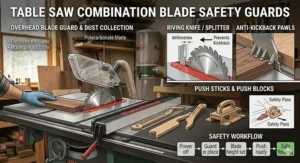
Combination blades don’t carry special regulatory requirements beyond standard table saw operation, but blade selection intersects with safety more than people assume. A dull or mismatched blade increases binding risk, and binding is the leading mechanical cause of kickback — one of the most dangerous table saw failure modes. The Occupational Safety and Health Administration’s guidance on table saw guarding covers blade guards, push sticks, and anti-kickback devices in detail, and it’s worth a read even for hobbyists working solo in a garage, since most of the same hazards apply regardless of whether the saw sits in a factory or a driveway.
Keeping your blade clean, sharp, and correctly tensioned isn’t just about cut quality — a well-maintained blade is meaningfully safer than a neglected one, and that’s not marketing language from a blade manufacturer; it’s basic physics. A struggling blade asks the wood to push back, and wood pushing back is exactly how kickback injuries happen.

FAQ
❓ What is the best combination blade for table saw use?
❓ How many teeth should a combination blade have?
❓ Can a combination blade replace both rip and crosscut blades?
❓ How long does a combination blade stay sharp?
❓ Is a thin kerf combination blade better for a table saw?
Conclusion
If there’s one lesson worth taking from comparing seven of these blades side by side, it’s that “best” depends entirely on how often you’re at the saw. The Diablo D1050X earns its reputation as the default recommendation for good reason — it’s the blade that asks the least of you while delivering the most. The Freud P410 makes sense once cutting becomes a daily habit rather than a weekend hobby, and the humble WEN BL1040 deserves a permanent spot in every shop specifically because it’s cheap enough to sacrifice without a second thought.
What matters more than any single spec sheet is matching the blade to your actual cutting pattern — and being honest with yourself about whether you’re a once-a-month DIYer or someone who should be thinking about resharpening schedules at all.
✨ Don’t Miss These Exclusive Deals!
🔍 Take your next project to the next level with these carefully selected blades. Click on any highlighted pick to check current pricing and availability — the right blade saves you more time than its price tag suggests.
Recommended for You
- 7 Best Crosscut Blades for Table Saws in 2026 (Honest Picks)
- Best Ripping Blade for Table Saw in 2026: 7 Proven Picks
- Which Table Saw Blade Do I Need? 7 Best Picks (2026)
Disclaimer: This article contains affiliate links. As an Amazon Associate, I earn from qualifying purchases. If you purchase products through these links, we may earn a small commission at no additional cost to you.
✨ Found this helpful? Share it with your friends! 💬🤗
