
In This Article
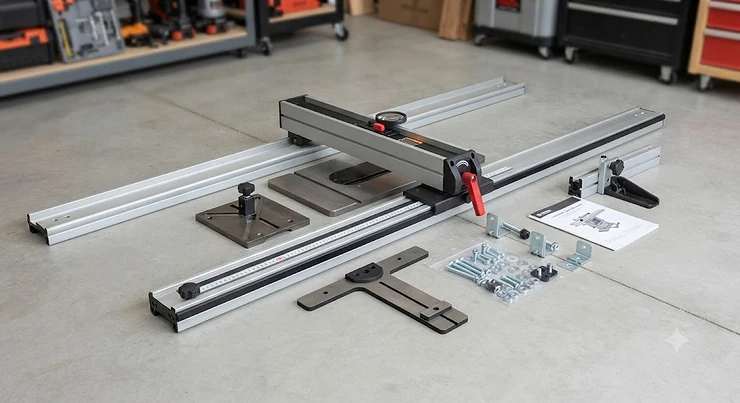
Every cabinet saw eventually hits the same wall: the fence. The motor’s fine, the trunnions are dead-on, the cast iron top is flat enough to check with a straightedge and not lose sleep — and yet every rip still feels like a negotiation. That wobble when you lock the handle down. The scale that lies to you by a sixteenth. The way it drifts a hair out of parallel every few months no matter how carefully you tune it. If any of that sounds familiar, you’re not dealing with a saw problem. You’re dealing with a fence problem, and a table saw fence upgrade kit for cabinet saws is the fix that actually sticks.
This guide skips the marketing copy and gets into what actually matters: real products, real specs, and honest analysis of who each one is built for. We looked at systems spanning a cabinet saw fence rail system built for full-size Biesemeyer-style rails down to compact, budget-conscious kits that still deliver machinist-grade repeatability. Whether you’re chasing a heavy duty fence upgrade for table saw work in a production shop, or you just want your weekend cuts to stop lying to you, there’s a real, verifiable option below — priced in ranges (never exact figures, since Amazon prices shift constantly), and evaluated on the same criteria a shop foreman would use. As the Wikipedia entry on table saws notes, the fence is one of the saw’s core guiding components, which is exactly why a mediocre one drags down an otherwise excellent machine.
Quick Comparison Table: Fence Upgrades at a Glance
Before diving into all seven picks in depth, here’s the fast version — useful if you already know your budget tier and just want a starting point.
| Fence System | Tier | Rip Capacity | Best For |
|---|---|---|---|
| Biesemeyer T-Square Commercial | Premium | Up to 50″ right | Cabinet shops wanting the industry benchmark |
| Delta T3 52″ Fence System | Premium | Up to 52″ right | Delta 5000-Series owners needing OEM-grade rails |
| Vega PRO 50 | Mid-range | Up to 50″ right | Woodworkers who want micro-adjust precision |
| Shop Fox W1410 | Mid-range | Up to 27″ (49″ w/ ext.) | Buyers who prioritize smooth, low-friction glide |
| VerySuperCool T-Square Kit | Budget-mid | Customizable (42″-48″ extrusion) | Retrofitting odd or metric guide rails |
| Woodhaven 4310 Fence Kit | Budget | Depends on rail length used | DIYers building a fence from scratch |
| BOW 46″ XT XTENDER | Budget | 46″ surface, T-track mount | Portable/hybrid saws needing quick-detach flexibility |
Looking at the spread here, the split isn’t really “good vs. bad” — it’s “which failure mode do you want to avoid.” The Biesemeyer T-Square Commercial and Delta T3 52″ occupy the same top tier because they’re both descendants of the same commercial-shop DNA, while the Vega PRO 50 and Shop Fox W1410 trade a bit of that industrial pedigree for a friendlier price. Down at the budget-mid tier, the VerySuperCool T-Square Kit, Woodhaven 4310, and BOW 46″ XT XTENDER solve a different problem entirely: fitting oddball saws, DIY builds, and portable setups that the big commercial fences were never designed to bolt onto.
💬 Already know which tier fits your shop? Scroll straight to your pick below — or keep reading for the full breakdown.
Top 7 Table Saw Fence Upgrade Kits for Cabinet Saws: Expert Analysis
1. Biesemeyer T-Square Commercial Fence System — the industry benchmark cabinet saw fence rail system
If you’ve spent any time in a cabinet shop, you’ve used one of these, whether you knew it or not. The Biesemeyer T-Square Commercial Fence System is built around a 14-gauge welded steel fence body riding a one-piece 14-gauge 2″x3″ rectangular steel guide tube, and that heft is the whole point. In practice, that steel-on-steel mass is why this fence doesn’t chatter or flex mid-rip the way lighter aluminum systems can under load. The 3-point locking system with twin hairline pointers means you lock the handle and the fence stays exactly where you told it to — parallel to the blade, every time, without babysitting a cheap cam lock. Reviewers consistently report that once it’s dialed in during installation, it rarely needs re-truing, which is a rare compliment for any fence. Based on the spec comparison against lighter aftermarket systems, what most buyers overlook is that the fence’s weight is actually a feature, not a drawback — it resists the small nudges and bumps that throw lighter fences out of true.
This is the fence for a shop doing repetitive, high-volume ripping where a sixteenth of drift compounds into a ruined sheet of plywood by cut number twelve. It’s overkill for someone building a birdhouse twice a year.
Pros:
- ✅ Rock-solid 3-point locking holds true under repeated use
- ✅ 9-ply birch plywood facings resist marring long-term
- ✅ Fits nearly any cast-iron cabinet saw with existing holes
Cons:
- ❌ Installation and squaring take real time and patience
- ❌ Premium weight makes solo installation cumbersome
Expect to pay in the $500-$650 range for the 50″ commercial version with rails, depending on configuration and whether legs are included — a premium price, but one that reflects genuine commercial-grade construction rather than marketing gloss.
2. Delta T3 52″ Fence System — OEM-grade rails built for 5000-Series cabinet saws
The Delta T3 52″ Fence System is Delta’s own Biesemeyer-grade answer for its 5000-Series cabinet saws, and the spec sheet reads like a direct descendant: a quick-removal fence body that can be relocated to either side of the blade, extruded aluminum facing bonded to solid steel angle iron, and a 57.5-inch rail set that gives real working room on both sides of the blade. What that quick-removal design means in practice is that left-tilt and right-tilt users both get consistent ripping capacity without needing a different fence — a detail that matters more than it sounds like it should once you’re actually reconfiguring a shop layout. The extruded aluminum face is also a smart materials choice: light enough to keep the fence from feeling top-heavy, but bonded to steel where the strength actually needs to live.
Reviewers who’ve fitted this to older 5000-Series saws note the rail-mounting holes line up cleanly without redrilling, which isn’t something you can say for most “universal” fences. On paper, this makes it the lowest-friction upgrade path for anyone already inside the Delta ecosystem.
Pros:
- ✅ Purpose-built rail spacing for Delta 5000-Series cabinet saws
- ✅ Quick-removal fence supports both left- and right-tilt setups
- ✅ Extruded aluminum face resists wear on high-use shops
Cons:
- ❌ Best value is saw-specific; less ideal as a universal retrofit
- ❌ Rail length can be excessive for smaller shop footprints
Price typically lands in the $450-$600 range for the 52″ kit with fence, rails, and guide tubes — a fair ask for what amounts to matching your saw’s original engineering intent.
3. Vega PRO 50 Table Saw Fence System — best micro-adjust precision for the money
The Vega PRO 50 Table Saw Fence System ships with a 42-inch fence bar and 50 inches of rip capacity to the right of the blade, and its signature feature is the threaded-rod micro-adjustment knob that moves the fence in thousandths of an inch. What that means for actual cuts: instead of the classic “tap it, measure, tap it again” dance every fence owner knows, you dial the exact width with a thumb-nut and lock it. Reviewers across multiple woodworking forums describe it as staying “square with the blade” reliably over years of use, and several specifically compare it favorably against Biesemeyer-tier fences at a meaningfully lower price point. Here’s what to weigh: the Vega uses existing mounting holes on most cast-iron saws, which cuts installation time down dramatically compared to fences that demand new drilling.
This is the fence for someone who wants commercial-grade repeatability without paying commercial-grade prices, and who values fussy, exact adjustments over raw brute-force mass.
Pros:
- ✅ Thousandths-level micro-adjustment for exact rip widths
- ✅ Installs on existing mounting holes for most cabinet saws
- ✅ Strong reputation for staying parallel over years of use
Cons:
- ❌ Heavier body makes solo installation slower than expected
- ❌ Shorter fence bar than some full commercial-length rivals
Typical pricing sits in the $350-$450 range, positioning it as the value sweet spot between a stock fence and a full commercial system.
4. Shop Fox W1410 Fence with Standard Rails — smoothest ball-bearing glide in its price class
Grizzly’s Shop Fox W1410 Fence with Standard Rails takes a different engineering approach than the steel-tube fences above: it rides on ball bearing rollers instead of sliding pads, and the manufacturer’s own spec claims it holds alignment within four-thousandths of an inch whether the lock is engaged or not. What that spec actually buys you is smoother positioning — you can nudge the fence into place without the stick-slip “jump” that plagues friction-based fences, which matters enormously when you’re sneaking up on a precise width. It’s designed to fit saws with 27-inch tables, covering Delta, Sears/Craftsman, Jet, Artisan, and Grizzly’s own G1022/G1023 models, with optional extension rails pushing rip capacity out to 49 inches.
Reviewers on woodworking forums frequently flag it as a strong value pick specifically because it runs on standard angle iron rail stock — meaning if you ever need a longer rip capacity, you’re not locked into a proprietary rail length; you can source and drill your own angle iron. On paper, that’s a meaningful long-term flexibility advantage over closed-ecosystem fences.
Pros:
- ✅ Ball bearing glide feels notably smoother than pad-style fences
- ✅ Compatible rail stock keeps future extensions affordable
- ✅ Fits a wide range of 27-inch-table cabinet and contractor saws
Cons:
- ❌ Double-locking mechanism draws mixed opinions vs. T-square styles
- ❌ Base rip capacity is shorter without the optional extension
Expect a price in the $150-$220 range for the standard kit, making it one of the more accessible ways to get bearing-smooth glide without stepping up to commercial pricing.
5. VerySuperCool Standard T-Square Fence Kit — most customizable T-square fence design on the market
Not every cabinet saw has standard American guide-rail dimensions, and that’s exactly the gap the VerySuperCool Standard T-Square Fence Kit fills. It’s built around a fixed-throat T-square head engineered to fit a standard 3″x2″ guide rail or, notably, a 75mm x 50mm metric rail — a detail that matters enormously if you’re running an imported saw or one with odd tubing. The T-square fence design itself is compatible with any existing Biesemeyer-style guide rail system you already own, and the company sells CNC-machined, anodized aluminum extrusions separately in 42-inch and 48-inch lengths, letting you size the actual fence body to your table rather than the other way around.
What the spec sheet won’t tell you, but user reviews consistently mention, is how much the modularity matters in practice: buyers who previously fought with proprietary positioner systems describe switching to this kit specifically because it let them keep their existing rails while only replacing the parts that were actually failing. That’s a genuinely different value proposition than the fully-boxed kits above — you’re buying a design, not a fixed product.
Pros:
- ✅ Fits both standard 3″x2″ and metric 75mm x 50mm guide rails
- ✅ CNC-machined, anodized extrusions resist bowing over time
- ✅ Compatible with existing Biesemeyer-style rail systems already owned
Cons:
- ❌ Requires careful measuring before ordering the right configuration
- ❌ Extrusion sold separately, adding a second purchase decision
Combined kit pricing (head plus extrusion) generally falls in the $250-$350 range, which is competitive once you account for not having to replace guide rails you already own.
6. Woodhaven 4310 Extruded Aluminum Fence Kit — budget-friendly DIY fence conversion kit for cabinet saws
For the DIYer building a fence system from the ground up rather than bolting on a boxed unit, the Woodhaven 4310 Extruded Aluminum Fence Kit is a genuinely different kind of upgrade. It supplies the precision-machined extruded aluminum “Ultra Track” fence body along with an MDF sub-fence, giving you the core components to build a fence that locks parallel and stays that way — but leaves rail selection and mounting details flexible enough to adapt to nearly any saw table. In practice, that means more setup time than a bolt-on kit, but significantly more flexibility for oddball saws, shop-built table extensions, or router table conversions that a fixed commercial fence simply can’t accommodate.
Reviewers who’ve built with it describe the extruded track as noticeably straighter than expected at this price, and the built-in MDF sub-fence support makes zero-clearance cuts and sacrificial facing swaps straightforward — a small but genuinely useful detail for anyone doing melamine or veneer work where chip-out matters.
Pros:
- ✅ Extruded aluminum track resists bowing better than expected at this price
- ✅ MDF sub-fence enables easy zero-clearance cuts
- ✅ Flexible enough for non-standard saws and shop-built tables
Cons:
- ❌ Requires more DIY assembly know-how than boxed fence kits
- ❌ Rail hardware and mounting largely left to the builder
Pricing generally lands under $200, making it one of the most budget-friendly true fence conversion kit for cabinet saws options available, provided you’re comfortable with a build-it-yourself approach.
7. BOW Products 46″ XT XTENDER Fence System — most versatile universal T-track fence upgrade
The BOW Products 46″ XT XTENDER Fence System takes yet another angle on the fence upgrade problem: instead of a fixed rail-and-tube system, it’s a robust aluminum extrusion fence with three T-slots running its length, designed to attach and detach in under ten seconds using T-Track Clamps. That quick-release design is the standout feature, and it matters most for shops running portable, contractor, or hybrid cabinet saws where the fence sometimes needs to come off entirely to clear the table for other operations. The three T-slots also mean it doubles as a mounting platform for accessories like featherboards and stock guides, effectively turning the fence itself into an accessory rail.
Aggregated user sentiment is consistently strong on ease of installation and how solidly it locks despite the tool-free attachment method, though buyers should budget for the T-Track Clamps and any add-on accessories separately, since the fence-only version doesn’t include them. Based on the spec comparison, this is less a direct Biesemeyer competitor and more a specialized tool for shops that value modularity and speed of reconfiguration over maximum rip capacity.
Pros:
- ✅ Tool-free attach/detach in under 10 seconds
- ✅ Three T-slots double as an accessory-mounting platform
- ✅ Compatible with a wide range of portable and cabinet saws
Cons:
- ❌ T-Track Clamps typically sold separately, adding to total cost
- ❌ Less rip capacity than dedicated commercial rail systems
Fence-only pricing is generally in the $150-$250 range before clamps and accessories, positioning it as an affordable, flexible entry point rather than a full commercial replacement.
Installing and Aligning Your New Cabinet Saw Fence: A Practical Usage Guide
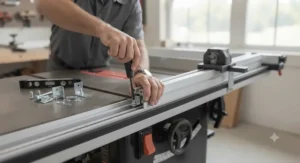
Buying the right kit is half the job — rail alignment is what actually determines whether you get the accuracy you paid for. Start by removing the old fence and rails completely, then dry-fit the new front rail before drilling anything; most kits, including the Vega PRO 50 and Shop Fox W1410, use existing mounting holes, but it’s worth double-checking clearance around the miter slot and any onboard switches first. Once the front rail is mounted, use a machinist’s square (or, better, a dial indicator) to check that the fence body sits truly parallel to the blade at both the front and rear of the table — not just eyeballed, since even a few thousandths of taper compounds badly on long rips.
A common first-30-days mistake is over-tightening the rear rail before the front rail is fully squared, which locks in misalignment that then requires a full re-teardown to fix. Instead, snug the front rail first, verify parallelism with test cuts on scrap, then lock the rear rail. For any fence with micro-adjustment — like the Vega PRO 50 — resist the urge to skip calibrating the built-in scale against actual measured cuts; factory scales are a starting reference, not gospel. Maintenance-wise, plan to clean and lightly wax bearing rails or ball-bearing tracks every few months, since sawdust buildup is the single most common cause of a fence that used to glide smoothly and suddenly doesn’t. On systems like the BOW 46″ XT XTENDER that use T-Track Clamps, periodically re-torque the clamps, since repeated attach/detach cycles can gradually loosen them. Because rail alignment work involves the blade area, review OSHA’s kickback-prevention guidance before your first test cuts on a newly mounted fence — a fence that’s slightly out of parallel is one of the more common contributors to kickback events.
Real Shop Scenarios: Matching the Right Kit to Your Situation
Consider three realistic buyer profiles. First, a production cabinet shop cutting sheet goods daily, where a sixteenth of drift across a full sheet ruins material and costs real money — this buyer should look hard at the Biesemeyer T-Square Commercial or Delta T3 52″, since the mass and 3-point locking of true commercial systems are built specifically to resist the wear of thousands of repeat cuts. Second, a serious hobbyist working solo in a home shop who wants commercial-level accuracy without commercial-level cost or a two-person installation — the Vega PRO 50 fits this profile almost perfectly, offering micro-adjust precision that rivals pricier systems while staying installable by one person in an afternoon.
Third, picture someone running a hybrid or portable cabinet saw in a shared garage workshop, needing to reconfigure the space regularly for other projects — the BOW 46″ XT XTENDER‘s ten-second attach/detach solves a real logistical problem that a bolted-down Biesemeyer simply can’t. A fourth, budget-conscious scenario worth naming: a woodworker restoring a vintage saw with nonstandard tubing, for whom the VerySuperCool Standard T-Square Fence Kit‘s metric-compatible design is often the only option that fits without custom fabrication, since standard Biesemeyer-clone rails assume American guide-rail dimensions.
How to Choose a Table Saw Fence Upgrade Kit for Cabinet Saws
- Measure your existing rail spacing first. Most upgrade failures start with an assumption about mounting holes that turns out wrong; measure before you buy, not after.
- Match rip capacity to your actual work, not your ambitions. A 50-inch rip capacity is wasted if you mostly cut furniture-scale parts, and it adds cost and installation complexity for no real benefit.
- Decide how much you value micro-adjustment. If you frequently sneak up on tight-tolerance widths, a threaded micro-adjust system like the Vega PRO 50 earns its price back in time saved.
- Weigh mass against convenience. Heavier steel-tube fences like the Biesemeyer T-Square Commercial resist drift better but are harder to install solo and reposition.
- Check T-slot or accessory compatibility. If you run featherboards, stock guides, or hold-downs, a fence with built-in T-track (like the BOW 46″ XT XTENDER) saves you retrofitting accessory mounts later.
- Confirm your saw’s table depth and mounting geometry. A fence sized for a 27-inch table won’t automatically fit a deeper or shallower cabinet saw without shimming or redrilling.
- Budget for the whole system, not just the headline price. Rails, mounting hardware, and accessories like T-Track Clamps are sometimes sold separately, and that gap changes the real cost comparison.
Common Mistakes When Buying a Cabinet Saw Fence Rail System
The single most common mistake is buying based on rip capacity alone without checking rail-mounting geometry — a 52-inch fence is useless if the mounting holes don’t line up with your saw’s cast iron. A close second is underestimating installation time: reviewers across multiple forums note that commercial-grade fences like the Biesemeyer T-Square Commercial and Delta T3 52″ genuinely take an afternoon (sometimes two people) to install and true up correctly, and rushing that step locks in inaccuracy from day one. Buyers also frequently overlook that some “universal” kits are universal in mounting only, not in rail length — meaning you may still need to buy or fabricate rail stock separately, which changes the real total cost.
Another recurring pitfall is ignoring saw-specific accessory compatibility. If you already own featherboards or stock guides designed for a specific fence profile, swapping fence brands can mean those accessories no longer fit without an adapter kit — something worth checking before, not after, purchase. Finally, some buyers skip verifying whether their saw’s table depth matches the fence’s designed mounting distance; a fence built for a 27-inch table, like the Shop Fox W1410, needs shimming or bracket fabrication on saws outside that range.
T-Square Fence Design vs Rack-and-Pinion and Clamp-Style Systems
Most upgrade kits on the market fall into one of three broad fence architectures, and the differences matter more than most buying guides let on. A T-square fence design — used by the Biesemeyer T-Square Commercial, Delta T3 52″, and VerySuperCool Standard T-Square Fence Kit — clamps to the front rail only, using the “T” shape’s geometry to guarantee the fence stays parallel to the blade regardless of rear rail tolerances. Rack-and-pinion systems, common on some portable and contractor saws, instead move both the front and rear simultaneously via a geared mechanism, which keeps things parallel through active mechanical linkage rather than passive geometry. Clamp-style systems, like older stock fences, simply lock at both ends independently — which is cheaper to manufacture but far more prone to drifting out of parallel over time, since nothing actively enforces the relationship between front and rear lock points.
| Fence Architecture | Parallelism Method | Typical Long-Term Accuracy | Example |
|---|---|---|---|
| T-Square | Passive geometry, front-rail only | High | Biesemeyer T-Square Commercial |
| Rack-and-Pinion | Active geared linkage | High | Portable-saw OEM fences |
| Clamp-Style | Independent dual-end locking | Lower, drifts over time | Older stock fences |
What this comparison actually means for your buying decision is straightforward: if your saw currently has a clamp-style stock fence and you’re fighting persistent drift, moving to a T-square design is very likely to solve the underlying problem rather than just masking it temporarily. Rack-and-pinion is excellent engineering but tends to appear on saws where the fence isn’t user-replaceable, so it’s rarely a true “upgrade kit” option for existing cabinet saws.
✨ Don’t Miss These Upgrade-Ready Deals!
🔍 Take your table saw fence upgrade kit for cabinet saws project to the next level with these carefully researched picks. Click on any highlighted product to check current pricing and availability. These fences will help you get authentic, repeatable rip accuracy your future projects will thank you for!
Cabinet Saw Rip Capacity: What to Expect in Real-World Performance
On paper, rip capacity numbers look simple — 42 inches, 50 inches, 52 inches — but what those numbers mean day-to-day depends heavily on your typical stock. If you mostly break down 4×8 plywood sheets, anything under about 30 inches of rip capacity to the right of the blade will force you to flip and re-reference cuts constantly, adding setup time and error opportunity to every sheet. Systems like the Delta T3 52″ and Biesemeyer T-Square Commercial, both offering up to 50-52 inches, let you rip a full sheet in one pass along either edge without repositioning — a meaningful production-time savings that compounds across dozens of sheets.
For furniture-scale work, that extra capacity matters less, and the Vega PRO 50‘s 50-inch capacity or the Shop Fox W1410‘s base 27-inch (extendable to 49 inches) covers the vast majority of real cuts without the table footprint and cost of a full commercial rail set. Reviewers consistently note that a fence’s stated maximum capacity rarely reflects daily use — most woodworkers report using less than half of their fence’s rated capacity on a typical project, so buying for your actual median cut width, not your rare maximum, is usually the smarter call. Because wider rip cuts also carry more kickback risk when material binds against the blade, it’s worth reviewing OSHA’s table saw machine-guarding guidance if you’re regularly ripping wide sheet goods on an upgraded fence.
Heavy Duty Fence Upgrade for Table Saw: Long-Term Cost & Maintenance
A heavy duty fence upgrade for table saw use isn’t just a purchase price — it’s a maintenance relationship. Steel-tube commercial fences like the Biesemeyer T-Square Commercial and Delta T3 52″ need periodic lubrication of sliding surfaces and occasional replacement of the plywood facing after years of contact wear, but the core mechanism rarely needs replacement, which stretches their effective lifespan well past a decade in most shops. Ball-bearing systems like the Shop Fox W1410 trade that steel-on-steel durability for smoother glide, but bearings can eventually wear or collect sawdust, meaning a periodic cleaning schedule is non-negotiable for keeping that “four-thousandths” alignment claim accurate over years of use.
| Fence System | Est. Total Cost of Ownership (5 yrs) | Maintenance Level | Best Value For |
|---|---|---|---|
| Biesemeyer T-Square Commercial | Higher upfront, low ongoing | Low (occasional facing swap) | High-volume production shops |
| Vega PRO 50 | Moderate upfront, low ongoing | Low-moderate | Serious hobbyists, solo shops |
| Shop Fox W1410 | Lower upfront, moderate ongoing | Moderate (bearing upkeep) | Budget-conscious smooth-glide seekers |
Looking at total cost of ownership rather than sticker price alone changes the calculus considerably: the Biesemeyer T-Square Commercial‘s higher upfront cost is offset by a genuinely long service life with minimal part replacement, while budget kits can end up costing more over a decade if their smaller components wear faster under heavy daily use. As one detailed independent fence testing roundup from Bob Vila notes, installation and rail alignment quality tend to predict long-term satisfaction better than the headline price does — a fence that’s properly trued at install tends to stay accurate far longer regardless of tier.
Fence Conversion Kits for Cabinet Saws: Features That Actually Matter (And Those That Don’t)
With so many spec sheets to compare, it helps to know which numbers actually predict a better cutting experience. Rail material and gauge matter — a 14-gauge steel guide tube, like the one under the Biesemeyer T-Square Commercial, resists bending under load far better than thin extruded profiles, and that resistance is what keeps long rips accurate. Locking mechanism design matters too: a 3-point lock with hairline pointers, or a true T-square geometry, does more for long-term accuracy than any marketing claim about “precision engineering.” Micro-adjustment, as seen on the Vega PRO 50, is a genuine functional advantage for anyone doing frequent fine-tolerance work, not a gimmick.
What matters far less than manufacturers suggest: cosmetic finish quality (anodizing color, powder-coat sheen) has essentially zero impact on cutting accuracy, and oversized rip-capacity numbers beyond what your actual stock requires mainly just add table footprint and installation complexity. Digital readouts, while genuinely useful for joinery-level precision, aren’t necessary for general ripping and framing work — they’re a nice-to-have layered onto a good fence, not a substitute for one. A fence conversion kit for cabinet saws succeeds or fails on rail rigidity, locking geometry, and mounting compatibility — everything else is secondary.
Frequently Asked Questions
❓ What is the best table saw fence upgrade kit for cabinet saws?
❓ Can I install a fence upgrade kit myself?
❓ What rip capacity do I actually need for a cabinet saw?
❓ Is a T-square fence design better than a clamp-style fence?
❓ How much does a heavy duty fence upgrade for table saw work typically cost?
Conclusion
A tired stock fence doesn’t mean it’s time for a new saw — it usually just means the fence hasn’t kept up with everything else the machine can do. Whether you land on the industrial-grade certainty of the Biesemeyer T-Square Commercial, the value-driven precision of the Vega PRO 50, or the flexible, budget-friendly path offered by the VerySuperCool Standard T-Square Fence Kit or Woodhaven 4310, the underlying goal is the same: a fence that holds its position honestly, cut after cut, so your accuracy stops depending on how carefully you tapped it into place that morning. Match the kit to your actual rip habits, not your aspirational ones, budget for the full system rather than just the headline price, and take the installation and rail alignment step seriously — it’s genuinely where most of the long-term accuracy either gets earned or gets lost.
✨ Ready to Stop Fighting Your Fence?
🔍 Browse the fence upgrade kits above, compare your saw’s mounting geometry against each option, and pick the one that matches how you actually cut — not just how the spec sheet reads.
Recommended for You
- 7 Best Table Saw Fence System Under $250 Picks – 2026
- Table Saw Blade Storage: 7 Best Solutions to Try in 2026
- Table Saw Blade Sharpening Service: 7 Blades Worth It in 2026
Disclaimer: This article contains affiliate links. As an Amazon Associate, I earn from qualifying purchases. If you purchase products through these links, we may earn a small commission at no additional cost to you.
✨ Found this helpful? Share it with your friends! 💬🤗
