
In This Article
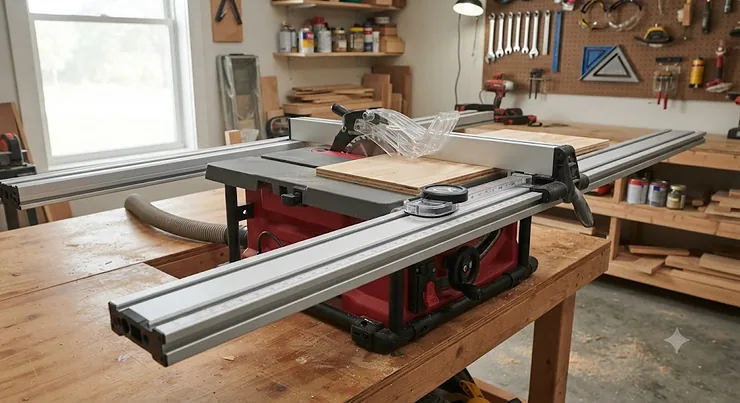
If you’ve ever ripped a board on a benchtop saw and watched the cut drift a hair-width off true, you already know the factory fence is the weak link. A universal aftermarket fence system for benchtop saws is exactly what it sounds like: a replacement or add-on rip fence, engineered to bolt or clamp onto a variety of small saw platforms, that locks parallel to the blade and stays there — cut after cut, board after board. Most stock fences on entry-level saws are stamped sheet metal with a single clamp point, which is why they flex, drift, and slowly erode your confidence in every rip cut. Swapping one out is usually the single cheapest way to make a $200 saw behave like a $2,000 one.
This guide breaks down seven real, currently available fence systems — from direct factory replacements to modular T-track platforms — so you can figure out which one actually fits your saw, your budget, and your shop. We researched actual specs, aggregated review sentiment, and installation reports rather than repeating marketing copy, and every product mention here includes honest analysis of who it’s for and why. According to the Occupational Safety and Health Administration, guiding the workpiece parallel to the fence is one of the core defenses against kickback — which makes fence quality a safety issue, not just a convenience one.
Whether you’re chasing a direct replacement for a broken factory part, a compact clamp-on fence for a saw with barely any table surface, or a full universal mounting fence for benchtop saw setups that swap between machines, you’ll find a real option below — along with the comparison tables, buying framework, and setup guidance to make the right call the first time.
Quick Comparison Table
| Fence System | Best For | Mounting Style | Price Range |
|---|---|---|---|
| Ryobi RTS Fence | Direct Ryobi RTS-series replacement | Factory drop-in, no drilling | under $70 |
| Woodpeckers ARF-BSCS | Tiniest jobsite/benchtop tables | Clamp-on auxiliary rail | $120-$150 range |
| Vega U26 | Hobbyists who want repeatable micro-adjust | Bolt-on, existing holes | $180-$260 range |
| Wixey WR750 | Precision seekers who want a digital readout | Drilled universal rail | around $400 |
Looking at this snapshot, the split is really about how much surgery you’re willing to do to your saw. The Ryobi RTS Fence and Woodpeckers ARF-BSCS avoid drilling altogether, which matters if you rent your shop space or share a saw with other users. The Vega U26 and Wixey WR750 ask for more commitment — new holes, more setup time — but reward you with tighter tolerances that a clamp-on simply can’t match.
💬 Just one click — help others make better buying decisions too!😊
Top 7 Universal Aftermarket Fence Systems: Expert Analysis
1. Ryobi RTS Fence — best budget factory-match replacement
If your Ryobi RTS10G1 or similar 10-inch benchtop saw came with a fence that cracked, warped, or simply walked out of alignment, this is the straightforward fix. It’s a direct factory-spec replacement rather than a universal drop-in, which is exactly why it installs in minutes with zero drilling.
The fence is stamped from lightweight aluminum and uses a single locking lever, and reviewers report a rip capacity around 30 inches when paired with extended rails on the compatible saw. That single-lever design means less clamping force than a T-square fence, so it’s built for trim work and DIY projects rather than cabinet-grade joinery. Based on the spec comparison with heavier universal systems, this is the right call for someone who just wants their saw functional again without spending three times the saw’s own value on the fix.
Aggregated buyer sentiment describes it as reliably matching factory tolerances for light use, with most complaints centering on the thin, easily-dinged aluminum extrusion rather than alignment issues. What most buyers overlook is that because it shares the saw’s original mounting geometry, there’s no adapter bracket guesswork — a common headache with true universal fences.
Pros:
- ✅ Drops in with zero drilling or adapter brackets
- ✅ Lightest option in this roundup, easy to remove for storage
- ✅ Lowest price point of any fence on this list
Cons:
- ❌ Locking force is noticeably lighter than T-square designs
- ❌ Limited to Ryobi RTS-series compatible saws
Priced under $70, this is the best value pick if your saw is already a Ryobi and the fence — not the whole machine — is the problem.
2. Woodpeckers ARF-BSCS — most compact for tiny saws
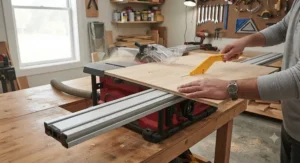
This auxiliary rip fence solves a problem most universal fences ignore: benchtop and jobsite saws often don’t have enough infeed or outfeed surface to keep a long board flat. Rather than replacing your existing fence, it clamps onto it.
Specs-wise, it’s a 36-inch, 3.5-inch-tall extruded aluminum fence with built-in T-track slots and two 7-inch material supports, and the fence-plus-clamping-block thickness measures exactly 2 inches, which keeps your saw’s existing scale usable with simple math. In practice, that means you don’t have to re-calibrate your rip scale every time you attach or remove it — add 2 inches to your target measurement and you’re done. Based on the spec sheet, the compact 36-inch length is deliberately sized for machines too small to accept full 48-inch aftermarket fences.
Reviewers who use it on portable jobsite saws consistently note it eliminates the wobble of thin factory fence faces on longer rips, since the machined aluminum won’t warp with humidity the way plywood-faced factory fences can. Here’s what to weigh: it’s an auxiliary add-on, not a full standalone fence replacement, so it still relies on your saw’s original locking mechanism for clamping force.
Pros:
- ✅ Installs in seconds without modifying the factory fence
- ✅ Two 7-inch material supports stabilize long boards
- ✅ American-made with tight, consistent machining tolerances
Cons:
- ❌ Requires separately purchased track clamps to mount
- ❌ Adds length but not extra locking rigidity of its own
At roughly $129.99, this is a smart mid-tier buy for anyone whose real complaint is table size, not fence accuracy.
3. Peachtree Uni-T-Fence (PW1112) — best sacrificial-face upgrade
Designed specifically as an upgrade section for the Delta Uni-fence system, this fence swaps in where your factory face bolts on, adding a full-length UHMW sacrificial face and multiple T-slots for jigs.
It’s a single-piece extruded aluminum bar, and the UHMW face is a half-inch-thick sacrificial surface that can be trimmed to fit dado and rabbet setups, reducing blade contact with the fence itself. Practically, that means you can run the blade right up against the fence for a clean rabbet without ever nicking your primary fence face — something a stock aluminum-faced Uni-fence can’t safely do repeatedly. Based on the spec comparison, this makes the most sense for shops still running older Delta Uni-fence-equipped benchtop and contractor saws that would otherwise need a full fence replacement.
Aggregated reviewer sentiment is largely positive on rigidity and the added T-slot versatility for featherboards and hold-downs, though a recurring theme in longer-term reports is that uneven bolt torque can create tiny flatness variations in the UHMW insert — a fixable, if fiddly, quirk. What most buyers overlook is that this only replaces the fence face section; the Uni-fence base and rail system must already be installed.
Pros:
- ✅ Sacrificial UHMW face protects the primary fence
- ✅ Multiple T-slots accept standard hex-head jig hardware
- ✅ Single-piece aluminum extrusion resists warping
Cons:
- ❌ Only compatible with existing Delta Uni-fence systems
- ❌ Bolt torque must be even or the face can develop dips
In the $150-$220 range, it’s a targeted, high-value fix rather than a ground-up universal solution.
4. Bow Products XT XTENDER Fence — most modular T-track system
This is less a fence replacement than a fence platform: it clamps onto your existing fence and adds a flat 5-inch-tall face with T-slots running the length of the extrusion.
The XTENDER comes in 24, 36, and 46-inch lengths, is crafted from a heavy-duty anodized aluminum extrusion weighing 8.8 pounds in the 46-inch version, with three T-slots accepting 1/4-inch and 5/16-inch T-bolts. What that spec sheet doesn’t spell out plainly is how much that changes your workflow: you can mount featherboards, stops, and infeed/outfeed feed supports anywhere along the fence face in seconds, rather than clamping accessories directly to a factory fence that usually has nowhere secure to grab. Based on this modularity, the XTENDER earns its keep on saws where you frequently swap between ripping, dado work, and jig-assisted cuts.
Reviewer sentiment consistently praises how it transforms small jobsite saws into something closer to a cabinet-saw workflow, particularly for owners feeding long stock without a helper. The trade-off, which the spec sheet won’t tell you but installers note, is that you still need the separately sold T-track clamps to attach it — so the “kit” price can creep up once accessories are added.
Pros:
- ✅ Three T-slots fit standard 1/4″ and 5/16″ T-bolt accessories
- ✅ Available in three lengths to match different table sizes
- ✅ Attaches and detaches in seconds without tools
Cons:
- ❌ T-track clamps are sold separately, adding to total cost
- ❌ Adds width to your rip capacity that must be accounted for
Expect to pay in the $110-$190 range depending on length, making it one of the more flexible mid-tier picks here.
5. Vega U26 — best micro-adjust precision for hobbyists
The Vega U26 has been a woodworking-forum favorite for decades, and for good reason: it’s one of the only aftermarket fences with a true threaded micro-adjustment mechanism built in.
It’s extruded from 6005-T6 high-strength aluminum with a polished chrome front rail, designed to bolt onto existing holes on Delta Unisaws, contractor saws, Powermatic Model 66s, and most Sears 10-inch saws without new drilling. In real-world terms, that chrome-tube-and-aluminum-head pairing is what lets the fence glide with almost no side play while you’re sneaking up on a precise width — a genuine advantage over fences that rely purely on a locking lever for final position. Based on the spec sheet, the micro-adjust thumb-nut mechanism is the standout feature: it lets you correct a cut by a few thousandths of an inch without loosening and re-locking the whole fence.
Longtime owners in woodworking forums describe it as transformative compared to stock fences, with one long-term user noting decades of reliable service on a vintage saw after the swap. A recurring criticism in aggregated feedback is that finish quality on some units has drawn complaints, and installation on older saws sometimes requires swapping factory bolts for slightly different thread sizes.
Pros:
- ✅ True threaded micro-adjustment for thousandths-of-an-inch precision
- ✅ Uses existing bolt holes on many classic saw platforms
- ✅ Chrome-and-aluminum bearing surface glides with minimal side play
Cons:
- ❌ Some units draw complaints about finish consistency
- ❌ May require different bolt hardware on older saw models
At around $180-$260, this sits mid-pack in price but punches above it on repeatable precision.
6. Shop Fox W1410 (Fence with Standard Rails) — best true universal drop-in fit
Shop Fox built this fence to be genuinely cross-compatible, targeting the huge population of saws with a roughly 27-inch table depth rather than one specific brand.
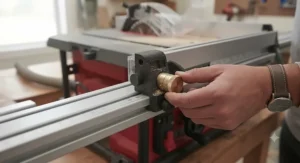
It uses ball-bearing guides for smooth travel and positioning knobs on both sides of the fence so it can be adjusted whether it’s mounted left or right of the blade, plus a three-point locking system that aligns the fence parallel to the blade. What that means day-to-day is that you get consistent glide action without the side-to-side wobble that plagues cheaper single-clamp fences, and the dual-side knobs mean left-tilt and right-tilt saw owners both get full functionality. Based on the spec comparison, this is the most broadly “universal” fence in this roundup by design intent, though buyers should verify their table depth before ordering.
Aggregated reviews are split but instructive: buyers who measured their table depth carefully report excellent results, while a recurring complaint involves the fit tolerance — several owners found their table depth measured slightly more than 27 inches once rail width was included, requiring recalibration of the fence internals. The spec sheet won’t tell you this, but installers note the pre-tapped mounting holes work better with through-bolts and nuts than the supplied tap-and-drill method on brittle cast iron.
Pros:
- ✅ Ball-bearing glide for smooth, low-friction adjustment
- ✅ Dual positioning knobs work for left or right blade mounting
- ✅ Fits the widest range of standard 27-inch-depth saw tables
Cons:
- ❌ “27-inch” fit claims can be tight once rail width is added
- ❌ Tapping new holes in cast iron risks chipped threads
In the $200-$280 range, it’s the closest thing to a true universal mounting fence for benchtop saw and contractor-saw owners alike.
7. Wixey WR750 Professional Table Saw Fence System — best digital-readout precision
This is the premium pick in the lineup: a complete fence and rail replacement built around Wixey’s well-known digital readout technology.
The system ships with a 72-inch heavy-duty aluminum rail, delivering roughly ±0.002 inches per foot of accuracy alongside a backlit digital display that shows readings in inches, fractions, or millimeters and retains calibration even when powered off. In practice, that constant-memory feature is the real differentiator — you can remove the fence for storage or blade changes and it remembers exactly where zero is when you put it back, which eliminates the re-zeroing ritual that haunts analog-scale fences. Based on the spec sheet, the micro-adjust wheels and roller glide are what make fine bevel and rip adjustments genuinely one-handed rather than a two-step lock-then-nudge process.
Reviewer sentiment on woodworking forums is enthusiastic about repeatability, with users specifically praising how a botched cut can be reproduced exactly using the saved digital reading. A recurring caveat: this fence requires drilling into your table saw’s rail to mount, and reviewers who transplanted the digital head onto an existing fence noted the splice between rail sections can introduce minor inaccuracy versus a genuinely one-piece rail.
Pros:
- ✅ Digital readout retains calibration when powered off or removed
- ✅ Accuracy rated around ±0.002 inches per foot
- ✅ Micro-adjust wheels and roller glide for one-handed fine-tuning
Cons:
- ❌ Requires drilling into your existing saw rail
- ❌ Two-piece rail can introduce a slight splice inaccuracy
At around $400, this is the investment-grade option for anyone whose time savings from not re-measuring justify the premium.
Practical Usage Guide: Installing and Aligning Your Fence Mounting Brackets
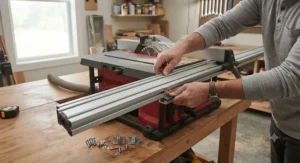
Most fence upgrade disappointments trace back to rushed installation, not bad hardware. Before you touch a wrench, measure your table’s front-to-back depth and the spacing between existing bolt holes — this single step avoids the single most common return reason cited across the aftermarket fence market. For clamp-on systems like the Woodpeckers ARF-BSCS or Bow Products XT XTENDER, hand-tighten the fence mounting brackets first, slide the whole assembly to confirm smooth travel, then fully torque down; tightening one bracket completely before checking alignment is what causes the fence to bind partway through a cut.
For drilled systems like the Vega U26, Shop Fox W1410, or Wixey WR750, use the supplied drilling jig rather than eyeballing hole placement, and thread test the first hole before committing to the full pattern — cast iron tops chip easily if a tap binds. Once mounted, check parallelism by measuring from the fence face to the miter slot at both the front and rear of the blade; the two measurements should match within a few thousandths of an inch.
In the first 30 days, expect to re-check that alignment two or three times as the mounting hardware seats and any factory paint or coating compresses slightly under clamping pressure. A common mistake is over-tightening bracket bolts in an attempt to eliminate all play — this can actually warp thinner aluminum fence bodies. Instead, snug bolts evenly in a cross pattern, similar to how you’d torque lug nuts, and re-verify parallelism after the first few dozen cuts rather than assuming day-one alignment will hold forever.
Real-World Scenarios: Matching a Fence to Small Shop Space Constraints
The apartment hobbyist: If you’re working out of a one-car garage or a corner of a basement, table depth and fence footprint matter as much as accuracy. A clamp-on option like the Woodpeckers ARF-BSCS or the shortest Bow Products XT XTENDER length lets you remove the auxiliary fence entirely when the saw needs to fold away, which matters enormously under real small shop space constraints where the saw itself might live on a wheeled base between projects.
The weekend furniture builder: If you’re making repeatable cuts for cabinetry or furniture components and have a dedicated (if modest) shop corner, the Vega U26‘s micro-adjust or the Shop Fox W1410‘s universal three-point lock are worth the permanent drilling commitment, since you’re optimizing for repeatability over portability.
The renter or shared-shop user: If you don’t own the saw outright, or share it with roommates or a maker-space community, a non-destructive option — the Ryobi RTS Fence if your saw matches, or a clamp-on auxiliary otherwise — avoids permanently modifying equipment you don’t fully control. Each profile trades a bit of precision for portability or vice versa, and none of them is wrong; the right fence is the one that matches how often your saw actually gets used versus stored away.
Problem → Solution: Solving Common Benchtop Saw Limitations
Benchtop saw limitations tend to show up in predictable ways, and most have a specific fix rather than requiring a whole new machine.
Problem: The fence drifts out of parallel mid-cut. This is almost always a single-point clamping issue. Solution: move to a three-point or T-square style system like the Shop Fox W1410, which locks at multiple points rather than relying on one lever flexing the whole fence body.
Problem: Not enough infeed/outfeed support for long boards. Benchtop tables are simply too small to support an 8-foot board on both ends. Solution: an auxiliary fence with built-in material supports, like the Woodpeckers ARF-BSCS, extends your effective support surface without buying a bigger saw.
Problem: No good way to mount featherboards or stop blocks. Factory fences on budget saws rarely have usable T-slots. Solution: a T-track platform like the Bow Products XT XTENDER or the Peachtree Uni-T-Fence adds accessory mounting points along the whole fence length.
Problem: Re-zeroing the scale every time you remove the fence. Solution: a digital-readout system like the Wixey WR750 retains calibration in memory, eliminating the guesswork entirely.
Problem: Budget doesn’t stretch to a full universal system. Solution: if your saw is a common model like the Ryobi RTS series, a direct factory-match replacement is both cheaper and simpler to install than any universal option.
How to Choose a Universal Mounting Fence for Benchtop Saw Setups
- Measure your table depth first. Most universal fences are built around a roughly 27-inch standard; anything outside that range narrows your options fast.
- Decide if drilling is acceptable. Drilled systems like the Vega U26 or Wixey WR750 offer tighter tolerances, but clamp-on options avoid permanent modification.
- Check the locking mechanism style. Single-lever fences are easier for beginners; three-point T-square locks offer superior long-term rigidity.
- Confirm accessory needs upfront. If you regularly use featherboards or stop blocks, prioritize a fence with built-in T-slots rather than adding them later.
- Match rip capacity to your typical stock width. A 36-inch fence bar is plenty for most hobby work; sheet-goods users should look at 46-inch-plus options.
- Weigh portability against precision. If the saw folds away between uses, a clamp-on auxiliary fence usually beats a drilled universal system.
- Budget for hardware extras. Track clamps, drilling jigs, and mounting bolts are sometimes sold separately — factor that into your real total cost.
Common Mistakes When Buying a Benchtop Table Saw Fence Replacement
The most frequent misstep is buying a benchtop table saw fence replacement based on brand name alone, without checking the actual bolt pattern or table depth against your machine — a mismatch here means returns and wasted shipping either way. A second common mistake is assuming “universal” means universal in every dimension; most systems are universal in mounting pattern but still have a minimum or maximum table depth requirement.
Buyers also frequently underestimate installation time, expecting a 15-minute swap when a drilled universal system can realistically take an hour or more, including drilling, test-fitting, and parallelism checks. Finally, a subtle but costly mistake is ignoring the accessory ecosystem: choosing a fence without T-slots because it’s slightly cheaper, then discovering months later there’s no clean way to mount a featherboard or stop block.
Compact Fence System for Small Saws vs Full-Size Rip Fence Systems
| Factor | Compact/Auxiliary System | Full-Size Universal Fence |
|---|---|---|
| Best For | Portable, small-table saws (Woodpeckers ARF-BSCS, Bow Products XT XTENDER) | Standard 27″-depth benchtop/contractor saws (Shop Fox W1410, Vega U26) |
| Installation | Clamp-on, reversible | Bolt-on or drilled, semi-permanent |
| Rip Capacity | 24″-46″ typical | Often 30″+ with extension rails |
| Precision | Good for general work | Better for repeatable, tight-tolerance cuts |
A compact fence system for small saws trades some ultimate rigidity for portability and lower installation commitment, which makes sense for anyone whose saw doesn’t have a permanent home in the shop. A full-size universal fence, by contrast, asks for a bigger upfront commitment — drilling, calibration, sometimes new bolts — but delivers the kind of repeatable, parallel-locked accuracy that compact clamp-ons generally can’t match over hundreds of cuts. If your projects lean toward furniture-grade joinery, the full-size route pays for itself in wasted-lumber savings alone.
What to Expect: Real-World Performance After the Upgrade
On paper, the spec sheets all promise straighter cuts, but the lived experience is more specific than that. Expect your first few cuts post-installation to require small parallelism tweaks as the new hardware seats — this is normal, not a defect. Expect noticeably less “chatter” or vibration in rip cuts on wider boards, since even a modest aftermarket fence typically weighs and clamps more solidly than a factory stamped-steel unit. Expect measurable time savings on repeat cuts if you’ve chosen a digital-readout system like the Wixey WR750, since you skip the tape-measure-and-squint step entirely. What you should not expect is a fence upgrade to fix bevel accuracy or blade alignment issues — those live in the saw’s trunnions, not the fence, and no fence system will mask a saw that’s out of square.
Long-Term Cost & Maintenance
Thinking in terms of cost-per-cut rather than sticker price changes the calculus here. A Ryobi RTS Fence at under $70 amortizes almost instantly if it saves even a single sheet of plywood from a botched rip, but it also has the least accessory ecosystem to extend its life through upgrades. A Wixey WR750 at around $400 looks expensive until you factor in the AAA-battery-powered digital readout’s multi-year lifespan and the fact that it eliminates a recurring source of measurement error on every single cut going forward.
Maintenance across all seven systems is similar: periodically clean glide surfaces of sawdust buildup, re-check parallelism every few months, and inspect T-slots for compacted debris if you mount accessories often. Aluminum-bodied fences resist rust entirely, while any steel components (as in the Wixey WR750‘s fence body) benefit from an occasional wipe with a rust-inhibiting cloth in humid shops.
Features That Actually Matter (And Those That Don’t)
What actually matters: locking mechanism rigidity, table depth compatibility, and — if you use jigs — T-slot accessory compatibility. These three factors determine whether a fence solves your actual problem or just moves it. What matters less than marketing suggests: exact color anodizing or cosmetic finish, since it has zero bearing on cut accuracy. Also lower priority: maximum theoretical rip capacity if you rarely cut sheet goods wider than 24 inches — paying for 50 inches of unused capacity is money better spent on a heavier-duty locking mechanism instead.
Safety, Alignment & Compliance Guide
A poorly aligned fence isn’t just an accuracy problem — it’s a genuine safety hazard. Guiding the workpiece parallel to the rip fence is one of the fundamental defenses against kickback that OSHA highlights in its machine guarding standards, and a fence that isn’t parallel to the blade is functionally guaranteed to bind stock and increase kickback risk. This isn’t a niche concern: the Consumer Product Safety Commission’s injury survey data has tracked tens of thousands of stationary-saw injuries annually, with fence and workpiece control implicated in a meaningful share of blade-contact incidents.
Practically, this means every fence installation in this guide should end with a parallelism check — measuring fence-to-miter-slot distance at both the front and rear of the blade — before you make a single production cut. It also means keeping your riving knife, blade guard, and anti-kickback pawls in place regardless of which fence you choose; a great fence reduces one risk factor, but it doesn’t replace the saw’s built-in safety hardware.
✨ Ready to Stop Fighting Your Fence?
🔍 Take your benchtop saw setup to the next level with one of these carefully researched fence systems. Click through to check current pricing and availability, and start making straighter, safer rip cuts today!
Frequently Asked Questions
❓ Will a universal fence fit any benchtop saw?
❓ Do I need to drill new holes to install an aftermarket fence?
❓ How much does a good aftermarket fence system cost?
❓ Can I add featherboards and jigs to any fence system?
❓ Will a new fence fix a saw that cuts crooked?
Conclusion
Upgrading the fence on a benchtop saw is one of the highest-value changes you can make in a small shop, and as this roundup shows, “universal” doesn’t mean one-size-fits-all — it means picking the mounting style, precision level, and accessory support that actually match how you use your saw. If your saw is a common budget model, a direct factory replacement like the Ryobi RTS Fence solves the problem cheaply. If table space is your real constraint, a compact clamp-on system like the Woodpeckers ARF-BSCS or Bow Products XT XTENDER adds capability without a permanent commitment. And if repeatable, tight-tolerance cuts are the goal, the Vega U26, Shop Fox W1410, or Wixey WR750 each deliver a meaningfully more rigid, more precise cutting reference than any stock benchtop fence.
Whichever route you take, measure twice, check parallelism after installation, and keep your saw’s core safety hardware intact regardless of how good the new fence feels. For further reading on saw safety fundamentals, the Woodwork Career Alliance’s safety guidance referenced by OSHA is a solid starting point.
✨ Found the Right Fence for Your Shop?
🔍 Compare these options side by side, check current pricing, and pick the system that fits your saw, your budget, and your space today!
Recommended for You
- Fence System for Hybrid Table Saws: 7 Upgrades for 2026
- T-Square Fence for Jobsite Table Saws: 7 Picks That Stay True (2026)
- Aftermarket Fence for Contractor Table Saws: 7 Upgrades (2026)
Disclaimer: This article contains affiliate links. As an Amazon Associate, I earn from qualifying purchases. If you purchase products through these links, we may earn a small commission at no additional cost to you.
✨ Found this helpful? Share it with your friends! 💬🤗
