
In This Article
Here’s a 45-word answer before we go any further: a budget aftermarket fence for hobbyist woodworkers is a replacement rip-fence system — usually T-square or clamp-style — that bolts onto an existing table saw to fix drift, slop, and inaccurate cuts without the cost of buying a whole new saw.
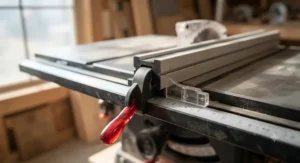
If you’ve ever measured twice, cut once, and still ended up with a rip that tapers a sixteenth of an inch over three feet, you already know the real culprit probably isn’t your saw. It’s the stock fence that came bolted to it. Most contractor and hybrid saws ship with a fence that’s, frankly, an afterthought — a stamped-metal guide the manufacturer included so the box could say “fence included,” not because anyone engineered it for repeatable accuracy. A rip fence exists to guide a workpiece in a straight line, parallel to the blade, for the full length of the cut, and when that guide flexes, drifts, or refuses to stay parallel, every project downstream inherits the error.
The good news: you don’t need a $3,000 SawStop-grade rig to fix this. A budget aftermarket fence for hobbyist woodworkers can transform a wobbly $400 saw into something that rips plywood dead straight, and it typically costs less than a decent cordless drill. This guide covers seven real, currently available fence systems — spanning true rock-bottom budget options up through premium Biesemeyer-style upgrades — with honest analysis pulled from spec sheets and aggregated owner feedback, not marketing copy. Whether you’re hunting for an affordable fence upgrade for weekend woodworkers or trying to figure out where a low cost table saw fence replacement actually pays off, you’ll have what you need to choose by the end of this article.
Top 7 Budget Aftermarket Fences: Expert Analysis
Real products, real specs, real trade-offs. Each entry below pairs the manufacturer’s numbers with honest interpretation of what those numbers mean once the fence is bolted to your saw and you’re standing in front of it with a board.
| # | Fence | Price Range | Rip Capacity | Construction | Best For |
|---|---|---|---|---|---|
| 1 | BOW Products 46″ XT XTENDER | Under $150 | Varies by mount | Aluminum, T-track | Tightest budgets |
| 2 | Vega U26 Table Saw Fence System | $200-$300 range | 26″ right of blade | Chrome rail, aluminum head | No-drill installs |
| 3 | Delta 36-T30T3 T3 Fence System | $280-$380 range | 30″ right of blade | Aluminum T-square | Biesemeyer look on a budget |
| 4 | Shop Fox W1716 Aluma-Classic Fence | $300-$450 range | 30″ right of blade | Steel and aluminum | Everyday durability |
| 5 | Wixey Professional Table Saw Fence System | $300-$400 range | 36″ rip capacity | Aluminum rail, steel fence | Digital precision |
| 6 | Vega U50 Table Saw Fence System | $350-$450 range | 50″ right / 8″ left | Aircraft-grade aluminum | Sheet goods |
| 7 | Delta 78-919BT2 Biesemeyer Fence | $500-$650 range | 30″+ configurable | Steel T-square | Premium accuracy |
Two things jump out when you scan this table side by side. First, rip capacity and price don’t move in lockstep — the Vega U26 and Delta 36-T30T3 both undercut the Shop Fox W1716 while offering comparable or better geometry, which tells you construction quality matters more than raw capacity for most hobby projects. Second, once you cross into Wixey Professional and Vega U50 territory, you’re not really paying for accuracy anymore (all of these fences, installed correctly, hold tolerances tighter than most hobbyists can measure by eye); you’re paying for convenience features like digital readouts and extended rail travel.
💬 Bookmark this table — you’ll want to scroll back to it once you’ve read the breakdowns below.
1. BOW Products 46″ XT XTENDER T-Track Fence — rock-bottom entry price with real accessory mounting
The standout feature here is the three T-slots running the length of the fence face, which is a detail you’d expect on something twice the price. This is a clamp-style fence rather than a full rail system, meaning it attaches directly to your existing table rather than requiring a two-rail mounting kit — a meaningful distinction if your saw’s factory rails are already in rough shape.
Constructed from extruded aluminum, the fence body is light enough to reposition one-handed but rigid enough to resist the twist that plagues cheaper stamped-steel guides. The T-track design lets you mount featherboards, flip stops, and shop-made jigs directly to the fence face, which the stock fence on most benchtop and jobsite saws simply can’t do.
Based on the spec comparison against pricier systems, this is the fence for someone who needs T-track versatility more than they need micro-adjustment dials or digital readouts. Reviewers consistently note that the multiple T-slots make it easy to dial in a shop-built setup exactly the way they want it, with one owner specifically praising how cleanly it matched an existing Delta-style fence profile.
Pros:
- ✅ Genuinely low buy-in price point for a real T-track fence
- ✅ Multiple T-slots for featherboards and shop-made stops
- ✅ Lightweight aluminum body, easy one-hand repositioning
Cons:
- ❌ Clamp-style mount is less rigid than a full two-rail system
- ❌ No built-in micro-adjustment mechanism
Priced well under $150 at the time of research, this is the clearest low cost table saw fence replacement on this list, and the value verdict is simple: if your budget caps out before three figures, this is where to start.

2. Vega U26 Table Saw Fence System — best no-drill install for classic cabinet saws
The headline feature is the no-drill mounting system, which uses the existing bolt holes already present on Delta Unisaws, Powermatic saws, and most contractor-style saws — a genuine time-saver expanded on below.
The 36-inch fence bar rides on a chrome-plated rail, engineered specifically to reduce friction so the fence head glides rather than sticks during adjustment. Rip capacity tops out at 26 inches to the right of the blade, which sounds modest next to the extended-rail options further down this list, but covers the vast majority of hobby-shop cuts — sheet-good breakdown aside.
Here’s what most buyers overlook about this model: because it reuses factory bolt patterns, installation on a compatible saw often takes under an hour with basic hand tools, which is a real advantage if drilling into a decades-old cast-iron table makes you nervous. Reviewers consistently report smooth, low-friction adjustment thanks to the polished chrome rail, and owners of vintage Unisaws in particular praise how directly it drops into place. The main honest caveat, echoed across owner discussions, is that the 26-inch capacity limits full plywood breakdown — you’ll need a circular saw and a straightedge for anything wider.
Pros:
- ✅ No-drill install on Delta Unisaw and Powermatic bolt patterns
- ✅ Chrome rail delivers noticeably smooth, low-friction glide
- ✅ Genuine T-square-style accuracy at an entry-level price
Cons:
- ❌ 26-inch capacity falls short for full sheet-good rips
- ❌ Fewer included accessories than the step-up Vega U50
At around $200-$300 depending on retailer and configuration, this is a strong entry level rip fence for hobby shop use, especially if your saw already matches Vega’s mounting pattern.
3. Delta 36-T30T3 T3 Fence System — the Biesemeyer look without the Biesemeyer price
This fence’s standout trait is its T-square geometry — the same basic design language as premium Biesemeyer-style fences — offered at a meaningfully lower price point, which we’ll unpack.
Built around a 30-inch aluminum rail with a front-locking T-square head, the T3 squares itself against the front rail automatically as you lock it down, which removes one of the most common sources of user error on cheaper sliding fences. The scale is easy to read at a glance, and the fence head locks with a single front-mounted lever.
Based on the spec comparison, the T3’s biggest selling point is familiarity: if you’ve ever used a premium T-square fence at a friend’s shop or in a woodworking class, this one operates almost identically. The honest trade-off, and it’s worth naming directly, is that the T3’s aluminum construction flexes more under lateral pressure than the steel-bodied options on this list — a pattern echoed by multiple owners who compared it directly against steel alternatives and noted it wasn’t as rock-solid. For hobby-scale cuts in plywood and softwood, that flex rarely matters. For repeated hardwood ripping, it’s worth knowing about upfront.
Pros:
- ✅ True T-square self-squaring design at a mid-budget price
- ✅ Simple, familiar single-lever front lock
- ✅ Easy-to-read scale for quick width setting
Cons:
- ❌ Aluminum body flexes more than steel-framed competitors
- ❌ Fewer accessory mounting points than newer designs
Expect a $280-$380 range at the time of research — a legitimately affordable fence upgrade for weekend woodworkers who want T-square geometry without paying full premium price.
4. Shop Fox W1716 Aluma-Classic Fence — steel-reinforced durability for daily shop use
The standout advantage is the combined steel-and-aluminum torsion-box body, which resists the twisting flex that pure-aluminum fences can develop over years of use — a meaningful upgrade explained further below.
Standard 57-inch rails deliver a 30-inch maximum rip to the right of the blade, and the cam-lever front locking mechanism is specifically engineered to work without needing a rear locking point at all, simplifying both installation and day-to-day operation. A magnified cursor lens sits over the scale, making width settings easier to read precisely without squinting.
What the spec sheet won’t tell you, but the torsion-box design implies, is that this fence resists the “walking” some cheaper fences exhibit when you push hard stock through a rip cut — the T-shaped cross-section is doing real structural work here, not just looking rigid. Reviewers consistently describe the W1716 as accurate and dependable, with several noting it was a direct, drop-in upgrade over troublesome factory fences on contractor-style saws. A handful of owner discussions mention wishing the design included a rear lock for extra rigidity on very long rips, though the front-lock cam system holds up fine for typical hobby-scale work.
Pros:
- ✅ Steel-and-aluminum torsion box resists twist and flex
- ✅ Cam-lever front lock needs no rear locking mechanism
- ✅ Magnified cursor lens improves scale readability
Cons:
- ❌ Standard 30-inch capacity is tight for full sheet goods
- ❌ Front-lock-only design rewards careful alignment technique
Pricing in the $300-$450 range at the time of research puts this squarely in mid-tier territory, and for shops that saw multiple times a week, it’s arguably the best value on this list.
5. Wixey Professional Table Saw Fence System — digital precision for repeatable cuts
This fence’s headline feature is a digital readout claiming ±0.002-inch-per-foot accuracy, which is a meaningfully different proposition than reading a printed scale through a magnifier — more on why that matters below.
The system pairs a heavy-duty aluminum rail with a steel fence body and a 36-inch rip capacity, and includes micro-adjust wheels for fine-tuning position without wrestling the whole fence assembly. Installation includes a drilling jig, which speeds up the mounting process considerably compared to eyeballing hole placement.
Here’s what most buyers overlook about digital fence systems: the value isn’t really in any single cut being more accurate than a well-tuned analog fence — a good T-square fence, correctly zeroed, can hit similar tolerances. The value is in repeatability across a full afternoon of setup changes, since you’re reading exact numbers instead of interpolating between hash marks. Reviewers consistently note that woodworkers running through a lot of stop-and-reset cuts, like batches of drawer parts, appreciate not having to re-verify each setting by eye. The honest downside is that any electronic component introduces a dependency — batteries need replacing, and a digital readout is simply one more thing that can eventually need recalibration or repair, unlike a purely mechanical scale.
Pros:
- ✅ Digital readout claims ±0.002″/ft accuracy for repeatable setups
- ✅ Included drilling jig simplifies a historically fiddly installation
- ✅ Micro-adjust wheels for fine positioning without full repositioning
Cons:
- ❌ Digital display adds battery dependency and a failure point
- ❌ Premium features push the price above simpler T-square fences
Expect a $300-$400 range at the time of research, positioning this as one of the better entry level upgrades for hobbyists who value data over guesswork.
6. Vega U50 Table Saw Fence System — best extended capacity for sheet goods
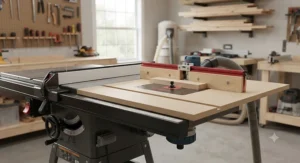
The defining feature is sheer reach: 50 inches of rip capacity to the right of the blade and 8 inches to the left, built from aircraft-grade aluminum alloy to keep that extra rail length from adding excessive weight.
The 36-inch fence bar mounts using the same rail-hole system found across the Vega lineup, and steel fence bars along the bottom double as a mounting point for an optional support table — a detail that matters if you’re regularly breaking down full 4×8 sheets solo. Micro-adjustment is built in, letting you dial in width settings without shifting the entire fence assembly.
Based on the spec comparison, this fence solves a problem the first five entries on this list simply can’t: ripping full plywood and MDF sheets without a second pair of hands or a separate outfeed table. Reviewers consistently point out that the extended rail can feel like overkill for typical hobby-scale projects — cutting shop jigs, cabinet parts, or furniture components rarely needs anywhere near 50 inches of capacity, and walking around a seven-foot rail system in a small garage shop gets old fast. If your projects regularly involve full sheet goods, though, that “overkill” becomes exactly the feature you need.
Pros:
- ✅ 50-inch right-side capacity handles full sheet goods solo
- ✅ Aircraft-grade aluminum keeps the long rail manageable to move
- ✅ Built-in micro-adjustment for precise width dialing
Cons:
- ❌ Excess rail length is genuinely unnecessary for small-project shops
- ❌ Requires more floor space to walk around during use
At a $350-$450 range at the time of research, this earns its keep specifically for hobbyists whose garage doubles as a cabinet shop — everyone else will get more daily value from a shorter-rail option on this list.
7. Delta 78-919BT2 Biesemeyer Fence — the reference-standard design, at hobby-shop scale
The standout feature isn’t a single spec — it’s the design lineage. This is a Biesemeyer-style T-square fence, and the Biesemeyer name has become the de facto reference point that most other cabinet-saw rip fences are designed to resemble, which is a genuinely different proposition than fences that merely borrow the aesthetic.
Steel construction throughout gives this fence a rigidity that aluminum-bodied competitors on this list can’t fully match, and the T-square head self-squares against the front rail every time it locks, minimizing setup drift between sessions. Rip capacity is configurable depending on rail length ordered, making it adaptable to a range of saw table widths.
What the spec sheet won’t tell you, but decades of shop history will, is that this design is why “Biesemeyer-style” became shorthand across the entire aftermarket fence category — when other manufacturers describe their fences as T-square systems, they’re implicitly measuring themselves against this one. Reviewers consistently describe the feel as noticeably more solid under lateral pressure than aluminum alternatives, which matters most when ripping dense hardwood repeatedly. The honest trade-off is straightforward: you’re paying a real premium for that steel rigidity, and installation is more involved than the clamp-style budget options earlier on this list.
Pros:
- ✅ Reference-standard T-square design most fences imitate
- ✅ Steel construction delivers class-leading rigidity
- ✅ Self-squaring lock minimizes setup drift over time
Cons:
- ❌ Highest price point among all seven fences covered here
- ❌ More involved installation than clamp-style budget options
At a $500-$650 range at the time of research, this isn’t the pick for every hobby shop — but for woodworkers who’ve outgrown budget fences and want the design everything else is chasing, it’s worth the jump.
✨ Don’t Miss These Exclusive Deals!
🔍 Take your table saw setup to the next level with these carefully selected fence systems. Click on any highlighted product above to check current pricing and availability. The right fence turns frustrating, drifting rip cuts into the kind of clean, repeatable results that make weekend shop time genuinely satisfying.
Quick Comparison Table
Before the deep dive, here’s the fast version — three tiers, three honest recommendations, and why each one earns its spot.
| Tier | Fence | Price Range | Best For |
|---|---|---|---|
| Budget | BOW Products 46″ XT XTENDER | Under $150 | Tightest budgets, T-track accessory mounting |
| Mid-Range | Shop Fox W1716 Aluma-Classic | $300-$450 range | Balanced rigidity and price for most hobby shops |
| Premium | Delta 78-919BT2 Biesemeyer Fence | $500-$650 range | Serious hobbyists who want the industry-reference design |
The pattern here is straightforward: the cheaper end trades rail rigidity and micro-adjustment for a lower buy-in, while the premium tier essentially buys you the fence design that most other aftermarket fences are trying to imitate in the first place. What surprises a lot of first-time buyers is that the mid-range tier is where the value curve flattens out hardest — you get 80-90% of the rigidity of a premium system for roughly two-thirds the price, which is exactly why it’s the default recommendation for most hobby shops. Budget buyers shouldn’t feel like they’re settling, either; a well-installed clamp-style fence still beats a sloppy stock fence every time.
💬 Found a tier that fits your shop already? Jump straight to the full product breakdown below — every option here ships and installs on most standard-width table saws.
DIY Fence Installation: What Actually Happens After You Order
Every fence on this list ships with instructions, but the instructions rarely tell you what installation actually feels like in a real garage shop, so here’s the honest version.
Start by measuring your existing rail spacing and mounting-hole pattern before you buy anything — this single step prevents the majority of return requests reported across owner reviews. Most fences, including the Vega U26 and Vega U50, use adjustable mounting brackets specifically designed to fit a range of factory hole patterns without drilling, but universal-fit clamp fences like the BOW Products 46″ XT XTENDER may need minor adjustment to seat flush on an unusual table profile. If your saw doesn’t match, don’t panic: cast iron drills easily with a sharp bit and a little cutting oil, and a five-minute drilling job is genuinely all that’s usually required.
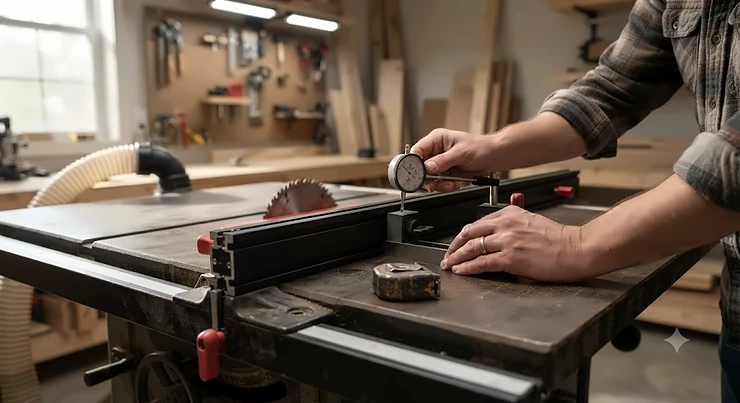
Once mounted, the real work is squaring the fence to the miter slot — not just visually, but measured front and back with the fence locked in position at a fixed width. A cheap combination square or a dial indicator on a scrap board will get you there faster than eyeballing it. Budget an hour for a straightforward no-drill install, or an afternoon if you’re drilling new holes and dialing in a fence with a magnified scale like the Shop Fox W1716. The most common first-30-days mistake, echoed across forum threads on this topic, is skipping a final test rip on scrap material before trusting the fence on a real project — always make a test cut, measure both ends, and adjust before you touch good lumber.
Real-World Scenarios: Which Fence Fits Your Shop
Specs only tell half the story. Here’s how three common hobbyist profiles actually map to the products above.
The Weekend Warrior in a One-Car Garage: If you’re an affordable fence upgrade for weekend woodworkers type — someone squeezing in shop time on Saturdays, working mostly with plywood and pine for shelving and small furniture — the BOW Products 46″ XT XTENDER or Vega U26 covers nearly everything you’ll build, and neither eats significantly into a hobby woodworking budget that also has to cover blades, glue, and finish.
The Furniture Builder Moving Into Hardwood: Once projects shift toward hardwood tables and cabinetry where repeated, precise rips matter, the flex tolerance of a budget aluminum fence starts to show. This is where the Delta 36-T30T3 or Shop Fox W1716 earns its higher price — steel-reinforced rigidity that holds up under the lateral pressure dense hardwood puts on a fence.
The Sheet-Goods Regular: If your shop regularly processes full plywood sheets into cabinet carcasses or built-ins, capacity becomes the deciding factor over everything else, which is exactly the gap the Vega U50 and its 50-inch reach exists to fill.
Problem → Solution: Fixing the Five Most Common Fence Complaints
Problem: The fence drifts out of parallel mid-cut. This is almost always a squaring issue, not a fence-quality issue — recheck alignment at both the front and back of the blade with the fence locked, and re-square if there’s more than a hair of difference between the two measurements.
Problem: Cuts burn or bind partway through. Binding usually means the fence has drifted slightly toward the blade at the rear. A T-square design like the Delta 36-T30T3 or Delta 78-919BT2 largely prevents this by self-squaring on lock, but any fence needs periodic rechecking.
Problem: The scale reads inaccurately compared to actual cut width. Zero your scale against a test cut rather than trusting the factory calibration out of the box — this applies even to digital systems like the Wixey Professional, which still benefits from a manual verification cut.
Problem: The fence flexes when pushing hardwood through a rip. This is a construction issue more than a technique issue, and it’s the clearest signal to step up from an aluminum-bodied fence to a steel-reinforced option like the Shop Fox W1716 or Delta 78-919BT2.
Problem: Mounting holes don’t line up with an older or unusual saw. Check whether your fence uses adjustable brackets first — Vega’s mounting system in particular is designed around flexibility — before assuming you’ll need to drill.
How to Choose a Budget Aftermarket Fence for Hobbyist Woodworkers
- Measure your saw’s rail spacing first. Buying before measuring is the single most common (and most avoidable) mistake hobbyists make.
- Match rip capacity to your actual projects, not your aspirational ones — 30 inches covers most hobby work; 50 inches is for regular sheet-goods breakdown.
- Weigh construction material against your material choices. Steel and steel-hybrid fences like the Shop Fox W1716 resist flex better under hardwood, while aluminum options are lighter and often cheaper.
- Decide if digital readout convenience is worth the premium — it buys repeatability, not fundamentally better accuracy, over a well-zeroed analog scale.
- Check whether your saw’s bolt pattern is drill-free compatible, particularly with Vega’s adjustable-bracket systems, to save an afternoon of extra work.
- Budget for a test-cut session, not just the fence itself — proper squaring takes real time regardless of which fence you buy.
- Read owner reviews for your specific saw model, since fit and flex complaints are often saw-specific rather than universal to the fence.
Common Mistakes When Buying an Entry-Level Fence
The single most expensive mistake is buying based on rip capacity alone. A 50-inch fence sounds impressive, but if your projects rarely exceed 24 inches of stock width, you’re paying for rail length you’ll never use and giving up valuable floor space in the process.
A close second: skipping the mounting-compatibility check before ordering. Entry-level upgrades are supposed to save money, but return shipping and restocking fees on an ill-fitting fence quietly erase whatever you saved by going budget in the first place. Take the ten minutes to measure your existing rail holes and compare them against the manufacturer’s mounting specs before checkout.
The third common misstep is assuming a higher price automatically means a better fit for your shop. The Delta 78-919BT2‘s steel rigidity is genuinely excellent, but it’s wasted value if you’re cutting softwood shelving on weekends — that budget is far better spent on blades, jigs, or dust collection that will actually move the needle on your results.
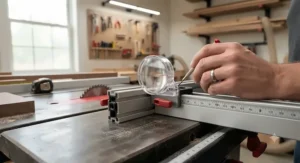
Aftermarket Fence vs Stock Fence: What Actually Changes
A stock fence, on most contractor and hybrid saws, is a stamped or lightly reinforced sliding guide designed to hit a bill of materials, not a tolerance spec. It typically locks at one point, offers no micro-adjustment, and relies on a printed scale that’s often miscalibrated from the factory.
An aftermarket fence changes the geometry, not just the material. T-square designs like the Delta 36-T30T3 and Delta 78-919BT2 self-square against the front rail on every lock, which structurally prevents the slow drift that stock fences are prone to. Even the budget-tier BOW Products 46″ XT XTENDER, while simpler, still offers a more rigid mounting approach than most factory-included fences on entry-level saws.
The practical difference shows up in edge quality and repeatability: fewer burn marks from binding, straighter rips on long boards, and — critically for safety — less risk of the kickback that happens when a workpiece pinches between a misaligned fence and the blade.
What to Expect: Real-World Performance
On paper, most of these fences promise similar accuracy claims. In practice, performance is less about the number printed on the box and more about how the fence behaves under actual working conditions — humidity swings, repeated locking cycles, and the inevitable bump from a stray board.
Steel-bodied and T-square designs hold their calibration longer between adjustments, based on the spec comparison of locking mechanisms across this list. Aluminum clamp-style fences need slightly more frequent rechecking, particularly after the fence has been removed and reinstalled, since clamp-style mounts don’t reference a fixed hole pattern the way rail-mounted systems do. None of this means aluminum fences are unreliable — it just means the maintenance rhythm differs by design type, which is worth knowing before you commit to a workflow.
Long-Term Cost & Maintenance
The upfront price tag is only part of the total cost of ownership. Rail-mounted fences with exposed hardware benefit from an occasional wipe-down and light lubrication of the rail surface — the Vega U26 and Vega U50 both use polished chrome rails specifically to minimize this maintenance need over time. Steel fences like the Delta 78-919BT2 are essentially maintenance-free structurally but benefit from periodic rust prevention if your shop isn’t climate controlled.
Digital systems like the Wixey Professional add one recurring cost stock and analog fences don’t have: batteries. It’s a minor expense, but worth factoring into a realistic hobby woodworking budget over a multi-year ownership horizon. Across all seven fences, the total cost of ownership gap narrows considerably once you account for how much scrap material a poorly aligned stock fence burns through in wasted cuts — a detail that rarely makes it into upfront price comparisons but matters enormously in practice.
Safety, Alignment, and What OSHA Wants You to Know
A misaligned fence isn’t just an accuracy problem — it’s a safety problem. According to federal workplace safety guidance, keeping stock guided parallel to the rip fence throughout the cut is one of the primary ways to reduce the potential for kickback, since kickback happens when the blade catches the stock and throws it back toward the operator. That single mechanical fact is the entire case for upgrading a drifting stock fence: a fence that can’t stay parallel to the blade is actively increasing your kickback risk every time you make a rip cut.
This is also why T-square designs matter beyond convenience. A fence that self-squares on every lock structurally reduces the odds of the rear-of-blade pinching that causes most kickback events. For a fuller breakdown of guarding requirements and safe operating practice around table saws, the OSHA machine guarding eTool for table saws is a genuinely useful reference, regardless of whether your shop is a commercial one or a one-car garage.
Benefits vs Traditional Alternatives
| Factor | Stock/Factory Fence | Aftermarket Fence (This List) | Analysis |
|---|---|---|---|
| Squaring | Manual, drifts over time | Self-squares (T-square models) | Fewer setup errors |
| Adjustment | Basic slide, printed scale | Micro-adjust or digital | Faster, more repeatable |
| Rigidity | Often stamped, flexes | Steel or reinforced aluminum | Cleaner cuts in hardwood |
| Accessory mounting | Rarely supported | T-track on select models | Featherboards, stops mount directly |
The takeaway from this comparison is that stock fences aren’t necessarily poorly made — they’re built to a cost target, not an accuracy target, which is a fundamentally different design goal. Even the entry-level BOW Products 46″ XT XTENDER, positioned as this list’s cheapest option, still out-features most factory-installed fences on jobsite and contractor saws. That gap is exactly why “budget aftermarket” doesn’t mean “compromise” here — it means choosing which upgrade tier matches your actual cutting habits.
Price Range & Value Analysis
| Fence | Price Range | Value Verdict |
|---|---|---|
| BOW Products 46″ XT XTENDER | Under $150 | Best dollar-for-dollar entry point |
| Vega U26 | $200-$300 range | Strong value if bolt pattern matches |
| Delta 36-T30T3 | $280-$380 range | Best T-square feel at mid-budget price |
| Shop Fox W1716 | $300-$450 range | Best all-around durability-to-price ratio |
| Wixey Professional | $300-$400 range | Best for repeatable batch cutting |
| Vega U50 | $350-$450 range | Best only if you regularly cut sheet goods |
| Delta 78-919BT2 | $500-$650 range | Best long-term investment for hardwood work |
Looking at the value spread, the Shop Fox W1716 consistently comes up as the pragmatic middle path — enough rigidity for hardwood, without premium pricing. Buyers chasing the lowest possible entry cost shouldn’t feel shortchanged by the BOW Products 46″ XT XTENDER, either, since it solves the actual problem — an inaccurate stock fence — for a fraction of premium pricing. The Delta 78-919BT2 only really justifies its price range for hobbyists who’ve already outgrown budget and mid-tier options through repeated hardwood work.

Frequently Asked Questions
❓ What is a budget aftermarket fence for hobbyist woodworkers?
❓ Can I install an aftermarket fence myself?
❓ Do I need to match the fence brand to my saw brand?
❓ Is a digital readout worth the extra cost?
❓ How much rip capacity do hobbyists actually need?
Recommended for You Reads
A few adjacent topics worth exploring once your fence upgrade is sorted: dialing in a zero-clearance throat plate, choosing the right rip blade for hardwood versus sheet goods, and building a simple outfeed support table for long rips. For deeper background on how rip fences function mechanically, the Wikipedia entry on rip fences is a solid starting reference, and if you want to understand the safety mechanics behind kickback in more technical detail, this Cornell EHS table saw safety guide covers guarding requirements clearly.
Conclusion
A drifting, imprecise stock fence quietly limits every project that comes off your saw — burned edges, tapered rips, wasted stock, and cuts you have to fudge with a hand plane afterward. The good news, hopefully clear by now, is that fixing it doesn’t require a saw upgrade or a professional-shop budget. Whether you land on the no-frills BOW Products 46″ XT XTENDER, the no-drill-friendly Vega U26, or work your way up to the steel-bodied rigidity of the Delta 78-919BT2, every option on this list solves the same core problem: a fence that actually stays parallel to the blade, cut after cut.
Match the fence to your real projects, not your aspirational ones. If you’re cutting plywood shelving on weekends, don’t overspend on 50 inches of capacity you’ll never use. If you’re moving into hardwood furniture, don’t undersell the value of steel rigidity. Measure your saw, pick your tier, and budget an honest afternoon for installation and squaring — the payoff shows up in every rip cut after that.
✨ Ready to Fix Your Rip Cuts for Good?
🔍 Compare current pricing on any fence covered in this guide and pick the tier that matches your actual shop habits. A properly squared aftermarket fence is one of the highest-value upgrades available for the price — check availability today and stop fighting your saw.
Recommended for You
- Top Rated Table Saw Fence Upgrades for Small Shops (2026)
- Precision Fence Upgrade for Accurate Rip Cuts: 7 Picks (2026)
- Universal Aftermarket Fence System for Benchtop Saws: 7 Picks (2026)
Disclaimer: This article contains affiliate links. As an Amazon Associate, I earn from qualifying purchases. If you purchase products through these links, we may earn a small commission at no additional cost to you.
✨ Found this helpful? Share it with your friends! 💬🤗
