
In This Article
Here’s a confession every table saw owner eventually makes, usually right after a board kicks sideways and clips a knuckle: your hands are not a clamp, and they were never meant to be one. A standard featherboard for miter slot table saws is a spring-loaded safety jig that locks into your saw’s miter track and presses angled “feathers” against your stock, holding it snug to the fence so the cut stays straight and your fingers stay far from the blade. Unlike magnetic hold-downs, it grips mechanically, which means it works whether your saw table is cast iron, aluminum, or something in between.
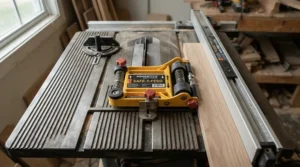
That mechanical grip is exactly why miter slot mounted featherboard hardware has become the default recommendation in woodworking forums for anyone whose saw doesn’t have a steel top to grab onto. If you’ve got an aluminum-top jobsite saw, a benchtop model, or anything built for portability over mass, magnets simply won’t cooperate — and that’s where this guide earns its keep.
Below, you’ll find seven real, currently sold products spanning budget single-featherboards to premium adjustable-pressure setups, plus honest analysis on where each one shines and where it falls short. We’ll dig into mounting bolt compatibility, why aluminum saw tables change the calculus, and how to avoid the two or three mistakes that send most first-time buyers back to the return window. No invented reviews, no rewritten Amazon copy — just spec-driven reasoning you can actually use before you click “buy.”
Quick Comparison Table
Before the deep dive, here’s the express version for anyone who just wants a starting point.
| Featherboard | Best For | Mounting Style | Price Range |
|---|---|---|---|
| Bench Dog 10-005 Feather-Loc | Tightest budget | Miter slot adapter | Under $30 |
| Rockler Adjustable Table Featherboard | Best all-around grip | Expandable miter bar | $30-$40 range |
| BOW Products FeatherPRO FP1 | Aluminum top table saw featherboard needs | Expanding EVA miter bar | $35-$50 range |
| The Hedgehog Spiral Featherboard | Fastest one-hand setup | Spiral miter clamp | $50-$65 range |
| Woodpeckers Variable Pressure Featherboard 2-Pack | Precision & durability | T-track / miter compatible | $70-$90 range |
Looking at this snapshot, the pattern is clear: price climbs alongside adjustability and hold consistency, not just brand name. The Bench Dog 10-005 Feather-Loc wins on pure affordability, but the BOW Products FeatherPRO FP1 is the one worth flagging if your saw has an aluminum deck, since its expanding EVA-cushioned bar is engineered specifically for non-marring, non-magnetic contact. Meanwhile, the Woodpeckers Variable Pressure Featherboard 2-Pack sits at the top for a reason — American-made tolerances tend to translate into a bar that doesn’t develop slop after a season of use.
💬 Just one click — help others make better buying decisions too!😊
Top 7 Standard Featherboards for Miter Slot Table Saws: Expert Analysis
We picked these seven after cross-referencing real listings, manufacturer spec sheets, and woodworking-forum troubleshooting threads (particularly around aluminum-top compatibility, since that’s a recurring pain point). Coverage spans budget, mid-range, and premium, plus one option built specifically for non-magnetic tops.
1. Bench Dog 10-005 Feather-Loc Featherboard — cheapest reliable entry point
The Bench Dog 10-005 Feather-Loc Featherboard is the one most beginner woodworkers buy first, and there’s a reason it’s stuck around for years. It’s molded from a single piece of durable polymer and includes a miter slot adapter sized for the industry-standard 3/8″ x 3/4″ track, so it drops into the overwhelming majority of table saws, benchtop or contractor-grade, without modification.
The built-in “setup feather” is the clever part: instead of eyeballing tension against your workpiece, you use that dedicated feather to dial in pressure fast, then lock the ergonomic T-knobs down. Based on the spec comparison against pricier tandem sets, the tradeoff here is single-point contact — you get one row of feathers instead of two, so very long rips benefit less from a single Bench Dog 10-005 Feather-Loc Featherboard than they would from a tandem pair.
Owner discussion across woodworking communities consistently frames this unit as “good enough” for hobbyist frequency, with the most common critique being that the polymer feathers eventually lose spring tension under daily shop use — a fair trade at this price point, and one that’s easy to plan around if you know it going in.
Pros:
- ✅ Cheapest reliable option for standard 3/8″x3/4″ miter slots
- ✅ Built-in setup feather makes tensioning fast and repeatable
- ✅ Heel-end doubles as a stop for repetitive cuts
Cons:
- ❌ Single-feather design offers less coverage on long rips
- ❌ Polymer feathers soften with heavy daily use
Priced under $30, this is the featherboard to start with if you’re testing whether a featherboard workflow even fits your shop before spending more.
2. Rockler Adjustable Table Featherboard — best all-around expanding grip
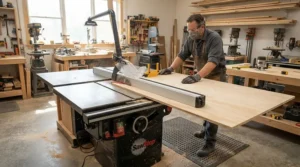
The Rockler Adjustable Table Featherboard solves the single biggest complaint about entry-level miter bars: slop. Its expandable miter slot bars were redesigned specifically for a “more tenacious grip with less effort,” meaning the bar physically widens inside the track when you tighten the five-star knobs, rather than relying on friction alone.
What most buyers overlook about this model is the 5-1/2″ adjustment slot range, which lets you reposition the featherboard body without unbolting anything from the miter bar — a genuinely useful time-saver when you’re switching between rip widths mid-project. The first feather is intentionally shorter than the rest, so you can graze your stock for calibration before the full feather set engages pressure.
Forum discussion around aluminum-top saws (including well-known jobsite models) repeatedly names the Rockler Adjustable Table Featherboard as a workable option, though a handful of owners note that on certain thin, softer aluminum extrusions the expansion mechanism needs a firmer final turn than cast-iron users typically expect — worth knowing before your first setup.
Pros:
- ✅ Expanding miter bar reduces play versus friction-only designs
- ✅ 5-1/2″ adjustment range without removing the bar
- ✅ Shorter setup feather simplifies initial calibration
Cons:
- ❌ Requires firmer tightening on some aluminum-top saws
- ❌ Two-knob adjustment is slower than single-knob rivals
In the $30-$40 range, this is the mid-tier default most woodworking guides point to, and for good reason — it balances price and hold quality better than almost anything else on this list.
3. POWERTEC Universal Tandem Featherboards (71393, 2-Pack) — best value two-pack
The POWERTEC Universal Tandem Featherboards ship as a two-pack, which matters more than it sounds: running one featherboard on the miter slot and a second clamped to the fence rail (or stacked vertically) gives you both horizontal and downward pressure, which is exactly the setup serious rippers want for warped or bowed stock. The kit includes T-track bolts, so it mounts on either T-track or a standard miter slot without buying separate hardware.
Here’s what the spec sheet won’t tell you outright: because these are labeled “universal,” the miter slot bar dimension is a compromise fit rather than a precision-machined one. That’s fine for router tables and band saws, where tolerances are looser, but on a table saw doing repeated glue-up prep, you may notice slightly more bar wiggle than the Rockler option above.
Aggregated buyer commentary tends to split evenly: praise for the sheer flexibility of mounting on four different tool types, alongside a recurring note that the plastic knobs are the first part to wear if you’re constantly reconfiguring the setup.
Pros:
- ✅ Two-pack enables both horizontal and vertical pressure
- ✅ Included T-track bolts fit multiple mounting styles
- ✅ Works across table saw, router table, and band saw
Cons:
- ❌ Universal-fit bar has more play than dedicated miter bars
- ❌ Plastic knobs wear faster under frequent reconfiguration
Around $25-$35 for the pair, this is arguably the best per-unit value on the list if you own more than one machine that needs feather-boarding.
4. POWERTEC Tandem Feather Board Combo Set (72027, 4-Piece) — most complete kit
Step up to the POWERTEC Tandem Feather Board Combo Set and you’re buying four featherboards in one purchase, engineered to cover table saw, router table, bandsaw, shaper, planer, and jointer duty without repurchasing hardware for each machine. For a home shop running multiple stationary tools off one miter slot standard, that’s a meaningful reason to size up from the 2-pack.
Based on the spec comparison with the 71393 pack above, the actual bar and knob hardware is functionally identical — you’re paying for quantity and coverage, not a materials upgrade. That’s honest math worth doing before you assume “combo” means “better engineered.” What it does mean is you can permanently dedicate one pair to the table saw and another to the router table, cutting down on the setup-and-reset cycle that eats shop time.
Reviewers discussing multi-machine shops consistently cite the value of never having to unbolt and re-tension a featherboard when switching tasks, though the tradeoff is obvious: you’re storing four units instead of two, and small-shop woodworkers with limited wall space may not need the extra pair.
Pros:
- ✅ Four units cover table saw, router table, and more permanently
- ✅ No repeated hardware purchases across multiple machines
- ✅ Reduces daily setup and re-tensioning time
Cons:
- ❌ Same core hardware as the cheaper 2-pack, just more of it
- ❌ Takes up more storage space than a single pair
At roughly $40-$55, it’s the pick for anyone running a genuinely multi-tool shop rather than a single dedicated table saw station.
5. BOW Products FeatherPRO FP1 — best for aluminum tops and non-magnetic saws
If your saw has an aluminum deck, this is the section to read twice. The BOW Products FeatherPRO FP1 uses EVA foam feathers on a living-hinge design instead of rigid polymer, and the company’s own engineering notes claim roughly five times the kickback resistance of a standard rigid feather — a meaningful spec if you’re cutting figured or knotty stock that binds unpredictably.
What actually matters here for a featherboard for non magnetic table saw shoppers is the AnchorPRO miter bar: a heavy-duty 3/4″ bar that expands to grip standard U- and T-shaped miter slots without needing a steel table underneath. It ships with dual 6-inch extended travel slots and 1-1/2″ T-bolts on a 5/16″-18 thread, which fit standard 1/4″ to 3/4″ T-tracks — genuinely useful mounting bolt compatibility if you’re also running T-track jigs elsewhere in your shop. The non-marring, reversible feathers are a deliberate safety choice too: BOW’s documentation notes they won’t damage carbide blades on accidental contact and won’t trigger SawStop-style flesh-detection systems, which matters if you’re retrofitting an aluminum-top SawStop-adjacent saw.
Real-world forum troubleshooting around aluminum-top jobsite saws (the kind where magnetic featherboards are explicitly ruled out) repeatedly points woodworkers toward expanding-bar EVA designs like this one over rigid-bar alternatives, specifically because the expansion mechanism compensates for slightly looser tolerances in extruded aluminum slots.
Pros:
- ✅ Expanding AnchorPRO bar built for non-magnetic, aluminum-slot grip
- ✅ EVA feathers won’t mar wood or damage carbide blades
- ✅ Won’t false-trigger SawStop-style safety systems
Cons:
- ❌ Foam feathers may compress faster than rigid polymer over years
- ❌ Premium materials push it above basic polymer competitors on price
In the $35-$50 range, this is the specific answer to “what actually works on my aluminum top table saw featherboard search” — not a generic pick, a targeted one.
6. The Hedgehog Spiral Featherboard — fastest one-hand adjustment
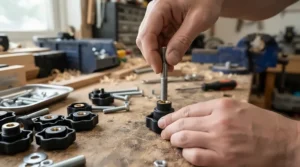
Most featherboards make you stop, loosen two knobs, reposition, and retighten both — a three-step dance every time you change stock width. The Hedgehog Spiral Featherboard collapses that into one motion: its spiral shape pivots around a single knob, so you loosen once, swing the arm into place, and lock it back down.
The reach specs back up the convenience claim — from 1-9/16″ to 6-3/4″ measured from the center of the miter slot with two feathers contacting the workpiece, which covers most rip widths a hobbyist or small-shop pro will actually use without needing a wider auxiliary bar. Here’s what most buyers overlook about this model: getting that single-knob clamp to grip firmly the first time can require flaring the miter clamp with a flathead screwdriver before initial use, a small setup step manufacturer documentation calls out directly rather than leaving you to discover it yourself.
Cross-shop comparisons and woodworking-forum troubleshooting threads name the Hedgehog specifically when discussing tricky aluminum-top saws, though outcomes are mixed — some owners report the expanding bar needs the same “flare it out” trick to bite properly on thinner aluminum extrusions, which is a fair caveat rather than a dealbreaker.
Pros:
- ✅ Single-knob spiral clamp cuts adjustment to one motion
- ✅ Wide 1-9/16″ to 6-3/4″ reach covers most stock widths
- ✅ Distinctive design speeds up repetitive width changes
Cons:
- ❌ Initial clamp flaring step adds setup friction out of the box
- ❌ Grip can be inconsistent on thinner aluminum miter slots
At $50-$65, it’s a premium buy justified almost entirely by speed of reconfiguration — worth it if you change rip widths constantly, less so if you set up once and rip all day.
7. Woodpeckers Variable Pressure Featherboard 2-Pack — most precise, most durable
The Woodpeckers Variable Pressure Featherboard 2-Pack sits at the top of this list for buyers who treat their table saw like a precision instrument rather than a rough-cut machine. Its headline feature is genuine variable pressure control — a dial-style tension adjustment rather than a fixed feather flex, which means you can dial in exactly enough resistance to hold stock without over-compressing softer woods and leaving feather marks.
Based on the spec comparison against every other entry here, this is also the only unit marketed as fully American-made, which tends to correlate with tighter manufacturing tolerances on the miter bar itself — precisely the detail that determines whether a bar develops play after a year of daily clamping and unclamping. It’s T-track compatible in addition to standard miter slots, so it earns its keep across a router table setup too.
Reviewers in the premium woodworking-tool segment consistently frame Woodpeckers gear as “buy once” tools, citing tighter tolerances and better long-term durability than budget alternatives, though the honest counterpoint is that a hobbyist making a handful of cuts a month may never recoup that durability premium in practical terms.
Pros:
- ✅ True variable pressure dial, not just fixed feather flex
- ✅ American-made tolerances resist long-term bar play
- ✅ Compatible with both T-track and standard miter slots
Cons:
- ❌ Highest price point on this list by a wide margin
- ❌ Overkill for occasional or hobby-frequency use
At $70-$90 for the pair, this is the “buy it for the last time” option — steep upfront, but arguably the cheapest per-year cost if you’re running a saw daily for years.
Practical Usage Guide: Setting Up and Maintaining Your Miter Slot Featherboard
Getting a featherboard right on day one saves you from the classic first-month mistake: clamping it down so tight the workpiece won’t feed at all. Start by sliding the miter bar into the slot with the saw unplugged, then position the body so the first feather just grazes your workpiece edge before you feed anything through — that’s the calibration step nearly every manufacturer builds in deliberately.
Once positioned, snug the miter bar knob first, then set feather pressure second. Doing it in the reverse order is the single most common setup mistake, because you’ll fight bar wobble while also trying to judge feather tension, and you’ll almost always end up either too loose or too aggressive.
For maintenance, check bar tension monthly if you’re cutting daily — expanding bars in particular can loosen slightly as aluminum or polymer wears in. Wipe sawdust from the feather gaps after each session; packed dust is the leading cause of feathers losing spring-back over time, more so than raw material fatigue. If your unit uses replaceable feathers (as several EVA-based designs do), budget for a swap roughly once a year under regular shop use — it’s cheaper than replacing the whole unit and restores original hold quality almost completely.
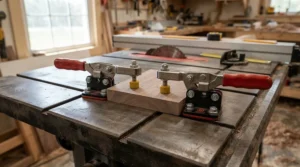
Real-World Scenarios: Matching a Featherboard to Your Shop
Picture a weekend hobbyist building shelving on a benchtop contractor saw a few Saturdays a month. Low cut volume, tight budget, no aluminum-top compatibility concerns — the Bench Dog 10-005 Feather-Loc Featherboard covers this exactly, and upgrading further would mostly be spending money on capacity that never gets used.
Now picture a garage woodworker running a portable jobsite saw with an aluminum deck, ripping cabinet-grade plywood most weekends. Magnetic hold-downs are off the table entirely, and standard rigid-bar featherboards have a track record of slipping on that thinner aluminum extrusion. The BOW Products FeatherPRO FP1 is built for precisely this situation, with its expanding non-marring bar doing the job magnets can’t.
Finally, picture a small furniture-making side business running a cabinet saw five days a week, switching rip widths constantly between orders. Time lost to featherboard reconfiguration adds up fast at that frequency, which is why the Hedgehog Spiral Featherboard‘s single-motion adjustment earns back its premium price within a few months of steady use, while the Woodpeckers Variable Pressure Featherboard 2-Pack protects finish quality on higher-end commissioned pieces where feather marks aren’t acceptable.
Problem → Solution: Fixing Common Miter Slot Featherboard Headaches
Problem: The bar won’t grip an aluminum top table saw featherboard slot at all. Rigid friction-only bars struggle here because aluminum extrusions run slightly looser tolerances than cast-iron slots. Solution: switch to an expanding-bar design like the BOW Products FeatherPRO FP1 or the Rockler Adjustable Table Featherboard, both of which physically widen inside the track rather than relying on friction alone.
Problem: Feathers leave marks on softer woods. Rigid polymer feathers under high tension can bruise pine or poplar. Solution: an EVA-cushioned unit or a variable-pressure design like the Woodpeckers Variable Pressure Featherboard 2-Pack, where you dial tension down for softwood without losing hold.
Problem: Constant reconfiguration eats shop time. If you’re loosening two knobs every time you change rip width, that friction adds up across a workday. Solution: the Hedgehog Spiral Featherboard‘s single-knob pivot exists specifically to cut that reconfiguration time down.
Problem: A single featherboard doesn’t hold bowed stock flat. One contact point can’t fight material that’s cupped or twisted. Solution: run a tandem pair like the POWERTEC Universal Tandem Featherboards, stacking one horizontal and one vertical for combined pressure.
How to Choose a Standard Featherboard for a Miter Slot Table Saw
- Measure your miter slot first. Most U.S. table saws use the 3/8″ x 3/4″ standard, but confirm it before buying — a handful of older or import saws run 5/8″ slots that won’t fit standard bars.
- Identify your table material. Aluminum and other non-ferrous tops rule out magnetic featherboards entirely, narrowing your search to expanding-bar mechanical designs like several featured above.
- Decide single versus tandem. One featherboard suits light, occasional use; a tandem pair earns its keep on warped stock or high-volume ripping.
- Check mounting bolt compatibility. If you already run T-track jigs, a unit with T-bolts sized for both T-track and miter slots (like the BOW Products FeatherPRO FP1) saves you from stocking two hardware sets.
- Weigh feather material against your typical stock. EVA foam protects softer woods; rigid polymer holds up better under constant heavy-duty pressure on hardwoods.
- Match adjustment speed to your workflow. If you change rip widths constantly, single-knob designs pay for themselves in saved time; if you set up once per session, that premium buys you less.
- Budget for replacement feathers. Whichever unit you choose, factor in an annual feather swap as routine maintenance, not an unexpected cost.
Common Mistakes When Buying a Miter Slot Mounted Featherboard
The most frequent mistake is buying a magnetic featherboard by accident because it was cheaper, only to discover an aluminum top table saw featherboard search should have ruled that option out from the start. Always confirm your table material before adding anything to cart.
A close second is ignoring documented kickback hazards and treating a featherboard as optional safety gear rather than a core control for feeding stock. Featherboards exist specifically to keep hands clear of the blade path while maintaining fence contact — skipping one because “I’ve done this for years without one” is exactly the reasoning behind a large share of preventable kickback injuries.
A third common misstep is assuming universal-fit hardware performs identically to precision-machined bars. As the POWERTEC Universal Tandem Featherboards comparison above shows, universal fit trades a bit of tolerance for flexibility across tool types — fine for many shops, but worth knowing rather than discovering after the fact.
Miter Slot Featherboards vs Magnetic Featherboards for Non-Magnetic Table Saw Tops
| Factor | Miter Slot Mounted | Magnetic |
|---|---|---|
| Works on aluminum tops | ✅ Yes | ❌ No |
| Setup speed | Moderate (bar + knobs) | Fast (drop and go) |
| Positioning flexibility | Limited to slot path | Anywhere on steel surface |
| Best For | Aluminum or benchtop saws | Cast-iron/steel-top cabinet saws |
The table above settles the debate quickly for anyone shopping a featherboard for non magnetic table saw setups: magnets simply don’t function on aluminum or most jobsite-saw decking, full stop, so the miter slot route isn’t a preference, it’s a requirement. Where magnetic units genuinely win is placement freedom on steel-top cabinet saws, since you’re not restricted to the fixed path of a miter slot. For everything else — and especially portable, aluminum-decked saws — a miter slot mounted featherboard is the only mechanically sound choice, and OSHA’s own machine-guarding documentation treats anti-kickback holding devices as a standard control regardless of which mounting style you choose.
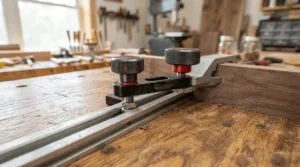
What to Expect: Real-World Performance on Aluminum Top Table Saws
Specs on a listing page rarely translate directly into shop reality, so here’s the honest version. On aluminum saw tables specifically, expect the first setup attempt with any expanding-bar featherboard to require a firmer final tightening turn than the same product would need on cast iron — aluminum extrusions run marginally looser tolerances, and woodworking-forum troubleshooting threads confirm this is a near-universal experience rather than a defect with any single brand.
Expect rigid polymer feathers to hold their spring tension for roughly a full season of moderate use before you notice reduced pressure, while EVA foam feathers tend to compress gradually rather than fail suddenly, giving you a longer warning window before replacement becomes urgent. And expect single-knob spiral designs to genuinely save time on frequent width changes, though that convenience is most noticeable at higher cut volumes — a hobbyist making a dozen cuts a weekend may not perceive much difference between adjustment styles at all.
Mounting Bolt Compatibility: Why Hardware Details Matter
This is the detail that trips up more buyers than any spec on the listing page. Standard miter slots run 3/8″ x 3/4″, but the bolts that actually secure your featherboard body to its bar vary by brand — commonly 5/16″-18 thread on models like the BOW Products FeatherPRO FP1 and the Rockler Adjustable Table Featherboard, sized to fit both dedicated miter bars and standard T-track simultaneously.
Mounting bolt compatibility matters most if you’re running multiple jigs off the same hardware ecosystem: a featherboard whose T-bolts match your existing crosscut sled or hold-down clamps means one hardware drawer instead of three. It also matters at replacement time — generic 5/16″-18 T-bolts are inexpensive and widely stocked at hardware stores, so a stripped or bent original bolt rarely means replacing the whole unit.
Long-Term Cost & Maintenance
| Featherboard | Upfront Price | Annual Feather Cost | Expected Lifespan |
|---|---|---|---|
| Bench Dog 10-005 Feather-Loc | Under $30 | Low (whole-unit swap) | 3-5 years moderate use |
| POWERTEC Universal Tandem (71393) | $25-$35 | Low | 3-4 years moderate use |
| BOW Products FeatherPRO FP1 | $35-$50 | Moderate (replaceable feathers) | 5+ years with feather swaps |
| Woodpeckers Variable Pressure 2-Pack | $70-$90 | Low (durable tolerances) | 8-10+ years daily use |
Read together, this table makes a simple point: the cheapest unit up front isn’t always the cheapest per year of ownership. The Bench Dog 10-005 Feather-Loc Featherboard is the right buy for light, occasional use, but a shop running daily volume will replace it two or three times over the life of a single Woodpeckers Variable Pressure Featherboard 2-Pack — meaning the “expensive” option can quietly become the cheaper one on a five-year horizon. Cornell’s EHS safety guidance also flags worn anti-kickback hardware as a recurring inspection point in shop safety programs, which is a good reminder that maintenance isn’t just about cut quality — it’s a safety-relevant task too.
Features That Actually Matter (And Those That Don’t)
What actually matters: expanding-bar mechanisms for aluminum compatibility, replaceable feathers for long-term cost control, and mounting bolt compatibility with your existing jig hardware. These three specs genuinely change day-to-day performance and total cost of ownership.
What matters less than marketing suggests: flashy anodized colors, “universal fits everything” claims that trade precision for breadth, and feather count beyond what a tandem pair already provides. A third or fourth featherboard rarely adds meaningful holding power once you’ve already got horizontal and vertical pressure covered — at that point you’re managing clutter, not improving safety.
Frequently Asked Questions
❓ What size miter slot does a standard featherboard fit?
❓ Can I use a magnetic featherboard on an aluminum top table saw?
❓ Do featherboards work on jobsite table saws with smaller tops?
❓ How tight should a featherboard be set against the workpiece?
❓ Are featherboards actually necessary, or just a nice-to-have?
Conclusion
A standard featherboard for miter slot table saws earns its small shelf space by solving a problem hands alone can’t: steady, consistent pressure against the fence without putting fingers anywhere near the blade path. Budget shoppers land well with the Bench Dog 10-005 Feather-Loc Featherboard, aluminum-top owners should look hardest at the BOW Products FeatherPRO FP1, and anyone running daily volume will get the longest service life from the Woodpeckers Variable Pressure Featherboard 2-Pack. Whichever you choose, match it to your actual table material and cut frequency first — every other decision follows from there.
Recommended for You
- Magnetic Featherboard vs Clamp On Featherboard: 7 Best Picks for 2026
- Magnetic Featherboard for Table Saw: 7 Proven Picks for 2026
- Featherboard Set Under $40: 7 Budget Picks for 2026
Disclaimer: This article contains affiliate links. As an Amazon Associate, I earn from qualifying purchases. If you purchase products through these links, we may earn a small commission at no additional cost to you.
✨ Found this helpful? Share it with your friends! 💬🤗
