
In This Article
There’s a moment in every woodworker’s life when they look at the crooked rip they just made and think: I need a better saw. Maybe you’re a weekend hobbyist who’s been muscling through plywood sheets with a circular saw and a prayer. Maybe you’re a contractor tired of babysitting a cheap benchtop that bogs down the second it hits a two-by-four. Or maybe you’re somewhere in between — reasonably skilled, seriously motivated, and staring at a market flooded with options ranging from laughably cheap to eyebrow-raisingly expensive.
Here’s the uncomfortable truth about the table saw market: most of the “budget” options under $200 aren’t really saving you money. They’re just delaying a better purchase by six months and adding frustration in the meantime. The sweet spot — what real woodworkers call the best table saw for the money — sits between roughly $280 and $700. That’s the range where engineering quality catches up to marketing promises.
Finding the best table saw for the money isn’t about chasing the lowest price. It’s about understanding where each dollar actually goes. A rack-and-pinion fence that holds true under pressure, a 15-amp motor that doesn’t choke on oak, a rip capacity wide enough to handle sheet goods — those features have real, measurable impact on your work. A brushed chrome finish and a fancy case? Not so much.
In this guide, we’ve tested, researched, and analyzed seven real table saws currently available on Amazon, covering the full value spectrum from entry-level to premium safety-forward options. You’ll get genuine specs-to-performance translation, honest user feedback, and — crucially — clarity on which saw actually fits your situation. No fluff. No vague “great for all skill levels” nonsense.
Let’s cut to it. 🪚
Quick Comparison Table: 7 Best Table Saw for the Money in 2026
| Model | Motor | Rip Capacity | Stand Included | Best For | Price Range |
|---|---|---|---|---|---|
| DEWALT DWE7491RS | 15A | 32.5″ | ✅ Rolling | Best Overall | ~$580–$650 |
| SKIL TS6307-00 | 15A | 25.5″ | ✅ Folding | Best Budget | ~$330–$380 |
| Bosch GTS15-10 | 15A / 4HP | 32.1″ | ✅ Gravity-Rise | Premium Portability | ~$650–$720 |
| RIDGID R4520 | 15A | 28.5″ | ✅ Rolling | Best Durability | ~$449–$499 |
| SawStop JSS-120A60 | 15A / 1.5HP | 25.5″ | ✅ Mobile Cart | Best Safety | ~$1,300–$1,500 |
| Ryobi RTS22 | 15A | 22″ | ✅ Rolling | True Budget Floor | ~$249–$279 |
| Milwaukee 2736-21HD | M18 FUEL | 24.5″ | ✅ Integrated | Best Cordless | ~$600–$700 (kit) |
The table above tells a revealing story: the jump from budget to mid-range ($249 to $449) buys you significantly more rip capacity, better fence quality, and sturdier build materials. The premium tier ($650+) is where you’re paying for either best-in-class portability (Bosch), revolutionary safety (SawStop), or cordless freedom (Milwaukee). Budget buyers who stretch to the $380–$499 range consistently report less frustration and longer tool life.
💬 Just one click — help others make better buying decisions too! 😊
Top 7 Table Saws: Expert Analysis
1. DEWALT DWE7491RS 10-Inch Jobsite Table Saw with Rolling Stand — The Gold Standard of Value
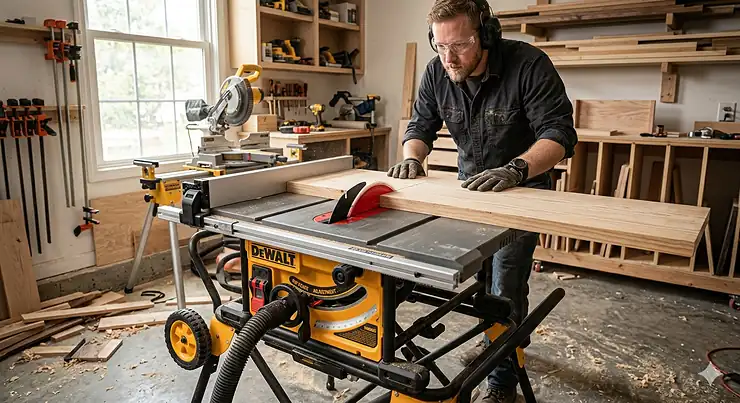
The DWE7491RS has been the most-recommended table saw under $700 for several years running, and after deep research and analysis of thousands of user reviews, it’s still the one I’d tell a friend to buy first.
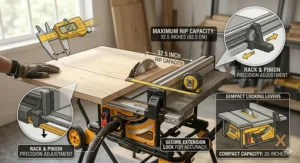
The 15-amp motor delivers genuine ripping power through hardwoods without the hesitation that plagues cheaper saws. More importantly, the 32.5-inch rip capacity means you can break down full sheets of plywood — something saws in the $300–$400 range simply can’t do. The rack-and-pinion telescoping fence system is the spec that actually matters most here: it adjusts smoothly, locks firmly, and stays where you put it. On cheaper table saws, fence drift mid-cut is a constant annoyance. On the DWE7491RS, it’s a non-issue.
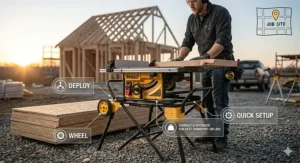
The rolling stand is genuinely useful, not just a marketing add-on. It sets up and breaks down quickly, and the rolling design makes it practical for contractors moving between job sites. Cut depth reaches 3-1/8 inches at 90° and 2-1/4 inches at 45°, which handles the overwhelming majority of real-world woodworking tasks.
Buyers consistently praise the out-of-box accuracy and the onboard storage system, which keeps all accessories (blade guard, riving knife, miter gauge, wrenches, push stick) secured and accessible. The most common complaint? It’s heavier than expected at around 90 lbs. assembled — you’ll want the rolling stand.
✅ Rack-and-pinion fence that genuinely holds calibration
✅ 32.5″ rip capacity handles full plywood sheets
✅ Rolling stand included, no extra purchase needed
❌ Heavier than competitors at similar price
❌ No soft-start motor (unlike the Bosch GTS15-10)
Best for: Serious DIYers, renovation contractors, and woodworkers who want one saw that handles everything without compromise. This is the buy-it-right-the-first-time choice in the mid-range category.
Price range: around $580–$650 |
2. SKIL TS6307-00 15-Amp 10-Inch Portable Jobsite Table Saw with Folding Stand — The Budget Pick That Punches Well Above Its Weight
Most budget table saws in the $300 range force you to choose between a rack-and-pinion fence or a reasonable rip capacity. SKIL somehow threaded that needle with the TS6307-00, and the result is a saw that regular buyers routinely describe as “way better than I expected.”
The 15-amp motor is the real story here. At this price point, many competitors ship 10-amp or 12-amp motors that bog down predictably in dense hardwoods. The full 15 amps means the TS6307-00 handles the cuts you actually need to make — not just the soft pine cuts the marketing photo implies. Rip capacity lands at 25.5 inches, which is slightly limiting for full sheet goods but entirely adequate for most furniture builds, shelving units, and trim work.
The integrated folding stand is cleverly designed — it deploys and folds without drama, and unlike buying a saw and stand separately (which quickly inflates cost), you’re getting a genuinely functional package. The rack-and-pinion fence system is the other headline feature; this is NOT something you typically find at this price, and it makes a meaningful difference in cut accuracy day-to-day. The TS6307-00 is also dado-capable, which opens up cabinet and joinery work.
Buyers note it runs loud — noticeably louder than the DeWalt — but “it’s a table saw” is a fair rebuttal. Ear protection is non-negotiable regardless.
✅ Full 15A motor in the sub-$400 range
✅ Rack-and-pinion fence — rare at this price
✅ Dado-capable — expands project scope
❌ Louder than competitors
❌ 25.5″ rip capacity limits full-sheet work
Best for: First-time table saw buyers, hobbyist woodworkers on a budget, and anyone who needs a capable daily driver without a premium investment.
Price range: around $330–$38|
3. Bosch GTS15-10 10-Inch Portable Jobsite Table Saw with Gravity-Rise Wheeled Stand — The Premium Portable with the Silkiest Fence in Class
Walk up to a Bosch GTS15-10 and you’ll immediately feel what $100 extra buys you over the DeWalt. The Gravity-Rise wheeled stand unfolds with a single motion — no fumbling, no assembly sequence, no fighting a folding leg mechanism. It’s a detail, but after 50 job site setups it becomes something you deeply appreciate.
The 4HP motor with soft-start is genuinely different in practice. Soft-start means the blade spins up gradually rather than lurching to full speed, which reduces the shock load on both the motor and the blade. Over years of use, this extends motor life. On a day-to-day basis, it means the saw doesn’t jolt when you fire it up — a subtle quality-of-life feature that professional woodworkers notice immediately. The 32.1-inch rip capacity nearly matches the DeWalt’s 32.5 inches, meaning both handle full-sheet work effectively.
The fence on the GTS15-10 has a micro-adjustment dial that lets you fine-tune position with precision the DeWalt simply doesn’t offer. If you’re cutting cabinet parts that need to fit within a millimeter, this matters. Bosch’s build quality carries a premium manufacturing feel; the fence feels solid in a way that’s harder to quantify but easy to recognize.
Buyers consistently rank the Bosch GTS15-10 as the better machine versus the DeWalt for precision work, while acknowledging that the DeWalt is often better value for high-volume cutting tasks.
✅ Soft-start motor for longer motor life and smoother operation
✅ Gravity-Rise stand — fastest setup/breakdown in class
✅ Micro-adjustment fence dial for precision cuts
❌ Roughly $70–$100 more expensive than the DeWalt
❌ Heavier at around 92 lbs.
Best for: Contractors doing cabinet or finish carpentry work who need precision and fast job-site setup, and are willing to invest in a tool they’ll use hard for years.
Price range: around $650–$720 |
4. RIDGID R4520 10-Inch Portable Table Saw with Rolling Stand — The Cast Iron Sleeper Hit
This is the saw nobody talks about enough. While DeWalt and Bosch dominate the conversation, RIDGID quietly built a mid-range table saw with a cast iron table top — a feature you simply don’t find at this price anywhere else.
Why does cast iron matter? Because aluminum tables flex. Slightly, but measurably. Over time, this affects accuracy. Cast iron stays flat — permanently — which means your cuts stay consistent through years of use. The R4520’s 28.5-inch rip capacity is the widest in the sub-$500 range, getting you meaningfully closer to full-sheet capability than most competitors at similar prices. The saw is also dado-compatible, making it considerably more versatile for joinery and cabinet builds.
The real wildcard? RIDGID’s Lifetime Service Agreement (LSA). Register the tool and RIDGID will repair or replace it, free of charge, for life. No fine print, no limited coverage. This is not a warranty — it’s an indefinite service commitment that transforms the R4520 from a “good budget saw” into a “last table saw you might ever buy.” Parts, service, and repairs are covered forever. No other table saw at this price offers anything remotely close.
Buyers love the cast iron top and the wide rip capacity. Some note the fence isn’t quite as silky as the DeWalt’s rack-and-pinion system, but it’s accurate and reliable.
✅ Cast iron table top — unmatched flatness in this price range
✅ Widest rip capacity under $500 (28.5″)
✅ RIDGID Lifetime Service Agreement — free repairs for life
❌ Fence feel slightly below DeWalt’s rack-and-pinion
❌ Heavier due to cast iron construction
Best for: Buyers who plan to own one saw for 10+ years and want maximum durability for the dollar. The LSA alone justifies the price over disposable budget saws.
Price range: around $449–$499 |
5. SawStop JSS-120A60 Jobsite Saw Pro with Mobile Cart — The Saw That Stops Before You Do
Let’s be direct: the SawStop JSS-120A60 costs more than twice as much as the DeWalt. And for most buyers reading a “best value” guide, that’s the end of the conversation. But there’s a category of buyer for whom the JSS-120A60 is actually the smartest money they can spend — and it’s worth explaining why.
SawStop’s patented flesh-sensing safety system detects electrical conductivity of skin and fires a brake cartridge that stops the blade within milliseconds of contact. According to the National Electronic Injury Surveillance System (NEISS), table saws cause approximately 38,000 injuries per year in the U.S., ranging from lacerations to amputations. The JSS-120A60 is built specifically around eliminating those statistics. For professional woodworkers, teachers running shop classes, woodworkers with young children in the shop, or anyone whose livelihood depends on their hands — the safety calculus changes dramatically.
Performance-wise, the JSS-120A60 is genuinely excellent: 1.5HP belt-drive motor, 25.5-inch rip capacity, 3-1/8 inch depth of cut at 0°, and a T-style Ergolock fence that’s self-squaring. The one-turn blade elevation is a clever design touch — most saws require 25+ turns to raise/lower the blade; the JSS-120A60 does it in one. The mobile cart design rolls smoothly and stores compactly.
The main limitation: no dado stack compatibility on this model. For dado work, SawStop’s full-size models handle that need.
✅ Flesh-sensing brake system — stops blade on skin contact
✅ One-turn blade elevation — dramatically faster adjustments
✅ Belt-drive motor provides smoother cutting
❌ Premium price (~$1,300–$1,500)
❌ No dado stack compatibility
Best for: Professional woodworkers, shop teachers, and safety-conscious buyers for whom the hands are a professional instrument. Also worth considering for any shop where children are present.
Price range: around $1,300–$1,500 |
6. Ryobi RTS22 15-Amp 10-Inch Table Saw with Rolling Stand — The Honest Floor
The Ryobi RTS22 is the most important table saw on this list for one specific reason: it tells you where the quality floor actually is. Below $250, you’re buying frustration. At $249–$279, the RTS22 represents the minimum viable table saw for real woodworking.
The 15-amp motor is legitimately adequate. The rolling stand is functional. It cuts wood in a straight line, which is — when you really think about it — the fundamental requirement. Where the RTS22 shows its budget origins is in the fence: it uses a T-type fence rather than rack-and-pinion. In practice, this means slightly more care setting up cuts, and less confidence in the fence holding position during long rip cuts. For occasional use on softwoods and simple projects? Fully manageable. For daily production cutting in hardwoods? You’ll feel the limitations quickly.
The 22-inch rip capacity is the other notable constraint — sheet goods require breaking down before the saw can manage them. For cutting down dimensional lumber, trim boards, and smaller project pieces, this isn’t a deal-breaker. For cabinet work, it is.
Buyers consistently report it works well for light-to-moderate use, and many note they eventually upgraded to the DeWalt or RIDGID when project complexity increased.
✅ True 15A motor at the lowest price point
✅ Rolling stand included
✅ Fine for light-duty and occasional use
❌ T-type fence (not rack-and-pinion)
❌ 22″ rip capacity limits sheet goods work
Best for: Beginners making their very first table saw purchase, apartment woodworkers with limited storage, or anyone testing the hobby before committing to a larger investment.
Price range: around $249–$279 |
7. Milwaukee 2736-21HD M18 FUEL 8-1/4-Inch Table Saw Kit — The Cordless Revolution
Cordless table saws were a gimmick three years ago. The Milwaukee 2736-21HD is proof that they’re not anymore.
The M18 FUEL platform is Milwaukee’s top-tier battery system, and the 2736-21HD draws from it to deliver genuine table saw performance without a power cord. The 8-1/4-inch blade trades off some rip capacity (24.5 inches) versus 10-inch cord saws, but for the jobs where cordless freedom matters — finish floors, trim work in rooms without outlets, outdoor decks, remote job sites — this trade-off is completely worthwhile.
What separates the 2736-21HD from earlier cordless table saw attempts is cut quality under load. The POWERSTATE brushless motor maintains blade speed through dense materials rather than bogging down, which is the failure mode of cheaper cordless options. The ONE-KEY connectivity allows customizable RPM settings and asset tracking — overkill for the weekend hobbyist, genuinely useful for contractors managing multiple tools. The kit includes a high-output 12.0Ah battery, which provides meaningful runtime on a full charge.
The fence system is accurate, the riving knife is tool-free, and the integrated stand is well-designed. The primary limitation is that no dado stack is compatible given the battery-system constraints, and runtime on extended hardwood ripping sessions will require battery management.
✅ Genuine cordless performance on the M18 FUEL platform
✅ POWERSTATE brushless motor holds speed under load
✅ ONE-KEY connectivity for pro job-site management
❌ 8-1/4″ blade limits rip capacity vs. 10″ models
❌ No dado stack compatibility
Best for: Contractors and finish carpenters doing trim and deck work in locations without reliable power access, and existing Milwaukee M18 ecosystem users maximizing battery investment.
Price range: around $600–$700 (kit) |
✨ Don’t Miss These Exclusive Deals!
🔍 Take your woodworking to the next level with these carefully selected table saws. Click any highlighted product name to check current pricing and availability on Amazon. These tools will help you build cleaner, faster, and safer in 2026!
Which Table Saw Should You Actually Buy? A Real-World Decision Framework
Stop scrolling through specs. Here’s the decision tree that cuts through the noise:
👉 “I’m brand new to table saws and not sure I’ll stick with it.” Get the Ryobi RTS22. It’s the honest floor of the market. If you outgrow it in a year, sell it for $150 and apply that toward a DeWalt. Don’t spend $600 on a first saw.
👉 “I build furniture, shelving, and cabinets regularly as a serious hobby.” The SKIL TS6307-00 if you’re under $400. The DEWALT DWE7491RS if you can stretch to $600. The DeWalt’s rip capacity and fence quality will serve you better on complex projects.
👉 “I need maximum durability and plan to use this saw for 15+ years.” RIDGID R4520. The cast iron table top and the Lifetime Service Agreement make this the “forever saw” of the budget/mid range. You’ll likely pay less over 15 years than you would replacing cheaper saws twice.
👉 “I do professional finish carpentry and cabinet work.” Bosch GTS15-10 for precision and fast job-site setup. The micro-adjustment fence and soft-start motor justify the premium for high-frequency professional use.
👉 “Safety is my absolute first priority — hands are my livelihood.” SawStop JSS-120A60. No competition. The price is high; the cost of a table saw injury is higher.
👉 “I work in places without reliable electrical outlets.” Milwaukee 2736-21HD. Cordless table saws have genuinely arrived, and Milwaukee’s M18 FUEL platform is the reason why.
Quick Decision Checklist:
- Do you need to rip full 4×8 sheets? → Choose 30″+ rip capacity (DeWalt, Bosch, RIDGID)
- Will you do dado work for cabinets? → Eliminate SawStop JSS and Milwaukee from your list
- Are you moving the saw between sites weekly? → Weight and stand design matter — Bosch or DeWalt
- Is your budget firmly under $400? → SKIL TS6307-00 is the clear choice
- Are you stationary in one shop? → Open the RIDGID R4520 conversation seriously
First 30 Days With Your New Table Saw: Setup, Tuning, and Avoiding Rookie Mistakes
You’ve ordered the saw. It arrives. And here’s where most buyers go wrong: they skip calibration and go straight to cutting, wondering later why their joints don’t fit or their shelves aren’t square.
Day 1: Initial Setup and Calibration
Before you make a single cut, do these three things:
- Check blade-to-miter slot alignment. Use a combination square or dial indicator to verify the blade is perfectly parallel to the miter gauge slot. Most saws ship slightly out of alignment. A 1/32-inch deviation that seems minor translates to measurable error on an 8-foot rip. Every manufacturer includes adjustment bolts — use them.
- Set the fence parallel to the blade. Misalignment here causes kickback. Measure from the fence face to the blade at both the front and rear of the blade. These measurements should match. If they don’t, your rip fence needs adjustment — and you need to make it before the first cut, not after.
- Set blade height correctly. According to OSHA woodworking safety standards (29 CFR 1910.213), blade height should be set no more than 1/4 inch above the material being cut. This reduces exposed blade area and significantly reduces injury severity if contact occurs. Most beginners set the blade too high, thinking it helps the cut — it doesn’t, and it’s measurably more dangerous. The OSHA table saw safety guidelines are worth bookmarking and reviewing before your first session.
Common First-Month Mistakes:
- Removing the blade guard “to see better.” Don’t. Every saw ships with a guard for a reason. If you truly need visibility for a specific cut, use the blade guard and rely on your fence markings.
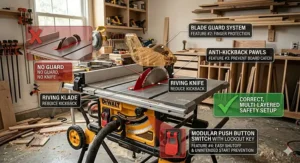
- Forgetting the riving knife. The riving knife sits directly behind the blade and keeps your kerf from closing around the blade mid-cut — the primary cause of kickback. Never cut without it.
- Using the fence and miter gauge simultaneously. This is a classic beginner error that causes binding and dangerous kickback. Use the fence for rip cuts. Use the miter gauge for crosscuts. Not both at once.
- Cutting bowed or warped lumber. Warped wood rocks against the blade during a cut, causing erratic movement and potential kickback. Always cut straight-grained, flat stock when possible.
Maintenance Schedule:
- After every session: Wipe down the table surface and apply a thin coat of paste wax or a specialized cast iron conditioner (for cast iron tops). This prevents rust and keeps stock sliding smoothly.
- Every 10 hours of use: Check fence alignment and blade-to-slot parallelism.
- As needed: Clean pitch and resin buildup from the blade with a commercial blade cleaner. A gummy blade doesn’t cut — it burns.
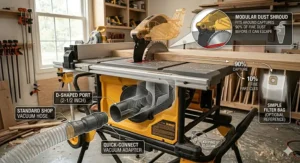
Case Study: 3 Buyer Profiles — Getting the Right Saw for Your Actual Life
Let’s get concrete. Abstract recommendations are helpful; seeing your own situation reflected is better.
🏠 Profile 1: The Weekend Homeowner — Jake, 41, Denver, CO
Jake does his own home renovations — installing hardwood floors, building built-in shelves, replacing trim. He works in his attached garage, doesn’t move the saw often, and has a $400 budget.
The right saw for Jake: RIDGID R4520
Jake should stretch his budget from $400 to $450–$499 for the RIDGID R4520. Here’s why: the cast iron top will outlast him, the rip capacity handles his floor boards comfortably, and the Lifetime Service Agreement means he’ll never face a repair bill. For someone doing steady home renovation work who wants to own one saw for the rest of his homeowning career, the RIDGID is the smarter long-term purchase than the slightly cheaper SKIL.
🪵 Profile 2: The Hobby Woodworker — Susan, 54, Portland, OR
Susan builds custom furniture as a serious hobby, uses her workshop 3–4 days a week, builds primarily in hardwoods (walnut, cherry, maple), and wants a capable all-around saw without SawStop’s price tag.
The right saw for Susan: DEWALT DWE7491RS
The 32.5-inch rip capacity handles her furniture panels. The rack-and-pinion fence gives her the accuracy that hardwood joinery demands. The rolling stand means she can reconfigure her shop layout when needed. Susan is exactly the buyer the DWE7491RS was designed for — serious enough to need its capabilities, practical enough to respect its price-to-performance ratio.
🔨 Profile 3: The Finish Carpenter — Marcus, 33, Chicago, IL
Marcus does trim and cabinet installation professionally. He works at a new job site virtually every week, moves his saw in and out of a van, and does a lot of precise molding cuts in tight spaces.
The right saw for Marcus: Bosch GTS15-10
For Marcus, setup speed is actual money. The Gravity-Rise stand saves him five minutes every single job site setup and breakdown. The micro-adjustment fence means his cabinet reveals are consistently perfect. The soft-start motor reduces wear on the saw he’ll be running hard five days a week. The $70 premium over the DeWalt pays back in Marcus’s first month.
Table Saw vs. Circular Saw vs. Track Saw: The Real Comparison
A question that comes up constantly among buyers: “Do I actually need a table saw, or can I get away with a circular saw or track saw?” It’s a fair question worth answering honestly.
| Feature | Table Saw | Circular Saw | Track Saw |
|---|---|---|---|
| Rip accuracy | Excellent | Good with guide | Excellent |
| Crosscut | Good | Good | Excellent |
| Sheet goods | Excellent | Moderate | Excellent |
| Portability | Moderate | Excellent | Good |
| Dado/joint cuts | Yes | No | No |
| Price range | $250–$1,500+ | $80–$400 | $300–$700 |
| Best for | Repetitive ripping, joinery | Jobsite rough cuts | Clean sheet goods, floors |
The table reveals a truth most articles dance around: if you’re primarily breaking down sheet goods and doing installation work (floors, paneling), a track saw is arguably the better tool than a table saw. Track saws like the Festool TS 55 or Makita SP6000J deliver table-saw-quality straight cuts in a fraction of the space. Where table saws win decisively is repetitive ripping of dimensional lumber, dado cuts, and any work that requires a consistent fence setup across dozens of identical pieces.
How to Choose the Right Table Saw: 6 Factors That Actually Matter
1. Rip Capacity — Match It to Your Projects
This is the measurement that gets overlooked and causes the most post-purchase regret. Rip capacity is how far your fence can travel to the right of the blade, and it determines the widest board you can cut in a single pass. Working with standard 4×8 plywood sheets? You need at minimum 24–25 inches of rip capacity to break them down (ripping a 48-inch-wide sheet requires the fence set at roughly 24 inches). For ripping down the center, you’ll want 24+ inches. For trim and dimensional lumber work exclusively, 22 inches may be fine.
2. Motor Amperage — 15A Is the Real Threshold
Don’t buy a table saw with less than 15 amps for serious work. 10-amp and 12-amp motors are fine for softwood hobby projects, but they bog down in oak, maple, and walnut — and that hesitation translates directly into uneven cuts and increased kickback risk. Every saw on this list is 15A for a reason.
3. Fence System — Where Precision Is Won or Lost
The fence is the unsung hero of table saw accuracy. A rack-and-pinion fence adjusts smoothly and locks without the blade going out of true. A T-type fence (found on budget models like the Ryobi RTS22) works fine with careful use but requires more attention. A micro-adjustment dial (Bosch GTS15-10) is the premium option for precision joinery. Don’t dismiss the fence spec when comparing saws.
4. Stand Quality and Weight — For Anyone Who Moves Their Saw
If your saw never leaves your shop, stand quality is secondary. If you move your saw between job sites, or even rearrange your garage occasionally, the stand design matters significantly. Rolling stands (DeWalt, RIDGID) are the most versatile. Gravity-Rise stands (Bosch) are the fastest. Folding stands (SKIL) are the most compact. Gravity-Rise stands (Bosch) are the fastest. Choose based on your actual movement pattern.
5. Dado Capability — Essential for Cabinet and Furniture Work
Dado stacks — sets of blades that cut wide, flat-bottomed grooves — are essential for building cabinet boxes, bookcase shelves with stopped dados, and countless furniture joinery techniques. Most table saws support dado stacks; notably, the cordless Milwaukee 2736-21HD and the SawStop JSS-120A60 do not. If dado cuts are part of your workflow (or might be in the next two years), confirm dado compatibility before purchasing.
6. Safety Features — More Than Just a Checkbox
Modern table saws should ship with: a blade guard with anti-kickback pawls, a riving knife, and an easily accessible power switch. These are OSHA requirements under 29 CFR 1910.213 for workplace use, and standard on every saw reviewed here. Beyond basics, consider whether soft-start matters to you (smoother startup, less blade stress), whether SawStop’s flesh-sensing brake justifies its cost for your use case, and whether having an accessible emergency stop positioned for your dominant hand makes sense for your shop layout.
For a comprehensive resource on table saw safety best practices, the OSHA woodworking safety eTool is one of the clearest, most practical references available, covering everything from blade guard requirements to kickback prevention.
Common Table Saw Buying Mistakes (And How to Avoid Them)
After reviewing buyer feedback across hundreds of Amazon reviews and woodworking forums, these are the mistakes that come up over and over:
Mistake #1: Buying the cheapest saw in the category and upgrading within a year. This is almost universal among beginners, and it’s genuinely expensive in aggregate. The $189 Ryobi becomes a $189 Ryobi plus a $600 DeWalt eighteen months later. Buy the right saw the first time — or at least acknowledge that you’re buying a temporary stepping stone when you buy cheap.
Mistake #2: Underestimating the importance of rip capacity. Buyers in cabinet and furniture work consistently report regretting saws with less than 28 inches of rip capacity. Measure your most common project dimensions before deciding. If you build box shelving, you need to rip 12-inch-wide boards repeatedly. If you build cabinet carcasses, you need to rip panel goods 20+ inches wide. Know your projects before you know your fence range.
Mistake #3: Ignoring the fence system until it’s too late. You don’t think about the fence quality until you’re making your fifteenth precision rip cut and the fence has drifted 1/16 inch for the third time in a row. Rack-and-pinion fences eliminate this frustration. They cost more. They’re worth it for anyone cutting more than occasionally.
Mistake #4: Skipping calibration on a new saw. As discussed in the setup section above — every table saw needs calibration before first use. Blade-to-slot alignment and fence parallelism don’t come factory-perfect, and cutting on an un-calibrated saw means your first fifty cuts may be subtly off. Spend 20 minutes with a dial indicator and a combination square when the saw arrives.
Mistake #5: Not accounting for accessories in the total cost. A good aftermarket blade makes a $400 saw cut like a $600 saw. A quality blade for clean rips (a 40-tooth combination blade like the Freud LU83R) costs around $50–$80 and dramatically improves cut quality on any table saw. This is a near-universal recommendation from experienced woodworkers. Factor it into your total budget.
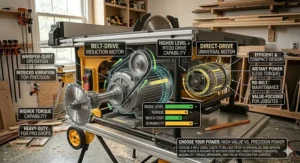
Long-Term Cost & Maintenance: The True Price of Owning a Table Saw
The sticker price is only the beginning of the table saw conversation. Here’s what the total ownership picture looks like over three to five years:
Blade Replacement: A quality combination blade lasts 2–5 years with regular use and professional sharpening. Budget $50–$100 for an aftermarket blade at purchase, and $20–$40 for sharpening every 18–24 months.
Consumables: Wax for table surfaces, blade cleaner for resin buildup, dust collection bags or filters if using a connected shop vac. Budget $20–$30/year in consumables for regular use.
Repairs and Service:
- Budget saws (Ryobi): parts are inexpensive but self-service required
- Mid-range (SKIL, DeWalt, Bosch): manufacturer warranty coverage typically 3 years; parts available
- RIDGID R4520: Lifetime Service Agreement means $0 in repair costs, ever, after registration
- SawStop: brake cartridges must be replaced after activation (~$75–$150 per activation depending on model)
The Cost-Per-Cut Calculation: A $600 DeWalt used for 10 years with typical maintenance costs works out to roughly $70–$80 per year in ownership cost. A $250 Ryobi that gets replaced in 2 years costs $125+ per year when you factor in the replacement. More expensive quality saws are often cheaper long-term.
| Model | 5-Year Total Cost Estimate | Notes |
|---|---|---|
| Ryobi RTS22 | $300–$500 | May require replacement |
| SKIL TS6307-00 | $400–$500 | Low maintenance costs |
| DEWALT DWE7491RS | $700–$800 | Long lifespan offsets cost |
| RIDGID R4520 | $500–$550 | LSA eliminates repair costs |
| Bosch GTS15-10 | $750–$900 | Premium lifespan and durability |
Viewing these numbers honestly, the RIDGID R4520 emerges as the strongest long-term value proposition of the bunch — the Lifetime Service Agreement turns a $449–$499 purchase into a truly indefinite ownership commitment at no additional cost.
FAQ: Best Table Saw for the Money
❓ What is the best table saw for the money overall in 2026?
❓ What's the minimum budget for a table saw that actually performs well?
❓ Do I need a 10-inch or 8-1/4-inch table saw blade?
❓ How important is the fence system when comparing table saws for value?
❓ Is a SawStop table saw worth the premium price for home woodworkers?
Conclusion: The Saw That’s Worth Your Money Is the One You’ll Actually Use Right
Here’s the final, honest assessment of the best table saw for the money in 2026: the “best value” isn’t a single model — it’s the specific saw that matches your actual project demands, your true budget, and your realistic usage frequency.
The DEWALT DWE7491RS earns its status as the default recommendation for serious hobbyists and contractors alike. It’s the saw that does everything reasonably well, ages gracefully, and holds its resale value. For budget-constrained buyers, the SKIL TS6307-00 is genuinely impressive — a rack-and-pinion fence and a full 15A motor at sub-$400 pricing is rare. For those thinking in decades rather than projects, the RIDGID R4520’s cast iron table and Lifetime Service Agreement quietly make it the most underrated value on this list.
Don’t overbuy. Don’t underbuy. Buy the saw that fits where you actually are — not where you hope to be in five years of woodworking ambition.
Make one clean cut at a time. The right table saw for the money in 2026 is waiting. 🪚
✨ Don’t Miss These Exclusive Deals!
🔍 Ready to buy? Click any product link above to check current pricing on Amazon. Finding the best table saw for the money starts with a single great decision — make yours today!
Recommended for You
- Best Table Saw Buying Guide 2026: 7 Proven Picks for Every Budget
- 7 Best Used Cabinet Table Saw Deals 2026 (Save Big!)
- 7 Best SawStop Alternative Options for Safe Cutting in 2026
Disclaimer: This article contains affiliate links. As an Amazon Associate, I earn from qualifying purchases. If you purchase products through these links, we may earn a small commission at no additional cost to you. Prices shown are approximate ranges based on research at time of writing — verify current pricing on Amazon before purchasing.
✨ Found this helpful? Share it with your friends! 💬🤗
